



Abstract
Globalization, technological advances, and changing employment structures have facilitated greater flexibility in how and where many Americans do their paid work. In response, a new work arrangement, coworking, has emerged in the United States. Coworking organizations bring together professionals from different companies to share a common workspace and build community. Despite the prevalence and potential benefits of coworking, little systematic research about coworking contexts exists, let alone research focused on gender inequality therein. Using 78 interviews and more than 700 hours of observation across nine coworking spaces, we examine the organizational logics that shape gender dynamics, as well as intersecting racial and class dynamics, in coworking spaces. Building on Acker’s inequality regimes framework, we uncover organizational logic that either reduces or reproduces inequality for diverse groups of women in coworking contexts. We conclude by discussing important theoretical and empirical implications of these findings.
Over the last several decades, changing employment arrangements, technological advances, and globalization processes have resulted in increased work flexibility, flatter and less bureaucratic organizations, and new career models for advancement in the United States (Thompson, Payne, and Taylor 2015; Williams, Muller, and Kilanski 2012). Scholars have since focused on understanding how the new economy shapes gender inequality, and more specifically, how gender informs emerging organizational logics that guide work and reward structures (Alfrey and Twine 2017; Brumley 2014; Mickey 2019; Williams, Muller, and Kilanski 2012). Recent scholarship suggests that new and traditional organizational logics may “collide” or create “hybrid” logics that disadvantage women’s (particularly racial minority women’s) workplace opportunities and upward mobility in new economy firms (e.g., Alfrey and Twine 2017; Brumley 2014; Mickey 2019). This research has focused on situations in which men and women are employed by an organization that dictates both their work context and career opportunities. It remains unclear, however, how gender and other intersecting structures (i.e., race and class) shape the organizational logic of a novel work context that brings together workers from different companies: coworking spaces.
Coworking spaces emerged as a result of a rise in workers with flexibility in when and where they work (Thompson, Payne, and Taylor 2015). This population includes workers with telecommuting abilities from a broader organization, as well as entrepreneurs or freelancers who need workspace. Coworking spaces also arose because many of these workers feel isolated from social and professional networks; coworking spaces offer opportunities to socialize, network, exchange ideas, and collaborate with other professionals in similar or different industries (Garrett, Spreitzer, and Bacevice 2017). Because of changes in work and the corresponding benefits associated with coworking organizations, the number of coworking spaces in the United States has grown exponentially in recent years from 14 spaces in 2007 to more than 6,000 in 2020, with membership estimated at approximately 900,000 people (Mazareanu 2020). How men and women experience coworking spaces and their work-related benefits, however, likely depends on the practices and policies associated with coworking organizations.
Sociologists have long recognized that organizations are not neutral sites; rather, they are built on organizational logic that tends to favor men and masculine-type behavior (Acker 1990; Williams, Muller, and Kilanski 2012). In this study, we define “organizational logic” as the practices (customs or routine way of doing things in an organization) and policies (written rules or guidelines that structure organizational interactions and operations) that make up an organization. More recent scholarship has highlighted that race and class are also infused into organizational logics and interlink with gender to create “inequality regimes” (Acker 2006, 2012; Alfrey and Twine 2017; Ray 2019; Wingfield 2007). In coworking spaces, however, organizational logics may differ from those typically found in traditional and other new economy organizations. For example, coworking spaces generally do not have centralized human resources departments to create and oversee organizational policies, or upper-level management to enforce them (Bouncken and Reuschl 2018). Also, because members tend to work for different companies, institutionalized hierarchies 1 (where white men tend to have more power) might be less present and less influential on how gender, and intersecting race and class, dynamics transpire. It is possible that inequality in coworking spaces is reconstituted in new, but less formal or institutionalized, ways. It is also possible that coworking spaces challenge disadvantaging patterns of inequality women often face in other work contexts.
In this study, we ask, “How are inequality regimes exacerbated or weakened in coworking spaces?” Given the importance of a workplace’s gender composition in shaping gender (and intersecting race/class) inequality (Ridgeway 2011), we also examine variation of inequality regimes by the gender composition of coworking spaces. We explore these questions by analyzing fieldnotes from more than 700 observation hours and 78 in-depth interviews with coworkers and proprietors across nine coworking spaces. Although our main focus is on how the organizational logic of coworking spaces influences the work experiences of diverse groups of women, we also interviewed men of color and white men and discuss their perspectives when pertinent. Importantly, our research builds on Acker’s (2006) conceptualization of inequality regimes and identifies specific organizational logic that either challenges or reproduces inequality in these unique, new economy work contexts.
Theoretical Background
An extensive body of theoretical and empirical work has highlighted how organizations produce and maintain gender inequality (e.g., Acker 1990; Kalev 2009; Ridgeway 2011; Williams, Muller, and Kilanski 2012). Scholars have argued that organizations are gendered sites wherein male advantage is built into job design, distribution of power, rewards and resources, physical design of the workspace, and rules for work-related behavior (Acker 1990). Gendered organizational logics do not, however, operate in isolation: They intersect with other systemic oppressions like those of race and class (Wingfield 2007).
Extending previous theorization, Acker (2006, 443) developed the concept “inequality regimes” to describe the “loosely interrelated practices, processes, actions, and meanings that result in and maintain class, gender, and racial inequalities within particular organizations.” This perspective underscores how gendered organizational logics are often intertwined with class- and race-based organizational logics that, together, produce complex patterns of inequality (also see Wingfield 2007 on gendered racism). In line with theorization by Acker (2006) and other scholars, practices that segregate workers by gender, race, and class (Kalev 2009); that are exclusionary regarding entry into an organization (Ray 2019); and/or that foster unequal informal interactions (Ridgeway 2011) tend to exacerbate inequality. These inequality practices are common in traditional, bureaucratic workplaces and often steer women and minority workers into narrow, lower-status jobs (Blau, Brummund, and Liu 2013). White men, on the other hand, are often filtered into the most highly valued and rewarded occupations (Blau, Brummund, and Liu 2013; Warner 2014). Thus, women and minority workers tend to interact with white men from unequal positions of power in organizations (Ridgeway 2011; West and Zimmerman 1987).
If organizational logics associated with traditional organizations facilitate inequality, what happens in organizations governed by new organizational logics in the new economy? New economy organizations often break from traditional bureaucratic practices, have flatter hierarchies, foster self-managing teams, and highly value social networking for advancement and opportunities (Alfrey and Twine 2017; Williams, Muller, and Kilanski 2012). Although departure from bureaucratic organizational logics could reduce gender and racial inequality (e.g., Kalev 2009), it could also reproduce inequality in different ways. For example, Williams, Muller, and Kilanski (2012) found new economy firms relied heavily on subjective evaluations for the distribution of rewards and privileged networking/self-promotion practices that disadvantaged women. Other research suggests that firms may create a hybrid of new and old organizational logic, retaining institutionalized occupational hierarchies while simultaneously privileging masculine-type behaviors, such as self-promotion and high visibility (Brumley 2014; Mickey 2019).
In such cases, new economy firms maintain control over aspects of organizational logic deemed critical to the construction of inequality regimes (Acker 2006, 2012), such as practices and policies associated with determining work roles and assignments, mobility and wage setting, and structuring formal relations between workers. Coworking spaces differ from other new economy contexts because they bring together individuals from different organizations working in nontraditional ways (e.g., solo entrepreneurs, remote workers). Thus, systems of control may be weakened because coworking organizations do not dictate members’ jobs, wages, or pathways for career advancement, nor do they determine relations among workers.
Coworking spaces do, however, retain control over some organizing aspects important for inequality because they still “pattern and organize work” of members (Blagoev, Costas, and Kärreman 2019, 910). Barriers to entering the space (like pricing policies), and the resulting diversity inside, may matter for coworking experiences. For example, women (and women of color in particular) may be more or less likely to be treated as “tokens” depending on the diversity and inclusivity of the space (Kanter 2006). Moreover, practices surrounding space allocation and the physical design of the environment may have implications for segregation patterns by gender and race. Given that workplace segregation can reduce women’s and racial minority workers’ access to advantageous networks and opportunities (Kalev 2009; McDonald and Day 2010), coworking practices that encourage substantive interactions among different members may reduce inequality in these spaces. Conversely, practices that segregate members by gender and race may suppress certain members’ access to advantageous networks and career opportunities. Additionally, policies that magnify or weaken hierarchies in coworking spaces may have important implications for inequality, given that hierarchies shape informal interactions between workers and establish which workers gain visibility (Mickey 2019). Finally, how coworking practices are structured may depend on and vary by gender composition of the space (Ridgeway 2011). Specifically, organizational logic that advantages men may be intensified and less likely challenged in male-dominated coworking settings. In the present study, we investigate these issues and heed Acker’s (2012, 222) call to examine novel work contexts and uncover how new organizational logics “deal, or not deal with gender, race, and class inequities.”
Data and Methods
We conducted in-depth interviews with 78 people using coworking locations in a Southeastern U.S. metropolitan area. Interview data were supplemented with more than 700 hours of observation (over four months) across a diverse set of nine coworking spaces (Table 1). 2 Each space differed in layout/locale and attracted different types of members. Although most spaces had members employed in a variety of industries and occupations, some spaces had particular industries or occupations, such as finance or technology, overrepresented.
Information about Observed Coworking Spaces
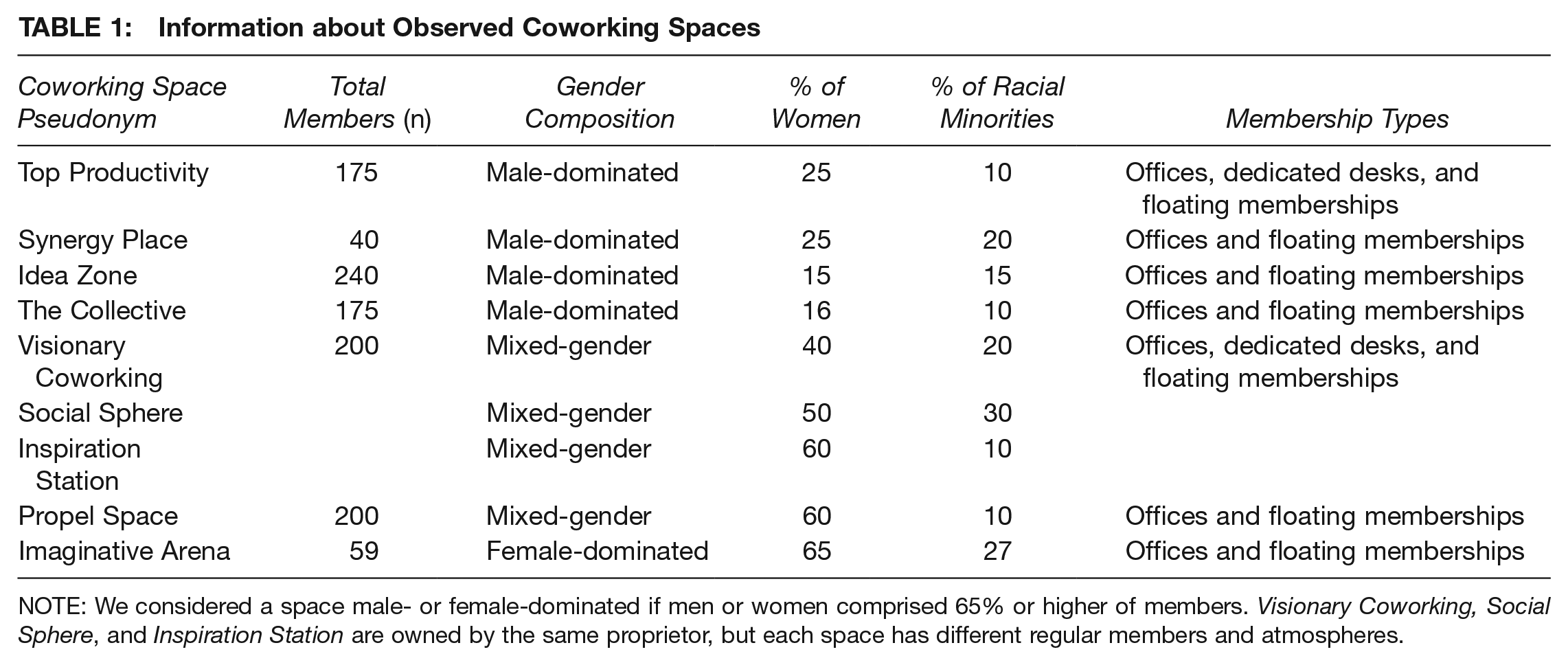
NOTE: We considered a space male- or female-dominated if men or women comprised 65% or higher of members. Visionary Coworking, Social Sphere, and Inspiration Station are owned by the same proprietor, but each space has different regular members and atmospheres.
Although coworking spaces did not keep detailed demographic records of members, we estimated gender and racial composition based on observations in the space. We checked our demographic estimates with those of each coworking space’s community manager to ensure accuracy and alignment. Four spaces were male-dominated, four were mixed-gender, and one was female-dominated. 3 The extent of racial diversity varied among spaces: in some spaces it was very low (at 10%) whereas in other spaces racial minorities made up roughly 30% of members.
All coworking facilities offered a variety of workspaces, including private offices and open areas with tables available for anyone’s use. All spaces had lounge areas with comfortable seating and free coffee, with most spaces offering alcohol at certain times (e.g., happy hour Thursdays). Several coworking spaces regularly hosted business and social events designed to connect coworking members and promote members’ businesses and skills.
Participants
Interviewees were recruited informally through conversation in open common areas. We attended multiple social and networking events to meet a diverse group of potential participants. Thus, we interviewed a heterogeneous sample that varied by race, income, age, and occupation (see Table 2 for sample demographics, broken down by gender).
Characteristics of Interview Sample by Men and Women
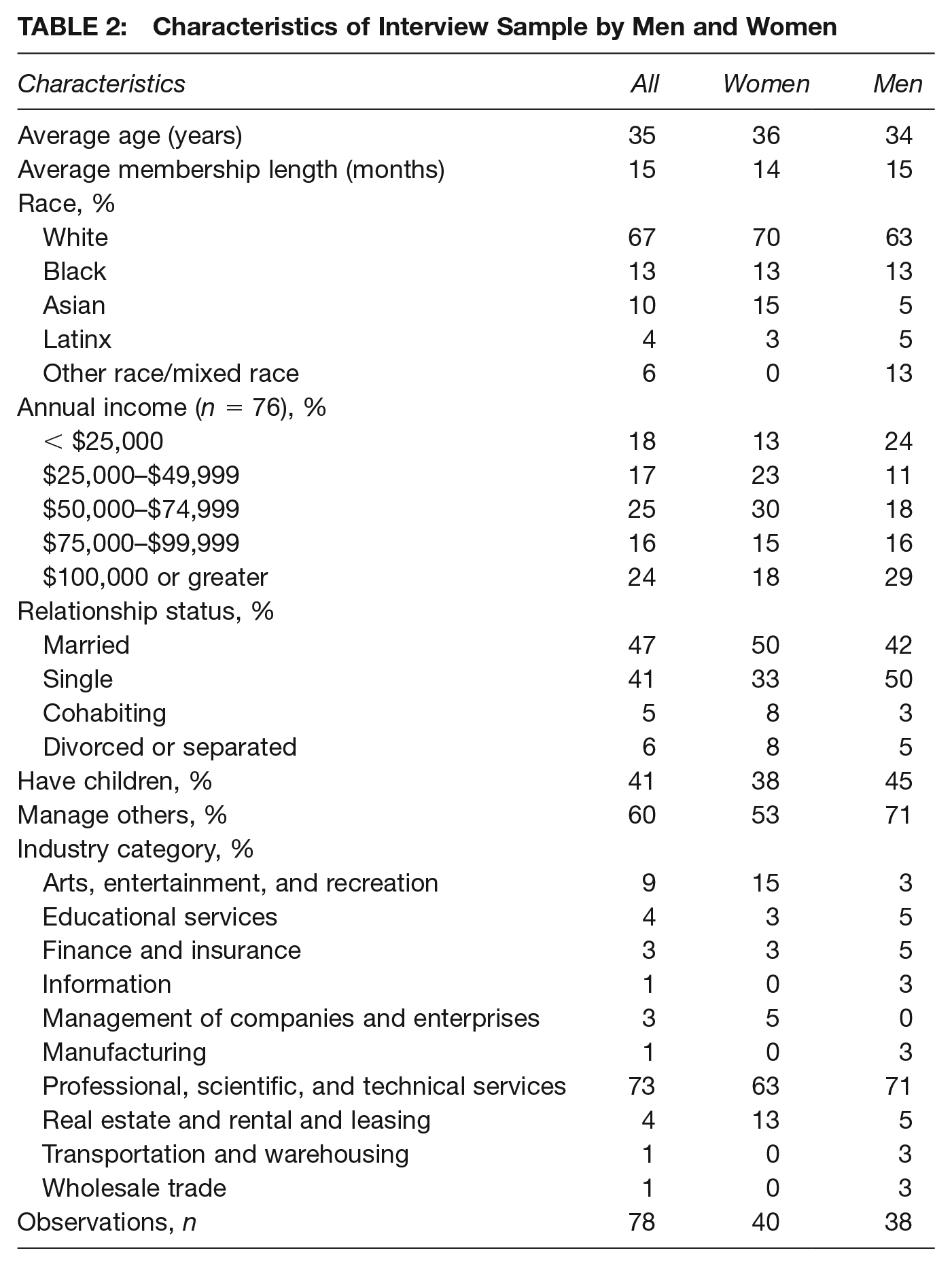
About half our sample were women. Interviewees ranged in age from 18 to 72 years, with an average age of 35. In terms of race, 67% were white, whereas 13%, 10%, 4%, and 6% were black, Asian, Latinx, and mixed race, respectively. Interviewees ranged in income (<$25,000 to >$100,000) and worked in various occupations and industries, and the majority (nearly 60%) managed other people in their firm. Interviewees’ average length of coworking membership was approximately 15 months.
Interviews
Interviews were 45 minutes to 1.5 hours long and primarily conducted in person in private conference rooms inside coworking spaces. Interviews included the following topics: experiences inside coworking spaces, relationships with coworking members, and career and personal benefits of coworking. See the Online Appendix for the semistructured interview guide. Interviews were digitally recorded and transcribed by a trained research assistant and a professional transcription service.
Observation Hours
Each researcher was assigned multiple spaces to observe. We carefully documented member use of the space and coworker interactions, including those related to business and opportunity sharing and other forms of networking. During professional and social events, we also took detailed notes on who attended, interactions between members, the topic or theme of the event, who presented (if anyone), and the overall atmosphere.
Regarding our positionality (to the interviewees and other coworking members we interacted with), each researcher was a highly educated white woman in her late 20s or early 30s. In some ways, our education, race, gender, and ages may have helped us appear “approachable” (because of stereotypes associated with white femininity; see Rosette et al. 2016) and enabled us to establish trust and rapport with people who shared similar statuses. On the other hand, for others with whom we did not share overlapping statuses (such as racial minorities or men), this may have impeded frank discussions about race or gender.
Analyses
Beginning with a close examination of the data, we carefully read the transcripts multiple times. Then, we developed a set of “index codes” based on broad topics pursued in the research and covered in the semistructured interview guide (Deterding and Waters 2018). “Index codes represent large chunks of text” that enable “subsequent rounds of reading to be more focused” (Deterding and Waters 2018, 19). Our index codes included spatial use, race, gender, career benefits, rules, personal benefits, and social interactions. We also coded interviewee demographics, such as race and gender, to identify connections between themes and different groups. We then identified subthemes from more in-depth readings of the data. For example, under the broader code “career benefits,” we coded subthemes of networking, business advice sharing, and opportunity sharing, among others. We then developed “analytic codes” for this study (Deterding and Waters 2018), focusing on concepts that tied categories together, such as “increased diversity of social networks.”
Throughout the analysis process, we applied constant comparative techniques by coding and analyzing data at the same time (Olson et al. 2016), wherein we each reviewed data independently first, discussed initial coding to find consensus, debated concepts that emerged from our codes, and refined our codes in iterative fashion. We also had ongoing conversations to reflect on our subjectivity, discuss our thinking, and develop shared conceptions about observed phenomena.
To ensure the trustworthiness of the data, we took several steps. We employed multiple forms of triangulation, including triangulating our methods, to enhance the credibility of our data and interpretations. By coupling interview data with extended periods of observations, we became very familiar with each context, had prolonged engagement in spaces, and built trust with participants (Tracy 2013). We were also able to assess how interviewees’ responses aligned with observations (and vice versa), and our fieldnotes provided rich context for understanding the data. Moreover, we employed data triangulation by studying nine different sites and also by varying the days and times of observation that we visited them (to capture different people’s coworking usages). Thus, we captured a more holistic view of the spaces and allowed opportunities for inconsistencies to arise. We also employed investigator triangulation, wherein multiple investigators observed each coworking site to increase credibility of observations. Every interview and fieldnote was coded by two researchers to increase credibility of interpretive decisions (Tracy 2013).
Findings
Coworking is designed to bring nontraditional workers together to facilitate networking, innovation, and community building (Garrett, Spreitzer, and Bacevice 2017). The mission to connect people of different occupational/professional backgrounds was evident in all observed spaces, although no formal requirements existed requiring members to interact. Therefore, coworking members could choose to forgo any substantive interaction if they desired. This was not the case, however, among the majority of spaces we studied: Coworkers interacted substantively with one another throughout the workday and at special networking events. They also shared career opportunities and collaborated on projects together. As we illustrate, the organizational logics of each space determined how diverse groups of men and women interacted and the benefits they derived from coworking.
In the next sections, we first detail aspects of organizational logics (i.e., specific practices and policies or lack thereof) found in coworking spaces that reduced gender inequality, along with other intersecting forms of inequality, in member interactions and experiences. We then highlight organizational logic, and one space in particular, that reproduced and reinforced forms of inequality.
Coworking Organizational Logics and Gender Dynamics
We found three key aspects of coworking organizational logics that helped weaken inequality regimes: affordable pricing policies, open-space design/allocation practices, and lack of policies inscribing occupational hierarchies. These aspects facilitated diversity and inclusion in the space, reduced feelings of tokenism by women and minority groups, diversified social networks and collaboration among members, and fostered more equal everyday interactions between typically advantaged and disadvantaged groups.
Affordable pricing policies: diversity and reduction of tokenism
Policies associated with entry into an organization can facilitate either inclusion or exclusion of diverse groups, depending on the extent of entry barriers (Ray 2019). Except for one male-dominated space (Idea Zone, discussed below), coworking spaces provided access to space and resources for relatively low cost, especially compared with the cost of purchasing or leasing independent commercial space (Bouncken and Reuschl 2018). Office membership fees ranged in price between $500 to $1,000 per month across spaces, with offices housing typically two to four people; floating membership fees (no dedicated desk) ranged between $99 to $150 per month. Notably, about a third of interviewees of various genders and races across spaces specified that affordable price was a primary factor in deciding to join a coworking space, and many others noted that coworking was attractive for the many amenities included in the membership price (e.g., printing, Wi-Fi, coffee, meeting space). Low pricing enabled a diverse set of racial and gender groups access to most coworking spaces and, as we illustrate below, helped build diversity into the space, fostered inclusivity, and even decreased experiences of tokenism for some members.
Indeed, multiple women mentioned feelings of inclusiveness or that their gender or race was not salient in their coworking experiences. For example, Delia (white woman, age in her 30s, graphic designer) told her interviewer, “I know that we have diversity in the space. I don’t really notice a difference in how I’m treated” when asked what it was like to be a woman in her male-dominated space. Nina (Asian woman, 30s, health care consultant) said she noticed a “healthy balance” of men and women in her space, stating “I think [my coworking space] seem[s] to promote diversity and inclusion. . . . I think it feels good to be a woman in this coworking space. . . . I think it feels good to be a racial minority in this space.” Similarly, Antonia (black woman, late 40s, marketing director) reported, “[My space] is pretty diverse. . . . You know, I’ve seen plenty of groups of African Americans and otherwise, who are taking advantage of [the coworking] space. . . . I think there’s also a great representation of women,” suggesting she perceives access to both people of color and women in the space. She further described her experience of the space as “inclusive” and that “racial minorities are not a big deal [in my space],” implying there was not a heightened focus on the actions or behavior of racial minority members. Men of color replicated many of these sentiments about race. Brayden, a black man (20s) said that in his coworking space “[race] hasn’t been a focal point in any interactions,” and Matthew, a biracial man in his 30s, said, “It’s actually multi-cultural. . . . It makes me feel included” as he described having people in his space of different races and genders.
Notably, several women of color went further with their statements regarding diversity in coworking spaces and more directly described that coworking reduced negative effects of tokenism. For example, Olivia (Asian woman, 20s, customer support manager) stated, “I feel much more widely accepted.” Olivia explained she was “the only Asian woman in my age group” in her last office job and that she often felt “out of place.” She elaborated, “You don’t have those stresses of that [in coworking]. So, I feel like I’m much more productive.” Working in a coworking space with other people of color enabled Olivia to feel less like a token, experience lower stress, and focus on doing her job more than when she worked in a traditional office setting. In another example, Alexandra (black woman, 40s, sales manager) said she specifically sought a coworking space to avoid her company’s office of mostly “older white men.” Alexandra described herself as “one of the youngest black females” on a “predominantly white male-dominated team” where she felt “biased and competitive energy” toward her. Alexandra said she now feels “very comfortable in this shared space” and perceives that people see her as “‘Alexandra,’ not the ‘little black girl.’” In both cases, Olivia and Alexandra highlight how the diversity and inclusivity of their spaces helped alleviate some tensions they faced in other work settings.
Built-in diversity of coworking spaces was also perceived as a benefit by some white men. Two white men entrepreneurs reported intentionally choosing coworking spaces because they intended to hire women. Both men described wanting to create an environment where women felt comfortable and had access to other women. Brendan (white man, 30s, IT professional) said his firm previously worked in a “bachelor pad.” The introduction of two women to his all-male team sparked his company to seek a coworking space to increase workplace “comfort level” and “cleanliness.” Similarly, Andrew (white, 30s, entrepreneur) told an interviewer that until we get to that point where we have more diversity in our own ranks . . . there’s that built-in diversity of being in a space like this . . . it allows me to go out and try to find the best talent I can. And when the best, the most talented, person for a particular role is a female, I won’t have any concerns about sticking her in a room full of a bunch of 20-something-year-old guys. . . . I would imagine that could be uncomfortable. . . . So coworking enables the business to do some things that we wouldn’t otherwise do.
As a temporary solution to a lack of diversity, coworking spaces may offer benefits for small businesses like Brendan’s and Andrew’s by helping them attract and potentially retain women talent. Coworking spaces provide women working on male-dominated teams access to other women while enabling male-dominated teams to engage with a more gender-diverse community. Of course, it is problematic if businesses rely on diversity of coworking spaces in lieu of hiring additional women or people of color. Nevertheless, the more balanced gender compositions of many coworking spaces may nudge men’s decisions in the direction of diversity and inclusion.
Open space design/allocation practices: diversification of networks and collaborations
Men and women are often physically and socially segregated in organizations, because they tend to occupy different jobs and hierarchical statuses (management vs. nonmanagement) (Blau, Brummund, and Liu 2013; Spain 1992; Wasserman and Frenkel 2015). In coworking, space design and allocation practices promoted close proximity between men and women. Although offices and designated desks were available for higher fees at most coworking spaces, a significant portion of coworkers opted for floating memberships to work in large open coworking areas. The open space design encouraged people to regularly see and interact with others, while taking breaks (e.g., getting coffee) or even as they worked. Importantly, all workspaces, including offices, were distributed on a first-come, first-served basis. This allocation practice enabled an even distribution of men and women in both open areas and office spaces, resulting in men and women often working adjacent to one another. The only site where this pattern was not observed was Idea Zone, where the allocation process of workspace was tightly intertwined with prohibitive membership costs (which we discuss later).
Opportunity sharing and/or networking relationships between men and women appeared to occur organically in coworking spaces due to members’ constant close proximity. Men and women frequently shared tables and workspaces in open areas where they solicited informal business advice and shared work-related needs/opportunities. Specifically, we documented 28 instances of cross-gender (compared with 23 instances of same-gender) business opportunity/advice sharing across coworking spaces, with little variation based on space gender composition. Many business exchanges also crossed racial boundaries. For example, we documented the following interaction as one white woman coworker (Diane, 30s, visual artist) encountered a black man coworker (Daniel, 30s, visual artist) walking through the open coworking area: Diane asked Daniel if he would run a supply swap with her at the coworking space . . . Daniel agreed. They continued to bounce ideas off one another for workshop topics, and the best ways to advertise . . . [ethnography note]
In this interaction, business advice and opportunity sharing between Diane and Daniel evolved from what began as a chance encounter in the coworking space. Diane later described how these informal conversations were essential to the “sustainability” of her business, as the ideas they generate can turn into “dollar signs” or “social capital.” Likewise, Gary (black man, 20s, professional speaker) said that he met and developed friendships with two black women through informal exchanges in the coworking space. He remarked that he frequently recommends these women coworkers for opportunities: “I’m always looking out for, you know, your friends, right? And trying to get them business . . . anytime someone, somebody’s talking about design work, I’m like, ‘Oh, you gotta get this person.’” These examples demonstrate how encounters facilitated by open coworking space design can result in important business and networking opportunities for women (and men).
Importantly, the organizational logic of spatial design/allocation in coworking created a “ready-made, go-to” gender-diverse network for members. Indeed, many coworkers specifically commented that when looking for business collaborations, other coworking members were the most easily accessible talent pool. For example, Kevin (white man, 30s, director) described multiple collaborations in his coworking space, mentioning two women specifically (one client and the other whom he hired). “You’re just around [them]. It’s quicker,” said Kevin when asked why he would source coworkers over others. For Kevin, the coworking space provided fast, easy access to a quality talent pool, negating his need to use personal networks. Similarly, Joshua (white man, 30s, CEO) said he often sourced talent, including women talent, from the coworking space because of “proximity . . . and because the relationship had been built . . . in some cases just proximity,” suggesting that coworkers were physically closer and more accessible than others. Georgia (white, 20s, recruiter) stated that she also looks to the coworking space first to find and offer opportunities because “I think there’s a lot of opportunity to know people’s strengths just through conversation . . . there’s a familiarity . . . and that I know them. . . . Like, I think that [is] half of the battle.” Notably, familiarity is one reason individuals tend to rely on homophilous networks to begin with (McPherson, Smith-Lovin, and Cook 2001); allocative practices (first-come, first-served) and openness of coworking spaces may help disrupt reliance on homophilous networks by encouraging diverse groups of people to observe each other’s work and quickly access their expertise. This may be particularly helpful to women and entrepreneurs of color, because they are often excluded from advantageous networks such as those enjoyed by white men, who tend to have greater access to resources and higher-status individuals (Jennings and Brush 2013; Ozkazanc-Pan and Muntean 2018).
Absence of policies inscribing hierarchies: more equal interactions
Organizational logics in traditional work contexts are often constituted by institutionalized occupational hierarchies that shape unequal gender and race interactions (Kalev 2009; Ridgeway 2011). In coworking spaces, interactions were not structured by typical gendered or racialized work hierarchies because no written policies or mandates from the space existed to organize members by rank, occupation, or status. Members largely worked for different companies or themselves, with half our interviewees identifying as self-employed (e.g., consultant, business owners) and another third reporting they worked for a smaller company. Given that coworking spaces lacked written policies indicating member occupational ranks (such as might be found in organizational charts for traditional organizations), the only institutionalized hierarchies present were those transplanted by groups of coworkers employed by larger organizations or established entrepreneurships (of which there were few in most spaces).
Across coworking spaces, women of various races suggested that relaxed hierarchies facilitated a greater sense of equality in everyday interactions. Women reported feeling more equally positioned to men, describing coworking as “level[ing] the playing field” (Alexandra, black woman, 40s, health care manager) or providing more “equal ground” (Samantha, white woman, 30s, lawyer) on which to interact with men. No women interviewees reported sexual harassment or seeing unwanted sexual attention in their space, answering our questions on these topics with responses like “haven’t seen it” (Nina, Asian woman, 30s, health care consultant) and “everyone I’ve interacted with has been very respectful” (Delia, white woman, 30s, graphic designer). Hope (white woman, 30s, creative director) suggested that the more even distribution of power in coworking spaces may be responsible for diminished instances of sexism at work: Everyone’s on equal footing. I feel like harassment and sexism and that kinda thing happens or is more prevalent when there are power dynamics or pay dynamics like in corporate settings . . . and we really don’t have that. . . . I couldn’t tell you what anyone else in here makes or what their title is.
Hope suggests the fact that coworking members are less aware of and influenced by people’s occupational statuses may reduce negative gendered interactions that women experience. Similarly, Antonia (black woman, 40s, retail) shared how “no one at [my space] is determining how you’re gonna grow in your business. So even if someone has an issue with you, they likely don’t have an influence on how you’re going to do.” Women’s perceptions of more equal interactions are important because people who regularly face hostility or microaggressions in workplaces tend also to be isolated and excluded from career opportunities (Alfrey and Twine 2017) and are more likely to leave their organization (e.g., McLaughlin, Uggen, and Blackstone 2017). This “equal footing” between men and women in coworking spaces may help maintain women’s strong, and growing, representation in coworking (Foertsch 2017).
Other ways we observed relaxed hierarchies in coworking spaces operating in positive ways for women was through monthly space-sponsored networking and showcase events (where people could promote their business or pitch a work-related idea). In most spaces, these events were open to all members with no qualifying criteria to attend or present. Rather than visibility being decided by occupational position or organizational status (Brumley 2014; Mickey 2019), these open policies for presenting enabled equal opportunities for men and women (and their businesses) to gain valuable visibility in the space. Events were widely attended (by other members and by people external to the coworking space) and could lead to additional business opportunities or collaborations for members, as noted by multiple participants in our interviews. Indeed, in reference to one space’s showcase event, Emma (Asian American woman, 30s, entrepreneur) said “It’s a great networking opportunity,” and believed members derived significant value from these events.
Notably, we observed just as many (sometimes more) women (both white and women of color) presenting as did men. Tanya (white woman, 20s, photographer) described her space’s showcase event as a time when “anybody has the opportunity to get up and share,” and later emphasized how many members would otherwise not have access to that kind of exposure or opportunity to “shine.” Similarly, Marnie (white woman, 30s, designer/entrepreneur) said that these events allowed coworking members to showcase and “leverage everyone’s strengths,” further highlighting how coworking spaces promoted diversity of talent.
In sum, the last three subsections highlight key aspects of organizational logic that helped interrupt common practices and policies that create gender—and intersecting forms of—inequality in work contexts. We next discuss a coworking space that offers an important counterexample to the logics described above.
Coworking Organizational Logic and the Perpetuation of Inequality Regimes
Originally, we expected the gender composition of coworking spaces to influence coworking organizational logic and resultant dynamics among diverse groups of men and women. However, our analyses revealed that gender composition was not sufficient on its own to produce inequality regimes; rather, in addition to having a male-dominated gender composition, other aspects of organizational logics were necessary, as we uncovered with Idea Zone. Idea Zone differed from other coworking spaces, including other male-dominated spaces, in multiple ways. [The following discussion is more centered around gender and class, though we note where there are potential race implications.]
Exclusionary pricing policies and gender segregation
Idea Zone had the highest percentage of male members (85%) and charged, by far, the highest entry and office rental fees of all spaces observed. Idea Zone also included more private office spaces than other coworking spaces and had the most modern décor, highest-profile location in the city, and highest-quality amenities of all spaces (e.g., large quantities of food and beverages, occasional masseuses on site). Together, Idea Zone’s upgraded features enabled it to demand higher prices for entry and enact an ascending price structure for the most desirable workspaces within the building. Access to Idea Zone was thus different from other coworking spaces.
While still first-come, first-served, Idea Zone’s high pricing policy restricted access to a small group of high-status labor market actors, who either worked for a company willing to spend a lot on coworking fees or entrepreneurs running already-successful startups that could afford the high membership fee. Because men (particularly white men) are more apt to fit these characteristics based on their generally advantaged occupational positions (Blau, Brummund, and Liu 2013; Jennings and Brush 2013; Warner 2014), exclusionary pricing restricted women’s membership access and contributed to significantly more men joining the space than women. Indeed, Idea Zone attracted primarily class-advantaged white men who either (1) worked in high-paying, male-dominated occupations/industries (mainly technology and finance) and were employed by midsize or large established organizations, or (2) were successful entrepreneurs already employing multiple workers. The higher occupational status of these men was also evident in the annual income of interviewees from this space, in which most reported earning $100,000 or more annually.
Idea Zone’s pricing policy also fueled gender segregation inside the space, separating the small number of women who did work there from the larger population of men. Unlike other spaces, nearly all members at Idea Zone paid for offices (instead of floating memberships to share common workspace), and office prices were on an ascending scale. The more prestigious offices (on the outer perimeter, with city views and floor-to-ceiling glass windows) cost approximately $4,000 to $8,000 per month; the less desirable offices (inner part of the building, without views) cost approximately $1,000 per month. Per counts of office occupancy by gender, primarily men occupied these larger, more desirable offices on the exterior part of the building and, if they shared, did so with other men from their organization. Women, on the other hand, mostly shared the inner, less desirable offices with other women from their same company. Thus, though all members at Idea Zone theoretically had equal access to workspace (first-come, first-served), actual obtainment of the most desirable space was largely restricted to those who could afford it (i.e., high-status men). Consequently, women’s offices were largely located in different parts of the building from men’s offices.
Because few people worked in the relatively small common space and most members had offices shared with same-gender others, men and women were less likely to casually encounter one another inside Idea Zone. Men’s office neighbors were more likely to be men, women’s office neighbors were more likely to be women, and few members who occupied offices spent substantial time in common areas. Overall, we documented few instances of cross-gender interactions at Idea Zone, with our fieldnotes including summary statements such as “I only saw women talk to other women, and men talk to other men the whole six hours I was there” and “again . . . largely only saw women interact with each other and men interact with each other.” Such findings highlight how class-based policies of access to premium space can significantly influence distribution of men and women inside coworking spaces and, subsequently, how interactions (or lack thereof) unfold between men and women in coworking organizations.
Idea Zone also had a low percentage of racial minority members; thus, the policy of setting high membership fees likely had similar exclusionary impacts on people of color. However, we observed that men of color were more evenly distributed among offices (including in highly desirable offices) than women, and they regularly interacted with white men. This pattern might result from the fact that male-dominated businesses and occupations were common in the space; thus, their gender made it likelier that men of color were part of these businesses and/or on teams with other white men.
Exclusionary pricing policies and delegitimization of cross-gender interactions
Idea Zone’s high pricing policy and resultant gender segregation in the space also helped delegitimize interactions between men and women. In the coworking spaces previously discussed, interactions with other members (including those between men and women) were considered critical to advancing their careers and businesses, in part because many members worked for early-stage entrepreneurships or small companies occupying the space. At Idea Zone, however, interactions with others did not appear as important to most members. Because high prices restricted access only to people who worked for companies who could afford a very high membership fee, members at Idea Zone generally worked for midsize or larger external firms or already successful entrepreneurships; thus, as several interviewees noted, networking with other members was less consequential for their career or business success. While the presence of workers from already successful or larger businesses facilitated less overall interaction and networking in the space, it appeared to especially decrease cross-gender interactions.
Ethnographic observations revealed that coworkers at Idea Zone who interacted with members external to their home firm were primarily men having casual conversations with each other or talking about their businesses. Importantly, our observations aligned with perceptions of interviewees from Idea Zone, who generally agreed social interactions in the space occurred mostly between men. For example, when asked who socialized in the space, Brayden (black man, 20s, freight broker) answered “definitely the men” and that he rarely saw women interacting with men. Likewise, when we asked Jeanne (white woman, 30s, office administrator) about whether men and women interact at Idea Zone, she said “I think they interact with the opposite sex only if they are on the same team.” Ron (white man, 30s, consultant) stated he is “less likely to see a woman from one company engage a man from another company” because “there’s not really anything to talk about.” For men, in the absence of business- or career-related reasons to interact with other members, cultural understandings of male friendship and bonding provided a framework for which casual conversations and interactions could occur. However, for cross-gender interactions, that framework looked very different (Alfrey and Twine 2017; West and Zimmerman 1987).
In other coworking spaces, cross-gender interactions had professional legitimacy because of the context of their relations (i.e., early-stage entrepreneurships and small companies occupying the space) and the career benefits members perceived as stemming from interactions. Without organizational goals and structures sanctioning men’s and women’s interaction, many coworkers at Idea Zone assumed that cross-gender interactions were sexually motivated. Brayden explained the main reason men approached women in the space was to flirt with them or “get their digits,” implying few other reasons existed to explain their interactions. These sentiments were echoed by another man (white, 30s) at Idea Zone, who told the interviewer “Oh, yeah that’s true. I always notice when a new woman is here . . . I then try to see if there’s a ring on her finger!” Brayden also recalled playfully chastising another man at Idea Zone for merely interacting with a woman, because “he had no real reason as to why he should be communicating with her,” saying “it’s just that he’s single and he’s ready to mingle.” Thus, men at Idea Zone might view women primarily as potential romantic or sexual interests, rather than as friends or professionals with whom to network or share opportunities. Furthermore, these statements demonstrate how cross-gender interactions without a perceived work-related motivation might be censured by other members in the space, perhaps further discouraging interactions between members of different genders.
While many coworkers disclosed beliefs that men and women largely interacted based on sexual interest, some said they purposefully did not engage in cross-gender interaction for fear of being perceived as initiating a sexual advance. Brendan (white man, 30s, IT professional) admitted not knowing how to interact with women coworkers and feeling concerned about how others would perceive his behavior: He said that he does not know how to be “buddy-buddy with women” because he is afraid of people perceiving that he is “hitting on them or flirting with them.” He also expressed strong concern about “something slipping and happening” if he were to get too close to a fellow woman coworker. [ethnography note]
Similarly, Landon (white man, 30s, marketing director) stated he was less likely to talk to women in the coworking space for fear of being perceived as pursuing them sexually: I do find it remarkably strange that in any other situation like this, I would go out of my way to talk to everybody. But here, I’m much more to myself. . . . I certainly don’t want people thinking I’m hitting on them.
Idea Zone’s women members also expressed concerns with being perceived as “hitting on” men coworkers. Zoey (black, 50s, management consultant) said, “I get in my head when talking to a man: thinking ‘oh my god, he thought I was hitting on him,’” though that was not her intention. These sentiments demonstrate how men and women at Idea Zone felt their interactions were constrained by views depicting cross-gender interactions as sexually motivated, particularly when not organizationally legitimized as professional. This pattern posed a stark contrast to interactions in other spaces, where members reported benefiting both personally and professionally from cross-gender interactions.
Overall, we found that the exclusionary pricing policies of Idea Zone ensured that fewer women could access the space, and if they did, they were segregated into offices restricting “natural” run-ins with men members. Subsequently, because Idea Zone primarily attracted higher-status people (particularly white men from more established organizations or entrepreneurships) who relied less on business opportunities from the space to advance their careers, the delegitimization of cross-gendered interactions was amplified. Thus, women in particular appeared to reap fewer benefits (e.g., regular interactions, information exchange opportunities) in this space, compared with others we observed. 4
Discussion
Traditional organizational logics can shift and mutate into new forms that perpetuate gender inequality in the new economy (e.g., Brumley 2014; Mickey 2019). Our study extends scholarship to an understudied work environment increasing in popularity among independent professionals (Mazareanu 2020): coworking spaces. Building on Acker’s (2006) conceptualization of inequality regimes, we identified specific aspects of organizational logic that either enabled and/or suppressed unequal gender, and intersecting race and class, dynamics in these spaces.
Together, three key aspects of coworking organizational logic disrupted the reproduction of inequality regimes in organizations. First, affordable pricing policies reduced entry barriers into coworking spaces, facilitating gender, and at least some racial, diversity among membership, even if coworkers’ own organizations or teams were not diverse. Lower membership costs helped prevent reinscription of external class-based labor market inequalities that are closely tied to inequalities of gender and race and fostered more equal access to coworking contexts. This built-in diversity helped reduce feelings of tokenism, particularly for women of color, and even helped some men in male-dominated businesses attract and potentially retain women talent.
Second, open space design and first-come, first-served allocation practices increased physical and social proximity of men and women in coworking spaces while limiting status-based segregation (i.e., gender, race, and class). As a result, these practices fostered substantive interaction among different groups and created “go-to” diverse networks from which men and women members (including people of color) could equally source talent and find opportunities.
Third, an absence of formal policies inscribing occupational hierarchies in coworking spaces facilitated equal opportunities for promoting members’ businesses or skill sets, increased positive visibility for women (including women of color), and encouraged more equal informal cross-gender (and cross-race) interactions. The importance of diverse groups of women reporting more equal footing in coworking spaces should not be understated. In traditional work organizations, social relations are often framed by unequal hierarchies where (white) men tend to have greater institutionalized power (Ridgeway 2011; Warner 2014). Coupled with expectations of doing gender, women, in everyday interactions, are repetitiously expected to show deference to higher-status men (Risman 2004; West and Zimmerman 1987). Coworking spaces may, at the minimum, weaken the extent of gendered interactions—a key level of analysis by which gender operates—for members during the workday, given that men do not appear to have any higher visibility or formalized status in coworking organizations (Risman 2004; Scarborough and Risman 2017).
Because many coworking members are entrepreneurs (Bouncken and Reuschl 2018), some advantages associated with organizational logics in coworking spaces may stem partly from the fact that women and people of color in such spaces are often their own bosses. Nevertheless, organizational logic in coworking spaces can disrupt challenges women entrepreneurs and entrepreneurs of color face, such as exclusion from (white) men’s networks. Women entrepreneurs often have less access to valuable resources, such as collaborators, business opportunities, and/or information, relative to their male counterparts (Jennings and Brush 2013; Ozkazanc-Pan and Muntean 2018). Thus, when structured in ways that disrupt inequality regimes, coworking may create positive change for entrepreneurs who have historically and culturally faced barriers.
In the coworking space with the largest concentration of men in the highest-status location (Idea Zone), however, we found organizational logic that amplified inequality regimes. Exclusionary pricing policies activated class-based processes of entry whereby high-status men had greater ability to access membership and the best physical spaces. Consequently, Idea Zone was significantly more gender-segregated, creating less opportunity for cross-gender interaction. Furthermore, the high prices of membership facilitated occupation of the space by a larger number of pre-formed teams from large organizations and highly successful, established entrepreneurships (who could afford membership). Coworkers from such firms saw fewer reasons to interact with people outside their company because of lower dependence on networking for business growth. Without sanctioning from their own organizations or motivations to advance their careers, Idea Zone’s members perceived few legitimate reasons to interact across gender lines. Instead, members invoked heterosexualized explanations for cross-gender interactions that tended to relegate women to roles as sex objects. The lack of gender integration meant that women at Idea Zone (who often belonged to all-women start-ups) were largely excluded from access to perhaps more established male-led entrepreneurships or larger firms with greater resources in the space.
Despite the many advantages of our study, it also has limitations. First, implications of our findings are limited to a narrow population of more advantaged, often white-collar, workers who have workplace flexibility. Although some women and minority workers may experience gains from coworking, many do not have access to coworking spaces, especially low-wage workers who often work in environments characterized by segregation, sexual harassment, and/or other forms of discrimination (e.g., service work; Minnotte and Legerski 2019). Also, our study lacks generalizability outside the Southeastern U.S. metropolitan area studied. Because of sparse information on gender compositions and/or pricing policies associated with coworking, it is unclear how prevalent coworking spaces like Idea Zone are in the United States. Future research should survey the demographic compositions, practices, and policies of coworking spaces nationwide to gain a better understanding of wider inequality patterns.
Despite limitations, and in addition to our many clear findings, this work has important broader implications. Acker (2006) argues inequality regimes are always present, fluid, and changing. Broadly, our work shows that organizations with less control over the advancement of workers, but that still “pattern and organize work” (Blagoev, Costas, and Kärreman 2019, 910), may have the ability to challenge inequality regimes. This looser form of control appears critical to forming initial cracks in the foundations of organizational inequality. Moreover, our research suggests that gender composition alone may not be enough to disadvantage women in new economy contexts such as coworking, but rather that inequality is contingent upon other organizational logics that segregate genders and reinforce men’s higher status. Overall, our study provides a blueprint for the types of coworking practices and policies that create favorable experiences and benefits for diverse groups of women, and pushes future research to continue investigations of organizational logic that exacerbates or weakens inequality regimes.
Footnotes

Notes
Amanda C. Sargent is a doctoral candidate at University of North Carolina at Charlotte. She has a Master’s Degree in industrial/organizational psychology from University of North Carolina at Charlotte and a Master’s Degree in community/clinical mental health counseling from Marymount University in Arlington, VA. Her research focuses on gender, race, and class inequality in the workplace, supportive supervision/organizations, and organizational justice.
Jill E. Yavorsky is an assistant professor of sociology and organizational science at University of North Carolina at Charlotte. Her research focuses on U.S. labor market patterns by gender, workplace inequality and discrimination; and divisions of labor among parents. Her research has been published in top-tier social science journals including American Sociological Review, Social Forces, and Journal of Marriage and Family.
Rosalyn G. Sandoval received her B.A. in psychology and M.A. in industrial/organizational psychology from California State University, Sacramento. Currently, Rosalyn is pursuing her Ph.D. in organizational science at University of North Carolina at Charlotte. Her research interests include entrepreneurship (focusing on female and minority entrepreneurs) and how positive psychological constructs can inform entrepreneurial practices. She is currently working on her dissertation, which examines the influence of gender and race homophily on new venture creation.