



Abstract
Almost 40 years ago, scholars identified a “chilly climate” for women in college classrooms. To examine whether contemporary college classrooms remain “chilly,” we conducted quantitative and qualitative observations in nine classrooms across multiple disciplines at one elite institution. Based on these 95 hours of observation, we discuss three gendered classroom participation patterns. First, on average, men students occupy classroom sonic space 1.6 times as often as women. Men also speak out without raising hands, interrupt, and engage in prolonged conversations during class more than women students. Second, style and tone also differ. Men’s language is assertive, whereas women’s is hesitant and apologetic. Third, professors’ interventions and different structures of classrooms can alter existing gender status hierarchies. Extending Ridgeway’s gender system framework to college classrooms, we discuss how these gendered classroom participation patterns perpetuate gender status hierarchies. We thus argue that the chilly climate is an underexplored mechanism for the stalled gender revolution.
In the 1980s, scholars identified a “chilly climate” in college classrooms, where women 1 faced overt and subtle forms of discrimination, such as professors calling on men students more than women and interrupting women more than men (Hall and Sandler 1982). The chilly climate is composed of “everyday inequities” that individually may “seem trivial, and may even go unnoticed” by the professor and the student; however, cumulatively they “can dampen women’s participation and lead them to doubt the value of their contributions” (Hall and Sandler 1982, 5, 7). Over the next two decades, researchers documented how these inequities create a chilly classroom climate for girls and women from elementary to college classrooms (e.g., Fassinger 1995; Sadker and Sadker 1994). Around the same time, however, women gained ground in a range of educational outcomes. For example, since 1982, women have attended and graduated from college with higher GPAs than men (DiPrete and Buchmann 2013). Some scholars and pundits have argued, therefore, that it is boys and men—not girls and women—who face disadvantages in school (e.g., Fortin, Oreopoulos, and Phipps 2015; Garibaldi 2006; Sommers 2000). This raises questions as to whether the chilly climate exists in contemporary college classrooms. We examine its extent along with the structural elements and processes sustaining it.
Our study directly responds to a call for more research on the “sociology of the college classroom” (Atkinson, Buck, and Hunt 2009), specifically to examine how everyday inequalities are created, reproduced, and dismantled within them. Our examination of college classrooms thus offers one way to understand why today’s gender revolution has largely been “uneven and stalled” (England 2010). Scholars have provided a range of explanations for the “stalled revolution,” including discrimination in workplaces, the glass escalator, and occupational segregation (e.g., Alegria 2019; England 2010). In addition to these processes, we argue that another possible explanation is the persistence of inequality in classroom “sonic space,” which refers to the sound or vocal space people occupy (Musto 2019; Sargent 2009). 2 In Ridgeway’s theoretical framework on the gender system (2001, 2011; Ridgeway and Correll 2004), cultural beliefs about gender that assign more status and competence to men than to women continue to frame social relations, thereby perpetuating gender inequalities. These reinforcements then become “multiple, nearly invisible nets of comparative devaluation” that limit women’s willingness to speak up and assert themselves as leaders (Ridgeway 2001, 652). To our knowledge, we are the first to apply this framework to classroom processes. Consequently, one contribution is to show how cultural beliefs about gender operate in college classrooms, positing that these gendered classroom participation patterns perpetuate gender status hierarchies. In this way, we argue that the chilly climate in college classrooms is an underexplored mechanism in gender inequalities.
Using 95 hours of ethnographic observations from nine classrooms across a range of disciplines at an elite college, we investigate whether there are any gender differences in participation patterns and interactions in contemporary college classrooms. Improving upon methodological limitations in past research, we designed a mixed-methods project with multiple observations of each classroom, using a standardized coding sheet and detailed fieldnotes to generate both quantitative and qualitative data on patterns over one academic term. In each class session, we examined the gender composition, types of student responses (comment, question, answer to professor’s questions), the way interactions begin (raise hand, speak out, called on), and professor’s reactions (praise, interruption, no response). We find that women occupy sonic space in classrooms less frequently than men; and when women do speak, they also tend to engage hesitantly and use apologetic language. By applying Ridgeway’s framework of the gender system to contemporary college classrooms, this study not only updates two decades of research on whether the classroom is still a chilly climate for women but also reveals taken-for-granted patterns of interactions and communications in a gendered society.
Background
Class Participation, Higher Education, and Gender
Because active participation in college classrooms contributes to increased student learning and development, a large body of work in the Scholarship of Teaching and Learning points to ways in which instructors can encourage student participation (e.g., Auster and MacRone 1994; Fassinger 1996; Gillis 2019). Through participating in discussion, students learn to communicate effectively by organizing their ideas, advocating for their points of view, and growing as leaders (e.g., Ming 2010; Opie et al. 2019). While it is important to increase participation rates overall, it is also important to examine participation rates of varying social groups—in other words, to view college classrooms as social sites and pay attention to who speaks and who listens. To this end, scholars have studied how class participation rates are affected by student race (Howard, Zoeller, and Pratt 2006; Pitt and Packard 2012), age (Howard, Short, and Clark 1996), and gender—the primary focus of this study.
Although women have made significant gains toward equal access to higher education since the 1970s (DiPrete and Buchmann 2013), women continue to be disadvantaged in other aspects. For example, researchers note gender differences in college major choice (e.g., Mullen 2014), in classmates’ perceptions of ability even when women have higher grades in STEM courses (Bloodhart et al. 2020), use of time for academic and social purposes (Quadlin 2016), and the gendered sexual script around hooking up (e.g., Hamilton 2014). Another possible inequality can be found in college classrooms, which remain sites of power and privileges. In 1982, Hall and Sandler coined the term “chilly climate” to describe a series of subtle “micro-inequities” in college classrooms that collectively create a chilling atmosphere that discourages women students. Interestingly, “chilly climate” is now being used to refer to other aspects of higher education that systemically disadvantage women, such as academic conferences (Biggs, Hawley, and Biernat 2018) and science in general (Simon, Wagner, and Killion 2017). We return to the original meaning of “chilly climate,” asking whether it exists today in terms of classroom participation and student–faculty interaction in an elite college’s classrooms.
Research on “Chilly Climate”
One of the first studies to bring attention to the gendered classroom environment was Hall and Sandler’s (1982) report, which concluded that faculty members often inadvertently made sexist comments and unequally displayed nonverbal cues, such as making eye contact, nodding, and standing near men students, to create a chilly classroom climate for women. Women’s invisibility was maintained through the “masculine” and competitive settings for discussion and women’s often passive speech style. Continuing this line of research, Sadker and Sadker’s (1994, 42) observations in elementary schools, high schools, and colleges reveal that a classroom consists of two worlds: “one of boys in action, the other of girls’ inaction.” In college classrooms, these patterns become starkest: “[w]omen’s silence is loudest at college” and men mostly “monopolize class discussions,” receiving more praise, criticism, and constructive help from their professors than do women (Sadker and Sadker 1994, 170).
Many studies conclude that men students participate and report participating more than women in college classrooms (e.g., Auster and MacRone 1994; Fassinger 1995; Krupnick 1985). For example, in a survey at a liberal arts college, men students reported participating more often in class and feeling more comfortable participating than did women (Auster and MacRone 1994). Similarly, in law school classes, women reported less frequent participation, and more women than men reported never participating in class discussions (Banks 1988). Women also reported “chilly climate behaviors”—specifically discouragement, invisibility, marginalization, questioning women’s competence, and defining women by their sexuality in both quantitative surveys and qualitative focus groups (Allan and Madden 2006). Observations of 23 large introductory biology classes find that women participate less frequently than men; women volunteer answers less than 40 percent of the time yet comprise about 60 percent of students (Eddy, Brownell, and Wenderoth 2014).
On the other hand, some research yields inconsistent evidence or concludes that chilly climates for women simply do not exist (e.g., Boersma et al. 1981; Brady and Eisler 1999; Drew and Work 1998). For example, Boersma et al. (1981) find no gender differences either in their observational data of classrooms or their survey of students’ perceptions of their professors’ behaviors. Likewise, studies by Drew and Work (1998) and Brady and Eisler (1999, 138) find no statistically significant differences in men and women students’ classroom participation patterns, arguing that “there are clearly more variables involved in classroom interaction patterns than faculty and student sex.” Based on 411 students’ participation grades in 12 sections of a business course, Opie et al. (2019) conclude that although men’s participation grades are not higher overall, men have higher participation grades in classes with higher proportions of men (Opie et al. 2019). Reflecting this conclusion, researchers have argued that other contextual factors, such as class size (Constantinople, Cornelius, and Gray 1988; Crawford and MacLeod 1990; Opie et al. 2019), gender ratio of students in the classroom (Canada and Pringle 1995; Constantinople, Cornelius, and Gray 1988), and student GPAs (Crawford and MacLeod 1990), are more important than students’ gender in determining classroom participation patterns.
Evidently, scholars do not agree on the existence of and reasons for the chilly classroom climate. This research, however, is largely out of date. Little research has explored the chilly classroom climate in the past two decades, and, as described above, the research that has been done comes to conflicting conclusions. Some scholars point to researchers’ methodological decisions and conceptual frameworks, particularly because “many ‘chilling’ behaviors may go unacknowledged because they reflect socially accepted patterns of communication” (Allan and Madden 2006, 685; see also Brady and Eisler 1999; Prentice 2000). Our study seeks to improve upon the methodological limitations of past research by systematically collecting quantitative and qualitative data on classroom interactions over multiple class sessions. Our methodological design as well as our theoretical framework enables us to systematically study classroom behaviors, even those that may typically go unnoticed because they conform to social norms.
Social Interactions in the Gender System
To this end, we use Ridgeway’s theoretical framework (2001, 2011; Ridgeway and Correll 2004) of the gender system to understand the gendered interaction patterns in college classrooms. According to this perspective, widely shared, hegemonic cultural beliefs about gender shape social interactions in what the authors call “social relational contexts” (Ridgeway and Correll 2004). And these cultural beliefs about gender, which are essentially “rules for enacting gender in American society,” assign greater status worthiness and competence at “what counts” to men more than women (Ridgeway 2011, 57). The gender beliefs then affect “participation initiation, opportunities given to participate, evaluations received, and influence over others” in social interactions (Correll and Ridgeway 2003, 30). These cultural beliefs are highly durable and widely held: Most individuals know what they are and expect others to hold the same beliefs. As a result, Ridgeway (2011) argues that the persistence of gender inequality in today’s society can be explained by the gender status beliefs that maintain gender status hierarchies and influence interpersonal expectations and behaviors.
If cultural beliefs are the rules, “social relational contexts are the arenas in which these rules are brought to bear on the behavior and evaluations of individuals” (Ridgeway and Correll 2004, 514). In this sense, gender is almost always “a background identity that also affects institutionally defined and situationally focal identities” (Ridgeway 2011, 70), such as student–faculty relations. This background identity becomes activated or salient in contexts where real or implied actors differ in sex category. In contemporary college classrooms, which are almost always mixed-gender settings, gender thus is arguably “effectively salient” (Ridgeway and Correll 2004, 517).
As a social relational context with formal rules of interactions, college classrooms exhibit gendered interactional patterns and resulting status hierarchies. Tannen (1991) also argues that classroom participation is more congenial to men’s language patterns than to women’s, because men are comfortable speaking in large public spaces whereas women are more comfortable speaking in private to a small group of people. Because college classrooms are embedded in a context where “men’s voices frequently command greater power and influence than women’s voices” (Opie et al. 2019, 38) and men are generally believed to be more competent than women in current society, men students end up with higher status, more opportunities to participate, and more positive evaluations in classrooms compared with women students. Scholars of gender and communication also point out that the same types of interactional behavior may not have the same meaning depending on the speaker and participant gender. For example, women students, who are fully aware of gendered cultural beliefs, often face a double bind in classrooms: They need to be active in classrooms to succeed academically, yet social penalties may accompany such violations. Thus, interruptions and turn taking in classrooms are important to examine through a gendered lens.
Hence, using the gender as a frame theory, we explore the following questions: (1) What, if any, are the gender differences in classroom participation patterns? (2) How do these differences reproduce gender status beliefs and hierarchies? We use Ridgeway’s framework to understand the complex, subtle social processes that may create status hierarchies in classrooms and operate as taken-for-granted mechanisms that reproduce gender inequality.
Methodology
Research Site
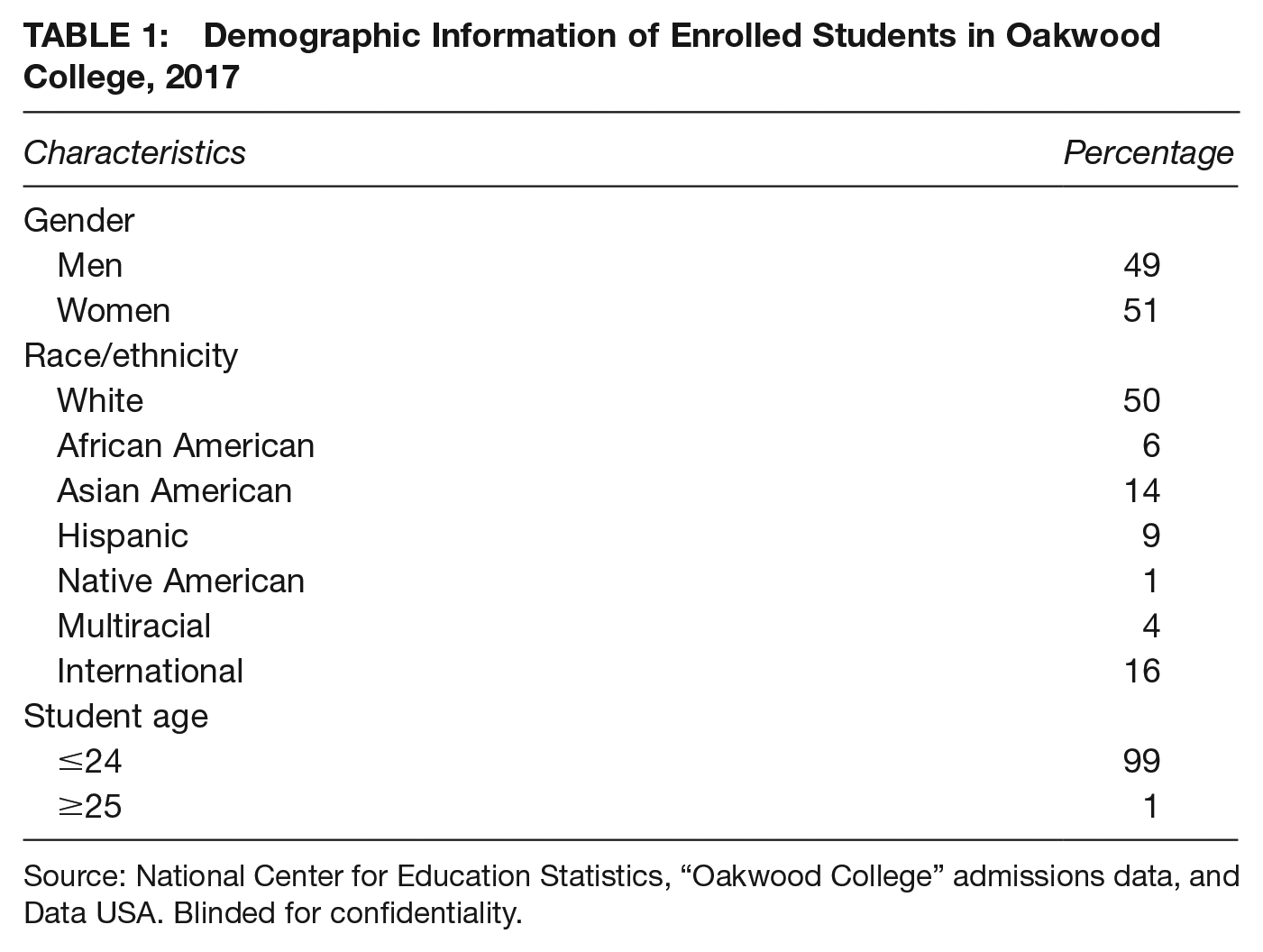
Data come from 95 hours of observation of classroom dynamics at Oakwood College (a pseudonym), an Ivy League college located in the northeastern United States. It enrolls approximately 4,000 undergraduates, with roughly equal numbers of men and women students in its predominantly white, traditional-age student body (see Table 1). As one of the highest-ranked undergraduate programs in the nation (U.S. News & World Report 2018), Oakwood College attracts highly qualified faculty and academically prepared students. In this sense, Oakwood is an important case study in examining gender differences in higher education. As other scholars note, alumni from elite institutions end up overrepresented in leadership positions and in lucrative fields, and these institutions are arguably direct pathways to power and status in our society (e.g., Jack 2019; Rivera 2015; Warikoo 2016).
Demographic Information of Enrolled Students in Oakwood College, 2017
Source: National Center for Education Statistics, “Oakwood College” admissions data, and Data USA. Blinded for confidentiality.
Another reason we chose Oakwood College was the first author’s established rapport. As the ethnographer and an undergraduate student at Oakwood, the first author’s familiarity with the setting enabled her to understand local lingo and reflect on hidden meanings specific to the context of Oakwood classrooms. Furthermore, her status as a young woman of color allowed her to seamlessly observe the classrooms 3 instead of disrupting the classroom interactions as a professor’s observation may have, which is especially important in classes enrolling only 10–40 students. These advantages increase the study’s validity.
Sample
Heeding past scholars’ call for a study with multiple observations of the same class (Tatum et al. 2013), the first author (henceforth, “I” or “the ethnographer”) observed nine courses over 10 weeks (i.e., one academic term). I observed each course for five weeks, totaling approximately 95 hours of observation and 80 class sessions. To our knowledge, previous studies observed each classroom only once (see Brady and Eisler 1999 for an exception). Although one observation may provide an accurate snapshot of the classroom environment, it cannot offer insight into any changes in the classroom atmosphere and gender dynamics. Observing each course for half a term enabled us to more seamlessly integrate into classrooms and attend to subtle biases that may accumulate (or ameliorate) over time. Five weeks per classroom provided appropriate balance between breadth (number of courses in our sample) and depth (the complexities of observations).
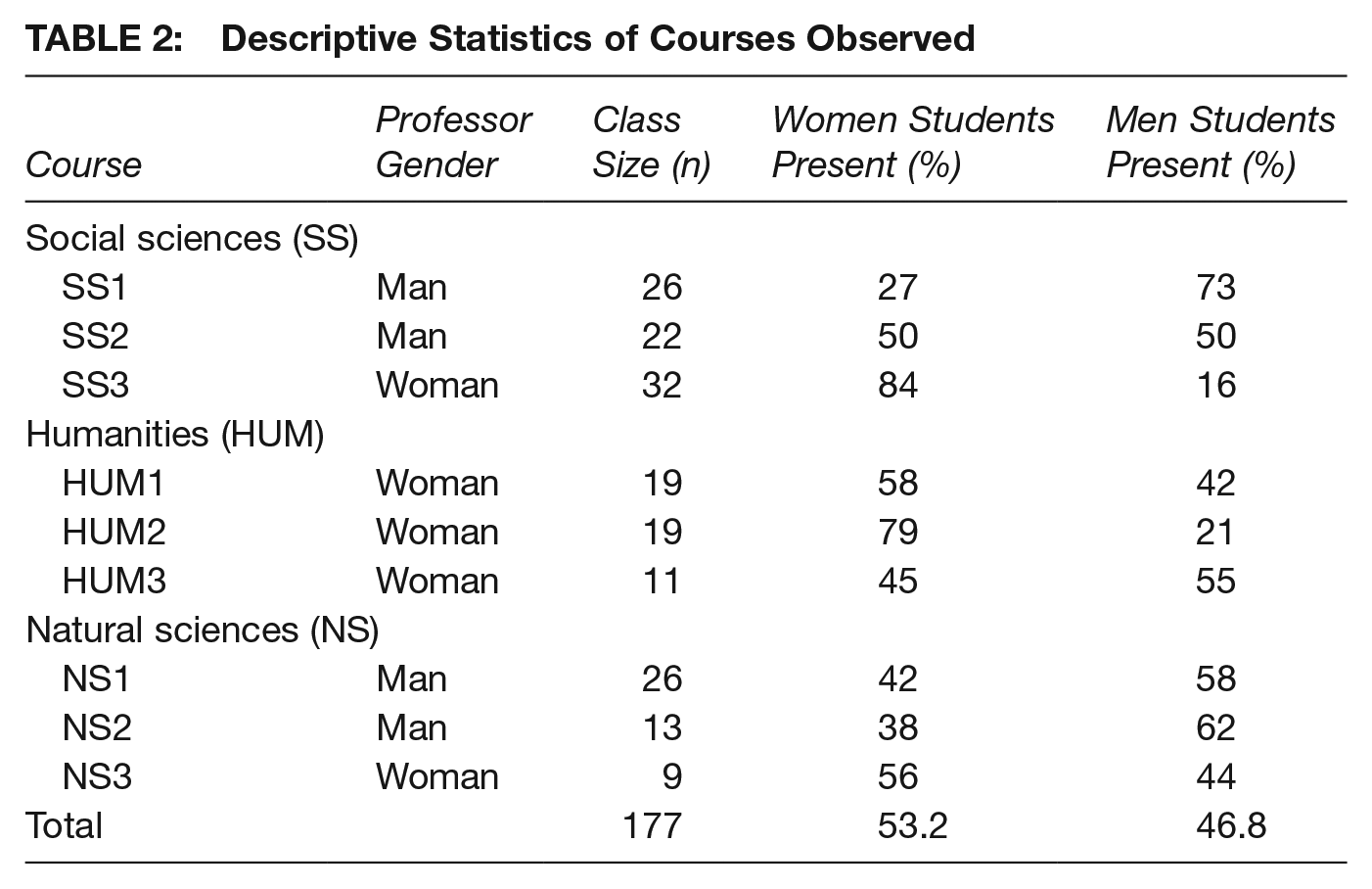
We selected courses to observe using quota sampling. After obtaining a list of all courses at Oakwood College in 2017 winter term, we excluded the following courses: (1) foreign language courses; (2) courses that were quite small (<10 students) or large (>40 students); (3) workshop-oriented courses, such as Theater or Studio Art courses; and (4) courses that conflicted with the ethnographer’s class schedule. Then we divided the courses into three categories: humanities, social sciences, and natural sciences. Using a random number generator, we picked three courses from each category, with each department represented no more than once in the final sample. Table 2 shows descriptive statistics of the nine observed courses including professor gender, class size, and gender composition of the students.
Descriptive Statistics of Courses Observed
After selecting courses, we emailed professors to outline the study’s aims, explain how we would maintain confidentiality, and obtain consent. Of the 18 professors contacted (5 humanities, 6 social sciences, and 7 natural sciences), 7 declined to participate 4 and 2 were unresponsive. That this sample most likely included professors who were sensitive to gender issues is a potential limitation we discuss later.
The study’s overall purpose is not statistical generalization but theoretical generalization (Small 2009). Rather than statistical significance and generalizability, we structured our sample to offer detailed, rich data on classroom interactions that would allow us to “justifiably state that a particular . . . phenomenon . . . exists” (Small 2009, 24)—in this case, whether the chilly climate still exists in contemporary classrooms. As is evident from our nonprobability quota sampling and small size, the study is not a representative sample of the college. We also made no attempt to artificially balance professor gender, class sizes, class levels (introductory vs. upper level), participation component of final grade course (0–30 percent), and student gender composition, thereby failing to control for these factors; in supplemental analyses of these factors, we found few differences, which we note later in the paper.
Furthermore, with this particular sample in a predominantly white institution (see Table 1), we could not make observations on student race without tokenizing their experiences or generalizing them into a “non-white” group. Because the number of men and women in each racial group in these nine classrooms was so low, any conclusion would have been meaningless and invalid. Nonetheless, we recognize the need for future research to explore how multiple identities influence classroom participation in classrooms with predominantly white students such as in Oakwood College as well as in more diverse settings. We return to this in in the conclusion.
Classroom Observations
Data were collected January–March 2017 by sitting in all 80 class sessions. Using a standardized coding sheet (see Online Appendix), 5 the first author recorded the date, course name, length of class session, number of students present, and the gender ratio before each session. We viewed each student–faculty interaction as the unit of analysis, so each time a student spoke, we noted their observed gender based on their appearances and pronouns, type of student response (comment, question, answer to professor’s question, or response to a previous comment), and the beginning of interactions (raise hand, speak out, called on by professor). As much as possible, we captured students’ and professors’ exact words and body language. This coding sheet, thus, enabled us to record not only the frequency of each type of interaction but also the specific content in a reliable and detailed way. Each interaction was recorded on a separate row on the sheet. 6
In addition to completing the coding sheet, the first author took extensive fieldnotes using four categories: field notes (FN), personal notes (PN), theoretical notes (TN), and methodological notes (MN). With FN and PN, relevant details were jotted down during class that later helped reconstruct the feel of what happened. TN helped to sensitize us to notice connections or contrasts to previously observed experiences; in other words, it helped us clarify, explain, or raise questions about specific occurrences. Through MN, the first author made quick notes about methodological improvements and remained cognizant that what the ethnographer finds out is inherently connected to how she finds it out (Emerson, Fretz, and Shaw 2011). At the end of each day, the first author typed up the coding sheets and expanded the fieldnotes, matching each interaction on the coding sheet to each note and aiming to recapture the flow of classroom interactions in thick detail. Because ethnography aims to depict the social world for its readers, the first author refrained from condensing details, using evaluative adjectives and verbs, or permitting a label to stand for description (Emerson, Fretz, and Shaw 2011). In all, the standardized coding sheet along with the thick fieldnotes provided important numerical patterns and specific content of the interactions, thus enhancing both reliability and validity.
We analyzed these data using ATLAS.ti software, which enabled us to generate codes and make connections across documents. Beginning with a list of deductive codes, such as “interrupting other students,” “raising hands,” and “using examples from external sources,” we looked for patterns across gender and generated more abstract themes, such as “authoritative language” and “competing for sonic space.” We frequently returned to the data to count the exact number of positive cases and actively search for negative cases and disconfirming evidence (e.g., men students who talked infrequently and women who talked frequently) (Glaser 1965). Through this analysis, we identified gendered patterns in classroom participation and how classroom structure influences these patterns. After we identified these patterns, Ridgeway’s (2011) framework of the gender system emerged as a useful theory to tie these inequalities with cultural beliefs about gender.
Results
Almost four decades after Hall and Sandler’s (1982) “chilly climate” research, we still find substantial gender differences in how students occupy the sonic space in college classrooms. We discuss three patterns that occur across disciplines and classroom gender ratios. First, men students more frequently occupy and compete for the sonic space, whereas women students are more likely to wait for their turns. Second, as they occupy the classroom sonic space, their style and tone differ: Men’s language is more likely to be assertive, and women’s more likely to be hesitant and apologetic. In this manner, classroom talk seems to be “an important arena for the reproduction of gender inequalities in interactional power” (Swann and Graddol 1988, 64). However, third, the observed individual behaviors certainly do not happen in a vacuum, and we show that professors’ interventions and different structures of classrooms alter existing gender status hierarchies.
Comfort with the “Sonic Space”
Table 3 details the average frequency of any type of speaking per course by women and men students. Ratios close to 1 signify that men and women present are equally represented in classroom participation. In all but one course (Social Science [SS]3), men students’ participation exceeds their representation; and in five courses, men speak more than twice as often as women. Table 4 compiles these per-class averages into one overall ratio: overall, in the nine courses observed, men students’ participation exceeded their representation by 1.6. In other words, adjusting for their unequal presence in the classroom, men students speak 1.6 times as frequently as women, on average, which is largely consistent with previous research on gendered classroom talk (e.g., Bergvall 1995; Holmes 1992; Swann and Graddol 1988).
Average Frequency of Any Speaking in Class, per Course
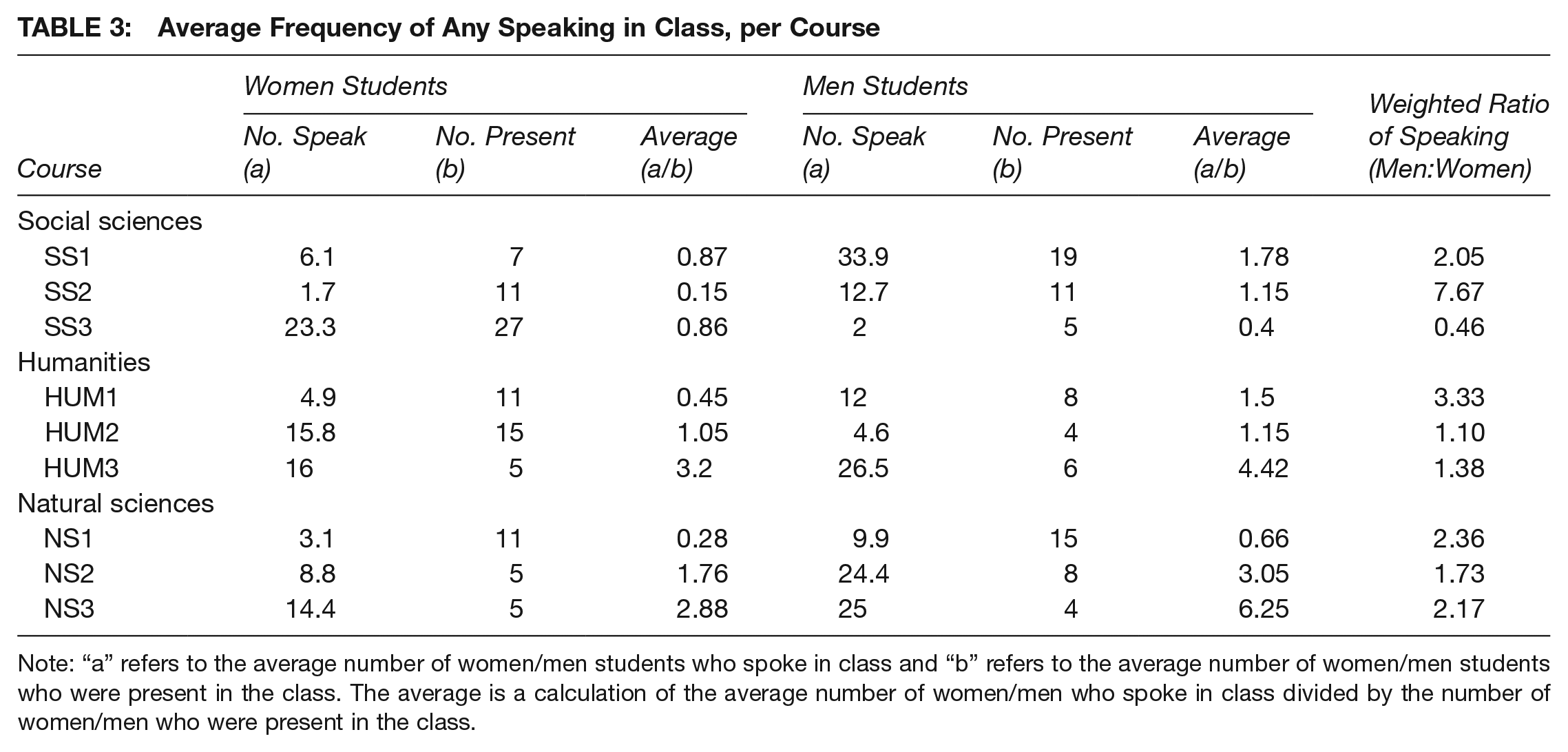
Note: “a” refers to the average number of women/men students who spoke in class and “b” refers to the average number of women/men students who were present in the class. The average is a calculation of the average number of women/men who spoke in class divided by the number of women/men who were present in the class.
Frequency of Speaking in Class, by Category

In all nine courses observed, dominant speakers—conceptualized as those students who talk the most frequently and dominate the topic of conversation—were men students. In SS1, Danny stood out as the dominant speaker: An extremely active participant, Danny also was very assertive and firm in his opinions. Similarly, Thomas quickly emerged as the dominant speaker in SS2; as the first author remarked in her field notes, “He completely dominates the conversation, and he is the only person who actively raises his hand and volunteers.” The fact that of the nine observed courses, we could not identify a single dominant woman speaker is telling. 7 This observation confirms existing research that it is not unusual for the same one or two men to dominate the conversation while the other students watch their interactions with the professor (Sandler, Silverberg, and Hall 1996). Not only were men the dominant speakers in all nine courses, they also made the first comment, a greater number of comments, and longer comments in most courses.
We also observed differences between men’s and women’s tendencies to engage in follow-up discussions and prolonged conversations with the professor. For the purpose of this study, we define follow-up discussions as interactions that involve one comment or question after the student’s initial comment, and prolonged conversation as interactions that involve two or more comments or questions (i.e., lengthy conversation with the professor during class). Throughout the 10 weeks, men students engaged in 31 follow-up discussions and 28 prolonged conversations, compared with women students, who engaged in 7 follow-up discussions and 3 prolonged conversations. As shown in Table 4, men were about 5 times more likely than women to engage in follow-up discussions or prolonged conversations with professors during class.
These inequalities in participation patterns provide men with greater opportunities to debate and clarify knowledge. Most often, follow-up discussions and prolonged conversations involved debating ideas with the professor. In one instance, the professor disagreed with a comment Danny had made, responding, “Okay, but let me push on that a little bit . . . ,” and Danny immediately defended his point without raising his hand. After additional comments from Danny and the professor, this interaction ended with Danny saying, “Um. Let me think about this.” Danny appears comfortable not only occupying the sonic space in a classroom of 25 other students but also publicly debating the professor. During this interaction, the rest of the class sat in silence, watching rather than actively participating.
Follow-up discussions and prolonged conversations also served to clarify knowledge. After asking a question, a man student immediately posed a follow-up question, starting with “I’m just trying to understand, but . . .” Similarly, in another class, a man used a follow-up question to double check the professor’s answer. These instances reflect men’s tendency to actively pursue answers and claim education, instead of passively receiving education (Rich 1979).
Although women students also used prolonged conversations to clarify uncertainties, we saw them do so only in two specific contexts. First, women students engaged in prolonged conversations in classes that were predominantly women. The first woman student we observed having a multi-turn conversation with the professor happened in Humanities (HUM)2, which had nearly 80 percent women students. This pattern suggests that women are more comfortable occupying sonic space when there are fewer men competing for the same space. Second, women students engaged in prolonged conversations when the professor continuously asked them follow-up questions. In Natural Sciences (NS)2, we observed a woman student making multiple comments in response to the professor’s multiple questions. Rather than coming from their own agency, women’s prolonged use of sonic space followed their professors’ active efforts to engage them in discussion.
Men’s tendency to be the dominant speakers in all nine classes further contributes to the persistence of the gender status hierarchy. Because classrooms are formal contexts in which “talk is highly valued” and “potentially status-enhancing” (Holmes 1992, 134), men students’ longer and more frequent contributions will be associated with higher status. Furthermore, we tend to perceive those who speak up confidently and assertively as more competent actors, following the common assumption that people are confident about things they are good at (Ridgeway 2011). Hence, these behavioral interchange patterns (men’s assertive, high-status behaviors and women’s deferential, lower-status behaviors in classrooms) lead to contrasting performance expectations, which further reinforce existing gender status and limit women’s opportunities to contribute to classroom conversations.
Competing for the Sonic Space
In a similar vein, men students were more likely to speak out without raising their hands and to interrupt other speakers. As reflected in Table 5, men were far more likely than women to speak out of turn in seven of the nine observed courses. The two exceptions (HUM2 and SS3) where women students spoke out equally or more frequently than men were classrooms where women comprised a clear majority (i.e., ~80 percent women). However, when accounting for their presence in each classroom, men students spoke out without raising their hand more frequently than women in all nine courses. As shown in the last column of Table 5, we observed no class where women spoke out of turn more than men.
Average Frequency of Speaking Out without Raising Hands, per Course
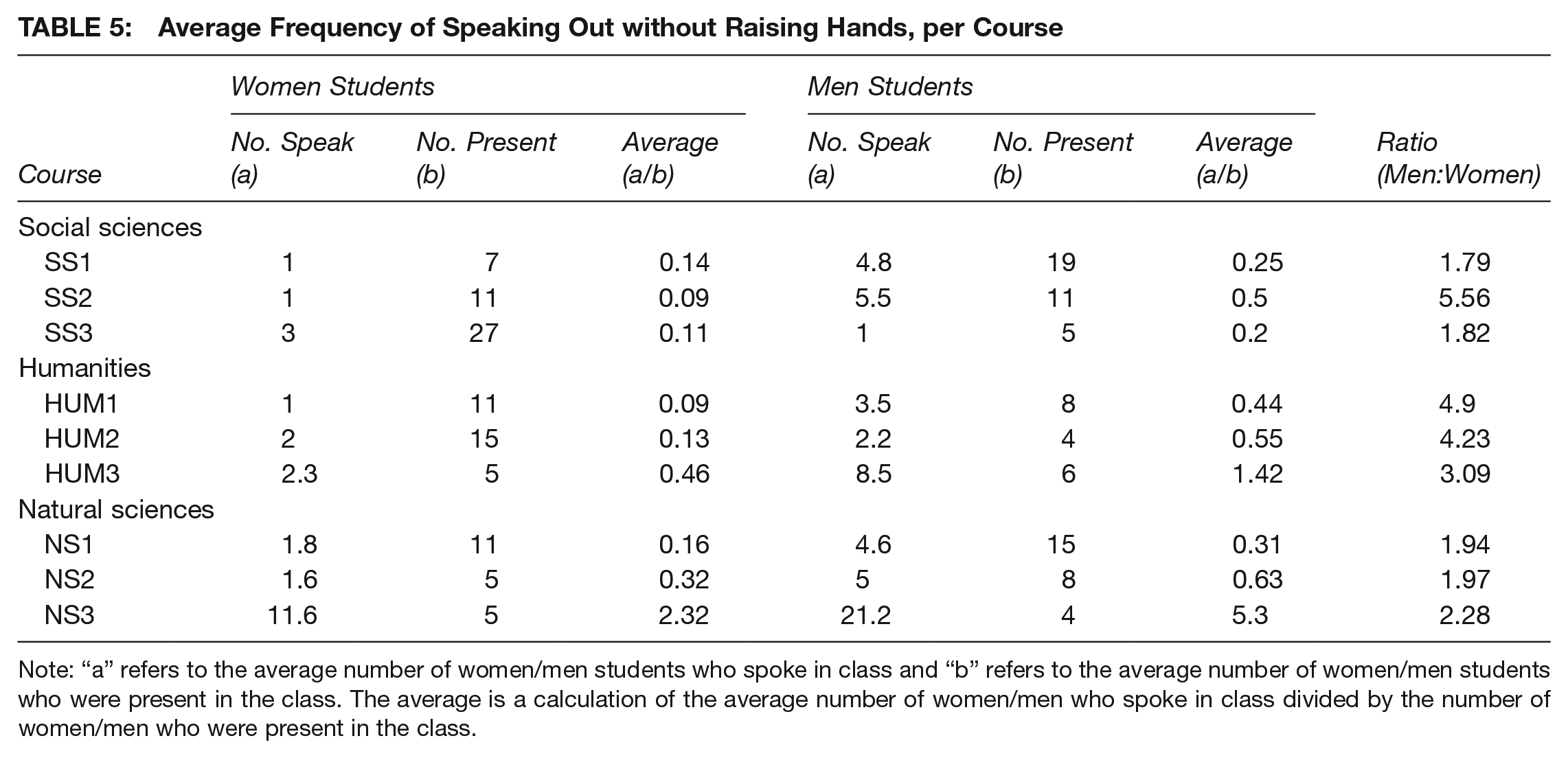
Note: “a” refers to the average number of women/men students who spoke in class and “b” refers to the average number of women/men students who were present in the class. The average is a calculation of the average number of women/men who spoke in class divided by the number of women/men who were present in the class.
Students who speak out without raising their hands actively take away other students’ opportunity to participate in class. For example, we observed numerous instances where women students had their hands raised while a vocal man student spoke out of turn. The following excerpt captures this trend: To this “radical argument,” Scott starts speaking out in response while Lisa has her hand up. Noticing this, the professor goes: “Okay, Scott first, then Lisa.” When it is her turn to speak, Lisa starts her comment with: “I wanted to make a similar comment, but . . . ” Because Scott got to speak first, Lisa’s point is now obsolete. (field notes)
Because Scott spoke out instead of waiting for his turn, he receives credit and praise (i.e., “Mhm, very good point”) from the professor. In contrast, Lisa’s ability to showcase her knowledge is undercut.
Men students also were far more likely to interrupt both the professor and their fellow classmates than women students. Table 4 shows that over the 10 weeks, men students interrupted a speaker 30 times, whereas women students interrupted a speaker only twice. In SS1: As the class continues, Tom cannot hold still, and he interrupts people here and there. At this point in class, Tom has already interrupted the professor multiple times. Before Tom can continue arguing with the professor, the professor calls on Jackie instead. As Jackie is making a comment, Tom interrupts her and the professor laughs at his comment. Jackie again tries to continue her point, and the professor is now able to respond to Jackie. (field notes)
Although some argue that interruptions may not always be an exercise of power (Murray 1987), as articulated by Tannen (1990) they become problematic when an individual’s rights and obligations are violated. In the instance above, Tom not only infringed on how the professor conducted his lectures and managed the flow of classroom discussion but also interrupted a fellow student, who is supposedly an equal member of the class. Evidently, the man student is comfortable with interrupting and dominating the sonic space. Our observations include various instances of men students interrupting other speakers’ comments regardless of the gender composition of the class or the gender of the professor. In contrast, the two instances of women students interrupting a speaker occurred in HUM2 and NS3, both courses with women professors.
Even when they had their hands raised and were potentially recognized by the professor, women students hesitated to compete for the classroom sonic space. In one class, The professor asks a question: “So why is this amusing?” Two students (one man and one woman) raise their hands. The professor calls on one student by nodding, but since they are sitting next to each other, both think that they are called on and speak up simultaneously. After politely offering each other the floor, the woman student eventually says: “You go ahead. I spoke a ton in class today”—even though they both spoke similar amounts in class today. As a result, the man student speaks first, followed by the woman student. (field notes)
In a similar incident in another class, a woman student immediately gave up the floor to a man who interrupted her and started making additional comments. Although the man student eventually said: “No, no. You go ahead,” our observations show how easily women students gave up the sonic space they rightfully earned. Such behaviors reflect society’s prescriptive gender stereotypes expecting women to be nice, caring, and concerned with others (Heilman 2001) and “a complex social process which seems to endow men with greater power than women in social interaction” (Swann and Graddol 1988, 49–50). They also reflect the gendered patterns in eighth-grade honors classes where girls participated less frequently and described their speaking skills with less confidence than boys (Musto 2019). Women socialized with these gendered expectations end up reluctant to aggressively compete for classroom sonic space at Oakwood College. Such reluctance coupled with men students’ tendency to speak out of turn contribute to making women silent members of too many classrooms. In sum, while interruptions are relatively rare in the classrooms we observed, the patterns are starkly gendered.
Assertive or Hesitant Language
Another consideration that is as important as the sheer quantity of the occupied sonic space is how students are using this space: Whereas men students used more assertive and firm languages, women students used more hesitant and apologetic languages. Because “simply taking long or frequent turns does not establish power or domination of the floor” (Bergvall and Remlinger 1996, 470), it is important to note the resulting power differentials from the gendered language styles.
In our observations, men students frequently used assertive language and tone to convey their arguments. Men’s comments included strong phrases like: “I’m not kidding.” “It’s impossible.” “That will never happen.” One man commented on a thought experiment initiated by the professor by saying: “Imagining that . . . is preposterous.” These words and tones all convey a firm and assertive stance; through such use of language, men students effectively establish themselves as strong participants in these classrooms.
In contrast, women students’ tones were largely hesitant and apologetic. In one class session, numerous women’s presentations started with hedges such as: “Um, so I couldn’t find a whole lot online, but . . . ” “I don’t want to repeat the lecture too much, but . . . ” “Perhaps this is too specific, but . . . .” In contrast, men’s presentations started directly with their prepared content. Furthermore, women frequently expressed “female preambles of self-deprecation” (Sadker and Sadker 1994, 171) when answering professor’s questions. They often started with “I don’t know if this is off topic, but . . . ” or “I’m not sure what you’re asking, but . . . .”
Women students not only began their comments with doubtful premises, they remained highly hesitant and apologetic throughout the rest of their comments. For instance, women repeatedly answered professor’s questions with another question, such as “Isn’t it what they are doing?” “Would it be . . . ?” “Doesn’t he commit suicide?” Even when they clearly had the correct answer, women often double checked their answers by offering them in question formats. Moreover, reflecting gendered trends in language use (e.g., Schumann and Ross 2010; Tannen 1990), women literally apologized more often than men students. In one class, after presenting on a required reading, a woman student apologized for misleading charts in the paper, which was assigned by the professor (not the student). Although speaking hesitantly does not necessarily mean that women lack confidence, it does suggest that men and women students position themselves very differently in classrooms, creating or reinforcing gendered perceptions of these students by their professors and peers.
This gendered language use creates a complex double bind for women. Because college classrooms are historically masculine spaces that value masculine styles of language (hooks 1994; Kramarae and Treichler 1990; Tannen 1990) where gender is “effectively salient” (Ridgeway and Correll 2004, 517), as students, women are equally expected to actively participate and contribute their ideas. At the same time, they may be stigmatized for transgressions of gendered expectations, such as engaging in firm and assertive language. As scholars of gender and communication conclude, the meanings participants attribute to interactions are themselves shaped by gender.
Structural Constraints: Role of the Professor
These unequal patterns in classroom participation, however, vary across courses. Table 3, which details average frequencies of all types of speaking per course, shows considerable variation. The largest ratio signifies that men speak nearly eight times as often as women students in SS2, adjusting for classroom gender composition. 8 Interestingly, in the instances where women students were represented or overrepresented among speakers (HUM2 and SS3), women taught both courses and comprised about 80 percent of students. 9 These differences among classrooms indicate that professors can alter classroom status hierarchies. As previous research has shown, we found that different ways of structuring and conducting classes influence women’s level of speaking in class (e.g., Auster and MacRone 1994; Fassinger 1996). We highlight two of those practices here.
One practice involves being aware of inequalities in participation and deliberately trying to distribute the sonic space. Some professors interrupted men students’ follow-up discussions and prolonged conversations to grant more opportunities to women: As Danny continues to make series of follow-up comments, the professor stops the student and says, “Let’s get some more voices in here.” He then calls on a woman student. (field notes)
In another instance, the professor facilitated the discussion by saying: “Let’s get other people’s points, and we’ll come back to you, Michael.” These direct interventions reflect the professor’s acknowledgement of differences among students and efforts to counteract existing status hierarchies. In contrast, other professors disregarded silent students, who are disproportionately women, and did not appear to notice gender imbalances. During one SS2 session when men had answered all the professor’s questions, a woman and a man student raised their hands simultaneously; however, the professor still called on the man student. Such instances reflect a lack of awareness of classroom gender dynamics and reinforce traditional power structures. Gender bias is often ingrained such that even women faculty may not recognize bias in the departments where they work (Britton 2017). Therefore, it is not enough to encourage women students to be more confident or organize their thoughts in time to raise their hand; professors can distribute the sonic space in more or less equitable ways. For example, the SS1 professor often came back to students with: “Diane, did you have a question?” “Cindy, did you have something to say in response?” By taking note of raised hands and coming back to students even when they no longer have their hands up, professors provide more opportunities for different students to contribute to the discussion. This practice creates opportunities to participate and demonstrates to students that professors “genuinely value everyone’s presence” (hooks 1994, 8).
Second, the practice of clear and enforced classroom rules for participation counters women student’s limited participation (Fassinger 1996). In NS3, the professor always sat with the students during classroom discussions, and she usually facilitated discussion by expecting students to raise hands and calling on them before they spoke. However, in one session, the professor did not interject during the discussion, instead allowing students to freely discuss their ideas. Without the usual structure of raising hands, women students conspicuously did not speak much in this session. On average, the ratio of women and men speaking in NS3 was 1:2.17. In this specific session, however, the ratio increased to 1:3.15. Strikingly, men students spoke three times as much as women when the professor did not actively facilitate and call on raised hands. These findings resonate with Musto’s (2019) observation that boys learn to feel comfortable competing for and monopolizing classroom sonic space and with Tannen’s (1991, B3) claim that “in a class where some students speak without raising hands, those who feel they must raise their hands and wait to be recognized do not have equal opportunity to speak.” Lacking the enforced rule of raising hands, women students are less likely to speak up and assertively fight for sonic space. Without the intervention of those in authority (i.e., professors in our classroom setting), those who occupy lower status characteristics (i.e., women) tend to have lower verbal and nonverbal assertiveness (Correll and Ridgeway 2003, 39).
We also found instances of less subtle gender bias in student–faculty interactions, including an asymmetry in how one professor addressed his students. The NS2 professor consistently addressed men students with “Mr. X” or “Sir” and women students as “young lady”: For example, he told a woman: “Explain your answer, young lady.” Throughout the entire observation period, he never referred to a man student as “young man” or a woman student as “Ms. X” or “Ma’am.” While both forms of address may be polite, they are imbalanced. 10 This imbalance reflects existing gender inequalities and conveys subtle messages to students that men students are more worthy of professors’ respect. These processes mostly occur outside the realm of conscious thought, necessitating that professors be more conscious and aware of these potentially harmful social processes.
Although cultural beliefs are highly durable (Ridgeway 2011), the discussion above indicates that professors can intervene with the classroom interaction norms they create (Fassinger 1996). Recognizing that men and women students come into classrooms with contrasting socialization processes and gendered expectations (Correll and Ridgeway 2003; Musto 2019) is an important step for professors. By then actively trying to distribute sonic space and enforcing stricter classroom structures, professors may transform existing status hierarchies.
Conclusion
Almost 40 years ago, scholars identified a “chilly climate” for women in college classrooms. We ask whether contemporary college classrooms remain “chilly.” In doing so, we also provide a corrective to past research by observing over multiple class sessions and exploring both the frequency and content of class participation. Both our quantitative and qualitative data suggest that men students continue to occupy advantaged positions in classrooms. 11 Men more frequently occupy the classroom sonic space and use assertive language, whereas women students are more likely to wait for their turn to speak and use hesitant language. On average, men students speak 1.6 times as often as women in the nine classrooms we studied. In line with Ridgeway’s framework of the gender system, these gendered patterns emerge from complex processes stemming from shared cultural beliefs about gender that continue to shape social interactions.
This study makes both theoretical and methodological contributions to scholarship on gender in higher education. Theoretically, this study fills a 20-year gap in observational research on college classrooms, updating the results from chilly climate research to a contemporary context. Prior “chilly climate” research also failed to examine the structural elements (e.g., classroom structure and professor interventions) that enable or constrain individual student actors. Considering that interactions always happen within broader constraints, this study highlights processes that either reinforce or transform existing gender differences in classrooms. To this end, it is important to keep in mind that the fact that men students do most of the talking does not mean that they intend to prevent women students from speaking. In fact, men students readily speak up because they assume others feel equally free to take the sonic space (Musto 2019; Tannen 1991). A study of middle-school classrooms saw this gender disparity develop from sixth to eighth grade when boys in Honors classes (likely similar to those who end up at Oakwood College) “learned to challenge girls’ opinions and monopolize classroom conversations” (Musto 2019, 387). In this manner, our study highlights both the durability of the chilly classroom climate and avenues for possible social change, as concluded by Ridgeway and Correll (2004, 528): “The gender system will only be undermined through the long-term, persistent accumulation of everyday challenges to the system resulting from . . . individual resistance.”
Methodologically, this project’s contribution involves pairing standardized quantitative and detailed qualitative observations of more than 80 class sessions. In contrast to previous studies using statistical analysis of quantitative survey data (Boersma et al. 1981; Brady and Eisler 1999; Crawford and MacLeod 1990; Drew and Work 1998; Fassinger 1995), frequencies of interactions (Brady and Eisler 1999; Canada and Pringle 1995; Constantinople, Cornelius, and Gray 1988; Tatum et al. 2013), and self-report data (Allan and Madden 2006; Crawford and MacLeod 1990; Fassinger 1995), our coding provides both standardization and context, resulting in data on classroom participation patterns highlighting subtle forms of privilege that often occur without the full awareness of the professor or the student. We identified overall numerical patterns—for example, that men speak on average 1.6 times as often as women students—as well as rich details on how students use the sonic space in college classrooms, supporting Sadker, Sadker, and Zittleman’s (2009, 215) assertion that “far more than numbers shape the college experience.” Another methodological contribution stems from the longitudinal nature of this project. To our knowledge, our study is one of two analyzing classrooms over time. In contrast to snapshots of one class session, we observed course dynamics over five weeks (i.e., half an academic term) (see Brady and Eisler 1999 for one exception). We were thus able not only to track consistency in most courses over time, but also to see how professors’ daily practices may alter these patterns, building on research on classroom dynamics (e.g., Auster and MacRone 1994; Fassinger 1996; Gillis 2019).
Despite these contributions, this study has some limitations that can be addressed in future research. First, because of the demographic composition of Oakwood College, meaningful comparison across race, ethnicity, nationality, and/or age would have necessitated a different sampling approach. Although there is some evidence that student race (Howard, Zoeller, and Pratt 2006; Pitt and Packard 2012) 12 and age (Howard, Short, and Clark 1996) influence classroom discussions, additional research with more diverse samples is needed to more fully understand how gender intersects with other characteristics (see Musto 2019 for an example from middle school). Here, we focus on gender in a predominantly white setting; a next step using Ridgeway’s framework would be to look at other social relational contexts, such as HBCUs (historically black colleges and universities) or colleges that had previously been single-sex institutions.
Second, adding interviews with students and instructors to classroom observations (similar to Musto 2019) could help us better understand the meanings that actors attribute to the gendered participation patterns. As a first step, we sought to establish the existence of gendered patterns in contemporary classrooms before asking students and professors to explain what they experienced. Considering that men and women not only use language differently (Holmes 1992; Tannen 1990) but also are perceived differently in our society, future research should examine students’ and instructors’ understandings of classroom participation. This research should particularly attend to “double binds” women face as they are encouraged to be assertive yet face potential negative consequences for this gendered violation (e.g., Ridgeway 2011; Swann 1989).
Third, this sample is not representative of classrooms in the United States or even at Oakwood College, and it includes professors who agreed to participate in a gender-focused study. The sample, then, may inadvertently include those who may be more sensitive to gender issues. That gender inequalities emerged even within these participants suggests there may exist more serious disparities in other classrooms. Ridgeway’s theory of gender structure suggests that context matters; future research could thus compare more female-dominated with male-dominated disciplines, campuses, and the like.
Even with these limitations, we find much evidence to support a contemporary “chilly climate” in college classrooms. We find gender differences in classroom interactions, which ultimately translate into status distinctions and contribute to perpetuating gender inequalities. Regardless of students’ or professors’ awareness of these inequalities, we find differences in how men and women occupy the classroom “sonic space.” These findings effectively shift the blame from individual-level to interactional social processes that continue to disadvantage women. Our findings that clear and enforced classroom rules are associated with more gender equality in classroom participation fit with similar findings in middle school classrooms (Musto 2019) and workplaces (Ridgeway 2011). Too many women students today blame themselves for their lack of quick wit or self-confidence in classroom settings. But this study explains how gendered interactional patterns and classroom structures work together to create a chilly classroom climate for women. Shedding light on the chilly climate not only reveals gendered patterns in contemporary college classrooms, it provides an additional explanation for why the gender revolution has stalled.
Footnotes
Author’s Note:
The authors would like to thank Brian Powell, Kathryn Lively, Jason Houle, and Emily Walton for their comments on early drafts.
1.
For readability, we refer to “women and men” rather than “female and male” students and professors when discussing past research.
2.
Research on “sonic space” posits that powerful groups take up more vocal space in public, including men customers in music stores (Sargent 2009) and boys in higher-level classes in middle school ( ).
).
3.
On the first observation day, two professors introduced her as someone observing the course, and she offered to answer any questions. We did not find different gendered patterns in these specific class sessions or courses compared with the overall sample.
4.
They cited various reasons, including a sudden leave term due to illness and career concerns.
5.
The coding sheet was developed based on prior literature and refined based on two classroom observations during Oakwood’s previous academic term.
6.
Although the Appendix shows three interactions (i.e., three rows), the coding sheet was expanded in practice, so each interaction was recorded separately and systematically.
7.
We do not claim that women never are dominant speakers in classrooms. Our sample, however, did not include a course where a woman was the dominant speaker.
9.
But in other classes taught by women where approximately half the students were women, rates of speaking varied.
10.
More broadly, the use of gendered titles and salutations also contradict advice for creating gender-inclusive learning environments.
11.
In supplemental analyses, we examined gendered interactions across fields of study, instructor gender, ratios of women students, instructor gender × student gender composition, and participation grade as a proportion of final course grade. There was no distinct pattern suggesting that these other features were less important than gender, which is largely consistent with Ridgeway’s arguments. These supplemental analyses are available from the author upon request.
12.
These studies suggest that white versus nonwhite students differ in the types of comments (e.g., discussions of lived experiences or becoming “experts” in discussions of racism) but not much in the quantity of participation per session; however, Howard, Zoeller, and Pratt (2006) admit that this finding may differ if they could separate findings among the racial minority groups.
Jennifer J. Lee is a doctoral student in the Department of Sociology at Indiana University-Bloomington. Her primary research interests include gender, higher education, and social psychology.
Janice M. McCabe is an associate professor of sociology at Dartmouth College. Her book Connecting in College: How Friendship Networks Matter for Academic and Social Success and other research focuses on how gender, race/ethnicity, and social class operate as social identities and how they shape social networks.