




Abstract
The economic shutdown and national lockdown following the outbreak of COVID-19 have increased demand for unpaid work at home, particularly among families with children, and reduced demand for paid work. Concurrently, the share of the workforce that has relocated its workplace to home has also increased. In this article, we examine the consequences of these processes for the allocation of time among paid work, housework, and care work for men and women in Israel. Using data on 2,027 Israeli adults whom we followed since the first week of March (before the spread of COVID-19), we focus on the effect of the second lockdown in Israel (in September) on the gender division of both paid and unpaid work. We find that as demand for housework caused by the lockdown increases, women—especially with children—increase their housework much more than men do, particularly when they work from home. The consequences of work from home and other flexible work arrangements for gender inequality within the family are discussed.
The COVID-19 pandemic, along with the national lockdowns and the new work arrangements following it, has created striking changes in the economy and in the society at large. Following the pandemic, workers have immediately and unexpectedly witnessed substantial job loss and temporary absence of public services, including shutdown of child care centers and schools. For families with children, the tension between work and family obligations has significantly intensified with the absence of public child care, the move to home schooling, and the absence of kin aid—especially grandfathers and grandmothers—which in Israel provide significant help (Okun 2016). With the necessity for social distancing and the increasing demand for housework and care work, flexible work arrangements—first and foremost the possibility to work from home—became much more prevalent.
This unique context gives us an opportunity to examine changes in the gender division of labor, with particular focus on the effect of the economic lockdown on the allocation of time between paid and unpaid work. Using longitudinal data of Israeli adults, collected before and during the second lockdown, we show and discuss the implications of the lockdown on the balance among paid work, housework, and care work for men and for women. The findings point to the significance of young children in this balance, particularly when parents are working from home. When the opportunity to work from home is encouraged, fathers and mothers “do gender” (West and Zimmerman 1987) even more than in traditional work arrangements. This is because in a gendered society, women—and not men—have the responsibility for housework and care work and thus are more likely than men to adjust their paid work to their home responsibilities in order to validate their gender identity (Davis and Greenstein 2009).
Can Flexible Working Arrangements Ease Gender Division of Labor?
One of the most striking characteristics of the “gender revolution” is its asymmetric change: Women have changed more than men (England, Levine, and Mishel 2020). Today, in most postindustrial labor markets, women constitute almost half of the workforce, and their representation in highly paid occupations and jobs has rapidly grown. That said, women still perform two to three times more housework than men, and most of them (as well as their husbands) view these arrangements as fair (Coltrane 2000). These uneven changes were found in Israel, among other postindustrial societies (Mandel and Birgier 2016).
With the entry of women into the labor force, work–family reconciliation policies as well as flexible working arrangements have become prevalent. Flexible work, such as reduced working time, nonstandard hours, or work from home, can be useful tools for reconciling paid and unpaid work. Studies have shown that these arrangements enable mothers to maintain their working hours and income after childbirth (Chung and van der Horst 2018; Fuller and Hirsh 2019). In the Israeli high-tech industry, flexible work enables mothers to reconcile a demanding workload with family obligations. It also increases their motivation to work and their satisfaction from their work as well as from their life in general (Frenkel 2004). Relatedly, the majority of working millennials report that they prefer flexible working arrangements, including the possibility to work from home (Deloitte 2020).
Flexible work arrangements may also contribute to preserving the traditional gendered allocation of labor by enabling employed women to keep doing the prime portions of housework and care work. Recent findings indicate that men and women utilize flexible work arrangements differently, in line with their society’s expectations and their own preferences, which, unsurprisingly, closely relate to their gender (Chung and van der Lippe 2020). Whereas men tend to use flexible work arrangements to increase their working hours, and therefore their income (Lott and Chung 2016), women tend to use them to increase their housework and care work (Hilbrecht et al. 2008). Thus, flexible work arrangements may enhance work–family conflicts, and subsequently also the unequal gendered allocation between paid and unpaid work. The additional time spent on unpaid labor by women may negatively affect their productivity and therefore increase bias against women employed in such arrangements.
As mentioned above, social distancing policies imposed by the pandemic, and particularly the national lockdowns, have increased family obligations such as housework and care work on the one hand and created new work arrangements on the other. These changes have the potential to alter family dynamics either toward greater gender equality or toward the opposite direction. Below, we examine the effect of the second lockdown in Israel on the time allocation of men and women. Unlike most studies, which examine paid and unpaid work separately, we examine them simultaneously, while attending to both the presence of children and the possibility of working from home.
The Israeli Setting
Israel was the first country to lock down the economy and put people in tight quarantine three times between March 2020 and January 2021. With the start of the new school year on September 1, 2020, when the number of confirmed cases had soared again, and on the eve of the Jewish new year (September 19), Israel entered into its second tight lockdown and economy shutdown. This lockdown lasted for about a month and included closure of child care centers and schools (with a move to remote learning), full closure of almost all businesses, and regulations prohibiting all movement by individuals excluding permitted work, health, or other urgent necessities. Consequently, unemployment rates increased from 9.7 percent (before the second lockdown) to 20.7 percent (during the lockdown) (CBS 2020).
The shutdown of all child care centers and schools is particularly consequential in Israel, the country with the highest rates of fertility (average 3 children per women) and the lowest rates of childlessness among OECD (Organization for Economic Co-operation and Development) countries (Weinreb, Chernichovsky, and Brill 2018). Despite this, participation rates of women in paid employment are relatively high. In our data before the first lockdown of the economy, about 30 percent of women in paid work had young children. Because parenthood is one of the most dominant factors accounting for the gender gap in housework (Baxter, Hewitt, and Haynes 2008), and given the high rates of mothers in paid work, the absence of all kind of child care due to the lockdown is expected to have substantial implications on the gender allocation of paid and unpaid work.
Methodology
Data
Data for this study are based on a longitudinal survey of 2,027 adult Israeli men and women (age ≥ 18 years) who were employed or self-employed in the first week of March, before the first lockdown of the economy. Data were collected by Panel4all, an online research company that holds an Internet panel of tens of thousands Israeli panelists, representing the adult population of Israel. The survey is not a probability sample of the population, because only those registered with the panel can be sampled, though it is a random sample of the panelists, stratified by age, gender, geographical region, and religiosity. 1 The current analysis focuses on wave 3, in June (before the summer school break and the second lockdown), and wave 4, in September (after the start of the new school year and amidst the second lockdown). Waves 3 and 4 include 1,614 and 1,432 respondents, representing 80 and 71 percent, respectively, of the original sample in wave 1. Attrition from wave 2 to wave 4 was 13 percent. 2 The analytic sample, comprising those who participated in both wave 3 and wave 4, includes 1,328 respondents.
Variables
Our prime interest is the workload of Israeli men and women in June and September, in three areas: labor market, housework, and care. Thus, our dependent variables are differences in the workload between June and September in these areas as measured by the following questions: “How many hours did you (1) work last week? (2) spend on housework tasks last week? (3) spend taking care of your children last week?” The last question was asked only if the respondent reported that the youngest child residing with them at home was younger than 19 years. If young children (up to age 18 years) were not residing at home, the number of care hours was set to zero. Additional variables in the analysis includes workplace location in June (workplace—if work mostly or only at workplace; home—if work mostly or only from home; unemployed, including unpaid leave), and child age of the youngest child (0–6 years, 7–18 years, older or no young children). We control for age and years of schooling. Table 1 presents descriptive statistics of all variables discussed above.
Means and Standard Deviations (in Parentheses) of the Variables in the Analysis (N = 1,328)

Only among respondents with children aged <19 years.
Total hours cannot be calculated from this table, as it is calculated for all respondents, including those without children aged >19 years who have zero care hours.
The analysis focuses on workplace (WP) in September.
Empirical Strategy
The goal of this analysis is to tease out the effect of the second lockdown on the amount of work devoted to each area by men and by women. Differences in number of hours before and during the lockdown were estimated in each area by ordinary least squares regression models. In the first model, we estimate the differences in hours only by gender, net of age and years of schooling. In the second and the third models, we add an interaction of gender and child age, and of gender and workplace location, respectively, to examine whether gender differences in the effects of the lockdown vary by child age and by workplace location, respectively. The final model explores the possibility that the effect of the lockdown on work hours varies by gender, and covaries within categories of workplace location and child age. To ease the interpretation of these models, we present graphically the predictive margins of changes in hours worked by gender and the other independent variables, adjusted to age and years of schooling, with 90 percent confidence intervals.
Results
Figure 1 displays the estimated differences in hours in each area between June and September by gender: (A) the total change; (B) change in Labor Force (hereafter LF) hours; (C) housework hours; and (D) care hours. As seen, although the total number of hours did not change much following the lockdown for both men and women, the balance between paid and unpaid work did. Specifically, women’s loss of paid work hours as a result of the lockdown is nearly twice as large as that of men’s (4.7 and 2.6 hours, respectively). At the same time, the increased demand for housework caused by the lockdown was fulfilled by both genders, but much more so by women (5.1 and 3.3 hours, for women and men respectively). Surprisingly, the lockdown did not affect the number of care hours differently by gender (about additional 2.5 hours for both). This result, however, can be understood by the very large gender gap in the number of hours devoted to care in both June and September, where women spent about 21 hours on care compared with just about half (12.4 hours) for men (see Table 1).

Estimated Lockdown Effects on Changes in Hours of Works (Total, LF, Housework, and Care) by Gender: (A) Total Hours Change, by Gender; (B) LF Hours Change, by Gender; (C) Housework Hours Change, by Gender; (D) Care Hours Change, by Gender*
Figure 2 helps to assess whether the above findings uncover heterogeneity that is associated with child age. The implications of parenthood, especially for young children, on the allocation of time during the lockdown when child care centers were closed and pupils moved to remote learning are very evident. Mothers with young children lost twice as many labor force hours than did fathers with young children (Figure 2). Similarly, women with young children and those without children spend about 6 more hours due to the lockdown on housework, compared with a much lower increase by men. Finally, change in the hours devoted to child care are, again, quite similar for men and women. This pattern of change was more common in families in which women earn about the same or even more than men (Herzberg-Druker, Kristal, and Yaish 2020). We can see here that the increase in care hours for both genders discussed above is a result of an increase in care hours due to the presence of young children at home, as both genders have increased their care hours by about three to four hours.
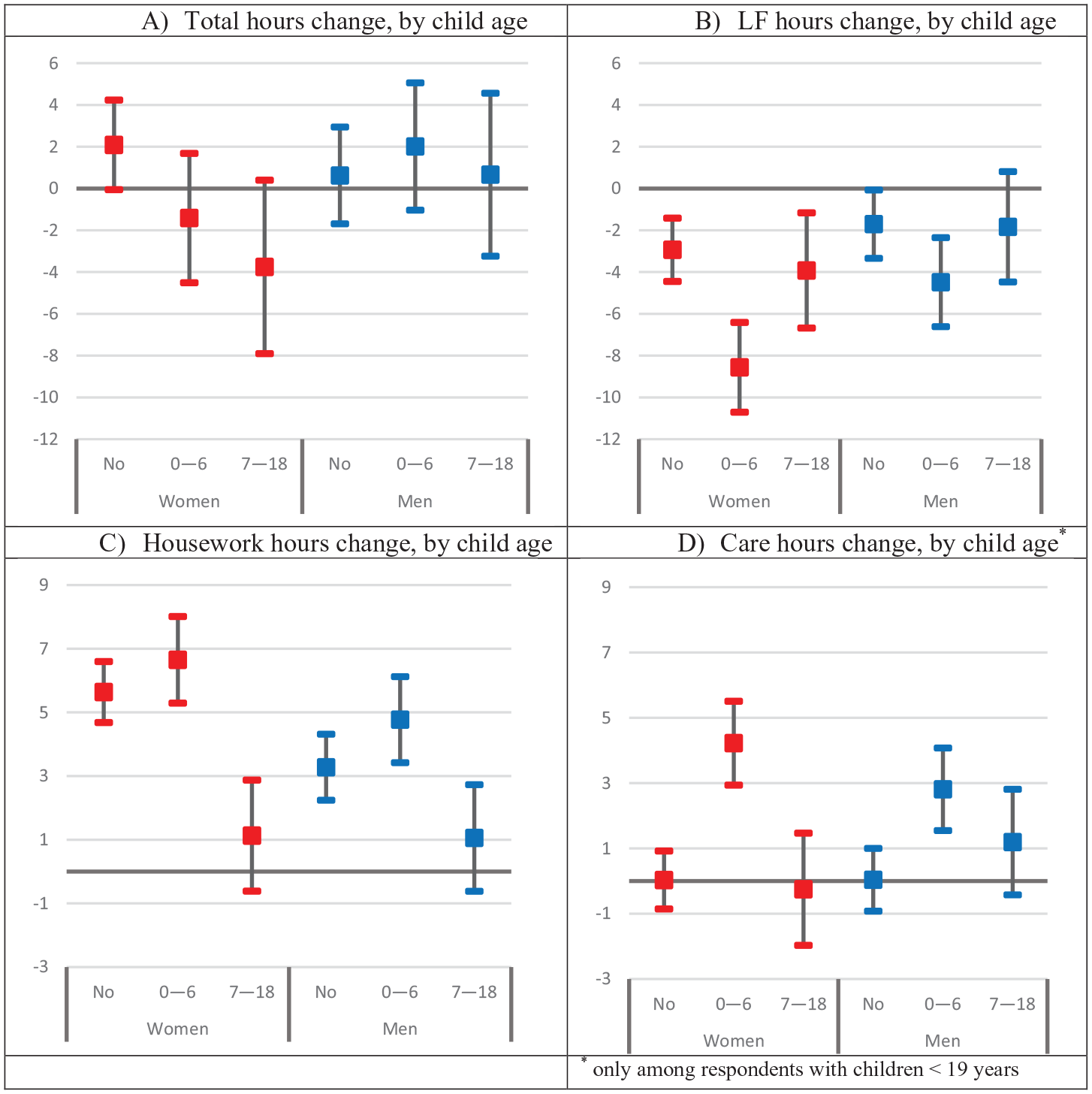
Estimated Lockdown Effects on Changes in Hours of Works (Total, LF, Housework, and Care), by Gender and Child Age: (A) Total Hours Change, by Child Age; (B) LF Hours Change, by Child Age; (C) Housework Hours Change, by Child Age; (D) Care Hours Change, by Child Age*
As mentioned above, one notable institutional change caused by the pandemic is the possibility of working from home: about 14 percent of the workforce before the lockdown and 23 percent during the lockdown, for both genders. Figure 3 displays the effect of workplace location on the balance between paid and unpaid work for employed men and women. The first thing to notice is that among the employed, the total number of hours has increased. Also noteworthy is the finding that working from home is associated with a reduction in paid hours (about 5 hours, for both genders), whereas staying at the workplace is associated with an increase in paid hours (about 4 hours for both genders). This pattern probably reflects the fact that most open businesses during the lockdown are those that provide necessary services and goods (e.g., health care, food manufacturing and sale), for which the demand has increased.
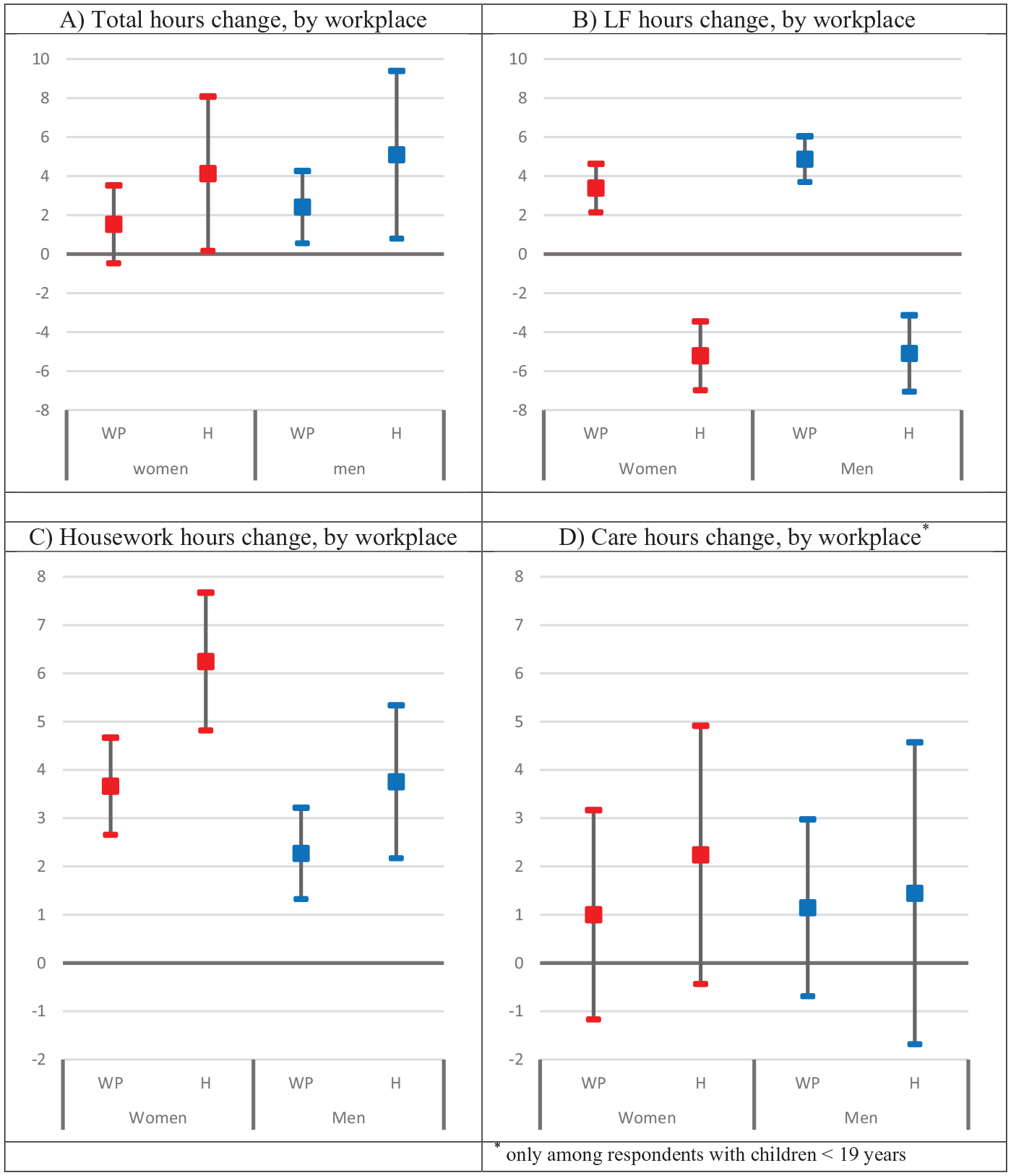
Estimated Lockdown Effects on Changes in Hours of Works (Total, LF, Housework and Care), by Gender and Workplace Location: (A) Total Hours Change, by Workplace; (B) LF Hours Change, by Workplace; (C) Housework Hours Change, by Workplace; (D) Care Hours Change, by Workplace*
Both men and women who work from home increased their housework hours more than those who continued to work from their workplace, but, not surprisingly, this increase was more pronounced among women. Thus, we can see here a first indication that flexible working arrangements in the form of work from home is a likely factor in the move to more traditional gendered family roles. As for child care, again, gender differences (in change of hours) are very small, but the starting points of both genders are very different: Hours devoted to child care by men are about half that of women and have been across time periods.
In Figure 4 we examine the full effect of the lockdown with relation to both child age and workplace location. The results show, again, that work from home, for women as well as men, is associated with fewer hours in paid work and more hours in housework. The results also confirm the previous finding regarding the presence of children; most significant gender differences in the effect of the lockdown are between mothers and fathers. However, the results also show that the effect of children is associated with workplace location. Mothers of young children who work from home lost much more paid hours following the lockdown (–7) than any other group, not only compared with fathers with young children who work from home (–2) but also compared with mothers who work outside (–1.5). Mothers of young children who work from home also increase the amount of housework more than the other two groups: fathers who work from home and mothers who work outside.
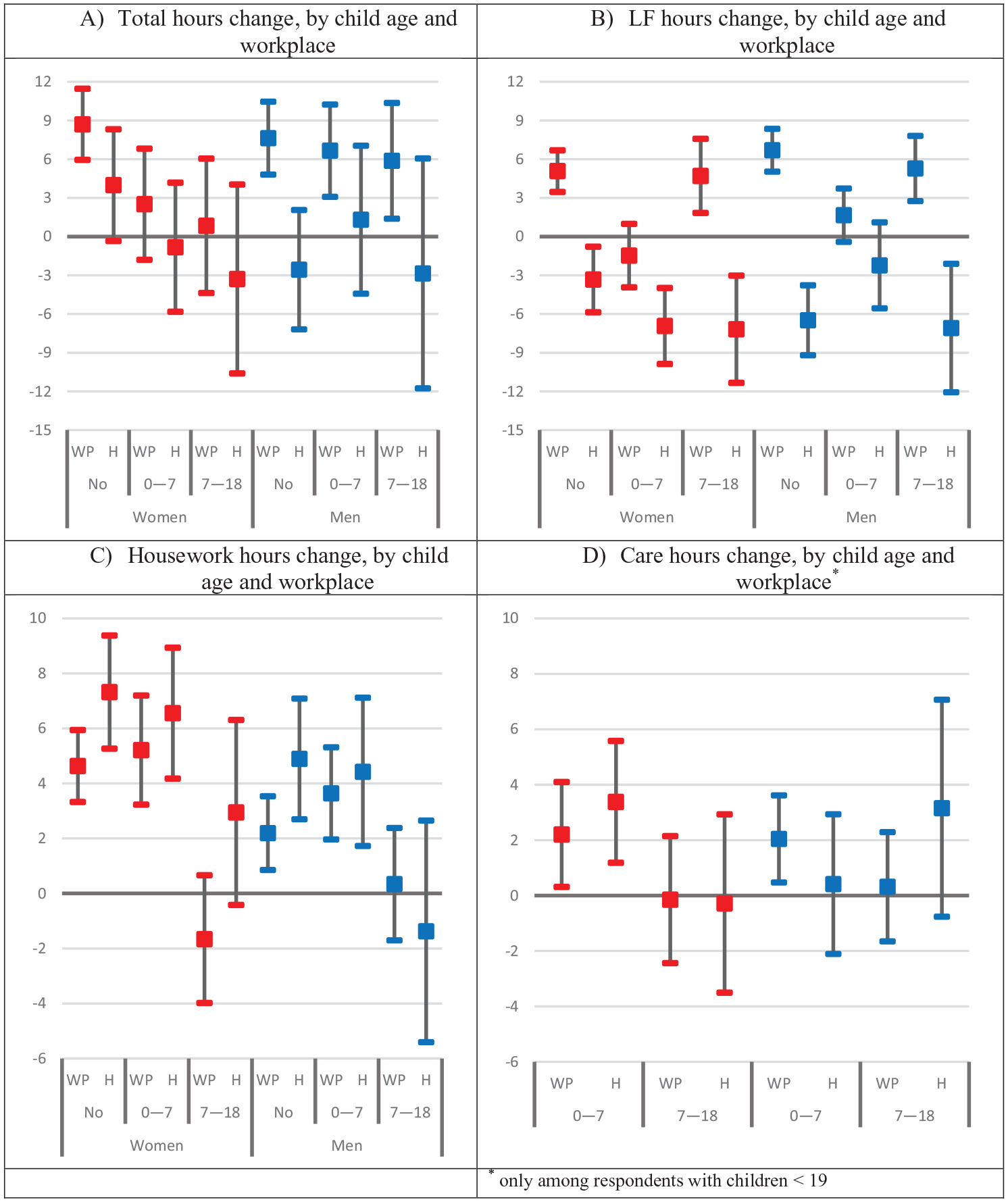
Estimated Lockdown Effects on Changes in Hours of Works (Total, LF, Housework, and Care), by Gender, Child Age and Workplace Location: (A) Total Hours Change, by Child Age and Workplace; (B) LF Hours Change, by Child Age and Workplace; (C) Housework Hours Change, by Child Age and Workplace; (D) Care Hours Change, by Child Age and Workplace*
Discussion
Using longitudinal data of Israeli adults, we examined the implications of the lockdown following the spread of COVID-19 on the allocation of time among paid work, housework, and care work, for both men and for women. Our findings stress the significance of children in the home for time allocation and the way it is affected by new work arrangements. Not only are women those who routinely do more unpaid work than men, but with the increased demand for housework caused by the lockdown, women increased their housework much more than men did. This increase—which was especially pronounced among women with young children—did not come without cost: Women’s loss of paid work hours was nearly twice as large as that of men.
An important distinction highlighted in our findings is between those who work for pay from home and those who work outside their home. This distinction is important because the possibility of working from home not only became much more prevalent following the pandemic and current technology adaption, but mainly because it is unlikely to disappear after the pandemic. The long-term consequences of work from home and other flexible work arrangements for gender in/equality within the family are not straightforward. On the one hand, flexible work contributes to a more continuous career; it enables mothers with young children to maintain their working hours (Chung and van der Horst 2018; Frenkel 2004; Fuller and Hirsh 2019). The ability to work from home saves commuting time to the workplace and creates the option to perform job and family tasks simultaneously (Osnowitz 2005).
Although positive consequences of flexible work arrangement do exist, our findings show that work from home increases the time devoted to housework for both women and men, but this increase is more pronounced among women, especially mothers of young children. Joining previous findings concerning the effect of flexible work on gender inequality (Craig and Powell 2011; Noonan, Estes, and Glass 2007), our findings show that “spousal exchange” based on either time or income (Brines 1994) is not a sufficient predictor of inequality within families. Rather, they suggest that gendered norms about household labor are powerful, and that flexible work arrangements allow such norms to increase gender inequality in families.
Our findings, then, support cultural theories by showing how the new flexible work arrangements that emerged with the pandemic are used differently by men and women. They show how men and women “do gender” (West and Zimmerman 1987) when using flexible work arrangements: They use it according to social norms regarding gendered expectations (Clawson and Gerstel 2014). As the “doing gender” theory suggests, flexible work enables each gender to combine housework and paid work while preserving her or his gendered identities and priorities, leading women to expand their household chores and men to expand their workloads (Chung and van der Lippe 2020; Clark 2000). Just as important, our findings reveal a labor market penalty for flexible work arrangements, indicated by the decline in working hours for those working from home. Although this decline applies to both genders, it is most pronounced among mothers, indicating that flexible work arrangements are related to more gender inequality both in the public and private spheres. The conclusions raised by these findings are rather gloomy; the potential equalizing effect of the new work arrangements will not change men’s and women’s behavior as long as assumptions about gender expectations are attached to housework and paid work.
Footnotes
Authors’ Note:
The authors have made equal contributions and are listed in a reverse alphabetic order. Yaish and Kristal have received financial supported for this study from the Pinhas Sapir Economic Policy Forum, Jerusalem.
Notes
Meir Yaish is an associate professor in the Department of Sociology at the University of Haifa. His research focuses on the determinants and consequences of social stratification and mobility and on the interplay between rational and cultural determinants of behavior. His research has appeared in Social Forces, the Proceedings of National Academy of Sciences, the British Journal of Sociology, Sociology, European Sociological Review, and Rationality and Society. Since 2010, he is the editor-in-chief of Research in Social Stratification and Mobility.
Professor Hadas Mandel is currently the head of the Department of Sociology and Anthropology at Tel Aviv University, and the head of the Pollak Program for Excellence for doctoral students at the faculty of social science. Her research focuses on gender, class, and race inequalities, and the complex implications of institutional aspects on the intersection between them. Since 2017, she is the Principal Investigator of the ERC-funded (Horizon 2020) project addressing the structural and individual aspects underpinning the development of gender inequality over time and across societies. Her works on these topics have been published in the American Journal of Sociology, American Sociological Review, Demography, Social Forces, European Sociological Review, the British Journal of Sociology and others.
Tali Kristal is Professor of Sociology at University of Haifa. Her research interests focus on how and why positions in the economy, such as organizations, industries, occupations, classes, and the relations between them, shape economic inequality, and how these vary across time and countries.