



Abstract
Gender ideologies are embedded in intersecting race, class, and gender systems. Yet Black masculinity is often defined one-dimensionally, without attention to class variation in gender enactment. Particularly, with regard to heterosexual partnering, representations of Black masculinity most often involve men enacting compensatory displays to account for having too little masculine capital to meet the dominant culture’s protector–provider prerequisites for accomplishing marital masculinity. Drawing from interviews with 42 never-married Black professional men, I explore their ideas about how masculinity ought to be done within the marital relationship—a critical site for the reproduction of gender inequality. Findings reveal that these men construct “Black professional hybrid masculinity” around a simultaneously racialized and classed compensatory strategy of masculine protection and equitable spousal sharing, resisting simple classification as either hegemonic or counterhegemonic. Rather, it is a distinctly hybrid masculine strategy. These men cherry-pick hegemonic gender norms to reconstruct gender identities that reaffirm their sense of manhood and idealize their future wives as symbols of hybrid femininity—work-devoted women who are also femininely in need of masculine protection. This research offers an intersectional extension of hybrid masculinity and illustrates the need for heterogeneous and context-varied theories of how Black men do gender.
In heterosocial relations with women, protecting and providing represent fundamental gender practices to be embodied by men as they endeavor to meet the “hegemonic” ideals associated with masculinity (Connell 1995; Connell and Messerschmidt 2005; Lamont 2020). Taking responsibility for the financial needs and safety of one’s family is also a long-standing marital prerequisite for American husbands. Men often compulsively aspire to meet these expectations and those who cannot have been stigmatized as “unmarriageable” (Bridges and Boyd 2016; Wilson 1987). While all men may strive to meet the hegemonic ideal, most are born into identity groups that make it less possible (Connell 1995; Connell and Messerschmidt 2005). As an ideal type embodied by few men, dominant expressions of masculinity are most often associated with white, heterosexual-identified, middle-class men (Collins 2004). Still, hegemonic masculinity remains the benchmark against which all men across social positions are measured and to which they are expected to aspire (Connell 1995).
Experiences of disenfranchisement and disempowerment have historically made pathways to dominant, or hegemonic, masculinity inaccessible to men of color. For centuries Black men particularly have been denied the means to protect and provide for their families, regardless of class status (Blassingame 1979; Collins 2004; S. A. Hill 2005). Because women tend to expect men to do gender in ways that align with dominant expressions of masculinity, men who fall short often play up other more accessible masculine features to compensate (Majors and Billson 1992) and to maintain masculine credibility (Bridges 2021). Little research considers “choice” or agency in matters of gender expression, stemming from the notion that those who can are also those who do (West and Zimmerman 1987). Recently, however, the theory of hybrid hegemonic masculinity has made space for choice, contending that different forms of privilege allow some men greater flexibility in gender expression (Bridges 2021; Bridges and Pascoe 2014). Bridges and Pascoe (2014) find that high-status straight white men can transgress hegemonic boundaries without the loss of masculine status, although such cross-boundary movement is not limited to this group. In fact, Bridges and Pascoe (2014) argue that men receive status for such transgressions. However, theories of gender and masculinities have had less to say about how privilege and choice intersect to shape the gender ideologies and expression of other groups of men. The subpopulation of Black men who are college-educated and meet social status prescriptions for marriageability are often centered in marriage literature but are rarely queried themselves. No research to date has investigated how these men themselves conceptualize marriageability. Given structural improvements that have generated greater opportunity for Black Americans, making upward mobility more accessible, it is necessary to investigate how newly emergent experiences of class privilege operate among this group (Clarke 2011; Landry and Marsh 2011).
The prevalence of poverty, unemployment, and incarceration among Black men has diverted scholarly attention away from the middle class (Cazenave 1984; Collins 2004; S. A. Hill 2005; Landry and Marsh 2011). Black high-status masculinity is particularly undertheorized. In this study, I offer an intersectional extension of hybrid masculinity related to the husband role, looking specifically at Black professional men’s normative beliefs about gender within the context of marriage. Drawing on in-depth interviews with 42 never-married, college-educated Black men, I consider how class privilege and race interact to affect how Black professional men construct the husband identity and narrate how masculinity should be performed within marriage. Findings reveal that these men construct a “class-inflected” (Valocchi 1999) hybrid masculinity I term Black professional hybrid masculinity. This hybrid masculinity is constituted by a racialized and classed compensatory strategy involving egalitarian financial and domestic responsibilities alongside traditional masculine protection. Although these men recognize the conventional expectations of masculinity, they actively reconstruct gender identities that reaffirm their sense of manhood and idealize their future wives as symbols of hybrid femininity: work-devoted and financially independent women who are at the same time in need of masculine protection (Barnes 2016; Blair-Loy 2009; Dow 2015, 2016; Landry 2000). Respondents construct their masculine identities around the perceived desires and needs of Black professional women. Although protecting and providing remain integral, this research shows that some high-status men exercise choice and cherry-pick these hegemonic gender expectations. This is particularly evident as college-educated women begin to eclipse men in the labor force and express increasing interest in egalitarian relationships (Lamont 2020; Risman 2018).
Mainstream Gender Ideologies, Identities, and Expressions
Hegemonic Masculinity
The durability of the gender division of labor as an ideal spousal arrangement, whereby husbands are the dominant earner and wives are responsible for domestic labor and childcare, is rooted in hegemonic gender ideologies about complementary biological differences between men and women (Connell 1995; Hays 1998). However, gender meanings and appropriate ways of doing gender are constantly in a state of flux, shifting over time across social, cultural, and institutional contexts (Connell 1995; Pascoe 2007; Ridgeway and Correll 2004). The process of constructing gender ideologies and identities is simultaneously shaped by internalized norms at the individual level (Lu and Wong 2014), “social relational contexts” at the interactional level (Ridgeway and Correll 2004; West and Zimmerman 1987), and social status at the structural level (Majors and Billson 1992). Gender ideologies and identities are also contextual and “role” variant. Hegemonic masculinity largely forms the foundation upon which men construct role identities (Lu and Wong 2013, 2014). Thus, gender shapes the ways men embody social positions (e.g., breadwinner, protector, or husband) by shaping their ideas about how these positions ought to be embodied. In addition to gender, these identities are also informed by other social factors such as race and cultural context, age, and class (Collins 2000).
As a cultural goal, breadwinning organizes men’s life choices. Men have been found to avoid low-earning careers in favor of more “provider-friendly” occupations (Cech 2016). The expectation that men be the dominant earner in a marriage has been shown to influence the majors that young men choose in college (Mullen 2014). Men’s exclusive access to education and occupations once necessitated a gendered division of labor, but young wives today are as likely to work outside the home as their husbands (Goldin 2021). Still, some scholars argue that the pervasiveness of gender is evident in the fact that the gendered division of labor continues to represent the “ideal” American family structure, particularly among white Americans (Lamont 2020; Landry 2000). Indeed, white millennial women have been found to utilize the premarital courting stages of the relationship to evaluate a man’s capacity to provide in a marriage (Lever, Frederick, and Hertz 2015), despite many expecting to remain in the labor force after having children (Blair-Loy 2009; Gerson 2009). Over time, Americans have encountered challenges to actualizing this ideal as men’s wages become less sufficient to independently support a family, thereby complicating the accomplishment of masculinity.
“Masculine challenges” (Messerschmidt 2000) describe interactional experiences in which masculinity is denied or contested. The challenges that most men encounter in pursuit of ideal masculinity may provoke negative self-concepts (Fine et al. 1997). This is particularly the case for men of color (Lu and Wong 2013). Other research has found that within the marital context, men who cannot actualize the financial provider expectation compensate by scaling back on contributions to housework (Brines 1994) or engaging in adultery (Munsch 2015) and domestic violence (Atkinson, Greenstein, and Lang 2005). In contemporary society, however, there are emerging incentives to enact masculinity in alternative ways as professional women increasingly call for egalitarian spousal arrangements to accommodate their lifestyles (M. E. Hill 2020; Lamont 2020; Risman 2018).
Hybrid Masculinity
Although some men may find engaging nonhegemonic masculinity precarious, research shows that cisgender, straight, white, middle-class men are afforded license to opt-out of hegemonic gender expectations without this choice detracting from their masculine status (Bridges 2021; Bridges and Pascoe 2014; Lamont 2015; Messerschmidt 2000). These men combine features of hegemonic and nonhegemonic masculinity into “hybrid” masculinities, “characterized by increasing levels of equality and less hierarchy” (Bridges and Pascoe 2014, 248). Hybrid masculinity has been applied to investigations of white heterosexual-identified men who engage in sex with other men (Silva 2017; Ward 2015), negotiate anti-feminism alongside white male victimhood (Ging 2019), and discursively position themselves as “good guys” by denouncing the masculine status of other similarly positioned white men (Pascoe and Hollander 2016). In a recent investigation of how white men understand themselves as members of a stigmatized group, Bridges (2021) offers the term “hybrid hegemonic masculinities” to conceptualize how racial forms of privilege associated with whiteness intersect with gender, class, and sexual privilege. Bridges contends that whiteness serves as a conduit, allowing some expressions of hybrid masculinities—particularly those associated with white men—not only to maintain gender inequality but also to render it less visible. Taken together, this research contends that white heterosexual-identified men assert their race, gender, and often class privilege as leverage in maintaining masculine capital while engaging in counterhegemonic practices. Although the research engaging the theory of hybrid masculinity centers on a diverse population of men across a wide range of social contexts, Black middle-class men and marriage have not been critically considered. As a microcosm of broader societal gender relations, marriage is a critical site for investigating the doing of gender as well as the construction of gender identities.
The privilege of self-determination has largely eluded Black Americans (Collins 2000, 2004). Different from white men, Black men are deprived of agency and the privilege to diverge from the conventions of masculinity without the loss of masculine status (Bridges and Pascoe 2014; Collins 2004). Within the frame of hybrid masculinities theory, however, it stands to reason that being high-status may afford some Black men greater discretion and flexibility in gender expression than lower SES (socioeconomic status) Black men represented in earlier work (Harper 2004). The primacy of whiteness in studies of hegemonic masculinity has largely obscured the privilege(s) available to non-white men. While hegemonic masculinity is notorious for its rigidity and exclusivity, hybrid masculinity shows a greater capacity for pliability in what constitutes dominant masculinity, potentially leaving space for theorizing more varied and diverse racialized constructions of dominant masculinity.
Black Masculinity
Hybrid masculinity theory highlights the complexity of gender identity and ideology but contributes very little to the understanding of race beyond whiteness (Bridges 2021). Different from white men’s experience, deviations from normative gender expression have been considered inferior, rather than hybrid, when enacted by Black men. William Julius Wilson (1987) argued that structural factors such as un/underemployment, low levels of educational attainment, and incarceration leave many Black men unmarriageable. He coined the term “marriageable men” to delineate marriage-eligible socioeconomically viable men from unmarriageable socioeconomically insecure men. Wilson and others (e.g., Burton and Tucker 2009; Edin and Nelson 2013) have held that Black men’s socioeconomic shortcomings, and consequent inability to provide financially for families, constrains their capacity to meet the hegemonic prescriptions associated with the husband role. With this in mind, gender theories contend that masculinity is weakened or “marginalized” by Blackness (Collins 2000; Connell 1995). However, without the economic means to organize their marriages and families around a traditional gender division of labor, Black couples have historically relied on “gender-role sharing” practices to sustain financially viable households (Landry 2000). This has been historically framed as one of many signifiers of Black cultural pathology and inferiority (Burton and Tucker 2009; Wilson 1987). Yet gender egalitarianism among dominant groups has been exalted within feminist scholarship as a newly emergent trend toward gender equality, despite long-standing feminist critiques of “new men” (Messner 1993). This is perhaps rooted in the assumption that Black Americans embrace egalitarianism out of necessity rather than choice, which calls for an investigation of how high-status Black Americans contend that marriage and gender should be done.
Class privilege may function as a form of symbolic capital affording Black professional men more agency in masculine expression than poor Black men have (Collins 2004; Ray 2012). Despite a shared vulnerability to “gendered racism” (Mutua 2006; Wingfield 2007), Black professional men often express masculinity both similar to and different from their lower status counterparts. As working professionals navigating (white) mainstream society regularly, upwardly mobile Black men must contend with competing discourses, integrating dominant cultural norms alongside those valued within the Black culture (Collins 2004). For example, college-age Black men have been found to value education to access provider roles, but many simultaneously endorse these hegemonic leanings alongside enactments of masculinity culturally associated with poor Black men (Diemer 2002; Harris, Palmer, and Struve 2011; Majors and Billson 1992). This tendency to integrate high-status and low-status expressions of masculinity may be evidence of a Black cultural continuity that is not easily, or willingly, dispelled by upward mobility. Yet Black high-status men also construct masculinity differently than their white high-status counterparts do. In a study of college-aged Black and white fraternity men, Ray and Rosow (2010) find that Black men reject the hegemonic approaches to hookups employed by their white counterparts, preferring chivalry and romance in pursuit of sex with women (Glick and Fiske 1996). As underrepresented minorities on college campuses, Black men are hypervisible (Ray and Rosow 2012) and must be more mindful than white men of how their treatment of women is perceived by others. Hence, these men are held to a set of masculine responsibilities that are inherently racialized, and to which white men are interactionally and institutionally held less accountable. Yet chivalry and romanticism, which appear benign, reify essentialist beliefs about gender at the core and qualify as benevolent sexism. This benevolence may be coded as sexist (Lamont 2015, 2020), despite being cited as favorable to women (Glick and Fiske 1996) and even required by Black women (S. A. Hill 2005). Taken together, this research demonstrates not only the class-inflected nature of masculine expression but also how and why these expressions come to be racialized.
The present study builds on previous work by shifting to marriage-age working professionals in diverse institutions and workplaces. Intimate gender relations on today’s college campuses are primarily characterized by “hookups” requiring little commitment and are unlikely to lead to committed relationships (Currier 2013; Ray and Rosow 2010). Black men in college may have ideas about marriage but are on average 10 years away from actualizing those ideas. There is a sizable body of literature focused on college-age Black men, primarily related to sports (see Harris, Palmer, and Struve 2011 for a review), but less is known about what happens to young Black men after college, specifically related to their engagement with women (Bridges and Boyd 2016; Raley, Sweeney, and Wondra 2015). Scholars have long criticized the glaring gap in Black masculinities literature which has left high-status Black men’s lives undertheorized (Cazenave 1984). Given the distinct historical context in which Black American marriages have been constructed and constrained, understandings of how Black women and men define marital roles cannot be inferred from other groups and must be queried themselves. This article fills this gap and, in so doing, makes contributions to the theories of doing gender and masculinities, with implications for Black gender relations.
Method
Based on a larger study of the marriage-related ideas of Black professional men and women, this study draws on a subsample of in-depth interviews with 42 never-married heterosexual Black professional men. Never-married individuals are ideal because the goal was to capture culturally informed ideals, unencumbered by present circumstances and marital agreements. Qualitative methods allowed me to interrogate not only knowledge of the gendered practices themselves but also insights into why gendered actors think it valuable to engage in those practices in the first place. Given that this study required an integrated inductive and deductive analytical approach, the ability to probe respondents was an advantage of semi-structured interviews.
Because 80 percent of young adults are active social media users (Pew Research Center 2021), participants were recruited from a regional social media group called “The Wave,” composed of Black college-educated individuals. All participants reside in Texas, and most reside in or around the Houston metropolitan area. The majority of the country’s Black population lives in the South, and Texas has the largest Black population of any state (Tamir 2021). In Houston, the median age for Black Americans is 32 years, meaning that a sizable portion of the population is of prime marriage age. Also, 34.3 percent of Black Americans in Houston, 25 years and older, have a Bachelor’s Degree or higher (U.S. Census Bureau 2020–2021). Houston thus represents an ideal location for college-educated Black Americans seeking class homogamous marital partners. Descriptive information for the sample is provided in Table 1.
Names and Interviewee Characteristics (N = 42)
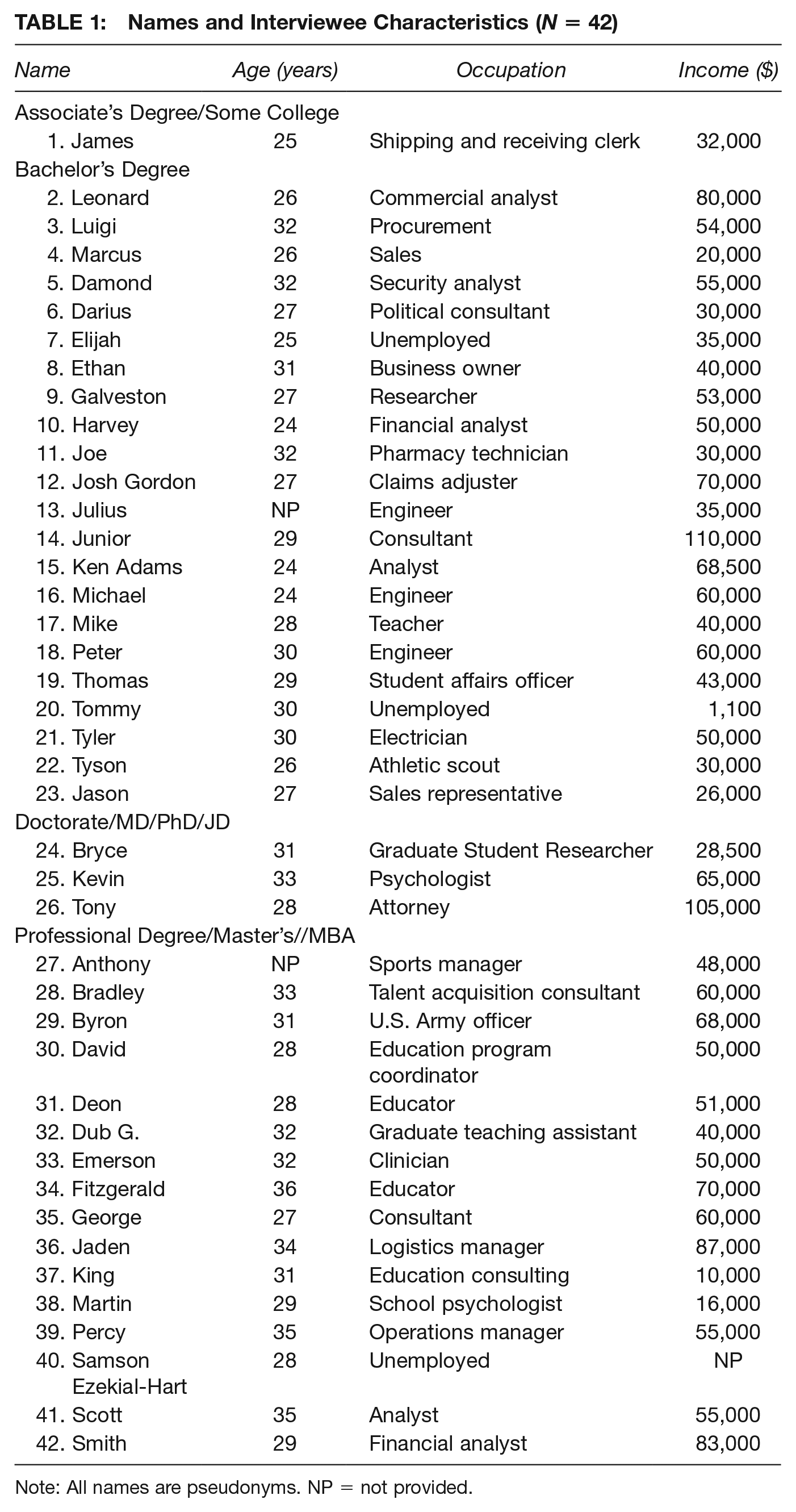
Note: All names are pseudonyms. NP = not provided.
All participants self-identify as Black/African American professional men and are 24–40 years of age. “Black professional men” are Black men who are classified as such based on a combination of education, occupation, and/or income (S. A. Hill 2005). All participants but one have at least a bachelor’s degree, and more than half have a graduate degree, typifying Wilson’s (1987) definition of “marriageable” men and Marsh’s analysis of “the emerging Black middle class” (Marsh et al. 2007). Although three respondents are unemployed, they reported working in professional occupations before their unemployment. Two respondents are enrolled in doctoral programs on pathways toward professional careers.
Interviews were conducted over 17 months, between August 2018 and January 2020. Respondents were asked to share their thoughts on a variety of gender-related norms specific to the marital context. Example questions include: How do you define the responsibilities of a husband and wife in a marriage? Could you marry a woman who did not cook or clean? Could you marry a woman who out-earns you? Twenty-six interviews were conducted in-person and 16 by phone. There were no distinctions in the substantive quality of interviews across mediums. Interviews lasted between 75 and 120 minutes, took place in coffee shops of the respondents’ choosing, were audio-recorded and transcribed, and were coded using MAXQDA software.
I used a “flexible coding” method (Deterding and Waters 2021), integrating both inductive and deductive analytical approaches. Coding involved an iterative process of several passes through the data to identify sensitizing concepts and themes. To situate the findings in conversation within the existing theory, I generated index codes from established profiles of masculinity in the first analytical pass (e.g., hegemonic/conventional masculinity, egalitarian masculinity, compensatory masculinity, and cool pose). Chunks of text labeled with multiple broad codes were then given a more refined subcode “hybrid masculinity.” Subsequently, analytical codes were informed by the domains that respondents referenced while constructing themselves as ideal husbands for Black professional women. Analysis was loosely guided by existing theory in that nonconfirmatory themes were also allowed to emerge from the data. However, the development of a new theory was necessary, because no respondents had narratives that fit wholly into one set of existing theories or another.
Although there was no contact or relationship between researcher and respondents before the study, shared racial- and age-group membership may have helped to bolster rapport and minimize perceived power differentials between the researcher and respondents. These similarities may have created a more comfortable interviewing environment, as respondents easily used colloquial language, including curse words and slang.
Findings
I draw on interview data to illustrate how Black professional men signify a uniquely racialized and classed form of hybrid masculinity I call “Black professional hybrid masculinity.” The men in this study do so by integrating elements of hegemonic, essentialist, and egalitarian ideals, which they rationalize in situated and racialized gender-relational terms. Although narratives reflect an awareness of hegemonic gender, respondents cherry-pick these prescriptions to construct the best-suited spousal arrangement (M. E. Hill 2020). While they profess egalitarian frames of mind (that marital roles should not be predicated on gender), they also routinely make exceptions to this frame through the processes I describe.
Black men redefine the norms of marital masculinity by prioritizing protecting over providing and expanding its bounds to include co-providership and feminine-typed work. They do so while emphasizing fairness and balance. In line with hegemonic masculinity, they viewed “protecting the family” as chiefly the husband’s responsibility. Deviating from hegemonic masculine norms, however, they did not define providing in exclusively economic terms but also incorporated activities such as providing “love” and “a safe haven.” Accordingly, protecting and providing were, for these men, not mutually exclusive but were used interchangeably to describe both similar and different sets of activities. The salience of the protector role to their masculine identities is evidence of a Black cultural continuity that may supersede the influence of class. These Black men signify a racialized hybrid masculine identity by policing the boundaries around certain elements of traditional masculinity but expanding boundaries around others.
Black Professional Hybrid Masculinity and Feminine-Typed Domestic Work
No men in this sample wholly endorsed a gender-based “separate spheres” division of labor. Men framed women as equal participants in the labor force and planned to compensate their wives for their financial contribution by exchanging a commitment to share household labor. Different from previous work showing that men compensate for providership shortcomings by exaggerating more accessible masculine features, such as aggression (e.g., Brines 1994; Pyke 1996), men in the present study “compensate,” or bargain, by specifically downplaying masculine features. This gender bargaining is a direct outgrowth of their perception of the terms around which Black femininity is constructed among Black professional women. Black working wives have been found to require egalitarian spousal relationships (Dow 2015, 2016). With this in mind, men regarded indoor household tasks, such as cooking and cleaning, as a shared domain. Accordingly, most men rejected essentialist beliefs about a woman’s inherent desires and superior capacities to cook and clean. Nearly all men (41/42) indicated that decisions about how household tasks are split should account for each spouse’s preferences, likes, time constraints, and “strengths and weaknesses.” These men demonstrate an acute awareness of the belief systems and behaviors of the women they are interested in marrying and seek to craft complementary husband identities.
Given the perceived similarities in many young couple’s work commitments, Tony, a 28-year-old attorney, rejected the notion of predetermined gender responsibilities and stated
You can’t go into a marriage with the preemptive idea that the husband’s gonna bring home the bacon and the wife is going to cook it type stuff, because there are a lot of women who have more earning potential than the husbands that they’re with. And that’s perfectly fine. The big thing is to make sure that you feel like there’s an even distribution of labor. So, if you know your wife is working 12 hours and you’re working eight hours, you should not make her come home and cook for you. But if your husband is working 12 hours and you’re working eight hours, he also should not come in and have to cook.
Ideas about how domestic labor should be organized were not predicated on gender, specifically because men expect that working and earning will be shared. Men overwhelmingly felt that wives who work as much as, or out-earn, their husbands should not be solely responsible for domestic labor. The ultimate goal is fairness and balance, ensuring that neither spouse is carrying an unfair burden.
Drawing on a similar set of considerations regarding who should complete household tasks, Tyson, a 26-year-old athletic scout, shared
I believe that [household chores] should always be split. . . .I mean of course, back in the day it used to be the woman stays at home and cooks. That’s not the case anymore. I mean when women have the same jobs, men have the same jobs, it should be split. . .it just makes everything easier and creates even a better bond as well.
Given the changes in how women’s labor is distributed over time, respondents advocate for expanding men’s labor to include the domestic sphere. Participants construct husband identities that they envision as best suited for their future Black professional wives. This “role sharing” (Haas 1980), or egalitarianism, aligns with the marital expectations of Black professional women, namely that marriage must not undermine the salience of financial independence (Barnes 2016; Dow 2015, 2016).
Although most respondents were like Tony and Tyson, framing gendered specialization as the leftover residue of an antiquated era, they also combined this egalitarianism with traditional gender expectations. More than three-fourths of men (36/42) indicated that they would be unwilling to marry a woman who did not cook or clean, particularly if she were unwilling to learn. This demonstrates that their ideologies were not rooted in feminism or in an interest in releasing women from traditional feminine-typed domestic work. Furthermore demonstrating this “role sharing” spousal arrangement as a compensatory strategy, men framed household labor as a responsibility of which neither spouse could simply opt-out. They discursively situated this reluctance as about “fairness,” not as related to patriarchy. Smith, a single 29-year-old federal investigator said
I don’t mean to sound vain, but . . I mean if you can’t cook or clean—and I don’t want to come off as like this sexist person—but dang, I’ma take care of everything? I gotta do that too? So it’s a partnership. So, I don’t know, maybe she’s a CEO and just makes so much money that it just makes me look poor. And maybe at that point I would put on a apron and just be coming home, like shit, you know, shit, Oprah gotta come home to a cooked meal man. You know?
Balance in role sharing is an integral feature of Black professional hybrid masculinity, but not in the interest of feminism or empowering women. Like Smith, men were opposed to taking on full responsibility for cooking, unless this was counterbalanced by their wife assuming greater financial responsibility. Smith did not shirk the possibility that he may be out-earned by his future wife but made light of this possibility by presenting it in the form of a joke. Although men do not oppose contributing to the housework, they envisioned few scenarios in which men should take on total responsibility for the housework. Hence, among these professional Black men, marital responsibilities are not determined by gender but by each spouse’s contribution across arenas.
In summary, men emphasized fairness as the goal in marriage, a goal that seemed to quite literally meaning a 50–50 split. In their view, each partner should be allocated enough housework to compensate for disparities in financial contributions. They want an equal partner in a marriage, who participates equally in the distribution of household labor and provider responsibilities. Tyson concisely articulates this point: “People feel like you got to bring something to the table that betters their life.” In these men’s view, if a woman is neither making a comparable financial contribution nor counterbalancing her husband’s work commitments, she is not an equal partner.
Black Professional Hybrid Masculinity and the Protector Role
Although men argued that most marital responsibilities can and should be shared, they also situated protecting one’s wife and family as central to a husband’s masculinity. When defining the husband as the protector, most men relied on some combination of gender essentialism and socialization. Tyson explained
. . As a man you just want to feel like you can take care of your family and the people that you love. It’s an instinct actually now thinking about it. That’s the best answer for it. It’s a manly instinct . . . That’s what we were taught . . to protect . . and again, that’s the norm. That’s hard to break.
Respondents believe that it is a husband’s duty, even birthright, to protect his family. They have internalized messages about the masculine protector role as integral to a husband’s identity.
Respondents also contend that they are a part of a group with a set of established codes of conduct, or collective identity. Tyson asserted
I feel like that’s actually kind of a universal thing amongst a lot of men. We just want to feel like no matter what, if something were to happen, we can take care of it. . .
They construct themselves as ideal husbands by asserting both a willingness and a capacity to comply with cultural expectations associated with masculine protection. This is a notable turning point because historical experiences of racialized gender violence have largely impeded Black men’s capacity to protect their wives and families.
It was also common that men drew on the teachings of their parents or grandparents as support, demonstrating an intergenerational transmission of gender beliefs despite changing economic needs. Harvey, a 24-year-old financial analyst, drew on his perception of his parents’ and grandparents’ ideal vision of marriage:
Like anything that just might happen in the household or the home, I feel like that would fall on me. . .in [my grandparents] ideal sense of a marriage, the men are supposed to take care of the responsibilities or the “what-if” responsibilities just in case something happens. If something needed to be done, or was to happen, that would be my responsibility . . . I think the husband definitely has to be the last defense. . .like he has to be prepared for whatever.
Earlier in his interview, Harvey explained that a large part of why he planned to delay marriage with his current girlfriend was to wait until he felt capable of taking care of “anything that might happen.” This demonstrates his commitment to his beliefs and the relationship between gender ideologies and actions. The degree to which men insisted on the husband as the protector, or the “last line of defense” varied, but the sentiment was expressed in every interview.
Black professional hybrid masculinity also constructs providing as secondary to protecting. When asked what the roles of a husband and wife should be, King, a 31-year-old education consultant, said, “I can’t speak on the role of a wife, but I mean for a man, you know, provide and protect. Protect and provide.” After being asked to elaborate on the meaning of those terms, he said
Well I changed it because . . . when you hear “provide” you think about financially, so take that away. Number one, protect . . . My main objective is gonna be to protect [my wife]. And then make sure I provide. . .
Respondents generally believed that while financial responsibilities can be shared, particularly when women are equal participants in the labor force, the husband is responsible for the family’s overall well-being.
Reinforcing the belief that being prepared for the unknown is an integral feature of this construction of hybrid masculinity, Junior, a 29-year-old consultant, shared
Men should always be a provider, not that a woman should not, especially in the day and age in which we live. Independent women are flourishing. I think the man should personally be thinking five, ten years down the line, be a forward planner for the safety of the family, a protector.
Here, Junior affirms Black women’s capacity to provide but situates men as responsible for the family’s long-term financial vitality. Within the context of marriage, Black professional hybrid masculinity both affirms Black women’s independence and positions men as masculine caregivers.
Men also expanded the boundaries of the provider role to include noneconomic forms of provision. Expanding on the definition of the traditional provider role, Michael, a 24-year-old engineer, stated “Marriage is the ultimate goal for me. As long as I could be a good husband and provide for her.” Michael was then asked if he sees being a good husband and providing as related, to which he replied “Yes. I think being a good husband is being able to provide. When I say provide, it’s provide love, provide nurturing, provide a safe haven. That’s what I mean, provide.” Both King and Michael articulate a belief that was echoed by most respondents: that the meaning of providing has evolved and expanded to include noneconomic practices and is a noncompulsive feature of Black professional hybrid masculinity. These men construct masculinities that blur the protecting and providing roles in some cases—in line with Stroud’s (2012) findings among conservative white men—and privilege protecting over providing in others.
Furthermore, despite the decoupling of protecting and providing, respondents demonstrate the salience of these practices to men in dual-earner marriages by describing how a man unable to fulfill these standards might feel. Like all other respondents, Junior believes that an inability to fulfill the traditional protector and provider roles results in feelings of inadequacy:
I believe that [men who cannot protect and provide] feel like less than a man, they feel inadequate. Probably embarrassed and angry . . . bitter or resentful for whatever decisions they made to put themselves in that predicament, regretful of those decisions as well.
Junior went on to say that if he were in such a predicament, he would feel a similar set of emotions, and even “rage,” a compensatory strategy connected with “cool pose” (Majors and Billson 1992). Similarly, Dub G., a 32-year-old doctoral student, shared “Well, I mean, it makes them feel like less of a man, obviously. Right? If you can’t take on the traditional roles it makes you feel like less of a man . . . ” Men believed that such a man would harbor negative emotions and internalize feelings of interiority. In so doing, respondents delineate between being able to fulfill mainstream expectations but opting out versus being unable to do so.
Black Professional Hybrid Masculinity and Doing the “Dirty Work”
Pairing traditional/essentialist ideologies with the previously discussed egalitarian ideals, men delineate between indoor and outdoor housework in gendered terms, categorizing outdoor “dirty work” as men’s exclusive responsibility. Men reinforce dominant frames by asserting themselves as inherently responsible for protecting their wives. They attribute this responsibility to essentialist gender differences. Out of consideration for women’s safety, they maintain that activities traditionally reserved for men should remain as such, constructing themselves as naturally better suited than women for activities involving risk. George, a 26-year-old consultant, said
If it’s something that requires like a lot of intensive labor and it’s dirty, I honestly expect the man to be like cutting the grass, something like that where you’re going to get dirty, something’s gonna be heavy, something outside. I feel like that’s a man’s job. It’s his responsibility to do the dirty work.
George’s expectations reinforce hegemonic notions of husbands as protectors responsible for shielding wives from dirt and harm. Within this frame, attributes such as strength, associated with men and husbands, and fragility, associated with women and wives, become taken-for-granted gendered matters of fact rather than expectations or coincidences. By simultaneously furnishing both hegemonic masculinity and emphasized femininity, Black professional hybrid masculinity reaffirms its hybridity—as simultaneously egalitarian and traditional. Similarly, Samson, 28 years old and unemployed, said
Well I think there are some tasks that should be for men. For example, taking out the trash is something that a man should always do, especially at night. A man should be the one that goes outside. You don’t want to put your wife in a dangerous situation like that . . mowing the yard for example is another task that . .a man should do. Changing the light bulb, things that traditionally men do . . I believe that those things shouldn’t change. . .men can do the same tasks that women are doing, but there are some tasks that I wouldn’t really want to see a woman do.
Respondents delineate between masculine- and feminine-typed work, dubbing indoor domestic work shared domain, but taking ownership of traditionally masculine-typed work. Men’s protectiveness over “men’s work” evidences the salience of both their gender identity—via the assumption of their innate greater strength—and the quality of their masculinity—via their belief that men should protect women.
These men were eager to demonstrate their rejection of a gendered division of labor, but simultaneously narrate essentialist beliefs that reinforce gendered spousal responsibilities in some areas. By claiming responsibility for activities that they believe could endanger women, men construct masculine identities by policing the boundaries of femininity, discursively constructing themselves as physically superior to women (Connell and Messerschmidt 2005).
Discussion
This research addresses a long-standing gap in social–psychological and gender literature concerning Black professional men’s gender ideologies and identities. I use the intimate social-relational context of marriage as a site for the investigation of beliefs about how gender should be done at a particularly underexplored intersection of race, class, and gender. Analysis located a culturally situated gender construct termed “Black professional hybrid masculinity”—a racialized and classed configuration of masculinity—among never-married Black professional men. These men’s hybrid masculine identities are constituted by cherry-picking elements of egalitarian, traditional, and essentialist gender ideologies (Bridges and Pascoe 2014; Connell and Messerschmidt 2005). This identity is produced by men’s engagement in a class-specific and benevolent compensatory strategy that centers on fairness as well as the desires and preferences they expect their future wives to hold. Men narrate notions of the ideal husband as one who protects his wife by assuming exclusive responsibility for traditionally masculine-typed domestic labor, and who is principally committed to achieving a marriage characterized by shared provider responsibilities and an equitable division of (indoor) domestic labor. To date, no theory of masculinity has theorized how the intersection of Black racial identity and class privilege contributes to unique constructions of masculine gender identity, particularly within marriage. The integration of hegemonic and nonhegemonic identities evidences the emergence of new hybrid ways of doing gender available to privileged Black men.
This research builds on existing literature in several ways. First, compensatory masculinity is traditionally characterized by extreme, and often destructive, expressions of masculinity (Pfeffer, Rogalin, and Gee 2016); this research shows, however, that some men compensate by bargaining and by playing down particular features of masculinity. Other examples of this bargain include young fathers’ increased desire to share in childcare in dual-earner households (M. E. Hill 2020).
Second, this research adds to our understanding of the gender options that privilege affords. Some of these expressions of Black professional hybrid masculinity run counter to hegemonic ideals that emphasize men as economic providers and women as homemakers. Earlier research suggests that Black men who acquire economic resources tend to shift toward more traditional patriarchal gender ideologies (e.g., Cazenave 1984; Ericksen, Yancey, and Ericksen 1979). The narratives of the men in this study, however, demonstrate the need to account for how the perception of agency shapes the construction of gender. Bridges and Pascoe (2014) theorize that class privilege affords some middle-class white men more discretionary power over their masculine performance. Similarly, I show that high social status also affords some Black men the ability to opt in and out of conventional masculinity, without the choice detracting from their masculine status. This may be particularly the case for men who are partnering with women whose lives increasingly require more egalitarian arrangements.
Furthermore, respondents viewed protecting as more salient than providing. Consistent with a body of work on masculinity suggesting a discursive shift from “provision” to “protection” (e.g., Carlson 2015), this research advances our understanding of the “marriageable” man profile (Wilson 1987) by disentangling marriage eligibility from the provision. This research also pushes marriage scholarship beyond investigations of women’s expectations and perceptions (e.g., Bridges and Boyd 2016; Clarke 2011), which is particularly important, given the well-documented challenges Black women face in finding men who meet their marriageability requirements (Burton and Tucker 2009; Clarke 2011; S. A. Hill 2005; Wilson 1987). This research reveals opportunities to ask new theoretical questions. For example, what is to be made of Wilson’s (1987) theory of marriageability when the marriageable men opt-out of providing, particularly when it is this very achievement which has been thought to qualify them as marriageable in the first place? This study demonstrates that although some Black men today may have the means to take on breadwinning status, the internalization of an egalitarian ethos—a Black cultural strategy structured by historical and structural disadvantage—transmitted intergenerationally may supersede hegemonic conceptions of masculinity. The potency of this continuity is an important area of consideration for future research. In this same vein, these Black professional men differ from college-educated men of color in previous work (Lu and Wong 2013, 2014) who more acutely felt and embodied the sociocultural pressures of the masculine provider role. Unlike the Latino men in Lu and Wong’s (2014) study who defined the provider role in exclusively financial terms and felt compelled to work to financially support their families out of cultural obligation, the Black professional men in the present study attributed their expectations to gender identity and manhood rather than race/ethnicity.
Some may be inclined to conclude that men’s insistence on protecting their wives reifies the hegemonic view of men as more physically capable than women. Although these demonstrations of chivalry may align with women’s desires, Becker (2010) argues that casting men as better suited for taking out the trash or mowing the lawn also affords men a greater degree of authority over how gender is organized in the marriage. However, gender is not only constructed but also construed differently across race lines. Intersectionality theory (Collins 2000) helps to reveal how masculine protection can be understood as a product of a distinctly racialized historical experience of masculine disempowerment, which “deprived black men of their masculinity and rendered them irrelevant to family life” (S. A. Hill 2005, 59). These findings could be interpreted as Black men reclaiming this relevance by making their masculinity visible. Due to a complex history of structural exclusion, neither Black men nor Black women have been able to meet dominant cultural prescriptions for doing gender (Collins 2000; S. A. Hill 2005). Thus, the gender privilege that white men have historically enjoyed, and have since been ridiculed for via the gender revolution, has not been available to Black men. Therefore, Black women are not seeking the same retribution or gender liberation as white women (Collins 2000). In this way, patriarchy is experienced and resisted in different ways and on different terms across race.
Although the husband identities produced in this bargain are not in perfect concert with egalitarianism, their sitting within a distinct historical and present context of racialized gender inequality positions Black men differently within the patriarchal landscape relative to white men. This is not to say that Black men are in no way culpable in the reproduction of gender inequality, but in the same way that doing gender varies across race and class bounds, so too do understandings of patriarchy. Scholarship has primarily conceived of patriarchy and benevolent sexism in race-neutral and ahistorical terms. As this research demonstrates, however, understandings of these concepts are incomplete if not understood intersectionally.
Finally, this paper also has important implications for Black gender relations. By constructing marital masculinities—ways of doing masculinity within the context of marriage—men also inherently construct marital femininities for their future wives. As stated earlier and consistent with findings on partnering preferences among millennials generally (Lamont 2015, 2020; Risman 2018), all men narrated a desire for an egalitarian spousal arrangement. Except for one respondent who was engaged to a non-Black woman at the time of the interview, all respondents indicated that they plan to marry a Black woman. Respondents construct masculine identities that celebrate Black women’s socioeconomic success and do not equate marital masculinity with economic control. In line with research on Black women’s career values (Barnes 2016; Clarke 2011; Dow 2015), men incorporate into their constructions of masculinity the perceived salience of financial independence and full-time work to Black women’s self-identity. This undermines the argument that Black men are too intimidated to marry financially independent Black women (Banks 2011; Collins 2004). Furthermore, respondents’ narratives largely reflect both a desire and an expectation to practice degendered marital responsibilities by sharing in them equitably with future spouses. This commitment is potentially beneficial to Black working wives, as egalitarian household arrangements are increasingly important to career-oriented women and may even bolster their success in the workplace (Lamont 2020). As Bridges and Pascoe (2014, 256) argue, “Hybridization is a cultural process with incredible potential for change.” Still, despite professing an interest in an equal partner, Black professional hybrid masculinity does not extend quite far enough to construct husbands and wives as gendered equals in marriage, as it is in part constituted by benevolent sexism and reifies essentialist assumptions about gender, thereby leaving the existing gender order intact.
Conclusion
While this research makes novel contributions to theories of doing gender and masculinities, it is not without limitations. Respondents were queried about how they might perform within an institution in which they have yet to engage. Consequently, these constructions may represent ideal types that men do not actualize in their future marriages. However, Black professional hybrid masculinity should be evaluated similar to hegemonic masculinity, which is taken to signify an idealized construction of masculinity against which masculinities are evaluated regardless of whether or not they are achieved (Connell and Messerschmidt 2005). Furthermore, the goal of this qualitative research is not to suggest that manhood meanings engaged by these men are generalizable, but to contend that as Black professional men navigate both dominant and Black cultural contexts, they extract varying elements into their identity repertoires that shape unique constructions of masculinity. This research enriches our understanding of the terms in which Black men define themselves on gendered terms.
Future research may address the abovementioned limitations as well as investigate similar concepts among other groups. Given that the men in this study centered their notions of husband masculinity around their potential partner’s gender performance, future work should query never-married Black professional women to understand how they construct meanings of marital femininity and on what basis. Future work might also include Black professional married couples as the unit of analysis. Furthermore, gender scholarship would greatly benefit from a racially comparative study of how Black and white Americans define such taken-for-granted concepts as patriarchy, sexism, and gender inequality because this research and others demonstrate that men tend to believe they are more egalitarian than they may actually be (e.g., Lamont 2015, 2020). Last, future research should investigate how Black professional hybrid masculinity is embodied in other domains, such as in parenting and in the workplace.
Given that today’s gender expectations are in flux (Risman 2018), we can surmise a great deal of what constitutes the cultural norms of gender and what is unfolding at the interactional level by evaluating the gender expectations that individuals hold and strive to meet. Thus, this particular construction of the Black professional hybrid masculinity is inherently intersectional and contextual, because it is constructed in relation to Black professional women’s distinct collective social identity. While limited, given its failure to actively center a feminist agenda, Black professional hybrid masculinity discursively supports gender egalitarianism for spouses by challenging dominant gender norms, thus leaving space for gender equality to improve by making marriage a more equitable domain.
Footnotes
Author’s Note:
I thank Sergio Chávez, Tristan Bridges, and William Rothwell for their comments on earlier versions of this manuscript. I am also grateful to the editor Barbara J. Risman and the anonymous reviewers for their thoughtful and helpful guidance through this review process.

Marbella Eboni Hill is a Sociology Postdoctoral Fellow at Stanford University in the VMware Women’s Leadership Innovation Lab. Her research focuses on how early-career young professionals navigate family formation and work processes at various race, class, and gender intersections.