



Abstract
Although the policing of gendered embodiment is central to ethnographic accounts of sexual minority bullying, data limitations have prevented population-level analyses of how gender expression shapes bullying victimization. Using novel data on gender expression, I document the dynamics of gender policing in contemporary American high schools. Analyzing population-representative surveys from eight states and 10 school districts, I examine how students’ assigned sex, sexual identity, and gender expression intersectionally shape their risk for bullying. Consistent with patterns of cultural sexism that stigmatize male “femininity” more harshly than female “masculinity,” I find that gender expression powerfully stratifies bullying among boys but is seemingly unrelated to bullying for girls. Boys who report feeling seen as “very feminine” are 3.5 times more likely to be bullied than their “very masculine” peers. By contrast, girls’ bullying rates are roughly constant across the gender expression spectrum. Stratifying by sexuality, I find that highly conforming gender expression offers some protection against bullying for sexual minority boys but no protection for sexual minority girls. This study illustrates the value of gradational measures of gendered embodiment and makes newly visible the powerful sanctions pressuring boys into narrow, heteronormative enactments of masculinity.
Queer kids learn early that gender is a discipline, sometimes a cruel one.
For sexual minority youth in America, the 2010s would seem to have been a decade of extraordinary progress. Gay rights triumphed at the U.S. Supreme Court. In 2015, the Court recognized a constitutional right to marriage; 5 years later, it outlawed lesbian, gay, bisexual, and transgender (LGBT) employment discrimination. These changes in law reflected rapid progress in public opinion. Since the 1990s, there had been “revolutionary” changes in support for gay rights (Rosenfeld 2022) “more sudden and more dramatic than we’ve seen on other issues” (Fetner 2016, 23). These changes in attitudes were most firmly established among younger generations, with both polls (Parker and Igielnik 2020) and in-depth interviews (Risman 2018) documenting major shifts in the way many young people thought about gender and sexuality. Indeed, by the end of the decade, as many as one-in-six members of “Gen Z” (born 1997–2002) identified as lesbian, gay, bisexual, transgender, and queer (LGBTQ; Jones 2021).
Yet, despite all this progress, one feature of sexual minority childhoods remained remarkably persistent throughout this time: bullying. For as long as the Centers for Disease Control and Prevention (CDC) has collected nationally representative data on it, homophobic bullying has barely budged. In 2015, 40 percent of all sexual minority high school students in America reported being bullied online or in school. By 2019, this figure had fallen only to 38 percent. Even in some of America’s most gay-friendly cities, sexual minority students were still bullied at much higher rates than their straight peers. In San Francisco, for example, 26 percent of sexual minority students reported being bullied in 2019, making them 50 percent more likely to face bullying than straight students (author’s calculations using data from CDC 2019).
Why did homophobic bullying persist in this nominally “post-homophobic era” (Pascoe and Bridges 2018)? Gender and queer theorists provide a clear answer: that what is narrowly characterized as homophobic bullying should be understood more accurately as gender policing (Pascoe 2007; Payne and Smith 2016; Robinson 2020). Bullying, in this account, serves not so much to express a specific hostility to gay rights or identities. Instead, bullying patrols the perimeters of gender, disciplining youth into “proper” expressions of masculinity and femininity. From this perspective, it is not homophobia alone that encourages bullying: It is much deeper societal investments in gender essentialism and the gender binary. Through bullying, youth reinscribe these investments, erecting and enforcing the gender binary throughout everyday life.
Gender policing provides a compelling framework for understanding bullying. Despite ethnographic evidence, however, the invisibility of gender expression in most social surveys has made gender policing difficult to document as a population-level process. Using large-scale data on gender expression among contemporary American teens, I document, in this study, the dynamics of gender policing in American high schools. Bringing together population-representative surveys from eight states and 10 school districts, I examine how students’ assigned sex, sexual identity, and gender expression intersectionally shape their risk for bullying victimization. In so doing, I document the multiple axes of inequality faced by sexual minority youth and theorize the mechanisms underlying the persistence of homophobic bullying.
Background
Theorizing Bullying as Gender Policing
Despite historic recent attention, bullying remains deeply rooted in the fabric of American society (National Academies of Sciences, Engineering, and Medicine 2016). Much of the research on bullying has focused on identifying the characteristics of bullies, the consequences of victimization, and the interventions that can curb bullying behavior (e.g., Juvonen and Graham 2014; Olweus 2013). By analyzing the individual-level correlates of aggression and victimization, this literature largely elides the broader societal contexts that shape and support bullying (Payne and Smith 2013). Advancing a more sociological perspective, gender and queer theorists argue that bullying is hardly the pathological behavior of antisocial youth. Instead, bullying is a deeply social practice, one that “reflects, reproduces, and prepares young people to accept inequalities embedded in larger social structures” (Pascoe 2013, 95).
Expanding the analytic frame in this way allows us to situate homophobic bullying within the broader constellation of heterosexist policies, practices, and discourses that organize not just American education, but American life more broadly. From this perspective, it is hardly surprising that homophobic bullying persists in stigmatizing contexts, such as schools without Gender and Sexuality Alliances (Day et al. 2020), counties without sexuality-inclusive anti-bullying policies (Hatzenbuehler and Keyes 2013), and neighborhoods with high levels of antigay hate crimes (Hatzenbuehler, Duncan, and Johnson 2015). These settings send clear messages about “how and whom to bully” (Robinson 2020, 85), encouraging “young people . . . [to do] the dirty work of social reproduction” (Pascoe 2013, 95).
What is more surprising is the bullying that persists in seemingly gay-friendly contexts. In cities such as San Francisco, for example, one might expect that few teens have internalized the message that they should harass their peers for being gay. Yet, as noted above, more than one in four sexual minority teens in San Francisco reported being bullied in 2019. The intransigence of bullying even in these contexts suggests that bullying serves a deeper social function than the simple expression of prejudice. That function, many suggest, is gender policing.
As used throughout gender studies, the concept of “gender policing” describes a wide range of interrelated phenomena, stretching from subtle social sanctions to “the mechanisms used by the police and the state to enforce dimorphic sex, binary gender, and compulsory heterosexuality” (Bohrer 2021, 75). As used in LGBTQ bullying research, more specifically, “gender policing” typically refers to the harassment that targets nonconforming gender expression. “Gender policing,” as Payne and Smith (2016, 129) define it, “is the social process of enforcing cultural expectations for ‘normal’ masculine and feminine expression.”
Reframing bullying in this way serves two primary theoretical purposes. First, it troubles the easy distinction between those behaviors labeled as “bullying” and the much broader, largely unmarked system of gender sanctions circulating in everyday life. Second, it foregrounds the deep interconnections of gender and sexuality, highlighting how sexual minority youth are bullied not simply because of their sexuality (as in, for instance, the targeting of same-sex public displays of affection). Instead, sexual minority youth face a much more ubiquitous system of gender sanctions, one that targets the embodied expression of masculinity and femininity throughout everyday life.
Sexuality and Gendered Embodiment
In describing their experiences of victimization, LGBTQ youth consistently report being targeted for the way they embody and enact gender (Kosciw et al. 2020; Meyer 2015; Pascoe 2007; Robinson 2020). As one of Robinson’s (2020, 59) respondents explained, “people would always pick on me based on my sexuality—the way I dressed, the way I acted, the way I talked.” The immediate elision of “sexuality” and embodiment here highlights just how powerfully gender expression shapes the social meaning of sexuality. By overlooking embodiment, therefore, scholars may miss much of “where the action is” in explaining the social dynamics underlying the persistence of disadvantage among LGBTQ youth. As Robinson (2020, 7) argues, “to understand [the] unevenness between LGBTQ social change and the lived realities of LGBTQ youth . . . we need to move beyond notions of rights and identity. We need to focus on embodiments and enactments of gender.”
From this perspective, contemporary teens may support “formal rights” for LGBTQ populations (Doan, Loehr, and Miller 2014) and endorse the idea that LGBTQ youth were “born that way.” For many, however, these commitments are largely decoupled from any deeper willingness to interrogate the gender binary or expand the possibilities for gender expression in everyday life (Pascoe and Bridges 2018). Indeed, bullies themselves are often quick to draw these distinctions, insisting that they would never harass someone for being “gay,” but only for being “a fag” (Pascoe 2007). In this logic, being gay is having an unchosen minority identity: something that deserves at least pitying tolerance. Being a fag, however, is an active gender transgression: something that could be fixed if a boy would only “man up.” Accordingly, nonconforming gender expression is often interpreted as a way of deliberately “flaunting” one’s sexuality (Lick, Johnson, and Gill 2014). As one fraternity brother explained to Hirsch and Khan (2020, 78), as long as gay men don’t “get all fay and faggy . . . it’s fine and these bros can just be themselves and be chill bros.”
Historically, survey research has been ill-equipped to capture these dimensions of inequality. Most embodied expressions of gender—the sound of one’s voice (Lagos 2019), the way one holds their body (Martin 1998), the clothing and styles that feel authentic (Moore 2006)—have been entirely invisible in large, population-representative surveys (Magliozzi, Saperstein, and Westbrook 2016; Westbrook and Saperstein 2015). By collapsing the entire spectrum of gender expression into a single binary variable, this research obscures the critical axes of inequality highlighted by qualitative research. Without measures of gender expression, it is not possible to document the distinct vulnerabilities faced by gender-expansive sexual minority youth, nor the supposed security of sexual minorities who conform more closely to binary gender expectations. At the same time, gender expression data help make visible the interactional pressures through which all youth are disciplined into narrowly “doing gender.”
The Relative Fragility of Masculinity
All people, whether assigned female or male at birth, face interactional pressures to enact gender in particular ways (Butler 1990; West and Zimmerman 1987). Therefore, bullying may target all nonconforming gender expression regardless of assigned sex. In their theorization of gender policing, for example, Payne and Smith (2016, 128–29) suggest that “the further the youth fall from idealized forms of masculinity and femininity, the more vulnerable they are to bullying.” The symmetry implied by this conceptualization may hold true. However, there are also reasons to expect that gender policing may be enforced asymmetrically, such that boys face particularly severe sanctions compared with girls.
In a system of gender stratification that valorizes masculinity and devalues femininity, gender nonconformity has distinctly different costs and benefits for women versus men. As such, throughout the life course and across a range of phenomena, women have largely won access to activities and attributes historically seen as “masculine,” but men still face steep sanctions for embracing anything seen as “feminine” (England 2010). One site where these asymmetric gender sanctions are particularly clear is parents’ responses to childhood gender nonconformity. Although all children face gendering pressures, several studies (Kane 2006; Martin 2005; Meadow 2018) show that parents respond to “feminine boys” with a kind of anxiety and intervention not provoked by “masculine girls.” “Feminine boys,” Meadow (2018, 51) concludes, “face much harsher scrutiny than their masculine female peers.”
The same asymmetry observed in parents’ responses to gender nonconformity also appears in peers’ bullying. Pascoe (2007, 54), for example, argues that homophobic “harassment is central to the formation of a gendered identity for boys in a way that it is not for girls.” For the girls in Pascoe’s study, dressing and acting “like a guy” provoked few social penalties and could even draw respect. By contrast, for boys, being seen as a “fag”—a feminized male—carried severe social costs. These patterns are consistent with the long-standing argument that homophobia serves a critical role in men’s constructions of masculinity but is comparatively less central to women’s constructions of femininity (Connell 1995; Diefendorf and Bridges 2020; Herek 1986). Indeed, the rapid rise of bisexuality among young women (England, Mishel, and Caudillo 2016) suggests that many women may feel increasingly empowered to cast off the constraints of compulsory heterosexuality (Rich 1980).
For all these reasons, the gender policing enforced by contemporary American teens may target male expressions of femininity much more intensely than female expressions of masculinity.
Current Hypotheses and Existing Evidence
Read together, this background supports three key hypotheses:
Despite ethnographic support, the population-representative evidence in support of each of these hypotheses is severely limited. Multiple studies have examined the relationship between retrospectively reported gender nonconformity and peer victimization in nonprobability samples of LGB young adults (e.g., D’Augelli, Grossman, and Starks 2006; Friedman et al. 2006; Toomey et al. 2010). Another study, using a nonprobability sample of high school students, experimentally analyzed attitudes toward hypothetical students described as gender (non)conforming and straight, gay, or lesbian (Horn 2007). In the study closest to the present one, Gordon et al. (2018) examined the relationship between gender expression and peer victimization using data from four school districts’ 2013 Youth Risk Behavior Surveillance Surveys (n = 5,469), finding that nonconforming gender expression significantly increased bullying.
This study builds on this body of research in two critical ways. First, unlike quantitative studies using relatively small, nonprobability samples, I take advantage of new population-based data from a geographically diverse set of states and school districts. Second, building on Gordon et al. (2018), I leverage a much larger sample that allows me to examine gender expression not only in isolation, but also in its intersection with sex and sexuality. In supplemental analyses (see the Online Appendix), I also analyze a subset of sites that included a transgender identification measure, allowing me to further disentangle gender identity and gender expression. In all these ways, I advance both theory and evidence on bullying by making gender expression visible as a population-level axis of inequality.
Data, Measures, and Method
Data
In this study, I use data from the CDC’s Youth Risk Behavior Surveillance System (YRBSS). Conducted every other year since 1991, the YRBSS is designed to monitor health behaviors among American adolescents. In addition to directly administering the national YRBSS survey, the CDC also funds additional YRBSS surveys conducted by states, tribal governments, U.S. territories, and large urban school districts.
I use data from every YRBSS site that has ever included measures of both sexual identity and gender expression. This yields a total of 18 sites, participating between 2013 and 2019, with most beginning in 2017. I analyze eight states (California, Connecticut, Delaware, Illinois, Maryland, New York, Pennsylvania, and Rhode Island) and 10 school districts (Florida’s Broward and Duval Counties, Chicago, Philadelphia, Los Angeles, San Diego, San Francisco, Oakland, Seattle, and New York City as well as separate surveys from each of New York City’s five boroughs). Despite their geographic diversity, these sites do not provide a nationally representative sample. In fact, because my sample is constituted only by those relatively progressive jurisdictions that voluntarily assessed students’ sexual identity and gender expression, these contexts are likely to be systematically unrepresentative of the broader national landscape. As such, my sample arguably represents a best-case scenario for the social dynamics faced by sexual minority youth.
Although my data are not nationally representative, they are representative of public high school students in each participating site during the survey year. To achieve representative samples, all sites selected students using a multistage, cluster sample design. For this study, I maximize sample sizes by pooling data across all available sites and years. To facilitate this approach, I adjust the survey weights of sites included for multiple years and include survey-year-by-survey-site fixed effects in all regression models (CDC 2014). Sample sizes by site and year are provided in Online Appendix Table A1. 1
Measures
Dependent Variable: Bullying Victimization
For my dependent variable, I analyze students’ reports on two questions: “During the past 12 months, have you ever been bullied on school property?” and “During the past 12 months, have you ever been electronically bullied? (Count being bullied through texting, Instagram, Facebook, or other social media.)” Because the pattern of results was substantively identical for each of these separate measures, I combine them into a single binary variable, measuring whether the student reported being bullied in school or online in the past 12 months. Separate results for in-person and online bullying are presented in Online Appendix Figures A1 and A2.
Independent Variables: Sex, Sexual Identification, and Gender Expression
For my independent variables, I analyze three measures: students’ assigned sex, sexual identification, and gender expression. The sex item asked students “What is your sex?” and provided only two options: “Male” and “Female.” The sexual identity item asked “Which of the following best describes you?” and provided the options “Heterosexual (straight),” “Gay or lesbian,” “Bisexual,” and “Not sure.” Using this item, I created a summary measure of lesbian, gay, bisexual, and queer/questioning (LGBQ) identification versus straight identification.
To promote students’ honest reporting on items such as these, all YRBSS surveys are administered under conditions designed to ensure privacy (e.g., desks spread out, completed surveys placed inside sealed envelopes).
Finally, for gender expression, I analyze student responses to Wylie et al.’s (2010) “Socially Assigned Gender Nonconformity” measure. Designed for use in health surveys of adolescents, this measure assesses precisely those aspects of gender expression that Robinson’s (2020) respondents highlighted as shaping their experiences of bullying. Specifically, it asks, “A person’s appearance, style, dress, or the way they walk or talk may affect how people describe them. How do you think other people at school would describe you?” The item provides seven response options: “very feminine,” “mostly feminine,” “somewhat feminine,” “equally feminine and masculine,” “somewhat masculine,” “mostly masculine,” and “very masculine.”
Although the inclusion of this measure marks a major advance over surveys that only assess binary sex, the measure itself faces important limitations. First, it captures only what Monk (2022, 19) calls “reflected appraisals”: the respondent’s perception of others’ perceptions of them. As such, the Wylie et al. (2010) measure provides no direct report of external perceptions, nor does it address the respondent’s own internal sense of masculinity/femininity. Second, by arraying masculinity and femininity along one single scale, this measure implicitly frames these concepts as static, mutually exclusive, and opposite (Magliozzi, Saperstein, and Westbrook 2016). Taken together, these limitations prevent the Wylie et al. (2010) measure from capturing such dynamics as, for example, a cisgender boy who expresses aspects of his femininity only at times and in contexts where he feels safe. Because the threat of bullying itself causes many young people to constrain their gender expression in this way (Robinson 2020; Wylie et al. 2010), this measure arguably understates the full consequence of gender policing.
Method
After presenting descriptive statistics, I estimate two sets of logistic regressions. First, I model the log-odds of being bullied as a function of gender expression, LGBQ identification, and a set of control variables. Second, I allow the effect of gender expression to vary by LGBQ identification, interacting gender expression and LGBQ identity. I estimate both models separately by sex, controlling for students’ grade level, age and race/ethnicity (reported as “white,” “Black or African American,” “Hispanic or Latino,” and “All other races”). All models are weighted to adjust for complex sampling procedures and include survey-year-by-survey-site fixed effects. To simplify interpretations, I present results in terms of average adjusted predictions (Breen, Karlson, and Holm 2018). Complete regression results are included in Online Appendix Tables A2 and A3.
Analytic Sample
There were low levels of item nonresponse within the data, averaging 2.9 percent across all covariates. Given this, I used listwise deletion to reach a final analytic sample of 149,822 students (out of an initial sample of 177,599 students). To screen for “mischievous responders” who may have intentionally misreported an LGBQ identity, I applied Cimpian et al.’s (2018) proposed machine learning approach. 2 Because my results were stable across a wide range of screening levels, I present all results using the full analytic sample.
Results
Descriptive Statistics
I begin by presenting key descriptive statistics. First, in Table 1, I report the percentage of respondents who identify as LGBQ, both overall and by assigned sex. Although my sample is not nationally representative, it is consistent in many ways with recent nationally representative research. First, whereas Gallup recently found that 15.4 percent of “Gen Z” young adults identified as LGBQ (Jones 2021), I find that 16.3 percent of the Gen Z teens in my sample identify as LGBQ. Second, consistent with other research (England, Mishel, and Caudillo 2016), I find a striking divide in LGBQ identification by sex: Slightly more than one in five girls reported identifying as LGBQ, compared with just one in 10 boys who identified as such. 3 This divide is driven almost entirely by girls’ higher rates of bisexual identification. In this sample, girls were more than three times more likely to identify as bisexual than boys. The high levels of LGBQ identification among today’s teens—particularly among girls—underscore the potential scope of homophobic bullying and the urgency of understanding its ongoing dynamics.
Percentage Reporting LGBQ Identifications

Note: All estimates are weighted to reflect complex sampling procedures; 95 percent confidence intervals are in square brackets. LGBQ = lesbian, gay, bisexual, and queer/questioning.
Next, in Table 2, I summarize all study covariates: overall and by sex and LGBQ identification. A few notable facts emerge. First, LGBQ teens report substantially higher rates of bullying than their straight peers. Among both girls and boys, just more than one in three LGBQ teens reported being bullied in school or online in the past 12 months. Second, although there are no differences in age or grade level between straight and LGBQ teens, there are notable racial/ethnic differences in LGBQ identification among girls. Consistent with prior research (Bridges and Moore 2018), I find that LGBQ identification is significantly higher among girls of color than white girls. Finally, across the entire spectrum of masculine/feminine gender expression, I find that LGBQ teens reported feeling seen significantly differently than their straight peers.
Sample Description

Note: All estimates are weighted to reflect complex sampling procedures. LGBQ = lesbian, gay, bisexual, and queer/questioning.
p < .05. ***p < .001 (two-tailed t tests comparing LGBQ and straight outcomes, separately by assigned sex).
In Figure 1, I more fully illustrate the gender expression spectrum reported in the sample, presenting histograms by sex and sexual identity. 4 This figure highlights the substantial heterogeneity that typically remains hidden behind binary sex indicators. Figure 1 clearly illustrates LGBQ teens’ comparatively expansive gender expression. For example, whereas 72 percent of straight girls report feeling seen as “very” or “mostly” feminine, LGBQ girls are more fully distributed across the gender spectrum: Only 40 percent report feeling seen as “very” or “mostly” feminine. Among boys, this spread is even wider: Seventy percent of straight boys but only 31 percent of LGBQ boys report feeling seen as “very” or “mostly” masculine. Even so, Figure 1 illustrates the fact that straight respondents are also represented throughout the gender expression spectrum. Thus, gender expression may mark an important axis of inequality for straight teens, not just their LGBQ peers.

Spectrum of Gender Expression Reported in Sample, by Assigned Sex, and LGBQ Identification
Gender Expression and Bullying
I now turn to analyzing the relationship between gender expression and bullying victimization. Figure 2 presents average adjusted predictions calculated from logistic regressions estimated separately by sex; purely descriptive results were nearly identical. 5 Among boys, the results dramatically confirm Hypothesis 1, which proposed that nonconforming gender expression will increase bullying rates. With nearly every step away from “very masculine” gender expression, male teens report sharply increasing rates of bullying. Indeed, “very feminine” boys are 3.5 times more likely to be bullied than “very masculine” boys.
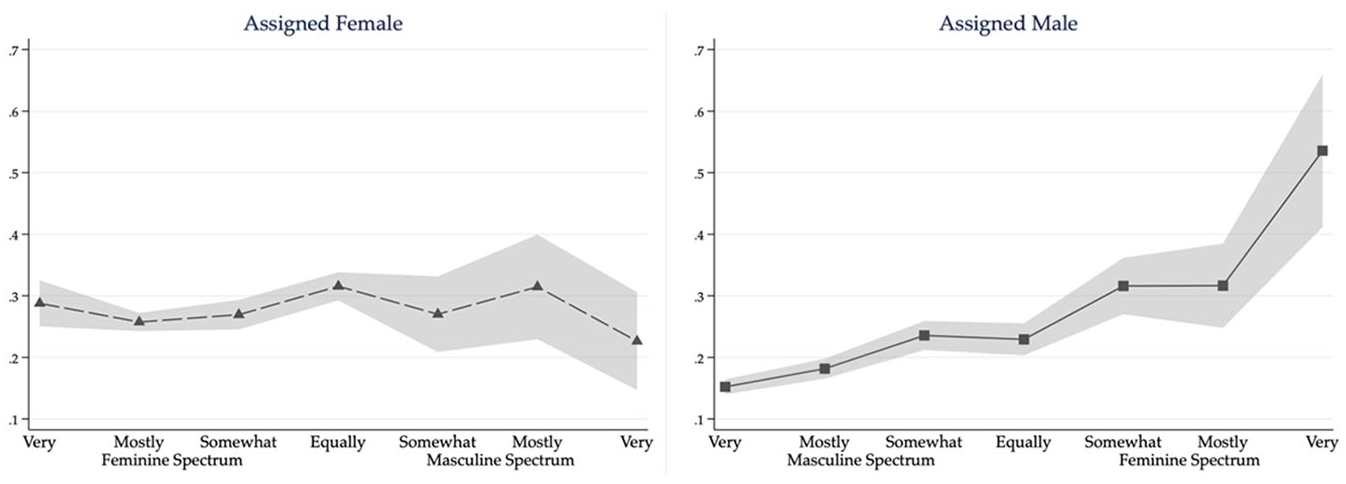
Proportion of Teens Reporting Bullying by Gender Expression and Assigned Sex
In striking contrast, bullying rates among girls are roughly consistent across the full spectrum of gender expression. Although there is some small variation across categories, there is no clear systematic trend. Comparing the two ends of the gender expression spectrum, “very masculine” girls actually reported slightly lower levels of bullying than “very feminine” girls.
Taken together, the results in Figure 1 provide unexpectedly strong support for Hypothesis 2: that nonconforming gender expression would shape bullying rates more strongly among boys than girls. As expected, anything other than “very masculine” gender expression put boys at a significantly higher risk for bullying victimization. Among girls, however, the relationship between gender expression and bullying was not just less steep, as expected: it actually did not appear at all.
The Intersection of Sex, Sexuality, and Gender Expression
The results in Figure 2 illustrate that gender expression powerfully shapes bullying among boys, but is seemingly unrelated to bullying among girls. However, those results do not address the question of whether gender expression is differentially consequential for sexual minority youth. If sexual minority teens are targeted primarily for their sexual identity—regardless of how that identity is expressed—then gender expression could be less consequential for these teens than it is for straight teens. By contrast, if sexual minority teens’ gender expression is scrutinized particularly intensely—seen, for example, as a way of “flaunting” their sexuality—then gender expression could matter even more for these teens. To answer this question, I reestimate the logistic regression models from Figure 2, interacting gender expression and LGBQ identification. Figure 3 presents the average adjusted predictions of this two-way interaction.

Proportion of Teens Reporting Bullying by Gender Expression, LGBQ Identification, and Assigned Sex
The results in Figure 3 suggest that the relationship between gender expression and bullying is effectively the same for LGBQ teens and straight teens. Among girls, bullying rates for both LGBQ and straight teens are roughly flat, rising and falling within a relatively narrow range. Among boys, the shape of the curve differs slightly between groups, but both LGBQ and straight teens face rising rates of bullying as they move away from “very masculine” expression. Together, these results imply quite different experiences of bullying for contemporary LGBQ teens based on their sex assigned at birth.
For LGBQ boys, Hypothesis 3—that gender-nonconforming LGBQ teens will face higher rates of bullying than their gender-conforming LGBQ peers—very clearly held true. Masculine gender expression does offer some protection against bullying for LGBQ boys. In these data, “very masculine” LGBQ boys were about half as likely to be bullied as “very feminine” LGBQ boys. This is a substantively large disparity. For example, the within-group difference in bullying rates between “very masculine” and “very feminine” LGBQ boys (28 percentage points) is much larger than the between-group difference in bullying between LGBQ boys and straight boys overall (16 percentage points).
Nevertheless, across most of the gender expression spectrum, LGBQ boys were still bullied at significantly higher rates than their straight peers. Although there appears to be a crossover in bullying rates at the highest level of nonconforming gender expression—such that “very feminine” straight boys actually report more bullying than “very feminine” LGBQ boys—these estimates are subject to very large confidence intervals and are not significantly different from one another. Apart from these results, it seems that no amount of “masculinity” can bring LGBQ boys’ bullying down to the levels reported by their straight peers. Indeed, “very masculine” LGBQ boys report being bullied at roughly the same rate as “somewhat feminine” straight boys. And so, for LGBQ boys, even “very masculine” gender expression can only reduce—not eliminate—one’s risk for bullying.
By contrast, the results in Figure 2 illustrate that Hypothesis 3 did not hold true for LGBQ girls. Similar to those of their straight peers, LGBQ girls’ bullying rates were roughly constant across the spectrum of gender expression. If anything, “very masculine” LGBQ girls reported slightly lower rates of bullying than “very feminine” LGBQ girls. Therefore, unlike LGBQ boys, highly conforming gender expression provides little protection against bullying for LGBQ girls. For LGBQ girls, the bullying they face seems to be targeting something other than gender expression itself. I explore more fully what might explain these results in the following “Discussion” section.
Sensitivity Tests: Disentangling Gender Identity and Gender Expression
One concern about the results so far is that, without a direct measure of gender identity, I may be conflating gender identity and gender expression. One might worry, for example, that what appears to be a general policing of gender expression—regardless of gender identity—could actually be driven only by the specific targeting of transgender youth. Fortunately, a subset of the sites in my analytic sample included a survey item specifically addressing transgender identification. In five states and eight districts, students completed the following item: “Some people describe themselves as transgender when their sex at birth does not match the way they think or feel about their gender. Are you transgender?” This item provided four response options: “No, I am not transgender,” “Yes, I am transgender,” “I am not sure if I am transgender,” and “I do not know what this question is asking.” Across participating sites, about 1.5 percent of teens responded “Yes, I am transgender.”
In Online Appendix Figures A7 and A8, I report analyses that use this measure to further stratify the sample between transgender and cisgender respondents. I find that transgender students report exceptionally high levels of bullying. About 48.4 percent of transgender students (95 percent CI: 41.9, 54.9) were bullied in the past year, more than double the level of bullying reported by cisgender students (21.3 percent). Although sample sizes limit my ability to analyze variation within the transgender sample, it appears as though transgender teens’ bullying rates were roughly uniform across the gender expression spectrum. By contrast, restricting the sample only to cisgender respondents, I closely replicate the pattern documented in Figure 2: Nonconforming gender expression sharply increased bullying rates for cisgender boys but showed little systematic relationship to bullying among cisgender girls. Taken together, these results provide reassurance that the sex-specific patterns of gender policing reported in my primary analyses are not driven only by the specific targeting of transgender teens. Therefore, although my incomplete data on gender identity is an important limitation of this study, this limitation seems unlikely to substantively change my results.
Discussion
Reflecting on his childhood in Kentucky, the novelist Garth Greenwell (2017, para. 4) writes that as a boy, I tried to police myself, to move in the ways I was told were manly, to check gestures that were effeminate or overly expressive, to control the way my hands moved when I talked, and to keep my voice in its proper range. But effeminacy and my faggy gestures, felt natural to my body. How often my father told me to be a man; how often I felt his embarrassment, his anger, and shame, when I failed.
Greenwell’s account vividly highlights three key issues. First, it speaks to the countless, quotidian ways that gender is continuously expressed through the body. Second, it articulates the unevenly distributed, largely invisible labor needed to discipline a body into “proper” forms of gender expression. Finally, it underscores the violence targeting those who defy gender expectations, particularly those unwilling or unable to “be a man.”
The kind of gender policing that Greenwell describes is central to queer people’s experience of violence, generally (Bohrer 2021; Meyer 2015), and bullying, specifically (Pascoe 2007; Payne and Smith 2016; Robinson 2020). Yet, in population-level bullying research, these dynamics have mostly escaped documentation. As in survey research more broadly (Magliozzi, Saperstein, and Westbrook 2016; Westbrook and Saperstein 2015), bullying research has mostly been restricted to the analysis of binary sex measures, leaving gender expression invisible as an axis of inequality.
Moving beyond these binary measures, in this study, I illustrate the importance of gender expression in the social lives of American high school students. Drawing on a geographically diverse sample of states and school districts, I found that gender expression powerfully shaped bullying for boys but was seemingly unrelated to bullying for girls. Intersecting gender expression and sexual identity, I found that LGBQ students reported feeling seen as substantially more gender nonconforming than their straight peers. Nevertheless, when it came to shaping their risk for bullying, gender expression affected LGBQ students in much the same way as straight students. For boys, anything other than “very masculine” expression put both LGBQ and straight boys at substantially higher risk for bullying; for girls, bullying was roughly constant across the gender expression spectrum regardless of LGBQ identification.
A skeptic might wonder whether all of these bullying reports actually matter. Perhaps these reports simply reflect the sensitivities of a generation trained to label as “bullying” relatively minor behaviors that are of little real consequence. The students in this study suggest otherwise. In Online Appendix Figure A9, I show how dramatically bullying stratifies two measures of mental health: whether the student reported clinically significant depression and whether they “seriously considered attempting suicide.” Online Appendix Figure A9 presents results from two logistic regressions, modeling the three-way interaction of sex-by-sexual identity-by-bullying, controlling for gender expression and the full set of controls described previously. On both outcomes and for every group, bullying is associated with considerable increases in serious psychological distress. I estimate, for example, that about 56 percent of bullied LGBQ girls experienced suicidality in the past 12 months, making them almost twice as likely to report suicidality compared with non-bullied LGBQ girls and more than 4.5 times more likely compared with non-bullied straight girls. Given the real harms that bullying still seems to inflict, what does this study imply about the bullying enacted by today’s teens?
For boys, these results make newly visible the powerful system of sanctions that disciplines boys into very narrow enactments of “masculinity.” It wasn’t just “feminine” gender expression that triggered higher rates of bullying among boys. Even moving from “very masculine” to “mostly masculine” gender expression was associated with a significant increase in bullying. In tracing out the bullying that targets even slight deviations from a “very masculine” ideal, we find clear evidence of “how we valorize normative masculinity while simultaneously treating the category ‘male’ as exquisitely fragile” (Meadow 2018, 20–21).
LGBQ boys were disproportionately—but not uniquely—targeted by this system of sanctions. Just as predicted by a gender policing framework, much of LGBQ boys’ bullying appears to be explained by their higher rates of “feminine” gender expression. I find, for example, that controlling for gender expression explains about 40 percent of the LGBQ–straight bullying disparity among boys. Even so, a certain irreducible portion of LGBQ bullying still appears to reflect a specific animus toward LGBQ boys, regardless of gender expression. Across most of the gender expression spectrum, LGBQ boys reported more bullying than straight boys. Contrary to the protests of Pascoe’s (2007, 58) respondents, even those LGBQ boys who “still throw around a football” were not safe from harassment.
All told, these results reveal that gender expression is a critical axis of inequality among American boys. This study adds to a growing body of evidence illustrating the value of embodied, gradational measures of group typicality (e.g., Hart et al. 2019; Monk 2015). Just as Monk (2015) finds that within-group health disparities between light- and dark-skinned African Americans are often larger than the between-group differences between Black and white Americans as a whole, I find that the within-group bullying disparities between “very masculine” and “very feminine” LGBQ boys are much larger than the disparity between LGBQ and straight boys overall. These results underscore the value of an “infracategorical model of inequality” (Monk 2022): one that uses new measures and methods to disaggregate the inequalities typically hidden behind binary, categorical indicators of group membership.
Whereas gender expression powerfully shaped the experience of bullying among boys, it was seemingly unrelated to bullying among girls. At least in the contexts surveyed here, girls enacting “masculine” styles of speech and dress in their high schools did not face elevated rates of bullying. These results illustrate in a vivid new way the long-standing argument that “masculine” girls are able to avoid social sanctions in ways that “feminine” boys are not (e.g., Meadow 2018; Pascoe 2007). Compared with the strict gender policing that this study documented for boys, the relative freedom afforded to girls comes as welcome good news.
Yet these dynamics leave open questions as to why LGBQ girls still face such elevated rates of bullying. Although LGBQ girls reported feeling seen as more masculine than straight girls, this explained almost none of the bullying that they faced: Controlling for gender expression reduced LGBQ girls’ bullying disparities only by about 6 percent. If LGBQ girls aren’t being bullied for their gender expression, then what marks them as targets for their peers?
Although my data cannot establish with certainty, I suspect that the bullying targeting LGBQ girls is focused more specifically on the policing of (hetero)sexuality. In analyzing conflict among adolescent girls, several studies identify sexual behavior as a central domain of contention and moralized boundary-making (e.g., Armstrong et al. 2014; Miller 2016; Mishna et al. 2020). Miller (2016), for example, finds that girls’ bullying most commonly took the form of “sexual drama,” with “lesbian/bisexual” rumors circulating with almost the same frequency as “slut” rumors. Although lesbian and bisexual girls were sometimes targeted for their gender expression, Miller (2016) finds that the more pervasive harassment they faced focused on their actual or imagined sexual behavior.
In this way, LGBQ girls can still be understood as facing “gender policing”: It is just that the femininity ideals enforced through bullying map less directly onto measures of one’s “appearance, style, dress, or the way they walk or talk.” Compared with boys, girls may have comparatively more freedom to dress, walk, and talk in gender-nonconforming ways. The sexual double standard, however, means that girls’ sexuality still faces far harsher scrutiny. In social systems, where girls’ claims to “proper” femininity rest on chaste, passive enactments of heterosexuality, LGBQ girls commit a double violation: not just sexually desiring women, but also asserting agentive sexual desire at all (Miller 2016).
The LGBQ girls’ persistent bullying is particularly notable, given the rising levels of LGBQ identification among younger cohorts of women. As noted above, more than one in five girls in this study reported identifying as LGBQ, double the rate reported by boys. Girls’ comparatively high levels of LGBQ identification—and particularly their rising rates of bisexuality—are often interpreted as evidence of the declining stigma against same-sex sexuality among young women today (e.g., England, Mishel, and Caudillo 2016). Although this may be true, the bullying reported by LGBQ girls adds a sobering asterisk to this established account. Even if destigmatization is allowing greater numbers of young women to recognize and act upon same-sex attractions, the high levels of bullying these women report indicate that they still risk serious social costs in doing so.
More broadly, the endurance of LGBQ bullying—even among today’s teens, even in some of America’s most progressive contexts—forces us to grapple with the limits of recent progress. During precisely the years when gay rights were triumphing in the courts and gaining support in the polls, the teens in this study were bullying one another in ways that directly reflected and reinscribed a heteropatriarchal gender order. This disjuncture dramatically illustrates Doan, Loehr, and Miller’s (2014) distinction between “formal rights,” legal protections granted by the state, and “informal privileges,” interactional advantages enjoyed by privileged groups. Without a doubt, recent years have brought critical gains in formal rights for LGBTQ Americans. However, the persistence of bullying highlights how LGBTQ youth are still systematically denied the informal privilege of being able to live authentically in their bodies without fear.
After the historically rapid progress of the 2010s, the 2020s have witnessed a record-breaking number of anti-LGBTQ bills proposed and passed across America. Most of these bills specifically target transgender youth: restricting gender-affirming care, preventing transgender students’ participation in sports, and even trying to criminalize drag (Lavietes and Ramos 2022). These attacks are being pushed most aggressively in precisely those contexts where data on LGBTQ youth are most limited, making it impossible to fully document the harms these bills will inflict. Indeed, just days after its “Don’t Say Gay” Bill was signed into law, Florida abruptly ended its participation in the YRBSS (Santich 2022), preventing LGBTQ students from reporting their experiences at exactly the time when we most need to hear them.
By centering the daily lived experiences of LGBTQ youth, the study of bullying helps make sense of this sweeping backlash. The persistence of bullying highlights how much of the progress of recent years was premised on terms of homonormativity (Duggan 2002; Robinson 2020): offering a specific set of liberal rights, but not any fundamental changes in the underlying structures of American life. Understanding LGBTQ bullying as gender policing brings these deeper structures into view. Gender policing enacts, as Bohrer (2021, 87) puts it, “the deep recesses of social order.” Even amid advancing rights and improving attitudes, these deeper investments in gender essentialism and the gender binary are much harder to shake.
These conclusions come with important caveats, given the limitations of this study. First, although I know whether respondents were bullied, I have no further information on the content of this bullying. Given the stark patterns of inequality I find at the intersection of sex, sexuality, and gender expression, I make inferences as to why particular groups of teens were targeted. However, more complete data are needed to confirm and refine these interpretations. Second, it is important to highlight that my data include only reports of recent bullying reported by high school students. Because bullying generally peaks in middle school (National Academies of Sciences, Engineering, and Medicine 2016) and because sexual minority bullying disparities are already well established by third grade (Mittleman 2019), this study substantially understates the full extent of bullying endured by sexual minority youth over the course of their childhoods. Third, I note again that, although the availability of large-scale gender expression data marks a critical advance in bullying research, my gender expression measure is limited to reflected appraisals. Finally, I reiterate that although I draw on a large, geographically diverse sample, my data are not nationally representative. This study cannot establish the prevalence and dynamics of gender policing in other geographic contexts or during other time periods.
Conclusion
The idea that gender is achieved through interaction and disciplined in response to external accountability is foundational to contemporary gender theory. In bullying, we see the sharp edges of this often-subtle process. Bullying enforces the boundaries of what’s permissible for male- and female-assigned bodies. Through bullying, children learn to discipline themselves and others into their “proper” places within the gender binary.
Compared with their straight peers, sexual minority youth face bullying earlier, more often, and with greater consequence. To explain these dynamics, theorists have emphasized the inadequacy of accounts focused solely on sexual prejudice. Sexual minority youth, they argue, are bullied not simply for their sexuality, but rather for the disruptive ways they embody and enact gender. Bullying isn’t just a way of enacting “homophobia”: It is a way of preventing and punishing “gender trouble” (Butler 1990).
Analyzing large-scale data on gender expression among contemporary American teens, this study provides population-based support for these theoretical insights. Sketching out patterns of bullying at the intersection of sex, sexuality, and gender expression, I find vivid new evidence of the enduring constraints imposed by the heteropatriarchal gender order inherited by today’s teens. Even in some of America’s most progressive areas, I show that there are still high costs for girls unwilling to comply with compulsory heterosexuality and that there is still tremendous pressure on boys to present themselves as “very masculine” men.
Supplemental Material
sj-docx-1-gas-10.1177_08912432221138091 – Supplemental material for Homophobic Bullying as Gender Policing: Population-Based Evidence
Supplemental material, sj-docx-1-gas-10.1177_08912432221138091 for Homophobic Bullying as Gender Policing: Population-Based Evidence by Joel Mittleman in Gender & Society
Footnotes
Author’s note:
The author gratefully acknowledges the thoughtful feedback of the Gender & Society Editor and anonymous reviewers.

Supplemental Material
Supplemental material for this article is available online.
Notes
Joel Mittleman is an assistant professor of sociology at the University of Notre Dame, where he is also a faculty affiliate of the Gender Studies Program and the Center for Research on Educational Opportunity. His research empirically centers LGBTQ populations, making novel contributions to the fields of stratification, gender, education, and demography.
References
Supplementary Material
Please find the following supplemental material available below.
For Open Access articles published under a Creative Commons License, all supplemental material carries the same license as the article it is associated with.
For non-Open Access articles published, all supplemental material carries a non-exclusive license, and permission requests for re-use of supplemental material or any part of supplemental material shall be sent directly to the copyright owner as specified in the copyright notice associated with the article.
