



Abstract
Political and popular tropes portray Muslims as monolithically, uniquely, and inherently patriarchal and misogynistic—a phenomenon of which Muslims are acutely aware. This study asks whether and how Islamophobic tropes influence Muslims’ gender ideologies. Using life history interviews with Muslim Americans, we find a diversity of gender beliefs, challenging the discourses that frame Muslims’ gender ideologies as monolithic. Four major typologies emerge in our data: Loyalist Complementarians, Patriarchal Reactionaries, Critical Egalitarians, and Reformist Egalitarians. These beliefs are multifaceted and are composed of a dialogic exchange between beliefs toward gender relations, perceptions of Islamic doctrine, and negotiation with what we call the Orientalist gaze. Each group navigates how their ideas about gender fit into or challenge a broader society that is scrutinizing Muslims, and each group articulates their gender beliefs through and against Islamophobic discourse, a process akin to walking an Orientalism tightrope.
Plain Language Summary
This article summarizes four ways that Muslim Americans think about gender. We argue that each mode is defined, in part, by how it responds to the stereotype that Muslims and Muslim communities are particularly gender oppressive.
Gender has long marked a symbolic boundary between “Muslim” and “Western.” 1 Although these categories are overlapping and internally heterogeneous, a “clash of civilizations” narrative has portrayed them as diametrically opposed—with gender and sexuality as fault lines of difference and conflict. This fault line has been wielded by both Western (e.g., Laura Bush advocating for the invasion of Afghanistan) and Muslim actors (e.g., the postrevolutionary Iranian state) to achieve political ends. In the Western narrative, Muslims are inherently and uniquely gender oppressive—so much so that their societies require both military and social interventions (Abu-Lughod 2002, 2013; Hirschkind and Mahmood 2002; Spivak 2003; Toor 2011). For Muslims who hold to this narrative, Western society is the site of moral decay, evidenced by sexual and gender liberalism, and all attempts at gender- or sexuality-based reform in Muslim societies or communities represents an imperialist incursion (Shahrokni 2020).
Western Muslims’ social and political precarity makes them both impacted by and acutely aware of Orientalist narratives. In Europe, presumed patriarchal and homophobic attitudes are used as a central justification for opposing Muslim migration (Gohir 2015). In the United States, Muslims are more likely to face prejudiced attitudes by those perceiving them as gender inegalitarian (Moss et al. 2019). Muslim women activists are often stuck between gendered Islamophobia and gender oppression in both Muslim and non-Muslim spaces (Ali 2022; Alimahomed-Wilson 2020).
In the social sciences, a vast literature documents differences between Muslims’ gender attitudes and those of other groups, concluding that Muslims are exceptionally gender conservative or inegalitarian (Fish 2011; Inglehart and Norris 2003). Scholars have pushed back against this portrayal by pointing to heterogeneity in Muslims’ gender ideologies, especially when gender ideology is unpacked along multiple dimensions (Charles et al. 2022; Glas 2023). 2 Growing evidence from survey research suggests that a context of hostility can further entrench conservative gender attitudes (Glas 2022; Glas and Spierings 2022), and qualitative research has long asserted a complex relationship between the othering of Muslims and gender ideals (Ajrouch 2004; Ali 2018, 2022; Alimahomed-Wilson 2020; Guhin 2021; Mir 2014). Still, the details of this relationship remain unclear.
Using in-depth life history interviews with Muslims born or raised in the United States, we examine how Muslims construct their gender ideologies in an Orientalist context. We suture together Foucault’s (1980) conceptualization of a disciplinary gaze, Said’s (1978) definition of an Orientalist discourse, and Fanon’s (1986) discussion of the gaze’s interiorization. We find that Muslims construct their gender ideologies in a dialogic exchange between beliefs about gender relations, perceptions of Islamic doctrine, and negotiations with what we call the Orientalist gaze. Four major configurations of gender ideology emerge at the intersection of these components: loyalist complementarians, patriarchal reactionaries, critical egalitarians, and reformist egalitarians. Each group must navigate how their ideas about gender fit into or challenge a broader society that is scrutinizing Muslims, and each group articulates their gender beliefs through and against Islamophobic discourse—a process akin to walking an Orientalism tightrope.
Literature Review
A substantial literature examines whether Muslims have exceptionally patriarchal gender ideologies (Fish 2011). A central thesis of Inglehart and Norris’s (2003) oft-cited Rising Tide: Gender Equality and Cultural Change around the World is that Muslim-majority nations are the last holdouts in a world moving toward gender equality. Several studies since Inglehart and Norris (2003) find differences in gender ideology between Muslims and non-Muslims, either across cultural contexts or within them (Diehl, Koenig, and Ruckdeschel 2009; Maliepaard and Alba 2016; Norris and Inglehart 2012; Röder 2014).
This scholarship has faced criticism as Islamophobic. Some have questioned the degree to which gender ideology actually explains important outcomes such as women’s employment (Abdelhadi and England 2019). Others have asked whether presenting population-level averages reinforces the idea that Muslims are a monolithic group and obscures intra-Muslim variation (Beek and Fleischmann 2020; Glas 2021; Van Klingeren and Spierings 2020). Scholars have also pushed against one-dimensional discussions of gender ideology, which has been increasingly conceptualized as multidimensional, rather than falling across a single spectrum from egalitarian to patriarchal (Brinton and Lee 2016; Grunow, Begall, and Buchler 2018; Knight and Brinton 2017). Although support for women’s access to the public sphere has been consistently high, some combine it with a belief in the centrality of family life for women—suggesting the rise of different forms of egalitarianism (Knight and Brinton 2017).
Recognizing the multidimensional nature of gender ideology, Glas (2023) distinguishes between European Muslims’ views on public-sphere gender equality, family role divisions, and sexual liberalization. She finds that with time in Europe, Muslims become more supportive of public-sphere equality and sexual liberalization, but less supportive of gender equality in family roles. Charles et al. (2022) find that MENA (Middle East and North Africa) Muslims’ views on “women’s chastity” and “marital patriarchy” differ by levels of piety and by social context. Also analyzing the MENA region, Glas and Spierings (2019) find that one in five people combine high religiosity with highly egalitarian gender views, proposing a typology that distinguishes among secular, religious, and Islamic feminists.
Scholars have also complicated the story of Muslims’ gender attitudes by attending to the role of context. In Europe, country-level hostility to migrants drives down migrants’ support for gender equality (Glas 2022), and perceived discrimination is correlated with more opposition to homosexuality, particularly among mosque-goers (Röder and Spierings 2022). Indeed, it seems that hostility to migrants not only correlates with gender and sexuality attitudes, but can modify the relationship between religion and those attitudes (Glas and Spierings 2022). Our paper builds on these studies by mapping how Orientalist discourse shapes gender attitudes across a spectrum of beliefs.
In the Muslim American context, qualitative studies suggest that Islamophobic discourse on gender figures into Muslims’ day-to-day lives (Abdulhadi, Alstultany, and Naber 2015; Naber 2005; Peek 2005). For example, Shabana Mir (2009, 2014) documents how Muslim women on college campuses attempt to simultaneously appear gender conservative to other Muslims and gender liberal to non-Muslims. Mir (2009, 241) directly connects this gendered behavior to Orientalist discourses, arguing that “Orientalist stereotypes haunt Muslim behavior.” Alimahomed-Wilson (2020) similarly shows that Muslim women activists are in dialogue with gendered Islamophobic narratives as they navigate gender oppression. Tazeen Ali’s (2022) ethnography of the Women’s Mosque of America illustrates this dynamic, showing how activists attempted to critique mainstream mosques’ treatment of women while side-stepping the ever-present gaze of Western feminism. Still other studies show how gender norms can be internalized by Muslims as a boundary marking their difference with white American society (Ajrouch 2004; Guhin 2021). By mapping both gender-essentialist and gender-egalitarian views among Muslims, we show how the context of Orientalism figures into the making of gender ideology for different Muslims—both women and men, essentialist and egalitarian.
Theoretical Framework: Orientalism as a Gaze
Edward Said (1978) famously described Orientalism as a discourse that produces knowledge as an instrument of power, using images of the Middle East as monolithic, chaotic, and in need of Western intervention to maintain domination. Much of the knowledge production in sociology, the disciplinary vantage point from which we write, has been shaped by orientalism (Chua 2008), yet this knowledge production is fundamentally in service of power relations, justifying Western domination. Orientalism is relational, providing an essentialized image of the East against which the West can define itself (Bayat 2015; Moussawi 2020; Ngai 2000). Orientalist discourses are multifaceted and variant, and can operate in overlapping ways (Bakić-Hayden 1995; Moussawi 2020; Ngai 2000). Orientalism can simultaneously operate on local, global, and regional scales, producing discourses that may seem to contradict the East–West, traditional–modern, patriarchal–egalitarian binaries, while in fact reinforcing a broad-scale reproduction of otherization—a phenomenon that Moussawi (2020) characterizes as “fractal orientalism.” New forms of Orientalism develop over time. For example, neo-Orientalism responds to globalization and shifting cultural exchange (Bayat 2015), whereas “data orientalism” emerges as algorithms are used to produce knowledge and shape power relations via big data (Kotliar 2020).
Across its varying and emerging forms, Orientalism is consistently deployed through gendered tropes. Muslims are rendered essentially patriarchal in ways that simultaneously justify Western intervention and figure the West as inherently gender-egalitarian (Abu-Lughod 2002, 2013). Indeed, since Said’s initial discussion of Orientalism, the image of Muslims as fundamentally backwards, misogynistic, and brutish has been remarkably persistent and has been rendered central to Orientalist discourses in the 20th and 21st centuries (Heffernan 2016; Skenderovic and Späti 2019). Media representations of Muslims in the United States continue to use gendered norms as an axis of moral differentiation between Islam and the West, making American Muslims heroes or victims based on their relationship to this dichotomy (Alsultany 2012; Charania 2014, 2015) Meanwhile, Orientalist discourses around Muslims and queerness have essentialized forms of Arab queerness and masculinity, shaped queer Muslims’ political imagination and mobilization, and reinforced Western domination through interventionist projects in the Middle East (Massad 2008; Moussawi 2013, 2020; Savcı 2021). Across context, time, and scale, Orientalist thought has relied on tropes of Muslim men as being uniquely and brutally patriarchal (Alsultany 2012; Heffernan 2016; Said 1978); of Muslim women as passive and in need of saving (Abu-Lughod 2002, 2013; Mohanty 1984; Spivak 2003); and of Islam as fundamentally and immutably regressive in ways that necessitate Western hegemonic domination.
We use these scholars’ definitions of Orientalism and apply them to the process of constructing and articulating a gender ideology. Deploying Foucault and Fanon, we show how Orientalism can be an external, disciplinary gaze that is interiorized by its subjects and, in turn, shapes their self-conception. Foucault (1980, 154) conceptualizes the external disciplinary gaze as comprising two components: the external imposition of the gaze, and its internalization, which he describes as an “inspecting gaze” that compels its subjects to become their “own overseer[s]” by interiorizing a degree of self-surveillance. Fanon (1986, 217) further clarifies this, arguing that a major effect of racialization is the constant state of self-comparison and self-evaluation, writing that the colonized “compares himself with his fellow against the pattern of the white man.” In egalitarian social relationships, individuals define themselves through mutual recognition with others. However, the power dynamic between Black and white—like the dynamic between Occident and Orient—disrupts this dialectic, justifying oppression (i.e., colonial subjugation, enslavement, and the like) rather than recognition. Consequently, subjugated people’s internal lives are shaped in response to this inherent misrecognition. That is, while disciplinary gazes might be externally enforced, their internalization does as much to control people’s behavior as the discourses themselves do, if not more. We refer to this phenomenon as the Orientalist gaze.
Our data illustrate how American Muslims are not merely passively and ambiently understood through the Orientalist gaze; rather, our subjects are shaped by this gaze and are compelled to respond to it. Consistent with the centrality of gender in Orientalist discourses (Abu-Lughod 2013; Alsultany 2012; Charania 2014, 2015; Moussawi 2020; Savcı 2021), we show that gendered discourses are essential to the internalization of the Orientalist gaze, which is made apparent in the extent to which the Orientalist gaze shapes our interlocutors’ discussion of their gender ideologies. As we will show, Muslim Americans understand, construct, and articulate their attitudes toward gender vis-à-vis Orientalist constructions of Muslims as essentially patriarchal, demonstrating the ubiquity and disciplinary strength of the Orientalist gaze, as well as the centrality of gender in its deployment.
Data and Methods
The data consist of 80 semistructured, in-depth, life history interviews conducted over two rounds by the first author as part of a broader study on how embeddedness in American Muslim communities evolves across the life course. Respondents were adult residents of New York, New Jersey, and Connecticut who grew up in the United States with at least one Muslim parent and were born between 1971 and 1986. 3 Sampling was designed to be orthogonal to respondents’ religiosity or level of involvement with Muslim institutions. Converts were considered ineligible for the study, because of the larger project’s focus on respondents’ relationships with Muslim communities over the life course. A list of registered voters with likely-Muslim names was purchased from a voter-targeting firm that uses a global name algorithm. 4 Voters were flagged if either their first name or their last name was likely to be Muslim. In each round of interviewing, we received a random sample of likely-Muslim voters from each state in the age range of interest. Potential interviewees were sent a recruitment letter, phone call, and text inviting them to participate. 5
The first set (N = 55) took place between April 2016 and September 2017, in person. To ensure that answers in this round were not artifacts of Donald Trump’s presidential campaign and subsequent election, a second round of interviews (N = 25) was conducted between August 2021 and July 2022 over Zoom. We found no significant differences in the two waves in terms of respondents’ discussion of gender. The resulting interviews ranged from 35 to 188 minutes, with an average of 91 minutes; and they were all transcribed, coded, and analyzed on Dedoose. Interviews were in the form of life histories and followed the social lives of respondents across the life course, with inquiries about ideology along the way. In our analysis, we take into account both explicit statements about gender ideology as well as the gendered dimensions of respondents’ lives, such as their household division of labor.
Our sample consists of 44 women and 36 men; it is older, more educated, and skews more heavily U.S. born and female than the national averages for this cohort of first- and one-and-a-half–generation nonconvert Muslim Americans. 6 Our respondents were also less likely to be married, more likely to have divorced or separated, and less likely to have had children. Among women, fewer wear the hijab than in the national comparison group (26 percent compared with 42 percent). 7 Overall, these trends suggest a more liberal and less religious sample than a probability sample of the same cohort might have yielded. This could be a result of the method of data collection. Our sample is limited only to registered voters, who overall tend to be more highly educated than the average American (Ahearn, Brand, and Zhou 2023; Lijphart 1997). Highly educated samples, in turn, skew less religious and more liberal (Albrecht and Heaton 1984; McFarland, Wright, and Weakliem 2011; Psacharopoulos and Patrinos 2018; Schwadel 2015). Religious Muslim institutions have also been subject to intensive state scrutiny and surveillance, which could have made religious respondents more reluctant to give a researcher access to their lives (Selod 2018).
Black Americans are underrepresented in our sample (at 7 percent compared with 17 percent in the national comparison group), while South Asians are slightly overrepresented. By excluding converts (who make up 16 percent of U.S. Muslims), we lose a significant proportion of Black Muslims, 44 percent of whom are converts (Mohamed and Smith 2017). Although the name algorithm flags respondents if either their first or last name is Muslim, sampling through names may have led us to missing children of converts who would have been eligible to participate. As a result of these limitations, this study does not reflect the racial makeup of American Muslims more broadly. Future research should address this important gap, since we know that differences in gender attitudes have appeared as a key fissure between Black and immigrant Muslims (Karim 2008; Prickett 2021).
Notably, the respondents in this study all happen to be cisgender. We have no data about the percentage of Muslim Americans that are transgender or genderqueer, but that group is not represented in these interviews. Respondents tended to speak about gender in binary ways, leaving the categories of woman and man relatively unquestioned.
Despite these limitations, to our knowledge this is the only qualitative study of American Muslims that does not sample on religiosity or embeddedness by relying on Muslim institutions. We consider this a core contribution of the work, because it provides a rare sample that varies in its religiosity and the strength of its ties to Muslim communities.
Researcher Positionality
The first author is an Arab, Muslim cis woman who does not veil, but has an identifiably Muslim name. Respondents were more candid and less defensive of their beliefs and their Muslim communities than they might have been with a non-Muslim interviewer. Respondents who felt critical of fellow Muslims or of Islam shared these beliefs rather openly, perhaps because they read the interviewer as secular, while still placing caveats around what they might say in public. Respondents who felt aligned with what they saw as Islamic doctrine assumed she shared those beliefs as a Muslim as well. The second author is a queer, white, Jewish woman. She did not conduct any of the interviews but undertook all of the interview coding and the first wave of analysis. Both authors collaborated on subsequent waves of analysis and writing, following an iterative, inductive process. We recognize, of course, that our sociological inquiries and interpretations are influenced by our own experiences and are embedded in a broader social world (Collins 2009, 2019; Sweet 2020).
Results
Muslim Americans’ gender ideologies were multifaceted. We identify three distinct dimensions that characterized respondents’ gender ideologies (see Figure 1). The first was beliefs about gender relations: whether women and men were inherently suited for different tasks and roles in society. The second dimension was the respondents’ perception of Islam’s take on sex and gender: whether Muslim doctrine assigned women and men separate roles, and whether it afforded them different levels of power. These two dimensions influenced each other and were in a dialogic exchange with the Orientalist gaze. Muslim Americans universally discussed their gender ideologies relative to how they felt Islam was being perceived by American media, policymakers, and the public through a process we call walking the Orientalism tightrope.
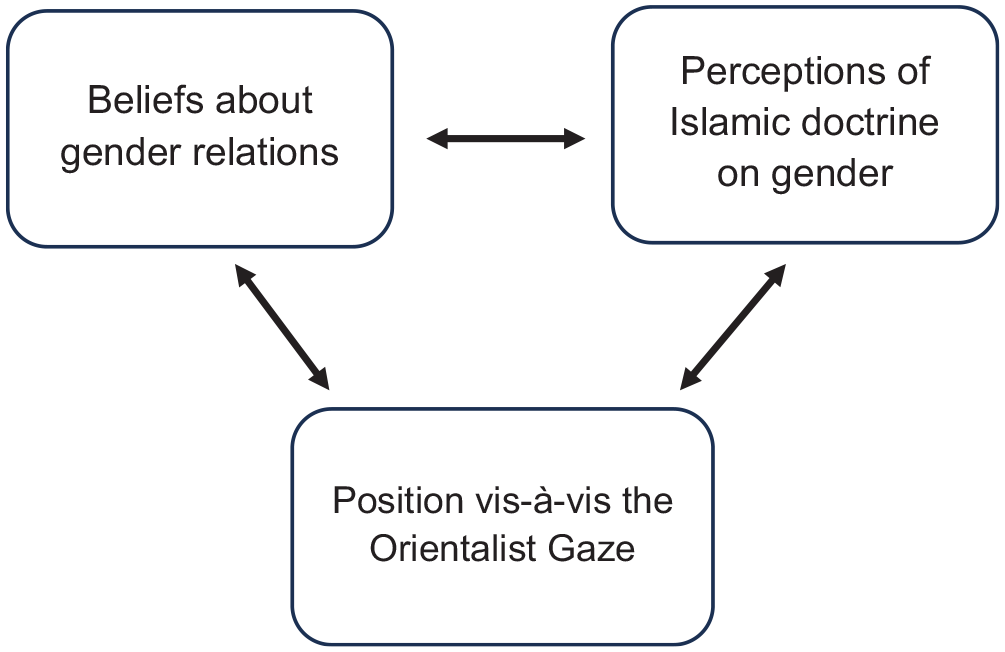
Dimensions of Muslim Americans’ gender ideology
Four different typologies emerge in our data, composed of different takes on each of the three dimensions mentioned above. Table 1 summarizes these typologies: Loyalist Complementarians, Patriarchal Reactionaries, Critical Egalitarians, and Reformist Egalitarians. 8 Loyalist Complementarians made distinctions between gender differences and gender hierarchy, and emphasized the extent to which complementarian gender roles worked to empower women rather than subjugate them. Patriarchal Reactionaries were supportive of gender hierarchy and saw a return to patriarchal Islamic doctrine as providing protection against the incursions of a morally decadent secular society. Like Patriarchal Reactionaries, Critical Egalitarians agreed that Islam was inherently patriarchal, and that secular society had fewer instances of overt gender hierarchy—though they articulated Muslim communities’ gender inequality as fundamentally oppressive and wrong. Finally, Reformist Egalitarians articulated gender inequality in Islam as symptomatic of patriarchal systems that transcended boundaries of culture and religion, rather than as a reflection of a Muslim-specific patriarchal imperative.
Muslim Americans’ Gender Ideologies

For each group, we show how respondents’ beliefs about gender are articulated through their beliefs about Islam and its gender system, and how these beliefs are managed vis-à-vis the Orientalist gaze. We argue that Muslims across all four groups must walk an Orientalism tightrope that forces them to reconcile their beliefs with how they are perceived by the external world.
Group 1: Loyalist Complementarians
Hannan, a 32-year-old, Arab American woman, felt unprepared to juggle a career and a family because she grew up without any examples of women doing so. Rather than seeing this as a direct result of her upbringing in a practicing Muslim community, Hannan saw it as a deviation from the tradition, citing the way Muslim women had combined these roles throughout history.
For me, because growing up I didn’t have a strong Muslim role model—I didn’t know anyone that worked, and had kids, and had a successful marriage—So whenever I think of my future, I think of finding the balance between all of that and kind of being that role model that I didn’t have as a child. It was kind of implied to me that it was one way or the other, you can’t have both. And there are women that do it now. And there are women in Islamic history and in history in general that did it.
Sure. Do you think that in an ideal world men and women play different roles in the house?
I think that western feminism is kind of like “anything a man can do, I can do.” I’m more, we have differences. Let’s embrace our differences and complement each other. For me, I’m more of a caretaker, so when it comes to who will be the primary person caring for my kids? It’s gonna be me. Especially in infancy—your husband can’t nurse your kids. That’s just a biological concept that we need to really just get around.”
Hannan, like many other Muslims, can be understood as having a complementarian gender ideology. For complementarians, men and women have inherently different social roles that are based in biology, supported by Islamic doctrine, and modeled in Islamic history. These differences in roles are not hierarchically related to one another. Rather, they allow for women’s agency and are inherently equitable.
Hannan critiqued Western feminism as erasing women’s unique skills and differences, and in doing so, implicitly treating women’s skills as less important than those of men. By treating women’s supposedly inherent skills, such as caregiving, as equally important to men’s professional roles, complementarians saw their framework as elevating women’s status, particularly compared with non-Muslim communities. Moreover, complementarians emphasized that these distinct roles do not entail hierarchy, rejecting the idea that men have a greater right to decision making in heterosexual households.
For Loyalist Complementarians, gender roles did not necessitate inequality or patriarchy. Jauher, a 29-year-old South Asian man, explained: From my interpretation of Islam, I would say they talk about equality. Men and women are always equal. There are certain things which belong—certain rights belong to men, but there are certain rights which belong to women also. When you come together and you combine . . . [men’s] lists and [women’s] lists, I think men and women are equal in status. There are definitely things a man cannot impart to a child whereas women can. Again, there are things which belong to women; there are things which belong to men. But both are equal in nature. Both are equal.
Islam puts forth a gendered division of labor that treats women’s labor as equally important to men’s labor. Because these roles are complementary to and dependent on one another, they are inherently equitable. Jauher emphasized the importance of gender equality both in nature and in status—suggesting an essentialized individual and social ontology of gender. Still, Jauher and others took this gender equity as being fundamentally opposed to patriarchy.
Complementarians—men and women alike—recognized that there are instances of hierarchy, patriarchy, and misogyny in Muslim communities. However, they attributed inequality to misinterpretation of Islam and to “cultural” elements that corrupt otherwise equitable gender dynamics. “Culture” is a catch-all term for ethnic and national particularities that are separable from Islamic doctrine (Ali 2018; Guhin 2021; Howe 2018; Karim 2008). Lamees, a 31-year-old Black woman, discussed how gender inequality in Muslim communities comes from male dominance, and strays from a purer and more equitable Islamic past: I feel like we’re deviating from the prophetic example and only focusing on the things that [men] want. So, I think that’s happening where they’re thinking, “Oh, they just take care of the babies. They cook, they clean, and they’re my tool for relieving myself from my desire” or whatever . . . Where they forget women have desires too, right? Men have responsibility—emotional responsibility. And so I think that because the rules and the rulings are made by men, they focus on their needs and they’re forgetting about those and their responsibilities and the needs of women. So, I feel like the culture comes into play a whole lot and I feel like that is causing the message—the importance of both genders—to be lost.
To Lamees, gender equality became distorted when women’s roles were understood as responsive to men’s desire, rather than as agentive in their own right. The “rules and rulings” Lamees referenced were not of the faith, but rather reflected the ethnic particularity of the rulers as well as their own desires as men. By reframing separate gender roles as hierarchical, rather than equitable, the underlying message (as modeled by Prophet Muhammad) of gender equality became lost. Men and women do not occupy the same social spaces—insofar as there are essentialist differences between men and women, which are reflected in their separate roles. Still, the truest, most Islamic version of these complementarian gender roles is free from hierarchy, gendered restrictions, and male domination.
Complementarians were acutely aware that these instances of patriarchy and hierarchy, which they understood to be cultural rather than religious, corroborated a negative impression of Islam held by many in the American public. Arham, a 43-year-old South Asian man, articulated his frustrations with the Orientalist gaze: You know, in Surah An-Nisa, and other things, there’s no other religion in this world that is arguably more pro-women. All these stupid restrictions are from stupid culture . . . All the cultural restrictions and oppression is all frickin’ cultural. And this is what I try to argue with my non-Muslim friends, what the media shows, that Muslim women are prohibited in this and that. You are a better species.
9
God has given you . . . the capacity, the stamina, and many other things, in addition to that. So, all the restrictions that are made by male dominant societies is cultural, in my opinion. That’s culture, or Pakistani culture, or whatever culture it is.
Arham’s discussion of Islam as an inherently feminist religion was not conducted in a vacuum. Rather, he presented his non-Muslim friends and the media as two foils against whom he argues. Implicit in his argument was a critique of media portrayals of Islam as being fundamentally backwards and patriarchal—a critique that was reflected in his non-Muslim friends’ understanding of gender dynamics in Muslim communities. For Loyalist Complementarians to get across the Orientalism tightrope, they needed to defend Islam’s complementarian gender politics and explain away instances of gender inequality. They did so by articulating a distinction between religion and culture. The former empowers women, enabling them to maximize their strengths for personal and social advancement, whereas the latter imposes restrictions on them for men’s gain.
Group 2: Patriarchal Reactionaries
Islam both justified and necessitated a patriarchal structure for Saleem, a 36-year-old Black man.
If people have a big problem with patriarchy existing in Islam, they use a fancy term like “male hegemony,” that type of thing. It’s a euphemism for misogyny and all those types of things . . . Islam by definition even in terms of lineage, genealogy, it’s patriarchal. Why? Because the first human being Allah created was a man; that’s why our law refers to us in the Quran as “banu Adam” [children of Adam]. We’re known as the children of Adam for a reason. Why? Because the first human parent was a male. The first human being was a male. Patriarchy most definitely has a place in Islam.
Islam both justified and necessitated a patriarchal structure for Saleem. When he spoke about such patriarchy, however, Saleem took care to contrast it with external critiques of “misogyny and all those types of things.” By characterizing ostensibly secular critiques of Muslim patriarchy as being reliant on “fancy terms” such as male hegemony, Saleem gestured toward an imagined division between a patriarchal Islam and an external critique.
Saleem was a typical example of a Patriarchal Reactionary. For this group, patriarchal structures were inherently Islamic, and hinged on both gendered divisions of labor and on an explicitly hierarchical power dynamic. The problems among Muslim men and women are introduced by attempts to dilute these patriarchal structures through egalitarian notions that are both un-Islamic and unnatural. Patriarchal Reactionaries understood attempts at equality as fundamentally bad for women, leading to discord and dissolution of the family unit. Moreover, they saw attempts at egalitarian reform as rooted in Western intervention perpetuated by outsiders and/or by misguided Muslims.
Like Loyalist Complementarians, Patriarchal Reactionaries rooted their gender ideologies in their readings of Islamic texts. Take Waheed, a 39-year-old South Asian man, who discussed his ideal household division of labor by first referencing a story about Prophet Muhammad: Ali and Fatima went to him and asked him “How should we divide our duties?”
10
He said: “Ali, your job is to take care of your affairs outside the house. Fatima, your duty is to take care of the affairs inside the house.” Now, that’s a general paradigm: a man should be responsible as a primary earner, fixing the car, mowing the lawn, all the outside stuff, and the woman . . . She can’t work. If you have a family, if you have kids, meals have to be cooked, the house has to be cleaned. Somehow it has to happen, it can’t just magically happen. If a guy’s doing what he is supposed to do, which is being out of the house and working, he can’t do everything. And then, within that, the man can help. He is not supposed to be expected to be the primary guy, cause he’s not supposed to be sitting at home. If he is, there’s a problem. He should be out. This is not something I heard from scholars, this is just an analogy I thought of myself. In decision-making, I look at it like two people in a car: if I’m driving with my wife, I have the steering wheel.
Waheed framed patriarchy as having textual justification that can be integrated into contemporary life. Such patriarchy, according to Patriarchal Reactionaries, is good for women—insofar as it has some flexibility within it. While women are responsible for making sure the cooking and cleaning gets done and, as such, cannot work, men may still “help” around the house. Still, rigid power dynamics were baked into Waheed’s gender paradigm. Men are the primary decision makers, steering the relationship and household decisions.
Yet this patriarchal approach was discussed alongside resistance to it. For Patriarchal Reactionaries, attempts at gender equality are aberrant, un-Islamic, and are ultimately attributed to external influences. Waheed, who ended up divorcing his wife after disagreements about the household division of labor, articulated this through his discussion of his ex-wife’s upbringing: “She saw this female-dominated household . . . so she thought that was the norm. [That was] the biggest problem I had with her. If that wasn’t there, I think we’d be together.” Ammar, a 43-year-old Arab man, similarly attributed women’s breaks from Islam to external forces, saying that technology has “brought society into the house.” He explained: My wife’s second cousin ran away from the house. She doesn’t want to wear the hijab. She doesn’t want to be Muslim. Whatever. The father was always working. The mother was always on the iPhone, chatting, and just . . . the money was coming in. And then, al dunya [the secular world]. So what did she learn? She learned it from the environment. That’s it.
For both Waheed and Ammar, the things that cause conflict and push women away from Islam—and their hierarchical households—came from households in which women were decision makers. These households symbolized a Western, consumerist set of ideals represented at once by the iPhone and the money “coming in” as well as by feminist intervention. The cousin’s mother may have opened the door to egalitarianism through her use of the iPhone, but it was the secular world that was to blame for the daughter’s rejection of gender hierarchy. Deviation from a male-led household created opportunities for the secular, non-Muslim world to further corrupt Ammar’s relative. In describing this conflict, he reinforced the idea that patriarchal Islam and secular Western culture are antagonistic toward one another, particularly when it comes to gendered values. The external world pushes a set of values that draw women and men out of their natural and Islamically prescribed roles, thereby threatening both the Muslim family and individual Muslims’ characters.
Patriarchal Reactionaries did not necessarily contradict the tenets of the Orientalist gaze; they just rejected its moral high ground. For this group, the patriarchy in Islam is worth embracing, because it facilitates social cohesion and harmonious households, and protects against the incursions of a morally decadent consumer culture. Like some other Muslims critical of Western norms—such as the women’s mosque movement in Egypt (Mahmood 2004)—these respondents saw gendered restrictions and patriarchal structures as a form of embodied resistance.
Group 3: Critical Egalitarians
Omar is a 40-year-old man born to a Syrian immigrant dad and an Irish mom who converted to Islam; his parents met in the United States. Early in Omar’s childhood, the family moved to the United Arab Emirates (UAE) following a lucrative employment opportunity for his father. They grew up relatively religious, praying regularly, fasting Ramadan, and refraining from pork and alcohol. When Omar was in his early teens, the family moved back to the United States. Omar said they stopped visiting the UAE because his mother and sister did not like being there. When asked why, he simply cited the “cultural and religious-based misogyny.” Omar described himself as a feminist, though he articulated feminism as incompatible with Islam and Muslim communities. Across his life, Omar grew frustrated with “the state of the Muslim world and how it treats women.” He distanced himself from the faith, a process he termed a “sort of liberalization.”
The source of the patriarchy in the Middle East and in American Muslim communities was clear for Omar. Unlike Loyalist Complementarians, he felt no need to distinguish between culture and religion. Nor did he think, like some complementarians, that instances of gender oppression among Muslims were a result of a misinterpretation of the texts or a privileging of ethnic or national culture over religious edicts. Culture and religion simultaneously contributed to the mistreatment of women, and the state of gender relations among Muslims was indistinguishable from Muslim teachings. While he associated patriarchy with Islam and the “Muslim world,” Omar made no observations about patriarchy in the United States. His mother and sister’s experiences in the UAE were set against a backdrop of a United States presumably free of gender-based oppression. Critical Egalitarians were exclusively critical of Islam, Muslims, and Muslim societies. They did not espouse gender-based critiques of secular or Western societies, implicitly or explicitly accepting the assumption that Western societies are fundamentally egalitarian.
Another respondent, Rimsha, a 35-year-old South Asian woman, was trying to have children with her Christian husband. They hoped to raise the kids in both faiths but were also aware that this may come with complications. She joked: “Or maybe we have to write that kid’s book. ‘Dad is Christian. Mom has to walk through a separate door that says, ‘Sisters,’ and this is why.’” For Rimsha, Christianity required no explanation, its gender ideology being presumably neutral and egalitarian. “Mom,” however, uniquely faced gender segregation that requires explanation for future children, which Rimsha cited as a potential hurdle to raising them Muslim. The joke suggested that patriarchy is exclusively a Muslim problem—one Rimsha’s children would only experience vis-à-vis their Muslim heritage.
When Ahmed, a 45-year-old Afghani American man, was asked if he attends the mosque, he said: “I wasn’t terribly involved, also because I was starting to get involved with more of the political, the feminist, the humanist.” These identities—feminist and humanist versus Muslim—were contrasted, as Ahmed suggested that he pursued the former at the cost of Muslim community involvement. Throughout the conversation, Ahmed compared himself with other Muslim men, affirming over and over that he was “liberal, feminist, and humanist.” Ahmed’s disenchantment with the Muslim community was specifically gendered. He watched his childhood mosque and college MSA grow increasingly conservative, as evidenced by the rise in the number of women choosing to veil.
What was most surprising was women that I knew voluntarily started wearing the hijab. We didn’t have the hijab growing up, I didn’t see the hijab on a single woman growing up; not one. And more and more women were wearing it all of a sudden . . . I was just like “what on earth.”
For Ahmed, veiling signaled a conservative shift in values, one associated with gender-traditional life course developments. He was shocked to see women in his community not only veil but also pursue early marriage.
You know it’s like here is this person who seemingly is so open minded and intellectual, wants to grow out of the mold, and all of a sudden you hear that she’s engaged. And you never meet this person, the person she’s engaged to. And they all of a sudden dissociate from you, and some of them manage to graduate [from college], some of them don’t manage to graduate, and some of them you hear are divorced.
Ahmed contrasted being “open minded and intellectual” with wearing the hijab or getting engaged at a young age. As his friends started to get married, the women disengaged from him, presumably to avoid a mixed-gender friendship. Of the women who got married, only “some of them manage[d] to graduate.” Ahmed juxtaposed religious and conservative life choices with secular achievement and, indeed, the liberal, humanist values that a college education represents.
Yet Ahmed tried to balance a critique of the hijab as signifying conservative and religious values with a refusal to overtly malign it, reacting strongly when asked whether his wife wore the hijab: No, no, noooo; it’s something I have an aversion to actually. I strongly believe it’s just as wrong to tell a woman to take it off as it is to put it on, except for my daughter and wife [laughs]. You’re not wearing it [laughs]. So, and they’re fine with that, that’s what they prefer.
Ahmed nodded to the notion that banning the hijab is a form of repression, signaling his divergence from Islamophobic policies that target women’s right to veil in the public sphere. Yet Ahmed was clear that he would not allow his wife or child to wear a hijab. He fundamentally framed the hijab as a bad choice that people (unrelated to him) should be free to make. Ahmed doubly employed a rights-based framework and a strategy of privacy. Although he refused to publicly defame the hijab, and was willing to defend it as a choice, he retained a critique of it as a form of gender oppression.
Critical Egalitarians did not question the theological bases of gendered restrictions or edicts. Ahmed and others of this group assert the belief that hierarchical relationships between women and men are part and parcel of Islamic teachings. Although they assessed the results differently, Critical Egalitarians and Patriarchal Reactionaries shared an interpretation of Islam’s orientation toward gender: that women should be subordinate to men, and that gender-based social roles are dictated by God. But while Patriarchal Reactionaries believed that these are morally positive teachings which are appropriate to the natural social order, Critical Egalitarians articulated these beliefs as outdated, embarrassing, and unfit for modern life.
However, disdain for Islam’s supposedly patriarchal beliefs posed a political dilemma for Critical Egalitarians, who were reluctant to align with Orientalist views of their communities. Take Shireen, who grew up in an abusive household. Her father justified his tendency toward control by referencing Muslim doctrine. Although she was religious as a child, Shireen—a 38-year-old Arab woman—began to feel alienated from the gendered elements of Muslim belief when she reached adolescence. As she got older, the rest of her beliefs disintegrated as well. “I am not a religious person at all,” she said. “I don’t like organized religion.” Much of Shireen’s criticism of Islam revolved around what she sees as the inherently patriarchal elements of the religion. But Shireen avoided a straightforward disavowal of Islam, largely on political grounds:
It’s really hard. I don’t wanna say Orientalist stuff right now, but I just find Islam to be very oppressive, at least for me. I just link a lot of abuse with Islam . . . I don’t want to in any way play on the stereotypes around Islam. It’s a very fine balance, I think, of talking about Islam and women, and the oppression, and just the sexism in Islam, and not wanting people like Bill Maher being like “Oh yeah, our views of Islam, you totally solidified them.”
Shireen struggled to reconcile her perception of “sexism in Islam” with her reluctance to give a win to Orientalists—an ambivalence shared by all the participants in this category. Respondents like Shireen seemed to worry that pointing to gender inequality in their experiences and in their communities would place them in the wrong camp. Thus, they kept their critiques private and internal—a strategy Reformist Egalitarians employed as well.
Despite his strong critique of the hijab above, Ahmed chose not to engage with non-Muslims who asked him about Muslim political life, and instead kept his critiques private: There were lots of people with closed-minded views, and asking really ignorant questions . . . I think that was one thing that I hated. When people wanted me to educate them, it wasn’t necessarily my job. And it wasn’t necessarily something I had time for. It was just surprising that people couldn’t figure it out for themselves, even though the information—the Internet was there at that point. The information was all there, but people couldn’t be bothered to research it on their own, and they would make very bad interpretations on very little knowledge.
Ahmed resented being asked to respond to “really ignorant questions” as if it was his responsibility to speak for all Muslims or educate non-Muslims. Because he felt that these non-Muslims would make “very bad interpretations” of Muslims’ behavior, even as nuanced information was accessible, he chose to keep his own evaluation of Muslim communal life to himself.
Critical Egalitarians arguably had the hardest time navigating the Orientalist gaze. They found themselves agreeing with critiques of patriarchy in Islam, but were loath to align themselves with it. Their strategies in return ranged from disavowal of Orientalism—as Shireen did, above—to rendering their critiques private, like Ahmed, refusing to translate them into social policy or sharing them only with other people of Muslim origin.
Group 4: Reformist Egalitarians
Kamal, a 30-year-old Arab man, is a practicing Muslim who described himself as a feminist. He recalled that he attended a Friday sermon where the imam talked about how women were traded as goods in pre-Islamic Arabia. Islam, the speaker said and Kamal agreed, elevated the status of women. For Kamal, this spoke to Islam’s revolutionary potential vis-à-vis the patriarchy, which has since lapsed. “It was revolutionary then, but not now in 2016.” Whereas Islam brought women out of being traded as goods in its earliest days, its interventions toward equality have stagnated in a more modern patriarchal landscape. “We have to carry that [revolutionary potential]—trying to evolve and adapt to the times and not just say ‘things were set in stone years ago, this is how it is.’” Kamal gestured toward members of his community who are reluctant to embrace a revolutionary interpretation of Islam, and he affirmed his belief that Islam both should and can be reformed toward gender equality.
Kamal was what we call a Reformist Egalitarian. This group of respondents, like Loyalist Complementarians and Critical Egalitarians, also identified patriarchal tendencies within Islam and within Muslim communities. However, they saw these tendencies as neither unique nor inherent to Islam. Muslim patriarchy was a local form of a universal tendency to police women’s bodies and behavior. Moreover, Reformist Egalitarians saw patriarchy as a context-driven problem within Muslim communities, suggesting that interpretations of the faith were capable of evolving toward more egalitarian ideals.
Afshan, a 36-year-old South Asian woman, complained of the gender inequalities in her mosque but saw them as functions of an entrenched and regressive leadership. She spent her teen years active in a mosque her parents helped start in their Midwestern hometown. When she returned as an adult, she found herself at odds with mosque leadership, which continued to alienate women.
There was a committee there that refused to open up the partition [between women and men]. I questioned them in front of everybody. I was like “Why do you feel like, as four men, that it’s okay for you to make that decision without consulting any of us . . . I just want you to know that I find your ways oppressive. I think you have oppressed a lot of people in this community by making those choices.” Afterwards, he went up to my dad right away. He was like “I can’t believe your daughter accused me of being an oppressor.”
Throughout her interview, Afshan framed encounters with the patriarchy at the mosque as specific instances of men’s power over resources. Unlike respondents from the Critical Egalitarian group, she did not see those instances as reflective of Muslim teachings, and her relentless activism against these forces reflects an optimism that things could change with the right interventions. This type of optimism was starkly missing from the narratives of Critical Egalitarians, who saw gender segregation and unequal resources as key features of Muslim life, from which they could withdraw and distinguish themselves. Afshan continued: “They were not ready—when I would say things like ‘Women are not being treated well in the community,’ they could not stand that.” Describing her community as “not ready,” Afshan evoked a progress narrative. Things are moving in the direction of change, even as her mosque stalled in its move toward equality. The problem of misogyny is temporally contingent rather than fixed.
Reformist Egalitarians saw Islam as capacious and Muslims as plural in their understandings of gender ideology. Iman, a 42-year-old Arab divorcee, understood the end of her marriage as a result of these differing interpretations. Her husband wanted a wife that would cook, clean, and care for the home even while maintaining paid employment. At first Iman managed all this, but soon fell ill with cancer. Even during her illness, her husband was unwilling to pick up household slack. Despite both being religious, they understood religion differently.
My bar for myself is that religion should make me a better person in the world . . . Religion is about personal betterment, and ethical exploration, and primarily kindness . . . My ex-husband didn’t come at religion that way, that wasn’t what it was for him. For him it was, controlling parts of himself. Like, the rules and regulations of religions spoke more to him. And, you know, there are good things that have come out of that for him as well. I’ve just learned that if two people are saying they love religion and that’s a core value for them, it doesn’t necessarily mean that it’s the same core value . . . So I think that that really changes what I’m looking for when I say that I’m looking for a Muslim partner. Like aligning on core values. Like I don’t take that for granted anymore: that you’re religious and I’m religious, so we’re both going to value these things. It’s not true. Coming out of my marriage, [I want] somebody who sees me as fully human, and not being limited by gender within a relationship is really important to me.
For Iman’s ex-husband, being religious meant fulfilling the social roles and rules granted from above—rules that are ultimately gendered. For her, being religious meant being kind and “fully human.” She was careful to speak of her husband’s brand of religiosity in remarkably neutral terms. Iman never suggested that he was wrong in his interpretations, and even lauded the benefits his approach had granted him. While Critical Egalitarians rejected future mates who might be religious, on the assumption that this religiosity would necessarily entail patriarchal impulses, Iman sought a religious partner who shared her feminist ideals. Thus, she evoked a view of Muslim life as one with multiple approaches and orientations both to faith and to gender. If Islam and Muslims were not monolithic, they need neither be condemned nor fully embraced. Patriarchy was neither inherent to Islam nor unique to it.
Reformist Egalitarians refused the notion that patriarchy is unique to Islam by speaking of Muslim patriarchal tendencies alongside other forms of patriarchy. Leenah, a 36-year-old Arab woman, who organizes an explicitly feminist Muslim space, explains: I see oppression in Muslim teachings and communities sometimes, yeah, but I also see oppression in the American mainstream. Why do you think women are so obsessed with being skinny and getting Brazilian Butt Lifts and being half naked all the time and wearing obviously uncomfortable clothing and being obsessed with their weight and being obsessed with getting boob jobs and never aging? That’s just a different form of the patriarchy controlling what you think, you know? Or how women talk about makeup—oh, it’s art. Okay, so you spend three hours a day every day on makeup? Because you’re an artist? Like no, come on, dude. I’m not saying that can’t be valid, but most women, they’re not doing that, they’re doing it because they want to present a certain face to the world, because pretty women get treated better.
For Leenah, the problem was not Islam, but the patriarchy. And the patriarchy was everywhere, including in Muslim communities and Muslim teachings. Her diatribe against consumer-driven gender expectations reflected her belief that gender is being policed both inside the mosque and outside of it. Referring to these pressures as “a different form of the patriarchy,” Leenah refused to let the non-Muslim mainstream off the hook. Unlike Critical Egalitarians, she did not see non-Muslims as inherently egalitarian, and therefore refused to designate Islam as uniquely patriarchal.
Yet, like many critical egalitarians, Leenah was also hesitant to criticize Muslim spaces among non-Muslims. She describes feeling alienated from “white feminist” spaces, and when non-Muslims critiqued Islam as being gender oppressive, she struggled to navigate both her dissatisfaction with the patriarchal tendencies that she saw in Muslim spaces and her frustration with non-Muslims’ critiques, which she saw as lacking context.
It’s this really complicated dance of like, yeah, I really disagree with a lot of this [gender inequality,] but then hearing other people say what they have to say about it, and then feeling defensive at the same time . . . Like, I can say these things about it, but you can’t say those things about it, you don’t know what you’re talking about.
Ultimately Leenah chose to avoid white feminist spaces entirely, saying that she “didn’t feel comfortable.” Rather than feeling pressured to respond to critiques of Islam from non-Muslims who lacked valuable context and imposed an Orientalist gaze that left her feeling defensive, Leenah kept her views private in these contexts, choosing instead to organize for gender equality alongside other Muslims.
Whereas Patriarchal Reactionaries condemned the Orientalist gaze for demanding a misguided gender equality, Leenah and other Reformist Egalitarians condemned it for neutralizing patriarchy in non-Muslim contexts. Reformist Egalitarians mirror Abu-Lughod’s (2002) critique of the Orientalist gaze as sanitizing American society from its own forms of gender oppression, thereby taking both Muslim and non-Muslim manifestations of patriarchy to task.
Discussion: Walking the Orientalism Tightrope
Orientalist discourses that paint Muslims as inherently gender oppressive and misogynistic constituted a gaze that was consistently present as people constructed their gender ideologies. The Orientalist gaze exemplifies what Foucault (1980) calls an “external disciplinary gaze,” as it was both received from the outside world and internalized by respondents, such that they disciplined their own thoughts and behavior in relation to it. Across a range of opinions, American Muslims’ own gender beliefs and their conceptualization of Islamic doctrine were both in constant dialogue with Orientalist discourse. The dialogue was not neutral; rather, it was imbued with moral evaluation. Fanon (1986) argues that power relations compel colonized subjects to occupy a place of constant and compulsive self-comparison, both among each other and against the blueprint of white society. We find the Orientalist gaze to be the blueprint amongst our responses, and we call its linked process of self-evaluation walking the Orientalism tightrope. The tightrope metaphor captures the delicate ideological work American Muslims have to do, the surveillance under which they do it, and the enormous risks awaiting them if they fail—all resulting from the unequal power relations that Fanon describes. Both egalitarians and complementarians must carefully balance a critique of their communities’ gender dynamics against inadvertently legitimizing the Orientalist gaze. Falling off the tightrope risks aligning oneself with Islamophobes—enemies who led the charge in 20 years of war in Iraq, Afghanistan, and elsewhere, killing millions. In a community that has faced 20 years of surveillance and criminalization (Kaufman 2019; Selod 2018, 2019) to be seen or to even see oneself as an Islamophobe would be enormously consequential. Thus, the tightrope additionally captures the surveillance under which Muslims are constructing and negotiating these positionalities. Like tightrope walkers at a carnival, Muslims are negotiating these ideological positions as an external gaze awaits and even anticipates their failure.
To navigate the Orientalism tightrope, each group had a different strategy: Loyalist Complementarians attributed problematic gender dynamics in the Muslim community to ethnic particularities—“culture”—rather than to Islam itself, challenging the notion that Islam is inherently misogynistic while still construing gender hierarchy as a problem in certain Muslim spaces. For Patriarchal Reactionaries to get across the Orientalism tightrope, they lobbed critiques back at secular society, citing broken families and moral disarray. They accepted the notion that Islam was inherently gender-traditional, but they refused the moral judgment assigned to this traditionalism. Rather than agree that patriarchy is regressive or bad for women, they argued that it reflected biological reality, provided social order, and offered women moral and stable lives. Unlike either Loyalist Complementarians or Reformist Egalitarians, Critical Egalitarians saw no differences between Islam and culture. They were intertwined, and both were plagued by patriarchy. Moreover, they believed that Islam was uniquely misogynistic—often contrasting it against a broader society that had no such problems. Critical Egalitarians, as we saw, were evaluating not just what other Muslims thought but also how those thoughts placed them vis-à-vis notions of progress, humanism, and, ultimately, civilization. Still, Critical Egalitarians had no interest in handing wins over to Islamophobes. They were careful to render their critiques privately or to bracket them with caveats such as “I don’t want to say Orientalist stuff.” Finally, Reformist Egalitarians opted to point to patriarchy throughout other non-Muslim cultures, thereby challenging the idea that Muslims are uniquely regressive or patriarchal. They saw Islam as malleable and capable of egalitarian reforms. Even the Patriarchal Reactionaries and the Reformist Egalitarians, who rejected the West’s claim to superiority, framed their sense of both their gender ideology and its intersection with Islam vis-à-vis that rejection, thus remaining firmly on the Orientalism tightrope.
Conclusion
Our results both extend and challenge current scholarship’s approach to studying the intersection of Islam, religion, and gender ideology. For Muslims, we show that gender attitudes are inextricable both from understandings of Muslim doctrine and from the shadow of the Orientalist gaze—yet both of these dimensions are missing from survey data. When Muslims say they believe in separate roles for women and men, for example, it is unclear whether they are Loyalist Complementarians or Patriarchal Reactionaries. While survey data may not distinguish between the two, they clearly hold vastly different ideas about the social world and gender’s place therein. Our typologies provide a different set of dimensions that may be useful in future research.
Future research might explore the extent to which these findings hold beyond the United States, and whether the typologies themselves—and the strategies for walking the Orientalism tightrope—take different forms in other contexts. For example, European Muslims may be under a similar set of pressures as they reside in a Western context where the Orientalist gaze may be prevalent. But is this the case in Muslim-majority societies as well? Even among Muslims in the United States, researchers might detail the distribution of these typologies across different demographics. Finally, Orientalism as a nexus of knowledge and power that renders a population “other” can apply to a host of non-Muslim populations, and indeed, Said (1978) argues that antisemitism has been a core component of Orientalism. Might other religious or ethnic groups navigate their own forms of the Orientalism tightrope, and, if so, how?
These typologies, and indeed the framework we provide, add to a broader literature on negotiating gender within religious contexts (Bartkowski 1997; Denton 2004; Makley 2007; Manning 1999). We point to the importance of external critique in shaping how individuals construct and articulate their gender ideologies. Muslims offer an example of a community facing intensive scrutiny and critique, but they are not unique in that position. An Orientalizing gaze homogenizes a community, condemning it as essentially morally or socially deficient (Bakić-Hayden 1995). Such a gaze often serves to justify external intervention, motivated by bids for power or profit. We suspect that every type of Orientalizing gaze produces its own tightrope, as members of a community must balance their own internal critiques against those of political enemies and outsiders.
Footnotes
Authors’ note:
We are grateful to members of the Gender and Sexuality Studies Workshop at the University of Chicago and members of the Notre Dame Institute for Advanced Studies for helpful comments on drafts of this paper. In particular, thank you to Kristen Schilt, Maliha Chishti, and our generous anonymous peer reviewers for your feedback. This article is an offshoot of a larger project that received funding from the Association for the Sociology of Religion and the Society for the Scientific Study of Religion.

Notes
Eman Abdelhadi is a sociologist and assistant professor in the Department of Comparative Human Development at the University of Chicago.
Anna Fox is a doctoral candidate in the Department of Sociology at the University of Chicago.