



Abstract
This article explores how leadership can help to enable student voice to occur in schools. We find that the relationship between teachers and the school leader is a critical context for enabling voice. Specifically, we find that the following concepts were important for efforts to enable and foster student voice: (1) clear vision of school that is incorporated deeply into practice as ‘the way we do things here’; (2) allowing opt-in strategies for teachers when possible; (3) recognizing that implementation across classrooms and personnel will vary depending on individual contexts, beliefs, and experiences.
Introduction
The United States democracy, along with others, rests on the idea that participation is the fundamental right of citizenship (Ochoa-Becker et al., 2001). Since participation is the assumption on which a democracy is built, it too should be the standard upon which a democracy is measured (Hart, 1992).Yet, few examples exist of opportunities for young people to participate in the public sphere in the United States. Research has found that US schools often focus on involving young people 1 in democratic activities such as community service (Flanagan and Faison, 2001). Schools tend to fall short when preparing young people to develop and lead such activities (Kirshner, 2008; Westheimer and Kahne, 2003).
At the simplest level, student voice can consist of young people sharing their opinions of school problems with administrators and faculty. Student voice initiatives can also be more extensive, for instance, when young people collaborate with adults to address the problems in their schools − and in rare cases when youth assume leadership roles in change efforts (Mitra, 2005). Opportunities for youth to participate in school decision-making can shape their lives and the lives of their peers. Increasing student voice in schools offers a way to re-engage students in the school community and increase youth attachment to schools (Mitra, 2004). Student voice also can lead to an increase in civic engagement, including the belief that youth are capable of making a difference in their own lives and the lives of others (Eccles and Gootman, 2002; Kirshner et al., 2005; Mitra, 2004). Student voice activities also can serve as a catalyst for positive changes in schools, such as improvements in instruction, curriculum, teacher−student relationships (Rudduck, 2007), teacher preparation (Cook-Sather, 2002), assessment systems (Colatos and Morrell, 2003; Fielding, 2001), and visioning and strategic planning (Eccles and Gootman, 2002; Zeldin, 2004).
When developing student voice initiatives, one of the greatest struggles is the role of the adult in these interactions. While collaboration among teachers and administrators can be quite difficult (Leonard and Leonard, 2001; Sergiovanni and Sterrat, 1998), partnerships between adults and students can be even more challenging. Power and status distinctions in school settings present challenges to student voice initiatives in classroom settings. Often adults either perpetuate hierarchical relationships or assume the other extreme and ‘get out of the way,’ allowing the students to take charge (Camino, 2005; identifying reference, 2005). The skills of the adult advisors have been consistently shown to be a critical component in both successful student voice initiatives and successful after-school programs (Ginwright, 2005; McQuillan, 2005; identifying reference, 2005).
This article specifically examines the role of school leaders in creating conditions that can foster student voice activities. We co-author this paper with the principal of a school that is committed and working hard at increasing student voice in its classrooms and throughout the school. By co-authoring with her, our goal is to ensure that her vision and perspective of fostering student voice are woven throughout the paper.
Methods
Sample
The study examines the emergence of student voice at ‘Dewey’ Elementary School (a pseudonym), which is located in a college town surrounded by rural areas in the Northeastern region of the United States. Dewey Elementary School encourages student voice and civic engagement activities, despite the growing trend of accountability pressures that push schools toward a focus on a narrower curriculum and test preparation. With 27 percent of students receiving free or reduced lunch (a poverty measure in US schools), Dewey Elementary is not seen as an economically advantaged school and it recently received a warning from the state government for not making sufficient scores on the statewide standardized tests. It is, however, situated in a high-performing district and has been labeled as a School of Success by the Education Commission of the States (ECS) and the National Center for Leadership and Citizenship (NCLC). Through service-learning, Dewey has built some strong partnerships with the local homeless shelter, the local teenage shelter, the food bank, the animal food bank and the local recycling center, which both support the school’s service learning initiatives and also become advocates for the school. Dewey has received awards for its attention to service learning practice, educational achievements, and environmental practices. Additionally, a number of the educators in the school have received awards and recognitions locally, statewide, and nationally.
Principal Donnan Stoicovy explained that her vision for the school focuses on building a ‘caring community of learners connecting our classrooms to the world outside.’ Building on this vision, the school regularly engages students in a variety of democratic pedagogies and forums. Dewey Elementary School offers a range of student-initiated inquiry processes that demonstrate ways in which students learn how to make a difference. Examples include fifth-grade girls working with school and district lunch officials to add a no-meat, no-dairy salad to the district-wide lunch menu (Serrirere et al., 2010), first-graders engaging in a campaign to reduce paper towel usage that resulted in a significant reduction of usage in both financial and environmental terms, and third-graders noticing that bottles were not recycled from classrooms and developing a school-wide recycling process. Primary children noticed that teachers and staff members were not composting in their lunchroom while students were composting in the lunchroom, leading to the addition of compost buckets to the staff lounge that are now managed by the primary students.
Principal interviews and observations
During our first year of data collection, Serriere and Mitra met with Stoicovy approximately once a month to learn more about how democratic processes were occurring from her perspective. Serriere and Mitra also observed Stoicovy’s role in faculty meetings once a month, professional development sessions during in-service days, and during interactions with students (in ASGs and SSGs) and teachers over the course of our data collection. Serriere and Mitra also conducted formal interviews with Stoicovy about her theory of action and asked her to develop a visual model of the school’s theory of action (see Appendix A).
All formal interviews were digitally recorded and transcribed as a part of the data collection process. These collaborations resulted in joint conference presentations with Stoicovy and ultimately in this article. Our various modes of data collection, members present, and their duration and frequency are outlined in Figure 1.
Data collection strategies
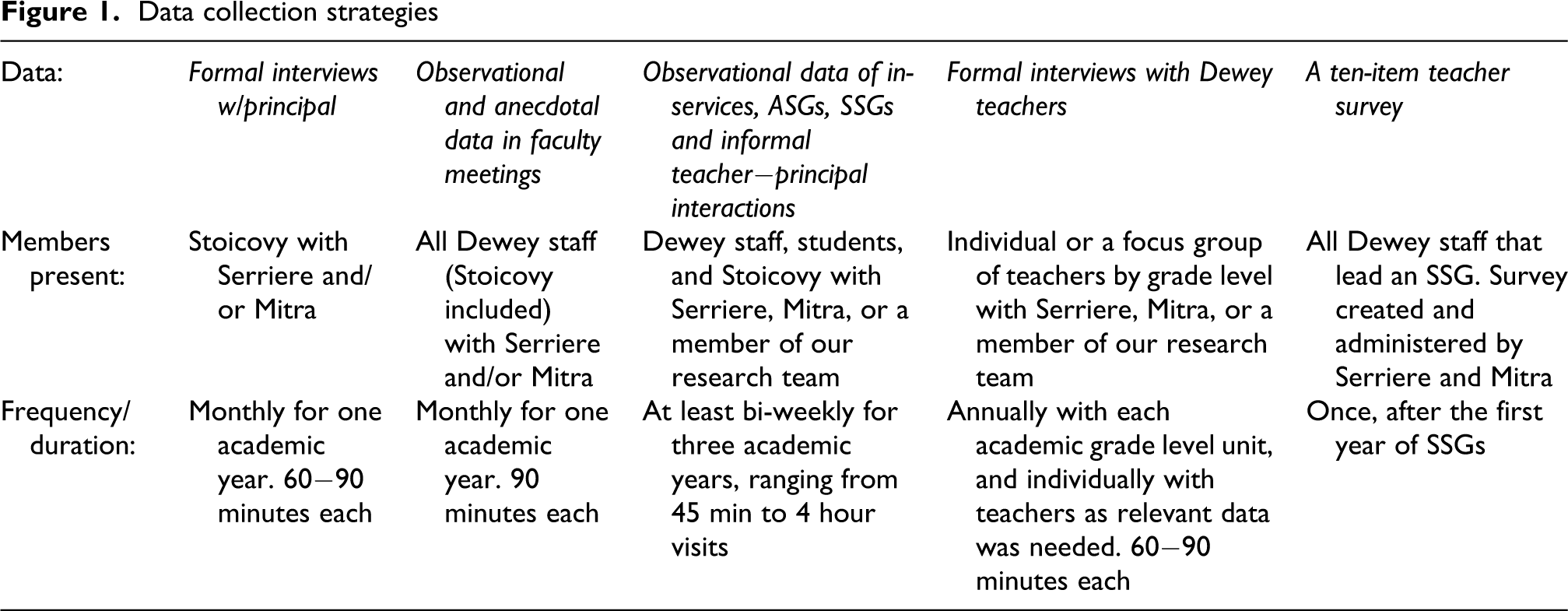
Serriere and Mitra’s research team (comprised of Serriere, Mitra, and trained graduate students) established a professional relationship with the staff at Dewey through our data collection over the last two academic years (2009−10 and 2010−11). The team often attend staff meetings, workshops and in-services, as well as committee meetings and other school events. The research team also conducted observations, focus groups, and interviews and administered a short survey. Quotations from Dewey teachers were derived from formal interviews and fieldnotes were masked to protect the identities of the teachers when working with Stoicovy on drafting this article. This article avoids using the pronoun ‘we’ but rather use each of the authors’ last names in particular to minimize confusion about Stoicovy’s overlapping role as subject and researcher as well as our roles in data collection.
Small-school gathering observations
The monthly ‘small-school gathering’ (SSG), which began in October 2009 (along with our observations), were instituted by Stoicovy as a complement to the larger weekly ‘all school gatherings’ (ASGs)that had been occurring for three years. The idea is that each child, for their entire enrollment at Dewey Elementary (ideally K-5), spends time each month with their SSG, as a sort of alternative social, civic, and academic network made up of K-5th grade students (about two or three from each grade level in each SSG, totaling about 12−15 students per SSG). Some faculty leaders at Dewey have set up their SSG to be a forum where students can raise issues of importance to them; some use it for community building, and for several, it is an opportunity to engage in service-learning.
Interviews and focus groups
The research team led both individual and focus group interviews with faculty and separately with elementary students. The teacher focus group interviews were conducted after school in grade-level groups and with specialist-teachers as a group in March of 2010, lasting about 35 minutes (Appendix B). All Dewey teachers were invited to participate in group interviews. These individual interviews lasted 30−90 minutes and focused on the teachers’reflections on the purpose of their SSG and their vision for their SSG. With individual interviews, Serriere and Mitra developed the teacher focus group interview protocol and asked probing questions based on their answers in the focus group interview and our observations of their SSG. The interviews were digitally recorded and transcribed.
Survey
Serriere and Mitra also surveyed the teachers at the end of the first year of data collection. The survey consisted of 10 questions and was emailed to all teachers. Cards for coffee at the local diner provided an incentive for completion. The survey questions included exploring their view of the purpose of SSGs, perceived importance, their view of administrative supports, and their remaining supports that they feel could help them succeed in SSGs.
Data analysis
Data analysis for this article focused on the ways in which leadership enabled and constrained the development of student voice and civic engagement initiatives. An inductive coding scheme was utilized to analyze the data. The recorded and transcribed data were analyzed with a line-by-line analysis and open coding (Strauss and Corbin, 1994) to identify major emic categories, utilizing the voice of Stoicovy herself. Grounded theory has been used to identify the emic categories in the data that create common, inductive patterns. After initial data coding, selective coding honed the central emic categories of significance in the data through the process of extensive writing of memos by the research team and references back to the original transcripts and field notes (Strauss and Corbin, 1994). The next sections discuss the themes we have found at Deway.
Vision as ‘the way we do things here’
While Stoicovy sees flexibility as important, she exhibits a strong vision of the school and an expectation that teachers will work under the school’s philosophy. Indeed, sustaining democratic initiatives is only possible if at some point these practices become embedded in the day-to-day functioning of the school.
Thus, an inevitable tension exists in having a clear vision while waiting for others to incorporate this vision in practice. This tension can be demonstrated in the development of all school gatherings (ASGs) occurring every Tuesday afternoon for 45 minutes. The structure of ASGs is an example of a school policy initiated by Stoicovy that has become ‘part of the way we do things’ at Dewey Elementary. The idea behind ASGs, in Stoicovy’s words, is that they are a venue for civic engagement that is ‘student to student.’
ASGs are a hallmark of student voice and leadership for the oldest students at Dewey. The fifth-graders (most senior students in the school, age 10−11) run ASGs. This student-led activity is accomplished with a minimum of teacher involvement (mostly logistical and technological issues), a shared Google document between students, the teacher, and Stoicovy, and a brief run-through with Stoicovy before the gathering. The student leadership of ASGs has become viewed as a rite of passage for the older students in the school. One teacher verbalized that the younger kids are beginning to ‘aspire to be…or look forward to this great experience of leading All-School.’
The ASG organizing team of fifth-grade students and teachers has great discretion with how to use their time. At one ASG a student read a poem by Maya Angelou because Angelou is her ‘(s)hero.’ Students have led all-school guessing games done with PowerPoint; shared artwork, songs, and skits; and given presentations on a variety of topics (usually newsy).
The fifth-graders have used ASG as a time to offer encouragement for standardized tests, and kudos to fellow students and teachers. On one occasion, after discussing Earth Day (a day in April in which environmental activities occur in the United States) and the need to keep their school trash-free, the fifth-graders gave an award to the janitor for being the best janitor. Presentations often have a civic theme and end with a call to action such as, ‘We need your help Dewey Elementary’ or ‘We also want you to know that by working together you can make a difference at Dewey Elementary.’ After one skit on trash a student called, ‘Shout out “Go green!” if you think you can make a difference!’ and the students in the audience shouted, ‘Go green!’
Some teachers of younger students raised concerns to Stoicovy and reiterated in focus group interviews that ASG is too long a time for the younger children to sit ‘watching’ something. Observational data indicate that student abilities vary. The younger students learn to sit attentively, and are occasionally removed from the room by Stoicovy and teachers.
As ASGs have evolved, more teachers have indicated support. Stoicovy reported that a specialist teacher who was especially skeptical of the ASG meetings came to her this year and said, ‘I get it now,’ as she saw the ways in which the community came together around SSGs. Many teachers speak with fondness of the rituals that the school has developed to celebrate the promotion of the fifth-graders to middle school at the end of the year.
For the past two years, the final ASG of the year has included the whole school lining the hallways to applaud the graduating fifth-graders. In the words of a primary grade teacher, ‘we embraced the fifth-graders as they were leaving. They came down the stairs and went through our hallways. We all came out of the rooms and cheered and clapped for them, because we knew that was it, they’re going to middle school… There’s a lot of good coming out of that, and it’s evolving as well.’ She then recounted how as their photos flashed on a slideshow screen, most of the students said aloud ‘every graduating fifth-grader by name.’ This activity has helped to encourage the final memory of Dewey fifth-graders as being one of a supportive caring community.
The public nature of the ASG presentations also makes them useful tools for sharing the work of the school and individual teacher practice at other professional venues. Teachers use videos from ASGs to share the work of the school during professional development sessions, conference presentations, district meetings, and individual portfolio development. For example, two Dewey teacher interns developed a video for their teaching portfolio that showed how the first- and second-grade students reduced paper towel wastage by making signs to place on all of the towel dispensers. The video filmed the student presenting this work during the ASG. In this presentation the students demonstrated, with physical data, the difference in the number of boxes of paper towels used in the school when students used one paper towel versus three towels. Since then, the paper towel waste has dropped dramatically school-wide and the students are now sharing their message with other schools in the district. This project is notable for its blending of service-learning and inquiry with a reinforcement of school-wide values, such as environmentalism, through the ASGs, and it provided a visual and interactive way for the teachers to explain their practice in other professional venues.
We highlight the example of ASGs to demonstrate that despite teacher buy-in, Stoicovy establishes non-negotiable components of fostering civic engagement. She trusts that some teachers will eventually ‘get it’ whereas others will never buy into a social or civic mission for schools. Over time, ASGs have become just part of the ‘way we do things here’ and we anticipate this acceptance for SSGs to occur as well,
Allowing opt-in strategies for teachers when possible
Stoicovy also emphasizes the independence of teachers to shape their teaching to align with their own talents and student needs. One particular project that exemplifies her ability to let teachers opt in is ‘Schoolyard,’ which is a project that includes a five-year professional development plan to use the outdoor space of the school grounds as a laboratory for teaching and learning. Participating classes engage in projects once a month in which they gather data in the environment, including temperature, rainfall, and bird migration. The activities are often student-initiated projects about their environment. In this example student voice drives learning goals.
Through grants from the state’s Department of Environmental Protection and Department of Education, teachers receive paid release time to plan their projects. A key process of this project was that teachers chose to participate rather than being mandated to do so. Stoicovy explained, ‘We talked about what our goals and hopes were and said, “If you want to be a part of this fine. It’s purely voluntary [teachers do not have to participate]. We’d like you to develop an action plan, do monthly reflections. We’ll give you a half day release time. We’ll have Mid-Year and End-of-Year Celebrations to recognize everyone’s good work.” The numbers for the program increased gradually, until now all but one teacher in the school has participated actively in the project.’ Thus Stoicovy provided incentives of providing release time and praising success in the program as strategic ways to grow civic engagement practices.
Two fifth-grade teachers seized on the Schoolyard project as a way to extend their literacy curriculum. In response to their dissatisfaction to their fifth-grade writing curriculum, made of traditional ‘writing prompts,’ they met with Stoicovy and asked permission to revamp their own writing curriculum because they noticed how motivated their students were to make their own choices about what to write about their schoolyard. Stoicovy encouraged them to try out their idea. They worked with each of their students to follow a line of inquiry, chosen by the student, from the Schoolyard experience.
One student wanted to know if all compost was equal and if certain types of plants grew better in various compost compositions. Students worked to collect data but also put their inquiry and findings into a kid-friendly ‘′Zine’ (a magazine-style of writing). In addition to the pupils’ inquiries, the two fifth-grade teachers collected data on student engagement (time spent on task, reported enjoyment) and district level writing scores to find out if this method was really more ‘authentic’ than their previous writing curriculum.
Buy-in allowed for teachers to get their feet wet in something new without administrative pressure. For other teachers, such as the fifth-grade teachers, the opt-in environment allowed them to flourish in trying out new civic practices without administrative constraints on their own professional development.
Implementation will vary across contexts
While some activities can offer an opt-in approach on the part of Stoicovy, other initiatives require implementation by all teachers. When giving teachers the choice to participate in reform activities, Stoicovy allowed flexibility of implementation across teachers to match teacher interests with the required task at hand. One such example of this strategy was the adoption of SSGs, an idea that places a small (12−17 students) cross-age group of students with the same teacher-leader for their entire time at Dewey.
Each group (about 40 in the school) meets once a month. In a focus group interview, one teacher explained to our research team that the purpose of the SSGs was ‘the connection that we’re building with students. It is interaction with one more adult that cares in their life…There are far too many students in our school who do not have a lot of adult and kind and caring support.’ Another teacher added, ‘Our hope is that we will all be group leaders acting as advisor, confidant and guide for students and that the SSGS will encourage peer mentoring as well.’ A third similarly stated, but in a separate focus group interview, ‘It’s also a chance too for the child to get another adult, you know, to bounce ideas off and another trusted adult in their lives. And then the community between the ages, too… So they feel more connected with the whole range of classes, too, from Kindergarten through fifth grade.’ One of the purposes of the SSGs was to provide a source of community building for students and a way to connect to adults and other children separate from traditional classrooms. By having the same SSG teacher and group of students for their entire careers at Dewey, the intention is for students to feel comfortable sharing their perspectives and having another set of individuals to share concerns and joys.
Acknowledging that teachers were at different levels of acceptance of student voice and efforts at the school, the building principal emphasized an overarching vision of SSGs as ‘a platform for people to become active in the school.’ Yet within this vision, teachers exhibited a range of personal goals for their own groups. After the first year of implementation, a survey (created and administered by Serriere and Mitra) found that the SSG leaders and over half of the groups focused primarily on building community between the students. Particularly, groups emphasized developing opportunities for the older students to help the younger students. Other groups emphasized integrating the citizenship concept of the week into their SSGs. A third theme included teachers who integrated service-learning projects into their SSG work, about 20 percent. Even though it was clear she was a strong proponent of service-learning, Stoicovy stressed that all types of SSGs were appropriate. She explained:
I don’t want to sound disappointed if someone just does community building [and does not integrate service-learning into their SSGs]. If they are even just a mentor, I’ll have accomplished a goal. If they even make a connection, I’ll have accomplished a goal. But if they [teachers with students in SSGs] begin to look at other ways to make our school a better place, to find ways to improve whatever the problem is that they come up with, I’ll feel really good about that.
A vocal minority of teachers expressed concern about the way in which the SSG was introduced to faculty and the speed at which it was implemented. A specialist teacher lamented in a focus group interview to our research team, ‘They’re trying to fix something that ain’t broken… and then they’re going to break it.’ This teacher felt that the school already spent ample time on community building and instead felt that the SSG time should be spent on traditional instruction rather than what he/she viewed as additional community-building activities. In other focus group interviews, an upper grade teacher raised concerns regarding ways in which the SSG was adopted, such as:
I don’t recall having a democratic decision about doing this project. A committee was formed somehow [to make the decision]. In August we [were told] ‘We’re going to do this, this year.’ So you run the risk of not having everyone buy into it. While a committee of teachers solidified the plans for the SSGs, the broader faculty did not feel that they had input into the choice of having SSGs. In this democratic school, despite the committee of teachers forming the concept, others still viewed the idea of SSGs as a decision coming ‘from the top.’
Beyond adoption, other teachers expressed concerns that they were not prepared to teach cross-aged groups − especially specialist teachers who usually worked one on one or in small groups with children. For example, one SSG leader who is a member of the school but not a classroom teacher pointed out that she ‘doesn’t even have a teaching certificate’ let alone have the know-how to ‘lead kids from Kindergarten to fifth grade’ at one time. To provide support to the teachers, a support committee provided teachers with example lesson guides and ideas for the SSG session based on citizenship curricula.
A Wiki space was then developed so that all teachers could share their lesson plans for monthly activities. Some primary-grade teachers wished that the principal would ‘put the lesson plan in my mailbox’ rather than the teachers having to develop their own vision for their groups or explore the schools collaborative Wiki page for ideas. A primary teacher lamented,
It’s one more thing − the one more thing that’s too much. And, the fact that we have to plan [for SSG]. I know that there are some things available whenever but nobody ever does that [plan ahead]. People are always like, ‘Oh my god what am I going to do?’ and are searching for something that fits their style [at the last minute]. So it’s a stressful time each month, and it’s especially stressful for people who aren’t teachers. For the counselors, the other people in the building who are not classroom teachers and have to be leaders of the Small School Groups as well.
Yet, Stoicovy discouraged a one-size-fits all approach. This open-ended strategy caused struggle among teachers who were not used to working with large groups of children or who did not embrace the vision of SSGs. For other teachers for whom this structure fit with their philosophies and teaching goals, SSGs were an opportunity to extend ongoing ideas. For example, one primary teacher extended his terra-cycling project from his second-grade classroom to his SSG group. The group began strategizing how to expand the collection of items that could otherwise not be recycled such as drink boxes, tape dispensers, and plastic caps.
Discussion
The Dewey experience emphasizes that leadership with clear vision must balance teacher voice/buy-in with maintaining the integrity of the vision of the school. This article explores how schools can be open for variation while at the same time adhering to clear and consistent goals. Leadership may not expect all teachers to be on board, but it must provide opportunities to safely ‘try out’ civic engagement and to expand possibilities for such opportunities to occur. Implementation of ideas requires both allowing for teacher choice and sometimes opt-in strategies, such as in the Schoolyard. Other school-wide mandatory activities allowed for variation in teacher implementation, such as the ways in which teachers sought to make use of small school gathering time. The collective participation of ASGs required a more uniform level of participation and demonstrated a structure that gradually has shifted from a new effort that raised some concerns to gradual acceptance and a growing embracement of the activities to growing involvement of K-4 students in aspects of the ASGs.
Despite the need to keep the vision of the school clear, how decisions occur matters − often even more so than what occurs. This distinction highlights an ongoing need in the democratic decision making processes that can occur in distributed leadership situations. The SSG effort in particular highlights ways in which process can detract from a promising school climate when democratic decision-making does not occur or that it is not perceived to have been ‘democratic enough.’
These frustrations are particularly paradoxical given that the goal of SSGs is to improve school climate and community. Although a committee of teachers planned the initiative with the principal, the entire faculty did not have input into the decision until after it was determined that it would begin. This quick action, without time for teachers to ‘warm up’ to the idea, caused resentment that continues for some.
In our observations, the teachers most resentful about the decision are leading the SSGs in the most traditional format; rather than encouraging student collaboration and voice into their work. Thus teacher resentment can lead into classroom practice in the worst of situations. For example, the teachers who have vocalized lack of interest in the SSG concept in our observations do not plan extensively for SSG time and instead create simple craft activities to pass the time, a sort of self-fulfilling prophecy that SSGs are not worthwhile.
Conclusion
One of the biggest struggles in student voice efforts is how to engage students as active partners in school change. The power and status distinctions in school settings especially provide a dramatic form of asymmetry due to institutional norms of deference to adult authority and the separation of adult and youth roles in schools. Youth−adult partnerships must develop new ways to communicate effectively and to learn how to work together in more equitable ways. The greater the youth role in student voice efforts, the greater the need to empower young people to become strong collaborators for educational change. This concept translates to administration working with teachers in their school.
Creating a new set of working conditions requires developing new norms, relationships, and organizational structures (Della Porta and Diani, 1999; Oakes and Lipton, 2002). To do so, adults must relinquish some of their power and work to build a tone of trust among adults and students (Cervone, 2002). Without an intentional focus on building relationships, student voice can easily become tokenism.
The case of Dewey Elementary School illuminates the ways in which teacher−principal reflections in turn affect opportunities for student voice to grow. At Dewey, Stoicovy has tried to create opportunities in which teachers can try out the idea of fostering student voice on their own terms. She balances this ‘opt-in’ approach with creating activities and structures that demand participation. These required spaces serve as way to define the culture of the school as ‘the way we do things here,’ including the value of student participation.
Students and adults struggle regarding power in developing student voice initiatives, including how best to delegate responsibilities to students, how to provide opportunities for all members to participate, and how to resolve disagreements of opinion − especially when adults and young people have opposing views. True student voice requires a ‘rupture of the ordinary’ (Fielding, 2004), which demands as much of teachers as it does of students. Future research can help to broaden our understanding of how leadership practices can serve as a part of a culture shift that can allow increased student voice in schools.
Footnotes
Acknowledgments
Funding for this project was provided by the College of Education and the Center for Youth, Families and Children at Penn State. We would like to acknowledge the Penn State graduate students who participated in data collection for this article: Christine Crain, Anna Fernandez, David Fuentes, Mark Hlavacik, Kevin Hulburt, Roi Kawai, Jennifer Lane, Amber Mallow, Elizabeth Manning, Kyle Martin O’Donnell, Karen McCoy, Mary Elizabeth Meier, Marcy Milholme, Becky Misangyi, Jon Niles, Katie Reed, Elliott Rosenbloom, Michelle Salopek, and Angel Zheng.
Note
Appendix A: Dewey philosophy
Appendix B: Protocol
Perceptions of SSG
SSG activities
SSG process
Service learning
Perceptions of school