



Abstract
This article explores the nature of the reflective learning undertaken by pre-service trainee teachers training to teach in the lifelong learning sector in the UK. The argument made is that reflecting on the student voice can support novice teacher’s boundary-crossing and legitimate peripheral participation (Lave and Wenger, 1991; Heggen, 2008). This article frames student voice practices as essential within teacher education pedagogy. As a counterpoint to post-Fordist and post-modern challenges to education in late capitalism, student voice practice is used to demonstrate to novice teachers the pedagogic and democratic value that ‘listening to learners’ brings. While recognising the highly contested nature of voice, value is held in both listening to trainee teachers and their anxieties and concerns and providing a reflective and reflexive context through which these can be expressed; and the value to be had for (new) teachers to listen to their own learners. Student voice practice is held to have significance for teachers’ iterative identity (Giddens, 1991), and is seen to provide pedagogic opportunities for the framing of relational agency (Edwards, 2005).
Introduction
With international interest in student voice continuing to develop (Czerniawski and Kidd, 2011), and the rise of a body of student voice literature locating ‘voice’ as a counterpoint to neo-liberal agendas (Giroux, 1986; Fielding, 2004; Flutter and Rudduck, 2004; Gunter and Thomson, 2007), the argument of this article is that student voice can support the identity construction of novice teachers through reflective and reflexive practices (Giddens, 1991; Heggen, 2008). While for some, student voice work impacts massively on creating inclusion (Demetriou and Wilson, 2010) and in improving the quality of learning and teaching (McIntyre et al., 2005), others are critical of the use of student voice to give authority to teachers and not learners (Rudduck, 2006) and of the privileging of some learners over other more marginal groups (Robinson and Taylor, 2007). For some, it is not a case of allowing voice but in engaging with dialogue, although it is noted that too often these dialogic pedagogics are rare (Arnot and Reay, 2007) and student voice is frequently marginalised as extracurricular and tokenistic (Bragg et al., 2009; Thomson et al., 2009).
The use of the student voice within the author’s teacher education pedagogy is located and framed within the post-modern and post-Fordist structural context of the lifelong learning sector in the UK (Avis, 1999, 2002) where the specific teaching and learning behaviours which are the focus of this enquiry are acted out (Salisbury et al., 2009). Student voice – and its role in trainee teacher learning – will be linked to arguments around teacher identity formation (Beauchamp and Thomas, 2009; Day and Gu, 2010) and the role of situated context and community membership in this process (Lave and Wenger, 1991). Student voice pedagogic practice is held to provide an antidote to neo-liberal agendas in education and to marketised and managerial forces sweeping through the lifelong learning sector in the UK (Avis, 1999, 2002). As a buttress to the consequences of late modernity (Savage and Warde, 1993) and the problems of late capitalism in constructing a ‘strain on the self’, student voice practice for novice teachers is seen to construct a forum for the exploration of relational agency (Edwards, 2005). Through this article, while aware of the contested nature of notions of ‘voice’ (Bragg, 2001; Fielding, 2000, 2004), I will use ‘student voice’ to refer to two sets of practices: the capturing of trainee teacher’s ‘voices’ through reflective pedagogic practices and the capturing of younger learners’ ‘voices’ through a series of semi-structured interviews. The student voice interviews are at the heart of this enquiry and were used to frame learning and teaching strategies to trainee teachers on the author’s own initial teacher education programme. As noted by Salisbury et al. (2009), teacher learning and teaching and learning itself:
…is shaped by the nature of the social contexts in which interaction occurs and the ways in which teachers and students construct their roles within it…teachers’ conceptualisations of their students’ learning can be related not only to their own and students’ backgrounds and learning biographies, but also to the wider structural context within which learning in FE is currently located. (Salisbury et al., 2009: 421)
Following Salisbury et al. (2009), the viewpoint explored here is that until trainee teachers visit colleges and meet learners, the ‘location’ and groundedness of their initial professional learning is highly ‘unsituated’. In other words, learning is not rooted or grounded in a context of lived experience as a professional in the making but perceptions are drawn upon autobiographical histories of the self which are limited by the individuals’ experience. Often trainee teachers are learning how to teach (and how to learn) in contexts radically different from their own educational biographies and in socioeconomic geographical locations different from their own upbringing. This is both a pedagogic and professional issue – how do trainees as professionals in the making come to develop sensitivity towards their learners and towards the mechanics and craft of teaching and learning itself? How can we, as teacher educators, model best practice in supporting trainees in this crucial initial development? It is by adopting the student voice – and using this to inform professional learning – that we might hope to achieve the ‘democratic schooling’ spoken of by Giroux (2005). As Giroux notes:
The concept of voice constitutes the focal point for a theory of teaching and learning that generates new forms of sociality as well as new and challenging ways of confronting and engaging everyday life. (Giroux, 2005: 454)
This article develops a commentary on the fears and anxieties of teachers in the making regarding their own learners and regarding the boundary-crossing practices they undertake while starting their training programme as a (new) ‘professional learner’; and in doing so it gives a voice to the thoughts that younger learners (aged 16−19) in the UK lifelong learning sector have about ‘good teaching’.
Unsituated voices
This article explores student voice research conducted by the author as part of the provision on an initial teacher education programme for the lifelong learning sector in the UK. As a means to better inform pre-service trainee teachers regarding teaching and learning, a variety of audio recordings (podcasts) were produced, through semi-structured interviews, of 16−19 year old learners. Interviews were conducted in a variety of diverse urban-situated contexts in schools and colleges, seeking to explore young learners’ views on teaching and teachers. These recordings have then been used as part of a blended delivery to aid the reflective practice of trainee teachers. The articulation of the learner voice through the recordings enables trainee teachers to (re)contextualise their assumptions (and ultimately their biographies) regarding expectations of learners and teaching and learning prior to starting teaching placement. In this way, the discursive and reflective practices supported by these learner voice audios enable the reformation of (un)situated learning and better informs trainees’ initial boundary-crossing practices from ‘outsider’ to ‘novice teacher’.
This enquiry captures student voice in two, related contexts. Firstly, the trainee teachers who are being supported are ‘(professional) learners’. Their voice has been captured through the adoption of reflective journals on their teacher education programme. Secondly, young learners’ voices have been captured through interviews, leading to the creation of an audio archive. The audio resource is used pedagogically as a means to inform the trainee teachers, supporting them to co-construct meanings of ‘what teaching means’ at the very start of their professional education.
My own experience of supporting professional learners – ‘trainee teachers’ – would indicate that many trainee teachers in initial teacher education arrive at the start of their programmes without much contact with younger learners. Thus, they are often surprised by the degrees of confidence, reflection and articulation with which many younger learners are able to engage with their own learning. They are surprised at how learners are able to talk confidently about what they think is good teaching and to be able to describe styles of teaching and teaching tools and techniques in some depth and with sophistication. At the same time, many trainees are understandably cautious and concerned about the teaching role – in particular over issues of classroom and behaviour management, often clouded by their perceptions of what learners (aged 14–19) are like. This article, and the enquiry it critically outlines, starts with the explicit value proposition so deeply embedded in many notions of student voice (Fielding, 2004; Rudduck and Flutter, 2000; Ruddock and McIntyre, 2007), that teachers and learners can be, are, and must be co-constructors of their own practice and social endeavours. As Salisbury et al. (2009) suggest, ‘it is important to locate teachers and learners as active participants in at least some of the processes of learning’ (Salisbury et al., 2009: 421).
Contested voices
In characterising the student voice movement Taylor and Robinson (2009) comment that, ‘As a field of educational endeavour student voice has been largely seen as oriented to action, participation and change’ (Taylor and Robinson, 2009: 163). However, not all voices are heard, or at least, not all voices are heard the same way. Literature suggests that learners most likely to be involved in student voice initiatives are those learners who would mostly likely have a ‘stake’ or investment in education due to the accumulation of cultural capital (Bragg, 2001; McIntyre et al., 2005; Taylor and Robinson, 2009). In some schools and colleges the ‘zeitgeist commitment to student voice’ (Rudduck, 2006: 133) is little more than an attempt to engage in ‘surface compliance with a notionally transformational agenda but which fail to take account of the intransigencies of power or disrupt its operations at a deeper level’ (Taylor and Robinson, 2009: 166). When student voice is linked to ‘school improvement’ agendas it often reproduces ‘surface compliance’ (Taylor and Robinson, 2009: 163) rather than more authentic and meaningful attempts to develop democratic processes (Fielding, 2000).
The agenda of some student voice work is to capture voices to give ‘privileging’ to the learner as the author of their voice (Solorzano and Yosso, 2002) – a claim seen by some authors informed by post-structural theories to be a ‘romanticisation’ of an ‘authentic’ voice (Jackson, 2003; Mazzei, 2009; St Pierre, 2000). For Fielding (2004, 2009) and Rudduck (2006) an authentic voice is possible and can operate as an alternative to performance cultures and ‘managerialism’.
Reflective voices
In this enquiry, I seek to use student voice to support the learning and development of trainee teachers. As professional learners, these trainee teachers also have a ‘learner voice’, which we can explore, alongside the voice of younger learners. Extracts from trainee teachers’ reflective journals
1
(quoted here with permission of the trainees themselves) express clearly ambiguous locations and tensions in the initial development of a professional self (Day and Gu, 2010; Czerniawski, 2011; Layder, 1993) and a ‘professional identity’ – what Beauchamp and Thomas (2009) describe as ‘how to be’, ‘how to act’ and ‘how to understand’.
When I arrived at a local sixth form to have a look around I felt a little intimidated, as my experiences of sixth form were very different studying in middle-class York. However, during our tour I saw nothing but eager, hardworking students who were all focussed and seemingly interested in what they were learning. (trainee teacher reflection)
I had half expected to walk past classrooms and see students running around, shouting, fighting and generally getting out of hand. (trainee teacher reflection)
In this way, ‘becoming a teacher’ is a learning process and based upon socialisation from within groups and interactional encounters (Hobson et al., 2004). In forming the initial stages of this professional identity, the trainee teachers in this enquiry express a range of emotions when thinking about the learners they are likely to meet in their training year:
As my choice to come to UEL was mainly based on the fact that I would be studying and working in east London, the introduction to the socio-economic ‘peculiars’ of the local area was of no surprise or shock. As I looked around the room I wondered how many in the group had a similar point of view (I’m guessing and hoping the majority) and how many might end up struggling to deal with East End’s ‘deprived youth’. One of course does not negate the other, and I suspect I too will find it rather challenging at times – despite all my good intentions and genuine interest in giving my students the best possible opportunities. (trainee teacher reflection)
This reflection, as discussed above, is initially unsituated – it is uncontextualised by practice at this early stage. Tensions exist between excitement and fear; between wanting to ‘change lives’ and being worried about the ‘nature’ of the lives of their younger learners; tensions between wanting to patronise learners and being willing to learn from them. As one trainee reflects,
I was worried that I had been too naïve about the challenges of teaching in FE colleges … and was left wondering if this was the right path for me after all. (trainee teacher reflection)
Once they have started their teaching placement, this hope for young learners can sometimes all too quickly become frustration:
I have an issue with student’s complete inability to work independently or for themselves. In many lessons it feels as though students would prefer me to just give them definitions of keywords and tell them to memorise. The idea of building skills for themselves seems beyond them. (trainee teacher reflection)
On recalling the group’s induction walk along the east London ‘Docklands’ area of the Thames, one trainee reflects:
The walk from Canary Wharf along the river to just east of Tower Bridge was a good addition, as it said plenty about what the area used to be like (warehouses, etc.) and what it is like now (posh flats, gated communities) It is in stark contrast to most of the rest of east London – as a walk to Shadwell station reminded us later – but the gated communities and riverside apartments could have as much an effect on the lives of east London’s young people as the council estates and tower blocks of Bow and Poplar. I can only try and guess what that effect might be at this point (anger? resentment? feeling of worthlessness? Who knows…) but I suspect I might find out once I start my placement! (trainee teacher reflection)
Many of trainees (as indeed do many ‘established’ teachers) find themselves occupying highly contested and ambiguous relationships with their learners:
I feel that I need to challenge them, and help broaden their horizons and their aspirations. Even if it needs to be done while they are kicking and screaming. (trainee teacher reflection)
My opinion varies − They are sweet and lovely, smart and enthusiastic, frustrating and hard work, stubborn and disrespectful. They can reduce you to tears in one lesson, but amaze you with their creativity and enthusiasm two days later. They are given a hard time by the media and the police − twice in the last four days I witnessed the police stop and search my students, once at the tube station and once outside the theatre. Their lives are not easy, or fair, and yet they sometimes seem resigned to their fate. I think they are scared of what they don’t know, so choose to dismiss it and stick to their small (and safe) known worlds. I find teaching them hard work, but also extremely rewarding when they ‘get it’. I feel it’s a greater duty to do the absolute best I can and give it my all. (trainee teacher reflection)
Within all these hopes, fears, insecurities and frustrations, the importance of the induction period into the initial teacher education programme becomes paramount for supporting teachers’ learning and development – to allow and encourage the ‘surprises’:
Students do have the ability to surprise you. Some students appear quite unmotivated until you get to know them and they turn out to be amongst the best students. (trainee teacher reflection)
The importance of using student voice to inform the professional learning of teachers in the making also becomes apparent. Induction into a professional learning programme needs to be supported through recognition on behalf of the trainee that the construction of their professional identity and self is about to undergo rapid transformation. The induction period becomes an attempt to turn this reflection into more situated learning – to contextualise first visits to placements and first contacts with learners within broader brush strokes. It is this research problematic that has led to the construction of the learner voice audio resource that this article addresses.
Post-Fordist voices
To support teacher education and professional learning we also need to consider the situatedness of where and how professionals in the lifelong learning sector, in the UK, ‘learn’ once they move from university training to ‘novice’ and eventually legitimate practice in the educational institutions which make up the sector in question. It is this very context that informs the need to encourage trainee teachers moving into the lifelong learning sector to listen to learners. It is also this context that informs the ‘voice’ of trainee teachers’ reflective accounts, as presented above, of their learning and boundary crossing (Heggen, 2008; Van Oers, 1998).
Much of the literature commentating on the past decade of ‘workplace reform’ within the UK lifelong learning sector adopts the language of a post-modern (and at times a post-structural) pessimism: it speaks of a late-modern and reflexive modern ennui characterised by anxiety, uncertainty, de-professionalism and surveillance (Avis, 2002; Ainley and Bailey, 1997; Wallace, 2002). Such is the prevalence of managerialism within the sector, Reeves (1995) described this sector in the UK as being ‘totalitarian’ in outlook and in working conditions and relationships.
However, there is another interpretation. This second narrative does recognise the realities of problematic conditions in the UK lifelong learning sector. However, while not negating the application of post-structural analytical tools, neo-Fordist working regimes and anxious, unconstructed, fragmented post-modern identities, it is possible to offer another framework. It is possible to see change within lifelong learning as a space for possibility, not pessimism. To see the possibility of identity change and also the possibility for newly formed identities for teachers in this sector. The fluidity of further education (FE), as characterised in the writings of Avis (1999, 2002), points to shifting (teacher) identities as global policy agendas shape the reality of the FE sector but more importantly, are in turn adopted, managed, maintained and subverted by the lived experience of trainees, teachers and teacher educators in the FE sector.
Avis (1999) offers an interpretation of the further education sector where previous notions of ‘proletarianisation’ or ‘de-skilling’ are seen as lacking and limited. For Avis (as for Bathmaker and Avis, 2007), FE is witnessing a transformation process – of both teaching and learning and of identity. The transformation of teaching and learning itself opens up a space within which it is possible for vocational education and training (VET) professionals to explore new professional knowledge, re-evaluate practice and construct new identities. This is a positive interpretation of the workplace reforms undertaken by the sector over the past decade, but one that owes as much to post-structuralism as do the more nihilistic interpretations of ‘risk’ and the onset of control and compliance. For example, education as a site for ‘policy technologies’ (Ball, 2001) is a space where teachers are ‘accountable and constantly recorded’ (Ball, 2004: 144).
Both these interpretations recognise that discourses produce subjects under their gaze, but the interpretation placed upon this subjectification process by Avis suggests that agents within policy settlements and ideologies are able to carve out and negotiate futures and identities for themselves (Avis et al., 2002; Avis, 2002). As trainee teachers ‘boundary-cross’ from the university to the training placement (Heggen, 2008), we might recognise that their identities are even more fluid than the identities being worked on by established teachers already working in a fluid and moving workplace. As such, trainee teachers’ identities are being worked-up rather than worked-on.
Theorising voices
The argument here is that adopting student voice work – talking with learners and making this dialogue transparent to trainee teachers – allows teachers to develop their own theorising. As Carr and Kemmis (1986) note:
Theories are not bodies of knowledge that can be generated out of a vacuum and teaching is not some kind of robot-like mechanical performance that is devoid of any theoretical reflection. (Carr and Kemmis, 1986: 113)
Many teachers – and certainly many trainee teachers – find both reflection and the application of theoretical insights difficult and find theory somehow distanced and separated from their experiences of their own practice (Griffin, 2003). While most trainees value and see the importance of their ‘field experience’ (Heggen, 2008; Avis et al., 2002), the other side of the coin, the teaching theory, is usually ignored and at best used in a clinical and cynical fashion for the writing of essays and assignments (Elliott, 1991). Field experience is invaluable; being in the classroom as a practical exercise is clearly essential, but practice without reflection and without critical thinking is ultimately of surface value only for teacher learning. The ‘craft knowledge’ of teachers as spoken about by Hagger and McIntyre (2006) is not atheoretical – far from it: it is situated in practice but also straddles the work place and the academy by linking theory to practical know-how. Adopting Bourdieu’s socio-cultural theory (Bourdieu, 1977). Heggen (2008), writing within the Norwegian context, has made the claim that there is a gap between professional practice and what professionals are taught about this practice. For Haggen, this makes teachers ‘boundary crossers’ – they are members of different horizontally segregated communities of practice (Wenger, 1998). This polycontextuality informs their identity and professional socialisation but the ‘realities’ of the field constitute the stronger pull. Following the Norwegian example once more, Van Oers (1998) offers a social-constructivist approach to notions of professional formation, arguing that knowledge learned on training programmes needs to be recontextualised before it can become of practical use in the field. Student voice work – and positive and democratic relationships with learners − can have the potential to transform the contextuality of trainee teachers as they begin this process of identity formation.
Pedagogic voices
It is important that we recognise that notwithstanding the ‘unsettling boundaries’ in and around the lifelong learning sector itself (Edwards and Fowler, 2007), teacher education in general, and teacher education and learning within the lifelong learning sector in particular, are contested and enacted by the professionals who ‘profess’ to practise them. Teacher education is equally constructed as a ‘subject’ in policy narratives and discourses. The shifting field of teacher education makes many claims: it is seen by some as the means by which teachers better know their ‘craft’ (Hagger and McIntyre, 2006), and to better know their ‘selves’ (Atkinson, 2004). While a new field, or at least, a marginal contribution to a larger and more established field, teacher education literature points to the need for teacher educators to articulate their pedagogies as a meaningful and collegiate way forward within a professional research community (Murray et al., 2009). There is also recognition that within the ambiguity that surrounds the teacher education field, it is impossible to make certain knowledge claims about teachers’ own practices as a professional body – let alone teacher educators’ own practice. The particular location for teacher educators – the double hermeneutical location of being both teacher and a teacher of teachers – seems to sit easily with notions of a pedagogy built upon ‘modelling’ (Loughran, 1996; Hagger and McIntyre, 2006; Malderez and Wedell, 2007); although the modelling of what is unsure. Through the enquiry which is the subject of the research-informed practice identified in this article, I seek to demonstrate to trainee teachers, modelling in my practice, the importance of a ‘democratic education’ (Giroux, 2005) and the value to be had in ‘listening to learners’:
Voice, quite simply, refers to the various measures by which students and teachers actively participate in dialogue. It is related to the discursive means whereby teachers and students attempt to make themselves ‘heard’ and to define themselves as active authors of their own worlds. (Giroux, 2005: 454)
I do this, essentially, through ‘story-telling’ practices bound up with the adoption of learner voice. Thus, trainee teachers are not just listening to learners – but are encouraged to speak with (not to) learners as a means to develop their professional identities. The voices of the young learners captured in this enquiry speak of their enjoyment, anxiety and at times frustration with the teaching they all too often ‘receive’ rather than participate in:
You can tell those poor teachers…they just seem like they turn up and don’t care; nothing planned and it’s just, like, do these exercises out of the book. (Female student, aged 17)
Digital voices
To develop the learner voice audio resource the recordings themselves were edited audio files drawn from a series of semi-structured interviews with 16–19 year old learners in diverse urban settings in the UK. On the basis of a ‘something-for-something’ contractual relationship to participant participation, the learners themselves were drawn from students currently studying sociology. It was hoped that the experience of taking part in a research interview would be a learning experience for them and one that they could apply to their own sociological studies. As an elicitation technique, considerable time was taken before and after each private individual interview to speak to each student about their studies, their coursework and in doing so to answer any questions about the research methodology and techniques of this research. A central feature of the research interviews was the emphasis at all times upon ‘good teaching’; all institutions and all learners were briefed on the importance to speak about positive experiences (and that those listening to the audio resource afterwards would infer from the research that ‘bad teaching’ would be the opposite of ‘good teaching’). In this way, the institutions themselves were comfortable with the recordings taking place and the learners themselves were comfortable with the idea that others would get to hear the files. All learners who took part spoke candidly, positively and enthusiastically about the experience and expressed interest and pleasure in the idea that their institutions and teachers new to the profession might develop their practice because of the creation of their participation.
Each interview was 25–40 minutes long and was recorded digitally using MP3 recorders and microphones. Each interview started with the question ‘What makes a good teacher?’ and ended with the question ‘What advice do you have for trainee teachers about to start to teach for the first time?’ Nineteen interviews were recorded in total, generating over nine hours of audio. Audio files were uploaded into sound-editing freeware programs and then edited down into a series of smaller chunks – each lasting between 45 seconds and up to 3 minutes. These chunks of data were re-coded with a file name that best summarised the content of the recording, often where possible drawing upon the exact words of the participants themselves (see Table 1 for a selection of file names).
(Selected) File names and coding of learner voice audios

File names coded in this way start to develop a sense of the authentic voice of the participant and yet at the same time help to establish anonymity. Each set of files – later to become part of the audio teaching tool – were then burned onto a CD-ROM and sent back to each institution for internal staff training. This part of the research is still ongoing with two out of the three institutions having made, to date, a strong indication that they are interested in developing an action research project/resource coming out of the data. Final data were coded using tools and a sensibility indebted to the ‘grounded theory’ approach as (re)versioned by Charmaz (2006), whereby the audios (as data) are brought closer into frame:
Like a camera with many lenses, first you view a broad sweep of the landscape. Subsequently, you change your lens several times to bring scenes closer and closer into view. (Charmaz, 2006: 14)
Theoretical sensitivity and frames have been constructed as the audios have been further coded down – a process replicating and mirroring the twin ‘archiving’ process of the audio for the learning resource. The individual pieces of audio – 247 in all – were merged into a digital archive and grouped according to theme. The audios are then used extensively during induction and early teaching sessions on the teacher education programme as a means to prompt and stimulate debate − allowing stories to come through. Learners spoke about what teaching methods, techniques and assessment strategies they found most helpful and what qualities and characteristics ‘good teachers’ displayed:
He was really freaky. You went into his lesson and thought ‘What’s he on?’ Every lesson different materials and they were all games and things. But the lessons were so interesting – so many things to do. I really felt like I was learning and no one had the time to be disruptive or anything like that. (Female student, aged 16)
Disembodied voices?
Most striking about the 19 interviews conducted for this enquiry is the common themes learners identified about ‘good teaching’ – both within the three institutions taking part (as might be expected), but also across all participants. Key findings are presented and summarised in Table 2.
Summary of the learner voice audio archive
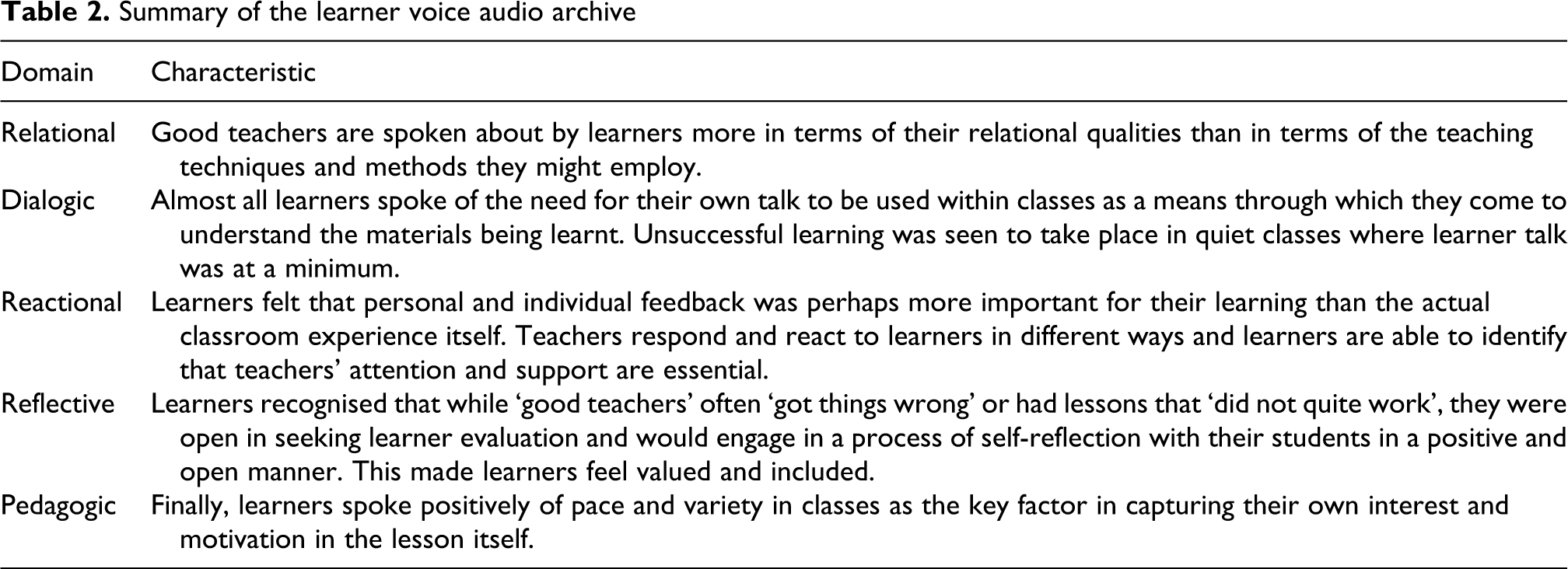
It is possible to identify five domains (see Figure 1) representing the sum of the learners’ stock-of-knowledge at hand regarding how they saw the nature of the teaching and learning process. These domains – relational, dialogic, reactional, reflective and pedagogic – allow us to conceive of learners as active agents, critical and self-aware.
it gets you really involved and interested. Lots of activities and it really whizzes by. Before you know it the lesson has ended and you think ‘I’ve really learned a lot this lesson’. (Male student, aged 16) the stock-of-knowledge at hand of learners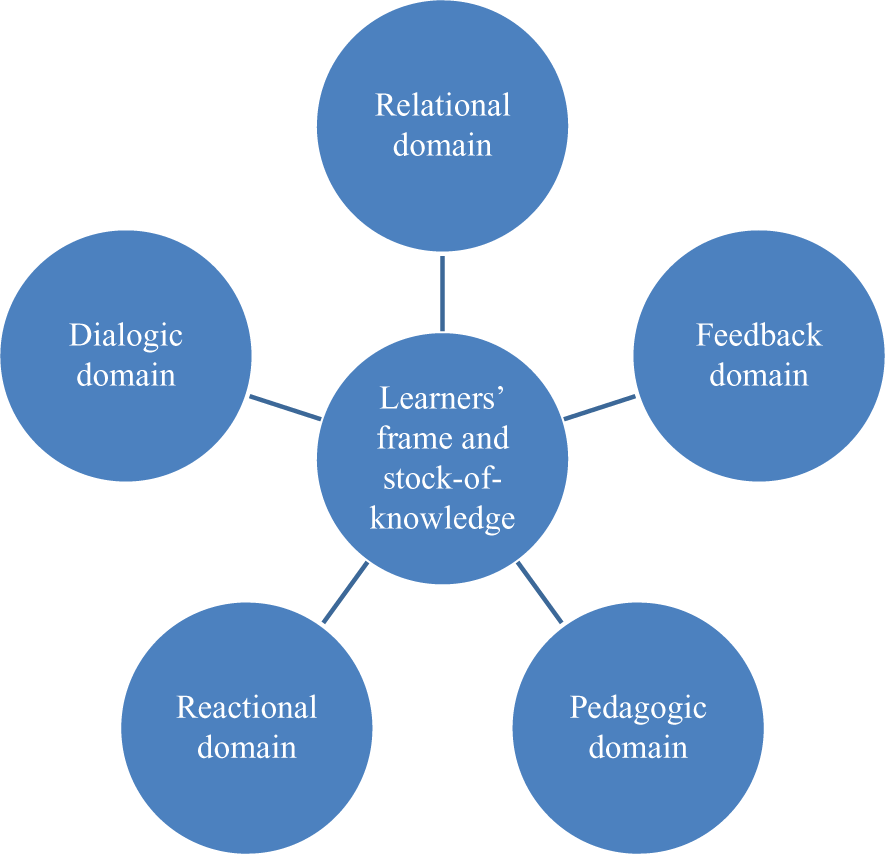
Learners interviewed were able to speak with both clarity and authority of what they felt ‘works’ in the classroom. For many trainee teachers the socioeconomic and geographical location of these voices – their accents and (sub)cultural languages – provided a stark contrast to the depth and authority with which their voices and stories were received by the trainees. The unpacking of judgements and assumptions in this way was also useful in demonstrating to trainee teachers the importance of locating learners as authoritative and ‘expert’ in their own right. However, the audios and voices were not ‘received’ by the trainee teachers in a straightforward way. Presenting the audios in a deconstructed form has the problematic of making, at times, the learners and the learner voice disembodied. Along with this, disembodied voices are themselves unsituated. The audio teaching and learning resource requires great orchestration on behalf of teacher educators to allow the stories and voices to become more fully formed as they become more context-sensitive. The ‘fully realised’, context-dependent voices are themselves reflective – learners are articulating their stories, their voice, through reflection and in doing so are demonstrating the significant degree of reflective pedagogic work they have already added to the frame through which they see the classrooms and institutions they inhabit. Thus we have a relationship between the reflective practitioner (Schön, 1983) and the reflective learner.
Hermeneutical voices
For Brookfield (1995) we have four ‘lenses’ through which reflective practice for professional learners can be developed: the autobiographical, fellow professionals, research literature and our students. The student voice movement and this enquiry seek to demonstrate the value to be had in adopting this fourth lens. In this enquiry, and the research-informed practice it supports, I seek to demonstrate to trainee teachers that their learners are ‘reflective learners’ too, and that what such learners bring to the classroom and interactional encounters is an often detailed and well-articulated understanding of pedagogy – more so, perhaps, than many trainee teachers when they start their professional learning. For Charmaz (2006):
Neither observer nor observed come to a scene untouched by the world. Researchers and research participants make assumptions about what is real, possess stocks of knowledge…Nevertheless, researchers, not participants, are obligated to be reflexive about what we bring to the scene, what we see, and how we do it. (Charmaz, 2006: 15)
In working with students, whether we are teachers, teacher-researchers, or researchers, we will inevitably find ourselves talking about them and, perhaps less frequently, on behalf of them or for them. (Fielding, 2004: 302)
a critical pedagogy takes into account the various ways in which the voices that teachers use to communicate with students can either silence or legitimate them. (Giroux, 2005: 454)
Conclusion
This enquiry, like a great deal of small-scale, qualitative student voice work, can only hope to begin to support transformation and democratic education on a local level. But, perhaps this is enough? As Les Back (2007) notes:
While the scale and complexity of global society may escape our total understanding, the sociologists can still pay attention to the fragments, the voices and stories that are otherwise passed over or ignored. (Back, 2007: 1)
To do this is, though, a highly modernist approach to the problems of the managerial, marketised and post-Fordist (Avis, 1999, 2002; Salisbury et al., 2009), changes sweeping across the lifelong learning sector in the UK, as elsewhere in other northern European societies. As Savage and Warde (1993) have noted, modernity is itself ‘double-edged’: on the one hand it promises the ‘self’ ripe for active development – a personal identity project; and yet, on the other, the need to shape and mould self-identity comes with it risk and anxiety. For Savage and Warde modernity is thus ‘disorderly’ since it ‘obliges individuals to experiment, to hope, to gamble and to be ambitious’ (Savage and Warde, 1993: 150). This means that the project of the self, of becoming who one is, for teachers and other professional learners, is fundamentally a risky proposition. Notwithstanding post-structural insights into the way teachers and learners are formed as objects through power relations, I have argued here that teachers and trainee teachers are best conceptualised as active agents – that the rapid and hyper-intensive ebb and flow of structural and discourse changes which characterise the UK lifelong learning sector in turn creates places and spaces for identity-work, and for the learning from learners as much as from other sources. In this sense, I argue here that it is better not just to conceive trainee teachers as ‘boundary-crossers’ (Heggen, 2008) but also as in need of (successful) ‘relational agency’:
Relational agency involves a capacity to offer support and to ask for support from others. One’s ability to engage with the world is enhanced by doing so alongside others. (Edwards and Mackenzie, 2005: 282)
strong forms of agency are required to help people, such as practitioners who need to collaborate across organisational boundaries, to find moments of stability as they move in and out of different settings without the protection of what Sennett (1999) describes as ‘institutional shelters’. (Edwards, 2005: 169)
Footnotes
Acknowledgement
An earlier form of this article appeared as Kidd, W. (2011) uSpeak, iPod, iTrain: Adopting emergent technologies to inform trainee teachers of young learners’ views of teaching and learning. In G. Czerniawski and W. Kidd (eds) The Student Voice Handbook: Bridging the academic/practitioner divide. London: Emerald. Used here with permission.