



Abstract
This article reports on doctoral research into the leadership practice of members of senior leadership teams in primary schools in England. We present the research findings as a visual construct representing school leadership as an integrated, holistic and dynamic process, named the PIVOT framework of leadership. This original structure connects the organizational systems, individual school contexts and leaders’ personal and professional development using five inter-related key themes. The central space of the PIVOT locates leadership as a balancing, mediating process, addressing issues associated with Purpose, Identity, Values, Options and Trust. Using this framework, school leadership is conceptualized as educational leadership, describing and analysing leaders’ practice as they develop their leadership in a trajectory of professional, intellectual and personal growth.
Introduction
A research interest for a professional doctoral thesis grew from Cain’s experience as a primary school headteacher and education consultant and trainer in national programmes for school leaders in England. Following on from three 10,000-word research papers, Cain planned and completed a 50,000-word EdD research thesis that built on her interest in the realities of the working lives of senior leaders in primary schools. This presented an intellectual and organizational challenge, particularly the lack of published research on senior leadership teams, as distinct from headteachers, and the lack of interest within policy initiatives in the working lives of such professionals. The emphasis in recent decades on formal training and accreditation of leadership based on national standards has, in our view, missed the most important aspect of professional learning, and so we wanted to examine how those working within leadership teams worked on their own and other colleagues’ leadership development through their professional practices. Cain undertook this project through reading published research on school leadership and development, and gathered data from senior leaders in four primary schools in the North of England. The wealth and status of the data offered considerable opportunities for a range of differing interpretations, categorizations and analysis, consistent with a range of different leaders and their leadership approaches. For example, a deputy head, new in post, stated how he ‘got a buzz from leading the more challenging staff and building up relationships’, evidencing a sophisticated and complex process contained within the singular practice of leadership. A multi-level approach to describing a multi-faceted activity was deployed to present the complexity of the data, and the PIVOT framework − Purpose, Identity, Values, Options and Trust − emerged as a useful construct to explain current leaders’ practice and development.
What is the PIVOT framework of leadership?
The PIVOT framework of leadership is an organizational construct designed to illustrate the complexities and novelties of leadership practice as an integrated and holistic process. This framework needs to be understood in two interconnected parts: the first is concerned with the identification of the key factors within leadership practice, and the second is concerned with the actuality of such leadership practice. This is illustrated by Figure 1, where we present the framework.
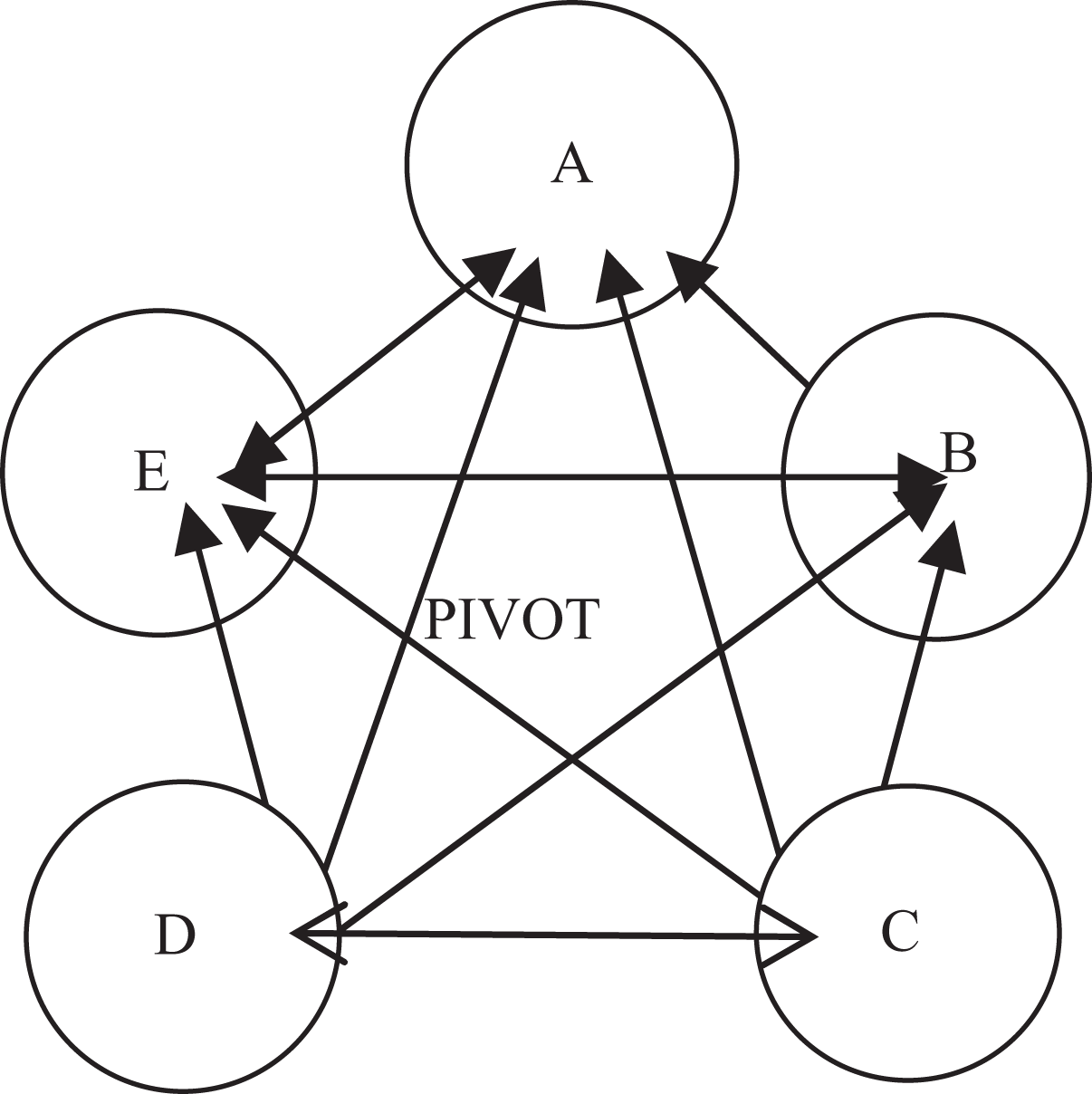
The PIVOT framework
We identified five factors of leadership – represented as A, B, C, D, E – from the literature regarding leadership as a professional practice. These are presented in a non-hierarchical construct and are described as: the Architecture, referring to the planning and direction for the leadership; the Building, referring to the school systems and organizational structures to implement leadership; the Context for leadership, that is the school culture requiring different leadership styles and approaches; the Development of leaders as an area of leadership work; and the Emotional aspects of leadership as an important element of leadership practice. These five themes are conceptualized as essential, contributory factors in an integrated, holistic leadership practice and presented as a circular framework of five inter-connected factors.
Our empirical data validated this framework, and created an understanding of working lives that are dynamic, complex and often very personal in relation to experiences and aspirations. By reading the data through these five factors we gave recognition to differences in emphasis; for example, it is possible for context to dominate and generate new leadership development imperatives, but in another school what matters is the importance of a proactive approach to leadership development generated from within the team. We represent this through the connecting lines, where the interplay between the agency of leadership actors and the structuring context of the school and professional experiences can be given recognition.
The consequences of this are that a central space is identified which we conceptualize, in a mental model of leadership, as a place for intellectualizing, theorizing and mediating, informed by knowledge and knowing drawn from the five factors. Our argument is that this is where leadership development is located, because it is concerned with the following: Purposes, or what leadership practice is recognized as being about; Identity, or how leaders doing leading and exercising leadership understand a sense of self and their biographical experiences; Values, or how professional practice can be related to an espoused set of principles; Options, or how situations are scanned and the interplay between principles and pragmatism plays out; and Trust, or how relationships are built up and processes of accountability operate.
This critical centre of leadership locates the leader or the leadership group as a site of power, influencing, motivating and mobilizing others from a position of organizational knowledge. Empirical data evidenced a discourse of negotiation, challenge and compromise as leaders expressed their purpose, beliefs and expectations, articulating different motives for their decisions. The central space of the PIVOT enabled Cain to position aspects of the data, not easily quantifiable, but identified as central and integral to leadership, associated with ethical, moral and philosophical issues underpinning and overseeing leaders’ practice. We now focus on the development of the PIVOT through an examination of the literature and fieldwork.
Developing the PIVOT through literature work
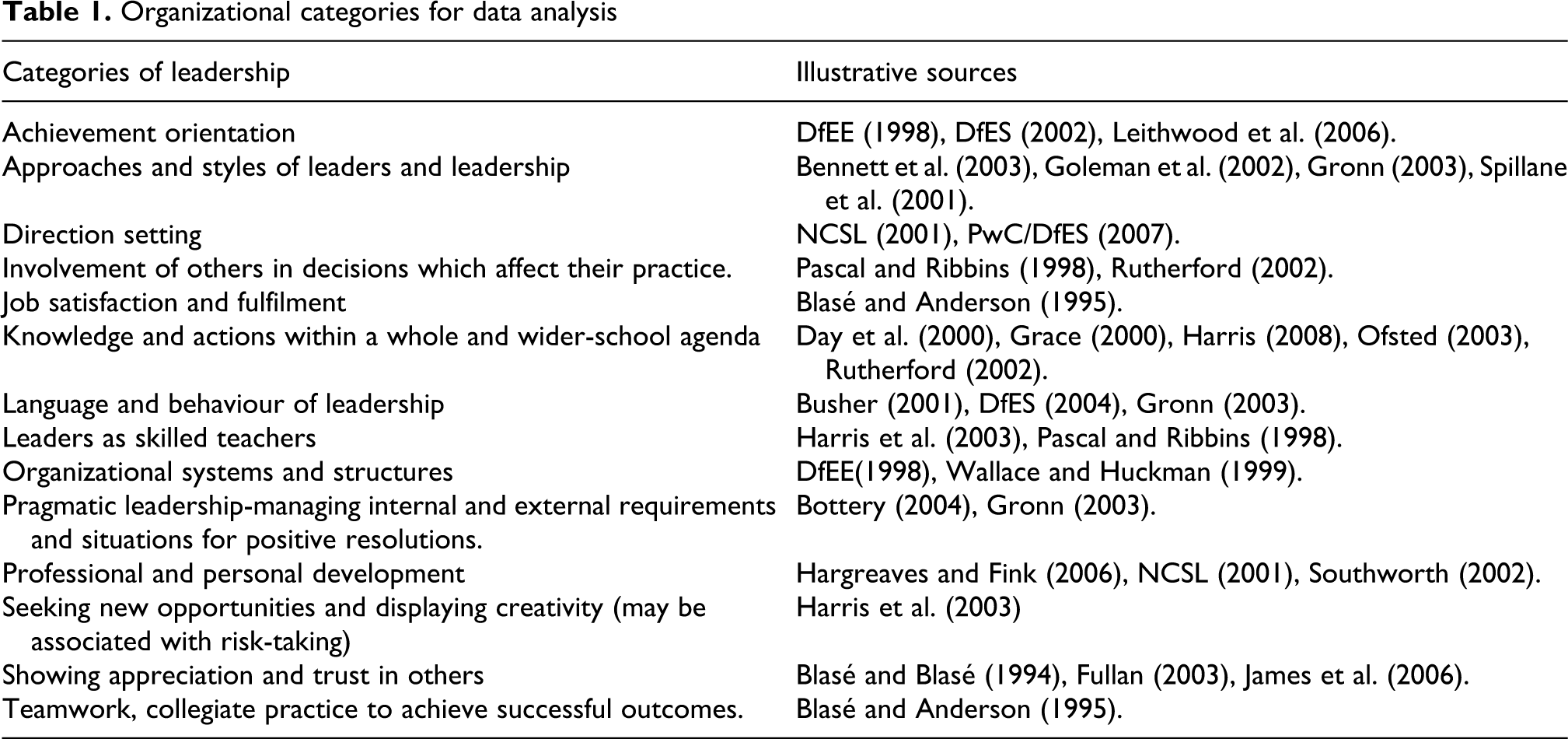
The literature review draws from official and research publications, providing knowledge of policy changes and expectations impacting on primary school leaders as they enact their leadership. We read a total of 40 texts in journals, books, on-line professional material and research reports that focused on senior leaders exercising leadership in educational organizations in general and primary schools in particular. This led to the production of 14 categories from projects and theorizing, and this is illustrated in Table 1 with examples of the sources. Further scholarly analysis of these 14 categories showed that clusters could be made that reduced them to five, and this is illustrated in Table 2.
Organizational categories for data analysis
A framework of leadership themes
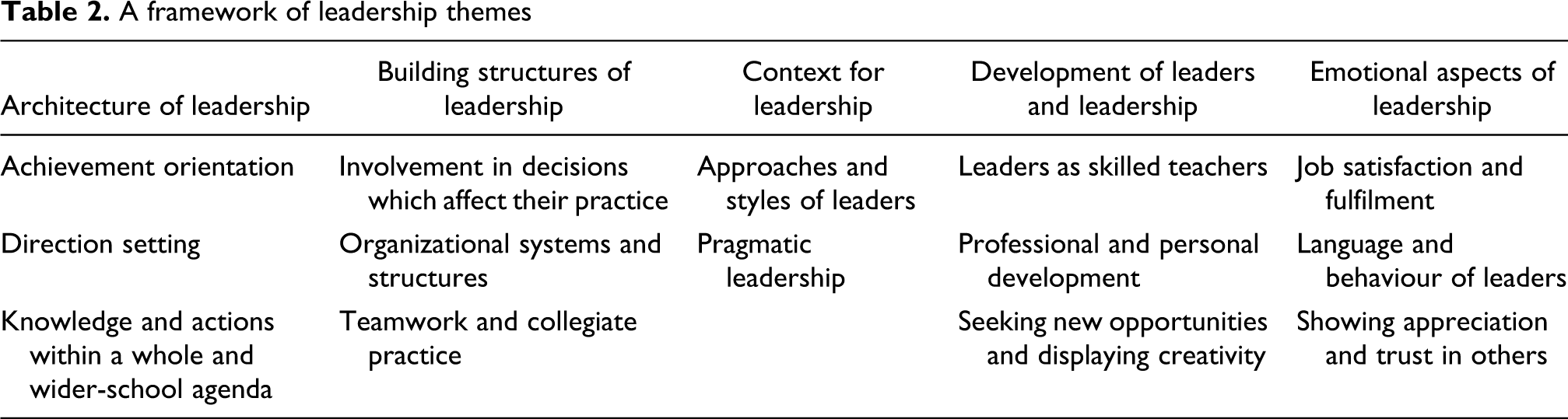
This categorization grew from an increasing immersion in the research data informed by the literature in a rigorous process of analysis and study. Building on research by Gronn (2003) and Southworth (2002), the Architecture of leadership describes the planning and direction of the leader, which is implemented through Building structures of leadership in which others are involved in the organizational systems (Hoyle and Wallace, 2005). The Context for leadership builds knowledge of the differences in school cultures and contexts impacting on differing leadership approaches and styles, and draws from the literature on distributed leadership (e.g. Spillane et al., 2001). The Development of leaders and leadership is a factor of leadership to position actions and processes as contributors to leadership learning (e.g. Rutherford, 2002). The Emotional aspects of leadership, explores participant responses as agents in their own leadership (e.g. Fullan, 2003; Goleman et al., 2002).
We began to realize that the functionality of much of the literatures could provide us with abstracted claims about the importance of context or emotional engagement, but the more we read the more we recognized the lack of research into the work of senior leaders and to the realities of professional practice. So we had access to published texts on senior teams (e.g. Wallace and Huckman, 1999), but we had identified an overemphasis in the field on the work of the headteacher. In addition to this we also recognized that the complexity of professional practice within our data could not be described or explained adequately through the functionality and behaviourist claims of much of what we had read. So we needed to look at theories of power and micropolitics so that we could examine the emphasis in the literature on how leaders are meant to gain compliance to their goals (e.g. Bottery, 2004; Grace, 2000; Gronn, 2003; Gunter, 2001; Hoyle, 1999). So alongside our scholarly work on the literature we began to interplay this with the field data, and from this we developed the PIVOT framework, and it is to this that we now turn.
Developing the PIVOT through fieldwork
Nineteen members of senior leadership teams (SLT) from four primary schools in the North of England provided empirical data in a research programme of interviews and SLT meeting observations during the academic year 2008−2009. The four schools, named as Ash Grove, Beech Walk, Cedar Bank and Damson Valley, offered opportunities to examine interesting and complex examples of leadership practice and development to show patterns and trends.
Ash Grove Community Primary School had been placed in an Ofsted category with a ‘notice to improve’ in the year prior to Cain’s research, which presented leadership challenges to all members of the SLT. Beech Walk Roman Catholic Primary School was involved in Local Authority succession planning programmes to develop leaders. The SLT at Cedar Bank Church of England Primary School was described by Ofsted as ‘outstanding’ and a new Head at Damson Valley Church of England Primary School was introducing an SLT as a new structure. The selection of these schools held an expectation that data from the participants on the multiple sites could show both particularity of person and context but also relatable patterns and themes. The selection of SLT staff for the programme included four headteachers (HT), three deputy heads (DH), three assistant heads (AH), three Key Stage 2 leaders (KS2), two Key Stage 1 leaders (KS1), one Early Years/Foundation Stage leader (EY/FS), two Special Education Needs co-ordinators (SENCo) and one Continuing Professional Development leader (CPD).
The data from the four schools was analysed separately and then used in a cross-site analysis based on the frameworks of analysis, shown above as Tables 1 and 2, and this built the conceptualization of leadership practice and development as a holistic, integrated process from which the PIVOT model emerged. Consistent with exploratory, inductive approaches to qualitative enquiry, the fieldwork complemented and expanded the literature findings and professional knowledge. We developed a rigorous system for coding the data according to ‘aggregation of instances’ (Stake, 1995: 74) to produce ‘a set of common principles and measures’ (Mason, 1996: 111) to ‘generate ideas, propositions and theories from the data’ (Mason, 1996: 120).
The full account of the project is in Cain (2011), and here we intend to present some illustrations of how we developed the PIVOT. School leaders expressed the importance of gaining knowledge of school systems and the wider agenda not only to equip them for their roles in setting direction for the school but also in developing their own leadership, evidencing the Architecture of Leadership, Factor A and the Development of Leaders, Factor D. The participants explained:
Getting the bigger picture has been a really important part of my work this last year, seeing how a school is run and seeing the links between all the different business of the school and how Performance Management fits into the cycle. [Deputy Head, Damson Valley]
I attended a meeting about the extra hours in nursery that are starting in 2010, it was a meeting the Head should have gone to but she sent me instead, as Foundation Stage leader and now I know what I need to do. [EY/FS leader, Cedar Bank]
These examples provide evidence of the importance leaders give to expanding their own knowledge and involvement in decisions affecting them. The following extracts offer examples of thematic cross-over with data providing knowledge of the importance of school systems, Factor B and the emotional response as an influence on leadership practice for these participants, Factor E:
Things are being arranged which haven’t been put in the diary and it’s creating trouble. You have to make allowances for people taking different lengths of time to do the jobs. People need an outline for the term so that they can see where we’re going. You need to be thinking ahead all the time and people need a prompt. We normally have diary dates and we haven’t got them at the moment and it’s a nightmare. [KS2 leader, Beech Walk]
I’ll never forget that meeting when there were three of us left outside, and there were eight in the room. We thought we must be really odd if we need all these people to meet and then come and tell us what to do afterwards. [KS1 leader, Beech Walk]
Leading teams was identified in the data as a meaningful experience for developing leadership skills. However, the evidence showed this was at the discretion of the heads, who made decisions on different staffing roles for different contexts, evidencing C. For example, the Head at Beech Walk asked a teacher to lead the Creative Studies team because ‘she is very gifted at Art’. Whereas the Head at Cedar Bank used SLT members to lead school improvement teams, using a clear philosophy for this practice:
Everyone needs to know what the school goals are. Now I’ve got four teams, one working on reading, one on the travel plan, one on enrichment and one on multi-cultural, the key issues on the school improvement plan. So in that hour and a half meeting I’ve got four things being actioned. [Headteacher, Cedar Bank]
The data from Damson Valley showed that staff involvement in decisions made a difference to the leadership direction and affected SLT goals. Clare took a pragmatic approach to her leadership, evidencing Factors A, C and E, and explained her strategies for implementing new Government policies and procedures, saying:
When initiatives come in and land on the desk we need to think about how they fit in with this school, so people don’t feel overwhelmed. You have to be very aware of what is happening and you have to bring back to staff what you think is going to be important and feed it in gently. [Headteacher, Damson Valley]
Nicola spoke of an incident which impacted on her own leadership learning and development. She was preparing to take up headship in another school and cites this example of a wrong leadership decision, demonstrating her own leadership growth and awareness of the importance of relationships. Nicola explains:
We’d set up a change team for a new development in the grounds and we had to change some of our systems. But the parents wouldn’t use the new system of collecting their children from the classrooms, for very good reasons, so we had to re-think that one. At my next school I want to make sure that the decisions are right for the children, the school and the community, not just the teachers. [Deputy Head teacher, Cedar Bank]
Although the leadership decision complied with management requirements, that is, it was identified in the School Improvement Plan, discussed in school teams and was approved by Governors, the new plan was not acceptable to parents. It may be argued that leaders build their leadership Identity and Trust by stake-holders through demonstrating moral and ethical Values of respect and justice when defining their Purpose. In this example, listening to parents’ views would have provided leaders with alternative considerations and Options for reflection and leadership discourse before reaching a decision. The Deputy Head considered it was essential learning for her own personal, intellectual and professional development.
Professional feedback
Cain provided consultation and feedback to the four SLTs engaged in the research. The PIVOT framework was used as an illustrative, schematic diagram to explain the separate research findings for each school. The diagram provided a description and analysis of the leadership practice but the participants interpreted the findings within a normative and prescriptive frame, identifying areas for school improvement which they had not previously recognized. The professional discourse in each school validated the authenticity of the framework and raised its status as a useful tool for professional development. For example, the Deputy Head at Ash Grove planned to ‘take everyone into the middle section for important discussions’ with additional comments promoting the importance of the PIVOT questions in ‘preventing a knee-jerk response’.
Conclusion
The research evidences primary school leaders operating a complex process integrating organizational structure, agency and context in a holistic framework of analysis. The central space of the PIVOT allows leaders to take an overview of the organization, identifying, considering and balancing all the factors for their leadership practice. It is this space that has the potential to move from management delivery into an arena of educational leadership addressing issues of values, ethics and the moral purpose. The statement from the Deputy Head, cited in the introduction, may now be explained through the PIVOT. The ‘buzz from leading the more challenging staff and building up relationships’ identifies the importance of Factor E in motivating all staff, building levels of confidence and well-being. Factor A and B were implicit in his work as a Deputy Head leading others in school improvement, whilst Factor D was evidenced by his interpreting the work as leadership development. Factor C provided the context for the work in which he recognized the importance of using different approaches for ‘challenging staff ’. By interrogating this through questions about Purpose, Identity, Values, Options and Trust, then school leadership can be given recognition as professional, intellectual and personal development.
The PIVOT framework invites all members of the school to identify and consider their involvement as a contribution to the success of the organization. It is the inclusiveness of this model that makes the PIVOT a potentially powerful tool for leaders and their leadership, providing a holistic overview to build confidence in addressing all issues in the leadership. Thus, it presents a structure for developing new leaders, well-informed of the managerial and instrumental goals of the organization from which to position their leadership as a professional and educational practice.
Footnotes
Acknowledgements
We would like to thank the staff of the four schools where the empirical work took place, and Professor Olwen McNamara who was co-supervisor for the project.