



Abstract
In many jurisdictions school leaders are being placed under increased accountability and stress, which then affects their ability to address the real issue of education − improving students’ learning. Flow Theory, developed by the Hungarian−American psychologist Mihalyi Csikszentmihalyi, has a high degree of relevance to the issue of the way modern school leaders carry out their roles. A purposive sample of school leaders (N = 8) was interviewed about their Flow experiences, in both in-school and out-of-school situations. The nine dimensions of Flow (Jackson and Csikszentmihalyi, 1999) were used as a conceptual guide in the e-interviews. Each of the school leaders gave powerful descriptions of their memorable out-of-school deep-Flow experiences, but their in-school experiences of Flow appeared to have far less impact. The data analysis showed that with this sample of school leaders only four of Jackson and Csikszentmihalyi’s nine dimensions of Flow were identifiable in their in-school experiences. The misfit of Csikszentmihalyi’s dimensions of Flow is important, and needs re-interrogation in future research. Importantly, the moral dimension of the school leaders’ job was identified by the respondents as the most important facilitator of Flow in both public and private schools, and this may provide the key to improved school leader resilience and motivation.
Introduction
The natures of schools, and school leaders’ roles, have changed in the past 30 years. Previously, the school leaders were head teachers and their roles emphasized leading the schools’ teaching staff. However, the impact of New Public Management, and like ideologies, on schools’ operations resulted in school leaders’ roles changing. Consequently, principals were increasingly pushed into administrative roles, and at the same time, teaching and learning changed when it became increasingly dominated by the external demands of accountability. Contrary to the growing belief in the need for shared, distributed and collaborative leadership in schools (Hartley, 2010), principals now have greater responsibility for ensuring that their schools meet all of the legal, financial and educational targets set by the school systems, within this context of increasing accountability (Wright, 2012). While Grenville-Cleave and Boniwell (2012: 4) have reported that teacher well-being is now linked to school-performance, one imagines it is even more so in the case of school principals.
The problem
Within the changing education context researchers and writers (Alexander, 2010; Grubb and Flessa, 2006) are now asking if the principal’s role is too big for one person. Reports are appearing indicating that the new roles expected of school principals are such that jurisdictions around the world are experiencing a shortage of aspirant principals. Time magazine, in the United States, predicted the forthcoming principal shortages (Goldstein, 2001). Hammer (2011) reported principal shortages in Ontario. Barty et al. (2005) examined Australian principal shortages, and Paton (2011) reported a recruitment crisis in the United Kingdom. This parlous situation was summed up by Topsfield (2012), who observed: ‘… schools are struggling to attract principals, with 60-hour weeks, “helicopter parents”, lack of support and insufficient pay deterring people from applying for leadership roles’. Against this background, the problems in recruiting principals, particularly in difficult-to-staff schools, place further strains on schools and school systems. Acknowledging the growing problems within school leadership, it seemed that school leadership, particularly in tough schools, was developing the Hobbesian quality of life in a state of war: ‘… solitary, poore, nasty, brutish and short’ (Hobbes, 1968: 186).
Against this complex background, this research originated in discussions of the impact of Csikszentmihalyi’s concept of Flow on the motivation of people undertaking sporting activities. It seemed that the Flow 1 experience had such a powerful influence on people’s lives that the researchers wondered if school leaders had similar joyful experiences in their jobs, and if the experiences were as intense and addictive as the Flow experiences outside the school environment.
Defining and validating flow
Flow Theory is the creation of Mihalyi Csikszentmihalyi (said: ‘chicks-sent-me-high’), a Hungarian-American psychologist, who originally saw Flow occurring when there was an achievable relationship between a skill level and a challenge. Teachers will recognize the Flow phenomenon when they successfully place learning tasks within students’ Zones of Proximal Development (Vygotsky, 1978). However, for athletes, teachers, principals and students when the task is far too difficult anxiety occurs, and boredom sets in, but when the task is far too easy, apathy occurs (Jones, Hollenhorst, Perna and Selin, 2000: 248). The balance between skills and challenge and the resultant sense of achievement remain the key to Flow.
Flow is a description of an optimal psychological state (Jackson and Eklund, 2004: 3) or optimal experience (Csikszentmihalyi, 1991: 3), which Csikszentmihalyi (1991: 2) observed as an elusive phenomenon. Elsewhere, Csikszentmihalyi (1994: xiii) acknowledged the metaphoric quality of Flow. He said, ‘I call it “flow” because this was the metaphor that several respondents gave for how it felt when their experience was most enjoyable − it was like being carried away by a current, everything was moving smoothly without effort’. Later, Csikszentmihalyi (1994: 177) confirmed that, ‘… many respondents in our studies have said that during these memorable moments they were acting spontaneously, as if carried away by the tides of a current’. Csikszentmihalyi also reported (1997: 29) that athletes refer to Flow as being in the zone, religious mystiques use the term ecstasy, musicians talk of being in the groove and artists refer to aesthetic rapture.
Csikszentmihalyi’s Flow Theory model has been refined over time, and it became more complex as dimensions were added. A key development from Flow Theory was the creation of the concept of the autotelic experience (self-motivation), which is derived from two Greek root words: ‘… auto (means self) and telos (means goal)’ (Asakawa, 2004: 126). The autotelic experience is both a developmental indicator and a consequence of the Flow experience. While being highly relevant to school leaders’ roles, the autotelic personality determines an individual’s motivation levels. Csikszentmihalyi claimed that the autotelic personality is motivated by strong intrinsic motivation and rewards, which he referred to as optimal experience (Csikszentmihalyi, 1991: 83):
Reflecting the meaning of the word, flow theory defines an autotelic individual as one who does things for their own sake, rather than in order to achieve some external goal. In other words, an autotelic individual is a person who has a strong tendency to find intrinsic motivation and flow in his or her daily activities (Asakawa, 2004: 126).
Jackson, a sport psychologist, with other researchers (Jackson and Csikszentmihalyi, 1999; Jackson and Eklund, 2004), has studied Flow extensively. The Jackson and Csikszentmihalyi (1999) model was based on Csikszentmihalyi’s earlier writings and then verified in research by Jackson and Eklund (2004). In terms of model construction, Jackson and Csikszentmihalyi (1999) confirmed nine dimensions of Flow, and this list was used as a basis for the semi-structured interview in this research: Challenge-skills balance Action-awareness merging Clear goals Unambiguous feedback Concentration on the task in hand Sense of control Loss of self-consciousness Transformation of time Autotelic experience. (Jackson and Csikszentmihalyi, 1999: 16)
The Jackson−Csikszentmihalyi (1999) model of Flow, with some minor variation, has been used in a wide range of research situations, as Beard and Hoy (2010) recently observed of this particular model of Flow:
Using confirmatory factor analysis, they studied athletics and sports and provided evidence that the nine components of flow (Csikszentmihalyi, 1990; Jackson and Csikszentmihalyi, 1999; Jackson and Marsh, 1996) did indeed form a holistic and integrated whole, which they called ‘flow’ or a ‘flow experience’. We refer to this unified conceptual perspective of Csikszentmihalyi’s construct of flow as the Jackson−Marsh model (1996: 430−431).
It is important to note that Csikszentmihalyi used this nine-dimensional model or the earlier prototypes to study Flow in diverse situations such as: art, chess, dancing, rock climbing, surgery (Csikszentmihalyi, 1975/2000); companionship, exercise, gambling, hobbies, music-making, sports, and work (Csikszentmihalyi, 1997). A number of researchers have also used this Flow model to examine other situations: employee well-being (Ceja and Navarro, 2011); intellectual Flow (Quinn, 2005); students’ learning (Moneta, 2004; Shernoff et al., 2003); and teaching (Basom and Frase, 2004; Beard and Hoy, 2010; Caouette, 1995; Cavanagh et al., 2008). While the literature search confirmed the ubiquity of Flow, it does not appear possible to find any research on Flow that specifically investigated the roles of school leaders.
Research design
This case study research was developed when the authors recognized that in school systems potential school leaders were not taking up the job opportunities in schools; and many more of the difficult schools were being left without substantive principals. It was recognized that over time many school leaders had become jaded, and their motivation fell away in increasingly stressful environments. The current researchers wondered if Csikszentmihalyi’s Flow Theory could offer some insights into all three of these problems.
In this research a literature search on the concept of Flow was conducted, research questions identified, and then a small purposive sample of school leaders was interviewed to see if and how Flow fitted into the working lives of school leaders.
The exploratory research was conducted in four phases: The literature search examined the corpus of knowledge about Flow Theory. While there had been research addressing teachers’ Flow experiences, there was not any research that had specifically examined Flow and the role of school principals. A purposive sample (N = 8) of school leaders was established from a group of public and private school leaders, male and female, in Western Australia and New York State. A prerequisite for selection was that each participant school leader had experienced Flow outside the school leadership environment. Asynchronous e-interviews (MacNeill et al., 2009) were conducted using email, which allowed the participants to make on-going corrections to their responses. The transcripts were analyzed using NVIVO 9, and the full report written. This article presents a brief summary of the research.
Results
The eight e-interview transcripts were coded, and the eight cases provided different Flow experiences in the school leaders’ private and professional lives. To establish Flow benchmarks, school leaders were asked to describe their most memorable out-of-school Flow experiences. In each case the respondents described an example of deep Flow, the details of which had influenced their lives at that time, and still do years later. For the male school leaders, sporting activities generally facilitated most Flow experiences. The female respondents described catering and saving the bushland from development as their Flow experiences. In each case personal risk-taking was the prerequisite for the success and the consequential Flow experiences.
Case example: Edwin Flack, school principal and former national distance runner
The school leader, Edwin Flack (pseudonym) described his Flow experiences when he won his first national school boys’ cross-country championship:
On the gun I took up position with the lead group and found the pace, although fast to be extremely easy, I situated myself in the pack towards the front. A favourite, after about 2 km, made a push which I covered easily and the pack went from 15 to 5 very quickly. At this point there was still no apparent effort on my part and the exertion of covering the move seemed non-existent. At 4km, as discussed with my coach, I made a push to the front on a small incline, at this point also only two runners came with me. Feeling extremely good I continued to accelerate up and over the hill however unlike my usual surges I kept accelerating and established a 100 m gap within half a kilometre. Still feeling very little effort I just continued to run and enjoy the moment. I remember feeling no effort and everything was extremely easy. No hard breathing or racing heart rate. The gap continued through to the end of the race and I was well clear by the time I crossed the line, to win the event.
Like most distance runners, Flack actively worked on getting into the zone when running and he knew that it made the difference between performing well and performing badly. He also confirmed Csikszentmihalyi’s (1991: 2) observation about the elusive nature of Flow. However, Flack’s marathon-running was almost solely dependent on his mind and body. The school leaders’ roles are different and they are characterized as being co-dependent on the efforts of staff, within the context of multiple uncontrolled variables. In comparison, Flack observed wryly of his school-based experiences:
as a school leader when do I ever get to concentrate on only one task? There have been very few times, if any, that I could say I focused on one task and ignored all others. These other worries, tasks or concerns are always in my peripheral vision. However, there have been times when I have flowed effortlessly from one task to the next in a seamless manner.
Findings
As with all small, purposive samples the caveat emptor remains that these findings need to be confirmed in further research. However, from this sample there was strong support for only four of Csikszentmihalyi’s nine dimensions: challenge−skills balance; clear goals, autotelic personality and unambiguous feedback. The five dimensions that were not supported by these school leaders were: Action-awareness merging Concentration on the task in hand Sense of control Loss of self-consciousness, and the Transformation of time.
All of these dimensions are strong indicators of Flow for individual enterprise in sport and games, but they become more difficult to experience in team events. Barry, the former rugby-playing principal of a small rural school, responded when asked if he had experienced any of these five dimensions in school: ‘Never – cannot afford to – must maintain clarity at all times because if you take your eye off the ball you are gone’.
At the conclusion of the e-interviews the school leaders were asked to list the factors that they thought enhanced their personal Flow experiences in the school environment. These descriptors were then categorized and ranked. What was interesting in the sampled school leaders’ responses was that they ranked ‘Doing moral good’ as their major generator of Flow, and they also inserted the two factors of trust and belonginginto the list, which were not variants of Csikszentmihalyi’s dimensions. In this case the moral good motivation may not have been unexpected because all of the school leaders in this sample had been influenced by service in tough schools. Table 1 shows the ranking of the Flow enhancing factors for this sample of school leaders.
School leader respondents’ rankings of their top Flow dimensions.

In comparison to the events of deep-Flow recorded by school leaders in personal pursuits (running, jumping, cooking), the most common micro-Flow experiences in the school leaders’ school lives were less personal, more elusive and they had an almost vicarious, experiential nature. This comes about because there are few available external measures against which a school administrator can measure his or her performance. Unlike field athletes, the school administrators’ experiences take place over an extended period of time − months and years instead of minutes or hours. Furthermore, some of the major tasks undertaken by school administrators, in many cases, represent their first efforts, and so it is impossible for them to measure their performance against personal past experiences. Finally, because of the uniquely novel nature of many of these administrative tasks and crises, and the lack of comparative experiences or external standards, the individual school administrators rely on significant others the give the necessary recognition for Flow experiences.
Examining the structural modelling of flow and the misfit of Csikszentmihalyi’s flow dimensions to school leaders’ roles
This research challenges the orthodox understanding of Flow when it is experienced by school leaders. Only four of the nine dimensions identified by Csikszentmihalyi (and Jackson) were identified as contributing to school leaders’ Flow experiences. The world of Flow is changing and new research is showing that Flow can be experienced in gaming and on-line situations. Model construction is a useful strategy in the visual presentation of the key concepts and constructs when building theory such as Flow. In recent years research modelling has received a massive fillip from researchers investigating on-line Web usage and associated advertising.
The nature of Flow, and its fit in complex organizational contexts, is important considerations when analysing the results of this research. The starting point is that Flow, in its own right, is an important motivational factor, which can be experienced by the students, teachers and school leaders. However, there are three dichotomous considerations that must be considered when examining the nature of Flow. First, Fullagar and Kelloway question whether Flow is a state or trait, but their research conclusion shows this to be a false dichotomy: ‘Thus, flow has both state and trait components with the former predominating’ (Fullagar and Kelloway, 2009: 607). A second false dichotomy that influences Flow modelling is the extrinsic and intrinsic motivation division, which strongly influences performance. The third dichotomy is from the research of Jackson and Eklund (2004), who developed the two Flow scales for both state and disposition, which recognized the state−trait distinction discussed by Fullagar and Kelloway (2009: 13). Finally, in his research Csikszentmihalyi recognized two levels of Flow: micro-Flow and deep-Flow. However, he noted: ‘In fact, the flow model suggests that flow exists on a continuum from extremely low to extremely high complexity’ (Csikszentmihalyi, 1975/2000: 141). But he also observed that ‘microflow activities may be as intrinsically rewarding as deep-flow activities, depending on the person’s life situation’ (p. 141).
The Quinn model
Knowledge work is a key component of the work of school leaders, and Quinn’s (2005) research at the Sandia National Laboratories examining the American national defence contractual work generated two competing models of Flow. Quinn’s results show Flow as a consequence of goal clarity, the challenge−skills balance, concentration and feedback clarity. As a result, the Flow experiences of the knowledge workers then affected the workers’ loss of self-consciousness, sense of control, and autotelic experience. The relative strengths of the inter-relationships are shown as correlations.
A major issue with Quinn’s model is that he shows the inter-relationships as being unidirectional, which they are not. Second, the dimensions are not delivered in discrete blocks of time, and the consequential Flow will vary in strength as each dimension is brought into play. For example, when the knowledge worker exhibits Flow, the people giving feedback are more inclined to tailor the feedback to the workers’ perceived state of self-efficacy and resilience.
The Novak and Hoffman web-based Flow research models (1996, 1997)
Web based customer research brought a new lease of life to the concept of Flow, as the on-line Flow experiences of clients were researched. The much quoted Hoffman and Novak (1996) model sets out the hypothesized antecedents and outcomes of on-line customers’ Flow experiences (Novak and Hoffman, 1997: 8). In the world of Hypermedia Computer-Mediated Environments (CMEs), the language of on-line purchasing transactions, Flow is seen differently and it is:
(1) characterized by a seamless sequence of responses facilitated by machine interactivity, (2) intrinsically enjoyable, (3) accompanied by a loss of self- consciousness and (4) self-reinforcing. In the flow experience, which formalizes and extends a sense of playfulness (Csikszentmihalyi, 1977; Csikszentmihalyi and LeFevre, 1989), consumers are so acutely involved in the act of network navigation in the hypermedia CME that ‘nothing else seems to matter’ (Csikszentmihalyi, 1990: 4). Two primary antecedents must be present in sufficiently motivated users of a hypermedia CME for the flow experience to occur. Consumers must focus their attention on the interaction, narrowing their focus of awareness so that irrelevant perceptions and thoughts are filtered out, and they must perceive a balance between their skills and the challenges of the interaction. (Hoffman and Novak, 1996: 57)
In the brave new world of on-line connectivity, a different sort of Flow exists, thus extending Csikszentmihalyi’s original conceptual model.
Conclusions
Modelling of the psycho-physiological responses termed Flow was different for school leaders in this research sample from those used by Jackson and Csikszentmihalyi (1999). As Asakawa (2004) has shown there are levels of Flow, and those levels change as runners get further into the zone, or golfers get further into the groove, which means that there is a constant two-way biofeedback loop in operation during all activities, and consequently Flow should always be identified with two-way arrows. In complex tasks (idiographic and nomothetic; Willower, 1960) such as school administration, it is feasible that a shortcoming in the model construction is that an administrative act has many parts, each of which can generate Flow in its own right, and those flow dividends are not represented by a single, engorged Flow experience as shown in the conceptual maps.
The mix of extrinsic and intrinsic motivation presented in this school leadership Flow model makes Flow a moral and social phenomenon (Figure 1).
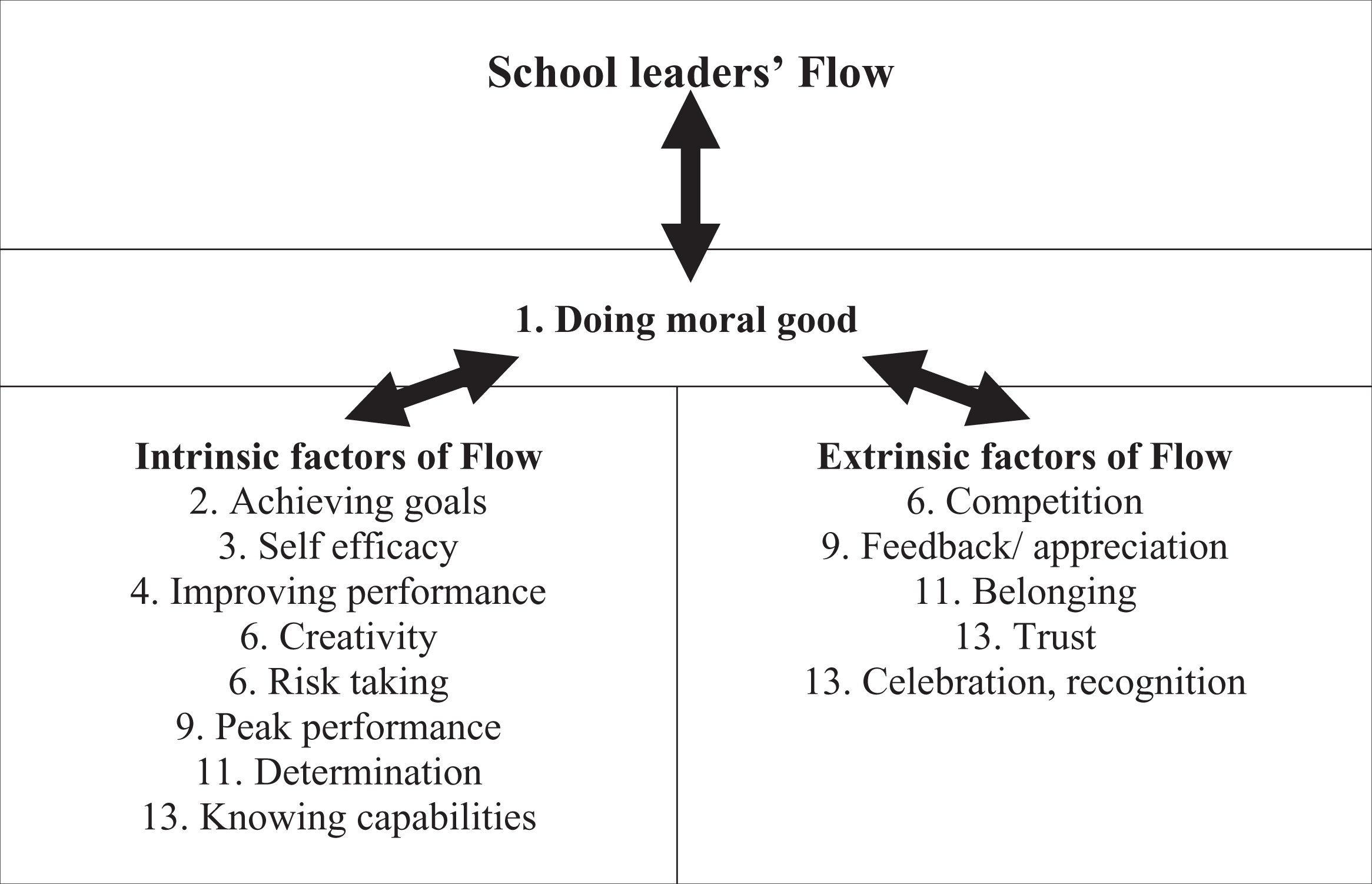
A model showing school leaders’ judgements on Flow in school contexts.
The conclusions of this research are that the school leaders’ professional model of Flow is structurally and internally different from that of Jackson and Csikszentmihalyi (1999). The sense of doing moral good underwrites the school leaders’ roles, and it is the major factor in the generation of Flow for school leaders in this sample. While the growing development of new understandings of Flow, especially in the virtual computer-mediated environments, means that the Flow model is being extended, this research raises concerns over the possible misfit of the orthodox Flow model. Of real concern is the nature of intrinsic and extrinsic rewards for school leaders, particularly in tough schools, and their consequential resilience and motivation. More research is necessary to confirm these findings and to ameliorate the potentially dire situations that face some school leaders.