



Abstract
School leaders face potential conflicts between the demands of national and local education policy and the values and ethics that brought them into teaching and subsequently into school leadership. This article asks whether head teachers’ values are changed by the policy context, and looks at incidents in head teachers’ professional lives that have put their values to the test. It draws on case study work undertaken with one primary school and two secondary school head teachers in an English urban local authority. The article concludes that, for all the opportunities and limitations of educational policy, the greatest influence on the agency of school leaders is the personal history that has shaped their values and given direction to their moral compass.
Introduction
This critical study explores ‘the interplay between the agency of the headteacher and the structures that enable and prevent that agency’ (Gunter, 2005: 172). It examines some of the ‘theoretical and perspectival and ethical challenges that need further consideration … the values and commitments of organisations and actors’ (Ball, 2011: 52). It is built around three research questions:
To what extent do school leaders experience tensions between their professional values and the priorities within the policy environment? How do individual leaders respond to those tensions? Are school leaders’ educational values changed by the policy context?
It explores through discussion with head teachers the interplay between structure (the policy context) and agency (their ability to shape the school culture and to exert authority and autonomy).
Literature
Since the 1988 Education Reform Act, under the leadership of different political administrations, there has been greater centralization and control despite the rhetoric of choice and diversity (Bottery, 2007a: 153; Holligan et al., 2006: 105). School leaders have become sceptical of the notion of local autonomy because of an architecture of compliance within which their role is to define and meet performance targets (Stoker, 2006: 44). They may want the school to be ‘theirs to run’, but:
Over less than a decade, English heads gained new freedoms and authorities to act within their schools, but there were also new audit and risk management procedures and new lines of accountability that delimited what could be done. (Thomson, 2010: 9)
These reservations have not been confined to England. In a study of principals in Queensland, Australia, Addison (2009) examines ‘the CEO perspective of principalship’, where the discourse and values of the business sector shape organizational practice for schools even if they conflict with the values of those who lead them. These leaders have ‘a feel for the game of principalship – a game in which market-based economic imperatives had become central to both their professional success and leadership practice’ (Addison, 2009: 335). This view aligns with the research of Eacott (2011), also conducted in Australia, which finds ‘the cultural re-engineering of school leadership and the embedding of performativity in the leaders’ soul’ (Eacott, 2011: 47). Also relying on the metaphor that inspires the title of this article, Eacott describes school leadership as a game where one must learn a set of rules ‘couched in economic language and with frequent intervention, or interference, from those beyond education’ (Eacott, 2011: 50). He urges school leaders to ‘engage in the conversation of the world’ and to contribute to ‘robust research that engages with the complexity of school leadership practice’ (Eacott, 2011: 51).
Two themes recur in the school improvement literature: the encouragement of empirical research into the responses of school leaders when their values are tested and the ‘playing a game’ analogy of school leadership in the policy context. The ‘game’ metaphor is articulated by principals themselves: ‘Schools necessarily played a game, and “if you have to play it, you know you’ve got to play it to your advantage”.’ (Bottery, 2007b: 96−102).
Gunter refers to ‘the leadership game’ as an example of the use of Bourdieu’s thinking tools to describe, explain and understand social practice. This is ‘the dominant game to play …, where those outside of schools … controlled the leadership of schools’ (Gunter, 2012: 18).
Process: Individual and shared perspectives
This study asks whether school leaders believe that they play the game without compromising the values that brought them into the profession. Three head teachers were each interviewed twice, with an intervening gap of one month when I asked them to keep a record of ‘critical incidents’ relating to the research theme. The two rounds of interviews were followed by an extended group discussion involving all three participants.
The first interview with each head teacher began with a Q sort activity which required participants to rank a set of 35 statements according to a scale ranging from ‘strongly agree’ to ‘strongly disagree’. Q methodology is typically used with a small number of participants ‘as a means of capturing, comparing and contrasting individual perspectives on a specific question in the field of educational leadership’ (Woods, 2011: 318). The statements used in the Q sort required participants to reflect on their values against the themes emerging from the ‘transformational leadership’ literature: autonomy, creativity, marketization, performativity, inclusion, faith. In the first interview I asked participants to give a commentary on their thinking about the positioning of the statements. Following that interview each participant agreed to keep a record of critical incidents relating to the research theme. Such incidents might include dealing with a curriculum matter, or a financial decision, or handling a difficult personal situation concerning a pupil or a member of staff. They are critical because ‘they affect the outcomes of the system or process and are memorable to those involved in the system’ (Robson, 2011: 366). The purpose of this activity was to move the focus of discussion from general principles to concrete examples of incidents that happened in the daily life of a head teacher.
In the second interview participants related the incidents and explained why they were examples of their values being tested. I also gave them an opportunity to reflect on their earlier responses to the Q sort.
The final stage of data collection was an extended group discussion stimulated by the output from the Q sort. Participants compared their responses, discussed similarities and differences, and commented on the effectiveness of the research methods. Built into the research process, therefore, were opportunities for respondents to validate or revise opinions expressed at earlier stages.
The schools and their leaders
The head teachers work in a metropolitan borough in the English Midlands with more than 100 schools. According to the Index of Multiple Deprivation it faces well above average educational, economic and social challenges. Examination results in its schools have risen steadily in recent years against a downward trend nationally.
Heather is head teacher of a large primary school whose senior leaders were described in its most recent Ofsted inspection (March 2010) as ‘a unified and powerful team with the knowledge and skills to drive up improvement’. The report further commented that ‘staff morale is high and the strong belief in the leaders, and in the future of the school, is seen at every staffing level. Governors are committed and astute and have a clear knowledge of their role in moving the school to a position of excellence’. Heather has been head teacher for ten years, having previously been deputy head at the school where she started as a newly qualified teacher in 1994.
Afzal is head teacher of an 11−19 secondary school in an area of high socio-economic disadvantage. About three-quarters of its students come from minority ethnic backgrounds and more than half speak English as a second language. Of these, a significant number − some of them refugees and asylum seekers − are at the early stages of learning English. In recent Ofsted inspections, leadership at the school has been judged to be good. Ofsted reports have commended the strong direction provided by the head teacher and have said that staff fully share the vision for the school that the head teacher and his senior team communicate. Afzal is in his fourth year as head teacher. He also works for Ofsted as a lead inspector and inspection team member.
Martin is head teacher of a voluntary aided school with close links to its Church of England diocese. The school has a strong record in the area of educational inclusion. It was the first full service extended school in the local authority, and has received national recognition for its work with students with special educational needs, including physical disabilities. Martin is in his second year as head teacher, having previously been deputy head at the school. He was still in the role of acting head teacher when this research began and was appointed to the permanent post between the first and second interviews.
Emerging themes
Several themes recurred in the Q sort − the individual interviews, the record of critical incidents and the group discussion:
The head teachers see their professional values as a constant and significant influence on their decision-making They reflect on the extent to which their values are shared by their leadership team and their staff The policy context shapes their work but does not greatly affect their day to day activity As school leaders they are more strongly influenced by their personal educational history than by national educational policy.
Values are at the centre of these head teachers’ thinking about how they manage their professional work. All three spoke about the values and ethos of their school: they should be reflected in classroom activities and it was their responsibility to provide a moral framework for the work of staff. Heather’s comment is typical:
I talk a lot about values to my staff and I always have a values question for everybody that I interview. I had a heated discussion once while I was in my NPQH with my tutor and I said ‘your values are your values – they’re your rock’ – and he was saying ‘no they really should change over time’. But that would depend on your values, on what you believed education was about.
It is in the classroom rather than in meetings or political discussions that values are put to the test. Participants were asked whether, when recruiting staff, deeply held beliefs about education were more important than teaching competence. They said that it was essential that new staff shared the mission and ethos of the school:
Perhaps I frighten (applicants) because I speak to them for about ten minutes when they come in for interviews and lay down quite clearly this is the trajectory that we’re working on, these are the expectations, it’s very student focused and they need to buy into that vision. The child comes first and we are here to provide a service. (Afzal) I want the people that I appoint to be striving to do the best for the kids. (Martin)
Teaching competence can be developed on that basis:
I always say that if I appoint somebody who shares the same values, then I can teach them how to be a more effective classroom teacher. If they’re not committed to the school’s beliefs then it will never work. (Heather)
None of the head teachers claimed to have a political position that informed their thinking about education. Nevertheless, they did not think that there was a good match between their values and those of policy-makers, nor that the voice of head teachers was taken seriously by policy-makers. They agreed that education was, in Martin’s words, ‘massively a political battle at the moment’. But the political context was more an unwanted distraction than a constant influence on their practice:
The fundamental bit that remains consistent is that those children at that moment in time need to receive a quality learning experience. The political position doesn’t inform what happens to them in the classroom really, that’s something that just happens in the background. (Afzal)
Head teachers must live with the frustration of policy direction that they see as whimsical or misinformed:
Changing the vision every five years, or even less than that, doesn’t help. I think the politicians at the moment have got misinformed ideas of education, they’ve got outdated ideas, and some of the people that are helping them to make policy are ill informed or lacking experience. So the whole policy bit frustrates me. (Martin)
Where head teachers experience tensions between values and policy, they must interpret policy for staff, mediate if necessary and prioritize the interests of the school community. They gave specific examples to illustrate this: the Year 1 phonics screening check, the Year 6 English grammar, punctuation and spelling test, the introduction of the English Baccalaureate and the discontinuation of some established vocational qualifications at Key Stage 4. In each case the head teachers saw disadvantages for the pupils for whom they are responsible. They found creative ways of developing local solutions that responded to the policy imperative without compromising their educational values or the ethos of their school.
Some policy changes are welcomed by head teachers. The most significant recent example of such a policy change, according to all three head teachers, is the new process for teacher appraisal and capability. These arrangements were introduced with effect from September 2012. They require schools to assess teachers’ performance of their role and responsibilities against new national standards. The new arrangements have met with resistance from teachers. At the time when this research was undertaken, all three participants were dealing with a tense situation with their staff. This is, however, a policy that aligns with their personal values: ‘probably the first time that I’ve felt really torn between staff and policy’ (Heather). As a consequence they have faced staff resistance while supporting their governing bodies to implement the new policies. Achieving this has required them to apply a certain amount of pragmatism − for example, explaining to staff that there was a legal requirement for governors to have a policy in place and committing to a review after 12 months. It has also been driven by a moral position: they do not want to keep teachers in their school who do not provide the best experience for young people:
If you had a member of staff who wasn’t doing their job properly it took far too long to get rid of them. (Heather) They are doing a disservice to the learning of kids, and it’s only in education where you get some of those compromises rather than just the hard line of ‘you’re not doing what you should be doing’. (Afzal) I do feel more empowered and more inclined to tackle deficiencies in people’s performance than I’ve ever done. I’ve gone and spoken to people about it because I think there is a moral imperative for making sure that those things aren’t happening. (Martin)
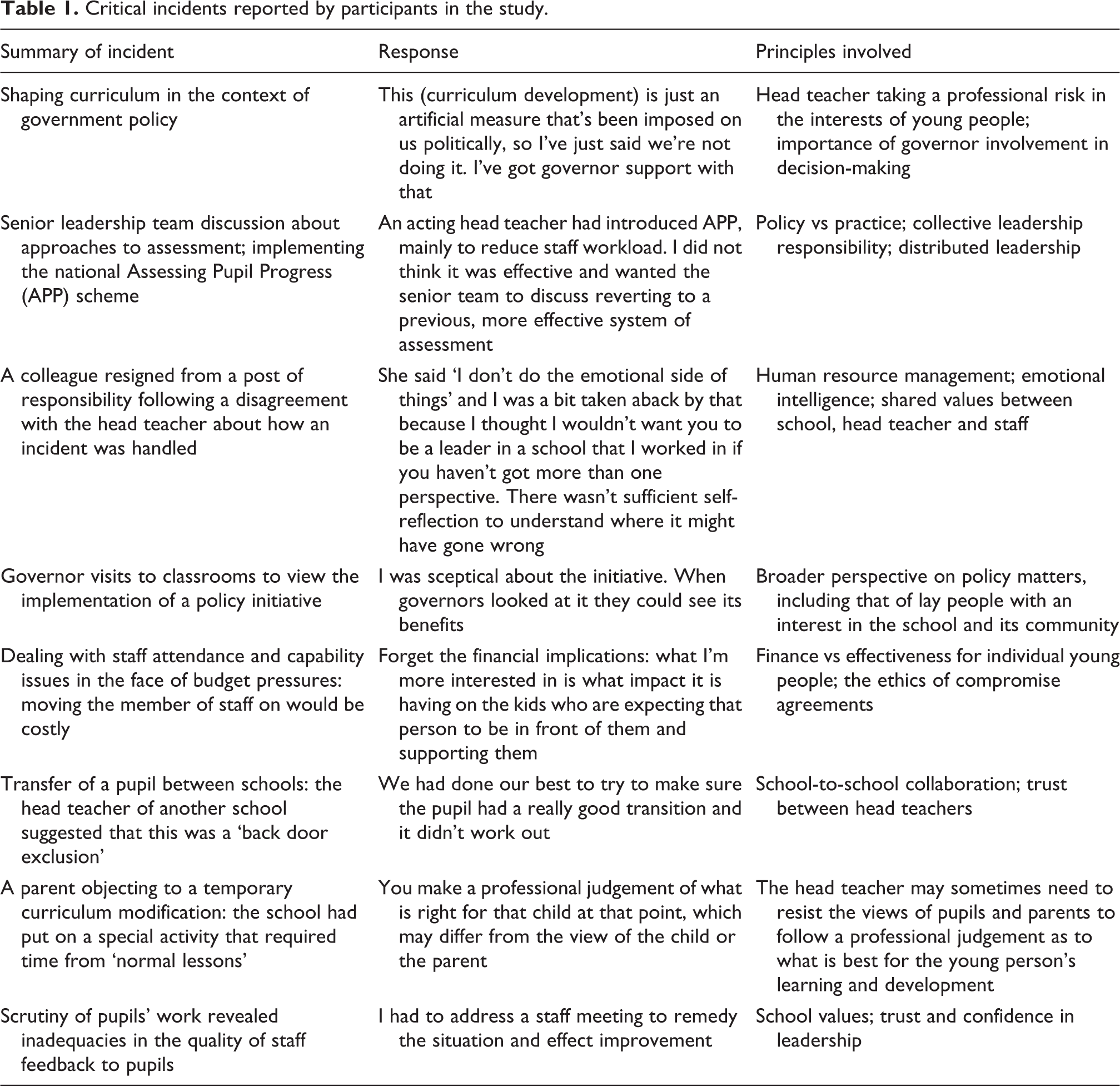
Between them the participants have worked with the National College for School Leadership (all have the National Professional Qualification for Headship), Ofsted, the National Challenge, the Specialist Schools and Academies Trust, the Academies Unit and in one case as a Local Leader of Education. The experiences that they relate are included in some detail because they confirm that irrespective of all the opportunities and limitations of educational policy and the government bodies that shape it, the way in which schools ‘do policy’ is strongly influenced by personal histories, purposes and values. Several examples of these tensions emerged from the record of critical incidents kept by participants during a period of one month (Table 1).
Critical incidents reported by participants in the study.
Have professional values changed?
The participants in this case study said that they had not changed:
My set of values is my driving force, that’s what brought me into it in the first place. (Afzal) I would say that I’m behaving in a way that has been consistent throughout my career. And I think it’s held me in relatively good stead for most of the time so why change now? And why because I’m in the position that I’m in do I have to behave in a totally different way? I think if the values and the approaches that I’ve had have got me into the position that I’m in, then I’d probably be better sticking with them. Otherwise I’m doing something that really isn’t me. (Martin) Education might change but what you essentially believe a good learner might look like or what we’re here for doesn’t really change. (Heather)
They drew on their personal history to support these statements. Heather’s responses focused strongly on teaching and learning, on teachers and learners. She is head teacher in the school where she has always worked. She identifies closely with the classroom experience of the teachers in her school, wondering at one point whether she might have left the classroom too early. Heather stressed her role in developing and nurturing staff:
I see my staff as my class. As a teacher I was trying to get the best out of my children. As a head I try to get the best out of my staff, for the children.
This was linked to her reluctance to chastise staff for unsatisfactory assessment practice, which to Heather was a source of disappointment rather than a cause for disciplinary action. Her reservations about national policy derived from her concern about their negative effects on individual pupils, whether in causing stress or in limiting children’s creativity. But she saw it as her role to make policy work for the benefit of those children:
I’ve learned over the years to make things fit and work for us. I’ve never turned anything down completely but I’ve made it work.
In Martin’s case there were two factors that influenced his response to policy: the context of his school and the point that he had reached in his career development. Both, he said, limited his scope for risk-taking. The school had been in the National Challenge because of low attainment. It had two successive ‘satisfactory’ judgements from Ofsted. Martin was still acting head teacher at the start of the research. He hoped for a time of greater stability but at this point his responses to questions about policy showed a preoccupation with what he saw as the school’s vulnerable situation and his own unproven status:
Because of the situation that I’ve been in I’ve tried to play things politically with a straight bat, and if I was a head teacher in a school that was more comfortable in terms of outcomes and had been in position for five or six years I might be reacting differently to some of these points.
Of the three participants, it was Martin who came closest to acknowledging that he might have adapted his beliefs and values. He spoke of a changed approach to exclusions and managed moves. As a deputy head with responsibility for pastoral care he had argued against excluding students. Now as head teacher he sometimes saw the need to do so for the good of the greater number. He respected the colleagues who had taken over the role of advocate for the young person in such situations. What had not changed was Martin’s commitment to supporting young people – as he saw it, against the odds – by maintaining his inclusive principles:
If you’re a head teacher in a school that has consistently high outcomes and doesn’t face some of the social issues that other schools have, you may feel that you have got the freedom to do things differently. It must be very easy to make a decision to get rid of some kids, but those kids deserve the same life chances as everybody else and by permanently excluding them you’re going to put their long term possible outcomes in jeopardy. Now I would never want to do that, I would want to work with a child to give them the opportunity to turn themselves around.
Afzal gave as an example a case where policy rhetoric can ignore reality:
This week we've had to feed a child breakfast, we've had to provide for him to have a wash, we've had to wash his clothes, iron them, buy new underwear and socks, and we're now concerned that although we've made referrals, apparently he doesn’t meet the criteria (for intervention by social services). The thought that this child can sit at home and do two hours of homework is so low on his priorities list - he would like a meal this evening.
Afzal went on to describe tensions of a different nature. His comments gave a fresh perspective to the notion of head teacher as servant of the community, supporting it at all times. Afzal sometimes found himself in conflict with the Muslim community of which he is a member. There were matters on which as a liberal educator he held a different view from some members of the local community. He gave as a particular example the education of girls. His own faith and values were established during his early years:
One of the things that I fight here is with my own community more than other communities and that’s this notion of girls in education. Having grown up in a family where my father was fairly religious but not just religious in practice, religious in terms of learning as well, he was quite adamant that the girls of today are the mothers of the future and therefore the value of education is so so important for the next generation. I actually witnessed him being challenged by his peers.
Members of the community confronted him with phrases such as ‘you of all people should know better’ because they expected him to conform to their interpretation of the faith that they shared. As a member of a minority ethnic community Afzal has a good understanding and an informed viewpoint on issues within that community. He can express views for which outsiders might be accused of being misinformed or racist. Prefacing his remarks with ‘I wouldn’t want to cast aspersions on the community that I’m within, but …’, he spoke of the lack of education of many members of the Kashmiri community and of the influence of the caste system on the Sikh community, for example. He talked of the way in which some families explained the bad behaviour of their children as being caused by demonic possession, to be resolved by exorcism or beating rather than via a school code of conduct. This is a question of values and beliefs that is untouched by educational policy and yet is an essential part of Afzal’s professional identity.
Conclusions and further work
Although not claiming to be based on a representative sample of head teachers, this study has enabled me to theorize about the approach of head teachers within the particular context of an urban education service. These three head teachers believe that for education professionals working in an area such as theirs it is more difficult to balance policy demands with a personal ethical standpoint than it might be elsewhere. They reached consensus on this in the group discussion.
Several themes emerged from the case studies that call for further investigation. The first is the extent to which head teachers’ personal values are shared by their leadership teams. Can some differences of opinion or ethical position stimulate a healthy professional debate that will contribute to raising standards in teaching and learning? Are there some ethical issues that are felt more acutely by head teachers than by other senior leaders, because the head teacher carries the ultimate responsibility and cannot simply focus on a single aspect of provision? The second theme is how school leaders are influenced by their personal history. Of particular interest would be other school leaders such as Afzal, who have values and principles as an educational leader which do not align with those of the faith community from which they come and which they are expected to serve. A final theme relates to policy formation: in what ways can school leaders insert their values into the system in order to influence, change and shape policy?
Footnotes
Acknowledgements
I would like to thank the three participating head teachers for giving their time and sharing their experiences, and Helen Gunter, Alan Dyson and Liz Gregory for suggesting improvements to this article. The article is an edited version of an unpublished research paper submitted to the University of Manchester as part of the EdD programme.