



Abstract
This article looks at the potential of using an online self-completing inventory that measures leadership consciousness awareness. The Consciousness Quotient inventory (CQ-i) has been developed to encourage leaders to be more conscious of their ability to be accountable and responsible for their leadership practice. The CQ-i as a method for researching leadership is piloted here between a university academic and a primary headteacher in the context of a school–university partnership. Pilot outcomes reveal that the inventory can be used as an evaluation of partnership work and ways of thinking about leadership on two levels: the personal and the partnership. The method is somewhat limited by a lack of distinctive criteria for personal domain statements and the absence of an overall profile outcome for the CQ score. Its strength lies in the way the outcomes of the inventory can be used as a starting point for personal reflection on leadership and as a vehicle for discussing a range of different ways of leadership working within different settings, such as school and university contexts.
Introduction
This article offers a possible methodology for researching a school–university partnership that has evolved over the past two years between a primary school headteacher and a university academic. It has been written from the perspective of the university academic but with the full consent of the headteacher who participated in a research pilot to assess the validity of a self-reporting inventory. In this article, I report on how we used our own data as a means of evaluating this inventory and offer it as a starting point for researching our partnership work.
The school context
The headteacher leads a primary school in challenging circumstances and the role of the university academic is to support the work of the teachers engaging in evidence-based teaching (EBT) or teacher inquiry (Poultney, 2017). Contextually, the school intake is from a large disadvantaged area of the East Midlands and has over 70 per cent of children designated as ‘pupil premium’ 1 and high instances of pupil mobility. The school has a chequered history of inspection outcomes ranging from special measures to ‘ungraded’ and is currently part of a larger group of trust 2 schools. The school–university partnership was predicated on the headteacher’s desire to critically evaluate the impact of various initiatives beyond the gathering of simple school data progress indicators. We have been working together for two years and have successfully engaged with EBT which has contributed to a range of positive outcomes for the school, including improved SATs results in 2016 and a publication detailing this work (Poultney, 2017). It is at this juncture that we decided to explore the potential of using the Consciousness Quotient inventory (CQ-i) to evaluate our partnership working.
Ground rules for school–university partnerships
Establishing a partnership was an important part of our work but it was clear that there needed to be agreement over:
the reasons for the introduction of EBT (for example, as a means of school improvement or a shift in school culture); clarity regarding each other’s experience and strengths when sharing out tasks; the focus and scope of the research being undertaken; communication protocols and the sharing of information.
The headteacher had already introduced some school routines as ‘non-negotiables’ designed to bring some consistency to teaching and learning across the whole school. We each saw ourselves as joint leaders in this partnership primarily because of our roles within our respective institutions. This meant that we saw the act of leading as relational, which is different from the traditional behaviourist approach to leadership (Bush, 2003). We had to use our collective wisdom or social intelligence (Mongon and Chapman, 2012) to make sense of how our personality-based partnership would work in practice. We envisaged that teachers and learners would benefit from our collective approach and that we would be able to use the teacher inquiry approach (EBT) to evaluate the quality of teaching and learning in the school. We were also aware that, for some teachers, undertaking this work would open up a whole new experience of researching their practice which would be supported and promoted at both school and university level.
Looking back, I now have a better understanding of how crucial our joint endeavour was to sustaining teacher inquiry in this primary school. What we understood less well was the nature of our leadership relationship (as we both perceived it) and how it could be conceptualized, observed and researched. Documenting the conditions, structures and processes for teacher inquiry was a relatively straightforward process but how to research and provide a methodology with an evidence-base for our partnership was more problematic. From the literature it became clear this work was drawing upon a reciprocal/democratic/participative and distributed field but as yet with no clear research approach to adequately describe this joint leadership endeavour (Austin et al., 2012; Waitoller et al., 2014).
What did we want to understand?
As the HEI academic reflecting on this journey it was clear to me that both of us as leaders were informants and participants in this research. Therefore, it was important to understand what unit of analysis would be most appropriate to conceptualizing our collective leadership approach and, crucially, to agree a methodology that would support this. Much of the research reported into school–university partnerships is anecdotal, consisting of case studies, narratives or post-reflections on practice, none of which we thought appropriate vehicles to fully describe the headteacher-academic partnership we have both experienced. It was clear that we would not be able to adequately illuminate this work from a joint leadership perspective by adopting any of these approaches. This positive experience of working with a primary headteacher inspired me to find out more about the characteristics and competencies we both needed to have for this partnership to work and, importantly, for the partnership to be sustained over time. If there was a particular blueprint for our leadership work, what did it look like in practice and how might it be evidenced in research data?
This led us to three research questions:
What does our leadership relationship look like; how is it conceptualized by us? What are the conditions, processes and actions for school leaders and academics to take into account as they establish their leadership partnership? How might we begin to research this relationship and what is a suitable methodology?
Researching into our own partnership was going to be challenging given that we would be reflecting on our experiences after a period of teacher inquiry work. In addition, we needed to take into account that we were both participants and informants, and that we may be regarded by others as apologists in this post-partnership evaluation exercise, which we did not desire. How could we provide evidence for what had been (and continues to be) a largely democratic and reciprocal partnership when there are few guiding methodologies? What we did understand was that we were working in a relational paradigm in which power was shared and our respective experiences were democratically used to make progress with our collective vision. Starting with that view, we began to think about the nature of our leadership endeavour and how we had both represented our respective domains of school and university. Using key words in an online search for the terms ‘reciprocal leadership’ and ‘authentic leadership’ I came across the term ‘consciousness quotient’ (CQ), a term coined by a Romanian professor of psychology, Ovidiu Brazdau, who talked about conscious leadership. Brazdau had developed a Consciousness Quotient inventory (CQ-i) and had undertaken a pilot study into participative leadership in the university context, part of which chimed strongly with our leadership work. In communication with Brazdau and reviewing his work with Valita Jones (Jones and Brazdau, 2015) it became evident that this inventory might be useful in assessing our leadership competencies given we were leading on a range of issues related to teacher inquiry across school and HE contexts. Although rooted in the field of psychology, Brazdau’s inventory explores aspects of what it is to be human in all its forms, which again chimed strongly with our working relationship. We wondered if this inventory could be used as some form of scale to evaluate our partnership working, to help us understand our respective leadership roles more fully and help our partnership to become more effective in any future projects we undertook together. Examining our individual ‘self-theory’ (Dweck, 2000) would give us each issues to reflect upon and together allow us to see areas of leadership working we needed to think more closely about. The inventory is specifically designed for personal development around improving conscious leadership skills, but we wondered if the inventory could form the basis of a benchmark for our work and as a possible new method for thinking about and researching educational leadership. We decided to pilot the inventory ourselves and our data is presented and evaluated in this article.
Conscious leadership as a way of describing our school–university partnership
Velmans (2009: 3) describes the act of being conscious as ‘all the things that we observe or experience’ and for leaders Jones (2012) describes conscious leaders as those who are at one with themselves (the act of being), are interconnected with the world and motivated to act responsibly. Becoming a conscious leader might be a way in which a leader understands self, others and the wider world, which seemed a good starting point for us to think about our partnership. Conscious leadership is viewed as a humanistic construct and draws on a transformational leadership approach as described by Burns (1978). We were drawn to the fact that transformational leadership is a mutual endeavour based upon our moral values and higher ideals, a means by which we could influence each other to achieve more. Further conscious leadership is predicated on vision sharing and placing trust in each other to achieve agreed goals.
These general assumptions aligned well with our way of working as we were engaging in critical discourse around issues of teacher inquiry, questioning our motives and actions, and reframing classroom methodologies that were unfit for purpose and proposing new ones for teachers to pilot. We were about to challenge long-held assumptions held by teachers in an inner-city primary school that they were unable to change their practice. I drew strength from this body of conscious leadership literature that allows leaders ‘to develop the multiple layers of consciousness they need to be able to have the fluidity, flexibility and openness that is increasingly required of them’ (Carter, 2009: 2). Our individual values of respect and trust for each other aligned with writers, such as Carter (2009), Brazdau (2014) and Chauhan et al. (2013) who collectively focus on consciousness beginning with self and one’s own self-awareness.
What is seen as fundamental to effective leadership is how a leader is able to report upon his/her conscious processes (Barrs, 2003, in Chauhan, Sharma and Satsangee, 2013) and the ability to be able to access a quantity of information (Brazdau, 2011). It is the way in which a leader is able to be mindful of him/herself, of others, and the environment, in order to gain an understanding that choices of action are based upon one’s values, beliefs and feelings (Carter, 2009: 4-5). Carter explains how leaders lead from the ‘inside-out’ which is predicated on:
awareness and being (what it is to be alive, awareness of self, others, organizational settings, the world around us); reflection and learning (having a sustained openness to learning, awareness of events occurring in the moment and externally to self, learning through awareness and reflection); conscious knowing (integration of awareness and intention, applies a moral code, integrates rational and intuitive thought processes that underpin choices made); purposeful and informed action (underpinned by conscious knowing, informed actions that embody our moral and ethical values and reflects our inner commitment to our leadership work).
Beyond self, there are contextual orientations that a leader must make sense of, working this time from the outside-in. These external orientations have an external reality and are linked with orientations of:
power (awareness and responsibility); confronting conflict and valuing diversity; working with complexity and celebrating paradox; embracing change; supporting interconnectedness; balancing present with future sustainability.
These orientations are situated under five domains of functioning, within which the conscious leader operates which relate to knowledge about personal self, interpersonal relations and internal and external settings. In detail these are:
the self (the awareness of own actions and impact of the leader on others); the interpersonal (emotional space between self and others); the collective (emotional space between self, team or community and outward manifestation of this); the internal setting (knowledge and understanding of own organization); the external setting (knowledge, awareness, understanding of the broader context and how one’s own organization operates in this sphere). (Carter, 2009: 8)
Why did this methodology excite us?
Brazdau’s methodology is based upon an online CQ inventory that measures overall leadership conscious awareness and the extent to which we, as leaders can support innovation, creativity and change as part of our leadership role. This I felt was a good start in providing quantifiable and qualitative data as a baseline from which we could further make sense of our partnership within this context. Could the inventory be a suitable method for evaluating our partnership ways of working? Although Jones and Brazdus’ (2015) study was grounded in the HE context for university administrators (leaders), the inventory provided a good ‘fit’ with some characteristics of leadership we were grappling with, namely, that of shared responsibility, trailblazing a new partnership and being aware of our own individual positions in the work and of each other and over a sustained period, in our case two years and on-going. In seeking a suitable methodology to describe our partnership that might be replicated in other contexts, we had seen the inventory as being a means of ‘baselining’ our CQ-i, which would then give us a quantitative and a qualitative measure of how well we might be doing in these terms and the evidence to re-evaluate the partnership. It may also give us the opportunity to use it in with different partnerships, such as teachers working together in school.
Other methods such as the use of a questionnaire, interview or structured narrative were all considered but had limitations: they needed to be administered by a third party and did not provide both quantitative and qualitative data. Their value lay as follow-up methods, especially interviews, which can then examine in more detail the constituents of being a ‘conscious leader’.
Jones and Brazdau (2015) take as given that aspects of conscious leadership such as introspection, collaboration, reflection and decision-making are integral as practice among higher education leaders. They wanted to make leaders in universities aware of their own identities and actions. On completing the inventory the outcomes would then form the basis of a series of interviews to reveal qualitative data around how the university leaders operate in practice. Taken together these data locate leaders as transactional (managerial leaders) or transformational (creative leaders) and identify the potential for them to become interconnected with others. I began to wonder if improving leadership acumen may mean having a framework such as this inventory which provides an opportunity for examination and introspection of one’s own leadership competency and personal dispositions.
The CQ-i inventory as a method
The CQ-i is a measure of access each of us has to a vast amount of information from the vast field of consciousness. It is a measure of ‘being conscious/aware throughout a day, in regular life conditions’ (Brazdau, 2016). It assumes that the participant has a degree of witnessing awareness of themselves and others and is able to make choices when interacting with others and one’s environment. Leaders who register a high CQ have the ability to see a lot of information simultaneously; a lower CQ indicates less ability to access this raft of information. Simply put, someone with a higher CQ normally has a broader perspective, as long as the information is understood. CQ is a measure of ability to access the information and, when linked with IQ, may measure the ability of a person to process this information. Brazdau (2014) has created a psychometric instrument to measure seven domains of consciousness:
physical CQ (being conscious of your own body and environmental awareness; emotional CQ (conscious of your own feelings, emotions, their development and interactions); cognitive CQ (conscious of your ideas, thoughts, reflective processes, meaning-making); social-relational CQ (conscious of human relationships and the way you connect with others); the self CQ (conscious of self and one’s own ego or identity); the inner growth CQ (capacity for awareness of personal development, personal growth); the spiritual CQ (conscious of yourself as part of a wider world and your place/connections in it, ‘I’ as an observer).
The headteacher and I agreed to complete the inventory, which neither of us had used before. This was a two-stage process, the first part to complete the inventory and the second part to meet and discuss our outcomes. We completed the inventory separately but on the same day, keeping a note of how long it took us to respond to all of the 273 statements. The inventory was based on a six-level Likert approach ranging from ‘Almost never’ to ‘Almost always’ for each of the statements. The first section (243 statements) requires the participant to evaluate the frequency with which they have encountered a specific situation (as specified in each statement), in their daily life. There is a range of percentage figures from 90–100 per cent (Almost always/Definitely yes), if the statement regularly applies to one’s daily experience to 0–10 per cent (almost never/Definitely no), if the item does not apply. There is a range of percentage graduations between the upper and lower limits of the scale. Statements in the first section are typically presented as: 59. I notice the automatic habits/patterns of my thinking (for example, positive, negative, optimistic) 123. It is easy for me to notice the various aspects (facets, parts) of my self
The second section has 30 items to be answered with a yes/no response scale. These are typically presented: 252. Do you fantasize about what you want or dream about having? 273. I have carefully designed my own perspective on life on Earth and my role here on Earth
A few days later we met to discuss our individual scores and to see how we compared. The meeting lasted for about one hour. We reflected on our experience of completing the inventory (how easy it was to come to a decision over each score), how long it had taken us to complete the inventory and our overall impression of how each inventory section might relate and or impact on our way of thinking about leadership issues that might impact positively or less so on our future partnership working. We discussed our experience of completing the inventory and agreed that many of the statements did not immediately resonate with issues we would normally associate with the skills, traits and abilities to carry out leadership work. We had not, for example, thought too closely about the domain of spirituality but it did generate a discussion which allowed us to think about why we did not see the immediate relevance of this domain to our partnership work. The inventory allowed us to re-evaluate our own leadership qualities and how we might strengthen our ways of partnership working. This was especially apparent with the domain of ‘Inner growth’ which we felt allowed us to discuss some of the challenges of working in each other’s context, that is, academic working in school and headteacher working in the university. In conclusion, we feel that the inventory has given us both licence to talk about partnership leadership from a personal and professional perspective and through such discussions given us both more confidence in the work of promoting partnership and teacher inquiry.
As a method for researching leadership the inventory was straightforward to complete and the results were generated by the online questionnaire.
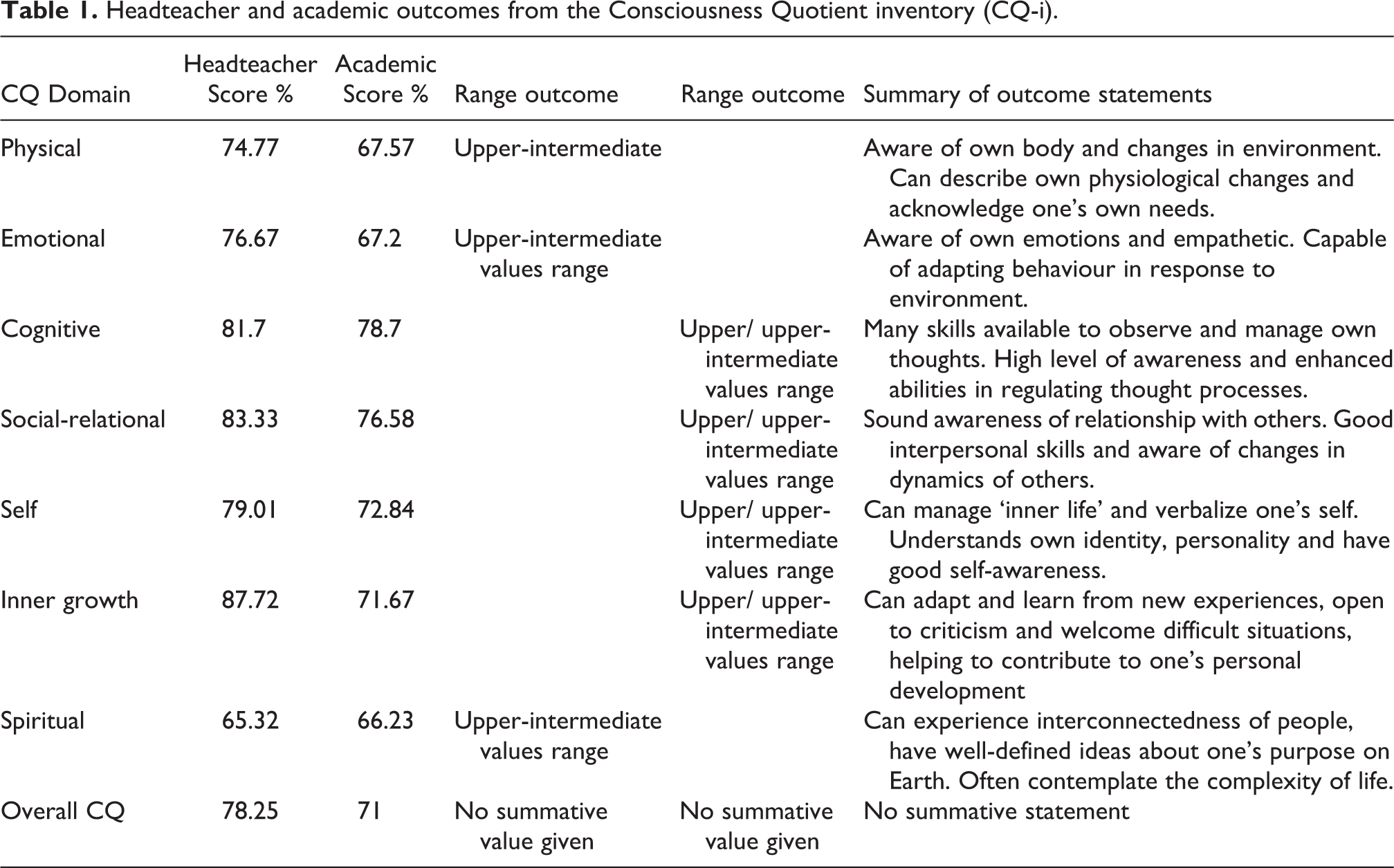
Our results are shown in Table 1 and we have decided to compare our statistics and outcomes for the purpose of this pilot.
Headteacher and academic outcomes from the Consciousness Quotient inventory (CQ-i).
Evaluation of our data and reflections about the inventory
The online assessment engine uses standardized scores for exploratory purposes only. For interpretation there are four categories: upper (80–100 per cent), upper-intermediate (60–80 per cent), average (40–60 per cent) and below average (0–40 per cent). For most of our scores we fell into the upper/upper intermediate range across the seven domains and our summative scores were 71 and 78 per cent, respectively (scores above 80 are highlighted in the table). We thought that repeating the inventory after an agreed time period (say after six months) might reveal improvements in our individual scores and be a better measure of validity of the inventory.
The merit of the inventory lies, we feel, in focusing the participant’s awareness of self, promoting reflection of one’s own scores for each domain and in developing an awareness of how well one relates to others over those collective domains, should a comparison of scores/outcomes be agreed between those completing the inventory. As a professional development tool the inventory provides opportunities for individual leaders to reflect on their scores and make the choice to disclose scores/outcomes with others or not. For those interested in their own personal development and in gaining a deeper insight and understanding of themselves, this inventory provides a good introduction. In our context, it gave us the opportunity to have further discussions about our leadership roles in our partnership working and the ways in which we might work together in the future.
Framing joint reflections on our leadership
Merits of using the inventory
We compared our scores and agreed that we were probably fairly balanced in terms of how we viewed ourselves, others and the wider world. There was no escaping the head’s joy at coming in with a higher overall CQ score, but this point emphasized for us Brazdau’s (2015) directive that the inventory should be used for self-disclosure and not shared; ethically this is an important point unless participants choose to disclose this personal information. The outcomes of the inventory also point to a participant’s IQ – the higher the score, the better the participant is at understanding themselves, others and the wider world in which they live and work. Looking at some of our outcome statements we realized these were pertinent to operating as a successful leader – being reflective, having a measure of ‘self-doubt’, a degree of empathy with others. The value of the inventory was enhancing our understanding of leadership within our own relative contexts in a way that we felt did not negatively impact on our partnership.
The impact of the inventory can be summarized as follows.
As a tool it was of personal and professional interest to each of us to have some evaluation of our leadership and levels of consciousness. It gave us both the opportunity to think about issues such as spirituality (collectively our lowest score) which we might not have considered as part of our leadership approach. The scores on the cognitive and social-relational range were high and confirmed we might make a good team. It provided affirmation that we were both clearly reflective (self) and likely to be, at least based on self-reported data, emotionally stable.
We agreed the inventory had some merit not only in the scores but around each of the seven domains. The tool itself provided a framework for further discourse around our own leadership actions individually and as a partnership. The domains appeared to be a good starting point for evaluating our leadership competencies, but we were less interested in the descriptive statistics (beyond giving us an individual indication of our conscious leadership) and more interested in the reasons why we obtained such results. Given that the tool is not finely graded, the results can only be an indication of our respective conscious leadership. In many ways, the use of the inventory has strengthened our partnership. Further impacts based on the inventory and subsequent discussion are as follows.
5. It has reaffirmed our commitment to partnership working. 6. It has helped us to better understand how we individually perform as leaders and to respect each other’s leadership perspective. 7. We agree that the leadership role deployed by the university academic is a worthwhile and useful activity in supporting headteachers in school improvement activities. 8. We actively and with confidence promote the school–university partnership to other local schools.
We felt the inventory could be a useful addition to a leadership development session in both school and university contexts. It could promote discussion around transformational leadership approaches and the characteristics of such leaders. Applying it to our particular context we considered at what point it might be introduced to a newly established partnership without impacting negatively on that relationship. As an experienced academic, I was very aware of the need to tread carefully, particularly during the early stages of the work as I did not want to encroach on the head’s professional territory. Southworth (2000: 20) summarizes this as: ‘…“working with” colleagues, rather than ‘working on’ practitioners, is more productive and ultimately more powerful because the sharing of ideas is so stimulating and challenging’.
There are many competing priorities for school leaders to consider and academics have to be aware of these pressures as part of their role as ‘supporters’, ‘dialogic critical friends’ or ‘knowledgeable others’. The role of an academic as another leader of learning is a compelling one but, in practice, nurturing this relationship can be fraught with difficulties. I found it helpful to try to work out the nature of our relationship considering such issues as:
recognizing each other’s experience and strengths when sharing out tasks; the focus and scope of any research being undertaken in school by me as academic; how and when to communicate with each other.
Brazdau (2014, 2016) suggests that outcomes of the inventory should not be shared with others, however we felt there was merit in sharing our data so that we could engage in a meaningful dialogue about our leadership work. Sharing more widely would need to be managed and negotiated with who sees the data and how it is disclosed, discussed and used. For the purposes of external research, third party data collection and anonymization of participants could allow for generic reporting of emerging patterns, themes and issues.
Limitations of using the inventory
In reviewing our experience of completing the inventory we felt the distinctions between some of the CQ domains and the close descriptive nature of the outcome statements were somewhat unclear. Emotional, self and spiritual domain outcome statements appeared to us to be less distinctive than the more straightforward outcome statements for physical, cognitive and social-relational domains. In discussing this we agreed there were domains very closely associated with personal ways of being and others that related better to our leadership/partnership work. We began to see the inventory as being useful on two levels: the personal and the professional, but wondered if others completing the inventory would agree with this view. Discussing the outcome statements to gain a deeper perspective on each domain would be a useful exercise to begin a follow-up in-depth interview if this method were to be used as part of any leadership research.
The overall CQ score for each of us provided no summative statement as previously with the seven domains. We had expected a form of ‘personal profile’ but this level of analysis was not a component and potentially a weakness of the inventory. However, our overall experience of engaging with this inventory has, on the whole, been a positive one and we turned our attention to how it might be used with other school/university leaders.
Recommendations for scaling up this approach to researching leadership
From a wider research perspective, the inventory would seem to have merit as a starting point for researching transformational leadership. As we have worked together in a spirit of cooperation, it seemed appropriate to engage with a psychological-based approach that is grounded in a sociocultural knowledge of reciprocity, essentially a participatory leadership style. Previous research using the CQ-i approach (Jones and Brazdau, 2015; Jones, 2012) has adopted a qualitative approach employing the use of in depth semi-structured follow-up interviews with participants who have completed the inventory. These interviews gave opportunities to follow up on the seven domains of the CQ-i inventory, such as ‘How do you connect with other human beings’, ‘how do you learn’ and ‘what is your specific worldview or perspective on leadership?’ (Jones and Brazdau, 2015: 253). I would suggest that research into effective school–university partnerships could employ a similar methodology or, perhaps, a self-completing questionnaire which provides broadly similar opportunities for participants to reveal more about their leadership values. The use of narratives again aligned with the seven domains of conscious leadership provides an alternative validation of the outcomes of the inventory and the means to accrue a rich data base of transformative leadership evidence.
Scaling up this research about leadership more generally, this method has potential for individual leaders (and those aspiring to leadership positions) to be more self-aware about their own leadership actions. The outcomes of the inventory for a participant bring into sharp relief a score and a written outcome which is useful for self-reflection and personal analysis of how one appears as a leader.
Conclusion
In an era of increased autonomy and system fragmentation, school leaders are charged with forging new alliances across and within their school communities. While on the one hand headteachers are grappling with improving attainment in their schools they are also charged with productively networking and forging close relationships with other institutions and services within their communities. These types of partnerships, if they are to be enduring, need to be built socially, based on trust developed and sustained over time. The partnership described in this article is, at its heart, a social activity from which positive impact has been taken by both parties. Our experience of piloting the CQ-i has opened up a way of exploring our sociocratic way of working (Mongon and Chapman, 2012) and to provide some quantifiable measure of our own personal dispositions. The impact of piloting the inventory has given us licence to reflect on our partnership work to date and how it might help us shape our work for the future. Completing the inventory has given us the space to reflect on how we are thinking about partnership working from a personal and partnership perspective.
Personal
The outcomes of our respective inventories gave us each an opportunity individually to reflect on the seven domains and how well we each scored in relation to them. There were clearly some areas for both of us that could have been improved, as designated by the scores and the summary of outcome statement. The content of each outcome statement and the information supplied on the CQ-i website lead us to realize that as leaders we have choices and decisions that we make during the course of our life and that these are largely predicated on primary emotions (gained in childhood) and later, secondary emotions (Damasio, 1994), which as adults allows us to be conscious of our emotional state and offers us the flexibility of response based upon our interaction with the environment. We become aware of ‘leading with the head and the heart’ (Sergiovanni, 1992), a form of moral leadership that is vital in our work with professional others.
Partnership
While we note some of the limitations of the inventory as discussed earlier in this article, overall it has been a positive experience for both of us. Having built up a measure of trust between ourselves over time, we felt in a good position to evaluate our work using the inventory. The inventory has given us a benchmark for our work to date and licence to reflect on how conscious we are about our leadership work and how we might work better together in partnership. Our work has not been compromised by engaging with this pilot or undermined our working relationship. We have undertaken many activities since the publication of our book Evidence-based Teaching in Primary Education (Poultney, 2017): conferences, continuing professional development sessions for other schools, trust and Teaching School Alliance meetings to name but a few. From a leadership perspective we better understand each other’s respective roles and in particular how we promote the school–university partnership as a beacon of good practice to schools in the local area. The empirical evidence presented here illustrates our dual leadership actions that support our endeavours with teacher inquiry and evidence the synoptic understanding that emerges from these shared learning opportunities. We have welcomed the opportunity to evaluate our partnership and put it under a microscope. It has allowed us to generate a dialogue around such issues as spirituality which we might never have had without completing the CQ-i. We feel it has broadened our thinking and confirmed our collective vision for school improvement through teacher inquiry.
Footnotes
Acknowledgement
I would like to thank Jon Fordham, headteacher, for his time, enthusiasm and suggestions and for allowing his data to be used as part of this article.
Declaration of Conflicting Interests
The author(s) declared no potential conflicts of interest with respect to the research, authorship and/or publication of this article.
Funding
The author(s) received no financial support for the research, authorship and/or publication of this article.