



Abstract
This article will examine different international approaches to leadership preparation and induction, linked to concepts of socialization and identity. Although leadership is widely understood to be the second most important factor influencing student outcomes, principal preparation is neglected in many countries. A teaching qualification and teaching experience are often considered to be sufficient attributes for new principals. The article will argue that being a principal is a different role from classroom teaching and requires specific preparation. This involves three phases of socialization. First, aspiring leaders require professional socialization, preparing to become a principal. Second, they need to change their identity, from teacher to principal – a process of personal socialization. Third, they need a period of organizational socialization, learning to lead in a specific school. The article will draw on international research and literature to consider the experience of new principals in different settings. It will also examine examples of preparation and induction in several settings to establish what works effectively and in what contexts. It will also consider the role of mentoring in successful principal preparation and induction, bearing in mind the need for induction to be an extended process, not a ‘one-off’ event. The article will conclude with a model for leadership preparation and induction, which could be applied in many places, subject to careful adaptation to fit the local culture and context.
Introduction: Leadership matters
Leadership is widely understood to be the second most important factor influencing student outcomes. ‘Leadership has very significant effects on the quality of school organization and on pupil learning’ (Leithwood et al., 2006: 5). There is also compelling evidence that specific leadership behaviours are more likely be effective in promoting student learning. Transformational leadership has been advocated for more than 20 years because of the research showing that it has positive effects on student outcomes. Leithwood (1994: 506) reported on seven quantitative studies and concluded that ‘transformational leadership practices, considered as a composite construct, had significant direct and indirect effects on progress with school-restructuring initiatives and teacher-perceived student outcomes’. Subsequently, he showed that ‘the effects of transformational school leadership on pupil engagement are significantly positive’ (Leithwood et al., 2006: 5).
The widely reported Leithwood et al. (2006) study also stressed the importance of distributed leadership, describing this claim as ‘compelling’. They use the notion of ‘total leadership’ to include all possible sources, including teachers, staff teams and vice-principals, as well as principals. They conclude that ‘total leadership accounted for a quite significant 27 per cent of the variation in student achievement across schools…much higher…than is typically reported in studies of individual headteacher effects’ (Leithwood et al., 2006: 12). This finding appears to support the current popularity of distributed leadership (see, for example, Bush and Glover, 2012a).
Robinson’s (2007: 21) meta-analysis of the research on the effects of leadership shows that the impact on student outcomes is likely to be greater where there is direct leader involvement in the oversight of, and participation in, curriculum planning and co-ordination, teacher learning and professional development. ‘The closer leaders are to the core business of teaching and learning, the more likely they are to make a difference to students’ (Robinson, 2007). This leads Robinson et al. (2009) to conclude that instructional leadership is more powerful than transformational leadership in promoting student learning: The impact of pedagogical (instructional) leadership is three to four times that of transformational leadership. The reason for this is that transformational leadership is focused on the relationships between leader and follower rather than on the educational work of the school (Robinson et al., 2009: 201).
The case for leadership preparation
The case for specific preparation is linked to the evidence that the quality of leadership is vital for school improvement and student outcomes, as noted above. Huber (2004: 1–2), drawing on school effectiveness research, claims that ‘schools classified as successful possess a competent and sound school leadership’ and adds that ‘failure often correlates with inadequate school leadership’. Conversely, Leithwood et al. (2006: 5) claim that ‘there is not a single documented case of a school successfully turning around its pupil achievement trajectory in the absence of talented leadership’ (Leithwood et al., 2006: 5).
In most countries, school leaders begin their professional careers as teachers and progress to headship via a range of middle and senior leadership and management roles. Principals often continue to teach following their appointment, particularly in small primary schools. This leads to a widespread view that teaching is their main activity, and that a teaching qualification and teaching experience are the only requirements for school leadership. Bush and Oduro (2006: 362) note that ‘throughout Africa, there is no formal requirement for principals to be trained as school managers. They are often appointed on the basis of a successful record as teachers with the implicit assumption that this provides a sufficient starting point for school leadership’. The picture is similar in many European countries, including Belarus, Cyprus, Denmark, Finland, Hungary, Iceland, the Netherlands, and Portugal (Watson, 2003). In England, the previous requirement, that new heads must have acquired the National Professional Qualification for Headship before being appointed, was dropped in 2013.
In the twenty-first century, there is a growing realization that headship is a specialist occupation that requires specific preparation. The reasons for this paradigm shift include the following:
the expansion of the role of school principal; the devolution of powers to school level; the increasing complexity of school contexts; recognition that preparation is a moral obligation; and recognition that effective preparation and development make a difference.
These arguments are explored below.
The expanded role of school leaders
The additional responsibilities imposed on principals in many countries make great demands on post-holders, especially those embarking on the role for the first time (Walker and Qian, 2006). These demands on school leaders emanate from two contrasting sources. First, the accountability pressures facing principals are immense and growing, in many countries. Governments, parents and the wider public expect a great deal from their schools, and most of these expectations are transmitted via the principals. Crow (2006: 310), referring to the United States, points to enhanced societal demands within an ‘increasingly high stakes policy environment’. The pressures facing leaders in developing countries are even more onerous than those in the world’s richest countries. In many countries in Africa, principals manage schools with poor buildings, little or no equipment, untrained teachers, lack of basic facilities such as water, power and sanitation, and learners who are often hungry (Bush and Oduro, 2006).
Devolution to school level
One of the main global policy trends is the devolution of powers to site level. In many countries, the scope of leadership and management has expanded as governments have shifted responsibilities from local, regional or national bureaucracies to school principals. The inevitable consequence of such changes is an increase in leadership scope as heads, principals and other leaders have to exercise functions, notably financial management and staffing issues, previously undertaken outside the school. Watson (2003: 6) shows that devolution produces increasing complexity in the role of the head of the school and heightened tensions for principals: ‘It leads to the need for the exercise of judgement in particular situations, rather than the simple following of rules’. The next section considers the extent and nature of this enhanced complexity.
The increasing complexity of school contexts
Hallinger (2001: 61) notes that ‘the rapid change around the world is unprecedented’. This arises from global economic integration leading to widespread recognition that education holds the key to becoming, and remaining, competitive. This has led to increased accountability pressures, as noted earlier. Because of the devolved nature of leadership in many education systems, these pressures are exerted on site-based leaders, notably school principals, who have to deal with increasing complexity and unremitting change. One example of increasing complexity is international migration, leaving schools to manage language and cultural diversity, as well as the other pressures noted above.
Leadership preparation as a moral obligation
The additional responsibilities imposed on school leaders, and the greater complexity of the external environment, increase the need for principals to receive effective preparation for their demanding role. Being qualified only for the very different job of classroom teacher is no longer appropriate. If this model were followed for other careers, surgeons would be trained as nurses and pilots as flight attendants. Although competence as a teacher is necessary for school leaders, it is certainly not sufficient. As this view has gained ground, it has led to the notion of ‘entitlement’ (Watson, 2003: 13). As professionals move from teaching to school leadership, there should be a right for them to be developed appropriately – a moral obligation. Requiring individuals to lead schools, which are often multimillion dollar businesses, manage staff and care for children, without specific preparation, may be seen as foolish, even reckless, as well as being manifestly unfair for the new incumbent.
Effective leadership preparation makes a difference
The belief that specific preparation makes a difference to the quality of school leadership is underpinned by research on the experience of new principals. Sackney and Walker’s (2006: 343) study of beginning principals in the US found that they were not prepared for the pace of the job, the amount of time it took to complete tasks and the number of tasks required. They also felt unprepared for the loneliness of the position. Daresh and Male’s (2000: 95) research with first year principals in England and the US identified the ‘culture shock’ of moving into headship for the first time. Without effective preparation, many new principals ‘flounder’ (Sackney and Walker 2006: 344) as they attempt to juggle the competing demands of the post.
Avolio (2005) makes a compelling case for leadership development based on the view that leaders are ‘made not born’. Those who appear to have ‘natural’ leadership qualities acquired them through a learning process, leading Avolio (2005: 2) to deny that ‘leadership is fixed at birth’. This leads to a view that systematic preparation, rather than inadvertent experience, is more likely to produce effective leaders. This view is supported by the findings from a longitudinal study of the effects of a national principal development programme in South Africa. Bush and Glover (2012b: 14) found that schools with at least one graduate from this programme improved their school leaving examination results faster than schools with no such graduate. They conclude that ‘there is every reason to believe that such favourable outcomes could be replicated in other countries’ (Bush and Glover, 2012b: 14).
Identity and socialization
As teachers embark on their training and professional practice, they become socialized as teachers and develop and hone their professional identity. These twin concepts are helpful in understanding how professionals frame and practice their roles. However, moving into the very different role of principal is likely to lead to new socialization processes and a change in identity.
Heck (2003) uses the twin concepts of professional and organizational socialization as a lens to examine the impact of preparation. Professional socialization includes formal preparation, where it occurs, and the early phases of professional practice. Organizational socialization involves the process of becoming familiar with the specific context where leadership is practiced. Heck’s (2003: 246) review of research in one US state shows that ‘the socialization process accounted for about one-fourth of the variance in administrative performance’. This is a significant finding which underpins the view that preparation should be a deliberate, rather than an inadvertent, process.
Crow (2006: 321) suggests that ‘a traditional notion of effective socialisation typically assumes a certain degree of conformity…a “role-taking” outcome where the new principal takes a role conception given by the school, district, university or community’. He argues that the greater complexity of leadership contexts requires a ‘role-making’ dimension, where new principals acquire the attributes to meet the dynamic nature of school contexts.
This involves three phases of socialization. First, aspiring leaders require professional socialization, preparing to become a principal. Second, they need to change their identity, from teacher to principal – a process of personal socialization. Third, they need a period of organizational socialization, learning to lead in a specific school. Crow and Moller (2017: 755) link identity formation to leadership development. ‘Understanding…how cultural and historical factors influence the fluid and developmental nature of identities should motivate us to take such factors into account in our leadership preparation and professional development programs’.
Weinstein et al.’s (2016) survey of 76 novice principals in Chile showed that 81 percent of their participants described their leadership role as ‘very difficult’ or ‘difficult’. They identified problems such as dealing with multiple tasks, feelings of unpreparedness, unanticipated events, and excessive time dedicated to administrative tasks. These findings connect to those reported by Crow (2006), who noted that organizational socialization of beginning principals in the United States entails taking the full load of responsibilities without much support. Novice principals also lack a reservoir of experience and confidence to sustain them through the most challenging times (Montecinos et al., forthcoming).
Induction: An event or a process?
Given that new principals often experience ‘anxiety, frustration and professional isolation’ (Kitavi and van der Westhuizen 1997: 253), an effective induction process seems to be essential. However, in practice, induction, where it occurs, is often a one-off event, typically offered by a local administrator, unconnected to previous or subsequent development and often provided just before, or just after, the principal takes up the post. This type of induction is usually confined to procedures and reporting processes, and is rarely customized to the specific needs of the principal or the school. In the absence of effective induction, principals may be left to ‘sink or swim’. In the Netherlands, for example, ‘every new head starts his or her job with trial and error’ (Derks, 2003: 172).
A better approach is to regard induction as an ongoing process, beginning with succession planning and continuing through to in-service development. Such a process might have six phases: succession planning leadership preparation recruitment and selection induction mentoring in-service development.
What is effective induction?
Designing an effective induction programme requires consideration of the nature of the process and of the providers. As noted above, if induction is provided by a local administrator, often the principal’s superordinate within a hierarchy, it is likely to be confined to administrative procedures and reporting processes. Given the increasing emphasis on instructional leadership, often accompanied by high-stakes testing, such a limited approach is clearly inadequate. Another approach is for induction to be provided by a professional mentor, for example an experienced and successful principal. Almost all research on mentoring reports positive outcomes (Bush, 2008; Hobson and Sharp, 2005). Pocklington and Weindling (1996: 189) claim that ‘mentoring offers a way of speeding up the process of transition to headship’. Personalized induction, co-constructed by the new principal, is likely to be more effective than a ‘one-size-fits-all’ approach.
A related issue concerns the purpose and nature of induction. Two alternative approaches can be discerned. The first is underpinned by the view that principals are part of a wider system and need to operate primarily as administrative leaders. The second arises from understanding that the principal is a professional leader and that his or her growth is an indispensable element for school improvement. Table 1 illustrates the components of these two models.
Alternative induction models.
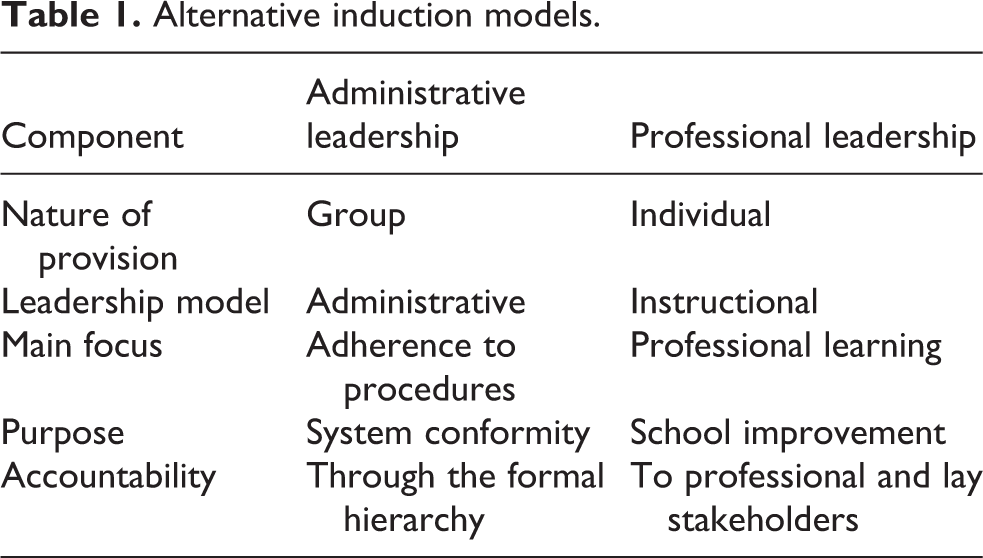
Column two of Table 1 shows a narrow approach to induction focused on administration and formal accountability. In contrast, column three illustrates a personalized approach designed to promote ongoing professional learning and an instructional approach. The administrative emphasis is found in many centralized systems, for example in Africa, Asia and Eastern Europe. Although policy-makers increasingly recognize that instructional leadership is more likely to promote student and teacher learning than traditional administrative approaches, enacting such changes is notoriously difficult. The Malaysia Education Blueprint (Ministry of Education Malaysia, 2013), for example, exhorts principals to become instructional leaders, but there is little evidence of any meaningful change in leadership behaviours (Norwawi, 2017 1 ).
A model for leadership preparation and induction
Drawing on the earlier discussion, I propose a model for leadership preparation and induction that could apply in any education system, subject to careful adaptation to meet the needs of the specific context. The model offers a comprehensive longitudinal approach to the development of school leaders beginning with succession planning (see Table 2).
A model for leadership preparation and induction.
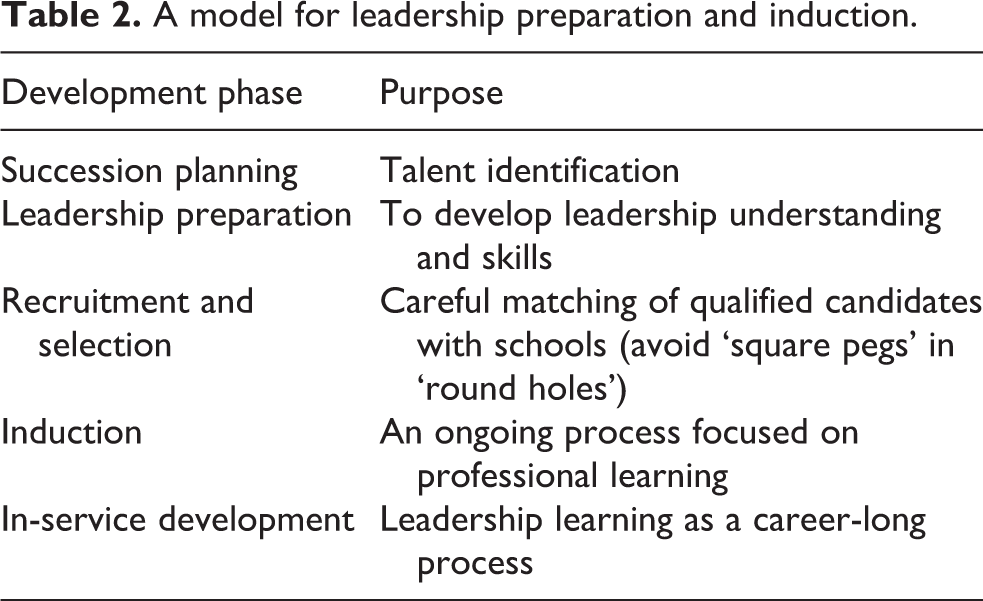
Table 2 shows a normative model for leadership preparation and induction, intended to illustrate the need for a careful longitudinal process, beginning with the identification of potential future leaders, and continuing with sound preparation, customized selection, professional induction and ongoing development. The Singapore system probably comes closest to matching this model. ‘In the Singapore context [leadership succession] has not been left to chance. The Ministry of Education has drawn up a framework where promising teachers are selected for various leadership or managerial positions in the school’ (Chong et al., 2003: 167). Suitable candidates embark on the ‘Leaders in Education’ programme which combines classroom activities with workplace (school) learning supported by a ‘steward principal’, intended to produce a ‘profound learning experience’ (Chong et al., 2003: 169). In decentralized systems, it is more difficult to achieve such coherence as different agencies may be responsible for each stage in the model. The increasing fragmentation of the English system, with only a weak residual role for local authorities, the closure of the National College for School Leadership, and the abandonment of a mandatory headship qualification, means that leadership preparation and induction are likely to be highly variable.
Conclusion
It is widely accepted that leadership is central to school improvement and student learning, reinforced by Leithwood et al.’s (2006) important study in England. There is also growing evidence (notably Robinson, 2007) that instructional, rather than administrative, leadership is required to produce the best outcomes. However, in many countries, including England, leadership preparation is neglected and teachers may become principals without any specialized training. The career path of many professionals, from classroom practitioner, to middle leader, senior leader and principal, means that they gradually reduce what they are trained for – teaching – while increasing what they may not be prepared for – leadership. It is hard to establish a rationale for what appears to be simple negligence. Although funding is always a constraint in developing countries, there can be no such excuse in developed contexts. If Canada, Chile, China, France, Hong Kong, Malaysia, Singapore and most US states can prescribe leadership qualifications for future principals, why is this not the case in other countries?
Induction arrangements are often inadequate in many contexts, leaving prospective principals to draw on an ad hoc apprenticeship model, where they learn the job from their own principals while holding more junior leadership posts. This can work well if the role model is competent, but this is not always the case. Moreover, it does not ‘widen the lens’ to allow aspirants to understand and experience alternative approaches. This is a narrow model, likely to lead to replication of previous practice; the complexity of twenty-first century schools requires a broader range of knowledge and skills. Planned induction can minimize the sense of isolation and uncertainty reported by many new principals. Lack of systematic preparation and induction at best delays principal effectiveness, and at worst wholly inhibits it.
Patterns of leadership preparation and development are highly variable across national contexts, ranging from prescriptive mandatory programmes, as in Singapore, to ad hoc ‘on the job’ learning in many countries. There is growing recognition of the need for specialized leadership preparation, but programme content and processes differ significantly. In centralized systems, such as China, France and Singapore, the learning model is standardized, providing consistency, but allowing limited scope for ‘role-making’. A degree of personalization, for example through mentoring, would enable participants to customize their learning to their personal needs and those of their school. In decentralized systems, for example in England, the challenge is how to judge the value of optional national professional qualifications, offered by different licensees, and to compare them with university master’s level programmes. There is limited evidence about how academy chains, for example, are promoting leadership development, but there is the potential for good practice to emerge, and subsequently to be generalized. The era of the National College now appears to have been a ‘golden age’, and there is inevitable post-College uncertainty about the future of leadership preparation. The current pluralist provision seems likely to continue for the foreseeable future. This may lead to innovative approaches, to enhance leadership practice, or leave current and future principals underprepared, and less effective than their schools and students deserve.
Footnotes
Declaration of Conflicting Interests
The author declared no potential conflicts of interest with respect to the research, authorship and/or publication of this article.
Funding
The author received no financial support for the research, authorship and/or publication of this article.