




Abstract
For those in ‘system leader’ roles in English schools, whether formally designated or informally appropriated, there has not been much systematic or long-term thinking about professional development to date. To contribute to such thinking, this paper presents a common framework for system leader development, based on consultancy research. The framework is broad in scope and critical in approach and can be adapted to role and function. Working within the assumption that all system leaders are consultants, it shows how a research engagement process can combine consultancy practice with consultancy research to generate professional development activities. During this process, system leaders work with higher education institution (HEI) researchers, to progressively interrogate their practice against consultancy research around four themes: ‘relationships’; ‘skills’; ‘outcomes’; and ‘the wider context’. At the same time, the researchers variously move through the roles of providers of research summaries, to co-creators of professional development activities, to co-facilitators of Action Learning Sets. It is argued that this research engagement process has much to offer HEIs and groups of schools wishing to collaborate on system leader development in the interest of generating principled, long-term helping relationships in a self- improving system.
Keywords
Introduction
This paper is about the generation of professional development activities for system leaders using a research engagement process.
‘System leaders’ in English schools really began in 2006 with Earley and Weindling’s report on headteacher support in the successful London Challenge initiative, although at the time they were called consultant leaders (Early and Weindling, 2006). By the time of Higham et al.’s landmark study of system leadership in 2009, consultant leaders were relegated to a subset of system leadership and the focus of research was on models of practice that included taxonomies of roles, characteristics and tasks rather than processes of helping relationships (Higham et al., 2009). In their study, the usual well travelled literature of coaching, mentoring and facilitation was wheeled out for professional development, but consultancy skills training only got a one line mention.
Meanwhile, as new school structures and groupings were emerging within the narrative of the ‘self-improving school system’, system leadership was growing apace. Over the period 2006–2010, the National College had formally designated a series of system leadership roles (national, local and specialist leaders of education (SLEs), governance and coaching were all created) and impact studies followed (Hill and Matthews, 2010; Robinson, 2012). By 2015, Simkins et al. were reporting many more system leader roles informally ‘appropriated’ by proactive headteachers and even local authority professionals (Simkins et al., 2015). But by 2016, with a National Foundation for Educational Research study of executive headship, another key system leader function, higher strategic skills for partnerships were important, yet the preoccupation with role definition at the expense of frameworks for understanding helping relationships was still dominating thinking (Lord et al., 2016).
This paper addresses the need for complex understandings and skills in the helping relationship that is system leadership by assuming that all system leaders are consultants, and that a framework for their professional development should be based on consultancy research. This framework should be relevant to the current schools’ policy landscape and broad enough in scope to be adaptable to all the system leader types outlined above. It should also form the beginning of a research engagement process in four stages that is designed to develop these complex understandings and abilities in consultancy. First, researchers produce the framework. Second, they test out the framework with a stakeholder group of system leaders in a teaching school alliance or multi-academy trust to locate ‘entry points of interest for practice’ and then interrogate that practice against further readings chosen to address those points of interest. Third, the researchers work with the system leaders to generate professional development activities from findings arising from this combination of research and practice, and fourth, the activities are put into professional development practice.
Developing the framework
Frameworks for professional development are inevitably values-based and echoing Hargreaves (2014), the overarching research question for the literature review that informed this framework had explicit normative assumptions around moral purpose and democratic process that challenged narrow conceptions of marketisation in education. The question was ‘If, as a professional community, we believe that education should be a public service in a democratic society, what sort of system leaders do we want in the future?’.
To address this question, the framework was constructed from principles and paradigms in two previous literature reviews of consultancy research. The principles of democratic values, sound organisational analysis and sophisticated understandings of change processes from the organisational development literature, reviewed in Burnes and Cooke (2012), provided us with what we called the ‘contextual dimensions’ of Values, Analysis and Change. The paradigms of ‘critical, functional and socially critical’ from a review of consultancy research across the social sciences by Gunter et al. (2015) gave us a device for framing micro, meso and macro perspectives of consultancy practice which we called ‘operating levels’. Together, these contextual dimensions and operating levels constituted our six areas of enquiry.
These six areas of enquiry were then translated into a composite definition of consultancy work that comprised our terms of reference for professional development, as follows: system leader consultants are skilled as ‘professional helpers’. They build ‘levels of mutual acceptance’ with clients, through ever changing combinations of ‘expert’, ‘diagnostician’ and ‘process’ roles that depend on task, client expectations and organisational context (Schein, 2002); system leader consultants are committed to democratic values (Burnes and Cooke, 2012). They base their diagnoses of client situations on policy appropriate organisational analysis (Woods and Simkins, 2014), and understand networked relationships between agency and structure in the work they do (Hadfield and Jopling, 2012); and consultancy work arising from their analyses is politically astute and ethically aware (Close, 2013). It acknowledges the complexity of contracting relationships (Hazle Bussey et al., 2014) and of change processes. (Burke, 2014) and takes a critical stance in public policy debate around consultancy and knowledge production (Gunter et al., 2015).
The areas of enquiry were then expressed as ‘propositions for action’, starting points, grounded in everyday practice, for justifying their inclusion in a professional development agenda. So, briefly, our rationale was that the contextual dimensions and skills set of consultancy development were located within the democratic values tradition of the organisational development literature (see Table 1). They drew from a variety of research literatures for organisational analysis and found the concepts of sensemaking, identity formation and loosely coupled systems particularly relevant for understanding change in the new policy landscape. At the ‘micro’ operating level of client/consultant relationships, ‘political coaching’ was important for learning how to exert influence with clients. At the meso organisational level, new models of contracting between consulting and school system organisations were useful for engaging strategic partners. At the macro level, system leader consultants would benefit from understandings of wider public policy debate around consultancy and knowledge production that were appropriate to their role and function.
A consultancy development framework: areas of enquiry and propositions for action (Close, 2016).
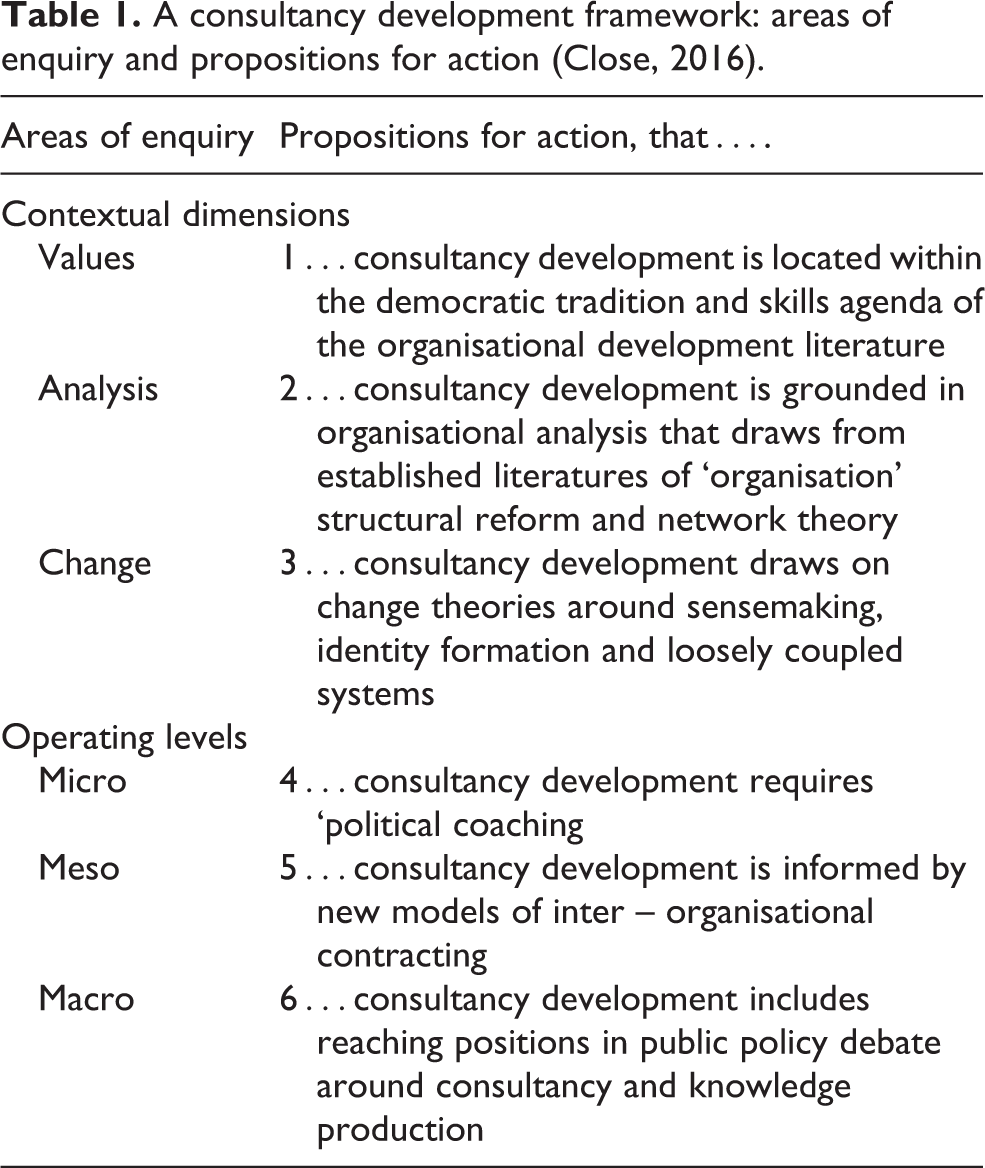
Drawn together, the central proposition was that the effective exercise of system leadership depended on certain understandings and proficiencies about which there was considerable knowledge from the field of consultancy and that more attention to this literature would provide an intellectual foundation for what was required to develop principled and long-term helping relationships in a self-improving school system. The resultant framework appears below.
Testing the framework
Asking system leaders to talk about issues and challenges in their practice around relationships, skills and outcomes is not remarkable in itself. It becomes so, though, when consultancy research is introduced into those conversations. Over a series of interviews, first, the framework paper is introduced, which carries examples of everyday system leader practice against each of the six propositions for action outlined above. ‘Entry points’ of interest are soon located that are related to some of these propositions. Within the theme of ‘relationships’, these might be around the psychodynamics of one-to-one client relationships in the organisational development literature (proposition 1), understanding resistance to change (proposition 3) or the politics of dealing with multiple clients (proposition 4).
The researchers then find further consultancy readings that enable the system leaders to explore, in later interviews, these entry points for their practice in more depth. For example, in the case referred to here, Specialist Leaders of Education were given chapters from Schein’s work on psychodynamics (Schein, 2002) and client typologies (Schein, 1998), an article on the nature of ‘political coaching’ (Close, 2013) and a chapter on ‘resistant’ clients from Block’s seminal consultancy text (Block, 2013). A sense ot the insights generated from these further readings can be gained from the following observations from SLEs (Close and Kendrick, 2016): Schein talks about ‘traps’ and ‘stereotypes’ in consultant-client relationships. I’ve found that stereotypes of help can get in the way of the help the helper can actually give. If you’re not sensitive to the dynamics that the client might be ashamed of having a problem then you have to deal with being ‘the expert’ and a resentful and defensive client who is always checking your knowledge and expertise…. I very much liked Schein’s idea of ‘moving through mutual levels of acceptance’ in order for work to proceed. The way Schein defines this process as constantly recalibrating the responsiveness of the client has helped me better understand the ways in which I determined how fast to go in my last deployment. Schein talks about ‘involved non-clients’ These can be allies of the primary client, for example friends of the teacher in the school who are telling them ‘you are great, you don’t need to do that’. This might happen during dinner time. Perhaps you need to go back into the classroom and you will see them chatting. When you return you almost have to rebuild the relationship. Block’s work.has helped me see that different skills are needed at different stages of the consulting cycle and to ask the ‘to what purpose?’ question continually – i.e. has anyone learned anything new and/or changed a policy, structure or procedure as a result of my deployment? Of the specific consulting skills in the Peter Block chapter I would say that identifying and working with various forms of resistance and not taking it personally are most relevant to my experience… …heads create the conditions for integrating the SLEs into the school and enabling them to influence the future sustainability of changes…Political coaching is needed to understand micro-political activity and the steering and nudging necessary for a positive outcome.
Generating the activities
Once insights into consultancy work around relationships, skills, outcomes and ‘the wider context’ have become more complex and developed through the continual interrogation of system leader practice against consultancy research, it is time to generate activities from these insights. At this time, system leaders are asked by the researchers to say how they think needs identified in their practice accounts might combine with skills and understandings discussed in the readings to create a menu of professional development activities.
So, Schein’s account of the psychodynamics of the helping relationship makes a lasting impression and it is thought that this could form the basis for reflective diary keeping on everyday practice. The ethics and politics of consultancy work is a subject of lively debate from the ‘organisational development’ readings and it is suggested that this could develop thinking about codes of practice for system leader work beyond existing professional guidance. A variety of skills workshops are proposed, using Block’s (2013) work, to link skills with stages of the consultancy cycle. Topics of perceived importance to system leaders in their deployments, designing for impact and working with multiple clients, are considered appropriate for seminar discussion. The notion of ‘wider picture updates’ on practical implications of the developing policy context are deemed to be necessary. Finally, the setting up of system leader Action Learning Sets is felt to be the most useful way forward for collaborative problem-solving in consultancy work.
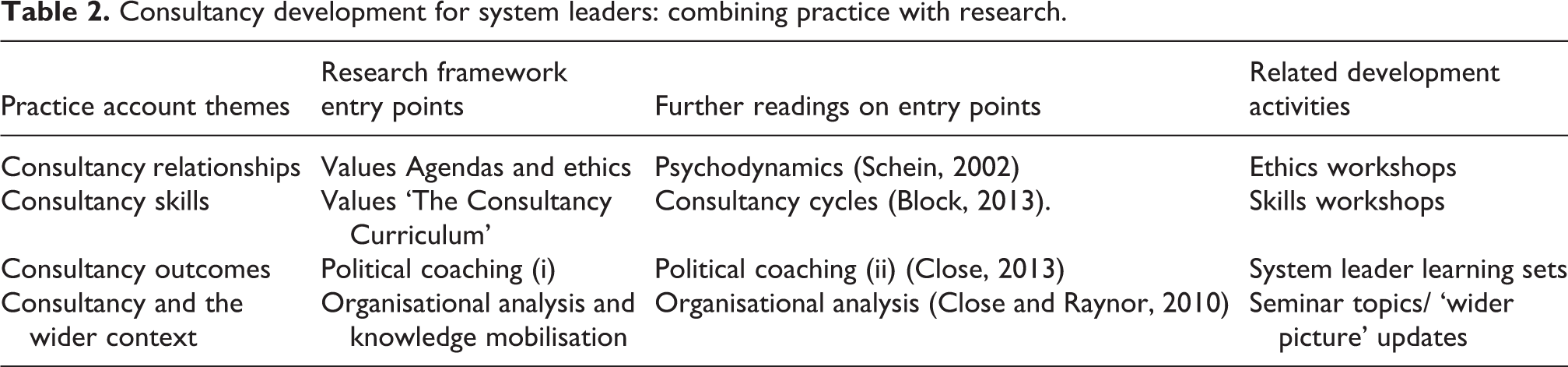
This process of combining system leader practice with consultancy research is represented in Table 2. It begins with practice accounts, progresses to ‘entry points’ of interest in the research framework and then onto interrogation of those practice accounts against further research on those entry points, ending with professional development activities. So, for example, if we take the first theme, ‘relationships,’ system leaders who talk about consultancy relationships in their practice accounts find entry points of interest around agendas and ethics in the research framework to help them explain those relationships. Further readings generated by those entry points, in turn, allow more detailed interrogation of agendas and ethics through the psychodynamics of the consulting relationship. This process of articulation culminates in an ethics workshop activity whereby a code of practice for system leader consultancy work is drawn up that supercedes existing professional guidance.
Consultancy development for system leaders: combining practice with research.
Using the activities
The case example of SLEs that has informed our scenarios thus far opted for Action Learning Sets (McGill and Brockbank, 2004) as a way of using professional development activities for consultancy problem-solving. The interrogation of practice against research had identified four problem areas: contracting, expressed as ‘setting agreements’, understanding and dealing with resistance to change; working with multiple clients; and designing for and assessing the outcomes of consultancy work. System leaders would initially come to the sets as clients, with stories from deployments that were relevant to one or more of these problem areas and, in allocated air time, would receive help in analysis, support and ways forward from fellow members acting as consultants. It was notable that the value attached to the research reading thus far was such that a consultancy reading group was recommended in parallel to the learning sets by the SLEs as a way of continuing professional learning through research-informed practice in the learning set process. This is especially encouraging as in the research engagement literature (Brown and Zhang, 2017; Godrey, 2016; Sheard and Sharples, 2016) one of the challenges of research engagement is to sustain engagement beyond the first research impetus.
In this final learning set stage the researcher role will switch to initial facilitator of the learning sets until members become self-facilitating. Thereafter the ‘mediator’ role between research and practice will be an observational one, monitoring and recording learning processes and outcomes. At the end of the learning set programme ethical tests of ‘appropriate confidentiality’ will be agreed between researchers and participants in order to produce a public account of consultancy learning from the sets that can be disseminated more widely to groups of schools interested in applying this model of professional development to their own contexts.
As some readers will be aware, the use of learning sets as a vehicle for professional development for those working in consultancy roles in public services is now a well-trodden path, with an established literature. Yet, to our knowledge to date, it has not been combined with a research engagement process for the consultancy development of system leaders in English schools.
Conclusion
The argument of this paper has been that all system leaders working across schools on school to school support, regardless of role, function or seniority, are consultants, and so consultancy research should be used to inform professional development. But consultancy research extends far beyond the narrow functionalist concept of ‘consultancy skills training’ mentioned in passing by Higham et al. (2009). As we set out in our terms of reference earlier in the paper, the consultancy development of system leaders also requires a commitment to certain values, and sophisticated political and ethical understandings of policy and organisational contexts, debates and processes of change. We hope that the framework for development and the research engagement process outlined here gives some practical relevance to these lofty aspirations, and counts as an instructive contribution to potential collaborations between HEI researchers and school groups in the interests of research-informed professional development for system leaders actively engaged in the self-improving school system.
Footnotes
Declaration of Conflicting Interests
The authors declared no potential conflicts of interest with respect to the research, authorship, and/or publication of this article.
Funding
The authors received no financial support for the research, authorship, and/or publication of this article.