



Abstract
Systems thinking can be explained as the ability to see the whole beyond its parts and to see the parts in the context of the whole. As a holistic management approach, systems thinking enables managers to cope with increasing complexity and change. Given the inherent complexity of school organizations within dynamic educational environments, systems thinking can significantly benefit the realm of school leadership. Despite its potential contribution, the available knowledge on systems thinking in school leadership is meagre. This article seeks to identify possible avenues for research regarding systems thinking in school leadership, suggesting aspects of this leadership approach that are worthy of further academic exploration.
Introduction
Principalship takes place within the complex organizations called schools (Connolly et al., 2018). Life at school is composed of a great many interconnected events, people and processes. At any given school and at any particular moment, there are many varied occurrences taking place, which affect each other and together constitute the school routine. Moreover, the complexity of a school is down to the varying demands, perceptions, identities, cultures and beliefs of those that make it up, and how they affect decisions, practices and occurrences. Given the inherent complexity of school organizations, principals and teacher teams are among those who could benefit most from systems thinking abilities (Fullan, 2005; Senge et al., 2012).
Systems thinking assists in dealing with complexity because it is an approach that places the study of wholes before that of parts. That is, it does not try to break systems down into parts in order to understand them; rather, it concentrates on how the parts function together in networks of interaction (Checkland and Poulter, 2006; Gharajedaghi, 2011; Senge, 2006). In contrast to the prevailing reductionist approach that attempts to understand systems by breaking them down into subsystems (Rosenberg, 2006), systems thinking focuses on the emerging organizational properties created by the ongoing interactions among the system’s components. Accordingly, in order to fully understand why a certain phenomenon arises and persists, it is essential to understand its parts in relation to the whole (Hammond, 2005).
Systems thinking is considered to be an effective means of managing organizations since it facilitates group learning, shared decision-making and improved organizational resilience (Jaaron and Backhouse, 2014). It increases coordination and cooperation between authorities and agencies (Leischow et al., 2008), assists managers in dealing with environmental conflicts (Van Mai and Bosch, 2010) and allows effective planning and resource mobilization (Bentley et al., 2013). Thus, it has been proposed as an approach for ameliorating managers’ coping with contemporary challenges, which often do not have a single solution but variety of options, each with a wide range of advantages, disadvantages and consequences (Jolly, 2015; Wilson and Van Haperen, 2015).
Our research on systems thinking in school leadership showed that the systems thinking approach may be seen as a world view regarding school leadership. It offers a new way to consider events, people and processes, enabling principals to better understand complex situations that arise in their schools. Systems thinking is not a tool for school leaders but rather a school leadership approach, where the term ‘approach’ refers to a comprehensive way of both conceptualizing and practicing within the entire work setting. Systems thinking may become regularized as ongoing leadership approach within schools, offering an effective way to regard everyday school life, ongoing management issues and numerous diverse aspects of principals’ work (Shaked and Schechter, 2017a; Senge et al., 2012). Therefore, systems thinking may facilitate team empowerment, decision-making and instructional leadership, as will be explained below.
Despite the growing interest in and research on systems thinking as a leadership approach, we are in need of further explorations regarding its theoretical understanding as well as its practical application in school contexts, particularly in school leadership and management. The goal of this article is to point out possible avenues for research on systems thinking in school leadership and management, suggesting aspects of this approach that deserve further exploration.
Systems thinking
Systems thinking is about seeing the whole picture. It advocates focusing not only on the trees but also on the forest – with the trees symbolizing particular situations or limited domains, and the forest symbolizing the overall phenomenon. A similar image was given by Heifetz and Linsky (2017: 51), who called on leaders to ‘get on the balcony’. Insofar as systems thinkers see a broad, general view of the system’s components and environment, and direct their efforts accordingly, systems thinkers are able to understand the system both conceptually and functionally even without understanding all its minutiae. They seek not only tactics, which are incremental steps and short time frames along the way, but also a strategy, which is oriented towards achieving broader missions and long-term goals (Arnold and Wade, 2015).
The Greek philosopher Aristotle laid one of the foundations of systems thinking by positing that a whole is greater than the sum of its parts. From this perspective, the only way to fully understand a system is to understand its parts in relation to the whole, because it is the whole that endows the parts with meaning. Moreover, the defining characteristics of the whole system cannot be found in its parts when they are isolated, because once the system is analysed – that is, taken apart – these defining characteristics lose at least some of their meanings (Gharajedaghi, 2011). Systems thinking is a holistic approach that focuses on how the parts function together in networks of interaction, not on breaking down systems into parts in order to understand them separately. Thus, to improve the whole, systems thinkers optimize the interactions among the parts. Interaction management may result in improved performance, reduced conflicts, expanded delegation of responsibility and overcoming resistance (Boardman and Sauser, 2008).
As will be noted below, studies directly exploring systems thinking in educational leadership are scant. However, there is relevant work in other areas that should be considered and built upon. For this article, two main theories will be mentioned, which help understand how systems thinking can be utilized as a management approach by applying a holistic approach to improving organizational performance. The first theory is system dynamics (Forrester, 1961, 1968). The purpose of system dynamics is to provide managers with a broader understanding of the feedback-loop structure of their systems in order to intervene in ways that ensure behaviours under the management goals. To that end, system dynamics puts much of its emphasis on using models and modelling techniques to study complex management issues. In terms of the implications of system dynamics for the field of school leadership, system dynamics provides a framework that can allow school principals to see beyond the surface, revealing deeper patterns of relationships among the feedback loops that are responsible for creating behaviours.
Another leading theory is the complexity theory, which seeks to conceptualize the emergence of order within complex systems (Johnson, 2010). Complexity theory has been applied to the study of leadership (Boal and Schultz, 2007; Lichtenstein and Plowman, 2009) and organizational processes (Lord, 2008; Uhl-Bien and Marion, 2009). Seeing the school as a complex adaptive system, a main type of complex system, allows administrators to manage it better. It is essential to understand the complexity of the school, as well as its adaptability: the school is like an organism that survives and thrives by continually adapting itself to its environment. Therefore, principals who want to ensure the success of the school, and even its existence, need to know that rigid structures, clear long-term planning, precise task definitions and elaborate rules might dangerously lead the school to remain fixed in pursuit of a particular vision when an uncertain world requires flexible responses. The lack of tight control does not mean that things will fall apart. According to this approach, continuous change of organizations and emergent order are a natural condition.
Systems thinking in school leadership
The research literature on systems thinking in school leadership is limited. Some of the books on this topic (e.g. Hoban, 2002; Senge et al., 2012; Zmuda et al., 2004) recommend using systems thinking for successful educational reforms. For example, Fullan’s (2005) book, Leadership and Sustainability: System Thinkers in Action, focuses on the sustainability of educational reform. In Fullan’s view, sustained school improvement requires ‘system thinkers’, that is, people who can address the entire system at all of its levels: school and community, district or local education authority and state or national policy. Systems thinkers know that all three of these levels influence each other. Furthermore, they proactively and naturally take into account large portions of the educational system because they know that context matters, for better or for worse, and that part of their work involves changing the context, which can only be accomplished by taking action in the broader sense. Thus, according to Fullan, it is not sufficient for principals to understand only their own reality and work, but also imagine the whole system simultaneously, expanding their perspective beyond the school boundaries. In other words, being a district and system player as well as looking out to improve within is one of the keys to maximizing the principal’s impact (Fullan, 2014).
Similarly, Daly and Finnigan (2016) argued that in order to attain better education outcomes, a system-wide – rather than school-by-school – improvement is required. Without a broad view of the whole system, schools that do not function properly will fail to raise student achievement. This renewed focus on system-wide improvement has been tightly linked to an emerging concern with system leadership (Hopkins et al., 2015). In an OECD review of school leadership practices involving 22 country reports, Pont et al. (2008: 9) claimed that: One of the leaders’ new roles is increasingly to work with other schools and other school leaders, collaborating and developing relationships of interdependence and trust. System leaders, as they are being called, care about and work for the success of other schools as well as their own. Crucially they are willing to shoulder system leadership roles because they believe that in order to change the larger system you have to engage with it in a meaningful way.
Systems thinking interacts with other school leadership approaches, such as strategic leadership (Davies, 2003) or corporate strategy (Johnson et al., 2008). However, its uniqueness is that it offers a set of synergistic analytic skills, working together as a system, used to improve the ability to identify and understand systems, to predict their behaviours and to change them in order to produce desired results (Arnold and Wade, 2015). One of the rare quantitative studies that focused on measurement of the effectiveness of systems thinking’s application as a holistic educational leadership approach was conducted by Pang and Pisapia (2012). Using the Strategic Thinking Questionnaire (Pisapia and Reyes-Guerra, 2007), they discovered that according to Hong Kong principals’ self-reporting, school principals’ holistic leadership approach based on systems thinking was the strongest predictor of their effectiveness, distinguishing between more and less effective leaders. In addition, school leaders who demonstrated more extensive use of systems thinking also reported taking more frequent action to accomplish the school’s goals, develop a continuously self-transforming learning organization and ensure trust and emotional commitment to the school’s aspirations and values among the teaching staff. These findings require further study to test for cross-cultural validity, using techniques that could complement principals’ self-reporting with more objective data on their systems thinking.
Furthermore, empirical qualitative research exploring the characteristics of systems thinking in school leadership found the following practical ways in which principals lead schools through systems thinking concepts and procedures: (1) Leading wholes, referring to principals’ holistic perspective, oriented towards seeing the big picture and not only its individual parts. (2) Influencing indirectly, referring to principals’ ability to address school goals and challenges circuitously, based on their awareness that countless reciprocal influences are at play among various school elements, each of which is connected to others, affecting them and being affected by them. (3) Adopting a multidimensional view, referring to principals’ contemplation of several aspects of a given issue simultaneously. (4) Evaluating significance, referring to principals’ ability to envision elements of school life according to their significance in terms of the entire system (Shaked and Schechter, 2014).
These four characteristics of systems thinking leadership fit in with our definition of systems thinking – seeing the whole beyond the parts and seeing the parts in the context of the whole (Shaked and Schechter, 2013), because each pair of characteristics reflects one of the two main complementary parts of this definition. As illustrated in Figure 1, both the leading wholes characteristic and the adopting a multidimensional view characteristic reflect the meaning of systems thinking that emphasizes how principals can see the whole beyond its parts, whereas the influencing indirectly and the evaluating significance characteristics reflect the meaning of systems thinking that emphasizes how principals can see the parts in the context of the whole.
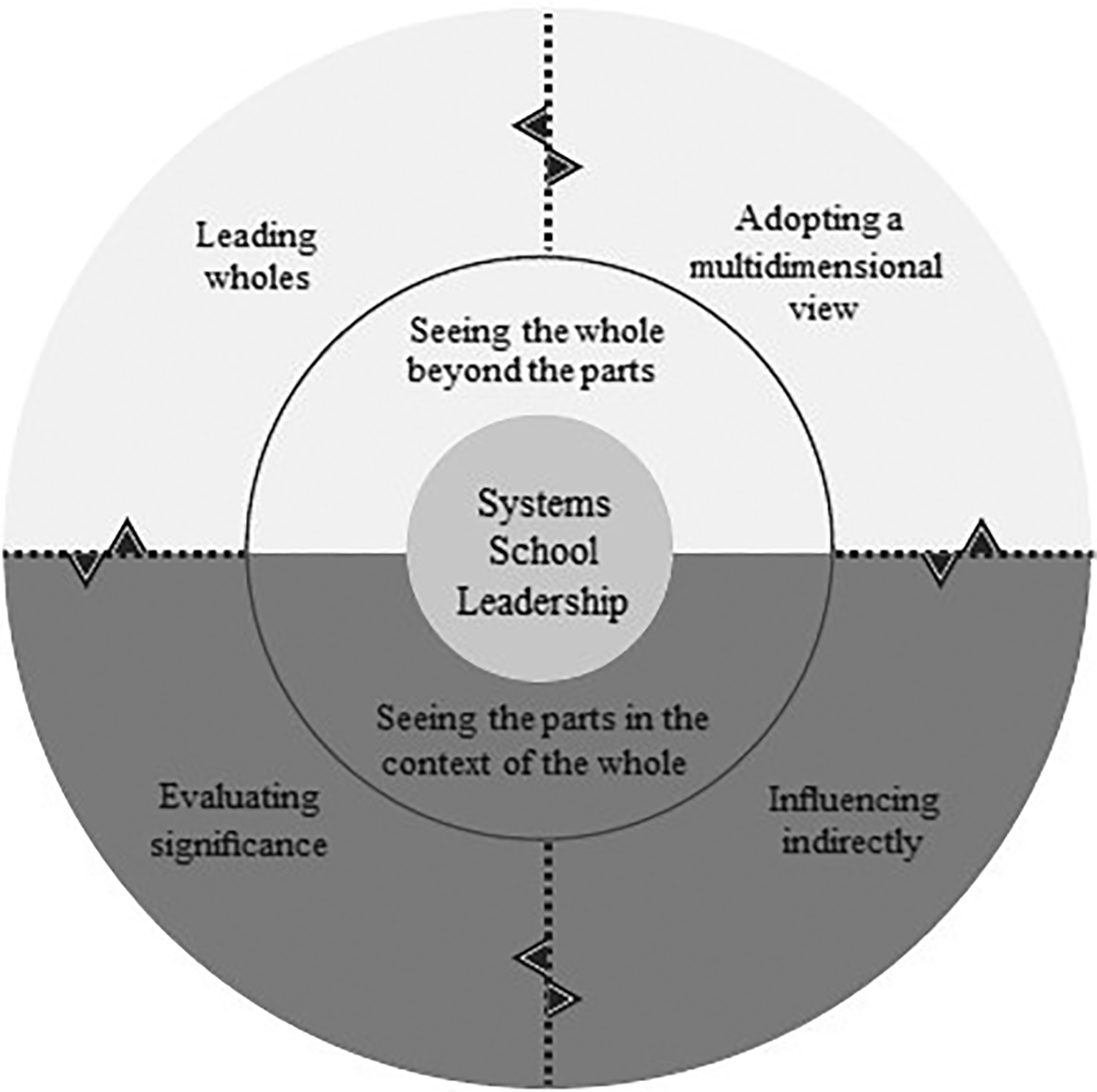
Four core characteristics of systems thinking leadership as reflecting the two main meanings of systems thinking.
The research on systems thinking in school leadership is restricted in scope. Although systems thinking is considered to hold promise for leaders, organizations and systems (Jolly, 2015; Wilson and Van Haperen, 2015), the available knowledge on its application in the field of educational leadership and policy is lacking in quantity and quality. Insofar as many questions remain open due to the limited literature on this topic, the goal of the current article is to suggest potential areas for future research on systems thinking in school leadership.
Further explorations
Systems thinking as a leadership characteristic
As aforementioned, the characteristics of systems thinking in school leadership, which are the major ways in which principals apply this approach and perform accordingly, were initially explored (Shaked and Schechter, 2014). Further research in this field may do well to explore how systems thinking not only helps principals to efficiently manage the current state of affairs, but also re-examines assumptions, redetermines values and goals and redraws organizational boundaries. Schools tend to develop a status quo, that is, maintain their present state of affairs, for many organizational reasons (Kershner and McQuillan, 2016). It can be speculated that these reasons range from principals feeling pressured for time and needing to prioritize, all the way to the ‘if it’s not broken, don’t fix it’ mentality. It is important to inquire whether systems thinking facilitates the recognition of the circumstances that created the current situation and paves the way for taking other possibilities into account, which may increase principals’ willingness to alter the body of rules governing the school structure, redefine roles and responsibilities and favour new ways of sense-making and action.
Knowledge about the development of systems thinking enablers and barriers is extremely limited. Further research should expand knowledge concerning the sources of systems thinking in school leadership, which are the foundations upon which principals could acquire their ability to perform at the systemic level (Shaked and Schechter, 2016; Hitchins, 2003), and to identify the developmental process of systems thinking corresponding to the milestones in their managerial careers. Such research should also seek ways to instruct the systems thinking leadership perspective, examining how and to what extent it can be taught in principal preparatory programmes and throughout the induction process with a principal mentor. This would enable the evaluation of school principals’ systems thinking leadership development over time, and more importantly, it would assist in discovering ways to support, enhance and accelerate the assimilation of this leadership approach.
Systems thinking as an organizational feature
Systems thinking in school settings is useful not only for the principal but also for the entire school as an organization. It would therefore be advisable for future researchers to explore how principals’ systems thinking characteristics influence other leaders within the school. In a previous research (Shaked and Schechter, 2017b), we found that for middle leaders in the school (e.g. subject coordinators, grade-level coordinators), systems thinking is more often an aspiration rather than a reality. However, we believe that a principal’s systems thinking may increase this mode of thinking by other school leaders as well. Exploring how a principal’s systems thinking permeates the whole school is of the essence, since today’s teachers are increasingly assuming leadership functions, and the concept of teacher leadership has become well-embedded in both the language and practice of educational improvement (Harris et al., 2019; Mangin and Stoelinga, 2008; Wenner and Campbell, 2017). Inasmuch as principals are key agents in empowering or alternatively marginalizing teacher-leaders, it is important to understand how the principal’s characteristics of systems thinking enable other leaders in the school to perform at the systems level. Can one principal’s systems thinking be disseminated within the school system and how? Can systems thinking be echoed throughout the system? Can systems thinking be viewed as constantly circulating, shifting and transforming through social relations in education systems?
The principal’s influence on systems thinking competencies of teacher-leaders should be explored in the contexts of both the present and the future. First, with regard to the present, these leaders are often those who act as the driving force behind attempts to improve teaching and learning quality, which can significantly influence student achievements. Second, with regard to the future, in many cases, tomorrow’s school principals start out as today’s teacher-leaders. The principal’s influence on teacher-leaders’ systems thinking competencies should be longitudinally examined. In such studies, it would be imperative and most instructive to explore how systems thinking competencies are transformed when middle leaders are inducted into the roles of assistant principal and principal.
Moreover, recent work suggests that within the existing school leadership literature, the focus remains on interpersonal interactions, while organizational aspects, such as processes and patterns, are often diminished in importance (Kruse and Johnson, 2017). When procedures and structures are addressed, they tend to be characterized as school ‘management’ and therefore marginalized (Murphy, 2016). Systems thinking may allow researchers to examine how organizational aspects serve principals in addressing the leadership demands and challenges (Johnson, 2019).
Principals’ systems thinking and decision-making
Making decisions is one of the most important duties of a school principal (Hoy and Tarter, 2004; Shapiro and Stefkovich, 2016). It is also one of the toughest and riskiest parts of the job; bad decisions could damage a school and a career, sometimes irreparably (Johnson and Kruse, 2009). Due to the complexity of school organizations, systems thinking may facilitate effective decision-making as a means for achieving the school’s expected results (Shaked and Schechter, 2016; Shapiro and Stefkovich, 2016). Further research may consider systems thinking as a new approach for the exploration of principals’ decision-making.
Traditionally, optimal decision-making in educational leadership is considered to be accomplished through linear thinking (Marzano et al., 2005). According to this world view, any occurrence results from an earlier cause, so that if we wish to explain it we must find that cause. Both input and output are predictable, and are efficiently and orderly presented, considered, studied and documented (Azzara, 2010). One may claim that the human mind seems to favour linear thinking. We have been educated to regard a straight line between two points as the shortest way to get from one to the other. Unfortunately, however, linear thinking, manifested in production-function change initiatives, rarely works in non-linear contexts (Bratianu and Vasilache, 2010). The role of systems thinking leadership as encouraging non-linear progression, where change is multidimensional and multicomponent, is worthy of scholarly attention. Since systems thinking suggests circular thinking (Senge, 2006), the many variables existing within any system are causally related in feedback loops, which consist of outputs of the system that are routed back into it as inputs. The feedback loops themselves interact, and their interactions constitute the system’s structure and determine its behaviour (Ford, 2009). This notion of feedback loops challenges the simplistic reductionist perception of the connection between cause and effect, where the first event is considered to be responsible for the second one’s occurrence. From the feedback-loops perspective, understanding the system as a whole is a prerequisite for decision-making, as the first event influences the second, but the second also influences the first, leading to a circular series of interactions (Åström and Murray, 2008). Thus, seeking to understand causation in systems, which is not wholly obvious and tends to be indirect (Pryor, 2008), may serve as a starting point for redefining the principles of decision-making in the school leadership arena.
Instead of refining the position of principal at the expense of not looking at constructs of collective/distributed leadership, formal leaders have to be seen as exhibiting and promoting a common set of values that underpin decision-making. It is unlikely that many organizations will be successful without commitment at the heart of its leadership decision-making and practices. Still, it does not have to be the privilege or personal responsibility of the formal leader. Importantly, value searching requires schools to employ triple-loop learning, which is a corrective change in the system of sets of alternatives from which choices are made. This learning allows the values and standards governing theories of use and organization to be called into question (Tosey et al., 2012).
Moreover, the desire to be right is a major motive of decision-making. From the systems perspective, the notion of correct decisions should be redefined, that is, replaced by situated decision-making, meaning that the principal recognizes that decisions can never be regarded as absolutely right. Borrowing a term from physics used to describe the area where a quantum particle will probably be found, decision-making should also be regarded as a probability cloud. In other words, school leadership decision-making should be explored as a sphere where the ‘correct’ decision is never totally such until actually interacted with or applied. In this sense, LeMahieu et al. (2017) highlight the importance of leaders’ efforts to facilitate effective decision-making: When a problem occurs in the system (e.g., poor student outcomes), leadership has the role and responsibility to investigate systems-based causes. This involves trying to pinpoint the interactions among structures, work processes and norms that are producing the current outcomes.
Systems thinking and leadership approaches
Systems thinking may be seen as an anchor of various leadership approaches whereby school leaders are actively involved in a wide range of activities aiming to improve teaching and learning for all students (Shaked and Schechter, 2018; Kensler et al., 2011). Further research may explore how systems thinking allows for the integration of two or more leadership approaches. For example, instructional and transformational leadership differ from each other: instructional leadership is primarily concerned with directing leaders’ influence due to its focus on improving teaching and learning. In contrast, transformational leadership deals mainly with the ways in which leaders exert their influence on their followers. Leaders are thought to inspire their colleagues to raise their followers’ commitment to organizational goals (Bush, 2014). Systems thinking should be explored as an approach enabling the combination of these two approaches. To bring another example of such a combination of approaches, instructional leadership also differs from the boundary management approach, since from the instructional leadership perspective, the principal should prioritize tasks such as setting school goals that result in student progress, helping teachers develop the knowledge and skills needed to increase student achievement and independence and using multiple sources of information to assess performance. On the other hand, the boundary management approach argues that in today’s schools, which are becoming more and more open to their environments, principals should pay considerable attention to the management of their schools’ boundaries, employing strategies by which they manage the critical boundaries both inside and outside the school (Benoliel and Somech, 2018). Systems thinking may be explored as enabling a synthesis of instructional leadership and boundary management, where these two approaches are not mutually exclusive, but rather support each other in improving academic performance and balancing the tension between internal and external demands (Shaked and Benoliel, 2019).
Systems thinking and leadership epistemology
Whereas other leadership epistemologies focus on the leading entity (i.e. form prior to relationship), the systems thinking approach focuses on the interactions and relationships among the leaders, and on how those interactions continuously create new organizational properties (Shaked and Schechter, 2017a; Gharajedaghi, 2011). Inasmuch as this approach constitutes a reflection on a possible alternative approach to leadership, further important questions arise. If systems thinking leadership is evoked through ‘irreducible’ relationships (Senge, 2006) which leaders maintain with constituents, does it exist outside relationality? Likewise, if systems thinking leadership processes are evoked through the complex and dynamic relationships between ‘the’ leader and the other leaders in the school, whose leadership is it? Furthermore, if systems thinking leadership processes are relational, what criteria would be pertinent for guiding the validation of this leadership approach when applied to school improvement? Embracing the systems thinking approach requires the espousement not only of a different frame of reference but also of a distinct language that would be sensitive to the dynamic relationships between the leader and the other leading participants. Moreover, this language should also express organizational aspects of processes, structures and patterns. Therefore, the questions arise: what is the language of systems thinking leadership? Can this dynamic approach be leveraged by an active, circular language, especially in times of linear organizational perspectives and policy initiatives?
Conclusion
It appears that too often, today’s principals are peddled simplistic solutions to complex situations. Unfortunately, as so many principals have discovered, these panaceas rarely work, because they are not sufficiently holistic (Shaked and Schechter, 2017a; Fullan, 2014). By focusing on the parts rather than on the whole, school leaders do not adequately consider the complex interactions among various parts in the system, thus may find it difficult to face the contemporary growing complexity, change and diversity characterizing school organizations. Yet, the available knowledge about systems thinking in school leadership is limited. Many questions regarding this topic remain to be addressed. Additional studies, using both quantitative and qualitative methodologies to understand the key tenets of systems thinking in school leadership, are needed. Systems thinking in educational leadership requires further study to test for cross-cultural validity. Such future research may meet the current need for comprehensive theoretical knowledge accompanied by practical strategies to guide principals towards success.
Footnotes
Declaration of conflicting interests
The author(s) declared no potential conflicts of interest with respect to the research, authorship and/or publication of this article.
Funding
The author(s) received no financial support for the research, authorship and/or publication of this article.
