




Abstract
Higher education institutions have evolved into a more stressful environment. Women have been experiencing higher levels of stress than their male counterparts. With higher education adopting to the onset of the pandemic, this brief report studied women’s perceived stress in relation to perceived organizational and supervisory support, and age during times of crisis. In an era of social distancing, quarantines, and lockdowns, the findings suggest that women’s perceived stress is negatively related to age, perceived organizational support, and perceived supervisory support. Society as we once knew it pre-pandemic will never be the same. Higher education is inevitably going to have to manage the aftermath, a new normal that can only be as effective as the employees that help keep the organization running.
Keywords
Introduction
Across the globe higher education institutions have become more stressful (Bowen et al., 2016; Kersh, 2018; Winefield, 2008). These stressors worsened with the onset of the COVID-19 pandemic when social distancing and safer at home measures resulted in mandated remote work for faculty, staff, and administrators. Unplanned workplace changes left many wondering how to manage the responsibilities of home and work while continuing business as usual. These challenges intensified the pressures of work and home, increasing the levels of stress (Young, 2020); especially for women in higher education who had already been juggling the conflicting demands of work and home (Kresh, 2018; Lendák-Kabók, 2020) pre-pandemic.
The ongoing uncertainty of the pandemic further exacerbated these issues with many institutions announcing and fine-tuning policies and procedures after-the-fact. An already stressful situation that was worsened by institutional policies that briefly mandated employees operate from home as they would in the office, void of any household and caregiving distractors (Fortin and Taylor, 2020). Though such policies have since been retracted, the perceptions of support (or lack thereof) have likely had irreversible implications on employee stress. Institutional (mis) management in times of a pandemic can display a level of neglect in organizational support, dismissing employee well-being, and accentuating stressors (Young, 2020). Stress can have a significant impact on employee wellbeing, workplace productivity, and retention with impacts worsening as stress lingers (Winefield, 2008). Thus, with this context in mind, this study explored the perceptions of stress, organizational support, and supervisory support held by women of varying ages in higher education during the COVID-19 pandemic.
Literature review
Stress
Stress can be defined as an emotional state that results in a negative physical manifestation when unduly aggravated, impacting normal functioning (Smith et al., 2014). Cohen et al. (1983) stated that stress can be gauged from one’s perceptions of feeling overloaded, out of control, and in an unpredictable circumstance. Unpredictable circumstances can be found in higher education where institutions have been undergoing restructuring, increasing the number of short-term contracts, and operating with reduced funding (Tytherleigh et al., 2005). Factors likely heightened during a global pandemic when circumstances require a drastic change in everyday patterns – such as a shift to remote work along with the simultaneous management of home and work responsibilities.
While men and women share the same stressors in managing personal and professional responsibilities, women tend to experience more overall stress in life than their male counterparts (Matud, 2004). Perhaps this is a result of societal standards regarding duties that are expected of women, but go unnoticed, unchecked, and remain overlooked when examining stress (Wong, 2018). Household chores have been regularly found to be unequally managed with women investing more time in housework than their male counterparts (Cerrato and Cifre, 2018). Although both men and women in faculty roles report working upwards of 40 hours a week, workload stressors are heightened in women who carry greater responsibilities in terms of household chores (Slišković and Seršić, 2011). This imbalance in household responsibilities; however, does not negate the gender disparities experienced in the workplace (Kresh, 2018; Safaria et al., 2012; Slišković and Seršić, 2011). Across job roles, women in higher education tend to experience increased stressors at work (Kresh, 2018).
Females working in higher education have reported varied levels of stress based on their rank and institution of employment. Across the globe female faculty members with lower ranks have reported experiencing higher levels of stress. In Croatia, for example, assistant and associate professors showed greater stress at work than full professors (Slišković and Seršić, 2011); and this trend is consistent with what has been found in institutions of higher education in Asia (Safaria et al., 2012). Women in staff roles also experienced comparable stressors, with variances found in the type of institution. Women at private institutions exhibited higher levels of stress than those in public institutions (Safaria et al., 2012).
The supervisor-employee relationship in higher education is also prone to adversities (Slišković and Seršić, 2011) demonstrating a need for a better understanding of the relationship between stress and support. Research has shown that female faculty members can experience various levels of work-place stressors without the necessary support to mitigate these challenges. ‘These include time demands, evaluations, and harassment…[with an institution or supervisor that] may or may not be supportive in acknowledging the difficulty and providing assistance, when requested, to improve or resolve the situation’ (Keim and Erickson, 1998: 61).
Workplace stressors can impact the personal and professional lives of women in higher education, taking work home (literally and figuratively) while managing the struggles of balancing work and home (Rout and Rout, 2002; Slišković and Seršić, 2011). Stress can have an impact on the employee and workplace outcomes, but support can play a role in alleviating stress. Institutional support can help provide women in higher education the assurances needed to distinguish the boundaries of work and home by implementing policies and procedures that are sensitive to the varying needs of the workforce (Safaria et al., 2012). Furthermore, institutions can extend this support down the chain of command by empowering supervisors to effectively practice and implement policies and procedures to manage the needs of women in higher education (Eisenberger et al., 2002).
Support
Organizational support theory (Eisenberger et al., 1986) proposes that employee’s perceived organizational support (POS) can mediate the worker’s actions based on the degree of support they believe the organization to extend towards their well-being. It is a theory (Eisenberger et al., 1986; Shore and Shore, 1995) that uses socially driven emotions to mediate the perceived degree by which an organization values and is concerned for its employees. The theory has been applied to explore support across many types of organizations, including institutions of higher education. However, organizations cannot extend support alone, supervisors act as the liaison, making perceived supervisory support (PSS) an important part of the POS discussion (Rhoades and Eisenberger, 2002). The following sections will briefly touch on POS and PSS.
Perceived organizational support
Rooted in the concept of social exchange (Kurtessis et al., 2017), POS identifies an organization as an entity with its own persona, where organizational actions can have a direct impact on employee reactions and outputs (Eisenberger et al., 1986). A direct relationship can be examined between organizational support and employee perceptions. Employees may work harder and be more committed when the organizations they work for are perceived to be more emotionally supportive; especially when employees feel valued and perceive to receive the necessary support to manage their job responsibilities and overall wellbeing during times of crisis (Rhoades and Eisenberger, 2002). Subsequently, employees that experience more POS from their employers, experience lower levels of stress (Eisenberger et al., 2016) and greater job satisfaction (Rhoades and Eisenberger, 2002). For example, POS is positively related to the motivation levels of female faculty in higher education (Siddiqua and Patrick, 2018). However, when compared to their male counterparts, women in higher education have indicated lower levels of organizational support (Shreffler et al., 2019).
Perceived supervisory support
The premise of PSS identifies supervisors to be the front-line agents of an organization, playing a role in mediating perceptions employees have of that organization (Eisenberger et al., 2002; Rhoades and Eisenberger, 2002). Supervisory support can be defined as ‘the degree to which supervisors value their [employee] contributions and care about their well-being’ (Rhoades and Eisenberger, 2002: 700). This positive association between POS and PSS is a crucial consideration because a supervisor can impact PSS and its subsequent effects on POS (Rhoades and Eisenberger, 2002).
An employee’s perception of their supervisory support can severely impact the self and the workplace (Eisenberger et al., 2002). Across genders and job roles, supervisory support in higher education plays a significant role. Especially during times of crisis, supervisory support can help alleviate uncertainties (Charoensukmongkol and Phungsoonthorn, 2020). Women in higher education have reported perceiving lower levels of supervisory support than their counterpart male colleagues (Loeffler et al., 2010); perceptions believed to be a leading cause of women voluntarily departing academia (Jo, 2008). However, it is important to note that the research on supervisory support in higher education is limited with respect to who the supervisor is. While those in staff positions may report to someone with a well-defined role, a faculty member’s superior may range from a Chair to a Dean to supervision by committee. The variations in the lines of hierarchy in higher education warrant further exploration regarding who the perceived supervisory support is coming from and how impactful the support may be. This exploration is especially crucial as women in higher education experience greater levels of stress.
Age
Organizational and supervisory support play a critical role on the employee’s perceptual experience of stress (Eisenberger et al., 2016). There is, however, a transactional component in how support is experienced and perceived. Supportive efforts that may be perceived are done so through perceptual filters that develop over time. Age can play a role as a perceptual filter, in a representative manner (Nilsson, 2018). Seasoned filters (Nilsson, 2018) cultivated through a larger number of stressful experiences in life (Siu et al., 2001) can impact how stressful events are viewed.
Furthermore, workplace stress and age are impacted by the type of work and the field of work (Mauno et al., 2013). Sarfraz et al. (2019) found age to be positively related to stress among nurses. However, the general trend in research has shown stress at work to be inversely related with age, i.e. the older the individual, the less workplace stress they experience (Rauschenbach et al., 2013). Research suggests that older employees exhibit lower levels of perceived occupational stress (Rožman et al., 2019). Whereby age and well-being are positively related, with older employees displaying less stress (Siu et al., 2001), and if nurtured, older employees could be valuable agents in the organizational knowledge sharing process (Slagter, 2007).
While there is an overall trend between age and stress, there seems to be occupational exceptions. The exacerbation of the experience of stress during a contagion is clear and obvious for those working in medicine, but not uniquely limited to that occupation. Those working in higher education have also experienced novel uncertainties directly impacting work life and potentially contributing to a more stressful day to day routine. Perceived organizational support can play a role in alleviating some of this stress for those in higher education as it was found to mitigate stress in nurses, even older more stressed nurses (Sarfraz et al., 2019). Age can be an important consideration when examining perceived support (Wang and Gruenewald, 2019) and the possible impact of support. Therefore, age should not be overlooked when investigating perceived stress and potential modifiers of stress for women working in higher education during a pandemic.
Rationale
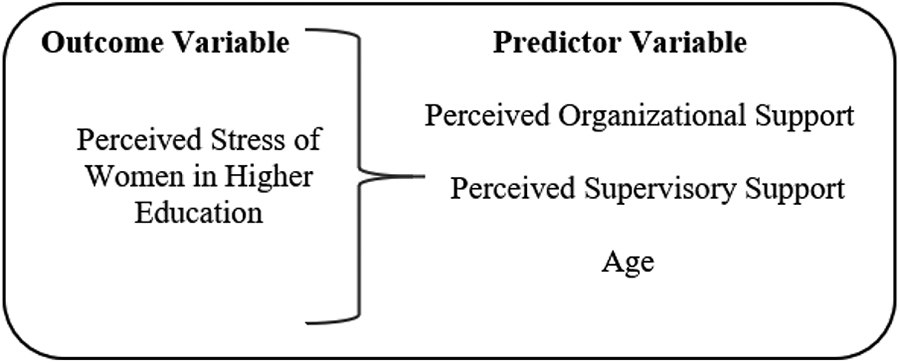
Given the current unprecedented times of the 21st century, it is undeniable that stress and anxiety are on the rise from the continued uncertainty and change rooted in the pandemic. This study explored the relationship of POS, PSS, and age with perceived stress among women working in higher education – Figure 1. The following hypotheses and research questions are advanced:
Quantitative research design.
Methods
Procedure and participants
Survey research approved by an Institutional Review Board was conducted using a non-probability networking sampling procedure. To manage social distancing measures, perspective participants were solicited online through expert networks relying on professional association membership listservs and other networking outlets such as LinkedIn. Using Qualtrics, participants were prompted to complete an informed consent followed by a questionnaire that explored perceived organizational support, perceived supervisory support, stress, and some other demographics. Participation was voluntary, and anonymity was granted by ensuring that no identifiable information such as names, emails, or any other identity revealing information was collected during the data collection process. Furthermore, to ensure mindfulness of the current-day stressors, institution name and role type were not solicited to provide participants more confidence in their anonymity.
The sampling procedure yielded 245 total female respondents working in higher education; of which 237 (97.1%) were employed full time, and 236 (96.7%) reported working remotely 5 days a week since the 2020 social distancing recommendation. Prior to the social distancing recommendation 175 (71.7%) respondents reported not working remotely at all; and 48 (19.7%) respondents reported working remotely only 1 day a week. By race, the sample consisted of: 10 (4.1%) African Americans, 9 (3.7%) Asian Americans, 206 (84.1%) Caucasian Americans, 12 (4.9%) Hispanic Americans, and 8 (3.2%) indicating other. The average age of the sample was 45.53 years (SD = 9.83), with ages ranging from 72 to 24.
Instruments
Organizational support was measured through the Eisenberger et al. (1986) POS scale; an instrument regularly utilized when applying Organizational Support Theory in various research contexts. This eight-item instrument uses a five-point Likert-type format ranging from 1 (strongly disagree) to 5 (strongly agree). For the current study, this instrument yielded a Cronbach coefficient alpha of .93 (M = 27.12, SD = 6.82), demonstrating an excellent level of internal consistency (Cronbach, 1951) in the measurement of organizational support. The alpha revealed in this study is consistent with previous research that has utilized this instrument (Eisenberger et al., 1986 , 2002; Rhoades and Eisenberger, 2002).
Supervisory support was measured through the Eisenberger et al. (2002) PSS scale; another instrument regularly utilized when applying Organizational Support Theory in various research contexts. This eight-item instrument uses a five-point Likert-type format ranging from 1 (strongly disagree) to 5 (strongly agree). For the current study, this instrument yielded a Cronbach coefficient alpha of .94 (M = 31.12, SD = 6.73), demonstrating an excellent level of internal consistency (Cronbach, 1951) in the measurement of supervisory support. The alpha revealed in this study is consistent with previous research that has utilized this instrument (Eisenberger et al., 2002; Khan et al., 2015).
Stress was measured through the Cohen et al. (1983) Perceived Stress Scale. A scale aimed to capture how overwhelming, unpredictable, and overloaded life is in the moment; the instrument offers a flexibility that is not driven by a specific context or population (Lee, 2012). The instrument was built to explore overall stress or stress in various contexts, making the instrument adaptable to capture the stress related to the onset of the pandemic, without jeopardizing the overall intent to learn about the impact on stressors in the moment. This 10-item instrument uses a five-point Likert-type format ranging from 1 (strongly disagree) to 5 (strongly agree). The preface of each item was modified from ‘In the last month’ to ‘Since the WHO’s recommended social distancing’. For the current study, this instrument yielded a Cronbach coefficient alpha of .90 (M = 26.28, SD = 6.85), demonstrating an excellent level of internal consistency (Cronbach, 1951) in the measurement of perceived stress. The alpha revealed in this study is consistent with previous research that has utilized this instrument (Lee, 2012).
Results
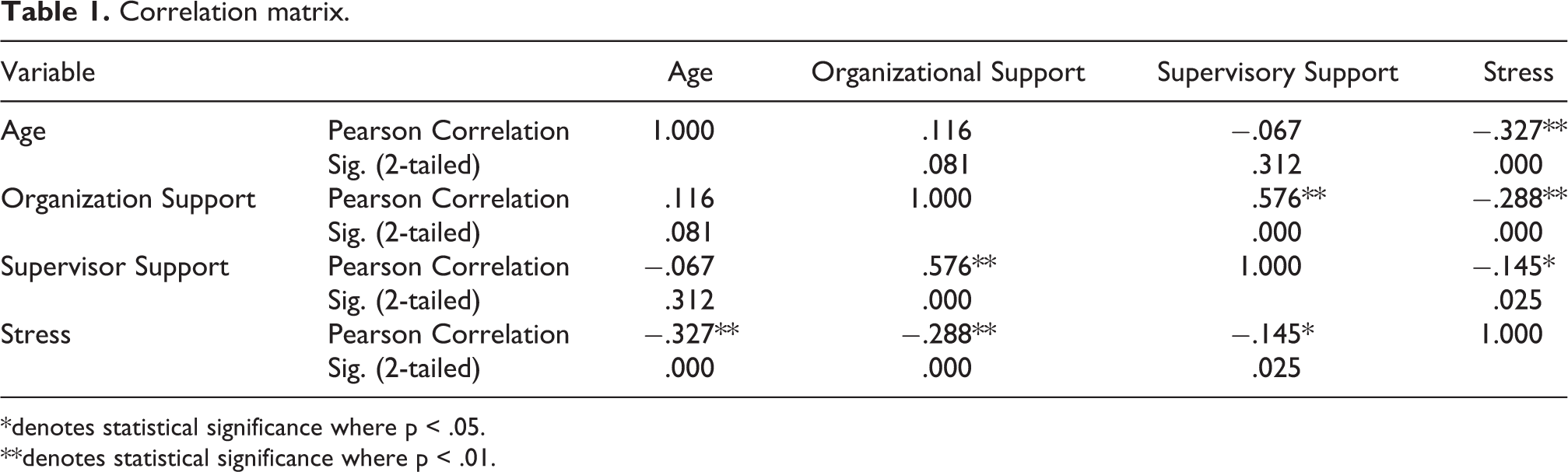
Results were analysed using both bivariate correlation and multiple regression. All Pearson correlations appear in Table 1. The bivariate correlations revealed three predictor variables that were significantly related to perceived stress. Hypothesis 1 predicted an inverse relationship between POS and perceived stress among women working in higher education during the pandemic and this hypothesis was supported (r = −.29, p < .001). Hypothesis 2 predicted an inverse relationship between PSS and perceived stress among women working in higher education during the pandemic and this hypothesis was supported (r = −.15, p < .05). Hypothesis 3 predicted an inverse relationship between age and perceived stress among women working in higher education during the pandemic and this hypothesis was supported (r = −.33, p < .001).
Correlation matrix.
*denotes statistical significance where p < .05.
**denotes statistical significance where p < .01.
The first research question asked how well POS, PSS, and age contribute to the alleviation of perceived stress among women working in higher education during the pandemic. To investigate this question, perceived stress was regressed on the linear combination of POS, PSS, and age. The equation containing these three variables accounted for 17% of the variance in perceived stress, F(3, 222) = 15.23, p < .001, adjusted R2 = .16.
The second research question asked if each of these variables individually contribute to the alleviation of perceived stress among women working in higher education during the pandemic. The regression model revealed that age makes the largest unique contribution (beta = −.30, p < .001), although POS also made a statistically significant contribution (beta = −.24, p < .01). PSS did not uniquely contribute (beta = −.03, p > .05).
Discussion
The findings of the current study indicate that women working full-time in higher education underwent an immediate shift from working onsite to working remotely at the onset of the pandemic. These women found themselves in a novel situation. According to Uncertainty Reduction Theory (Berger and Calabrese, 1975) the uncertainty that comes from a novel situation generally produces anxiety in those who find themselves in that situation. An abrupt departure from habituated work routines as documented by the current group of women (i.e., suddenly working from home) certainly constitutes a unique circumstance; one that would breed anxiety or produce stress. The current study set out to explore factors that might be associated with such stress during the onset of the pandemic. The results of this study reveal varied levels of perceived stress based on POS, PSS, and age. Age was shown to have the strongest association with perceived stress in crisis, with older respondents reporting lower levels of perceived stress. While age may contribute to a more composed employee, it might not be the only or primary driving mechanism. Rather, it may increase the probabilities of having life experiences that give one perspective to compose oneself more efficiently during times of crisis.
POS was demonstrated to be negatively related to perceived stress, and potentially help alleviate stress. This finding is in line with organizational support theory (Eisenberger et al., 1986), contributing added support to the theory by indicating that the negative relationship between stress and POS hold true even during a pandemic crisis. Hence, during times of crisis, women in higher education may be more inclined to look to their organization to provide the necessary support to help deal with external stressors; and when such organizational support is not available their perceived stress may increase. The effect of PSS was not as significant based on the results of this study. While PSS was found to be significantly inversely correlated with perceived stress, as predicted by organizational support theory; the magnitude of the effect was extremely small. Furthermore, PSS did not uniquely contribute to the easing of perceived stress. In higher education there is not always a clearly and consistently identified direct supervisory person to report to across institutions. Some employees report to a course coordinator, others to a department chair, and still others to a dean. The variation of the individuals being reported to may have nullified any effect of PSS on stress in this study.
Implications
The research conducted here might offer some insights for supporting women in institutions of higher education operating during stressful times. This research focused on the stress experienced during the current global pandemic. However, it is important to note that institutions of higher education regularly go through transitions; and such organizational change normally breeds added stress to those employed (Cartwright et al., 2007).
Supervisors play an important role in an organization during times of crisis or in managing change, however, they might not be the primary contributor in facilitating perceptions of organizational support in the employees they manage during times of transition. Elias and Mittal (2011) found the supervisory support of front-line supervisors to play a less significant role than other factors for employees experiencing organizational change. Institutions of higher education may benefit from leveraging other employees who have experiences that have garnered greater perspective to lead and/or be more active agents in work groups in efforts to cultivate more supportive environments in times of crisis. The employees selected to be these active agents during such crises may not need to be supervisors. Perhaps organizations should leverage more seasoned employees during times of crisis when uncertainty is high. While delivering messages in these contexts, the more seasoned employees might evoke perceptions as a source of wisdom and confidence that is often needed to feel supported during stressful times. These individuals will probably model needed composure as well. Consistent with previous research (Safaria et al., 2012; Slišković and Seršić, 2011) this study found older, more seasoned women in higher education to experience less stress; and therefore, probably appear more poised during stressful events.
However, age should not be the sole factor in selecting individuals in the organization to serve as active agents of support during times of crisis. Many other relevant factors need to be considered such as the tenure of the individual within that institution and the opinion leadership of that individual. Andrews et al. (2016) found colleagues in higher education departments who were identified as opinion leaders to be highly influential in a positive manner. These opinion leaders were also found to have spent a significant amount of time within their respective departments. The selected individual’s attitude towards innovativeness might also be an important factor. Some scholars argue that individuals in an organization who are early adaptors regularly influence the early majority when considering the experience of, and potential success of change implementation (Rogers and Shoemaker, 1971). These factors might contribute more to the alleviation of stress in women as facets of an active agent of potential organizational support, than front-line supervisory support efforts. As demonstrated in this study, when women in higher education were forced to shift work environments, POS appeared to play a more significant role than PSS in lessoning perceived stress. Therefore, institutions of higher education would do well to implement policies identifying active agents of support utilizing these facets and then train those individuals identified for potential organizational predicaments and/or anticipated organizational change. Such action might be particularly important to a time-sensitive and dynamic period when decisions need to be continually iterated.
Limitations and future directions
Limitations of this study include a lack of diversity in the sample, as well as an application of the results to all employees in higher education and even other sectors. The survey also neglects to capture who the respondents are directly reporting to as a supervisor as well as other potential sources of stress of the respondents such as household habitants and caregiving responsibilities. Furthermore, there are other mechanisms that employees find support from and potentially look to for stress relief during times of crisis and during transitional periods such as organizational culture shifts. Future studies could benefit from a more diverse sample, and a questionnaire probing potential sources of stress and who these women are directly reporting to in their respective institutions. Additionally, future research could add to the current quantitative data by diving deeper and probing women’s lived experiences during the onset of the pandemic qualitatively. Finally, future studies should explore the impact and utility of other support mechanisms and stress relief options during crises and while organizational cultures are in transition. Society as we once knew it pre-pandemic will never be the same. Higher education is inevitably going to have to manage the aftermath, a new normal that can only be as effective as the employees that help keep the organization running.
Footnotes
Declaration of conflicting interests
The author(s) declared no potential conflicts of interest with respect to the research, authorship, and/or publication of this article.
Funding
The author(s) received no financial support for the research, authorship, and/or publication of this article.
