



Abstract
The purpose of this paper is to show what are the applicants' institution selection criteria in higher education in Hungary and what changes this will imply in higher education management and communication. These questions were investigated based on a review of the most relevant literature and the analysis of 1396 Hungarian higher education University of Pécs applicants in two consecutive years. Exploratory and confirmative factor analyses were used to identify the relative order of the application influencing factors: as a result, the first most important is the vivacity, followed by career and costs, fourth is image and the last one is the low commitment. In this context, the paper has shown that the identification of the application strategies requires renewed management and communication techniques. The results help the institutions to determine the possible actions to be implemented to attract more students and improve the level of offered services. The permanent system change of the Hungarian higher education as a phenomenon versus the applicants' institution selection criteria gives the uniqueness of the Hungarian situation, and this study provides information for researchers in higher education in this field additionally.
Introduction
There are many significant changes in higher education (HE) systems; the tertiary education environment is highly dynamic, competitive and uncertain, the global expansion of HE has created an increasing demand for the comparison of universities, as highlighted by many researchers (Chapleo and O’Sullivan, 2017; Csató and Tóth, 2020; Fumasoli and Stensaker, 2013; Gunina et al., 2019; Lumby and Foskett, 2015). In the last 20 years, the sector has been shaped by three broad tendencies that combine in various ways according to national circumstances, massification, marketisation and globalisation (Marginson, 2016).
The HE systems and institutions have been under the constant pressure of performance and efficiency since their considerable expansion in the 1990s (Starr, 2020; Vasyakin et al., 2016); this pressure increased in the last decades as a result of the financial crisis, the spreading of international and national rankings and the growing competition for international students (Lumby and Foskett, 2015). Throughout the last two decades, the tertiary education field has faced intense competition in Hungary as well. Of course, Hungarian HE is influenced by these megatrends as well as the factors determining the domestic characteristics (Berde and Ványolós, 2006; Derényi, 2020).
Today's HE attracts a wide variety of students who are diverse in many ways (Armour, 2019; Macmillian and Yue, 2017), so the choice of HE is one of the most important issues for universities, and regarding this topic, it is still a question: what are the main factors affecting the choice of university? (Al-Dajani and Alsamydai, 2018; Mbawuni and Nimako, 2015; Ming, 2010).
The goal of this study is to show the main factors affecting the Hungarian University of Pécs (UP) HE applications, which is indispensable to know for the HE decision makers (HE rectors, HE policy makers, and in a wider sense, the stakeholders of the HE including the potential students, the parents, the employers, etc.). This contributes to understanding the selection criterion of the applicants, which gives the uniqueness of the Hungarian HE situation. In accordance, two research questions are investigated:
What are the main changes in the Hungarian higher education applicants' market? What are the main factors, and how these factors influence the application at UP?
Method: A review of the topic was completed during which the sources connected to the area of applications in HE have been analysed.
Method: A primary research has been carried out with a standard online survey, the data of which have been analysed with reliability, exploratory and confirmatory factor analysis (CFA).
The paper starts with a theoretical background to identify the influencing factors. After, with the help of an empirical statistical analysis applied on the dataset of 1396 HE UP applicants, the relative order of the factors will be revealed, and related strategies and communication guidelines are provided.
Theoretical background
The theoretical background provides the mapping of essential previous research results. The authors reviewed previous Hungarian studies connected to the topic and relevant literature on international trends in HE to create a broader context based on their research strategies. The literature review method is closest to the semi-systematic review approach (Snyder, 2019). Based on the most important keywords related to the research goal, the authors reviewed the relevant literature on Hungarian HE published after 2006.
University customers are not only students because the HE institutions have multiple target audience groups, such as students, friends and family, graduates, academics, administrative staff, companies, partners, supporters, investors, media, government and society (Gunina et al., 2019; Kotler and Fox, 1995; Tetrevova and Vlckova, 2018). Moreover, universities attempt to match the expectations of direct consumers and other stakeholders (Papadimitriou and Blanco Ramírez, 2015; Armour, 2019).
This study deals with students with direct access to HE because HE has increasingly become competitive, and institutions have to compete with each other to attract students in the recruitment markets (Maringe and Gibbs, 2008). The basic assumption is that today's HE attracts a wide variety of students who are diverse in many ways; attraction and choice are some of the most important problems and issues for universities today (Al-Dajani and Alsamydai, 2018; Macmillian and Yue, 2017).
Changing HE's decision and factors
Dealing with the student topic is primarily referred by the marketing and communication literature of HE. Many authors focus on student role, student identification process both at the international and domestic level (such as Clayson and Haley, 2015; Filip, 2012; Hoxby, 1997; Kotler and Fox, 1995; Maringe and Gibbs, 2008; Svensson and Wood, 2007). These are not discussed in detail due to the topic and the limitations of the scope of the study. However, it can be concluded that considering prospective students as consumers, it is important to address the main factors influencing student applications.
Drewes and Michael (2006) describe that the applicants prefer universities that are closer to their homes, spend more on stipendiums and teaching and offer higher levels of non-academic student services.
The study of Chatfield et al. (2012) identified factors that influence students' choices among three groups, in-state, out-of-state and international students. The study utilised exploratory factor analysis (EFA) to identify appropriate factors and multivariate analysis of variance to determine differences in college choices. Tuition and financial aid are different for each of these groups. Also, the reputation or recognition of a college might be different internationally and domestically. This could affect job opportunities for students in their own countries.
Mbawuni and Nimako (2015) provide an empirical framework for understanding some of the critical factors underlying college students' choice in HEIs from a developing country perspective in Ghana. They used factor analysis, which indicates seven main factors: the cost of the programme, student support quality, recommendation from lecturers and staff, failure to gain alternative admissions, personal intention to pursue master's programme, attachment to university and school location benefits.
Lányi and Pozsgai (2016) defined a student choice model, in which if potential students recognise the need to study at a university, the most crucial factor is information; after receiving all relevant information and evaluating alternatives, students choose the institution most suitable for them. As choices of HE are long, therefore the choice of institution is a serious and complicated decision; there are a lot of questions. The most significant evaluation criteria are programme, cost, facilities, processes, lecturers and locations. Post-purchase behaviour is crucial for students as it contributes to the validation of their decision (Hoyt and Brown, 2003; Lányi and Pozsgai, 2016).
Today's university students are diverse in a number of ways; they arrive at university with varying degrees of ability and commitment to pursue HE. Some students are very well prepared, some are committed to attaining a university degree and the multi-year investment of time and money. In contrast, others attend for other reasons, and some have been pressured by family members or teachers, or simply because they see no other viable option (Macmillian and Yue, 2017). Foskett et al. (2006) found that students consider more carefully economic factors (job opportunities to supplement their incomes, accommodation costs and family home proximity) in times of distress and financial difficulty.
Rudhumbu et al. (2017) determined some factors that influenced decisions of undergraduate students' choice to study at master level in Botswana, for example, academic programmes offered, image and reputation of the institution; however, tuition fees, the chance of getting stipendiums and campus factors did not have high influence.
Al-Dajani and Alsamydai (2018), in their study, investigated the factors influencing the attraction of students' selection of Jordanian universities. For this purpose, a model has been designed to test seven factors: university's attributes, economic factors, geographic factors, reference groups and marketing communication, attraction and university selection.
Summing up, a number of studies have shown, there are some factors related to personal and individual characteristics of students, as well as institutional characteristics that influence decisions to choose a university (Ming, 2010). Mapping prospective students by ‘thinking with their heads' can help to get information about the attraction and long-term relationships. To sum it up, one of the key features of HE marketing is that it has to meet multiple consumer and service needs at the same time.
In Hungary, several surveys have been carried out in recent years (e.g. Polónyi, 2018; Rámháp, 2017; Rechnitzer, 2011; Törőcsik, 2015; Törőcsik et al., 2014) to identify the decision-making procedure; the results show that the applicant first searches for a programme of his/her interest and chooses an institution or city only after that. Based on the surveys mentioned above, the main considerations of the institutions' assessment (typically 1–2 positions in ranking ranges per research) are institutional reputation, marketable diploma, employment opportunities, proximity to residential place – lower living and housing costs, and attractive, liveable cities where the institution is located. Altogether, the rationality related to the institution choice-making process comes to the fore. At the same time, the attractiveness of the city can also be a competitive advantage among those who prefer university cities.
Dynamics of Hungarian HE applications and changing institution choice (1990–2021)
Before 1990, the Hungarian HE system was publicly financed. The Central European and Hungarian HE, which operated at the turn of the millennium, has been and continues to be characterised by ongoing educational reforms and changes initiated by current governments (Cieśliński, 2018; Vlk and Stiburek, 2018). During the period of economic and social change (1989–1990), the abolition of the teaching of communist ideologies and dogmas, the introduction of the teaching of modern scientific knowledge, methodologies and results, and the overcoming of infrastructural deficiencies and disciplinary backwardness were the main goals of modernisation.
The accession of the countries of Central Europe to the European Union (2004) brought with it the so-called the Bologna reform (Rudas, 2010), which took root in the adoption of euroconform structures, the establishment of a bachelor's and master's level training structure and the complete revision of curricula (Kerékgyártó and Szarvas, 2009), as well as the periodic review activities of the Hungarian Accreditation Committee (Csépe and Christina, 2018). With the implementation of the European Higher Education Area, the university education system reform was begun, which led to a profound transformation of the university as a concept. In Hungary, the HE systems and institutions have been under the constant pressure of performance and efficiency since their considerable expansion in the 1990s; this pressure increased in the last decades as a result of the financial crisis, the spreading of international and national rankings and the growing competition for international students (Kováts and Rónay, 2019). After 2007, a dramatic decline occurred in student numbers, mainly among the Hungarian students, which could only be partly explained by demographic characteristics, for example, adverse effects of birth rate.
The ‘change of pace in higher education’ strategy placed a major emphasis on the creation and promotion of a world-class HE of international acclaim (Hungarian Government, 2016). This major systemic change is the establishment of the Chancellery System (2014), which ensured the enforcement of the guidelines for maintaining fiscal accounting efficiency in public universities (Kováts and Berács, 2018). The strategy envisaged the complex and combined development of several factors: the measures affecting the re-positioning of the socio-economic function of HE; the re-organisation of the institutional network; the maintenance direction model; the internal operational mechanisms of the institutions; the quality of the fulfilment of educational and research obligations as well as the quality- and performance-based transformation of the incentive system of the stakeholders promised comprehensive changes.
Nowadays, most public Hungarian universities, following Western European organisational patterns, will be transformed into more independent, foundation-based ones. This process lasts from 2018 to the present day; for example, the UP is going to start operating as a foundation from the 1st of August, 2021. Thus, in today's Hungarian HE structure, state, foundation, ecclesiastical (Szűcs, 2010) and Hungarian and foreign private institutions will be included, in which the foundation based universities will become dominant from the end of 2021.
All these steps, the constant systemic changes posed a constant challenge to the current leaders of the universities, based on how to maintain their institutions. One of the main funding pillars of this endeavour to the date has been normative support based on student numbers paid by the state (Polónyi, 2009). This system has also meant that HE institutions are competing with each other for the market, unfortunately for a shrinking potential student body as a result of unfavourable demographic effects.
Based on these, it can be stated that although the majority of Hungarian HE actors are currently predominantly state-owned, they are in strong competition with each other and try to influence applicants' institutional choice with active student-oriented behaviour, similar to British private universities and in contrast the German public universities. This struggle for the student is expected to intensify only in the shrinking market and in the order of operation of the foundation, which is independent of the state and more dependent on its own revenues.
In addition, it is important to state that for the future, it is expected to increase levels of participation in HE in the medium to long term (Polónyi, 2016). Connected to this, the Hungarian HE system has serious responsibilities, it needs to respond to changes affecting HE; it is necessary to provide training in international contexts where Hungarian students stay in Hungary and foreigners come to study here.
The educational policy has its constricting effect (close management of the state-funded programmes) in the short term (from 2011), as the fall back in the number of applicants/admitted ones between 2010 and 2015 was stronger than the decline in the number of secondary school graduates. After a significant drop in the application trends, it can be experienced a slight increase in recent years, although the number of secondary school graduates is constantly decreasing. Polónyi (2016) points out that the decline in the numbers of new entrants to HE in the last 10 years is more than twice the number of the relevant age groups base, which is accompanied as a plus element by the 20% drop of the state-funded HE students.
It is worth examining the extent of each expansion phase to evaluate the proportion and number of people with HE graduates. Trow (1973) has approached them very complexly (not just the participation ratios but the absolute numbers and their growth rates as well), simplifying his findings, he indicated the end of the elitist phase at 15% of participation ratio as a threshold, at a ratio of 30–35% the mass participation, and finally, the ratio of 50% can be considered a point where the HE graduation is already a self-generating process, and it becomes quite a commonplace. In Hungary, the proportion of tertiary graduates should be increased to 30.3% by 2020 in the 30–34-year-old population according to the EU2020 commitments. Since this target has been reached in Hungary by 2013 (31.9%), in 2015, the country-specific commitments increased to 34% (Miniszterelnökség, 2014; Miniszterelnökség, 2015), and it has been realised. This means that Hungary is at the stage of massification based on Trow categorisation. At the same time, it is important to note that the government's current policy does not encourage a further increase in participation in HE (Polónyi, 2016).
To summarise, it can be stated that international competition is growing, the role of marketing is changing and the role of strategic marketing is strengthened, in which one of the most important areas is information gathering and analysis. However, in today's data grid, newer data communication is no longer a value. Instead, it has to be a system for guiding decision making that helps it, thus giving the institution a significant competitive advantage.
Empirical research
To connect the theoretical background to the real world, an empirical analysis was conducted on the Hungarian UP HE applicants dataset. First, the basic information is demonstrated; second, the applied statistical tools and procedures are explained in detail.
Conceptual framework
The review of the existing literature provides the starting point in developing a conceptual framework (Figure 1) to understand the factors that are likely to influence students' choice in HEIs in the research context.
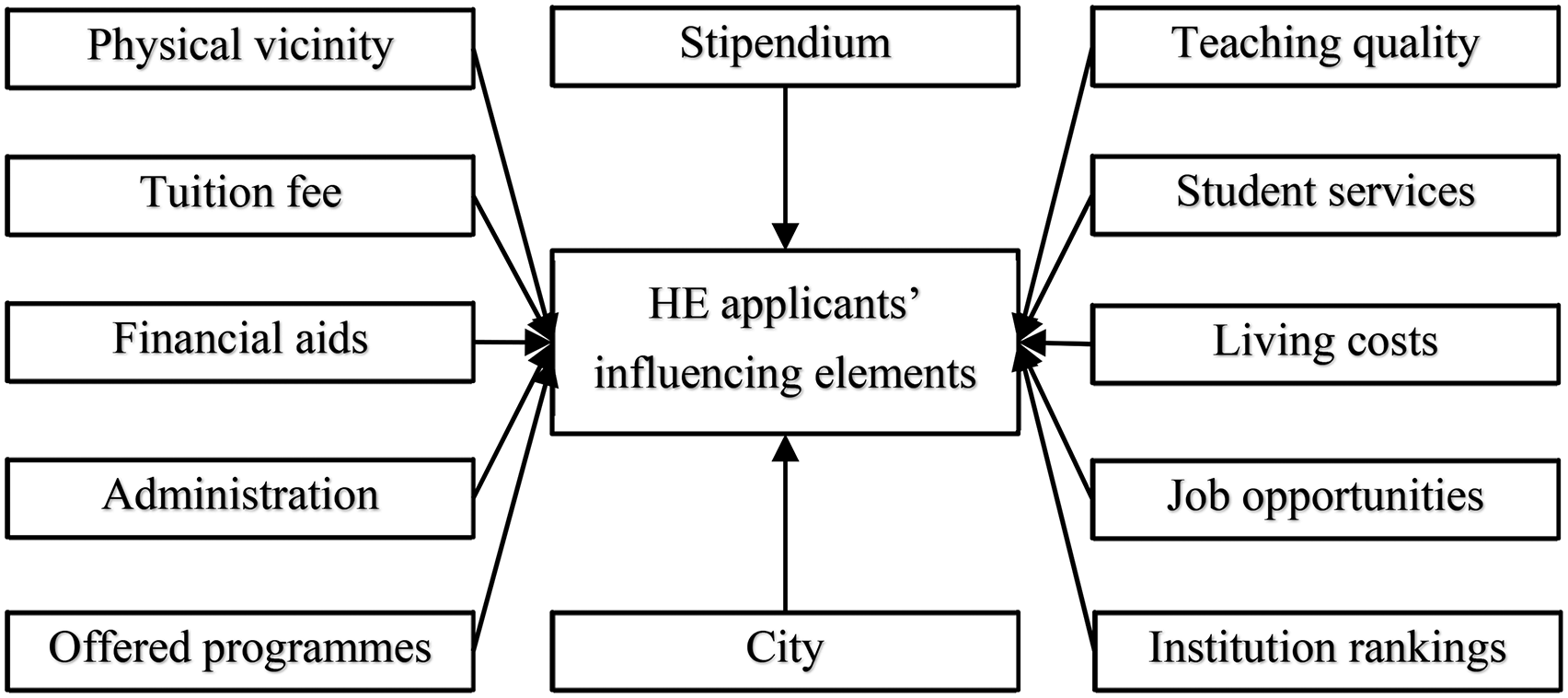
Higher education (HE) applicants' decision-making conceptual framework. Source: Authors' own elaboration.
The researchers conducted a preliminary focus group interview to find out other context-specific unique factors that might be important for consideration in 2015. Combining the findings from existing literature and the focus group interviews, 23 items were initially obtained, of whom 21 were surveyed in both academic years.
Population and research context
The features of the HE UP applicants in 2015/2016 and 2016/2017 periods are presented on the basis of a survey conducted by the UP. The given years-related surveys will be accessible to the wider public by the beginning of the academic year of 2021/2022, but they can already be processed in similar researches by UP members. This is a common practice; the Hungarian universities consider similar surveys as business secrets, and only after a certain period can they be accessed either for scientific purposes. The most important messages and benefits for the applicants are used in application stimulating marketing campaigns, but not the full reports are available. Therefore, it is not possible to compare the specific results with other Hungarian HE applicants' surveys, nor can the raw data be directly used for analysis.
Questionnaires were sent to secondary school graduates, university open days and regional and national HE exhibitions (e.g. Educatio HE fair in Budapest). The participants were motivated by a prize draw where university souvenirs were distributed among the winners. The returned and verified questionnaires in 2015/2016 802 and in 2016/2017 594 were evaluated based on a filtering criterion that UP application intention can be identified.
Sampling and data collection
The majority of respondents decided to graduate in the given year or within one year; 65% of them were women, and most of them want to apply for full-time training. The sample distribution can be used to examine the attitudes of students applying for full-time and first-time undergraduate training. It should be noted that most respondents (more than 50% in both years) are from Transdanubia (accompanied by a strong, 20–30% presence of Central Hungary), which can be evaluated as the predominant characteristics of the UP applicants for the given two consecutive years. The gender element could be the most surprising one, with a suspicion that a distortion effect takes place, but in the long run, the women ratio is about 60–62% of all the UP students (e.g. Kuráth et al., 2016), while a little higher ratio can be identified among those applying for the UP based on internal calculations.
Generation of research instrument
This paper analyses applicants' decision-making criteria for the UP, applying factor analysis using SPSS and STATA software. The questions determining the choice of the UP were evaluated on a Likert scale of 5, according to Hungarian school grades (5 means a total agreement, 1 means a total disagreement). The construct reliability was controlled by Cronbach alpha, which resulted in a value of 0.791, which is above the recommended minimum of 0.7 suggested by Hair et al. (2010). Therefore, as a starting point, it can be assumed that the 21 items can be used to identify the applicants' decision-making choices.
Data analysis method
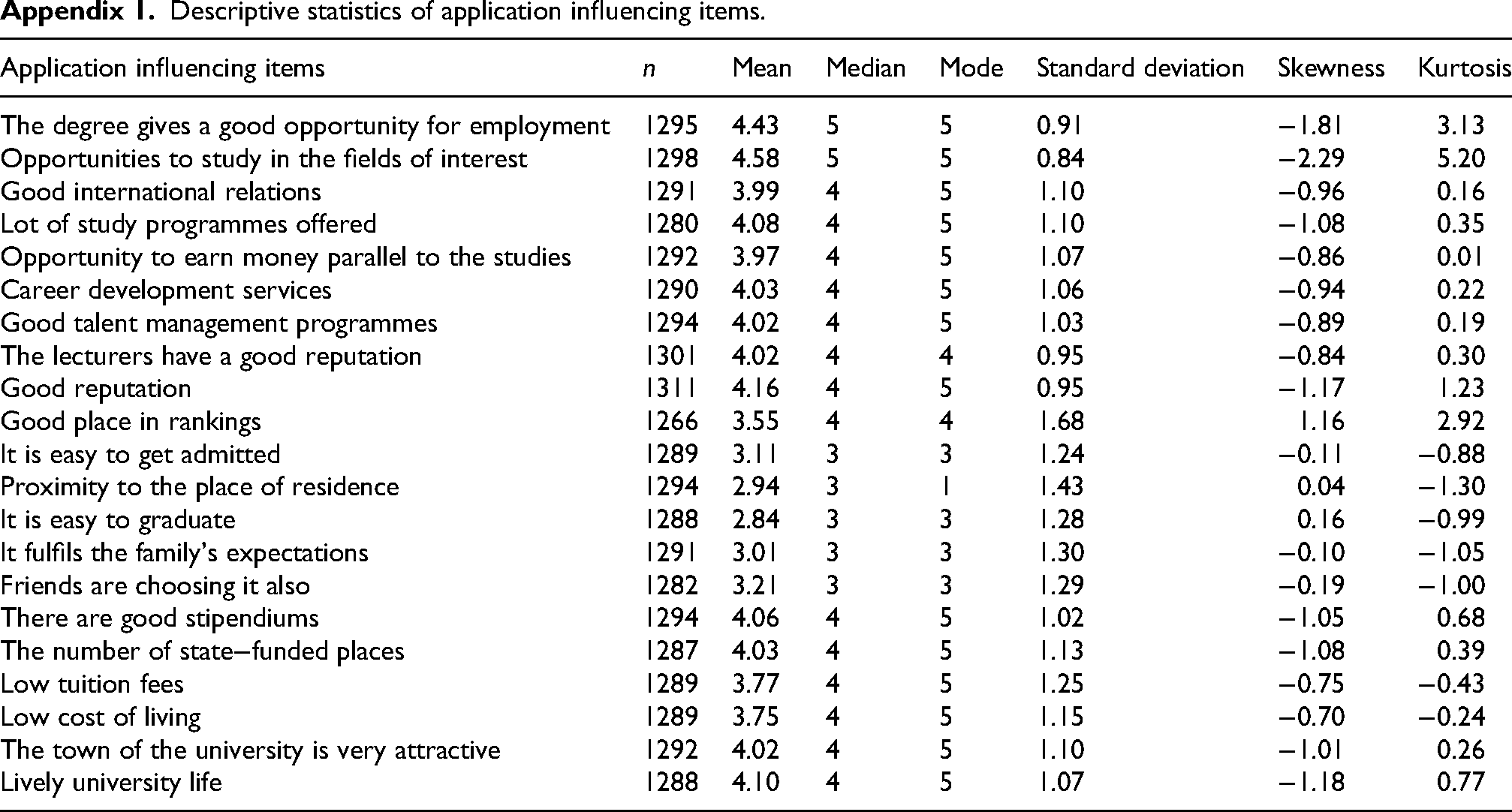
The involved 21 items-related descriptive statistics can be seen in Appendix 1. After the confirmation of their existence and their appropriateness of measuring the intended influencing factors, a multifold approach was applied; the three steps are as follows:
EFA and item grouping based on the results. CFA. Validity control.
First, with the help of an EFA, the identification of the inter-correlating items was realised. The EFA assumes that beyond the items, there are some underlying factors that can explain the inter-correlations between the different elements; therefore, it is a great tool to understand these connections and to control the factors in line with the theoretical background's findings. EFA is intended to construct the maximum variance from the data for each factor. It is strongly recommended to use the principal component analysis with varimax rotation, which ensures total independence and better fit of the factors, and so the final interpretations are clear. The initial communalities extracted (ICE) values are acceptable by reaching a value of 0.5; the Kaiser–Meyer–Olkin (KMO) and the Bartlett's test of sphericity can be used to ascertain the suitability of the data structure.
In the case of the factor loadings for identification of the rotated final factors, it can be stated that those with 0.5 or higher can be considered. Furthermore, no items are allowed to have more than one higher loading than the cut-off value, and if there is no factor loading reaching 0.5, that item can be safely removed from the analysis as having no influencing power.
Second, the identified factors should be controlled by the use of a CFA, which has an opposite methodological concept than the EFA. It is starting from the assumption that the items are constructing the identified latent variables, which can be used as a theory control to understand the main factors of the application-related decision-making process. Therefore, the CFA is controlling whether the factors are existing and, along with certain criteria, they can be considered as a valid factors or not. According to Pituch and Stevens (2015), the CFA factors will correlate with each other; therefore, multicollinearity occurs, but the model's general goodness of fit values can prove its existence. The following measures will be used: the root mean square error of approximation (RMSEA) with acceptance criteria of lower than 0.1, the comparative fit index (CFI) and the Tucker–Lewis index (TLI) with acceptance criteria of higher than 0.8, the standardised root mean squared residual (SRMR) with acceptance criteria of lower than 0.1 and the coefficient of determination (CD) with acceptance criteria of higher than 0.8 (Pituch and Stevens, 2015).
Finally, if the model is existing, the composite reliability (CR) and average variance extracted (AVE) values will be controlled for the factors. For the former one, values >0.7 are expected, whilst for the latter one, values >0.5 but no lower than 0.4 can be considered acceptable. After this step, the ranking of the summated scale (SMS) will be conducted (DiStefano et al., 2009), which is the average of the CFA items' loadings to the given factors. The ranking of the SMS can be interpreted as the final order of the factors which represent their influencing power of the applicants' decision-making choices.
Results
In this section, the 1396 applicants' choices will be investigated based on the methodological approach explained in the ‘Data analysis method’ subsection.
Exploratory factor analysis
The first EFA of the 21 items evidences the suitability of the dataset for structure detection. The KMO score is 0.822, with a high level of significance (Bartlett's test of sphericity χ2: 2797.088, df = 231, p = 0.000). The initial variance explained was 56.28%. Based on the ICE, three items have lower values than the acceptance criteria (cut-off value of 0.5 – these are indicated with XXX after the ICE values); therefore, they should be excluded from the EFA as they cannot be considered reliable (Table 1).
Exploratory factor analysis of application influencing items, initial communalities extracted.
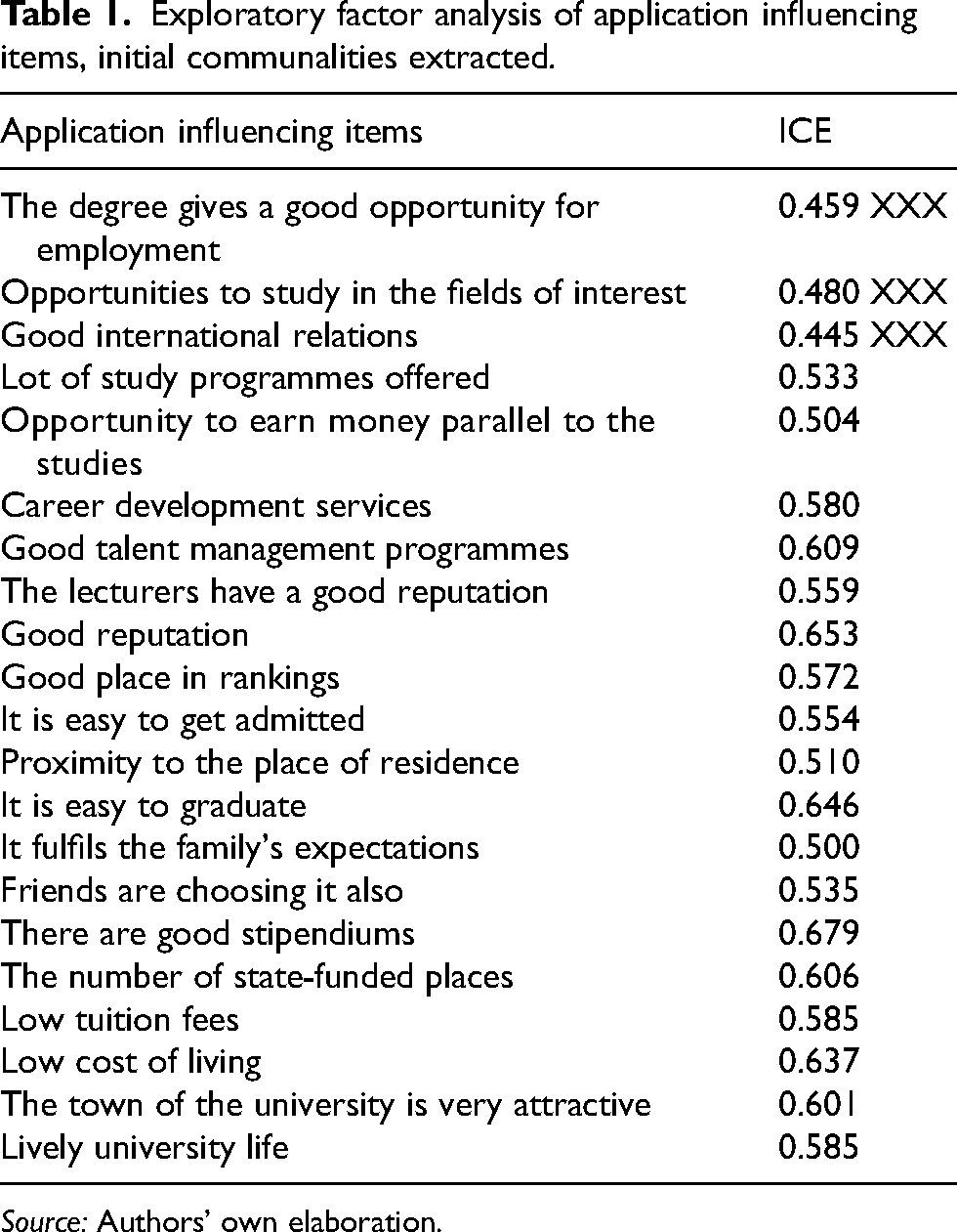
Source: Authors' own elaboration.
Excluding the non-reliable ones, 18 items remained, and the EFA was run again. The second EFA KMO score is 0.793 with a high level of significance (Bartlett's test of sphericity χ2: 2259.887, df = 153, p = 0.000), the general Cronbach alpha is 0.774. The initial variance explained was 51.29%, which still can be considered high, given the context. Table 2 shows, five final factors were identified based on the suggestions of the theoretical background's findings and the meanings of the significant factor loadings. For clarification purposes, the factor-related items were relabelled and reordered. The factor loadings related to the given factor were highlighted with italic and underlining. The justifications for the different factors are as follows:
Second exploratory factor analysis of application influencing items, rotated component matrix.
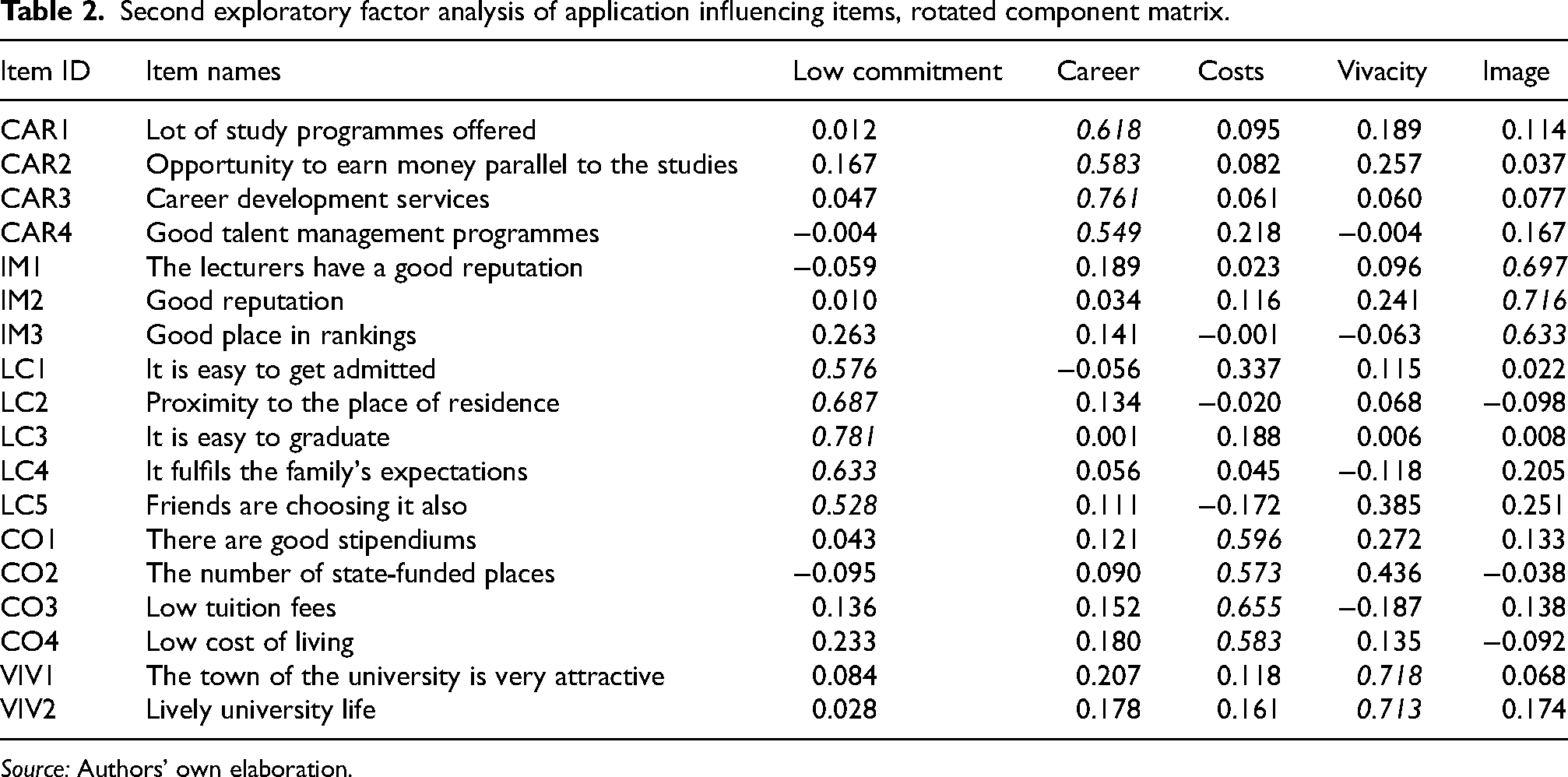
Source: Authors' own elaboration.
Factor 1 is consisting of five items that are closely related to elements not considering the aims and commitment of the applicant. The following of the friends' choice or the parents' will are evidence of not having their own clear goals. Even the relatively easy thing to being admitted or becoming a graduated one, accompanied by the vicinity to the residential place, led to name it as low commitment.
Factor 2 contains four items that are connected to having exact expectations and vision of labour market position. The opportunity to find the diverse study programmes, which might also offer the chance to change if necessary, the career development and talent management services are all targeting the future life. This is enhanced by the opportunity to gather labour market related experience. As a sum, it was named career.
Factor 3 is dominated by four items, all related to the expenses and costs related to the tuition fees and everyday living; therefore, it was named costs.
Factor 4 has two items, one of them is targeting the university life, whilst the other is connected to the city where the institution is situated; as a result, it was labelled as vivacity.
Factor 5 is focusing on three elements, which all are connected to the general quality of the institution, which is determined by different factors and also can be caught through objective measures. These are more likely items related to the general opinion of the institution; therefore, it was called image.
Confirmatory factor analysis
As the next step, a CFA was run on the 18 items and the five factors. The χ2 is 623.35 with a p value of 0.000. The CFA-related measures are appropriate (RMSEA: 0.071, CFI: 0.930, TLI: 0.915, SRMR: 0.048 and CD: 0.996), the model exists, and the items are loading the EFA-based latent factors in an appropriate manner; therefore, these factors can be used for identifying the applicants' decision-making choices of the HE institutions (Figure 2).
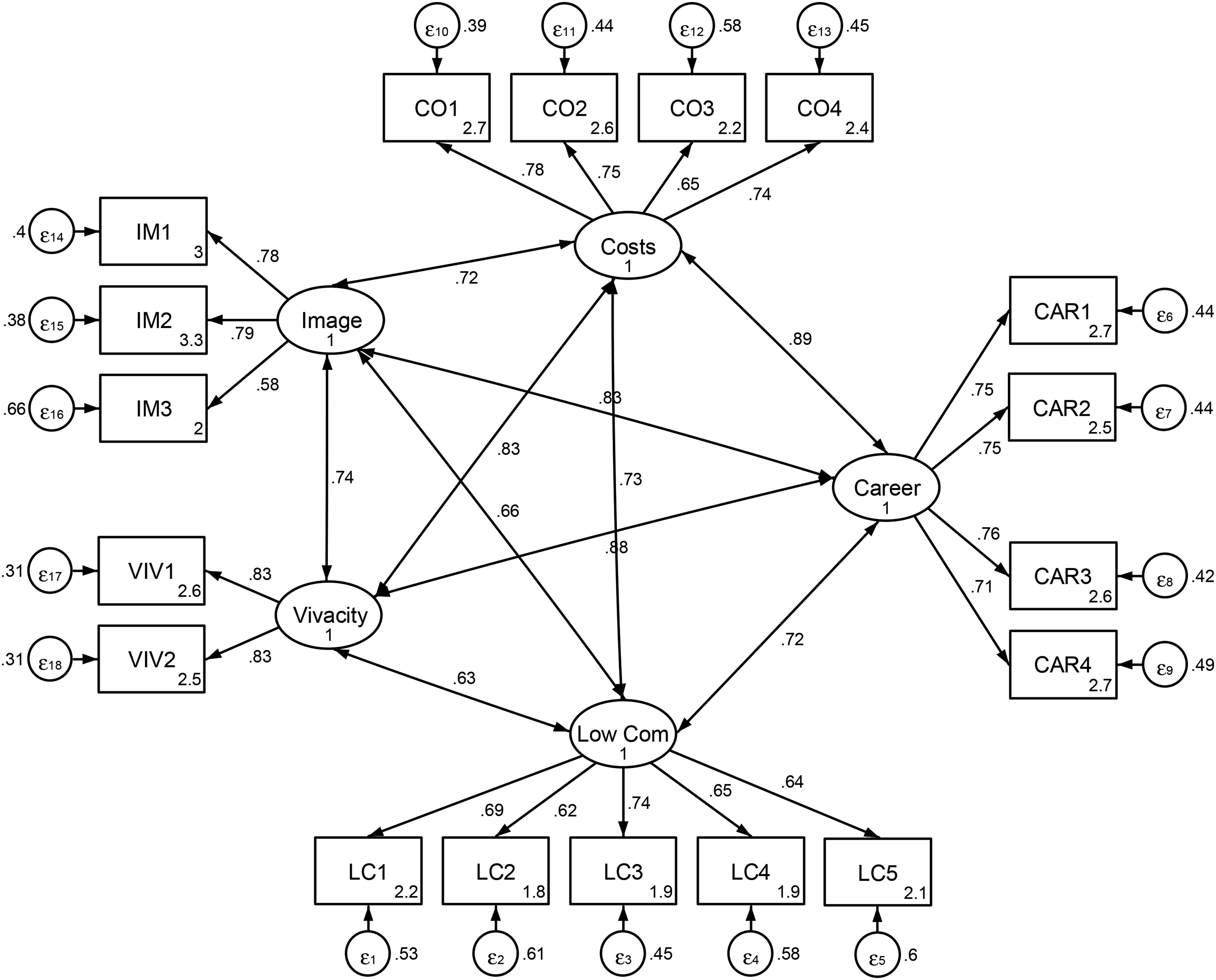
Confirmatory factor analysis (CFA) of application influencing items. Source: Authors' own elaboration.
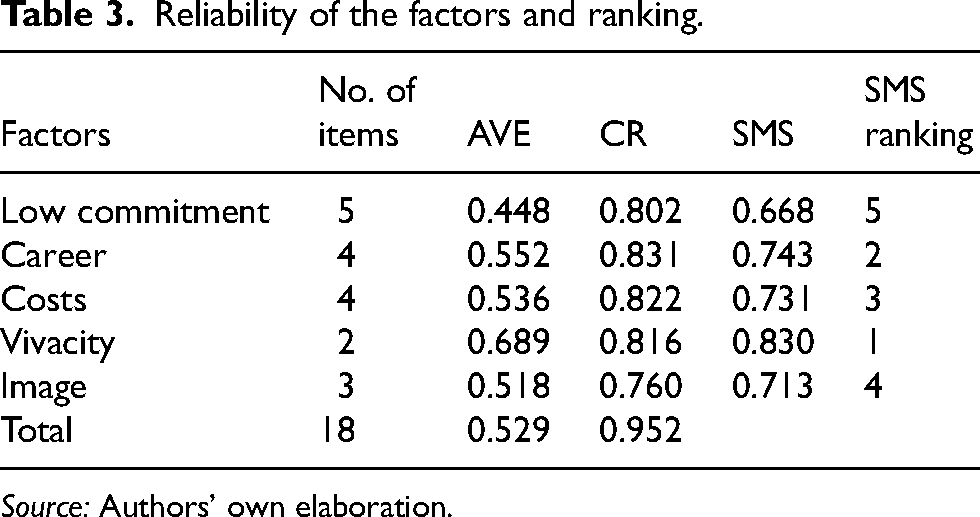
The final reliability of the factors was controlled by the calculation of the AVE and CR. Based on the statements of the ‘Data analysis method’ subsection, all of them can be considered acceptable, even if low commitment has a lower AVE score (Table 3).
Reliability of the factors and ranking.
Source: Authors' own elaboration.
To identify the relative order of the application influencing factors, the SMS scores were also calculated, as shown in Table 3 and Figure 3. As a result, the first most important factor is the vivacity, followed by career and costs, fourth is the image and the last one is the low commitment.
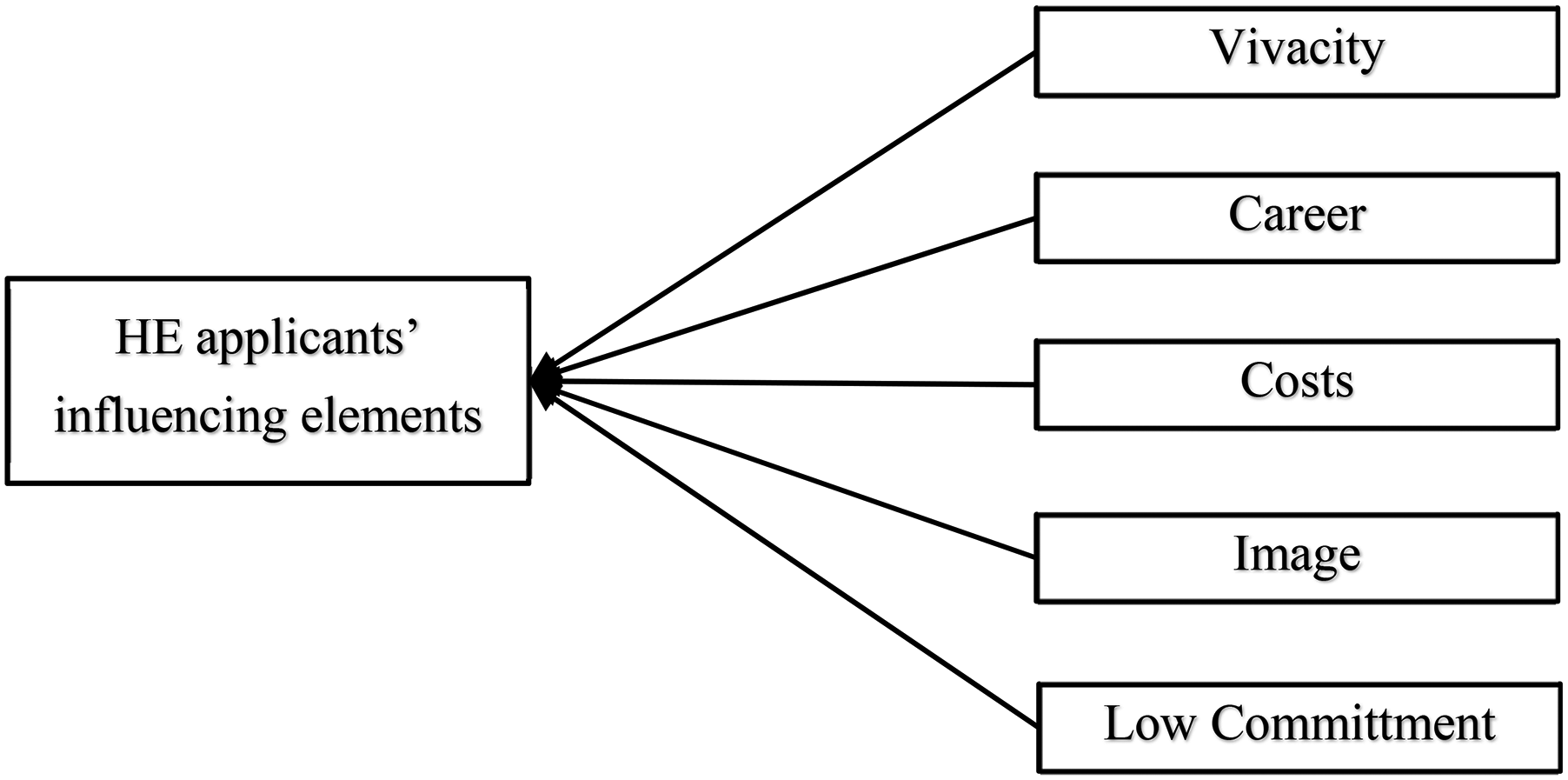
The five dimensions influencing the HE applications. Source: Authors' own elaboration.
The vivacity was the first most important factor and had outstanding importance based on the SMS, which is contrary to the theoretical background's findings (where this element also can be identified, but with a lower priority). The city and the university life are not considered as one of the most important influencing element (Al-Dajani and Alsamydai, 2018; Lányi and Pozsgai, 2016; Mbawuni and Nimako, 2015; Rámháp, 2017; Rudhumbu et al., 2017; Törőcsik et al., 2014). This also means that this should be put in the fore during marketing campaigns as this seems to be a significantly influencing element.
The career is in second place. The importance of the academic programme and the opportunity to switch to a different path if it turns out to be not the ideal degree. This is highlighted by several pieces of research (Al-Dajani and Alsamydai, 2018; Rámháp, 2017; Rudhumbu et al., 2017; Törőcsik et al., 2014). Even the career development and talent management services are important in line with Drewes and Michael (2006), Lányi and Pozsgai (2016) and Mbawuni and Nimako (2015). Even the job opportunities parallel to the studies can be considered a future career-building contribution (Chatfield et al., 2012; Foskett et al., 2006).
The costs are only in the third place (even if with less SMS difference), which is important to almost all of the students according to the theoretical background section. This is a little different as in this study is not so important, but it is understandable that the costs matter. This includes the available stipendiums and state-funded places (Al-Dajani and Alsamydai, 2018; Drewes and Michael, 2006; Rudhumbu et al., 2017), the low tuition fees and the low cost of living (Chatfield et al., 2012; Lányi and Pozsgai, 2016; Mbawuni and Nimako, 2015; Rudhumbu et al., 2017).
The image is the only in the fourth place, which might not be considered as a negative factor because it can be considered the basic starting point for all of the other elements, which can rely on it. The quality of the lecturers (Drewes and Michael, 2006; Lányi and Pozsgai, 2016), and the general reputation (Rámháp, 2017; Rudhumbu et al., 2017; Törőcsik et al., 2014) are influencing the application procedure.
The low commitment was ranked as the last one of the five influencing factors. This is contrary to the findings of Drewes and Michael (2006) but in line with Törőcsik et al. (2014) and Rámháp (2017), and it can be considered an important statement that during marketing processes, only those less enthusiastic and focus oriented can be targeted by emphasising this aspect. It should not have to be neglected (as suggested by Lányi and Pozsgai, 2016; or Macmillian and Yue, 2017), but rather providing this information through informal channels. Other highlights (e.g. Fullerton, 2016), those influenced mainly by this factor, need more resources and are less loyal, which in the long term, is not an ideal path to follow by the side of the HE institutions.
Discussion and implications
With regard to these phenomena, domestic institutions should concentrate their attention on the long-term development of target groups, on the establishment of a right positioning strategy, and the exploration of the directions of change. The permanent system change of the Hungarian HE as a phenomenon versus the applicants' institution selection criteria gives the uniqueness of the Hungarian situation, and this study provides information for researchers in HE in this field additionally.
Based on the results, three development areas can be designated.
Strategic management areas
Top management support can make significant changes and achievements, as the core of market-oriented marketing is not the communication but the strategic areas:
Because of the element of vivacity, the city image should be emphasised and improved by the HE institutions and the city together; this intention can be identified in almost all of the city or UP level initiatives. Typically, the aspect of the city is strong for the case of the UP; the university slogan is also used since 2013: ‘Everybody wants to be from Pécs'. It is necessary to provide the programmes and services by, for example, significantly extending the student's career planning and development opportunities. At the same time, these services also offer an opportunity for community building. Most of them bring students together with new, different group composition, providing an opportunity to gain a shared experience, thus indirectly contributing to strengthening the vivacity. The above is followed by the communication of the university centre and the faculties, which is a necessary but not sufficient condition for the enrolment activity: prestige aspects, career considerations, experiences and student life.
Studies show that it is of critical importance that factors that influence students' choices of universities are investigated to enable effective planning of student recruitment strategies (e.g. Al-Dajani and Alsamydai, 2018). Therefore, the definition and operation of each area require conscious marketing work and the provision of an adequate organisational background; consideration must be given to aspects affecting the effectiveness of enrolment work as well as to external and internal environmental factors.
Communication challenges – integrated campaigns
Knowing and understanding students' choices is only the first step to develop programmes that attract them.
As the spread of the multitasking phenomenon characterises the communication of students and at the same time, they have advanced media awareness, it is necessary to reconsider the enrolment marketing communication as follows:
There is a need to develop new arguments for the target groups – in addition to emotional arguments, the rational area is becoming increasingly marked, such as stipendiums, the cost of living, and the salary available for that qualification. Given the order of the factors, great emphasis should be placed on the vivacity, which involves two factors. First, university life falls within the competence of the institutions; second, the attractiveness of the university's city, which falls outside it, but in its favourable conditions, it provides a very good basis for communication. Even the rational and emotional aspects require the planning and implementation of integrated marketing campaigns.
An exciting and attention-grabbing factor is the low involvement. It may be a consequence of the HE massification, which at the same time leads to the increased risk of nonparticipation in HE. For students following this selection criterion, it is a task and an opportunity to develop services (such as a mentoring programme) that facilitate learning, fulfil requirements and explore real career goals. With these programmes, it can also be reversed the original student intention, motivation (or lack of motivation).
It also provides an insight into the factors influencing the application that in this study, the following factors were not found to be significant: the degree gives a good opportunity for employment, opportunities to study in the fields of interest, good international relations.
Complex research
This paper focuses on the evolution of the expectations of the users of UP HE services and the factors that shape the market, in connection with the development of the marketing information system and the importance of the preparation of decision making, such as student statistics, macro-environment, information, competitor analyses.
In the case of the use of results, the information function is very important, besides the general information and modification of the public opinion, for the applicants of HE as well. It should be highlighted the analyses of the Hungarian Graduate Career Tracking System, as the growing social demand for career-tracking results is perceived, pointing to the development of national data collection systems (Kuráth and Sipos, 2020; Veroszta, 2016). From a content perspective, the international trend is indicative of increasing attention for potential students.
There is a need for HE institutions to work in this environment, and data that is produced, valued and evaluated the same way and can provide a basis for the development of positioning strategies.
Research limitations and future research
Nowadays, looking at the situation in Hungary, there are significant changes in some areas. The main limitation of this study is that it used samples from one country and one (even if one of the biggest) HE institutions, the UP. As the applicants-related information is treated as business secrets, there is no place to make at least a Hungarian HE-wide comparison, even if some researches were used to evaluate the results.
Due to the limitation of the study, three main factors are highlighted:
The paper focuses only on Hungarian students, as the international ones have so many different elements (e.g. Lányi and Pozsgai, 2016; Page and Chahboun, 2019), which cannot be investigated in this framework. The sample is robust but not representative for Hungary but for the UP. The results show the period before COVID. As a result of COVID, institutional selection considerations are likely to change. It is hypothesised that in the aftermath of a pandemic, the type of online courses on offer and the ways (online teaching experience, technical conditions, online learning materials) in which institutions will be prepared for online education will become more critical. the direction in which the motivation of participation in HE move; the aspects and their order of choosing an institution; city and university cooperation context-based image analysis to identify the potentials how to develop the attraction factors; the opportunity to embed a common section into the Graduate Career Tracking System (which is obligatory to the Hungarian HE institutions, and thus, no institution-side business secrecy issue occurs) regarding the first-year students' motivation to apply to the given institution. In this way, in the upcoming years, it will be available to compare the Hungarian HE institutions from this perspective, too; whether new, previously insignificant factors arise (such as security); whether the social changes to what extent are influencing the applications of the HE and vice versa (Schofer et al., 2020); whether the changes in the domestic and international education market are moving in the same direction; the importance and demand for online education, and how this trend will affect the vivacity element of the HE institutions.
The limitations determine the direction of further research. It is necessary to examine
Footnotes
Declaration of conflicting interests
The authors declared no potential conflicts of interest with respect to the research, authorship and/or publication of this article.
Funding
The authors disclosed receipt of the following financial support for the research, authorship and/or publication of this article: The research was financed by project no. TKP2020-IKA-08, which has been implemented with the support provided by the National Research, Development and Innovation Fund of Hungary, financed under the 2020-4.1.1-TKP2020 funding scheme.

Author biographies
Appendix
Descriptive statistics of application influencing items.
| Application influencing items | n | Mean | Median | Mode | Standard deviation | Skewness | Kurtosis |
|---|---|---|---|---|---|---|---|
| The degree gives a good opportunity for employment | 1295 | 4.43 | 5 | 5 | 0.91 | −1.81 | 3.13 |
| Opportunities to study in the fields of interest | 1298 | 4.58 | 5 | 5 | 0.84 | −2.29 | 5.20 |
| Good international relations | 1291 | 3.99 | 4 | 5 | 1.10 | −0.96 | 0.16 |
| Lot of study programmes offered | 1280 | 4.08 | 4 | 5 | 1.10 | −1.08 | 0.35 |
| Opportunity to earn money parallel to the studies | 1292 | 3.97 | 4 | 5 | 1.07 | −0.86 | 0.01 |
| Career development services | 1290 | 4.03 | 4 | 5 | 1.06 | −0.94 | 0.22 |
| Good talent management programmes | 1294 | 4.02 | 4 | 5 | 1.03 | −0.89 | 0.19 |
| The lecturers have a good reputation | 1301 | 4.02 | 4 | 4 | 0.95 | −0.84 | 0.30 |
| Good reputation | 1311 | 4.16 | 4 | 5 | 0.95 | −1.17 | 1.23 |
| Good place in rankings | 1266 | 3.55 | 4 | 4 | 1.68 | 1.16 | 2.92 |
| It is easy to get admitted | 1289 | 3.11 | 3 | 3 | 1.24 | −0.11 | −0.88 |
| Proximity to the place of residence | 1294 | 2.94 | 3 | 1 | 1.43 | 0.04 | −1.30 |
| It is easy to graduate | 1288 | 2.84 | 3 | 3 | 1.28 | 0.16 | −0.99 |
| It fulfils the family's expectations | 1291 | 3.01 | 3 | 3 | 1.30 | −0.10 | −1.05 |
| Friends are choosing it also | 1282 | 3.21 | 3 | 3 | 1.29 | −0.19 | −1.00 |
| There are good stipendiums | 1294 | 4.06 | 4 | 5 | 1.02 | −1.05 | 0.68 |
| The number of state−funded places | 1287 | 4.03 | 4 | 5 | 1.13 | −1.08 | 0.39 |
| Low tuition fees | 1289 | 3.77 | 4 | 5 | 1.25 | −0.75 | −0.43 |
| Low cost of living | 1289 | 3.75 | 4 | 5 | 1.15 | −0.70 | −0.24 |
| The town of the university is very attractive | 1292 | 4.02 | 4 | 5 | 1.10 | −1.01 | 0.26 |
| Lively university life | 1288 | 4.10 | 4 | 5 | 1.07 | −1.18 | 0.77 |