




Abstract
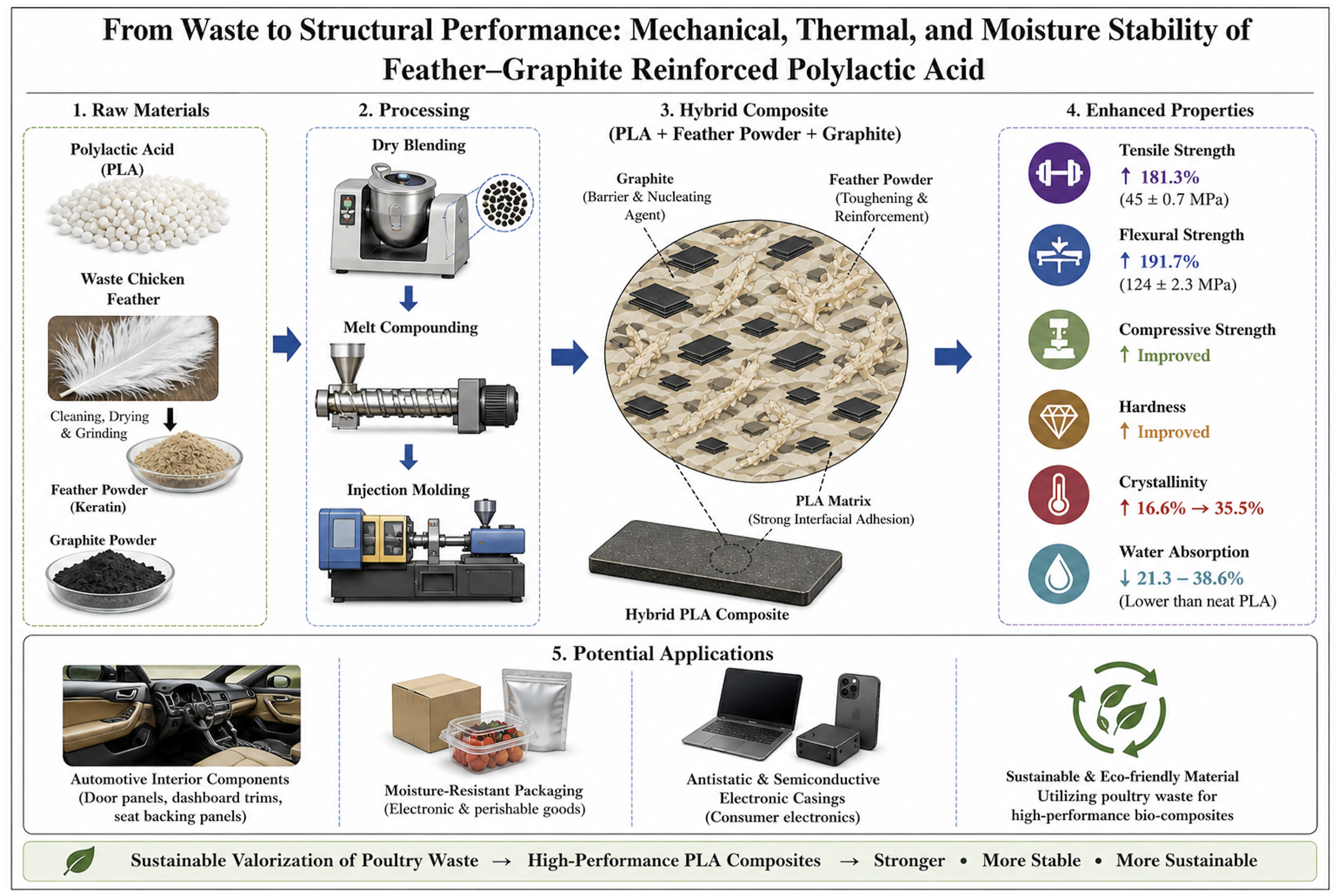
Agricultural waste is utilized as filler to mitigate manufacturing constraints and brittleness in polylactic acid (PLA). However, the hydrophilic nature of fillers leads to moisture absorption and swelling, diminishing material’s strength. Thus, this study investigates the impact of hydrophobic fillers such as waste feather (WF) and graphite powder as reinforcements to enhance mechanical properties and reduce moisture absorption in PLA. Three hybrid PLA-composites (HPLAC) are produced, with varying WF and graphite percentages: HPLAC1 (15% WF, 5% graphite), HPLAC2 (10% WF, 10% graphite), and HPLAC3 (5% WF, 15% graphite). HPLAC3 demonstrates higher tensile strength (45 ± 0.7 MPa) and flexural strength (124 ± 2.3 MPa), exceeding pure PLA by 181.3% and 191.7%, respectively. The addition of WF and graphite enhanced compression strength and hardness, while higher graphite content reduced impact strength due to its lower density and higher stiffness. The glass transition and melting temperatures are increased to 64.4°C and 178.5°C corresponding to an increased crystallinity from 16.6% (PLA) to 35.5% (HPLAC2). Furthermore, HPLAC2 has a 38.6% lower water absorption than pure PLA, showing that the HPLACs with WF and graphite have higher mechanical properties and reduced water absorption than PLA. Consequently, they can provide a wide range of applications across several sectors, setting up a balance between performance, sustainability, and cost-effectiveness.
Get full access to this article
View all access options for this article.