



Abstract
Introduction:
Endoscopic combined intrarenal surgery (ECIRS) has emerged as a significant advancement in the management of patients with a high stone burden or large, complex stones. This technique has been reported to improve the stone-free rate (SFR) while reducing complications commonly associated with percutaneous nephrolithotomy (PCNL). However, most available evidence comes from single-center studies with relatively small cohorts. We conducted a systematic review and meta-analysis to compare perioperative outcomes between the two procedures.
Methods:
A systematic search of PubMed, Embase, and Scopus databases was conducted to identify both randomized and nonrandomized studies comparing ECIRS and PCNL. Primary outcomes included SFR after a single session, need for ancillary treatments, and major complications (Clavien–Dindo grade ≥3). Secondary outcomes were transfusion rates, operative time, and hospital stay. Random-effects models were applied when heterogeneity was high (I2 > 50%). Results were expressed as odds ratios (ORs) and mean differences (MDs) with 95% confidence intervals (CIs).
Results:
Fifteen studies (12 retrospective and 3 randomized) involving 1988 patients were included. A significantly higher SFR (OR 3.02, 95% CI: 2.40–3.80; p < 0.001) and a lower need for ancillary procedures (OR 0.20, 95% CI: 0.13–0.31; p < 0.001) were observed with ECIRS. Similarly, a lower rate of major complications (OR 0.58, 95% CI: 0.34–0.97; p = 0.03) and transfusions (OR 0.49, 95% CI: 0.28–0.88; p = 0.01) also favored ECIRS. Operative time (MD −9.25 minutes, 95% CI: −16.82 to −1.67; p = 0.01) and hospital stay (MD −1.61 days, 95% CI: −2.54 to −0.69; p = 0.0006) were significantly longer in the PCNL group.
Conclusions:
ECIRS achieved higher single-session SFRs without increasing major complications or transfusion rates. This technique may also reduce operative time and hospital stay, particularly when performed by experienced endourologists. Given that most included studies were retrospective, further randomized trials are required to strengthen the evidence base and better define the clinical role of ECIRS.
Keywords
Introduction
The management of large, complex kidney stones, which often involve multiple caliceal or staghorn calculi, poses a significant challenge in urology. Percutaneous nephrolithotomy (PCNL) has long been regarded as the gold standard treatment in these scenarios.1,2 Over the years, PCNL has undergone significant refinements in access techniques, patient positioning, energy delivery systems, and the development of miniaturized instruments.3,4 Despite these evolutionary advancements, PCNL is not without limitations, particularly in the management of complex nephrolithiasis. The need for multiple access tracts—associated with increased risk of parenchymal injury and blood loss—and the requirement for auxiliary procedures remain key limitations of this approach as a stand-alone treatment. 5
Endoscopic combined intrarenal surgery (ECIRS) represents a pivotal advancement in the management of complex kidney stones, providing simultaneous access to the pelvicaliceal system through both flexible ureteroscopy (fURS) and percutaneous approaches. 6 This dual-access technique enables thorough exploration of the renal calices and facilitates removal of residual fragments (RF), thereby improving the stone-free rate (SFR). 7 Moreover, ECIRS may reduce morbidity by minimizing complications typically associated with PCNL and by decreasing the need for multiple procedures.8,9 Although previous meta-analyses have suggested the superiority of ECIRS in certain outcomes, most of the included studies in these analyses as well as the broader body of comparative evidence are retrospective in nature.9–11 Emerging evidence from randomized controlled trials (RCTs) and propensity score-matched (PSM) analyses has begun to address this limitation, with several such studies published in the current year.7,12–14 Therefore, we conducted a systematic review and meta-analysis to compare perioperative outcomes between ECIRS and PCNL.
Patients and Methods
This systematic review and meta-analysis were conducted in compliance with the Preferred Reporting Items for Systematic Reviews and Meta-Analyses (PRISMA) guidelines. 15 The study protocol was prospectively registered in PROSPERO (ID: CRD420251144157).
Search strategy and study screening
In June 2025, a systematic search encompassing PubMed, Embase, Medline, and Scopus databases without restrictions on publication year was conducted. Keywords and free words were used to search for endoscopic combined intrarenal surgery or ECIRS and percutaneous nephrolithotomy or PCNL. The complete search strategy can be found in Supplementary Data. Retrieved references were screened based on title and abstract, followed by a full-text review as a second step. Two independent authors screened each article in a blinded manner, with a third author resolving any disagreements. Reference lists of included articles were screened for additional relevant studies. The PRISMA flow diagram of the study selection process is shown in Figure 1.
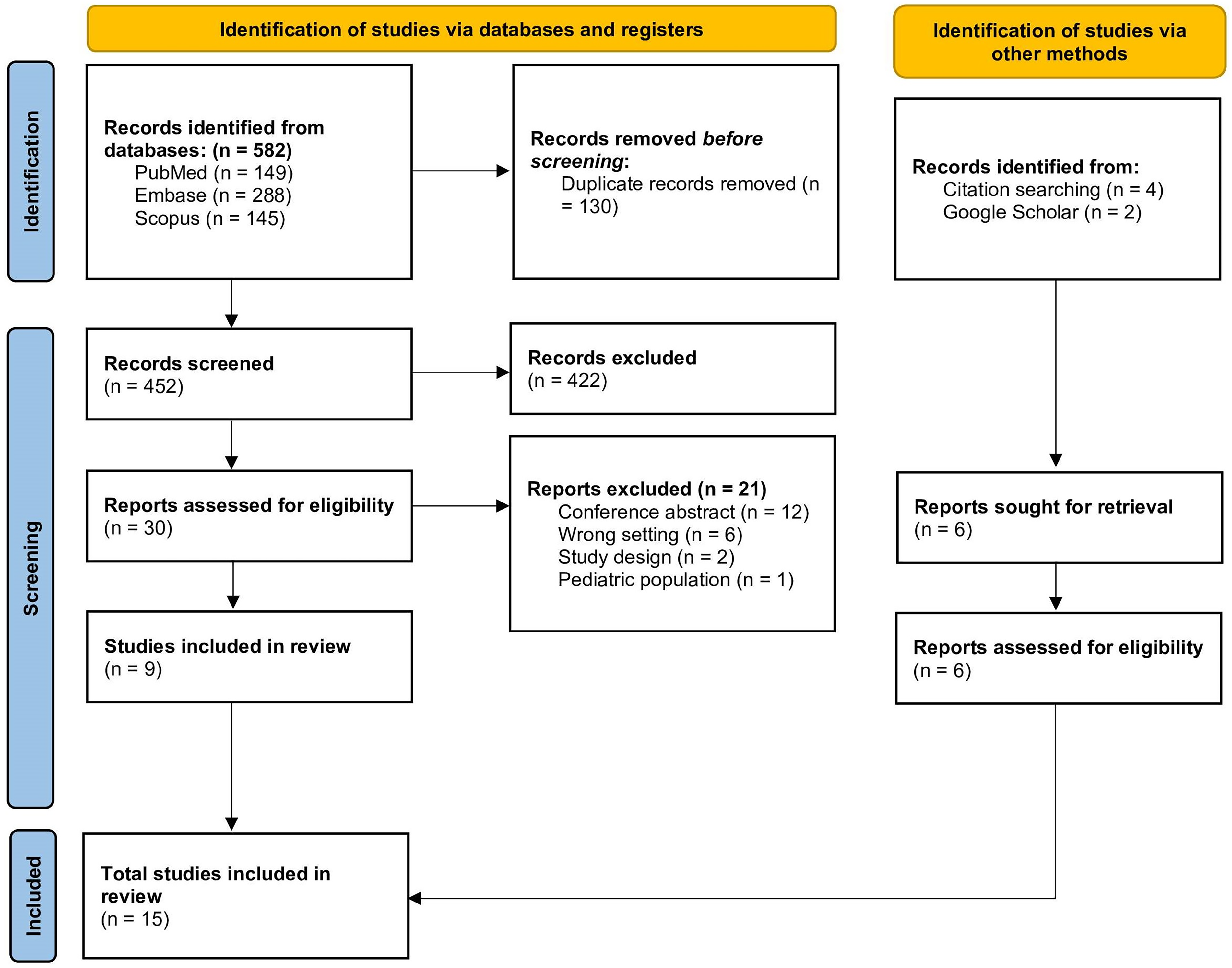
Preferred Reporting Items for Systematic Review and Meta-Analysis (PRISMA) flow diagram for study selection.
Criteria of the included studies
Using predefined inclusion and exclusion criteria based on the PICO model, we identified relevant studies as follows:
Population: adult patients requiring surgical treatment for urolithiasis Intervention: patients undergoing ECIRS Comparator: patients undergoing PCNL Outcomes: SFR, major complications (according to a Clavien–Dindo [CD] ≥3), need for ancillary procedures, operative time, length of stay (LOS), and transfusion rates.
Studies were excluded from the analysis if they evaluated endourologic procedures other than ECIRS, involved pediatric populations, or lacked a PCNL group for comparison. In addition, systematic reviews, literature reviews, case reports, conference abstracts, letters to the editor, and basic science research were also excluded.
Data extraction and quality assessment
Using a predefined spreadsheet, two independent authors extracted the following data: (1) Baseline characteristics of the studied population; (2) summary of the characteristics of the included studies; (3) outcome measures; and (4) quality assessment domains. An assessment of study quality and bias was conducted using the Risk of Bias in Nonrandomized Studies of Interventions tool for observational studies, 16 whereas for RCTs, we used version 2 of the Cochrane risk-of-bias tool for randomized trials. 17
Statistical analyses
Categorical data were assessed by analyzing event frequencies and calculating the odds ratio (OR) with 95% confidence intervals (CIs). Continuous data were reported using the mean difference (MD). Heterogeneity was assessed using the Higgins I2%. Variables with >50% I2 were considered heterogeneous and analyzed using a random-effects model. Otherwise, a fixed-effects model was utilized. Statistical significance was set with a p-value of <0.05. Subgroup analyses were performed to account for potential confounders, and studies were stratified based on study design—non-RCT (observational), RCT, or PSM for those studies that used this analytic tool. Variables reported as medians with ranges or interquartile ranges were converted to mean and standard deviation using Hozo’s method. 18 Forest plots were utilized to observe the outcome. All statistical analyses were performed using R (version 4.4.1).
Results
Study selection and characteristics
From an initial pool of 582 studies, 15 were included for analysis, totaling 1988 patients.7,12–14,19–29 Of these, 862 (43%) underwent ECIRS, whereas PCNL was performed in 1126 patients (57%).
Twelve studies were retrospective in design, of which three used propensity score matching to account for potential confounding factors.13,14,29 In contrast, three studies were RCTs.7,12,27 Regarding the tract size used for PCNL, nine studies exclusively implemented a standard tract,7,13,14,20,22,23,25,26,29 five used a miniaturized tract,12,19,24,27,28 and one used both standard and miniaturized tracts. 21
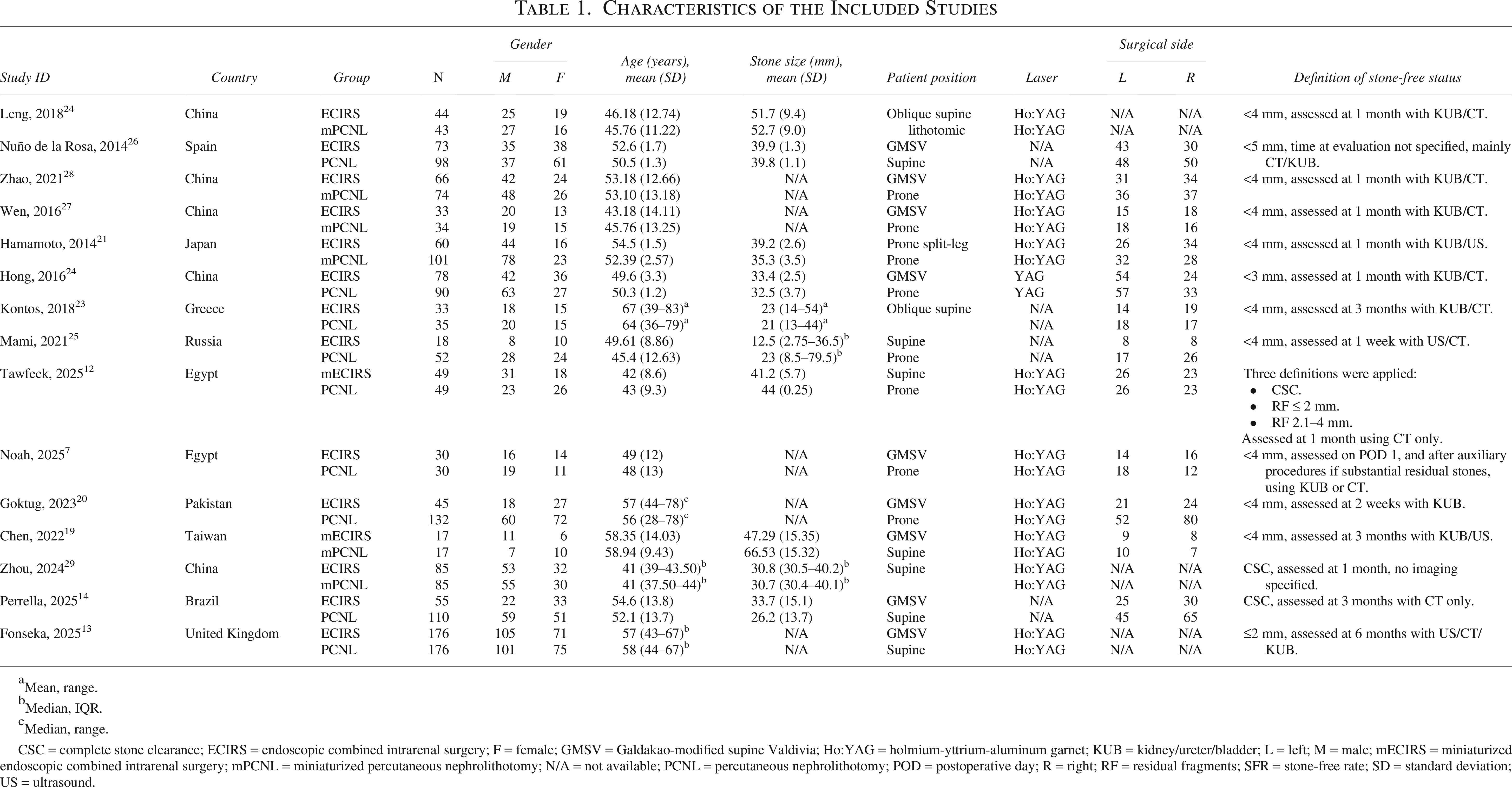
SFR was evaluated after a single session and after a second procedure in seven studies,7,12,21,22,24,27,29 whereas the remaining studies provided only single session rates. We did not perform a separate analysis of second-session SFR because these data may conceptually overlap with our outcome on the need for ancillary procedures. The most common definition of SFR was RF < 4 mm with 10 studies using this threshold. Imaging modalities used to assess SFR included X-ray, ultrasound, and CT. The overall characteristics of the included studies are summarized in Table 1.
Characteristics of the Included Studies
Mean, range.
Median, IQR.
Median, range.
CSC = complete stone clearance; ECIRS = endoscopic combined intrarenal surgery; F = female; GMSV = Galdakao-modified supine Valdivia; Ho:YAG = holmium-yttrium-aluminum garnet; KUB = kidney/ureter/bladder; L = left; M = male; mECIRS = miniaturized endoscopic combined intrarenal surgery; mPCNL = miniaturized percutaneous nephrolithotomy; N/A = not available; PCNL = percutaneous nephrolithotomy; POD = postoperative day; R = right; RF = residual fragments; SFR = stone-free rate; SD = standard deviation; US = ultrasound.
Baseline characteristics
Patients in the ECIRS group were slightly older than those in the PCNL group, although the difference was not statistically significant (Standardized mean difference (SMD) 0.23, 95% CI −0.02 to 0.47). No significant differences were observed between groups in body mass index (SMD 0.04, 95% CI −0.12 to 0.20) or stone size (SMD −0.03, 95% CI −0.49 to 0.43). Stone density was higher in the ECIRS group compared with PCNL; however, this difference did not reach statistical significance (SMD 0.29, 95% CI −0.09 to 0.67) (Supplementary Fig. S1A–D).
Primary outcomes
Stone-free rate
Fifteen studies comprising 1988 patients reported SFR after a single session. SFR was 83.7% in the ECIRS group and 63% in the PCNL group. The pooled analysis demonstrated a significantly higher likelihood of achieving stone-free status with ECIRS (OR 3.02, 95% CI 2.40–3.80; p < 0.001). This superiority was consistent across subgroup analyses stratified by study design (Fig. 2) and tract size. When analyzed by tract size, ECIRS achieved higher SFRs in both standard (OR 2.61, 95% CI 1.98–3.43) and miniaturized (OR 3.02, 95% CI 2.40–3.80) PCNL subgroups (Supplementary Fig. S2A). Additional subgroup analyses based on CT-confirmed SFR, definition of complete-stone clearance, and SFR evaluation at 3–6 months consistently favored ECIRS over PCNL (Supplementary Fig. S2B–D).
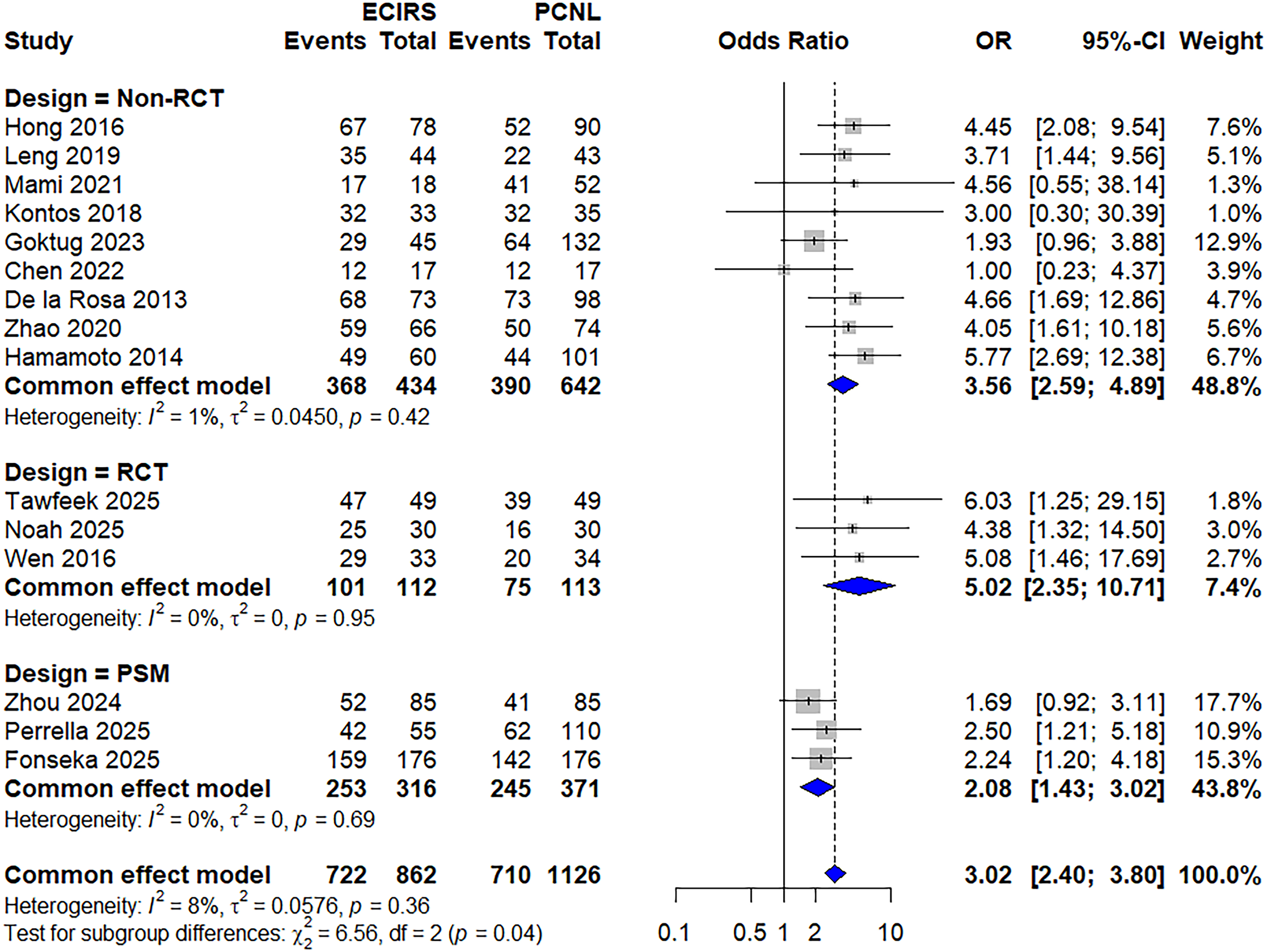
Stone-free rates in ECIRS and PCNL groups, stratified by study design. randomized controlled trials (RCTs). ECIRS = endoscopic combined intrarenal surgery; PCNL = percutaneous nephrolithotomy.
Ancillary treatment requirement
Six studies provided detailed data on the need for additional surgical procedures. Reported ancillary treatments included second-look PCNL, fURS, or shockwave lithotripsy. The need for ancillary treatment was significantly lower in the ECIRS group compared with PCNL (OR 0.20, 95% CI 0.13–0.31; p < 0.001). This difference remained significant in both non-RCT and RCT subgroup analyses (Fig. 3).
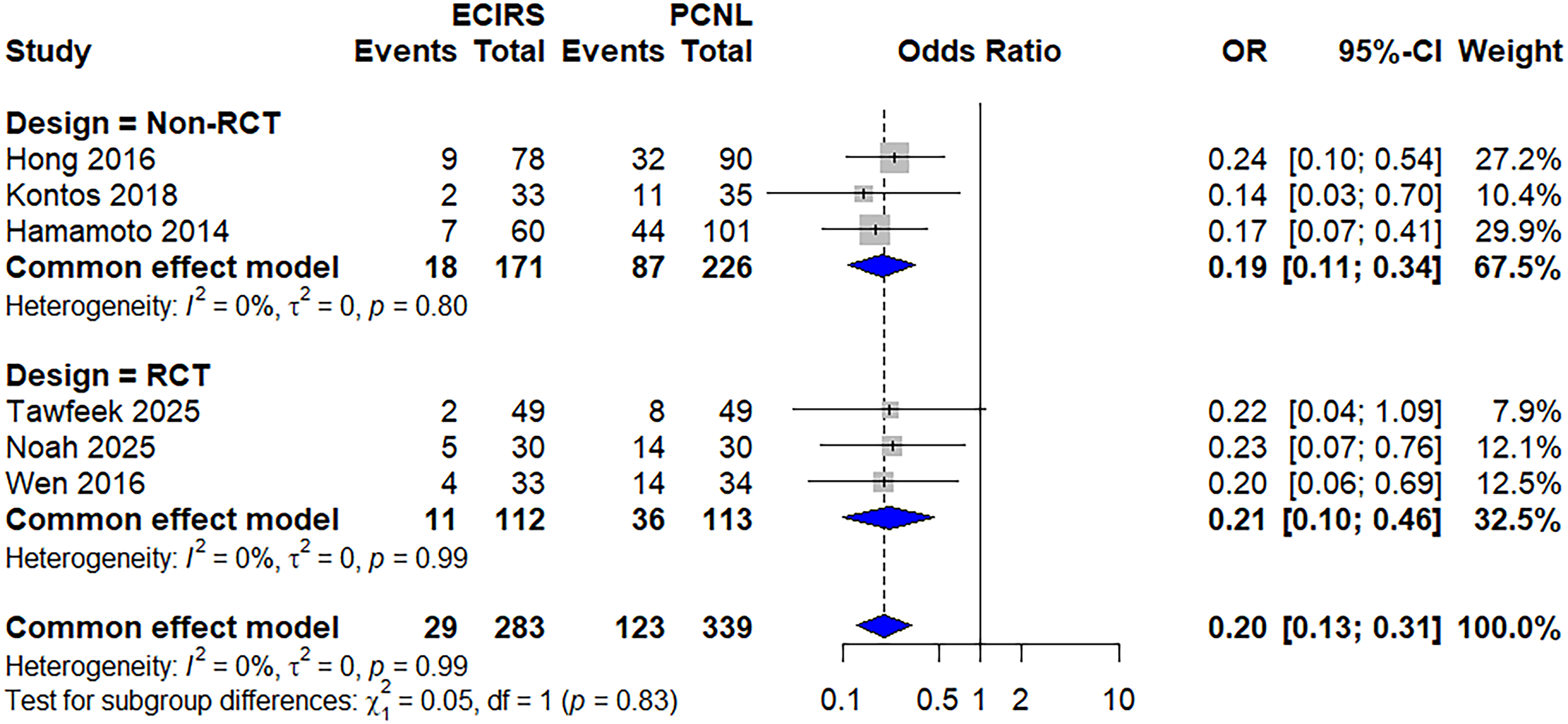
Ancillary treatment requirement in ECIRS and PCNL groups, stratified by study design. Randomized controlled trials (RCTs). ECIRS = endoscopic combined intrarenal surgery; PCNL = percutaneous nephrolithotomy.
Major complications
Data on major complications (CD ≥ 3) were reported in eight studies. Subgroup analyses by study design demonstrated a nonsignificant trend favoring ECIRS. After pooled analysis, a complication rate of 4.4% in the ECIRS group and 7.9% in the PCNL group was observed, with a statistically significant difference favoring ECIRS (OR 0.58 [95% CI 0.34–0.97]; p = 0.03) (Fig. 4).
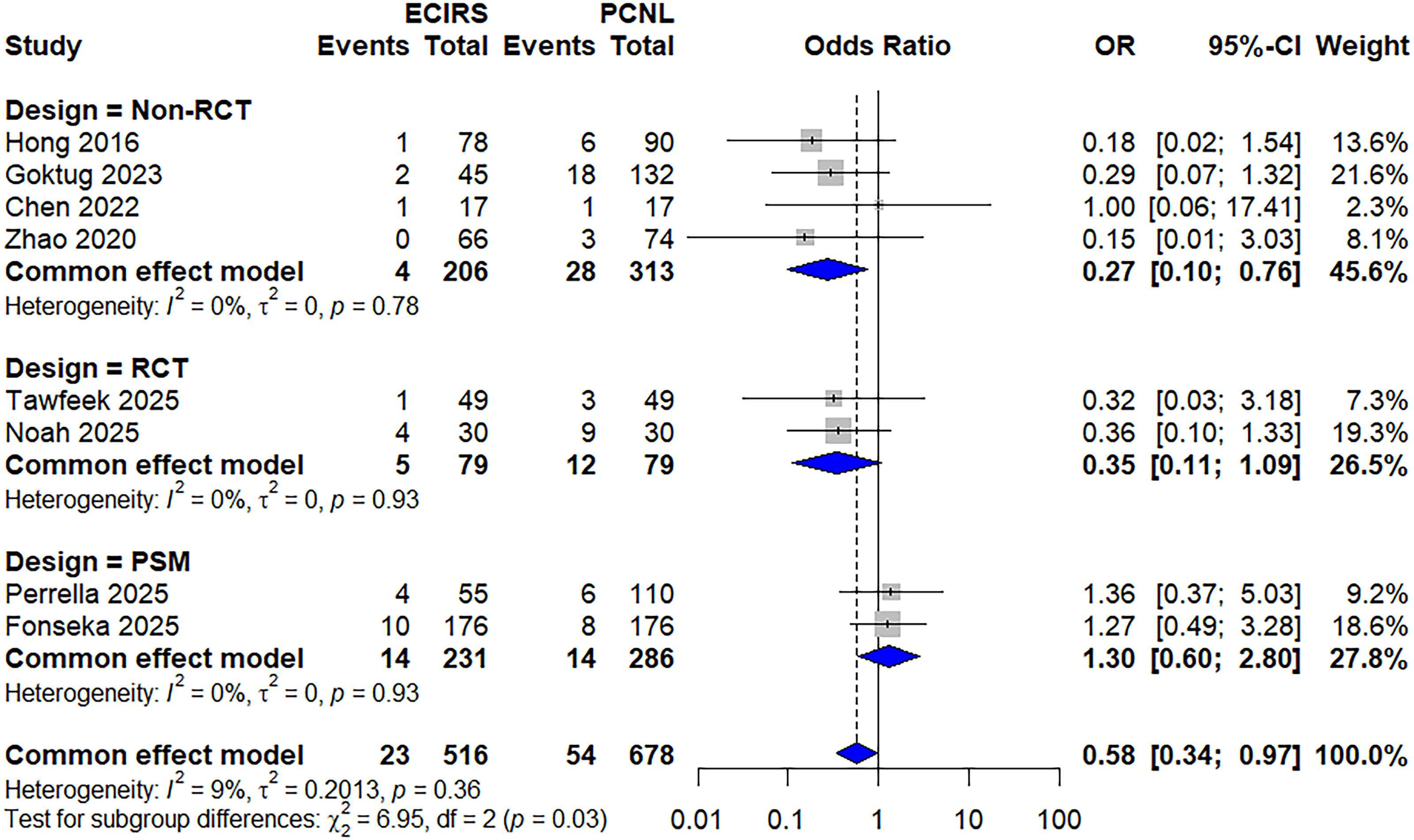
Major complication rates in ECIRS and PCNL groups, stratified by study design. Randomized controlled trials (RCTs), propensity score-matched (PSM). ECIRS = endoscopic combined intrarenal surgery; PCNL = percutaneous nephrolithotomy.
Secondary outcomes
Transfusion rates
Twelve studies reported transfusion rates for both procedures. Subgroup analyses by study design demonstrated a trend toward lower transfusion rates with ECIRS, although these differences were not statistically significant. However, the pooled analysis demonstrated significantly lower odds of transfusion in the ECIRS group (OR 0.49 [95% CI 0.28–0.88]; p = 0.01) (Supplementary Fig. S3).
Overall complications
Fourteen studies were analyzed for overall complications. The overall complication rate was 21.1% in the ECIRS group and 28.9% in the PCNL group. Meta-analysis of these data demonstrated a significant OR of 0.63 (95% CI 0.44–0.89; p = 0.001), suggesting lower rates of overall complications in the ECIRS group (Supplementary Fig. S4).
Operative time
Fourteen studies reported operative times. Overall, a statistically significant shorter operative time with a MD of −9.25 minutes (95% CI −16.82 to −1.67; p = 0.01) favored ECIRS over the PCNL group, although the magnitude of this difference was modest (Supplementary Fig. S5).
Length of stay
Fourteen studies described LOS. The pooled analysis demonstrated a statistically significant MD of −1.61 days (95% CI −2.54 to −0.69; p = 0.0006), indicating a shorter LOS in the ECIRS group over PCNL (Supplementary Fig. S6).
Risk of bias and publication bias
A low risk of bias was observed in all three RCTs. Among the nonrandomized studies, two exhibited a low risk, seven a moderate risk, and three a serious risk of bias (Supplementary Fig. S7).
We assessed publication bias through a funnel plot analysis of the primary outcome, which demonstrated visual asymmetry (Supplementary Fig. S8). However, a nonsignificant result on Egger’s regression test (p = 0.24) indicated the absence of publication bias.
Discussion
PCNL in patients with a high stone burden and complexity remains a challenging procedure. In these scenarios, lower SFR and higher postoperative complication rates have been reported. 30 The introduction of ECIRS has helped address these challenges through the adjunctive use of fURS, which mitigates limitations related to nephroscope rigidity and facilitates more complete stone clearance. 12 In the present study, we performed a comprehensive meta-analysis of perioperative outcomes comparing ECIRS and PCNL, encompassing 1988 patients across 15 studies. Our analysis favored ECIRS, revealing superiority in SFR—both after a single and a second procedure—along with lower rates of minor and major complications, reduced transfusions, smaller postoperative hemoglobin decreases, and a lower need for ancillary procedures. Conversely, PCNL demonstrated a longer operative time and LOS.
Achieving the highest SFR through the least invasive means and in a single session is a primary objective in urolithiasis procedures. Reported SFR for ECIRS across the literature ranges from 52% to 98%, with a mean exceeding 80%. 31 Our findings align with these data, as we observed an overall SFR of 83.7% for ECIRS after a single session. The evaluation of stone-free status in endourology research remains a topic of debate—primarily considering RF cutoffs and imaging modalities—as no standardized criterion exist. 32 The reported SFR for PCNL in complex stones also varies widely, complicating head-to-head comparisons and making it difficult to establish a clear superiority of ECIRS over PCNL. It is undeniable, however, that multiple comparative studies have consistently shown superior results for ECIRS despite the significant differences and variability when defining SFR.9,11,12 Moreover, evaluating SFR after a second procedure can substantially increase success rates. For instance, a recent multicenter study reported an SFR of 44.4% after the first PCNL, which increased to 82% after a secondary procedure. 33 In our current work, some studies differentiate initial and final SFR, and ECIRS maintained higher SFR after pooled analysis, even after a second procedure. Still, we believe that an SFR estimate after a single session—whenever feasible—would be less biased and offer a more accurate reflection of true procedural efficacy. That said, the need for ancillary procedures represents an outcome of utmost importance, as additional interventions can put a significant burden on patients and health care costs. 8 Our results demonstrated significantly lower odds of ancillary procedures among ECIRS patients. Although formal cost-effectiveness analyses remain underexplored, emerging evidence suggests that ECIRS may reduce costs related to secondary treatments. One randomized trial reported mean ancillary treatment costs of $100 USD for ECIRS vs $337 USD for PCNL. 12 Predictive models may further improve surgical planning and patient selection. Using a machine learning model, Ito and colleagues identified the number of involved calices (<4) as the strongest predictor of SFR, followed by stone burden, age, and number of stones. 34 Such approaches may refine the selection of patients most likely to benefit from ECIRS while optimizing outcomes and resource utilization.
Complication rates for both ECIRS and PCNL vary widely across studies, with major complications consistently representing the least frequent events. 31 Notably, multiple reports have demonstrated lower overall complication rates with ECIRS, partly attributed to its previously described advantages, including reduced need for multiple percutaneous tracts and the adjunctive use of fURS. 8 Our findings reinforce these observations, showing significantly reduced odds of both minor and major complications among ECIRS patients. In addition, transfusion rates were approximately 50% lower in the ECIRS group, and the postoperative hemoglobin drop also favored this technique.
Findings regarding operative time and hospital stay remain inconsistent across the published data comparing ECIRS and PCNL.7,27 In fact, previous meta-analyses have not demonstrated significant differences between the two procedures. In contrast, our results revealed longer operative times and hospital stay in the PCNL group. Nonetheless, the difference in operative time was relatively small and may have limited clinical impact. Furthermore, both outcomes are inherently heterogeneous and influenced by several confounders, such as variations in how operative time is measured and potential biases introduced by patient repositioning during operation. 31 Similarly, institutional and national practices regarding postoperative care can substantially affect reported hospital stays. 8 For instance, the feasibility of same-day discharge after PCNL—particularly when using miniaturized tracts—has been demonstrated in selected cases. 35 A shorter LOS may reduce overall costs and serve as a surrogate measure of cost-effectiveness; however, further cost comparison studies between ECIRS and PCNL are needed to clarify their economic impact and resource utilization. This is particularly relevant given that ECIRS often requires two experienced surgeons, which may represent a substantially greater resource allocation.
Several limitations to our study must be acknowledged. Despite recent efforts to generate randomized data, most available evidence comparing ECIRS and PCNL originates from retrospective studies—including the analyzed data in our meta-analysis, which inherently introduces potential selection bias and residual confounding. Multiple included studies were categorized as having a moderate (n = 7) to serious (n = 3) risk of bias, further constraining the reliability of conclusions. Differing definitions of stone-free status directly impact the validity and interpretation of pooled estimates, undoubtedly posing a significant limitation to this study. Outcome reporting for access modality (ultrasound vs. fluoroscopy) and patient positioning was insufficiently detailed to allow meaningful subgroup analyses, limiting our ability to explore potential effect modifiers of clinical relevance. Additional heterogeneity arises from variability in imaging modalities used for outcome assessment and inconsistent follow-up intervals—all of which further constrain the generalizability of our findings and limit the ability to definitively establish the superiority of one approach over the other. Moreover, as noted previously, ECIRS requires coordination between two experienced surgeons, which may limit its widespread adoption and represent a logistical disadvantage in certain clinical settings.
Conclusions
ECIRS represents a valuable approach for the management of large and complex stones. The procedure achieved high single-session SFR and reduced the need for ancillary procedures compared with PCNL. Nonetheless, because most available data are retrospective, further high-quality randomized trials—including cost-effectiveness analyses—are necessary to better define the role of ECIRS as a standard treatment option.
Authors’ Contributions
A.C.-R.: Conceptualization, data curation, formal analysis, methodology, writing—original draft, writing—review and editing, visualization, and supervision. F.P.: Conceptualization, methodology, writing—review and editing, supervision, and visualization. A.A.: Data curation, writing—original draft, and visualization. C.J.d.R.-M.: Data curation, visualization, and writing—review and editing. J.E.A.-R.: Data curation and writing—review and editing. J.S.C.: Data curation and writing—review and editing. D.E.H.-G.: Writing—review and editing and visualization. J.A.S.: Conceptualization, methodology, writing—review and editing, supervision, and visualization.
Footnotes
Author Disclosure Statement
The authors have no relevant financial or nonfinancial interests to disclose.
Funding Information
No funding was received to conduct this study.
Supplemental Material
Abbreviations
References
Supplementary Material
Please find the following supplemental material available below.
For Open Access articles published under a Creative Commons License, all supplemental material carries the same license as the article it is associated with.
For non-Open Access articles published, all supplemental material carries a non-exclusive license, and permission requests for re-use of supplemental material or any part of supplemental material shall be sent directly to the copyright owner as specified in the copyright notice associated with the article.
