



Abstract
Objectives:
The objective of this study is to characterize the impact of stone disease on sexual quality of life (QoL). As a secondary end point, we identified predictors of reduced sexual QoL to identify characteristics of stone patients who may benefit from sexual counseling.
Subjects/Patients and Methods:
A multicentric cross-sectional study in eight centers across North America was carried out from July 2022 to March 2024. Patients with a history of kidney stones were recruited. Patients taking medication affecting erectile or ejaculatory function were excluded. Participants filled out the Wisconsin Quality of Life questionnaire to assess stone disease burden. Indicators of sexual QoL included the Sexual Distress Scale, the Global Measure of Sexual Satisfaction, and either the Male Sexual Health Questionnaire or Sexual Function Questionnaire to evaluate sexual function in men and women, respectively. We examined the impact of kidney stone events on indicators of sexual QoL.
Results:
A total of 202 patients, including 70% (142/202) men and 30% (60/202) women, were recruited. The mean age was 53 (standard deviation [SD] 13) with men averaging 7 (SD 13) stone events and women 10 (SD 32). Men had good erectile (12/15) and ejaculatory (28/35) function. Women had low levels of sexual arousal (16/40), enjoyment (14/30), and orgasm (7/15). Men with worse erectile function demonstrated a significant association with increased frequency of kidney stone disease: 2–5 stone events (β = 2.95, CI [0.92–4.98], p = 0.005), 6–10 events (2.64 [0.64–5.22], p = 0.045), and more than 10 events (3.75 [0.80–6.70], p = 0.014). Both men (28/35) and women (25/35) had good sexual satisfaction and low sexual distress (5/20 and 6/20), respectively.
Conclusion:
This is the first study investigating sexual QoL among kidney stone formers. Both men and women had good satisfaction and low distress. Women had low sexual desire and arousal outcomes. Urologists may help in screening for these forms of dysfunction upon the diagnosis of kidney stones to better address their needs. Men reported worse erectile function with an increase in stone burden; however, this association may not be causal.
Introduction
Indicators of sexual quality of life (QoL) among stone formers are understudied. The impact of kidney stone disease on sexual intimacy was revealed through the development of the Wisconsin Quality of Life (WISQOL) questionnaire, a measure designed to assess QoL specifically in stone formers. During this questionnaire development, sexual intimacy was identified as a domain potentially affected by stone disease.
In a retrospective multicenter subanalysis of cross-sectional unpublished data from centers within the North American Stone Quality of Life Consortium, a sample of patients with a history of stone disease indicated that the maintenance and preservation of their sexual function and intimacy was a prevalent and important concern. 1 Most patients indicated that kidney stones led to a prevalent and important decrease in sexual function (56%) and sexual intimacy (67%). Overall, patients were less interested in sex/sexual contact than usual-following their kidney stones. However, it is noteworthy to mention that decreased sexual desire was not necessarily associated with reduced erectile function. Although these preliminary results are not fully comprehensive, they suggest that kidney stone patients’ sexual QoL merits further investigation. In addition, ensuring that stone patients’ sexual capacities are preserved may also have potential expulsive benefits for distal stones in men.2,3 Finally, our review of published evidence suggests that no comprehensive study has explored the impact of kidney stones on indicators of sexual QoL.
Therefore, we aimed to identify associations between patients with more frequent kidney stone episodes and sexual QoL indicators, including sexual function, sexual distress, and sexual satisfaction in comparison with those with less stone disease to inform future research on sexual QoL. These findings may also help identify characteristics of kidney stone patients that may benefit from sexual counseling as well as help improve our understanding of kidney stone-forming patients’ sexual concerns. As a secondary end point, we aimed to identify predictors of reduced sexual function, distress, and satisfaction.
Materials and Methods
Study design
Using sexual function, sexual distress, and sexual satisfaction questionnaires, a quantitative study evaluating the sexual QoL of kidney stone formers was designed.4–6 The protocol was developed with the help of a PhD sexual medicine researcher. A multicentric cross-sectional study from eight centers across North America was conducted. After obtaining the institutional review board approval at all sites, patients with a history of kidney stone disease and associated symptoms were recruited at urology stone clinic follow-up visits from July 2022 to March 2024. The main institution issuing review board approval was the research center at the University of Montreal Hospital Center. Informed consent was obtained from all participants before completing the survey. Consented patients were instructed to complete the survey at a single time point using an online platform (REDcap). Patients were sent a personal link to their email address to complete the survey.
Survey instruments
Male and female participants completed four questionnaires.
WISQOL is a 28-item questionnaire designed to measure the overall QoL of patients with different stone statuses and symptoms in which higher scores (max of 140) are indicative of a better QoL. This measure was used to characterize the sample, including assessing disease severity and burden.
The Male Sexual Health Questionnaire (MSHQ) and the Sexual Function Questionnaire (SFQ28) were used to evaluate sexual function in men and women, respectively. These are self-reported questionnaires that have been validated in various populations to measure sexual function.6,7 The MSHQ exclusively examines erectile and ejaculatory function and bother using four subscales each scored on a Likert scale: erection (range 0–15), erectile dysfunction bother (range 1–5), ejaculation (range 1–35), and ejaculation dysfunction bother (range 1–5). Higher scores indicate higher sexual functioning. The MSHQ also provides a subscale score for satisfaction (range 6–30) composed of six items in which higher scores indicate higher satisfaction levels. Currently, there are no cutoff scores reported for the MSHQ and its subscales.
The SFQ28 includes eight subscales measuring sexual desire (range 5–31), arousal-sensation (range 4–20), arousal-lubrication (range 2–10), arousal-cognitive (range 2–10), orgasm (range 1–15), pain (range 2–15), enjoyment (range 6–30), and partner (range 2–10) in which higher scores indicate better sexual function. Previous studies evaluating the SFQ28 have determined cutoff scores for each section indicative of poor sexual QoL.8,9 Suggested cutoff scores were as follows: desire (16/31), arousal-sensation (11/20), arousal-lubrication (6/10), arousal-cognitive (5/10), orgasm (6/15), and pain (10/15). SFQ cutoff scores were originally determined from clinical trials evaluating (1) the treatment of female sexual dysfunction with sildenafil citrate and (2) female sexual dysfunction among posthysterectomy or postmenopausal women.10–12 After comparing SFQ scores with age-matched women without female sexual dysfunction, 9 a logistic regression analysis was used to determine the score that corresponded with a probability of 0.5 of experiencing sexual dysfunction. These respective scores were then translated to cutoff scores for each respective subscale.8,9 Of note, there are no reported cutoff scores for the enjoyment and partner domains.
Additional variables of focus include sexual distress and sexual satisfaction. These were assessed using the short form of the Sexual Distress Scale (SDS-SF) and the Global Measure of Sexual Satisfaction (GMSEX) questionnaire, respectively.13–15 The SDS-SF and GMSEX have both been validated in healthy men and women. The SDS-SF is a five-item and five-point Likert scale questionnaire where higher scores indicate greater sexual distress. Preliminary cutoff scores for the SDS-SF are seven for women and eight for men. The GMSEX invites a response to five bipolar rating scales to the question prompt: “Overall, how would you describe your sexual relationship with your partner?” The seven-point scale (1 = low to 7 = high endorsement) is used to rate the following descriptions: good–bad, pleasant–unpleasant, positive–negative, satisfying–unsatisfying, and valuable–worthless. A total score is calculated (5–35), and higher scores are indicative of greater sexual satisfaction. There is no cutoff score available for the GMSEX.
The questionnaires used can be found in Supplementary Appendix SA1.
Recruitment and participant inclusion and exclusion criterion
All patients were recruited from eight participating sites from the North American Stone Quality of Life Consortium, a multicenter, longitudinal, prospective study of kidney stone patients’ QoL. Patients who are ≥18 years of age and have a history of kidney stones were recruited at their follow-up kidney stone clinic visits. Patients taking medication known to have a high risk of affecting erectile or ejaculatory function, sexual desire, or satisfaction were excluded. These included but were not limited to selective serotonin reuptake inhibitor, serotonin and norepinephrine reuptake inhibitors, prolactin-elevating antipsychotics, androgen-suppressing therapies, 5-alpha reductase inhibitors, and phosphodiesterase inhibitors. At their discretion, physicians excluded patients taking medications that might affect sexual QoL. Patients on alpha-blockers were included.
Data collection
The patients recruited were required to complete four validated quantitative questionnaires to assess patient sexual function, distress, and satisfaction. These surveys were completed using an online platform (REDcap).
Data analysis
Patients were split into those with mild and severe stone disease. Stone disease burden was categorized according to the WISQOL questionnaire: (1) single (1 stone event), (2) recurrent (2–5 events), (3) moderate recurrent (6–10 events), and (4) severe recurrent (more than 10 events).16,17 Total and subscale scores for sexuality related variables, including sexual function, distress, and satisfaction, were tallied, and means and standard deviations (SDs) are represented for each group.
Using univariable and multivariable logistic regression models, we examined the effect of increased frequency of kidney stone episodes on the odds of experiencing reduced sexual function, sexual satisfaction, and sexual distress among stone patients. To identify predictors of reduced sexual QoL, both univariate and multivariate logistic regression models were used to examine the effect of gender, age, and body mass index (BMI) on the odds of experiencing decreased sexual function, sexual distress, and sexual satisfaction among stone patients. To account for multiple testing, all p-values were Bonferroni adjusted. All analyses were performed in Stata MP14 (StataCorp, College Station, TX, United States).
Results
Participants
A total of 202 kidney stone formers were enrolled from eight different North American centers. Among these participants, 70% (142/202) were men and 30% (60/202) were women. The average age was 54 (SD 13) for men and 51 for women (SD 14). The mean number of stone events among men and women enrolled was seven (SD 13) and 10 (32), respectively. Among the patients recruited, 18% (36/202) had a single stone event, 53% (107/202) had 2–5 stone events, 14% (28/202) had 6–10 events, and 15% (31/202) had more than 10 stone events. Participant baseline characteristics are highlighted in Table 1.
Baseline Demographics
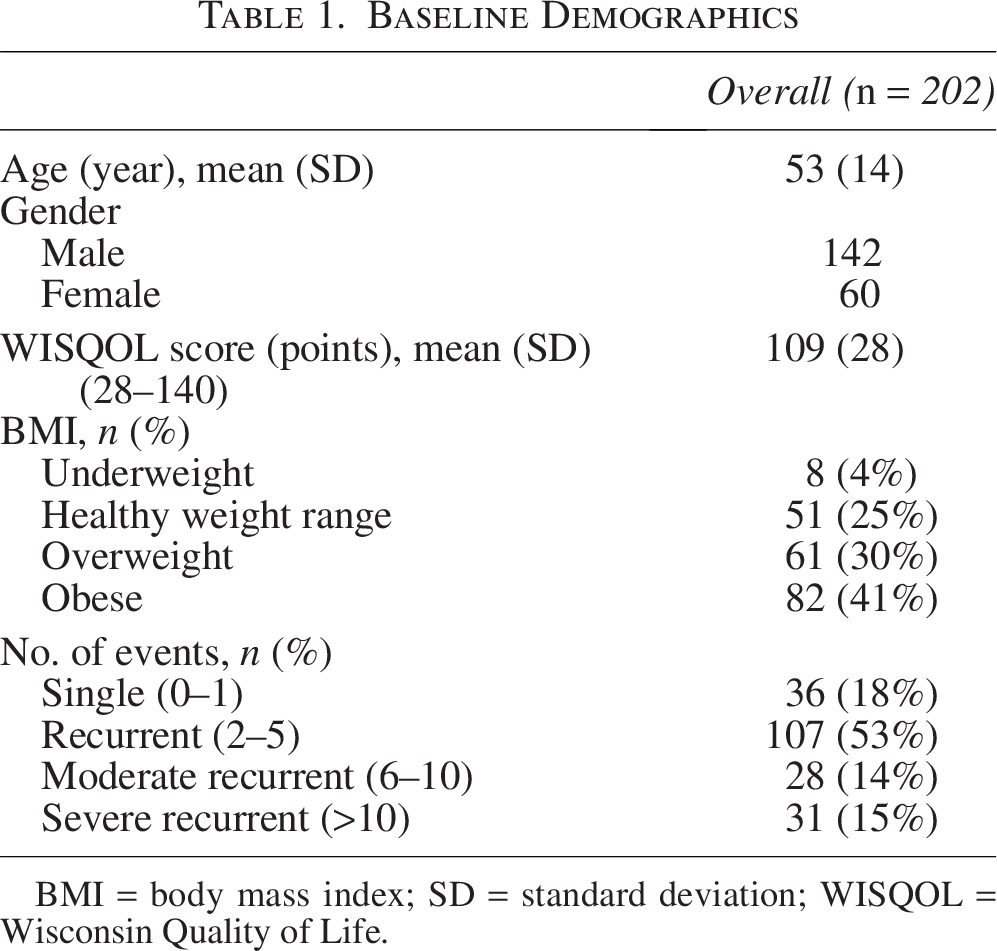
BMI = body mass index; SD = standard deviation; WISQOL = Wisconsin Quality of Life.
Sexual QoL
Overall, men had good erectile and ejaculatory function. Women had low levels of sexual arousal, enjoyment, and orgasm. Both men and women had good sexual satisfaction and low sexual distress.
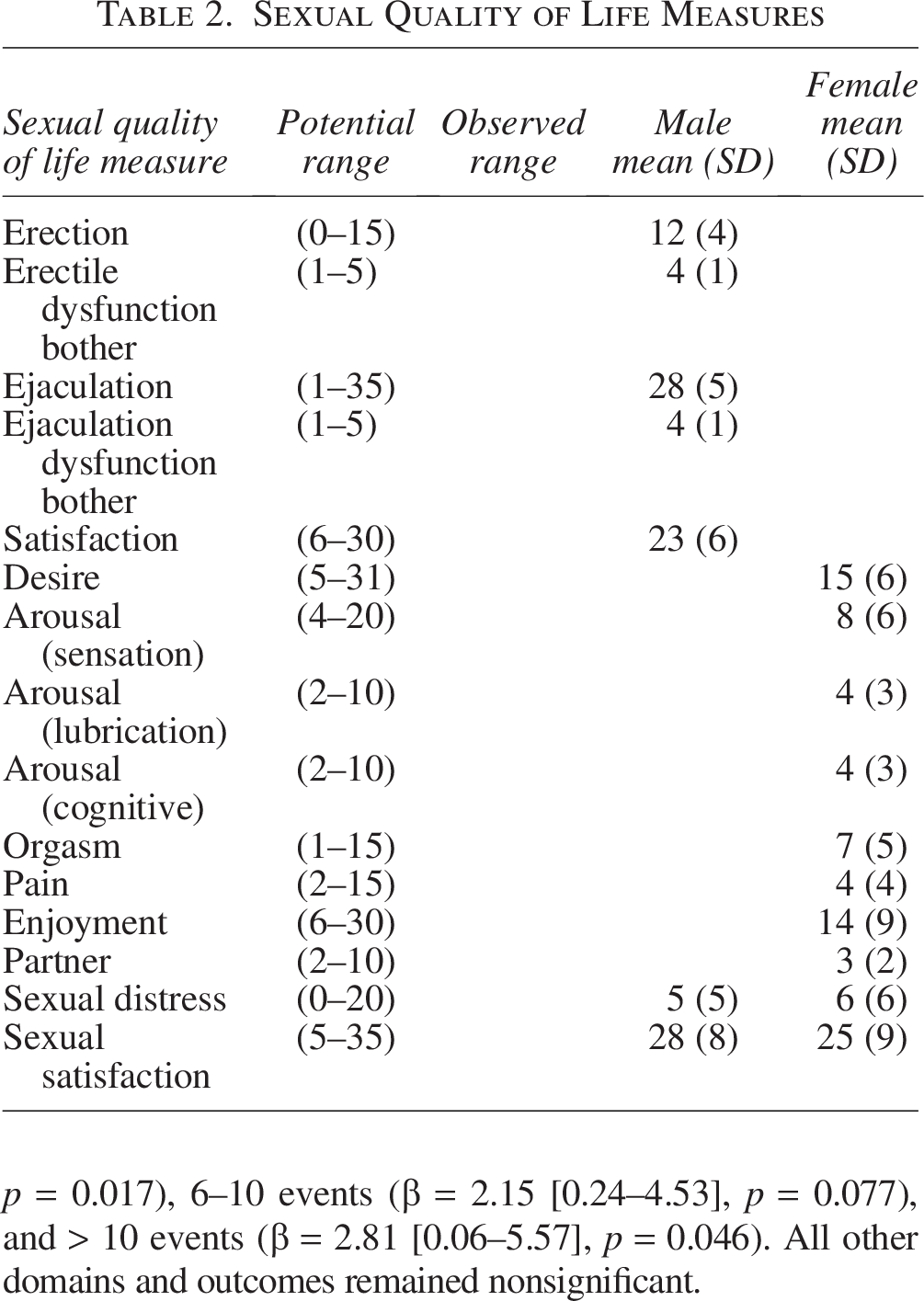
For male participants, mean (SD) MSHQ subscale scores were as follows: erection, 12/15 (4); erectile dysfunction bother, 4/5 (1); ejaculation, 28/35 (5); ejaculation dysfunction bother, 4/5 (1); and satisfaction 23/30 (6). Among women, mean (SD) SFQ28 domain scores were as follows: desire, 15/31 (6); arousal (sensation), 8/20 (6); arousal (lubrication), 4/10 (3); arousal (cognitive), 4/10 (3); orgasm, 7/15 (5); pain, 4/15 (4); enjoyment, 14/30 (9); and partner, 3/10 (2). The average SDS-SF score among male and female patients was 5/20 (SD 5) and 6/20 (SD 6), respectively. Finally, on average, men and women scored 28 (SD 8) and 25 (SD 9) on the GMSEX questionnaire, respectively. These findings and the individual score ranges are summarized in Table 2.
Sexual Quality of Life Measures
Univariable and multivariate analysis of sexual QoL
On univariate analysis, men with worse erectile function on the MSHQ (captured using the erection scale) demonstrated a significant association with increased frequency of kidney stone disease. There was a significant association for men with 2–5 stone events (β = 2.95, 95% CI [0.92–4.98], p = 0.005), 6–10 events (2.64 [0.64–5.22], p = 0.045), and more than 10 events (3.75 [0.80–6.70], p = 0.014). Otherwise, there was no significant association between recurrent stone disease and the different indicators of sexual QoL for both men and women. After adjustment for age and BMI, the pattern persisted but attenuated: 2–5 events (β = 2.32 [0.42–4.21], p = 0.017), 6–10 events (β = 2.15 [0.24–4.53], p = 0.077), and > 10 events (β = 2.81 [0.06–5.57], p = 0.046). All other domains and outcomes remained nonsignificant.
Discussion
The relationship between poor sexual QoL and kidney stones was first indicated during the development of the WISQOL questionnaire. 1 However, these preliminary results are not fully comprehensive and suggest that kidney stone patients’ sexual QoL merits further investigation. To the best of our knowledge, this is the first study to comprehensively examine the relationship between the number of kidney stone episodes with sexual function, sexual satisfaction, and sexual distress. Our findings suggest that although not necessarily directly related to the number of kidney stone events they may experience, female patients with kidney stones may be at risk of experiencing sexual dysfunction.
Kidney stones often recur at a rate of 50% within 5 years. 18 A subanalysis of the North American Stone Quality of Life WISQOL Consortium demonstrated that an increased frequency of stone events led to worsened overall QoL. 16 More specifically, the number of lifetime stone events was a significant independent predictor of lower QoL for patients with more than five stone events. WISQOL scores decreased by 0.4, 2.5, and 6.9 points with 2–5, 6–10, and > 10 events, respectively. 16 In our study, this pattern did not extend to sexual QoL indicators, with the exception of the erection-function domain. After accounting for age and BMI, stone-event burden was not associated with sexual QoL apart from the erection-function domain.
Our findings demonstrate that women with stone disease experience significant sexual dysfunction. On average, women scored below the cutoff scores for four of the SFQ28 domains, including the desire (<16/31), arousal-sensation (<11/20), arousal-lubrication (<6/10), and arousal-cognitive (<5/10) outcomes. In the general population, women scored below these cutoff scores on the desire section, arousal-sensation, arousal-lubrication, and arousal-cognitive domains.8,9 Studies report that 41% to 47% of women in the United States meet criterion for female sexual dysfunction.19,20 Our findings suggest that although not necessarily directly related to the number of kidney stone events they may experience, female patients with kidney stones may be at risk of experiencing sexual dysfunction. Because of the cross-sectional design, causality cannot be inferred, but it may be that low sexual function and the presence of kidney stones are comorbid conditions. These conditions could influence each other or could be related to other factors which predispose women to one or both conditions. These findings suggest that urologists can play a practical role in screening for sexual dysfunction among patients with recurrent kidney stones—particularly women, who may benefit from referral to sexual-health counseling at the time of diagnosis.
There was a significant association between worse erectile function and those with an increased frequency of kidney stone disease. It is difficult to interpret these findings, as there is no clear dose–response relationship. Other studies have similarly found an association between erectile dysfunction and kidney stones. 21 In a case–control study using a nationwide population‐based dataset, including 5620 patients with erectile dysfunction and 16,860 controls, erectile dysfunction was associated with patients having a prior diagnosis of kidney stones, especially in younger patients aged 40–49 years. 21 Although it is true that metabolic syndrome and erectile dysfunction share common risk factors, it was noted that erectile dysfunction was an independent risk factor for the development of kidney stones while adjusting for all medical comorbidities. In addition, another study also documented a correlation between sexual dysfunction and urinary stones. 22 However, this study was focused on bladder stones rather than kidney stones and did not make the distinction between the different domains of sexual function. 22 Although the authors do not provide a clear explanation for these findings, the authors report significantly improved sexual function after bladder stone removal.
There was no association drawn between the number of stone events and sexual distress or sexual satisfaction. Sexual distress is an important component of sexual dysfunction. 23 Preliminary cutoff scores indicate that patients in our study did not meet the threshold for clinically significant distress. 13 Cutoff scores for the sexual satisfaction scale are not available. Sexual distress and sexual satisfaction are important indicators of sexual well-being and are independent of sexual function. Patients with urological disease may report reduced sexual function, but may not necessarily be distressed by their function and may still report good sexual satisfaction. 24 Although the results of this study are somewhat exploratory and need to be replicated, this study suggests that even if sexual function is negatively associated with experiences of kidney stones, patients may still experience sexual satisfaction and may not be particularly burdened by sexual distress.
Taken together, our findings support a brief and structured sexual QoL screen for patients with kidney stones. For women, urologists can administer the SFQ-28 at the visit and focus on the desire and arousal domains (sensation, lubrication, cognitive). Low scores should prompt a brief, empathetic discussion, documentation of contributory factors (i.e., pain, mood, medications), and referral to sexual-health counseling when indicated. For men, targeted questions on erection and ejaculation function (using the MSHQ) can serve as a parallel screen. This workflow encourages the use of validated instruments and clear referral pathways for sexual dysfunction when encountered.
Our study is not without limitations. For one, the cross-sectional design of the study does not allow us to measure the variation of a patient’s sexual QoL throughout their recurrent kidney stone episodes or to control for any preexisting sexual concerns. Second, there is an element of selection bias present, as we did not keep track of patients who declined to participate in the study. In addition, patients completed a self-administered survey, which was not necessarily filled during an active kidney stone episode and, therefore, may be subject to recall bias. There is also an element of bias as we did not obtain information regarding the type of kidney stones, prior interventions, and timing of these interventions relative to the sexual QoL assessment, which may affect the reported sexual QoL at the time of completing the questionnaire. However, the surveys used measure domains of sexual QoL at varying time points, which can help reduce the impact of this bias. We also acknowledge that BMI may not capture all aspects of metabolic health. However, BMI is a reliable and widely used indicator of metabolic syndrome, as it correlates strongly with obesity and insulin resistance.25,26 Other comorbidities (i.e., diabetes, depression, and smoking) and markers such as waist circumference or direct measures of metabolic health could provide additional insights; however, we did not collect this information, but this could be further explored in future studies.
Of note, we included patients taking alpha-blockers, which may lead to abnormal ejaculation. We also compared our findings to reported clinical cutoff scores that are not specifically validated for use in kidney stone populations, as there are no validated cutoff scores for this specific population. Therefore, it is important to acknowledge that these may not be accurate in our studied population. Finally, separate measures were used to assess sexual function for male and female participants, which reduced opportunities for meaningful comparisons across sex.
Strengths of this study include the broadened focus on sexual QoL, including other important indicators of sexual well-being such as sexual distress and sexual satisfaction, rather than focusing only on sexual function. In addition, given that the participants were recruited from multiple centers allows for a more diverse population which can improve the generalizability of our findings and minimize site-specific biases. Finally, although this study includes a minority (30%) of women and may be underpowered given the sample size, studies on sexual outcomes in urological samples often focus more on men’s experiences; therefore, despite its smaller sample size, this study broadens the understanding of sexual QoL in women with urological disorders, which is often underreported.
Conclusion
This is the first study comprehensively investigating sexual outcomes among kidney stone formers. Overall, both men and women were found to have good sexual satisfaction and low levels of sexual distress. Regarding sexual function, women with kidney stones had low levels of sexual function in the desire and arousal (sensation, lubrication, and cognitive) domains. The number of stone events was also predictive of worsened erectile function in men. Given that there was no clear dose–response relationship, it is difficult to interpret the nature of these findings specific to erectile function. Urologists may play a role in screening for sexual difficulties, upon the diagnosis of kidney stones to better address their needs. Risk factors for kidney stones may include those similar to sexual dysfunction such as metabolic syndrome. Recognition and treatment of these states may help the patient’s overall health with regard to both sexual function and kidney stones.
Authors’ Contributions
Study concept and design: D.B., D.-D.N., L.M., L.W., R.S., S.A., S.K.B., and N.B. Acquisition of data: D.B., L.M., R.S., S.A., S.K.B., V.G.B., K.C., B.H.C., J.D.H., K.P., R.L.S., N.M.S., and N.B. Analysis and interpretation of data: D.B., D.-D.N., L.W., and N.B. Drafting of the article: D.B., D.-D.N., L.M., L.W., R.S., and N.B. Critical revision of the article for important intellectual content: D.B., L.W., S.A., S.K.B., V.G.B., K.C., B.H.C., J.D.H., K.P., R.L.S., N.M.S., K.B., and N.B. Supervision: S.A., S.K.B., V.G.B., K.C., B.H.C., J.D.H., K.P., R.L.S., N.M.S., K.B., and N.B. Project administration: D.B. and K.B. Funding acquisition: D.B., L.W., S.A., and N.B.
Footnotes
Author Disclosure Statement
N.B. is a consultant and investigator for Boston Scientific and Olympus. No other authors have any relevant disclosures to report.
Funding Information
This study was supported by the SMSNA Scholars in Sexuality Research Grants Program (Grant #3144).
Supplemental Material
Abbreviations
References
Supplementary Material
Please find the following supplemental material available below.
For Open Access articles published under a Creative Commons License, all supplemental material carries the same license as the article it is associated with.
For non-Open Access articles published, all supplemental material carries a non-exclusive license, and permission requests for re-use of supplemental material or any part of supplemental material shall be sent directly to the copyright owner as specified in the copyright notice associated with the article.
