




Abstract
People are increasingly using their mobile devices to multitask and carry on multiple conversations in organizations. This study contributes to the growing work in multicommunication—communication practices involving technology where people conduct multiple, nearly simultaneous conversations. Through quantification of the communicative behaviors involved in the practice of multicommunicating, this study helps to operationalize this construct and, by refining measurement, contributes directly to theory development. The resulting model suggests that multicommunication in meetings consists of five major factors. While the factors of Informing, Influencing, and Supporting Others might be the most obvious functions of multicommunicating, the other two factors, Participating In Parallel Meetings and Being Available, provide additional insight into the influential role that others have in the practice of multicommunicating. Future directions and implications for using this scale are also discussed.
Keywords
As he sits in a conference room meeting, he hides his BlackBerry® under the table; his thumbs are flying as he feigns full attention to the meeting leader. In her home office, the leader begins her web meeting, where she presents her monthly report to faceless participants on a conference call. She tries to ignore the faint sound of typing coming from another participant, and she secretly wonders if anyone is actually listening to her.
Fifteen years ago, only the very wealthy or technologically savvy had mobile information and communication technologies (ICTs); today more than 74% of Americans have cell phones (Horrigan, 2008), and laptop computers are abundant. These mobile devices have infiltrated our work and home lives in myriad ways. In organizational meetings, people have always been able to lean over to the person next to them and whisper a question, even when they are physically located in a room where others are presenting material. Now, people can engage in that behavior, electronically reach many people, and be virtually invisible. The impact of mobile ICTs has received increasing attention from organizational and communication scholars (Chudoba, Watson-Manheim, Lee, & Crowston, 2005; Katz, 2007; Kim, Kim, Park, & Rice, 2007; Mahatanankoon & O’Sullivan, 2008; Mazmanian, Orlikowski, & Yates, 2005; Reinsch, Turner, & Tinsley, 2008; Rennecker, Dennis, & Hansen, 2010; Stephens & Davis, 2009), including a special issue in Communication Monographs (e.g., Katz, 2007; Sawhney, 2007). Recognizing the proliferation of ICTs at work, several scholars have issued calls for organizational studies carefully to consider including technology in our research agenda (Fulk & Gould, 2009). Yet there are few, if any, measurement scales available to help advance our research and quantify and specify types of communication behavior performed by ICT users.
As a step toward addressing that need, this research develops a scale to quantify how people multicommunicate in meetings. Multicommunication (Reinsch et al., 2008) is defined as using technology to participate in more than one conversation simultaneously. Multicommunicating, an emerging communication practice within a technology-enabled workplace, has recently garnered increased attention (Belanger & Watson-Manheim, 2006; Cameron & Webster, 2010; Reinsch et al., 2008; Rennecker et al., 2010; Stephens, Cho, & Ballard, 2012; Stephens & Davis, 2009; Turner & Reinsch, 2007, 2010; Wasson, 2004; Watson-Manheim & Belanger, 2007) that highlights its importance in organizational contexts and specifically in meetings. Multicommunicating, like multitasking, can be a productive process and desirable for efficiency (Dennis, Rennecker, & Hansen, 2010), but it is demanding and has the added consideration that distinct and compartmentalized audiences, often with very different needs and expectations, are addressed in each of the conversations (Reinsch et al., 2008). This complexity in the technology-enabled communication environment adds relational considerations—for example, perceptions of incivility (Cameron & Webster, 2010)—in addition to the mounting evidence that decision-making quality and practices might change (Rennecker et al., 2010).
Whereas previous research on multicommunicating has attempted to identify and describe this practice of attending to multiple conversations simultaneously, the current research delves into the micro-level behaviors that help refine this construct and allow measurement of these behaviors. In emerging communication practices, it is important to develop standardized measures that specify and define a construct (Miller et al., 2011). Measures help operationalize constructs and directly contribute to theory development (Kelly & Keaten, 2007). One of the biggest values in creating this type of measurement scale is to advance prescience theory development, defined by Corley and Gioia (2011) as “discerning or anticipating what we need to know, and equally important, of influencing the intellectual framing and dialogue about what we need to know” (p. 13).
This scale development process begins with the creation of measurement items that are derived from prior qualitative research that articulated how people invisibly “whisper” when using instant messaging (Rennecker et al., 2010). The method consists of a pilot and a larger scale development study. After providing initial reliability and validity data on this scale, theoretical implications, directions for future research, and suggestions for how this scale can help organizational scholars who study the communicative aspects of practice and meetings are advanced.
Review of Literature
Multicommunicating Practices in Meetings
In contemporary organizational meetings, participants frequently communicate via instant messaging and e-mail with organizational members both inside and outside meetings (Mazmanian, et al., 2005; Turner & Reinsch, 2007). The prolific use of ICTs has greatly enabled these types of multitasking behaviors (Turner & Reinsch, 2007)—termed multicommunicating (Reinsch et al., 2008)—during organizational meetings. Theoretical work on multicommunicating has relied heavily on a structurational perspective (Giddens, 1984) because structures, such as technology, both shape and in turn are shaped by multicommunication. Although the theoretical work on multicommunicating defines this term as a “behavior” and differentiates it from a preference or attitude (Reinsch et al., 2008), it also describes this behavior as a practice. Viewing multicommunicating as a practice is especially helpful when these behaviors occur on a larger scale where other people are viewing the behaviors. To measure multicommunicating, an understanding of practice is informative.
Two different theoretical perspectives on practice influence how this study conceptualizes multicommunication behaviors: a practice lens perspective in general (Orlikowski, 2000) and a strategy-as-practice perspective in particular (Golsorkhi, Rouleau, Seidl, & Vaara, 2010; Whittington, 1996). Both of these approaches, much like structuration theory (Giddens, 1984), seek to link agency, structure, individual action, and institutions and apply them to (a) organizational technology use (Orlikowski, 2000) and (b) strategic organizational situations (Golsorkhi et al., 2010). Orlikowski’s (2000) conceptualization of a practice lens is highly relevant in a meeting context because technology is an integral part of meeting practices today. A practice lens can be considered a focus on technology structures that emerge in practice as opposed to focused on more fixed technology structures (Orlikowski, 2000). Multicommunicating behaviors embody a practice perspective because they emerge during meetings and are influenced by many different types of structures and agents, and these behaviors in turn influence organizational meetings.
As meetings are often strategic events that occur regularly in organizations (Jarzabkowski & Seidl, 2008; Tracy & Dimock, 2004), a strategy-as-practice perspective (Golsorkhi et al., 2010; Whittington, 1996) is relevant to multicommunicating practices. This perspective justifies a focus on the more micro-level communication behaviors that constitute a practice of multicommunication. Furthermore, this approach focuses on the production of strategy as a communicative process (Spee & Jarzabkowski, 2011). Strategy is conceptualized as “something people do rather than something firms-in-their-market have” (Jarzabkowski & Seidl, 2008, p. 1391). Although much of the strategy-as-practice research has focused on theoretical concepts, it is important for empirical studies to examine the tools and technologies that constitute strategizing activities (Spee & Jarzabkowski, 2011). The practice of multicommunicating in modern organizations is important for the production and shaping of strategy.
In their work on meetings, Jarzabkowski and Seidl (2008) position meetings as “focal points for the strategic activities of organizational members” (p. 1393), and they identify the structuring characteristics of meetings that either stabilize or destabilize strategic orientations. Several key considerations in their stability findings focus specifically on “discussion” and how practices either restrict or support discussion. The technology tools used to multicommunicate—for example, smartphones, and instant messaging—can be considered strategy tools (Spee & Jarzabkowski, 2009) that allow meeting participants to span intra- and interorganizational boundaries through discussion. No longer are meeting attendees limited to communicating only within the formal meeting boundaries, but they can also engage, either on task or not, with resources outside the formal meeting. These tools are embedded in the meeting, which is a sociopolitical situation. The meeting can shape how the technology tools are used and those tools can shape strategizing practices (Spee & Jarzabkowski, 2009).
Multitasking, Decisions, and the Link to Meeting Multicommunicating
Previous research on multitasking can inform the developing practice of multicommunication because ICTs, such as instant messaging and smartphones, allow users to multitask communicatively. Multitasking is typically considered performing two or more tasks at the same time, but recent research has indicated that there are at least two types of multitasking (Stephens et al., 2012). These types include the conventional perspective on simultaneous task completion but also consider that people can still multitask when they rapidly sequence their tasks (Stephens et al., 2012). Turner and Reinsch (2007) have found that “multitasking has become synonymous with the communication technology-infused workplace of today” (p. 36). Considerable literature in the field of psychology links cognitive multitasking to a decrease in performance (e.g., Rogers & Monsell, 1995; Stroop, 1935). Stroop (1935) initially documented that tasks can interfere with one another and the brain cannot completely process these multiple tasks. Current experimental psychology research also tends to agree that while people can become more practiced at multiple tasks, there are performance costs to pay when people switch between tasks (e.g., Ophir, Nass, & Wagner, 2009; Rogers & Monsell, 1995).
In a meeting, some typical tasks involve conversing with other meeting attendees or with people not involved in the meeting. Research suggests that the quality of individuals’ multicommunicating skills varies, and this quality can affect organizational and relational outcomes (Cameron & Webster, 2010; Wasson, 2004). In her ethnographic analysis of an organization that relied heavily on virtual meetings, Wasson (2004) found five factors that influenced the quantity of multitasking used by the meeting attendees. These included (a) interactional barriers like the level of visual and auditory access between participants, (b) individual skill with multitasking, (c) meeting activity and the attention required of the participant, (d) topic relevance to the meeting participant, and (e) competing claims, defined as other things going on that demanded more immediate attention. She also found that different types of meetings require more or less attention, which in turn affects the degree of multitasking that people employ. In her study multitasking was productive for some of the employees and the organization, but the practice also created problems that affected decision making. Some people were simply not good at the practice because they did not recognize cues for when they needed to provide their full attention on the focal meeting.
Multicommunicating is a fairly young practice, and Cameron and Webster (2010) warn that when a practice is so new that organizational and group norms have not developed around it, understanding how others will view this emerging practice is difficult. Already the research suggests that if people are inattentive or make errors during a meeting, others judge their multicommunicating harshly (Cameron & Webster, 2010; Turner & Reinsch, 2010; Wasson, 2004). These relationship findings are elaborated in Cameron and Webster’s (2010) work on incivility perceptions of multicommunicating. They studied multicommunicating as an independent variable and incivility as a dependent. They found that an individual’s own perceptions of multicommunicating acceptability and others’ abilities to juggle multiple conversations affected the individual’s perceptions of the practice and that, in turn, affected the trust the individual had in the person multitasking. They also found several other factors that influenced individuals’ perceptions of multicommunication acceptability including who initiated the juggled conversation, if the conversation juggling was related to the main topic, and if the person juggling the conversations made errors because of the practice. Dennis and colleagues (2010) found that multicommunicating can be used to support others, but it is also used to gossip and criticize.
Organizational differences
Organizations differ concerning the acceptability of this practice. Rennecker et al. (2010) found that opinions about the practice of engaging in multiple simultaneous conversations through instant messaging are related to organizational norms. In one organization they studied, instant messaging was an institutionalized practice, whereas in another organization, it was viewed with suspicion. They noted a variety of individual differences in both the acceptance of this behavior, as well as preferences to engage in it. Some individuals found these practices distracting, whereas others felt it contributed to productivity and enhanced their satisfaction. Furthermore, recent research has found that people are socially influenced by observing others multicommunicating and multitasking, which in turn influences their intention to multicommunicate (Stephens & Davis, 2009).
Benefits of muliticommunicating
Although multitasking and multicommunicating can be interpreted differently, in their study of instant messaging, Dennis et al. (2010) found that a key benefit of multicommunicating practices was increased efficiency in collaborative decision making. Their study participants reported needing fewer follow-up meetings because they combined their backchannel communication with their current meeting. This practice allowed them to exchange information in real time, gather information from outside sources, and make faster decisions. Multicommunicating allowed the “participants to condense multiple, serial decision-making steps into parallel performances” (p. 867). Although their study participants generally reported an increase in decision-making effectiveness, Dennis et al. (2010) raise some important issues that could point to poorer quality decisions. These issues include a rush to closure, position anchoring, and excessive cognitive load.
Multicommunicating and Multiple ICT Use
Research in this area has also uncovered that many common forms of multicommunicating involve using multiple ICTs (Turner & Reinsch, 2010). In their work on persuasive communication and multiple ICTs, Stephens & Rains (2011) found that combining oral and written channels (instead of using the same channel repetitively) is a more persuasive communication strategy and can lead to reducing perceptions of communication overload. Multicommunicating (Reinsch et al., 2008) and ICT succession theory (Stephens, 2007) both suggest that channel combining either in simultaneous or sequential conversations offers promising avenues for future research. These findings have potential applications for meeting multicommunicating, because people are likely mixing their ICTs in this context as well. This current scale development effort provides one tool to help multicommunication research quantify different behaviors involved in these communication practices. Research can explore the ICT combinations involved in different meeting activities and better understand how these practices affect issues of decision making, multicommunicating skill, and evaluation of multicommunicating practices.
Identifying Behaviors Involved in Multicommunicating
Multicommunicating and the associated practices continue to advance conceptually and theoretically as evidenced by the research reviewed. An essential part of growth in a burgeoning field is “continual construct specification, testing, and refinement” (Miller et al., 2011). One advantage that this growing field of multicommunicating has is that empirical research conducted thus far has embraced multiple-methods (e.g., Cameron & Webster, 2010, survey design; Rennecker et al., 2010, qualitative interviews; Turner & Reinsch, 2010, qualitative critical incident technique; Turner & Reinsch, 2007, experimental design). This breadth is advantageous for construct refinement.
One qualitative study closely examined how people conduct multiple near-simultaneous conversations and identified six dimensions of behavior (Rennecker et al., 2010). Rennecker and her colleagues described how people use instant messaging to communicate privately with some people while publicly interacting with others. Whereas some of the findings from their study reflected actual information-exchange behaviors, other findings reflected the social nature of these conversations and the increasing reality that organizational members are rarely isolated in meetings now that technology has enabled meeting boundary crossing.
The six behavioral dimensions they identified were derived from interview data with 23 managers and workers across two different organizations and include seeking clarification, providing focal task support, providing social support, directing the meeting, participating in parallel meetings, and managing extra-meeting activities. Seeking clarification refers to participants’ attempts to check or improve their understanding of meeting content. Providing focal task support involves providing information to others to further the meeting’s agenda. Providing social support focuses on how meeting attendees address the affective dimension of meeting participation, including encouraging others to speak up. Directing the meeting involves attempts to influence the content and direction of the meeting. Participating in parallel meetings includes the background conversations that can be distracting to a meeting’s core purpose. Finally, managing extra-meeting activities includes all the nonmeeting related multitasking, such as working on to-do lists and being available to others even during meetings.
Research Question for Scale Development
Identifying these six dimensions of behavior is helpful for understanding activities like meeting multicommunicating, but Rennecker et al.’s (2010) study focused only on a specific type of technology, instant messaging. The behaviors they identified and termed “invisible whispering” not only occur when the communicators are remotely carrying on simultaneous conversations, they also happen in a face-to-face context (Turner & Reinsch, 2010). In a face-to-face situation where people can see and hear each other, these whispering behaviors are not fully invisible. For example, if an individual is in a meeting and sends a text message to someone, others in the meeting can see that individual typing on her phone. They may not know what she is typing or to whom she is typing it, but they see the interaction happening. These behaviors are a type of whispering, but they are often observable and are likely influenced by other people due to the social nature of communication. Furthermore, they occur through many ICTs, such as smartphones and laptops, in addition to instant messaging.
Rennecker et al.’s (2010) study provides the foundation for this scale development effort. The fact that prior empirical research has identified these key dimensions provides a considerable advantage when trying to quantify these behaviors. Instead of starting completely from scratch to determine scale items, in this study the qualitative findings provide the initial scale items. Based on this prior research and the increasing need to further operationalize constructs related to multicommunicating behaviors, the following research question guides this research:
Research Question 1: To what extent can the dimensions qualitatively uncovered by Rennecker et al. (2010) be validated in a quantitative design?
Method
This study was conducted in two parts, a pilot study that used an organizational sample and a larger sample of college students involved in student organizations.
Pilot Study Method
The main goal of this pilot study was to assess the viability of developing a scale containing multicommunicating behaviors by relying on the qualitative dimensions developed by Rennecker et al. (2010). In addition, the principal investigator on this project also relied on previously collected interview data from organizational members that included individuals’ perceptions of meeting multicommunicating. It was important to ground the item-pool-creation process in actual organizational experiences.
Pilot Study Participants and Procedure
This study used a criterion sampling approach and began the process by personally contacting individuals in approximately 20 organizations. An email message was constructed to reach an audience that (a) had access to multiple workplace technologies and (b) likely engaged or saw others engage in using these technologies during organizational meetings. All those initially contacted were asked to forward the email to others who fit the sampling criteria. The resulting sample was 58.7% (N = 54) female, had an average age M = 33.90 SD = 10.82, was quite comfortable with technology M = 5.53 SD = .97 (on a 1-7 Likert-type scale), had been in their current position for M = 3.9 years SD = 1.56, were 60.9% (N = 56) nonmanagers, and 65% of them attended between 0 and 5 meetings per week. They represented diverse organizations with the highest industry percentages being engineering (26.7%), computers/IT (12.2%), finance/accounting (10.0%), energy/utilities (5.6%), legal (5.6%), advertising/marketing (4.4%), education (4.4%), and human resources (4.4%). The organization size also varied considerably, with 29.7% of participants from organizations with 501 employees or more and 28.6% from organizations with 21 to 50 employees.
Pilot Study Instrument
Unless otherwise indicated, all variables were assessed on a Likert-type scale ranging from 1 = strongly disagree to 7 = strongly agree. The scales created for these measures were derived from Rennecker et al.’s (2010) six dimensions of invisible whispering (see Table 1 for a summary of these dimensions) along with the principal investigator’s knowledge of meeting multicommunicating. After developing the initial list of items, the principal investigator consulted with an additional researcher who has expertise in organizational meetings and technology use. In addition, the emerging literature on multicommunicating was consulted to guide this development effort. After item creation and narrowing, an item pool of 20 questions was created. The measures were administered using an online survey format.
Translating Qualitative Dimensions into Quantitative Scales

Note: The stem for all these questions was “How often do you use communication technologies during organizational meetings to:”
Pilot Study Results
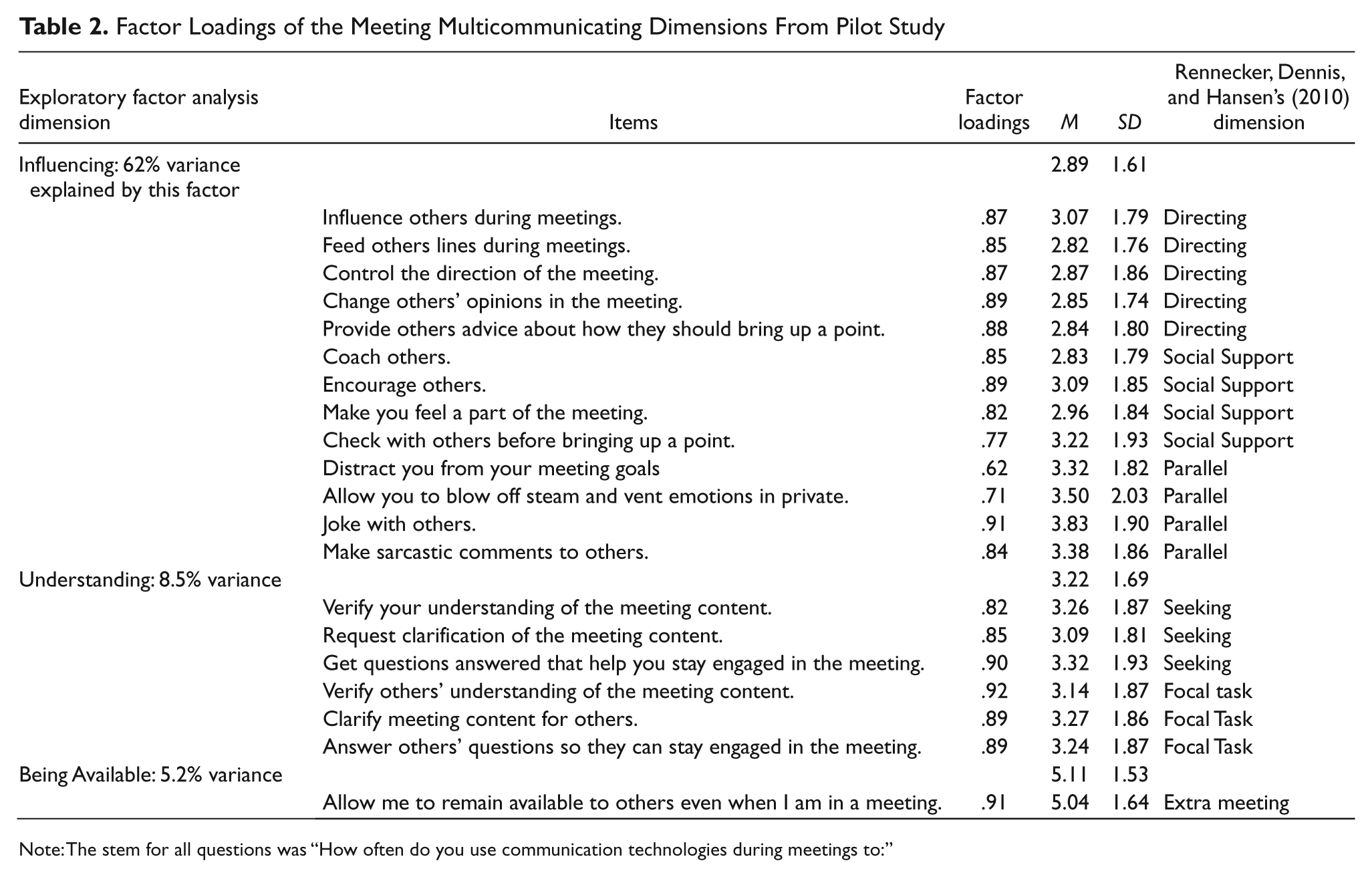
The internal reliabilities of these created scales were strong, ranging from Cronbach’s α = .85 to α = .94 The sample size was small, but this pilot study suggested that most of the developed items would likely be valuable when conducting a larger scale creation effort. In addition to assessing the internal reliabilities, an exploratory principal components factor analysis with varimax rotation and scree plot examination was used to better understand the relationships between the items in scale. Even though there were hypothesized factors, considering the small sample size and large number of items, exploratory factor analysis (EFA) was more appropriate than confirmatory factor analysis (CFA). This analysis suggested that a three-factor solution characterized the data, and those factors were named Understanding, Influencing, and Always Available. Those three factors accounted for 75.7% of the variance (see Table 2 for a summary of the items composing each factor). The factor that accounted for the most variance in meeting multicommunicating behavior (62%) was what this study terms Influencing Others. This factor contained 13 items and had an M = 2.46, SD = 1.35. This factor represented collapsing the original distinction between social support, participating in parallel meetings, and directing and influencing the meeting. The second factor, Understanding, accounted for 8.5% of the variance explained in meeting multicommunicating and had an M = 3.12, SD = 1.67. This factor represented combining the two original understanding dimensions, seeking clarification and providing focal task support.
Factor Loadings of the Meeting Multicommunicating Dimensions From Pilot Study
Note: The stem for all questions was “How often do you use communication technologies during meetings to:”
The third factor consisted of a single item, being available. This factor accounted for 5.2% of the variance in meeting multicommunicating behavior and had an M = 4.19, SD = 2.2. This item appears different from the first two dimensions, yet, it highlights the importance people place on using communication technologies to be reachable by others even when engaged in another activity like an organizational meeting.
Post hoc findings
Of the three factors identified from the EFA, Influencing Others (13 items) contained items from three different conceptualized concepts. Although the EFA suggested that these concepts statistically tap into the dimension of Influence, the items originally conceptualized as Participating in parallel meetings, Directing and influencing the meeting, and Social support could also be distinct dimensions. The decision was made to collect additional data and expand the number of items measuring Being Available to achieve a sample size sufficient for conducting a confirmatory factor analysis.
Scale Development Study Method
The scale development study was undertaken to explore further the development of a Meeting Multicommunicating Scale (MMS) from a different and much larger sample. The second study used the same items as those included in Study 1 with one exception. Because the single item measure of Being Available was identified in the EFA as a separate factor, and because literature supports the value of this factor, three additional items were created to make this a more robust measure. Those items included “Be reachable during a meeting,” “Be connected to others during a meeting,” and “Be within reach if others need me during a meeting” in addition to the original item of “Allow me to remain available to others when I am in a meeting.” Even though the EFA for Study 1 suggested that several of the originally conceptualized dimensions were not distinct, during scale development it is important to use conceptual and theoretical justifications, not just statistical findings (DeVellis, 2003) to develop more theoretically robust scales.
Participants and Procedure
The participants in this study were undergraduate students of diverse majors who were enrolled in a basic communication course in a southwestern US university. They received extra credit for their participation in this study. To qualify for this study the students needed to be a member of at least one organization that had meetings at least once a month. The first question on the instrument asked them to type in the name of one organization where they attend meetings and to choose a typical meeting. These results indicated a variety of meetings ranging from academic, student government, social, and sports-related organizations. The characteristics of the meetings chosen are similar to many organizational meetings. The meetings varied in the size of attendance with 65.3% of the chosen meetings having more than 20 people attend and 27.5% having between seven and 20 attendees. The majority of the participants had been a member of their chosen organization between 1 and 3 years (45.5%) and 51.8% of them reported that attendance was considered required. Seventy-one percent of the participants held some type of leadership role with 12.3% of them being in the executive level and 28.1% being a mid-level leader. The participants also reported a variety of acceptable use policies and norms concerning ICTs in meetings. The sample was 67.4% (N = 196) female and had an average age M = 20.4 SD = 1.69. They rated themselves as being comfortable with technology: 11.7% rated themselves as experts, 45.4% rated themselves as strong users, 36.1% rated themselves as good users, and the remaining 6.9% rated themselves as neutral, fair, or poor users. They were 9.6% (N = 28) freshman, 25.1% (N = 73) sophomores, 32.6% (N = 95) juniors, 30.6% (N = 89) seniors, and 6% (N = 21) other.
Instrument
The instrument used for the study was very similar to the one used in the pilot study except for the differences noted earlier. This instrument was also administered online and all variables were assessed on Likert-type scales ranging from 1 = strongly disagree to 7 = strongly agree. See Table 2 for the details of these questions.
Results
Preliminary Analyses
Prior to analysis, descriptive and frequency analyses were performed and the data were examined for outliers, significant linearity and normality violations, and missing data. There were no outliers or significantly skewed variables. There was missing data in 14 of the 304 cases. For the variables included in the confirmatory factor analyses, the means were imputed using mean substitution to retain all cases. An exploratory principal components factor analysis with varimax rotation was also performed and those findings suggested that one item did not load cleanly on a single factor, “Check with others before bringing up a point,” and that item was removed prior to the confirmatory factor analysis.
Hypothesized Model
Model estimation
The hypothesized model conceptualized all six dimensions as being constructs needed to characterize meeting multicommunication (see Figure 1 for the hypothesized model). The model and the latent constructs were allowed to correlate with one another, while the error terms were not allowed to correlate. Model fit was evaluated using the maximum likelihood chi-squared statistic, comparative fit index (CFI), Tucker-Lewis Index (TLI), root mean square error of approximation (RMSEA), and standardized root mean square residual (SRMR).

Hypothesized model of meeting multicommunication behaviors
The hypothesized model was supported despite a significant chi-square result χ2(196, N = 304) = 469.55, p < .001, CFI = .96, TLI = .95, RMSEA = .07, and SRMR = .04. The CFI and TLI were less than .9 and the RMSEA and SRMR were less than .09 (suggested as good indication of fit by Bagozzi & Youjae, 1988; Hu & Bentler, 1999). The chi-square value was significant, but the ratio of the value to the degrees of freedom was less than 2.5. All of the items loaded well on their hypothesized factors with only two (out of the 22) items having a loading lower than .80 and those were .66 and .74. All of the latent factors were also significantly correlated. The lowest correlation was between Being Available and seeking clarification (r = .19 p < .01) and between Being Available and focal task support (r = 19 p < .01). There was a very strong correlation between seeking clarification and focal task support (r = .95, p < .001). Considering that the items reflecting each of these dimensions were identical except for the self or other distinction, this finding suggested attempting a model modification to achieve a more parsimonious model.
Model Modification
While the hypothesized model did fit, more complex structural equation models often fit the data better than a more parsimonious solutions and in scale development, overfactoring can result if parsimony is not explored (Tabachnick & Fidell, 2001). First, the correlations were examined and considering the strong correlation between the factors, seeking clarification and providing focal task support (r = .95, p < .001), those two dimensions were combined into a single new factor that was named Understanding. This resulted in a new model containing all the same measured variables, but five instead of six latent factors. To assess the fit of this new model, the same fit indices were used in addition to the chi-square-change analysis. The Δχ2(5) = 30.09, p < .001, which suggested that the change was significant. In addition to consulting the chi-square-change statistic, the fit indices indicated very little change from the more complex model, so this more parsimonious model was accepted: χ2(201, N = 304) = 499.64, p < .001, CFI = .96, TLI = .95, RMSEA = .07, and SRMR = .04.
To verify that each item significantly loaded on the identified factor, the factor loadings were examined. All items loaded above a.66. The specified items were summed and divided by the number of items reflecting a latent factor to create scale reliabilities ranging from .86 to .96. The five factors were also highly correlated ranging from r = .18 to .87. See Figure 2 for the standardized regressing weights and correlations between the factors.
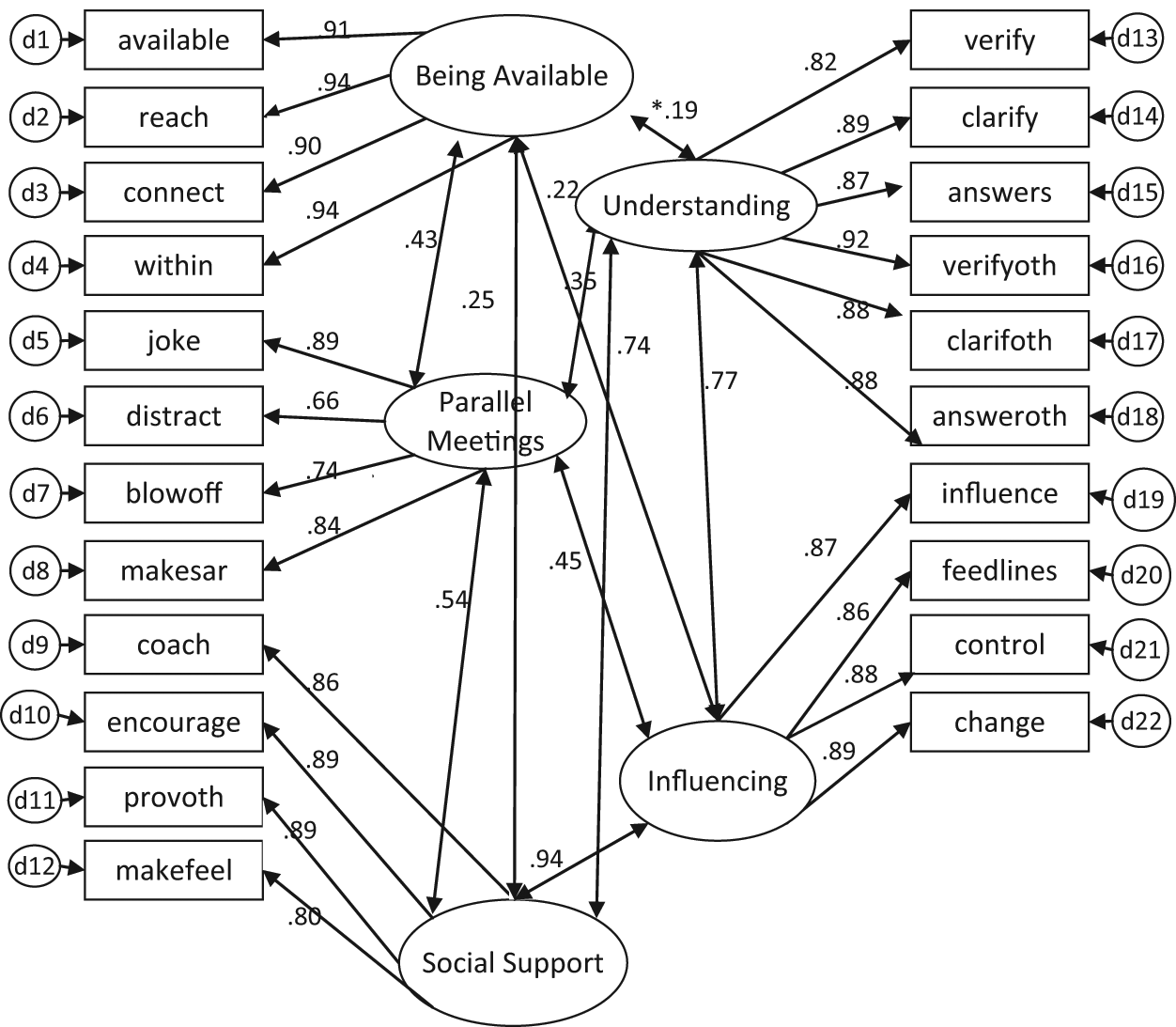
Modified model of meeting multicommunication behaviors
Research Question
The research question asked to what extent the dimensions qualitatively uncovered by Rennecker et al. (2010) can be validated in a quantitative design. Their study originally contained six dimensions and during the quantitative design validation, this study found a five-factor model. The model respecification process indicated the two dimensions, focal task support and seeking clarification, could conceptually and empirically be combined resulting in a more parsimonious, five-factor model. See Figure 2 for a picture illustrating this relationship and the model estimates.
Validation Efforts
Convergent validity of the MMS was established by constraining the correlations of all factors to one and then reassessing the model fit (this method was similar to the approach used by Ballard & Seibold, 2004). This type of validity check helps create an argument that the 22 items do indeed result from five different dimensions instead of all reflecting a single dimension. The resulting model indicated a poor fit in every index χ2(191) = 869.76, p < .001, CFI = .89, Tucker-Lewis Index (TLI) = .88, RMSEA = .11, and SRMR = .18. This suggests that the 22 items do not simply reflect a single dimension.
Predictive validity of the MMS was established by examining the relationships between the various factors in the MMS and an outcome variable. Theoretically each of the dimensions should be related to an individual’s propensity to engage in multitasking behaviors. For example, people who use electronic devices to communicate during meetings should also be using them for the various reasons composing the meeting multitasking dimensions. Four items designed to measure an individual’s propensity to multitask were examined. The items included “I use communication technology devices,” “I close all communication technology and provide my undivided attention to what is happening” (reverse coded), “I multi-task,” and “I hope I can always use communication technology devices during meetings.” The stem for these items was “during meetings . . .” and these items were measured on a 7-point Likert-type scale. A confirmatory factor analysis of these items confirmed that they created a scale with a χ2(2, N = 304) = .32, p > .1, CFI = .99, TLI = .99, RMSEA = .00, and SRMR = .01. The scale M = 4.72, SD = 1.38, N = 304 and α = .82. The correlations between the individual multitasking scale and the dimensions of the MMS were highly significant and in the predicted direction ranging from r = .31 to r = .52, with the relationship between Being Available and individual multitasking being the strongest correlation. Thus the predictive validity of this scale is supported. See Table 3 for the correlations.
Intercorrelations Between Meeting Multicommunicating Factors in the Scale Development Study
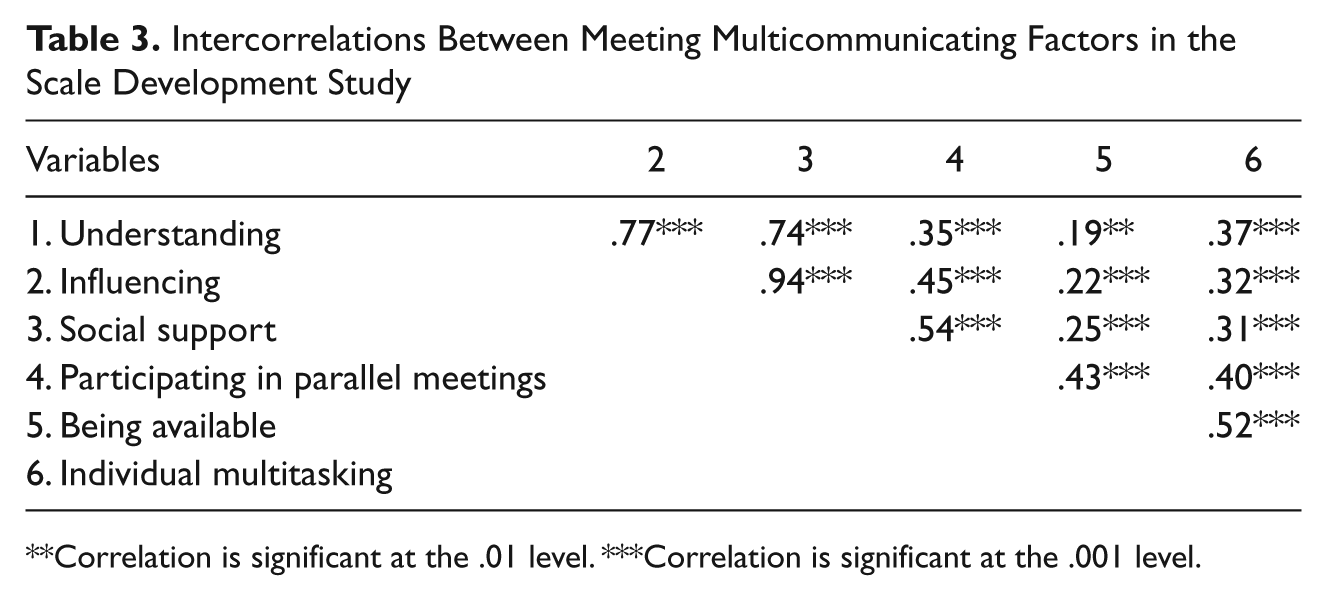
Correlation is significant at the .01 level. ***Correlation is significant at the .001 level.
Discussion
This scale development effort addresses a need in organizational studies to better understand and measure the microbehaviors that influence communication practices. This effort to define and refine ways to measure the practice of multicommunication provides an important step in advancing the theoretical understanding of multicommunicating. The fit of the final model and substantial variance that these dimensions account for in meeting multicommunicating suggest that this scale can be useful for future studies. Not only are these findings grounded in research using multiple methods, but there is also a substantial face validity for the identified dimensions as well. It is theoretically consistent to believe that people multicommunicate to send and receive information, to influence others, to provide social support, to participate in parallel meetings, and to remain available to others. It is also conceptually rational that Being Available is an important factor because it is a state of readiness to engage in multicommunication. This final factor highlights the key role that other people play in contemporary communication practices and how the proliferation of technology and mobile devices has increased accessibility.
This study also demonstrates the value of using qualitative data to generate scale items. The final scale closely reflects what Rennecker et al. (2010) found qualitatively in their study of instant messaging, and the current study provides a way to measure quantitatively these multicommunicating behaviors. Although Rennecker et al.’s research is highly descriptive and provides rich interview data, a quantitative scale measuring these behaviors extends their work beyond a single ICT (instant messaging), provides a tool that can bridge to the practice community, and opens the doors for much more research in this area.
Examining the interfactor correlations also highlights some potentially important relationships between these factors. First, Social Support and Influencing Others are highly correlated at .94, yet the CFA suggests that they are best treated as separate factors. Influencing Others is also highly correlated with Understanding (r = .77). Finally, Understanding and Social Support are correlated at a .74 level. This could mean that meeting multicommunicating often involves an interplay between these three factors. Perhaps people who are more actively involved in a meeting or conversation are doing a combination of these activities.
This type of an interpretation is further supported because the correlation between Understanding and Being Available is the lowest, yet still significant, bivariate correlation at .19. Examination of all the factors does indicate that Participation in parallel meetings and Being Available have a smaller relationship with the other three factors. Yet the mean on Being Available is the highest of all the factors at more than 5.0 on a 7.0 scale. This finding suggests that Being Available is particularly important and could be a major reason that people multicommunicate. Being available is highly focused on other people and emphasizes the bidirectional nature of communication.
This scale development effort also provides a resource to bridge into the applied community. The MMS can be used as an independent variable to examine how multicommunicating influences outcomes, but it can also be used as a dependent variable because the specific behaviors involved in this practice could be influenced by organizational variables. Furthermore, MMS is not intended to justify or vilify the practice of multicommunicating because practitioners are often more interested in applying a strategy tool in an appropriate situation and “may thus be less concerned about the ‘proper’ or ‘improper’ use of a strategy tool” (Spee & Jarzabkowski, 2009, p. 223). This argument raises the theoretical treatment of multicommunication to one focused on practice, and it builds on Jarzabkowski and Seidl (2008)’s work that established the importance of considering a series of successive meetings and provides a way to study empirically simultaneous meetings as well.
Theoretical Contributions
In addition to the empirical contributions of this scale development effort, this work also contributes theoretically in two ways. First, it extends the theoretical and empirical work on multicommunicating to include the micro-level behaviors composing multicommunicating. Previous research has theorized antecedents and outcomes of this practice (Reinsch et al., 2008) and treated the behaviors more broadly as carrying on simultaneous conversations. This study provides additional conceptual specificity, develops a way to measure these behaviors, and quantitatively identifies specific types of multicommunicating practices—that is, information, influencing, and supporting—that are more related to one another. This scale helps advance the theoretical development of multicommunicating research by operationalizing this construct, an essential research activity involved in theory refinement, especially in a growing field (Kelly & Keaten, 2007; Miller et al., 2011). The findings concerning availability also elaborate on the boundary-extending role that technology and mobile devices play in organizations. People can be available and participate in multiple non-co-located meetings simultaneously. The findings begin to provide explanations for why the practice is interpreted differently between individuals and the role that organizations might play in multicommunicating practices.
This study also positions organizational research on multicommunication for expansion. The proliferation of the practice of multicommunicating serves as a key signal that communication is changing in organizations, and our theory development has an opportunity to lead, instead of follow, this new practice. This research on multicommunicating could inform a strategy-as-practice perspective (e.g., Golsorkhi, et al., 2010; Whittington, 1996) by elaborating on how a practice shapes and changes the role of strategy in organizational meetings. If decision making is significantly changed by multicommunicating practices, either positively or negatively, organizational strategies could be affected. In addition, several dimensions in this scale development point directly to the social practices that can affect strategic organizational decisions and processes. For example, if people privately share information with select others, they could influence key decisions.
This research also positions the practice of multicommunicating as linked to, but not determined by, a wide range of contemporary communication technologies. While much communication technology research has focused on simply descriptive, technology-specific findings (Sawhney, 2007), this study focused on behaviors that are not specific to one or even a few ICTs. Future studies using this measurement approach should find these concepts and measures applicable even as communication technology changes. This project embraces the perspective of considering the increasingly complex, multichannel ICTs of contemporary society instead of drawing an artificial distinction between separate tools (Rice, Hiltz, & Spencer, 2004; Reinsch et al., 2008; Stephens, Sørnes, Rice, Browning, & Sætre, 2008; Turner & Reinsch, 2007; Watson-Manheim & Belanger, 2007). Even the tool(s) we call “smartphones” today are a clear example of the importance of this perspective; within one device is the ability to engage in many different types of interaction across multiple channels. Even typically text-based instant messaging can include voice and video.
Limitations
Although there are likely opportunities to extend the use of this scale beyond meetings, there are also limitations that could affect the conceptual applicability of this research. This study relied on self-report data, which can be subject to social desirability biases, especially because some of the multicommunicating behaviors can be seen as unproductive and not on task for the meeting. The main sample also consisted of students, and even though this sample attended meetings much like work organizations, there could be differences due to age and experience level that could affect the conceptual applicability to a full-time working adult sample. To reduce these biases, the pilot and main study focused on practice diversity and part of the study design was deliberately choosing a sample of people who represented diverse organizations instead of focusing strictly on a single organization. The broad sample base captured different organizational norms and policies, yet the snowball sampling did not provide the sampling robustness of random sampling. The survey procedure did include the assurance of anonymity to reduce the social desirability biases. Despite the use of a student sample in the main study, the communicative behaviors observed in a young generation of well-educated individuals may eventually diffuse into large-scale organizations in the next few years.
An additional limitation of this study concerns the range of respondent behaviors included on the MMS. Due to practical concerns like the length of the instrument, behaviors that were more interpersonal and nonwork-related were not included on the instrument. The items in the Being Available factor very likely tap into issues of work/life and connections with family and friends, and Rennecker et al. (2010) mention this in their qualitative research as well. Expanding the range of behaviors measured on this scale, possibly using some of Ling’s (2004) interpersonal considerations of mobile connections, could extend this research more broadly and allow for further understanding of the work/life boundary blurring occurring with increasing frequency. One additional limitation to this sample is that it contained more women than men, and this imbalance could affect conceptual applicability even in a similar sample.
Opportunities for Future Research and Scale Utility
Extending the multicommunicating scale beyond meetings
In this study, the scale was developed in the context of a meeting. There are likely some particularities to meetings that are reflected in these findings that could affect conceptual applicability, but people meet for many reasons other than work. For example, people increasingly communicate during gatherings of community groups such as parent teacher associations and religious groups. There are also reports of groups of friends as small as four people texting one another while sitting across a dinner table. It is possible that multicommunicating differs depending on the context, but the face validity of the factors identified in this study fits a variety of situations.
Behaviors affecting meeting satisfaction
This scale could be used to identify specific behaviors that affect meeting satisfaction. For example, Mejias (2007) studied technology use in meetings and how that affects satisfaction, and he found that it is important to distinguish between outcome and process satisfaction. These distinctions are likely important when meeting attendees multicommunicate and specific types of multicommunicating behaviors could have negative effects on outcome satisfaction—for example, poor decision—yet positive effects on process satisfaction—for example, was able to get other work completed during the unproductive meeting.
Further refinement and distinctions in multicommunicating
Future research should consider using these scales to begin testing concepts related to multicommunicating. First, this scale could be used to determine if multicommunicating is a distinct construct from multitasking. It is possible that engaging in multiple conversations is simply another form of task switching, a commonly studied multitasking process in experimental psychology (e.g., Rogers & Monsell, 1995), but these types of communicative tasks could also be quite different. If these more communicative tasks do tap into different types of behaviors, empirical testing of people’s ability to multicommunicate should lead to a much broader understanding of multitasking. Second, this scale can be used to measure multicommunicating as a predictor and outcome. For example, multicommunicating is likely linked—either positively or negatively—to productivity, to engagement in a meeting, and to perceptions of communication and work overload. In addition to the variable used in this study for predictive validity, individual desire to multitask, additional variables such as meeting goals, meeting type, and whether workers are collocated are likely predictors of multicommunicating.
This scale will also be useful to understand better how people electronically interact with others who are physically collocated and those who are not. It will be interesting to learn if most multicommunicating occurs between people physically in the same meeting or if this communication involves those physically outside of the current conversation. These communication behaviors can be richly inclusive of people who need not be physically present to be involved. These practices can also be helpful when collocated groups are sharing information selectively or even building coalitions. For example, one person might be “stuck” in a meeting, unable to leave, and need information from a coworker in a different meeting. Simply exchanging information might change the progress of decision making in one or both of these groups.
Future research should refine the factor, Being Available, because it likely has conceptual applicability well beyond organizational meetings. The findings from this study suggest it is important for human communication, but research suggests there are paradoxes created when technology makes people available around the clock (Jarvenpaa & Lang, 2005). Future studies could integrate the empowerment/enslavement and independence/dependence paradoxes uncovered in Jarvenpaa and Lang’s work into the concept of Being Available and they might find additional nuances that enhance the understanding of this factor. For example, Rennecker et al. (2010) studied this issue of remaining available in an organizational context. Many middle and upper-level managers spend a great deal of their work time in meetings, and remaining available is a matter of necessity. Furthermore, participants in their study reported feeling less trapped by their meeting obligation when they could monitor external activities. Rennecker et al. suggest this behavior may replace some more intrusive behaviors of meetings in times past, such as an administrative assistant interrupting a meeting to deliver a message to a supervisor. For people with a number of obligations and social contacts, remaining available is one productive way to manage large communication loads.
Understanding perceptions of acceptability
A major area for future research involves the perceived acceptability of multicommunicating because the current scale does not address this issue. Research on netiquette and organizational meetings suggests that some organizations ban portable devices from meetings because they think their employees are distracted and not paying attention (Chudoba et al., 2005; Mazmanian et al., 2005). The findings from the current study suggest that people do a combination of engaging with the meeting and participating in parallel, perhaps non-meeting-related activities. A series of studies with college students have investigated perceptions of acceptability, and the higher education community is beginning to address multicommunicating practices occurring in classrooms (e.g., Baron, 2010, 2008; Campbell, 2006). Baron and her colleagues (2010, 2008) have found that factors such as the perceived importance of the topic being discussed, whether people are face-to-face or in a mediated context, and whether people perceive that the multiple activities interfere with one another all affect people’s perceptions of acceptability. We need to conduct additional research examining the specific benefits of including ICTs in many types of meetings (and classrooms) and then to weigh those against the potential distractions. This scale provides one way to extend the acceptability and incivility research.
Communication scholars have used politeness theory (e.g., Brown & Levinson, 1987) and organizational scholars have used incivility (e.g., Cameron & Webster, 2010) to explain the relational considerations of multicommunicating. Our field could learn much more about multicommunicating by combining the current scale with other theories such as these. It is possible that combining the current multicommunicating scale with other scales developed, such as affect for communication channels (Kelly & Keaten, 2007), will help advance research in ICT use across many communication contexts. Examining the communicative behaviors people are employing could help organizational scholars and practitioners understand why some people view this practice as rude and others view it as productive. This examination is especially relevant as younger generations enter the workforce because they often have integrated these devices more completely into their lives and might use them in novel ways.
Communication practices continue to evolve as people increasingly depend on mobile devices to stay connected at work and in their lives. The scale developed in this study provides an initial attempt to operationalize the communicative practices involved in multicommunicating. As we better understand the evolving communicative practices in organizations, we can more completely link their use to important outcomes relevant to organizational communication research and scholarship.
Footnotes
Acknowledgements
The author would like to thank Jennifer Davis, Michele Jackson, Sarah Rayburn, Caroline Sinclair, associate editor Ling Chen, and three anonymous reviewers for helpful comments on prior versions of this manuscript.
The author(s) declared no potential conflicts of interest with respect to the research, authorship, and/or publication of this article.
The author(s) disclosed receipt of the following financial support for the research, authorship, and/or publication of this article: This project was funded by a University of Texas Research Grant and a College of Communication Reddick Grant. An earlier version of this article was presented at the National Communication Association Conference in November 2009.