




Abstract
Extant empirical research fails to support the popular belief that paternalistic leadership (PL) style is a basic characteristic in Chinese organizations. In search of empirical evidence of PL as a practicing style, surveys were conducted with employees from small Chinese family businesses (CFBs) in mainland China and Hong Kong (HK). In the China sample, PL’s three dimensions (authoritarianism, benevolence, and morality) were internally convergent; managers exhibited reasonably high levels of PL, and PL as a whole predicted positive employee-perceived outcomes. In the HK sample, however, PL’s three dimensions showed inconsistent correlations, greatly similar to the extant findings. Consequently, PL as a whole could not be analyzed for that sample. Findings suggest that PL may be restricted only to CFBs in China. Management communication implications are discussed.
In today’s global economy, the differences emerging among various cultural leadership styles is garnering increased attention (Muczyk & Holt, 2008). Findings from such research serve to promote mutual understanding, enhance intercultural communication, and nurture interdependence among organizations engaging in international outsourcing and other exchange activities (Lin, 2008). As China is rapidly becoming the next economic center, research interest in the nature and impact of Chinese leadership styles is also on the rise globally (Pittinsky & Zhu, 2005). The present study examines whether the theoretically prominent Chinese paternalistic leadership (PL) is a practiced style in Chinese family businesses (CFBs; i.e., businesses owned by one or more member[s] of a family/families). An analysis of the behavioral patterns of PL is provided to probe how that leadership style may or may not be effective. Findings can offer empirical evidence for evaluating paternalistic leadership as a theoretical construct and contribute to developing culture-specific leadership theories. Findings can, too, serve as a basis for implications in understanding leadership communication processes.
Communication is broadly defined as the processes of human encounters, interactions, and relationship management that include (but are not limited to) message exchanges (Ashman & Lawler, 2008). The style approach to leadership (in contrast to the trait approach or the situation approach) emphasizes a leader’s predictable behavioral patterns in influencing employees and achieving organizational outcomes (Barge & Horkawa, 1989; Northouse, 2009). Communication plays a determining part in leadership behavior (Flauto, 1999; Hackman & Johnson, 2000). Using a broad definition of communication, Husband (1985) published an essay on organizational leadership behavior in Quarterly Journal of Speech, a vintage speech journal in the communication discipline. In that essay, he focused on behavioral patterns/dimensions (e.g., centralized/decentralized and task/relationship) rather than explicitly linguistic attributes. Consistent with the same broad definition of communication, this study examines the validity of the paternalistic leadership style and its impact on employee outcomes.
Overview of the State of the Paternalistic Leadership Literature
Scholars contend that paternalistic leadership is a basic or traditional characteristic in Chinese organizations (e.g., Cheng, Chou, Wu, Hang, & Farh, 2004; Tsui, Wang, Xin, Zhang, & Fu, 2004; Zhou & Long, 2005). However, most of the current literature on paternalism is characterized by philosophical debates and conceptual discussions while little empirical research has been conducted to validate the conceptual arguments (Pellegrini & Scandura, 2008). Among the few empirical studies aiming to uncover evidence supportive of PL’s important role in Chinese organizations, the findings present cause for concern. First, PL, operationalized as consisting of authoritarianism, benevolence, and morality in most extant studies, has shown positive, negative, and no correlations among the three dimensions (see Sheer, 2010, for a literature review), which indicates a lack of convergence with regard to construct validity. Second, PL has never subsequently been used as a whole to predict outcomes. The empirical findings cast doubt on whether (a) PL is a viable, internally consistent concept; (b) paternalism as one leadership style is actually practiced in modern Chinese organizations; and (c) PL, if practiced, is predictive of desired employee outcomes.
Despite unsupportive and sometimes contrary evidence, declaring paternalism as a defunct leadership style in Chinese organizations is premature, as the samples used in the extant studies were drawn from government and nongovernment agencies, education sectors, and public corporations. These organizations exhibit cultures quite different from those in Chinese family businesses where PL was first conceived (Redding, 1990; Silin, 1976). Thus this study examines whether PL is a practicing leadership style among managers (including owner-managers) in Chinese family businesses, specifically those in Hong Kong (HK) and mainland China. In organizational studies, managers, because they are in supervisory positions, are examined in terms of leadership style and the degree to which the behavioral and communication patterns they exhibit pertain to the examined leadership style. Managers can be strong or weak leaders.
Academic Discovery of Chinese Paternalistic Leadership
The claim of Chinese-specific paternalism began with Silin’s (1976) qualitative study of leadership behaviors of Chinese owners and business managers in companies in Taiwan. He found that leadership behaviors in those organizations were quite different from what was typically observed in Western corporations. These managers were directive, had centralized power, preserved ambiguity about their intentions, exercised implicit personal control tactics, and maintained social distance from subordinates. The label of paternalistic leadership as an explicitly Chinese management style came from Redding’s (1990) report of his interviews with owners and/or managers of Chinese family businesses in the United States. He discovered that authoritarianism accompanied by benevolence and personal loyalty was an important control aspect of paternalism. The works of Silin and Redding established the initial descriptive conceptual foundation for much of the later literature on Chinese organizational paternalism. Westwood and Chan (1992) and Westwood (1997) proposed a model of paternalistic leadership but imposed some restrictions in the applicability of that model in that the PL model was only to fit Chinese family-business organizations that are characterized by centralization, low formalization, harmony, and personalism.
Conceptualization of Chinese Paternalism
Influenced heavily by Silin’s (1976) and Redding’s (1990) work, Cheng and his colleagues (e.g., Cheng, 1995; Cheng et al., 2004; Farh & Cheng, 2000) have brought forth the most influential conceptualization of Chinese paternalism, such that the majority of published articles, theoretical debates, and empirical studies are grounded in or otherwise cite their works. Having examined PL in various “indigenous” Chinese contexts (e.g., local Chinese organizations), Farh and Cheng (2000) discovered a new paternalistic element, morality. They added morality to authoritarianism and benevolence, which they extracted from the works by Silin and Redding, and made PL a three dimensional construct. Authoritarianism refers to the practice through which the leader, with absolute power over followers, makes all decisions and controls their actions. Benevolence shows a soft side of the leader, who cares about followers’ personal well-being and shows personal concerns for them. Morality requires that the leader demonstrate high moral values, show good citizenship behaviors, be unselfish, and set a good example of superior personal virtues and self-discipline for followers. Farh and Cheng later created a corresponding three-dimensional PL measure, used extensively by researchers.
Farh and Cheng (2000) traced the historic origins of the three paternalistic dimensions and explain them in terms of Chinese cultural values. Authoritarianism comes from Confucianism and Legalism. In the Confucian cardinal relationship of father-and-son, a father has legitimate authority over his children and all other family members (Fernandez, 2004; Yang, 1996). Legalism values control and political manipulation. Authoritarian leadership is a manifestation of the historical development of these values. Benevolence also reflects the Confucian hierarchy of the cardinal relationships and the norm of reciprocity (e.g., a superior’s benevolence and the subordinate’s loyalty to him; Kang & Chang, 2001). Implied in the hierarchical order, the father should show kindness to children, who, in turn, should fulfill their filial piety by respecting and obeying the father. The subordinate–superior dyad then mirrors the father–child relationship. Morality, too, originates in Confucianism and Legalism, as both stipulate that leaders must show dexin (moral behaviors) and set examples for followers.
The Paternalistic Leadership Style and Its Communicative Characteristics
Although no previous research has explicitly addressed PL’s communicative characteristics, one may infer such characteristics via an examination of the paternalism notion and the high power distance characteristic of Chinese culture. In Chinese organizations, characterized by the norm of high power distance, employees, with little autonomy, expect managers to make decisions for them (Carl, Gupta, & Javidan, 2004). Thus a paternalistic manager can easily exercise authority by ordering employees to perform tasks with little need for persuasion. When exercising a benevolent act (shi en), the manager needs to provide little explanation to employees (Sheer, 2007). Morality is about setting a good example and avoiding immoral behavior, and a moral leader is not known for communicating moral values (Zhou & Long, 2005). Thus from the analysis of its three aspects, the paternalistic leadership style is unlikely to be communicatively expressive (e.g., leaders tend not to discuss or explain their vision with subordinates). The communication content likely is about executing tasks (but not why) or soliciting loyalty when in need (Harrison, 1995). Regarding relationship management, a fundamental communication competency (Barge & Hirokawa, 1989), the paternalistic leader can resort mainly to benevolence in exchange for respect and unquestioned trust from subordinates (Zhou & Long, 2005). Yet little is known thus far as to whether benevolence can help the leader succeed in maintaining good employee relationships.
Presumed Organizational Prevalence of Paternalistic Leadership
Not bound by the constraint of family-business environments prescribed by Westwood (1997), Cheng and colleagues hold that paternalism, rooted in the broad Confucian values, is generally applicable in Chinese organizations. Many scholars subsequently adopt that general approach to organizational paternalism (e.g., Aycan, 2006; Cheng et al., 2004; Tsui et al., 2004; Zhou & Long, 2005). Tjosvold and Fang (2003), too, describe paternalism as a general leadership style, not restricted to any particular types of organizations. In a review of the PL literature published mainly in Chinese language journals, Zhou and Long (2005) conclude that paternalism is popular and seems effective in various types of organizations.
Based on the assumption of its broad applicability, paternalistic leadership has been examined in qualitative studies that investigated professional basketball teams in Taiwan and mainland China (Chau, 2003), Taiwan’s postal offices (Lin & Cai, 2002), a research and technology institute (Yan, 2002), and Taiwan military units (Chang, 2001). Quantitative studies also have examined PL in Taiwanese companies (Lin & Cheng, 2007), mainland Chinese management training facilities (Li, Meng, & Shi, 2007), mainland Chinese government organizations, corporations, and middle schools (Zhou & Long, 2007) and organizations in Hong Kong (Man, 2007). These studies share the same conceptual basis reviewed earlier in this article.
Problematic Empirical Evidence for Organizational Paternalism
Despite the popular belief that paternalistic leadership is prevalent in Chinese organizations, empirical findings thus far have provided little support for such belief. Specifically, Chinese paternalism has encountered problems with construct validity and ecological validity. These problems have been ignored by researchers of paternalistic leadership.
Problems with construct validity
PL has exhibited internal inconsistency among the three dimensions as they were negatively and positively correlated, and sometimes unrelated. Correlations among the three dimensions from five studies found in the literature search are summarized in Table 1. None of these empirical studies has produced a reliability for paternalistic leadership, which clearly points to the lack of consistency among these three dimensions. In these studies, the total paternalism measure was never used to predict employee outcomes. Paternalism was examined only via the three separate, internally inconsistent individual dimensions.
Correlations Among the Three Dimensions of Paternalistic Leadership in Previous Studies
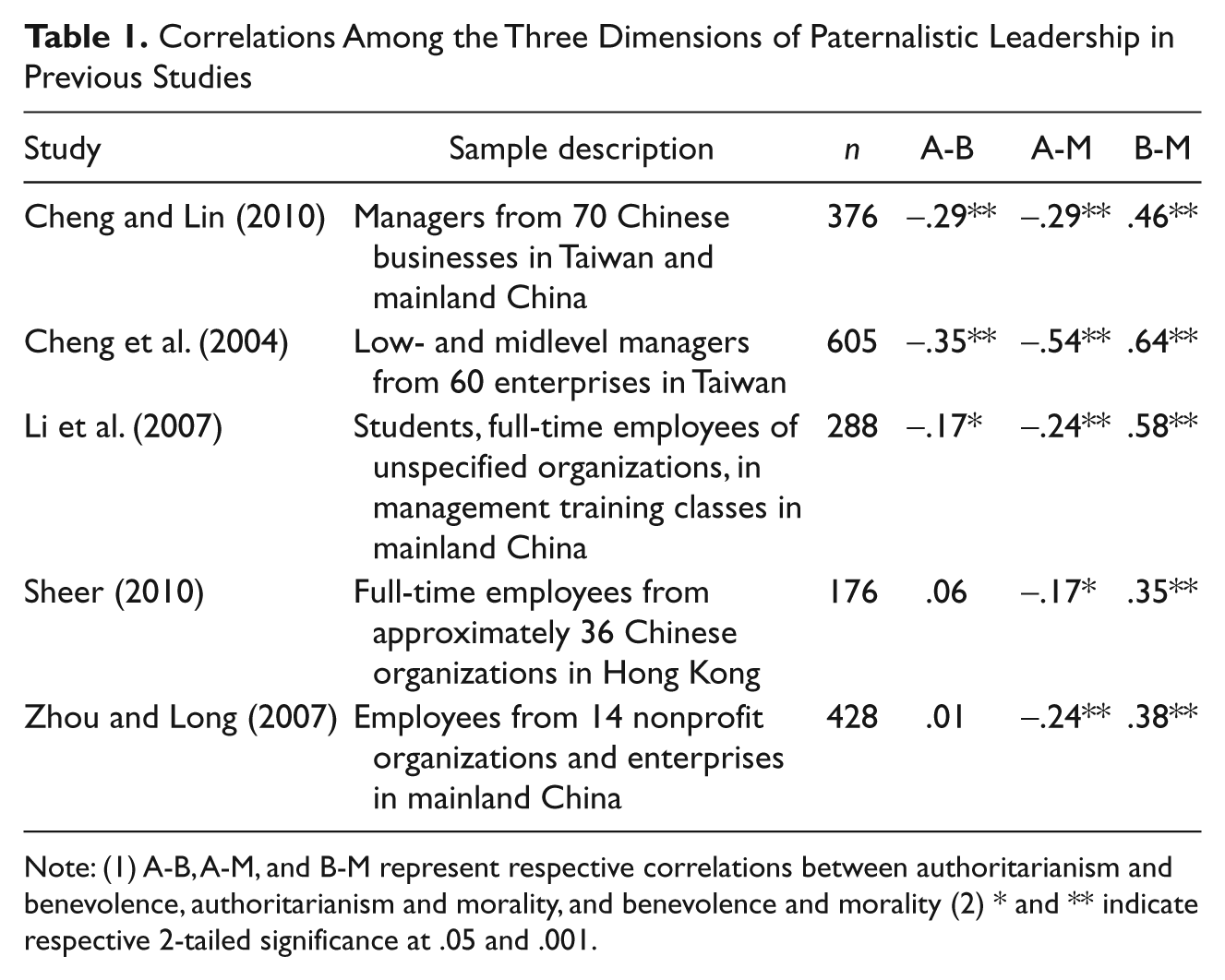
Note: (1) A-B, A-M, and B-M represent respective correlations between authoritarianism and benevolence, authoritarianism and morality, and benevolence and morality (2) * and ** indicate respective 2-tailed significance at .05 and .001.
Problems with ecological validity
Ecological validity refers to the degree to which behaviors recorded in a study reflect the behaviors that actually occur in real-life settings. For PL to possess ecological validity, research must demonstrate that all three dimensions of paternalistic behaviors do occur in leaders in Chinese organizations. That is, a paternalistic leader must exhibit authoritarianism, benevolence, and morality. Sheer (2010) discovered, in her HK sample of employees from various organizations, that only 1.70% of the managers who scored 5 or higher (of a maximum of 7) on all three paternalistic dimensions were qualified as paternalistic leaders. This clearly manifests the weak ecological validity of paternalism.
Need to Examine Conditions for Paternalism
The construct and ecological validity problems raise the question as to whether paternalism is a practiced leadership style in today’s Chinese organizations. The samples in the extant 3-dimensional paternalism studies were drawn from various untargeted organizations, as explained in the Presumed Prevalence of PL section above. With these samples, studies have gleaned little empirical evidence of the practice of paternalism. Likely, modern organizations are based on rational rules and hierarchical systems, in which the inconsistent carrot-and-stick (i.e., benevolence and authoritarianism) behaviors can severely undermine a manager’s credibility and render him or her ineffective. This lack of evidence points to the need to examine the specific conditions under which paternalism might still exist and thrive. One such condition, the environment of a family business organization, as prescribed by Westwood (1997), may serve as a starting point for the search of practicing paternalism. Thus Research Question 1 and Research Question 2 were posed.
Research Question 1 (RQ1): Is the three-dimensional paternalism an internally convergent construct in Hong Kong and mainland small Chinese family businesses?
Research Question 2 (RQ2): Is paternalistic leadership exhibited differently in small Chinese family businesses in Hong Kong compared to those in mainland China?
Culture of Chinese Family Business (CFB)
As the discovery of practicing organizational paternalism came from Chinese family businesses of decades ago, organizations with a culture that resemble these early CFBs still may be a nurturing ground for paternalism. Based on past observations (e.g., Davies & Ma, 2003; Fu, Wu, Yang, & Ye, 2008; Redding, 1990; Silin, 1976; Whitley, 1992; Wong, 1995), Chinese family businesses share a few dominant cultural traits. First, power is highly centralized in the hands of only a few people. Decisions are conceived and made by top management. Low-level management and employees rarely participate in decision making. Second, hierarchy and power distance are deliberately maintained as a control mechanism. People on the lower end of the hierarchy obey orders from more powerful persons. Third, guanxi (i.e., personal networks) is highly valued. Loyalty to the superior is an important criterion for promotion. Fourth, the lack of formalization leads to low transparency as employees’ responsibilities are not clearly defined. Finally, harmony is the essence of interpersonal relationships. Conflict is suppressed and is not dealt with publicly. These traits characterize Chinese family business in the context of leading, managing, and controlling employees. Likely, paternalistic leaders will thrive in organizations with these CFB traits, and Chinese small family businesses are promising venues for researchers to examine PL.
Small CFBs tend not to have elaborate, rational structures or well-established policies and rules, and leaders/managers tend to exert strong individual influences. Any large organization, family-owned or not, likely requires elaborate, formal management systems, strong legal-rational authority, and low personalism. Thus small CFBs were targeted for the current study. To achieve greater generalizability, two samples respectively of mainland China and Hong Kong were compared. In this context, Hypothesis 1 was proposed to investigate the relationship between family business culture and paternalistic leadership.
Hypothesis 1 (H1): Family business culture likely is related to paternalistic leadership exhibited in small Chinese family businesses in Hong Kong and those in mainland China.
PL and Employee-Perceived Outcomes: Culture and Communication
Leadership as a goal-oriented process is grounded in task accomplishment (Robinson, 2001). The practice of a leadership style can be evaluated in terms of outcomes (Hede, 2001). In the predominantly Western literature, communication is considered a requirement of effective leadership as leaders must communicate to motivate and persuade followers to act (e.g., Ashman & Lawler, 2008; Flauto, 1999; Hackman & Johnson, 2000). Yet the analysis of the Chinese paternalistic leadership style early in this article indicates that PL is a power-based, communicatively inexpressive style. Can an inexpressive leadership style lead to desired employee outcomes?
To examine whether PL is an effective practicing style, its relationships with key employee outcomes must be established. Seven employee-perceived outcomes are identified based on measures used in a published study (Sheer, 2010) so that the current findings can be compared with earlier findings. The three outcomes specifically relevant to PL entail personal loyalty, organizational loyalty, and compliance (e.g., Cheng & Lin, 2010; Lin & Cai, 2002; Pellegrini & Scandura, 2008), whereas, four typical employee outcomes relevant to any given leadership include commitment, job satisfaction, leadership satisfaction, and relationship satisfaction (e.g., De Cuyper & De Witte, 2006; Joo & Lim, 2009; Kaptein & Schwartz, 2008; Walumbwa, Cropanzano, & Hartnell, 2009).
The culture-based literature shows that a paternalistic leader often uses benevolence to cultivate employees’ personal loyalty to him or her and to the organization; yet, such loyalty can be compromised when the leader exercises authoritarianism (Cheng, Chou, & Farh, 2000). The person focus (e.g., personal relationship, individual power over system rules) by the leader can also motivate subordinates to view loyalty to the leader as more important than loyalty to the organization (Sheer, 2007). Compliance, or sometimes obedience, is an often-measured outcome of paternalism. A manager’s benevolence and morality can result in willing compliance. Authoritarianism theoretically leads to unwilling or habitual obedience (Fleming, 2005). Yet empirical evidence from non-CFBs shows a negative correlation between authoritarianism and compliance (e.g., Cheng et al., 2004), which raises the issue of PL’s ineffectiveness in gaining employee compliance.
From a communication perspective, managers’ communication predicts employee outcomes (Madlock, 2008). Communication interactions between managers and employees can increase employees’ self-worth (Orpen, 1997), enhance mutual understanding and trust (Mackenzie, 2010), and satisfy individuals’ needs of pleasure and inclusion (Madlock, 2008). In fact, when managers spend time giving information, providing feedback, explaining the vision to subordinates, discussing tasks, and/or otherwise socializing with subordinates, employees reported increased organizational commitment and satisfaction with the job, the relationship, and the leadership style (e.g., Abu Bakar, Dillbeck, & McCroskey, 2010; Mackenzie, 2010).
Paternalistic leadership, however, is a power-based style that uses little persuasion. Paternalistic managers often do not identify self-direction as a key corporate value (Sarros & Santora, 2001) and discourage employee participation in decision making (Sheer, 2010). In collectivist culture, high power distance, little autonomy, and low employee participation have consistently predicted low job satisfaction (Bowen & Lawler, 1995; Hui, Au, & Fock, 2004), and poor manager–employee communication results in low trust, low-quality relationships, low commitment, and high job tension among employees (e.g., Harrison, 1995; Huff & Kelley, 2003). In this vein, paternalistic leadership style, characterized by anemic communication, may lead to low employee outcomes such as low commitment and low job, relationship, and leadership satisfaction. However, two aspects of PL, benevolence and morality, albeit noncommunicative, may still positively contribute to organizational outcomes. Will PL’s benevolence and morality overcome the problems associated with paternalistic leaders’ poor communication and result in positive employee outcomes? Research Question 3 specifically addresses whether PL leads to desired organizational outcomes in the current context of small family businesses in Hong Kong and Mainland China.
Research Question 3 (RQ3): To what degree, does paternalistic leadership as a whole relate to employee-perceived outcomes in personal loyalty, organizational loyalty, compliance, and satisfactions in job, leadership style, and leader relationship in small Chinese family businesses in Hong Kong compared to those in mainland China?
Method
Sample and Procedures
The HK sample consisted of 251 full-time employees from 48 small family businesses with 200 people or fewer. A team of graduate students was trained to make contacts, distribute, and collect questionnaires at various small CFBs in Hong Kong. An instruction sheet attached to each questionnaire stressed voluntary and anonymous participation and asked respondents to complete the questionnaire independently without any discussion with other people and to seal the questionnaire in the attached envelope. To collect data in China, a mainland scholar with connections in a midsized city in Jiangsu Province was hired and trained as the data collection coordinator. With the instructions being the same as those used for the HK sample, the scholar then trained a team of university students as field data collectors. These students gathered questionnaires on the sites of 37 small businesses with 200 people or fewer. The final sample size for the mainland study was 275. The characteristics of both samples are reported in Table 2. The two samples appeared generally compatible.
Sample Characteristics

Questionnaire and Measurement
Because field survey was the main data collection method, the questionnaire length was kept necessarily short to increase the probability that all questions were answered. The questionnaire consisted mainly of previously tested measures: family business culture (Man, 2007), paternalistic leadership (Cheng et al., 2004; Sheer, 2010), and employee-perceived outcomes (Sheer, 2010; Sheer & Chen, 2003). These items, originally designed in English, have a comparable Chinese version (which was derived through back-and-forth translation procedures in the respective cited studies). The Chinese version was used in the current study. The questionnaire first tapped respondents’ perceptions of the immediate supervisor’s paternalistic leadership style, followed by family business culture. Then respondents rated perceived employee outcomes. The rating scale for all items ranged from 1 (very untrue) to 7 (very true). Last, factual information was gathered regarding respondent demographics and organization characteristics.
Paternalistic leadership consisted of 3 dimensions: authoritarianism, benevolence, and morality. A measure of 12 items, adapted from Cheng et al.’s (2004) version and used in an earlier study with a HK sample (Sheer, 2010), tapped each dimension with four items. For the HK sample, a principal component factor analysis yielded three distinct factors that converged with the three conceptual dimensions. However, one morality item had loadings below the .50 cutoff level (see Kaiser, 1970) on all three factors (i.e., .13 to .34) and was dropped from further analyses. The dropped item was “My supervisor uses guanxi (personal networks) to solicit personal gains.” A rerun of the remaining items produced three clear-cut factors, each with an Eigenvalue greater than 1, accounting for 69.91% of the variance. See Table 3 for details. Reliability analysis showed that authoritarianism, benevolence, and morality had Cronbach’s alphas of .80, .85, and .75 respectively. Yet the reliability for the total scale was only .60, unreliable for further statistical tests.
Factor Analysis of Paternalistic Leadership Items
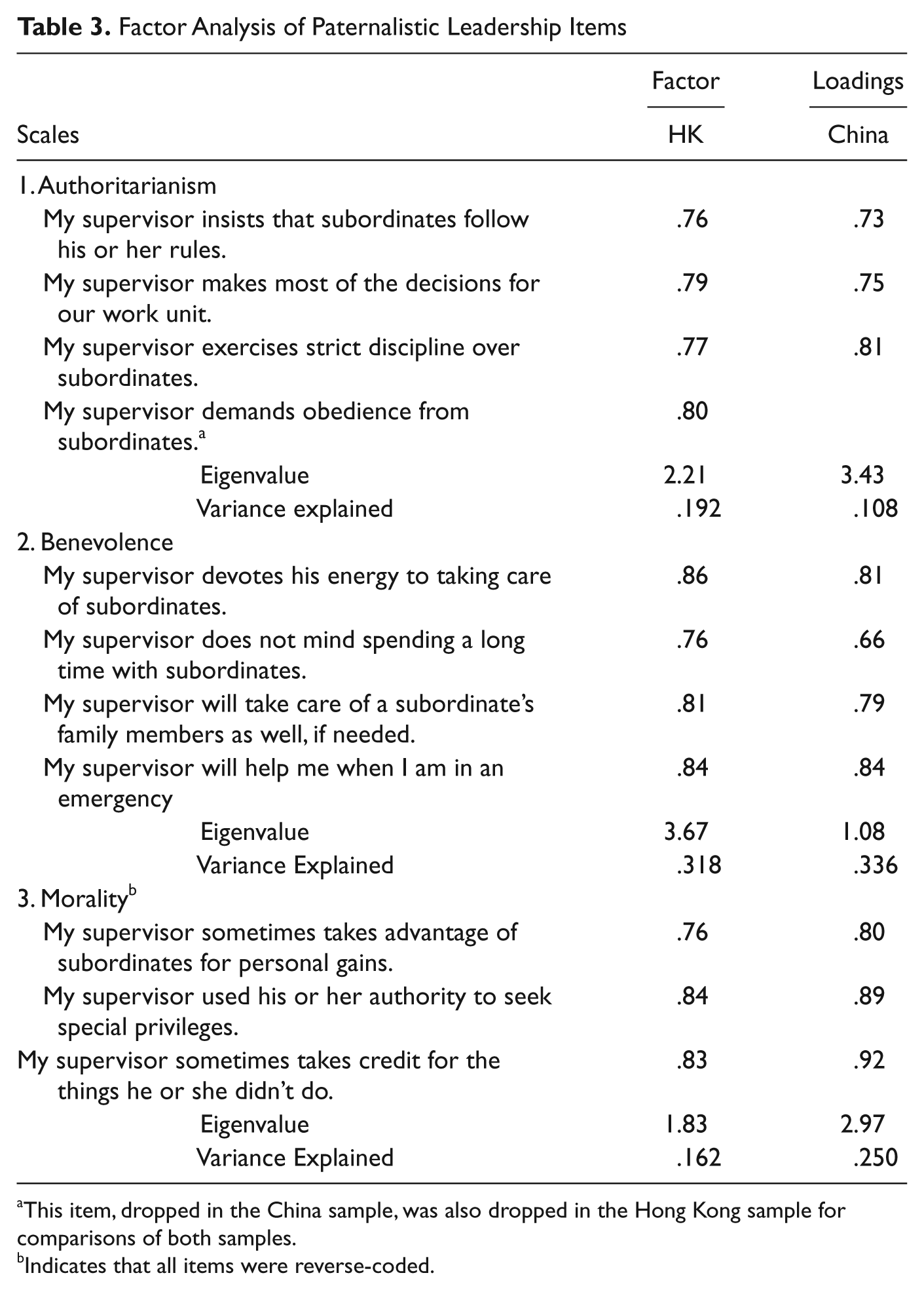
This item, dropped in the China sample, was also dropped in the Hong Kong sample for comparisons of both samples.
Indicates that all items were reverse-coded.
For the China sample, a similar factor analysis procedure was performed, resulting in three interwoven factors. An authoritarianism item, “My supervisor demands obedience from subordinates,” and a morality item, “My supervisor uses guanxi to solicit personal gains,” manifested double loadings. A rerun of the factor analysis without these two items generated three conceptually consistent factors, each with an Eigenvalue greater than 1. The total variance accounted for was 69.29% (see Table 3 for details). The subsequent reliability analysis yielded Cronbach’s alphas of .72, .84, and .82 for authoritarianism, benevolence, and morality respectively. The reliability for the total PL scale was .73.
PL’s benevolence and morality carried identical items in both samples, but authoritarianism had four items in the HK sample and three in the China sample. Any analysis of authoritarianism involving both samples demanded identical items. Thus the item, “My supervisor demands obedience from subordinates,” was dropped from the authoritarianism measure for the HK sample; the remaining three items identical to the ones used for the China sample yielded a Cronbach’s alpha of .78.
Chinese family business culture
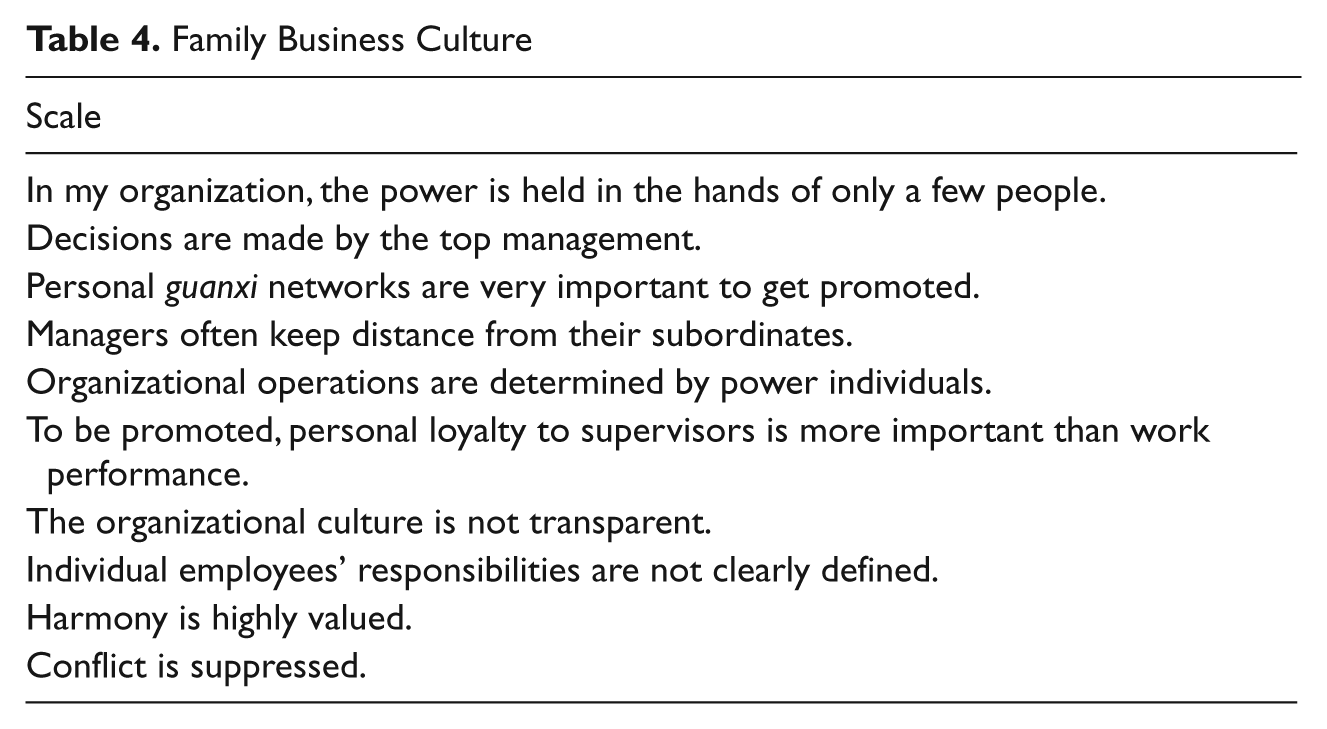
With a basis in the extant literature, Man (2007) created and tested the 10 items measuring Chinese family business culture. These 10 items exhibited high internal consistency (Cronbach’s α = .85). In the current study, these items yielded a Cronbach’s alpha of .87 and .88 for the respective Hong Kong and China samples. See Table 4 for the specific items.
Family Business Culture
Employee-perceived outcomes were examined through the reviewed seven overall aspects: personal loyalty to supervisor, organizational loyalty, compliance, commitment, job satisfaction, leadership satisfaction, and satisfaction with the relationship with the supervisor. Single items used in the early field studies (Man, 2007; Sheer, 2010) measured these seven aspects:
I am loyal to my supervisor (personal loyalty). I am loyal to my organization (organizational loyalty). I fully comply with my supervisor’s work-related requests (compliance). I can see myself staying in my organization for a long, long time (commitment). I am happy with my job (job satisfaction). I am satisfied with my supervisor’s leadership style (leadership satisfaction). I am satisfied with the relationship with my supervisor (supervisor relationship satisfaction).
Single items are superior to multi-item measures in capturing cumulative, overall perceptions for samples with respondents of heterogeneous backgrounds (as in the current samples), as multi-items scales often include specific attributes that may differ in relevance to differed populations (Olsen & Johnson, 2003; Scarpello & Campbell, 1983; Wanous, Reichers, & Hudy, 1997).
Results
Paternalistic Leadership and Its Dimensions (RQ1)
The factor analyses detailed in the measurement section showed that PL’s authoritarianism, benevolence, and morality held up well as three distinct facets for both the HK and China samples. Benevolence explained more variance than did either of the other two factors in both samples (see Table 3). Regarding intercorrelations (i.e., Pearson’s rs), the two samples showed different patterns. For the HK sample (n = 251), authoritarianism was negatively related with benevolence (r = −.26, p < .01) and morality (r = −.15, p < .05), and benevolence was positively correlated with morality (r = .20, p < .01). The total PL scale (i.e., all three dimensions included) was unreliable (Cronbach’s α = .60). For the China sample (n = 275), authoritarianism was positively correlated with both benevolence (r = .46, p < .01) and morality (r = .16, p < .01), but morality was not related to benevolence (see Table 5 for details). The total PL scale was reliable (Cronbach’s α = .73) for the China sample.
Intercorrelations of Dimensions of Paternalistic Leadership and Family Business Culture

Note: * and ** indicate respective 2-tailed significance at .05 and .001.
In answering RQ1, for the HK sample, paternalism did not hold as a coherent, internally consistent construct due to a lack of consistent directions of correlations among the three dimensions, and the total PL score could not be calculated due to the low reliability for the total scale. For the China sample, paternalism generally held as an internally consistent construct except for the lone nonsignificant relationship between morality and benevolence. As a result, paternalism of the HK sample could be examined only through its individual dimensions.
Exhibited Levels of Paternalism (RQ2)
The three paternalism dimensions were compared between the HK and China samples with independent-samples t tests. For authoritarianism, China managers scored higher (M[SD] = 5.13[1.12]) than did the HK counterparts (M[SD] = 4.61[1.19]), t(df) = 5.12 (524), p(2-tailed) < .001. For benevolence, managers in China again scored higher (M[SD] = 4.71[1.23]) than did the HK managers (M[SD] = 4.33[1.26]), t(df) = 3.52 (522), p(2-tailed) < .001. However, China managers displayed much lower morality (M[SD] = 3.86[1.54]) than did the HK counterparts (M[SD] = 5.38[.81]), t(df) = −5.12 (524), p(2-tailed) < .001. The overall paternalism for the China sample had a mean of 5.22 (SD =1.34).
To answer RQ2, paternalism as a whole for the HK sample could not be assessed because the total PL scale (consisting of all three dimensions) could not produce an acceptable reliability; the China sample showed relatively high paternalism. For the individual dimensions, Chinese managers were rated higher on authoritarianism and benevolence, but lower on morality than were the HK counterparts.
Paternalism and Family Business Culture (H1)
An independent-samples t test produced no statistical difference in levels of family business culture between the two samples. For the HK sample (n = 251), family business culture was positively correlated only with authoritarianism (r = .38, p < .01). For the China sample (n = 275), family business culture positively correlated with overall paternalism, authoritarianism, and morality (but not benevolence). Thus, H1, which predicted an association between family business culture and paternalistic leadership, was largely supported. See Table 5 for details.
Paternalism and Employee-Perceived Outcomes: Hong Kong Versus China (RQ3)
For RQ3, overall paternalism for the China sample correlated positively to all measured outcomes, with Pearson’s rs ranging from .36 to .46 (see Table 6). Due to its unreliability, paternalism as a whole for the HK sample could not be used.
Standardized Correlation Coefficients Between Employee Outcomes and Paternalistic Dimensions
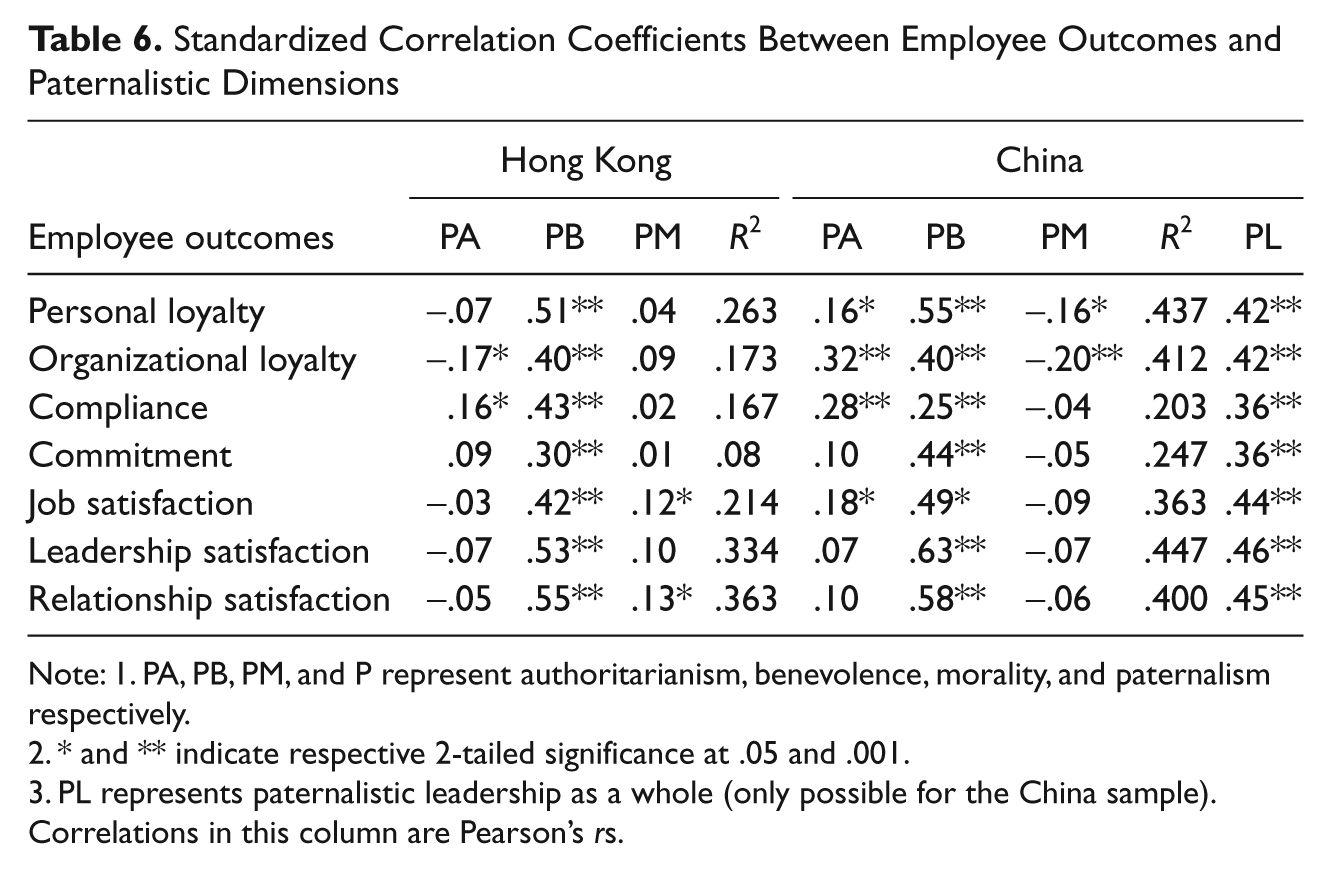
Note: 1. PA, PB, PM, and P represent authoritarianism, benevolence, morality, and paternalism respectively.
2. * and ** indicate respective 2-tailed significance at .05 and .001.
3. PL represents paternalistic leadership as a whole (only possible for the China sample). Correlations in this column are Pearson’s rs.
For additional information, standardized correlation coefficients were calculated as multiple correlations between employee outcomes and the dimensions of paternalistic leadership. Authoritarianism in the HK sample was negatively related with organizational loyalty (standardized r = −.17, p < .05) and positively related with compliance (standardized r = 16, p < .05). For the China sample, authoritarianism was positively related to personal loyalty, organizational loyalty, compliance, and job satisfaction. See Table 6 for details.
Benevolence in the HK sample was positively related to all outcome variables (see Table 6). For the China sample, benevolence exhibited positive correlations with all employee-perceived outcomes (Table 6).
Morality for the HK sample had significant standardized correlation coefficients with job satisfaction and relationship satisfaction (Table 6). For the China sample, morality showed weak, negative correlations with personal loyalty and organizational loyalty (see Table 6).
Finally, independent-samples t tests were computed to compare the HK and China samples with regard to the seven measured outcomes. Mainland respondents perceived greater organizational loyalty, compliance, commitment, job satisfaction, leadership satisfaction, and supervisor relationship satisfaction than did their HK counterparts. See Table 7 for detailed statistics.
Independent Samples t tests Comparing HK and China Samples

Discussion
With a sample of China’s small family businesses (CFBs), the current study likely was the first to discover that the three-dimensional paternalistic leadership measure as a whole was a reliable scale. The HK sample showed patterns consistent with the extant findings unsupportive of paternalism.
Paternalistic Leadership Held in China but Not in Hong Kong
The three dimensions, authoritarianism, benevolence, and morality, were mostly positively correlated in the China sample. More importantly, the total scale for paternalism reached a reliability of .73. Mainland Chinese respondents observed that their supervisors exhibited relatively high authoritarian and benevolent behaviors, but showed low moral acts (i.e., below the scale midpoint of 4). Paternalistic leadership style, despite its communicative inexpressiveness, was quite effective in these small family businesses. Specifically, PL positively predicted subordinates’ personal and organizational loyalties, organizational commitment, compliance, and satisfactions with the job, the leadership, and the relationship with the manager. Standardized correlation coefficients showed that benevolence, among the three dimensions, was the strongest predictor of positive employee outcomes. Perhaps benevolence was able to overcome communication deficiency. These findings lend some validity to the prevalent claim that Chinese paternalistic leadership is a practiced style (see the literature review), albeit only in small family businesses in mainland China.
Findings regarding paternalistic leadership from the HK sample were quite similar to the extant empirical evidence; the three internally inconsistent dimensions rendered paternalism unanalyzable as a whole. Specifically, authoritarianism predicted (based on standardized correlations) only compliance gaining positively and organizational loyalty negatively, but revealed no relationships with the remaining employee-perceived outcomes. Benevolence bore moderate positive correlations with all outcomes; morality exhibited weak positive correlations with job satisfaction and relationship satisfaction. Clearly, benevolence stood out as the most effective element of the three dimensions, and authoritarianism was the least effective.
When the HK and China findings were compared with regard to PL’s three dimensions, benevolence appeared to be the aspect that worked the best in both samples. Authoritarianism seemed effective to a certain degree in the China sample, but entirely ineffective in the HK respondents. Morality, showing few statistically significant relationships with outcomes, was the weakest dimension of the three in both samples. Furthermore, Chinese managers were rated slightly higher on authoritarianism and benevolence, but much lower on morality than were their HK counterparts. Nonetheless, mainland managers’ low morality did not seem to discourage their subordinates, who surprisingly reported greater loyalty, commitment, and satisfaction with the leadership than did their HK counterparts. The unexpected findings deserve further inquiry.
Conditions for Paternalism: Beyond Family Business Culture
The current findings provide initial evidence that paternalistic leadership exists in small family businesses in mainland China. However, given the similar levels of family business culture, a question arises as to why the three dimensions of paternalistic leadership held as a coherent construct in the China sample but not in the HK sample. Furthermore, the HK sample validated authoritarianism as a negative contributor or noncontributor to employee-perceived outcomes; yet, authoritarianism and overall paternalism generally were positive contributors to the same employee-perceived outcomes in the China sample. In examining the evolution of businesses, Wren (2005) concluded that paternalistic leadership is historically a prevalent management style in the early capitalistic businesses in which rules and commands dominated organizational activities and persuasion was not needed. Perhaps CFBs’ characteristics (e.g., vertical power structure and person orientation) largely resemble the conditions that nurtured paternalism in the early stage of industrialization, whereas small businesses in Hong Kong possibly have advanced beyond the early historical business model of paternalism.
Furthermore, PL may, regardless of culture, require certain follower characteristics, those of a needy child with a sense of dependency. Follower characteristics (other than the demographics) in China’s small family businesses may differ from those in Hong Kong. Possibly, other conditions such as organizational history, business laws, and external environment may play a role. Future studies can examine conditions beyond family business culture. To understand further why paternalistic leadership appeared effective in CFBs such as the ones sampled in China in the current study, researchers need to uncover the intrinsic leadership process of communication.
Possible Role of Communication in Paternalistic Leadership Processes
The extant empirical findings are not supportive of the existence of paternalistic leadership as one coherent leadership style, which has rendered research on the communication process of that style unnecessary. The results supportive of the existence of paternalistic leadership make investigating communication as the intrinsic leadership process a meaningful task—but only in small CFBs in China. Specifically, the current findings call for future research endeavors into examining the communication processes of paternalistic leaders in terms of identifying the types of organizations in which PL is likely practiced, raising questions about the role of communication, and recognizing possible unique leadership-member interaction patterns. Paradoxically, the PL’s effectiveness suggests diminished need of communication in completing essential organizational tasks (e.g., production).
High power distance tends to lower managers’ need for persuasion. With a great deal of power over employees, paternalistic leaders seemed quite effective in the mainland CFBs. Possibly, communication was directive in task situations and the overall level of communication was not high in those CFBs. As no published study has examined the intrinsic communication processes of paternalistic leaders in mainland CFBs, qualitative studies are warranted to discover (a) communication themes in daily manager–employee interactions; (b) how these themes may fit into the PL framework of authoritarianism, benevolence, and morality; (c) situations in which these themes occur and recur; and (d) a possible series of events in which authoritarian, benevolent, and moral communication acts occur. These qualitative studies potentially can explain why the three PL dimensions, perceived as inconsistent elsewhere, may be reconciled by employees in mainland CFBs.
Equally important, research needs to probe how paternalistic managers interact with subordinates; particularly, how subordinates react to managers’ paternalistic behaviors and then act. Reciprocity, upward communication, dependence and interdependence, and their effects are relevant aspects in this context. Via such research efforts, communication patterns unique in paternalistic organizations are likely to emerge.
Implications
Theoretically, paternalism as a general leadership construct is further called into question due to the lack of empirical support from the HK sample. Thus the scope of Chinese paternalistic leadership may be restricted to only small Chinese family businesses. That benevolence, rather than authoritarianism, was the most salient aspect for paternalism warrants further theorizing in terms of the weight and the interrelationships of the PL dimensions. Practically, that PL worked in mainland CFBs probably does not warrant PL training for such organizations, as PL has not worked in other types of Chinese organizations. Although overall paternalistic leadership was positively correlated with all employee outcomes, benevolence, among the three PL dimensions, exhibited the strongest standardized correlation coefficients with these outcomes. The strong showing of benevolence may have contributed to the positive employee outcomes despite inadequate communication by paternalistic leaders. Perhaps benevolent acts enable employees to feel good and become motivated to complete tasks without much persuasion or explanation from managers. The practical benefits of paternalism may rise mostly from a leader’s benevolent behaviors.
Limitations
Obviously, any study with a convenience sample is limited in the generalizability of its findings, and this study is no exception. Particularly, the findings supportive of paternalistic leadership as a coherent style were from one lone sample of mainland CFBs. With the extant studies considered, one needs to exercise caution in generalizing current findings to other settings. Furthermore, only the employees’ perspective was examined, which may have painted a partial picture. Future research needs to investigate managers’ accounts of paternalistic leadership. Although mainland Chinese respondents reported accepting of and even being satisfied with inconsistent paternalistic behaviors, a longitudinal study is needed to track whether and how employees’ attitudes may change when the internal and external conditions change. Worthy efforts can be spent in exploring communication processes in mainland Chinese family-owned businesses.
Conclusion
Previous empirical findings do not support Chinese paternalistic leadership as a coherent, three-dimensional construct. With targeted samples of small Chinese family businesses (CFBs), the current study likely is the first that discovered that paternalistic leadership was coherent and practiced (but only in mainland CFBs). However, much the same as the existing findings, evidence gleaned from the sample of HK CFBs still did not validate paternalistic leadership as a coherent style. Thus the relevance of paternalistic leadership may be restricted to the likes of the mainland CFBs in the present sample. To understand further the driving forces behind Chinese paternalistic leadership in those CFBs, researchers can examine the intrinsic communication processes involving the leader and the followers.
Footnotes
Declaration of Conflicting Interests
The author declared no potential conflicts of interest with respect to the research, authorship, and/or publication of this article.
Funding
The author disclosed receipt of the following financial support for the research, authorship, and/or publication of this article: This project was supported by a faculty research grant, Hong Kong Baptist University.