




Abstract

In contrast to North American academia, in German-speaking academia (i.e., in Germany, Austria, and the Northern parts of Switzerland), the research field of organizational communication does not have a long-standing tradition. Although the “Deutsche Gesellschaft für Publizistik and Kommunikationsforschung” (DGPuK)—the national communication association of Germany—has a joint division called “Public Relations and Organizational Communication,” under which research in these two areas is subsumed, by far most of the research conducted by German-speaking scholars focuses almost entirely on public relations (PR) or at least on the external dimension of organizational communication. This asymmetry between the German-speaking countries and North America can be traced to the fact that the DGPuK sprang from the field of mass communication studies, whereas in North America the field of organizational communication emerged from speech communication (Taylor, 2004).
Nevertheless, in recent years, there has been growing interest among German-speaking researchers in the relation between organization and communication. Some of these works originate in neighboring disciplines, such as management and organization studies. In light of these developments, the objective of this MCQ special topic forum is twofold: first, as in the previous MCQ special topic forums dedicated to organizational communication in Brazil (Putnam & Casali, 2009) and France (Cooren & Grosjean, 2010), we aim to make visible to an international audience the particular trends in an academic community that still publishes a significant share of its work in German language. Second, we aim to help establish organizational communication as a distinct field of research in German-speaking academia. Overall, we argue that the interdisciplinary nature of organizational communication as a field of research in German-speaking academia may provide fruitful opportunities for research.
The Opportunity of Interdivisional Links
A consequence of the DGPuK’s origins in mass communication research is that German-speaking communication scholars are primarily trained to approach organizations as a holistic endeavor and to account for the interplay between organizations and their environment. This approach is also reflected in the joint history of the PR and Organizational Communication Division within the DGPuK (which are two separate divisions in the International Communication Association, for instance). We argue that this specific background offers German-speaking scholars the opportunity to help build the connections between organizational communication on the one hand and PR and communication management on the other hand—an important research avenue, as recently stressed in an MCQ article by Christensen and Cornelissen (2011). In view of the above, this forum features a section devoted to exploring the links between the disciplines of organizational communication and PR through two articles. In the first article, Theis-Berglmair provides an historical outline of why organizational communication never really gained a foothold in German-speaking communication studies. In the second article, Wehmeier and Winkler analyze the main gaps between organizational communication and public relations and suggest that German-speaking communication studies have the potential to build bridges between the research areas of PR and organizational communication.
The Opportunity of Interdisciplinary Links
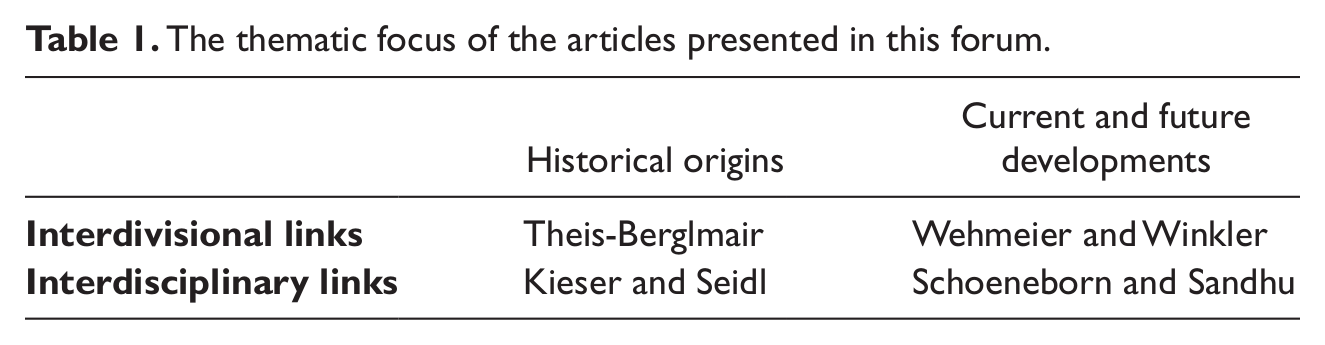
Although organizational communication has no distinct tradition as an established field of research in German-speaking academia (as described above), there are important works in neighboring disciplines, particularly in organization studies (as a subdiscipline of management studies), organizational sociology, and linguistics that prove relevant to the study of organizations as communicative phenomena. While the “container-like” notion of the relationship between organization and communication (Putnam, Phillips, & Chapman, 1996, p. 125) is still prevalent among the majority of German-speaking communication scholars, in the field of organization studies, scholars like Kieser, Ortmann, or Schreyögg have embraced an understanding of organizations as primarily constituted by communication some time ago. This reflects the influence of eminent social theorists such as Luhmann (1995) and Habermas (1987), who understand communication as the fundamental mode of constructing social reality (cf. Deetz, 1994). Recently, young German-speaking scholars from the areas of organization studies and communication studies joined forces in an interdisciplinary network funded by the German Research Foundation (DFG). Their work centers on the notion of “organization as communication,” an idea that can transcend disciplinary boundaries. These interdisciplinary links are explored in the second section of this forum; again, through two articles. First, Kieser and Seidl trace the historical roots of the idea of “organization as communication” in the neighboring field of organization studies. Second, Schoeneborn and Sandhu shed light on the recent activities of young German-speaking scholars who focus on the notion of “organization as communication” through a brief review of these scholars’ work and the outline of a research agenda. Table 1 classifies the four articles thematically.
The thematic focus of the articles presented in this forum.
Footnotes
Declaration of Conflicting Interests
The author(s) declared no potential conflicts of interest with respect to the research, authorship, and/or publication of this article.
Funding
The author(s) disclosed receipt of the following financial support for the research, authorship, and/or publication of this article: This forum benefitted from the guest editors’ and most authors’ involvement in the scientific network ‘Organization as Communication’ ( ), funded by the German Research Foundation (DFG; grant no. BL 1149/1-1).