



Abstract
In this article, we present a rhetorical analysis of organizational communication by a non-profit, social movement organization, Amnesty International Denmark (AID), to illustrate how communication by non-governmental organizations (NGOs) simultaneously serves organizational self-interest and provides a set of symbolic tools for individuals to use in the process of constructing biographical certainty. Our analysis shows how AID’s member communication constructs a view of the world centered on moral binaries and invites members to identify with the moral position that AID represents. This idealistic morality not only offers members a sense of collective identity, certainty, and order in their own lives but also serves AID by preserving the moral high ground for the organization and creating a broad basis for support.
This article presents a rhetorical analysis of organizational communication by a non-profit, social movement organization, Amnesty International Denmark (AID), illustrating how communication by non-governmental organizations (NGOs) simultaneously serves organizational self-interest and provides tools for individuals to use in the process of constructing biographical certainty. We situate our analysis in the context of reflexive modernization (Beck, Giddens, & Lash, 1994) and the “risk society,” where individual life-courses are less and less defined by society’s formal and informal institutions. Instead, individuals are increasingly responsible for their own biographies using resources that emerge through interactions with organizations, groups, and individuals (Beck, 1992). In this context, organizational communication offers a set of rules and options for action that act as “building blocks” for the reflexive individual’s preferred biography.
We aim to contribute to the growing literature that complicates organizational rhetoric and takes “a skeptical stance that identifies the multiple interests involved” (Boyd & Waymer, 2011, p. 475). We explore how different rhetorical techniques both provide for individual biographical needs and simultaneously construct organizational legitimacy, thereby protecting organizational power. While many rhetorical studies have focused on corporate or government communication, non-profit organizations (NPOs) have been noted as a neglected but important site for communication scholarship (Dempsey, 2009; Lewis, 2005). They play a significant role in civil society, affecting corporate practices and government policy, communicating particular visions of the world (della Portia & Diani, 2006, p. 109), and providing a means for their audiences to affirm commitment to a collective identity (Polletta & Jasper, 2001). However, the political nature of their communication practices has not received a great deal of attention (Dempsey, 2012; Lewis, 2005). In taking a non-profit NGO as our case study, we add to the limited scholarship that explores organizational rhetoric beyond profit-driven corporate contexts (e.g., Ganesh, 2005; Heath & Waymer, 2009).
We begin by contextualizing organizational communication within reflexive modernity, before considering the specifics of communication by NPOs and NGOs, a subset of NPOs, then discussing the method and case. Finally, we reflect on the implications of the study for future research.
Organizational Communication in the Context of Reflexive Modernity
Organizational communication is an interactive process through which reality is constructed. It is both productive and ideological, constructing systems of meaning that regulate understanding in particular contexts (Cheney, 1991; Mumby, 1988; Mumby & Stohl, 1991). Symbols and rhetoric present options for interpreting the world and our place within it, but also restrict the options from which we may choose.
An organization’s practices, purpose, and values are framed within these discursive contexts, together constructing an organizational identity to which internal and external audiences can relate. Cheney and McMillan (1990) have argued that increasingly fluid organizational boundaries mean that audiences traditionally understood to be outside the organization are now frequently and proactively engaged in internal organizational processes (e.g., customers giving feedback, or designing products). Hence, “external” organizational communication must be understood as self-referential, where messages serve as much to reinforce the identity of the organization among its members, as to communicate to those outside its boundaries (Cheney & Christensen, 2001). The point is particularly pertinent to NPO communication, where supporters may not be formally employed by the organization, but frequently carry out its work as volunteers, and feel they have a significant stake in its existence. Understood in this way, organizational communication is a means of both defining the organization for itself, and setting out the values that frame how and why people might identify with it. It provides individuals with tools to construct and publicly assert their identity through the organization, and a rationale for affiliating with others in a complex world (Cheney & Christensen, 2001; Jones, 2002).
These functions align with the demands of risk societies and reflexive modernity (Beck, 1992, 1994), where traditional institutions and social boundaries have weakened and individuals must find ways to both construct their identity and minimize risk in an environment marked by indeterminacy and nonlinearity. As “subject[s] of entitlements” (Beck, 1994, p. 8), they are bound to choose between various educational, career, and lifestyle opportunities as they create their identity, and bear the risks inherent in their decisions (Lash, 2003). The continuous cobbling together and staging of a stable biography instills a sense of linearity in the life course by locating the self securely in a particular narrative and social context, but the multiplicity of available identities means that drawing subject boundaries becomes a matter of “rule-finding” rather than “rule-following” (Beck, Bonns, & Lau, 2003; Lash, 2003). Thus, reflexive modernity foregrounds the individual as the locus of risk management, driven by a fundamental need to “invent new certainties for oneself” (Beck, 1994, p. 14).
Zinn (2004, 2005, p. 94) argues that there are five basic types of biographical certainty, each a function of the interaction between the ways individuals draw on norms, perceive the nature of uncertainty, understand the nature of time and the future, and develop specific grounds for action. In the case of NPO communication, Zinn’s “approximation” type of biographical certainty is most pertinent. 1 Individuals relate their biographical construction to normative forms of morality; interpret uncertainty as imperfections in the external environment; assume that it is possible to attain an idealized future goal, even if that goal can never be fully realized; and rationalize their action within the logic of a particular value system. The “rules” they seek to guide their biographical construction relate to these parameters.
As civil society institutions that distance themselves from more traditional sources of authority by offering alternative narratives for understanding the environment, NPOs may contribute to this process insofar as they counter economic and political norms with a set of “rules” grounded in moral responsibility. An environmental NPO, for example, may communicate a collective and individual responsibility to preserve the planet for future generations (normative morality), locate the cause of environmental damage in human activity (imperfection), focus on the goal of a fully sustainable future (ideal future goal), and present a set of values that direct action (rationale)—for example, privileging the natural environment over man-made landscapes, recognizing the rights of future generations to a healthy planet, and taking personal responsibility for the environmental impact of one’s lifestyle.
Strategies for rule-finding may be realized through engagement with organizational communication as members of “discourse arenas involved with the exchange of meaning and identity” (Jones, 2002, p. 50), to rationalize specific lifestyle choices, support for particular causes, and/or the adoption of particular opinions. Such rationales are not set in stone: Identification needs only be asserted in the context of division, and does not negate the separate nature of things (Burke, 1969b). In organizational communication, identification emerges through the dialogic interaction of organization and audience (Toth, 2009). During these exchanges, organizations also find ways to serve their own interests by using rhetoric, defined as “the art of using symbols to persuade others to change their attitudes, beliefs, values or actions” (Cheney, Christensen, Conrad, & Lair, 2004, p. 79), to create discourses that establish their identity and legitimacy among as wide an audience as possible (Cheney, 1991). The challenge of constituting meaningful relationships is ever-present (Ihlen, 2011), because identification emerges as a choice in response to rhetorical strategies and may change over time (Burke, 1969b).
As Cheney and Christensen (2001) note, “The ongoing rhetorical struggle for organizations of most kinds is to establish a clearly distinctive identity and at the same time connect with more general concerns so as to be maximally persuasive and effective” (p. 233). These contradictory goals present a dilemma: An overly specific organizational identity may alienate particular groups and reduce legitimacy. Consequently, precision must be sacrificed in the service of effectiveness. Organizations may adopt “strategic ambiguity” in their communication, drawing on abstract ideas that unify rather than fragment audiences, but still permit a range of individual interpretations (Eisenberg, 1984). Strategically, ambiguous communication allows institutional messages to be deployed as ideological tools that “bring together disparate social worlds by allowing people to proceed as if they were all talking about the same thing” (Barley, 2011, p. 203). For example, NPOs might use terms such as “justice,” “poverty,” or “environmentally friendly” repeatedly, without defining their exact meaning, yet still invoking normative understandings of morality and responsibility that may prompt collective action. Alternatively, organizations may use rhetoric to promote different identities to different audiences in ways that align with their particular interests (Cheney et al., 2004; Sillince, 2006).
Context is fundamental to any analysis of organizational communication (McGee, 1999), and reflexive modernity is an important contextual consideration that offers insights into how organizational rhetoric manages to serve the biographical needs of audiences while constructing a legitimate organizational identity and purpose that will garner support from as wide an audience as possible (Crable, 1990). This is particularly important when considering the work of NPOs. Scholars have called for greater attention to the complexities and tensions inherent to NPOs as institutions ostensibly working in the service of society (Dempsey, 2009; Koschmann, 2012; Lewis, 2005; Sanders, 2012), and a more critical approach to the ways in which they operate as “political actors” (Dempsey, 2012, p. 149), exercising power and control through discourse (Lewis, 2005). In the next section, we review existing scholarship on NPO and NGO communication to frame our analysis.
NPO and NGO Communication
NPOs constitute part of what Beck calls the sub-political arena, where action is concerned with the “shaping of society from below” (Beck, 1994, p. 23). NPOs differ in important ways from commercial organizations: They are not driven by a profit imperative, do not have a contractual relationship with the majority of their members, and promote social change in the interests of society rather than the market. Their survival depends on generating enough support to legitimize their cause in the eyes of those who have the power to make the social change in which they are interested. These material realities shape their communication as they draw on a range of techniques to enhance their reputation and mobilize audiences (Meisenbach & Feldner, 2011; Peruzzo, 2009). However, NPOs should not be considered as purely altruistic channels through which societies are reformed for the better; they have contradictory relations with the institutions and populations where they are active, creating unforeseen cultural, social, and economic problems through their interventions (Feldman, 1997; Ganesh, 2005; Meisenbach, 2008). NPO communication should be understood in terms of this complexity. Like that of other organizations, it is both productive and disciplinary, valorizing individual identities, practices, and values that align with the particular world view being promoted (Mumby, 1988).
Generally speaking, NPOs frame their purpose in terms of fulfilling a legitimacy gap between institutions and societal expectations (Heath & Waymer, 2009). Activist NPOs act as signifying agents whose discourses construct meanings that generate “collective action frames” for individual engagement (Benford & Snow, 2000, p. 613), challenging the practices and policies of governments and corporates in particular. In rhetorical terms, their communication anticipates, shapes, or responds to the situations in which such practices and policies are couched (Cheney et al., 2004). They must simultaneously communicate ethos, or their own identity and authority, as a rhetor.
NGOs are a specific type of NPO, set apart by their identity as “formal (professionalized) independent societal organizations whose primary aim is to promote common goals at the national or the international level” (Mertens, 2002, p. 282). Ganesh (2003) notes that NGO communication is characterized by a tension between legitimacy, or “the extent to which an organization searches for justification for its existence from its environment,” and accountability or “the extent to which an organization is publicly required to justify its actions to its environment” (p. 565). While accountability is central to NGO identity, more often than not, legitimacy supersedes accountability in discourse, to the detriment of those whom the organization is ostensibly trying to help (Feldman, 1997). Dempsey (2009) also takes a critical view of NGOs’ “communicative labor.” Through a case study of an environmental justice organization, she illustrates how NGO communication actively constitutes identities of beneficiaries and organizational members, to serve a particular politico-economic agenda. Meisenbach (2008) found a similar pattern in community-level NPO communication. Her analysis of community engagement programs in North American universities showed how “engagement” discourses and practice perceived as legitimate in the academic context, in fact contributed to the material and discursive separation of universities from their local environments, and to the homogenization of different local identities through the use of terms like “community.” Both effects were resented and challenged by stakeholders: Legitimacy may have been achieved among academics, but accountability was far from realized.
In summary, the research on NPO and NGO communication suggests that their organizational identity and purpose are framed in the interests of beneficiaries, supporters, and other stakeholders, using a self-serving logic that prioritizes legitimacy over accountability. In the context of reflexive modernity, it may involve presenting a perspective of environmental risks and opportunities that appeal to a broad audience, offering an easily understood set of “rules” for biographical construction.
The Case: AID
To explore how NGOs discursively establish and maintain symbolic relationships with their supporters in reflexive modernity, we used AID as the case study for an investigation of multiple texts that would enable us to demonstrate particularities while accumulating knowledge about organizational communication (Flyvbjerg, 2001).
Amnesty International is a transnational social movement organization (della Portia & Diani, 2006) campaigning for the principles encompassed in the United Nation’s Universal Declaration of Human Rights. It was established in 1962, following a successful year-long campaign led by British lawyer, Peter Benenson, advocating the release of incarcerated political prisoners (Hopgood, 2006). It has become one of the most influential NGOs worldwide, with a strong, non-negotiable identity as a social movement organization focused on human rights (Snow & McAdam, 2000), offices in more than 80 countries, and more than 3 million members and supporters (Amnesty International, 2011a). The Danish chapter employs around 60 people and engages paid recruiters on the streets, alongside volunteers. It has experienced soaring membership, reaching 100,000 in 2010, and is the eighth largest contributor to the movement’s budget (Amnesty International, 2011b).
AID challenges the expertise and actions of governments and associated institutions, by focusing on their shortcomings in protecting citizens’ rights. It highlights an apparent vacuum in institutional leadership and offers a means through which individuals interested in social justice can make their voices heard. For supporters, engaging with AID means engaging with its broad mission: Donations cannot be earmarked for specific causes (with occasional exceptions).
Our data collection ran from December 2010 to July 2011. During this period, two global events, both closely related to Amnesty International’s focus on human rights, dominated the news agenda: WikiLeaks’ release of U.S. diplomatic cables to global news organizations (November 2010 onward), and the citizen uprisings of the Arab Spring (December 2010 onward). Both events constituted an explicit challenge to traditional institutions, including governments, the police and legal systems, reflected in global media coverage questioning the trustworthiness and morality of the state. The events revealed the uncertainty inherent to reflexive modern societies, challenging individuals to make sense of their world without relying on governments to protect them, as the limits of morally correct behavior were blurred by the actions of those same governments. For AID, the situation was an ideal backdrop to provide a normative moral stance on human rights as a foundation for biographical construction, and to argue for the importance of its own role as an NGO championing universal human rights. The time period was therefore particularly apt for a study of how NGO communication might be shaped by the conditions of reflexive modernity. During the data collection period, AID’s communication dealt explicitly with these major events, as well as more local issues such as the rights of asylum seekers in Denmark and the conflicts in Afghanistan and Iraq (where Danish troops were present).
Rhetorical Analysis
Rhetoric is constructed in the context of the need for humans to make choices about action. It emerges in specific rhetorical situations (Bitzer, 1968), where language plays a central role in promoting a particular course of action or intervention in response to certain environmental conditions; persuasion toward a partisan end is the ultimate goal (Hauser, 2002). Rhetorical situations usually have a predictable life cycle in that they emerge, mature, decay, and die, but as we have argued, taking reflexive modernity as an important environmental condition allows us to recognize the ongoing importance of decisions about risk, (un)certainty, and biographical construction for audiences engaging with organizations in discourse arenas (Jones, 2002). In addition, in the context of social movements, the rhetorical situation is temporally open-ended, and will evolve according to the interests of different rhetors (Hauser, 2002). Central to rhetoric is the process of bilateral argument, through which different perspectives of the rhetorical situation can emerge. Bilateral arguments feature a “wedge” between rhetors and their messages, enabling them to reflect on alternative meanings and the possibility of change (Johnstone, 1982). In practice, however, unilateral arguments are frequently used, which attempt to impose a singular interpretation of the situation by denying other rhetors equal opportunity of response (Hauser, 2002).
Rhetorical analysis is concerned with the strategic presentation of symbols that induce identification and action in reference to particular situations (Hauser, 2002; Hoffman & Ford, 2010; Suddaby & Greenwood, 2005). Identification that can lead to action is grounded in four stages of rhetorical influence: a judgment of salience by the audience, an ability to affect attitudes, an ability to affect the substance or intensity of beliefs, and finally, the translation of beliefs into action (McGee, 1999, pp. 71-72). In addition, Hauser (2002, p. 78) suggests that rhetoric dealing with public problems, such as human rights, will be structured to address three main concerns: problem definition, causes, and possible solutions.
To provide a flexible framework for our discussion, we structured our analysis in the context of Hauser’s overarching conceptualization of rhetorical strategies (Figure 1). First, the rhetor presents the environment in a certain way through the deployment of “god-terms” and maxims. “God-terms” have an impenetrable, almost sacred character; they are popularly accepted without interrogation and have a motivational appeal because they are constitutive of a rhetorical community (Burke, 1969b). In the case of AID, for example, god-terms are likely to reflect the organizational mission of ensuring human rights for all. Similarly, maxims are expressions of a truth or ethical principle with which the audience is expected to sympathize (Graff & Winn, 2006) and have argumentative force because they communicate a condensed value judgment constitutive of the social group being addressed (Perelman & Olbrechts-Tyteca, 1969). Taken together, abstractions in the form of god-terms and maxims permit strategic ambiguity and help to generalize the world view presented through organizational communication. In addition, Mumby and Stohl (1991) emphasize the importance of attending to binary oppositions, where one concept dominates organizational discourse at the expense of its counterpart. Deconstructing the ways in which god-terms, maxims, and oppositions are used in AID’s rhetoric will therefore reveal the normative moral “rules” that underpin their claims and should guide individual behavior.
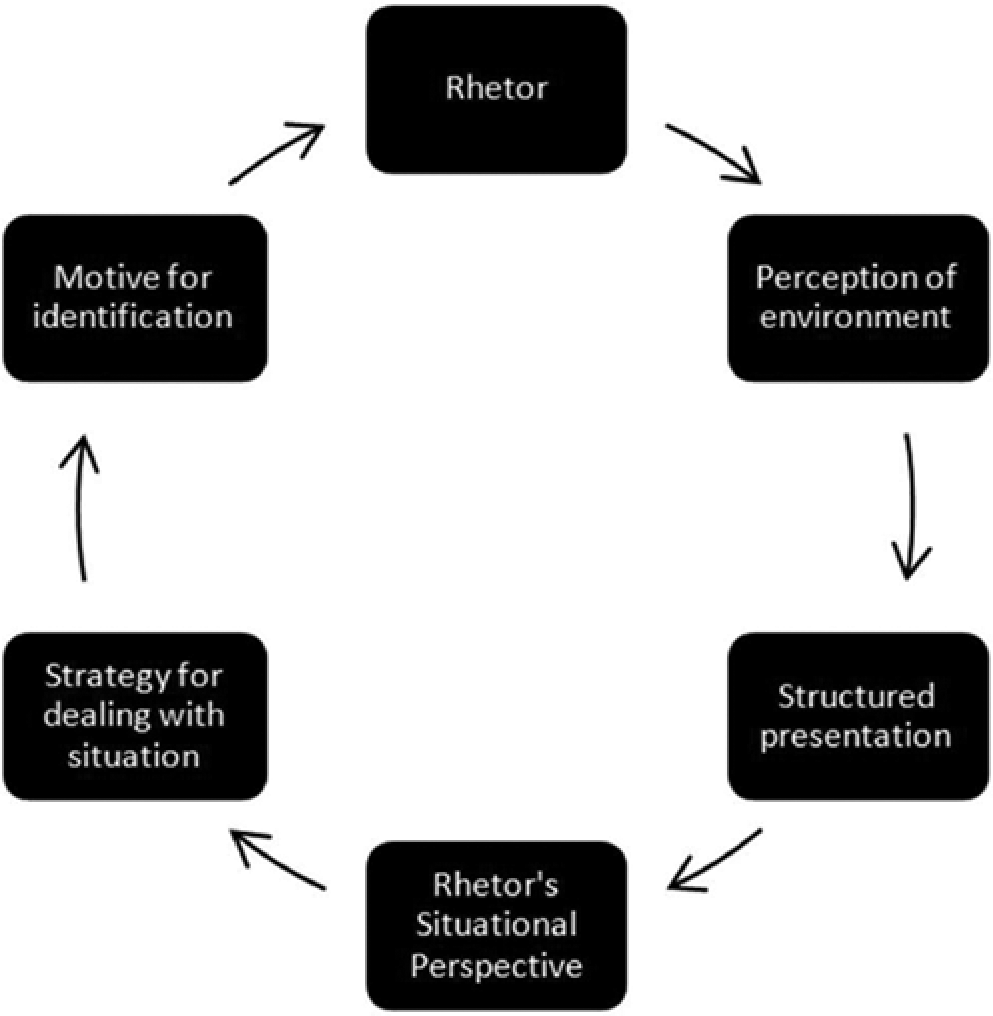
The strategic process of rhetoric.
Tension in the environment (arising from, for example, an instance of human rights abuse) leads the rhetor to define their situational perspective by deploying a normative definition of the current problem, specific roles for different actors involved, and criteria for judging the situation. Benford and Hunt (1992) suggest that the construction and nurturing of a particular vocabulary, or terministic screen (Burke, 1966), serves as an interpretive filter for problem recognition and identification, directing attention to some aspects of a situation while placing others in obscurity. Arguments by example are also partial, engaging the audience as co-constructors of meaning through the interpretive work they must do to understand the relevance of the example (Hauser, 2002). The rhetorical strategy of repetitive form (Burke, 1968) is also relevant here, where the same principle is continually restated in new guises, increasing its salience in the minds of the audience, which comes to expect its continuation. Analyzing the use of terministic screens, arguments by example and repetitive form in AID’s communication, should therefore reveal how audiences are oriented toward interpretations of events that align with AID’s mission.
Finally, the rhetor presents the audience with options and motivations for identification and engagement that can act as a means of solving the problem. Personal stories make abstract maxims and god-terms tangible, and function rhetorically as “fantasies” with predictable plots and characters that consistently communicate the rhetor’s world view (Bormann, Cragan, & Shields, 1994). Epideictic discourses educate audiences by defining and promoting certain positions and principles on an issue—for example, praising or blaming a person, situation, or event to demarcate right from wrong (Aristotle, trans. 2004, 1.9.1366a). Intersubjective tactics increase the audience’s identification with an organization (and/or, in the case of NPOs, those whom the organization helps) by emphasizing either sufficient similarities (adequation) or differences (distinction) between the organization and someone or something (Bucholtz & Hall, 2005). Such techniques would allow AID to create a strong rationale for both identification and action among its supporters.
Data Sources
We analyzed the two most widely circulated types of AID communication: the quarterly magazine sent to all members and subscribers, and “letters of appeal,” which are calls to action emailed to all supporters who provide a contact, including all five letters of appeal issued over the 8 months and all the magazine issues during this data collection period. We also included the September 2010 magazine issue in our sample, so as to have a full year of copies in the data set (September 2010, November 2010, February 2011, May 2011). While the qualitative approach did not require a representative sample, including a full year of issues ensured our selection better reflected the range of topics that Amnesty might address in a single year. We present the sources as “textual fragments” (McGee, 1999, p. 69), best understood as a connected series of texts used to communicate a particular rhetorical strategy across time and space. They represent attempts to both explain and legitimize AID’s work on human rights, and appeal to supporters for their continuing engagement. In Beck’s terms, they explain (or construct) the risks to a just society that exist in normative governance structures, and the ways in which AID and its members can mitigate those risks by actively challenging institutions. As a form of Hauser’s (2002) rhetorical strategies, they posit AID’s perspective of a situation, options for identification, and possible solutions or strategies for action.
Letters of appeal are emailed to a selected list of members and newsletter subscribers. They comprise three or four short paragraphs, approximately 200 words in total, and include a picture and a “button” for taking action. The magazine is sent in hard copy to members and other subscribers. Each issue is approximately 50 pages long, providing a large body of data. However, the magazines are consistent in terms of their structure, the representation of human rights abuses as moral infringements, and the moral stance of AID in relation to human rights debates (see below). We therefore selected a sub-sample of three articles from the November magazine and the editorials from each issue (Table 1).
Sample Selection.

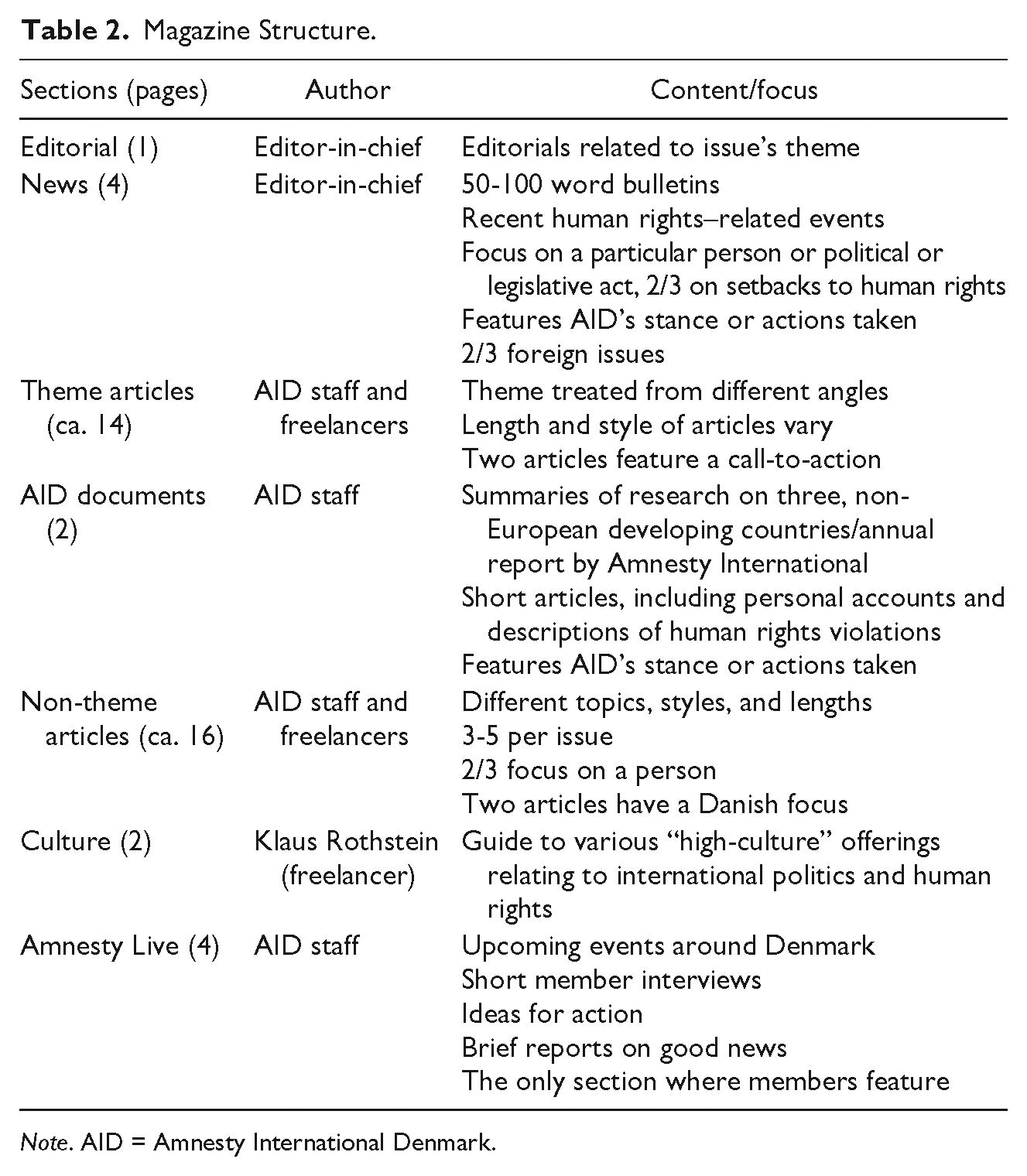
The three articles were representative of the in-depth stories that take up a substantial amount of space in every issue (see Table 2) and were typical of the style of articles in terms of topic (a strong focus on human rights violations rather than success stories), length, and structure. They took the form of a journalistic report, setting the scene with a discussion of a specific event relating to human rights abuses, followed by an account of the circumstances and debates that contextualized the event. While both sides of debates were always presented, the discussion privileged AID’s perspective. The editorials were constructed as the “voice” of AID, usually authored by the editor-in-chief, and were either a reader-directed monologue, reflecting on current human rights issues, or one side of a conversation with human rights abusers, in which case the author was assumed to “speak” on behalf of AID supporters.
Magazine Structure.
Note. AID = Amnesty International Denmark.
We first examined the structure and content of the magazines, to assess their consistency and ensure that selecting a smaller sample would not distort our analysis by including articles that had an unusual focus, or a perspective that was not representative of AID’s normative position on human rights. Second, we subjected the letters of appeal, four editorials, and three articles to an in-depth rhetorical analysis using the approach outlined above.
Magazine Structure
The magazines have a consistent structure as shown in Table 2. Each issue has a particular theme (e.g., post-war Iraq), introduced by an editorial. Four pages are then devoted to small news bulletins on recent human rights-related events and AID’s stance or actions taken. Foreign news dominates and the majority of bulletins concern human rights setbacks. The stories in this section, combined with the editorial, set the scene for longer articles in the remainder of the magazine by creating the impression of a world where human rights are constantly under threat.
Several articles in each issue address the main theme from various perspectives. For instance, the theme of the February 2011 issue was the imprisonment of asylum seekers in the Danish prison of Ellebæk. Stories contained personal accounts from prisoners as well as interviews with Amnesty Medical Group and defense lawyers. In line with AID’s sub-political agenda, the articles challenge the actions of governments and institutions for their neglect of human rights. The only exception is the May 2011 issue, which marked Amnesty International’s anniversary and where the theme articles were positive. The next section, “Amnesty documents,” presents the main findings from three country reports. This section follows the style of the articles, including personal accounts and dramatic descriptions of violations of human rights. Non-thematic articles draw on personal accounts to focus on the bigger picture of human rights violations elsewhere, and quote other NGOs in support of AID’s arguments.
Two pages review cultural events and products relating to international politics and human rights. The reviews mostly concern what can be labeled “high culture” as opposed to “popular culture” and mainly cover non-fiction works. The final section, “Amnesty Live,” includes small pieces on upcoming events, member interviews, options for getting more involved, and a short column on human rights success stories. This section is the main area in which members are urged to engage with other members, or take other forms of action.
Findings
Moral Binaries: “Rules” for Biographical Construction That Serve Organizational Legitimacy
AID’s mission may be understood as essentially moral. Its aims are both to raise awareness of the obligations that come with recognizing universal human rights, making them a “public problem” in rhetorical terms, and to ensure those obligations are met by generating attitudinal change and substantive action. The first step toward realizing this mission is to make the issue of human rights salient to their audience. AID achieves this by using rhetoric to define the world in moral, rather than economic, social, or cultural terms, and co-opting the audience on the side of moral righteousness. In biographical terms, the “rules” AID offers suggest the existence of a normative morality, a value system that can be used as a backdrop for individual decisions about identity, self-conduct, and action (Zinn, 2005). In addition, positing the possibility of an ideal world where human rights are upheld suggests that moral risk and uncertainty can be managed if we try hard enough to tackle them, thereby also providing a rationale for audiences to support AID’s work.
The binary moral landscape that AID constructs provides the logic underpinning its appeals for action: An opposition is established between virtuous groups and individuals (AID, its supporters, and abuse victims), and self-interested, corrupt human rights abusers (usually governments or associated institutions). For example, the Arab Spring uprisings are presented as movements that can be trusted to engage seriously with human rights, in contrast to the governments they oppose (Normann Jørgensen, 2011, p. 2):
[Young Arabs] have realized that human rights are too serious to leave solely in the hands of governments, and they stand fast in spite of bullets, batons, tear gas and tanks. [ . . . ] [T]hey create a public bulwark that those in power cannot circumvent.
Other binaries operate along similar lines: The environmental imperfections that generate uncertainty (Zinn, 2005) are attributed to institutional self-interest, corruption, and power. Self-serving governments are contrasted with virtuous victims and their supporters. For example, “65 Years of Struggle for an Apology” (Klitgaard, 2010) portrays the weekly protests by Korean women demanding an apology from the Japanese government for being forced into sex slavery during World War II: “The demonstration takes an hour and takes place with microphones and music. Under sunhats, the old women sit facing the embassy. Even behind blinded curtains and hermetically closed doors the employees cannot but hear the message.” The moral binary is reflected in the contrasting actions taken by each side of the protest: sound versus silence; action versus inaction; visibility versus invisibility.
Binaries help to construct social movements, which “derive their significance from their relation to opposite terms” (Burke, 1969a, p. 408); ego emerges out of antagonism, and self and other are mutually constituted (Carr & Zanetti, 1999). “The rhetoric of attack becomes at the same time a rhetoric of ego-building, and the very act of assuming such a rhetorical stance becomes self-persuasive and confirmatory” (Gregg, 1971, p. 82). In arguing that institutional imperfection must be eliminated, AID implies both that an ideal world of morally upstanding institutions is possible, and that it is worth striving for. Thus, by validating its cause, AID also validates its own identity as a morally righteous source of potential stability and security in an uncertain world. In the context of reflexive modernity, this process of self-justification is not limited to organizational identity, but also extends to “rule-finding” individuals who engage with organizations as part of their search for meaning, identity, and risk reduction. Oppositions invite a decision about whose side one is on, and in AID’s communication, the choice is made easier by the lack of distinction between AID’s identity as a formal organization and its community of supporters. By discursively reflecting AID and its work in the dubious and deplorable actions of governments and authorities, both its own and its supporters’ identities are constructed as an essential sub-political counterpart to dominant power. In biographical terms, members make the same moral choices as AID, and occupy the same moral high ground.
The master analog that helps to explain this reality (Bormann et al., 1994) is the ever-present righteous persona, bestowing the authority to define both the nature of human rights issues and the normative moral framework that guides action against human rights abuse. In the articles and letters, the imputed motives that brought about human rights abuse all reflect this sense of righteousness as government priorities are criticized. For example, in the letter “Write: Freedom for a Danish Citizen” (Amnesty International, 2011f), facts are presented to make clear who stands for right and wrong in a case of wrongful imprisonment: “Amnesty believes that the trial against Abdulhadi al-Khawaja is politically motivated and that he should be pardoned or brought in front of a civil court of justice.” Elsewhere, the Japanese government prefers saving face over taking responsibility for making the Korean victims suffer “a long wait despite the fact that Japan has admitted other war crimes” (Klitgaard, 2010). In publicizing the cause of the victims, AID distinguishes itself and its supporters from the guilty parties and becomes the righteous rhetor in an imperfect world where human rights are constantly at risk, upholding ideals on behalf of those who adhere to its values.
God-terms, maxims, and oppositional arguments relating to abstract moral concepts such as justice, freedom, and fairness are incorporated into an additional rhetorical strategy of repetitive form, where AID’s binary presentation of the problems and causes of human rights is constantly reiterated. For example, letters of appeal frame calls for action in moral terms: “Sign for justice” (Amnesty International, 2010); “Write [ . . . ] to give him a fair trial in a court that respects human rights” (Amnesty International, 2011f); “[Sign digitally] to fight for the right to a life without discrimination” (Amnesty International, 2011e). The evidence that action is morally correct is given in brief, factual statements about the cases:
Abdulhadi al-Khawaja was yesterday sentenced to life in a military court of justice in Bahrain. He is one of the most well-known political dissidents in the country and has been convicted of inciting protests against the regime in Bahrain and the spread of hatred towards the king. (Amnesty International, 2011f)
The facts, it is assumed, speak for themselves. AID does not spell out the logic for action: Readers impute the argument based on an appeal to broader notions of right from wrong in the context of AID’s moral binary value system (e.g., fighting for justice and freedom of speech versus politically motivated murder or imprisonment). The god-terms are an important argumentative force because they transcend the complexity of specific situations and direct attention to desired, albeit abstract end states (Hitlin, 2003); after all, who would argue with the need for justice, a fair trial, or freedom? Thus, repetitive form reinforces the validity of god-terms, maxims, and the moral binary as expressions of meaningful “rules” that can be used to construct a personal biography in the service of an ideal future state of affairs.
For this ideal future to seem attainable, the texts must assume a concord between AID and its audiences about the definition and importance of human rights. The success of this strategic assumption depends on oversimplification: If problems and causes were too deeply interrogated, the binary would become precarious because the complexity of human rights issues would be revealed. In other words, AID’s ideal future depends on an idealistic view of the present. Consequently, choices about what to include in human rights stories and letters of appeal are selective, framed purely by moral rather than material considerations. Institutional self-interest is invariably defined as the cause of human rights violations; rarely are there concessions in terms of governments’ economic, political, or institutional capabilities to adhere to human rights, or of the need to consider the complex consequences of events. For example, in “Dear Uncle Sam” (Hoff-Lund, 2010a, p. 2), U.S. actions on counter-terrorism were evaluated negatively according to human rights ideals alone, ignoring other rationalities such as homeland security or national sovereignty:
You seemed strange when you didn’t want to set up a court of justice in order to penalize the worst scoundrels and war criminals in the world. You said it was because you were afraid of being convicted yourself. Where was your belief that we must stand together to create a better world?
In “Hope has Returned” (Normann Jørgensen, 2011), the Arab Spring uprising is interpreted as a demand for human rights rather than a question of living standards or youth unemployment rates: “Young people in the Middle East and North Africa demand both their political rights ( . . . ) and their economic and social rights.” In the story praising WikiLeaks (Hoff-Lund, 2010b), there is no consideration of the implications of disclosing confidential documents, such as putting people’s lives in danger. Rather, a U.S. spokesperson is somewhat ridiculed: “A spokesperson from the U.S. Department of Defense strongly encouraged [WikiLeaks] to ‘return the stolen documents’ and warned the entire world’s news media against cooperating with ‘the indecent organization known as WikiLeaks.’” In every case, the presentation oversimplifies the issue being discussed and discourages any interrogation by supporters.
In terms of the rule-finding inherent to reflexive modernity, oversimplification, like the moral binary, provides AID supporters with a clear and consistent take on the world. The moral landscape requires individuals to take a position on ethical and moral “rights” and “wrongs” as part of their biographical construction, and AID provides a simple set of rules for position-taking, based on whether a situation upholds human rights, justice, fairness, equality, and related abstract ideals. Overall, AID’s strategically ambiguous communication facilitates both personalized strategies for biographical construction based on a clear set of rules, and a collective identity among AID supporters that helps to legitimize the organization. Biographical certainty as “approximation” (Zinn, 2004) emerges through the journey individuals undertake with AID, grounded in a clear moral value system and focused on improving the imperfect human rights landscape by committing to a moral ideal (the universality of human rights) that may only ever be partially realized, but is in principle possible.
Transforming Moral Ideals Into Action?
AID’s rhetoric provides the measure for individuals to assess and take a moral stand on human rights violations. It also provides a solution for these injustices, in its message that acting on the moral ideals it promotes will lead to their elimination. But realizing action requires that morality be somehow transformed into motivation. In line with our theoretical arguments, we suggest that a key motivator for action is the degree to which the latter delivers to individual biographical needs and reduces the degree of uncertainty and risk in the environment. At the same time, the action that AID promotes must serve its own organizational interests, and therefore the options for individual action are circumscribed from the start.
AID’s main motivational strategy is to promote supporters’ identification with the victims featured in its stories. In part, this is done by making clear the “righteous” position in the context of the moral binaries described above, but other rhetorical tactics also contribute. Intersubjective tactics (Bucholtz & Hall, 2005), for example, prompt identification by defining the moral identities of institutions and individuals, and using distinction or adequation to position them in relation to AID and its supporters. In “Dear Uncle Sam” (Hoff-Lund, 2010a, p. 2), for instance, the United States is addressed as Uncle Sam, a friend of AID, who has fallen into moral depravity and thus betrayed AID’s trust: “The image of a hero cracked when we heard the stories from the Abu Ghraib prison and Guantánamo. We don’t know you anymore.” Here, the immoral U.S. government is clearly distinguished from AID and its supporters, who actively oppose the U.S. position. In contrast, “391,832 Documents Later” (Hoff-Lund, 2010b) and “Farewell to the Front-Line Fighters” (Hoff-Lund, 2011) highlight the similarities between AID and morally sound institutions and individuals. In the former, WikiLeaks is presented as an organization working in the public interest by uncovering the truth, echoing AID’s efforts to make public problems out of issues that are frequently hidden. The latter editorial, which focuses on two deceased “front-line fighters” against the encroachment of minorities’ rights, ends with a wish that “others are capable of taking over their battle.” In the context of the theme for that particular issue (minority rights in Denmark), the statement implies that AID and its supporters could be the “others” who can take up the fight. In the letters, similar tactics are used. For example, the text of “Murdered for His Work for Homosexuals in Uganda” (Amnesty International, 2011d, emphasis in original) contrasts the action of AID and its supporters with the indifference of the Ugandan government to the fate of homosexuals:
Amnesty demands that the Ugandan authorities immediately initiate an investigation of David Kato’s death. We also demand that they provide protection to the other 99 homo-activists who were displayed by picture and name in the newspaper Rolling Stone. [. . .]
Thus, various manifestations of righteousness and morality are used as benchmarks for encouraging identification with, or opposition to, individuals and institutions.
Action is also encouraged by rhetorical fantasies (Bormann et al., 1994) that tap into the audience’s social consciousness. Multiple real-life examples of abuse allow abstract moral binaries (grounded in god-terms such as blame/innocence and justice/injustice) to be made material. They appeal to pathos by stirring indignation and creating space for audiences to identify with victims who embody the consequences of human rights abuse, thereby also aligning themselves with AID’s righteous position. In presenting stories of injustice, the organization calls out readers’ sense of justice; in presenting stories of shocking abuse, the organization calls out a shocked response, motivating readers to engage in prescribed forms of support (e.g., signing a petition, donating to the organization).
At the same time, personal stories direct attention to the bigger picture of human rights violations and the more general moral binary. For example, Niels Holck, a Danish citizen facing extradition to India for supplying weapons to Indian insurrectionists, is the vehicle for describing India’s treatment of prisoners (Hoff-Lund & Klitgaard, 2010); the torture of a Saharawi woman in a Moroccan prison is a means to explain unjust actions as the consequence of a disagreement over fishing rights in an area marked by an unresolved colonial conflict (Ellesøe, 2010); and the torture of an 18-year-old Egyptian protestor is used in a letter of appeal to prompt donations for AID’s work in Egypt (Amnesty International, 2011c). Hence, the victim’s role fuels the broader “social movement dramas” (Benford & Hunt, 1992, p. 40), or inductive arguments that entice the audience to engage in rule-finding by seeking further understanding of the context for specific stories, and thereby uncover the moral framework that can guide their own biographical construction.
The moral binary means that the texts, and the moral positions that underpin them, can be enthymematic, or incomplete. We respond to patterns, expecting their continuation and completion (Hauser, 2002); an argumentative pattern such as the moral binary instills certain expectations in the audience: Human rights are vulnerable to attack even by those we thought we could trust, and do not defend themselves. Selective conclusions, and rationales for action, follow: Institutions must be continuously challenged, to avoid human rights being eroded. Consequently, much may be imputed by AID’s audiences, and detailed arguments are not always required. The letters of appeal, for example, act as rituals in which action prescribed by AID is the logical outcome. These letters allow the audience to actively assert a desired moral identity through their support for AID, without ever receiving a detailed explanation of the cases they are being encouraged to support. Their headlines (see Table 1) are broad, emotionally driven appeals to the audience’s sense of indignation, and betray AID’s desire to invoke a response from the reader not only in relation to the case but also to the wider threat it represents to the vision set out in the Universal Declaration of Human Rights. The implication is that the suggested actions (donating, writing letters, or signing petitions), when engaged in by enough supporters, will help to reduce risk and uncertainty in the global landscape of human rights, but that delivering detailed knowledge about the issue at hand is not necessary for this to happen. In this way, the moral binary facilitates a broad appeal for AID by permitting strategic ambiguity even as AID narrates specific cases of abuse, and ensuring its interpretation of the world remains uncontested by its supporters.
Discussion
In the context of reflexive modernity, AID provides a strategically ambiguous, rule-based rationale for an “approximation” mode of constructing biographical certainty (Zinn, 2004), where the morally imperfect landscape must be dealt with according to a moral binary value system. Abstract concepts such as freedom, justice, and fairness are ideals toward which all should strive, to fulfill (albeit partially) the ideal future goal of universally protected human rights. Taking action to realize this goal is a logical outcome of applying the value system to an imperfect world. The moral binary constitutes an important resource for individuals in reflexive modernity, because it provides a set of rules that simplify both the framework for the construction of biography and the decisions required to achieve that biography in a risky and uncertain world. Supporters express their morally righteous activist identity by engaging sub-politically; their actions (letters, petitions, donations) constitute a historical record that evidences their efforts to change society from below.
As the locus for action, AID also constitutes a hub for a shared political consciousness around which its supporters can converge, validating their chosen identity in community with others (Jenkins, 2004; Jones, 2002). Its rhetoric directly challenges the assumption that understanding and solving human rights issues is the privilege of public authorities and traditional expert systems, “demonopolising” their expertise (Beck, 1994, p. 29) and invoking skepticism among members. Engaging with AID allows individuals to act in concert by having their views symbolically represented in public discourse—the organization speaks on their behalf (Jones, 2002)—and, through AID-orchestrated activities, by participating in communal forms of active citizenship that challenge the traditional political sphere.
In a world defined in moral terms, the more absolute AID’s claim to moral authority can be, the greater is its legitimacy. As Demetrious (2006) argues, detachment from economic self-interest and political independence, both lend sub-political organizations the “legitimacy to dissect and describe and advocate social, economic, and cultural impacts in the public sphere” (p. 99). Having deposed the authority of traditional institutions, AID claims an expert role by positioning itself as the guardian of moral ideals in an imperfect world and an authority over the interpretation of complex issues. It advocates ideal states of human rights protection rather than incremental improvements, suggesting that adherence to these ideals is the only path to resolving current issues. Its extensive use of research to shore up its arguments enhances the claim to authority and objectivity (Wilson, 1997).
In taking on the (moral) expert role, AID instills reflexivity in debates about human rights, as issues that were formerly dealt with behind closed doors become the subject of public dialogue. This creates a “partial publicity” (Beck, 1994, p. 29), a visible debate that makes AID’s claim to expertise in the matter of moral judgments even more powerful. At the same time, conflating the identity of AID with that of its supporters instills in the latter a sense that they too are active, with the ability to manage moral risk and affect political and social outcomes.
Nonetheless, the active citizenship AID offers to its supporters has limits, because the rhetoric that AID uses is unilateral, rather than bilateral. Constructing AID’s expertise in the context of unequivocal binaries may create a clear focus for biographical construction, action, and identification as well as a stable foundation for biographical narratives, but it also limits the potential for supporters to manage or complicate the meaning of AID in the public sphere, which could blur the symbolic space that the organization occupies. In fact, AID’s rhetorical strategy, while apparently promoting sub-political engagement, actually creates a rather passive audience and minimizes the potential for supporters to challenge its work and legitimacy. In representing the world in binary terms, AID performs a magical “sleight of hand” (Crable, 1990, pp. 123-124), drawing the audience’s attention away from its own processes and practices and toward the practices of others. AID is important as a foil for immorality; to function effectively in this rhetorical role, its own integrity and judgment must remain unquestioned. Indeed, Amnesty International has faced significant criticism from media and governments about its internal financial management and ideological bias, yet supporters are not invited to enter into a dialogue about AID practices or act autonomously to defend human rights. AID works on their behalf or suggests appropriate strategies for them to engage in. From the organizational perspective, the response sought from supporters is approval, sympathy, and implicit or explicit support, alongside recognition that AID’s activities have a positive impact. Implicitly, the argument is made that action is more effective when conducted as a collective, with or in support of AID, rather than independently. Thus, in providing supporters with the biographical resources they need to make their way in reflexive modernity, AID also protects its own position.
The analysis presented here is one example of how NGO communication can fulfill individual needs for biographical certainty and risk reduction by providing a set of rules and strategies for action, building blocks through which identity may be constructed consistently, over time. At the same time, it illustrates how NGO communication must facilitate organizational legitimacy by constructing a space within which the organization may safely claim the moral (social, cultural, political) high ground. Strategically ambiguous communication maximizes the appeal of such claims, while making them “safe” means limiting the degree to which supporters may debate or co-construct the organization’s identity. Consequently, unilateral arguments based on abstract ideals predominate, and reinforce the disciplinary effect of organizational rhetoric as a means of securing support (Crable, 1990). Individual supporters are obliged to take a position in the moral landscape AID constructs. To take a position against AID would be to align oneself with other moral outcasts. Inevitably, the most desirable position is in support of the organization because it facilitates an attractive biography and a sense of belonging, while allowing the individual, through AID, to manage the risks inherent in a complex and changing world.
Our theoretical approach and findings extend the understanding of the persuasive power of NGO communication in modern societies. The case study gives further credence to Ganesh’s (2003) finding that legitimation is indeed more important than accountability in NGO communication, which must serve the needs of the organization as well as its supporters. It also raises questions about the extent to which the findings might apply to other types of NPO. By treating reflexive modernity and its associated phenomena as an ongoing rhetorical situation, the case suggests new ways of understanding the delivery, reception, and use of NPO communication by individuals faced with the need to construct their own biographies and minimize risk. For example, it may be that the stronger the moral steer provided by an NPO, the greater its potential to be perceived as a legitimate organization, and the greater the personal value derived from engaging with it as part of the process of moral “rule-finding.” Avenues for further research might include investigating the varying types of biographical construction facilitated by NPOs that differ in their size, geography, and adopted causes.
Finally, in terms of the broader understanding of organizational rhetoric, using reflexive modernity as a framework for analysis is an important means of extending our understanding of the disciplinary effect of organizational communication beyond Foucauldian models. The rhetorical sleight-of-hand that organizations deploy serves a purpose not only in generating support but also in its cognitive, affective, and material effects on our strategies to make sense of an uncertain world and reach decisions about how we live our lives.
Footnotes
Acknowledgements
We thank the editor and reviewers for their insightful comments on the article.
Declaration of Conflicting Interests
The author(s) declared no potential conflicts of interest with respect to the research, authorship, and/or publication of this article.
Funding
The author(s) received no financial support for the research, authorship, and/or publication of this article.