



Abstract

Some of the most meaningful products of my academic life are the friendships that I have formed over the years with “respondents” and “participants.” Often, they have emerged from the research, but in other situations, they have driven the research itself. My PhD dissertation methods chapter provides an extended account of how my longstanding friendship with two people who were unhappy with the nongovernment organization in which they worked drove my interest and critique of that organization. Yet, when I put that fact into a manuscript that I eventually submitted more than a decade ago to this very journal, a colleague advised me to remove it. Even then, my “bias” met with critique. “There is too much emotion,” a reviewer intoned. “While I appreciate the direct attention to demonstrating the importance of this issue, the rhetoric is too heated and the tone is too dismissive.”
Make no mistake: I actually cringed when I re-read the early version of the eventually published article (Ganesh, 2003). The voice in which I was speaking (or perhaps shouting) came off as shrill, the manuscript was clumsily put together, the writing was poor, and many arguments lacked nuance. I am deeply grateful to the reviewers who engaged that piece despite its flaws, and the revision process, trial by fire though it was, taught me a thing or two about writing for communication journals.
One of those lessons was the notion that ideas needed to be presented in a considered, manifestly dispassionate, and quasi-realist tone. There are a host of robust warrants for this argument, including the need for methodological transparency and the need for qualitative research to be presented as rigorous, systematic, and valid. However, like other contributors to this forum, I fear that pressures to strike a dispassionate stance have elided the deeply constitutive role that personal and relational experiences play in the production of knowledge in the slew of methods that we loosely call “qualitative.” In this essay, I hope to recenter the issue of researcher subjectivity and passion by drawing attention to the tension between realist and confessional modes of representation that animate the majority of academic writing practices populating the pages of our journals.
Unraveling the Confessional Tale
Twenty-five years ago, Van Maanen’s (1988) much-cited book Tales of the Field broke ground in organizational ethnography by legitimizing multiple modes of representation in qualitative inquiry. In particular, the book encouraged a literary and textual turn toward ethnographic poetics and personal narrative (Denzin, 1997) through its elucidation and critique of various conventions associated with “confessional tales.” Many scholars have invoked confessional tales as a legitimizing device for autobiographical and highly reflexive forms of ethnographic writing (e.g., Biaett, 2012; Connolly & Reilly, 2007), framing their writing as a way of escaping the omniscient, detached, and neutral stance of “realist tales” (Emerson, Fretz, & Shaw, 1995; Van Maanen, 1988).
However, what is less evident in scholarly appropriation of Van Maanen’s (1988) work is his implicit and subtle critique of the genre. This is evident in at least three fronts. First, he describes the confessional genre as often attempting to make qualitative fieldwork scientifically acceptable: “Most confessionals have at their core some hope of making fieldwork, if not fully safe for science, at least respectable in terms of upholding some community standards and disciplining the undisciplined of fieldwork” (p. 74). Second, confessional tales are often sequestered into a methods section, chapter, or appendix, “interesting only insofar as there is something of note to confess as well as something of note to situate the confession” (p. 81). And finally, confessional tales are often saturated with dreary conventions surrounding the need to create an aura of personal authority, reinforce the difficulties and hardships involved in fieldwork, and ultimately demonstrate the competence of the field-worker.
It is easy to see then, that the confessional tale as rendered by Van Maanen (1988) actually buttresses and reinscribes the representative authority of realist tales by serving as a warrant for the scientific rigor of ethnographic work, being relevant only insofar as it further supports the “real” or “objective” analysis that precedes it, and boosting the scientific and cultural credibility of the field-worker. Furthermore, the very semantics of the term confessional construct a somewhat privatized and sequestered notion of researcher subjectivity; as Pillow (2003) implied, it rests on a form of reflexivity that is thoroughly modernist in that it presumes a knowable self that can be accessed, be reflected upon, and not be lost during the process of fieldwork.
Thus, at least part of the reason that some of the most raw, relational, or even frightening aspects of fieldwork are left out of my formally published research are because a lot of my work continues to rely on insidious realist tropes that themselves have been sharply criticized for their deductive style (Tracy, 2012) and that demand that researcher “biases,” or passions and identities be mentioned as an aside rather than be problematized as a central aspect of the analysis itself. For me, this is true even of studies that have used participant observation as a method of analysis (Ganesh & Stohl, 2013). It is only when researcher experience has been the subject of research itself and I have employed personal narrative as a trope to address issues ranging from sexuality and assimilation (Ganesh, 2008) to professional identity and place (Ganesh, 2009) that I have broken past the mutual construction of confession and realism, and front-story and back-story. In the process, I have discovered fragile, small, new, and precious moments of insight.
In addition to the historically institutionalized sequestering of personal narrative in fieldwork accounts, there are some aspects of theories themselves that accentuate the textual disconnect between some of my formal published analyses and the personal significance of that work. Large terms like theory and method after all mean vastly different things and are consonant and dissonant in multiple ways depending on the paradigm that surrounds them (Corman & Poole, 2000).
One particularly important kind of theory–method dissonance is rooted in questions about what counts as legitimate forms of academic writing. Tracy (2012) argued that “most reviewers and editors still expect grounded, interpretive or iterative research articles to proceed in roughly the same format as quantitative and postpositive empirical analyses” (p. 112). She argued that the consequence of trying to fit square pegs into round holes not only misrepresents the iterative character of much qualitative research but also significantly constrains theory building, because it sets up qualitative studies to work primarily with already established literatures and theories instead of enabling them to “pay close attention to contextually specific explanatory cues for behavior” (Tracy, 2012, p. 119), often reducing commentary about the inductive character of the study to a footnote (see, for example, Nag, Corley, & Gioia, 2007).
My broad theoretical commitments to organizational communication studies have at times rendered aspects of fieldwork invisible in the final “product” of research, including my own identity investment in the issue as well as the personal and relational significance of the fieldwork itself. Some of this is inevitably due to academic textual representation practices that are not only the product of reviewer and editorial injunctions but also due to authorial self-censoring. For instance, in a recent piece on the Occupy movement that was driven by participant observation, the need to meet the journal’s word limit resulted in my voluntarily cutting out an entire field extract, because a key point about digital connective action enabling connections between diverse groups of activists had already been made in the theoretical section (Ganesh & Stohl, 2013). The deleted extract is reproduced below:
I continue moving around the bridge, from one portion of the crowd to another, trying to talk to protesters with placards, and find people who are distributing pamphlets and other material. Many other people are milling around, taking photographs, checking their smartphones. As I do this, I keep listening to the speeches. One activist who identifies as queer talks about the importance of ensuring the Occupy movement attracts many different groups with different values. Another speaker makes connections between industrialism and climate change, also talking about the need to act locally to prevent environmental disasters. Yet another introduces herself as a woman from Westland, who talks about this year’s mining disaster that killed 29 miners. She talks movingly about her own loss, and the devastating emotional, economic and social effects the disaster was having in the community there, asking all of us to push for safety regulations for miners that had either not been enforced or had deteriorated over the years at the insistence of the Pike River company.
There are insights to be gained from this brief extract not only on connective action but also on the emergence of an intersectional identity for protest participants and the renewed importance of locality in contemporary global protests. However, the very format of journal articles; the need to be structured, focused, and editorial, means that fragile, small, and relatively fleeting moments of insight that are captured through qualitative forms of data-gathering are inevitably elided or deleted. I elaborate on this issue in the following section.
Confessions, Theories, and the TPPA
About nine months ago, I participated in a protest against free trade agreements; the Trans-Pacific Partnership Agreement or TPPA. My reasons for attending encompassed two classic factors that prompt protest participation: I cared deeply about the issue, and friends of mine were attending (Fisher, Stanley, Berman, & Neff, 2005). My primary scholarly reason for being there was to test whether or not I would be able to identify people in the protest who would be willing to share their digital records of the protest with me. Doing so was critical to the methodology of a larger grant on technology and protests, and I wanted to see whether my envisioned method stood any chance of success.
The crowd of about 500 thickens as we turn the corner from Wellesley Street onto Nelson Street, congregating outside the Crowne Plaza hotel, where the Trans-Pacific Partnership Agreement (TPPA), a highly controversial multi-national set of relatively secret negotiations about free trade, are being held. I find myself hanging out on the fringes at first, and receive word from others that one of the negotiators will come down to accept the boxes of 750,000 signatures collected from around the world that represent global opposition to the signing of this free trade deal [see Figures 1 and 2]. After a long delay, however, a hotel representative informs us that the negotiators will now not accept the signatures, and a palpable sense of frustration sweeps through the crowd, which surges forward a few feet toward the hotel barrier. I move closer to the centre of the crowd as a group of policemen begin to push people back and see from relatively close up how they are landing some hard blows on protestors’ bodies. [see Figure 3]. I move to one side, just as a policeman hits a female protestor particularly viciously—or is it fearfully?—and then the crowd surges forward some more, visibly angry. I feel a sense of outrage, and my first thought is that this is going to be misrepresented in the evening news, and that the pictures that participants are taking might well become valuable evidence. A woman bumps into me who was in turn pushed by someone who was pushed by a cop; the scene becomes chaotic, and I get angry. I want to both push back at the bodies now pushing me out of the centre of the crowd, and find someone on the other side of the hotel lobby to argue with and tell them that the simple act of accepting some boxes of signatures would calm people down. I keep taking pictures with my iPhone. All of a sudden, I find myself close to the hotel but on the side of the crowd, and I pause to get some breath and secure my safety. I then turn around to see Jeanette Fitzsimons and Cathy Casey, both politicians I know, looking extremely worried. And I turn around again to see that the boxes of petitions are now on fire [see Figure 4].
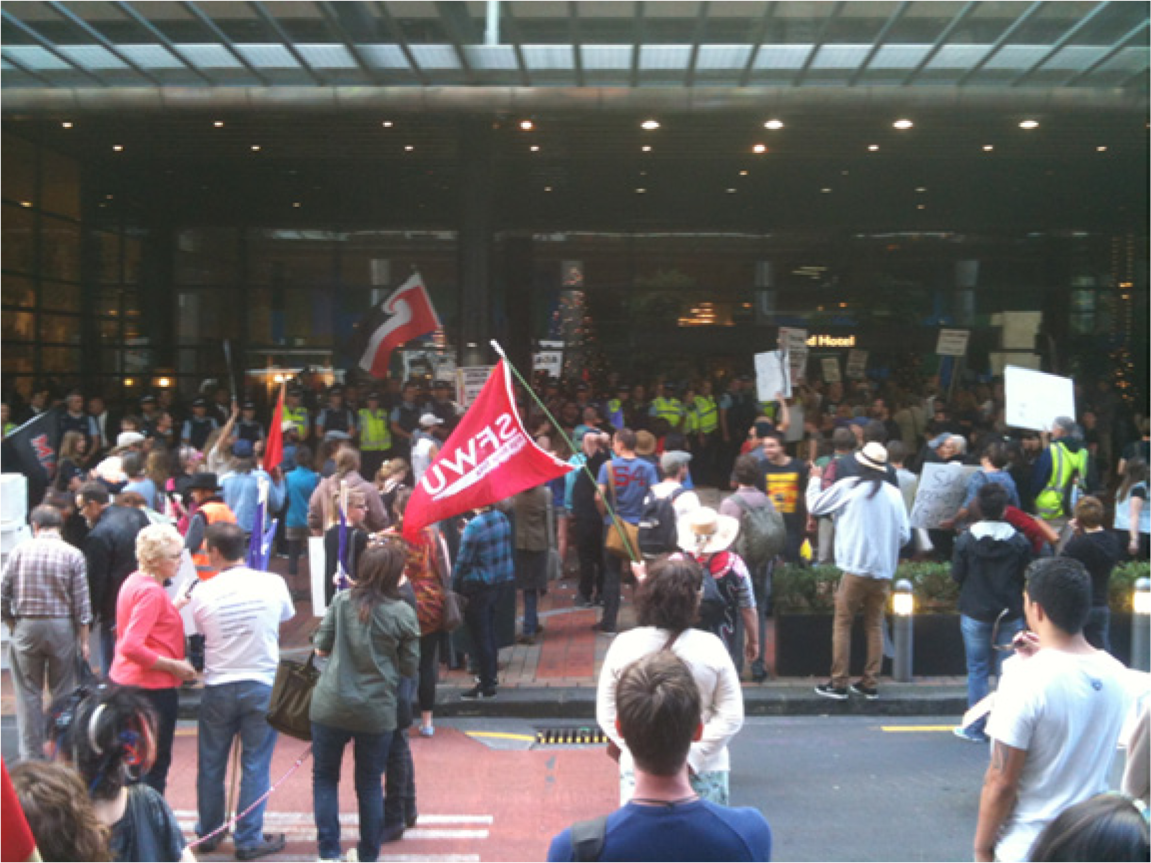
Protestors aggregrate.
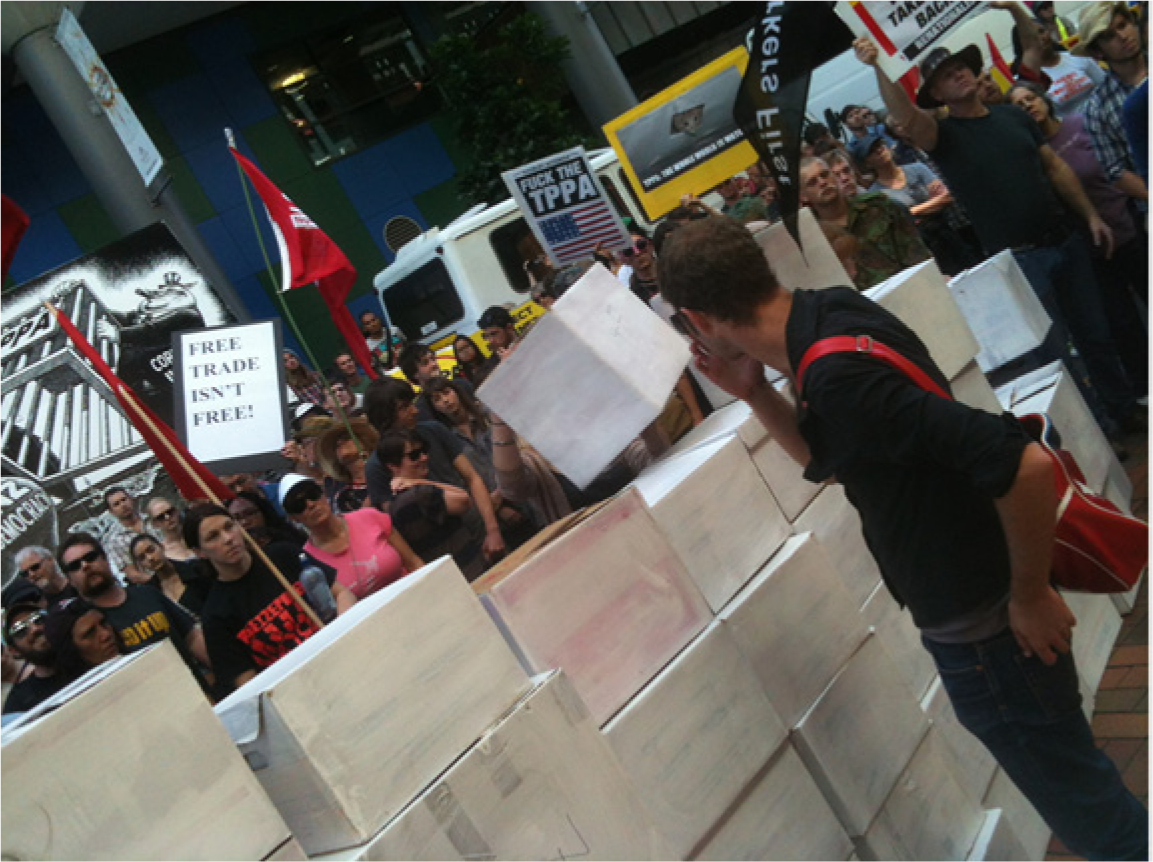
Submitting signatures.
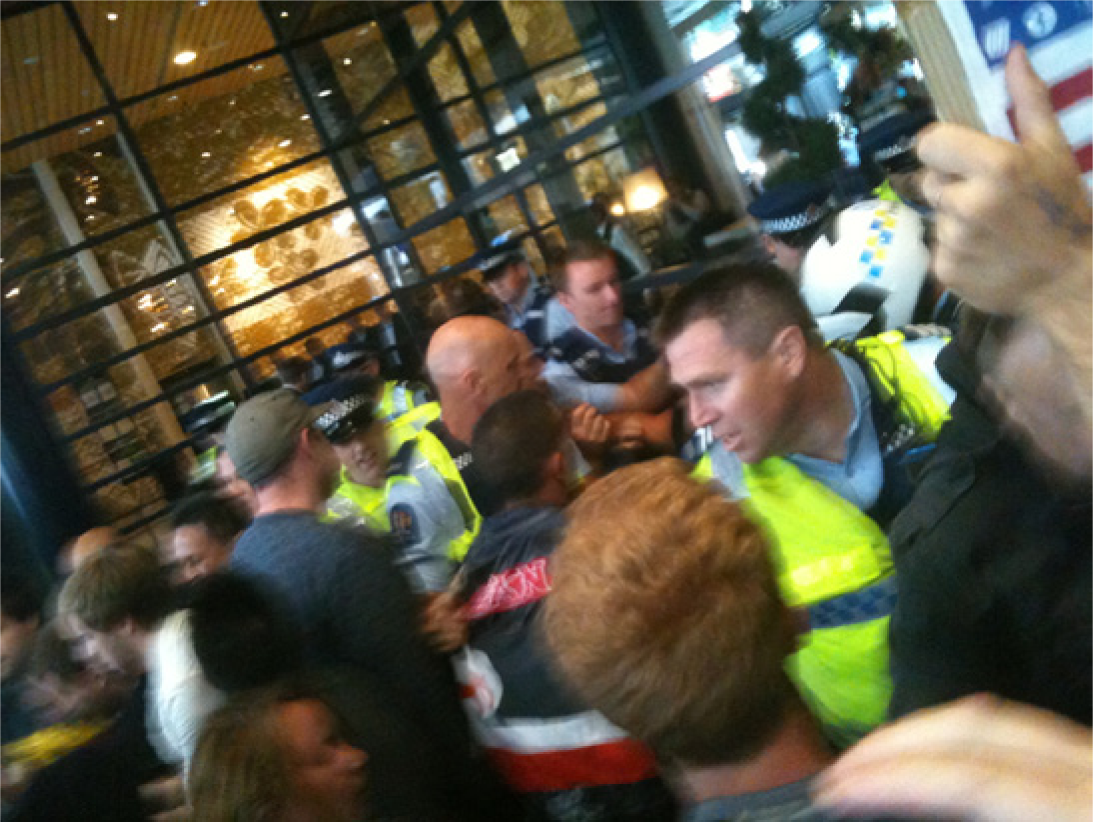
The crowd surges.
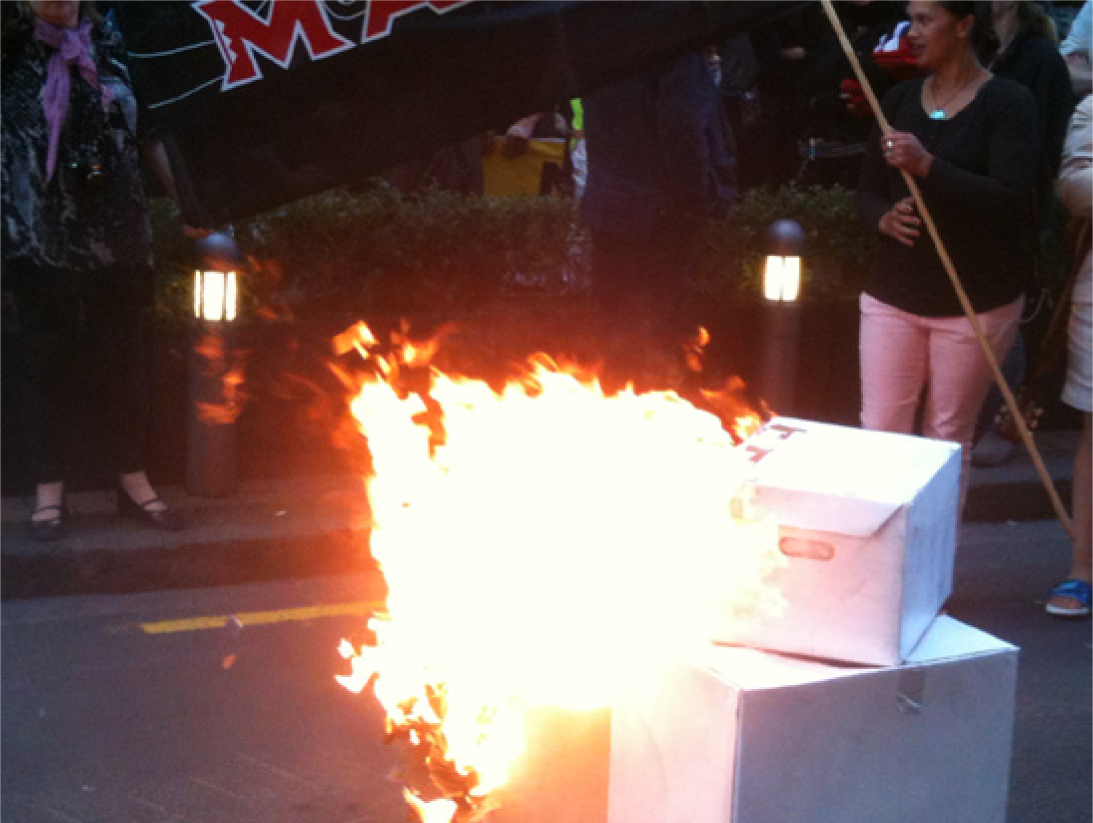
Burning petition boxes.
When I reflect on this visually discursive reconstruction of the protest, a few things come to mind. First, I realize that this vignette sheds some genuine insight into the immense value of digital communication media for documenting protests, especially as a way of keeping authorities honest, and thus the method will be of immense help to my grant on digital technologies and protests. Perhaps more importantly, the vignette illustrates important affective moments: I can feel my panic, random questions that flashed through my head (“what would the institutional review board think of this?” was one—although I did have ethics approval to study protests; “how did I end up here” was another), and my palpable sense that something uncontrollable was about to wake in the crowd (and it did later on, when protestors got angrier and burned the signatures). As a protestor, I passionately wanted a material outcome; I wanted the negotiations to at least become transparent, and it was frustratingly evident to me, even at that very moment, that we were likely to fail.
As an academic writer, I am well aware that I have to pick and choose aspects of fieldnotes that are especially relevant to the topic at hand—in this case, the role that digital media play in protests. Indeed, I am sometimes quite comfortable with the fact that viscerally insightful portions of my fieldnotes do not make their way into studies, because like any ethnographer, I know that every event is a universe of possibilities, and we can only ever represent fragments of it in our work.
However, my notes at the Occupy as well as the TPPA protests also illustrate that bursts of researcher insight are necessarily unexpected, fleeting and momentary, even feeble, and admitting those partial insights into print, even though they do not meet traditional standards for rigorous research, could teach us something unexpected about communication. Even such conventionally understood “poor” data can be extremely rich when understood in the context of the subject position of the researcher. I learned a thing or two about crowds that day, including a few moments of feeling as though I were losing my own middle-class subjectivity in it and being suddenly, helplessly, and incompetently consumed by the anger, frustration, and chaos that ricocheted and amplified between the police and the crowd until it felt like a deep sonic boom.
Fully understanding this protest and my role in it thus involves moving beyond the conventions of confession required for ethnographic work, especially the realist assumption that knowing a researcher bias can somehow help readers arrive at complete and accurate understanding, to frank accounts that always and already situate knowledge as a product of the sometimes incompetent researcher. Perhaps we need a moratorium on the use of the word confession itself, as both tales of confession and tales of realism are told in the same church.
Realizing the potential of researcher experience also requires us to push back against the tendency to theoretically overdetermine and overframe research projects such that additional insights seem superfluous to the main goal of the project. Even “poor data,” like my excerpt above, that do not seem especially rigorous can contain unexpected and new theoretical insights. Moreover, recentering researcher passion in qualitative analysis might enable us to explore new and emerging forms of methodological robustness or insight. Consider how the visual sequence of the four images referred to in my fieldnotes animate, extend, and support the narrative constructed in the notes and accentuate the sense of chaos and confusion that built during the event. In short, if we allow ourselves to step away from prescriptive formulations about theory, data, and method, we might actually learn more about communication itself.
Footnotes
Acknowledgements
The author would like to thank Sarah Tracy for her imaginative and hard work as editor of this forum, as well as his fellow participants for their feedback and review.
Declaration of Conflicting Interests
The author(s) declared no potential conflicts of interest with respect to the research, authorship, and/or publication of this article.
Funding
The author(s) disclosed receipt of the following financial support for the research, authorship, and/or publication of this article: The research for this article was made possible by a grant on technology and collective action from the Royal Society of New Zealand’s Marsden Foundation (MAU1209).