




Abstract
Building on Orlikowski’s reflections on sociomateriality, this article argues that we have to stop separating the material and the social to be able to precisely account for what matters in technology adoption and use, and that one way to do this is to take people’s matters of concern seriously. This means two things: taking into account all the matters of concern that come to express themselves in conversations (whether related to tools, rules, documents, principles, etc.) and not just the people who voice them, and showing how some of these concerns start mattering more than others by connecting with other matters of concern. To demonstrate the theoretical and empirical value of this approach, we analyze two interactional episodes taken from our longitudinal study of the introduction of a wiki at the French National Agency for Radioactive Waste Management.
Keywords
How can we account for technology adoption and use within organizations without relying on preconceived notions of materiality and sociality—notions that inevitably lead us to favor either a techno-centric perspective or a human-centered perspective (Orlikowski, 2007)? In other words, is there a way to make the relations between technologies and their users the end points of our analyses rather than their starting points, so as to better understand what actually matters in organization technologies? In this article, we will show that it is possible to do this by analyzing the matters of concern that emerged over the course of the introduction of a wiki at the French National Agency for Radioactive Waste Management (ANDRA in French).
We will first discuss the literature on organizational wikis and, more precisely, the de-compartmentalization of document writing that is generally associated with the introduction of wikis in organizations. We will see that despite the publication of a few detailed case studies (Caby-Guillet, Guesmi, & Mallard, 2009; Danis & Singer, 2008; Holtzblatt, Damianos, & Weiss, 2010; Stocker, Richter, Hoefler, & Tochtermann, 2012), the substance of this de-compartmentalization and the reasons for its often-reported failure remain unclear. Following Orlikowski’s (2007) insights, we will argue that these shortcomings come from preconceived categories that keep the material and the social worlds separate from one another.
To resolve this issue, we will present a conception of technology use in organizations that is grounded in the CCO (communication as constitutive of organizations) perspective (Ashcraft, Kuhn, & Cooren, 2009; Putnam & Nicotera, 2009). This approach invites us to take people’s matters of concern seriously. This means two things: (a) taking into account all the matters of concern that come to express themselves in conversations (whether related to tools, rules, documents, principles, etc.) and not just the people who voice them, and (b) showing how some of these concerns manage to matter more than others by speaking to, for, with, through, or against each other. To demonstrate the theoretical and empirical value of this approach, we will analyze two episodes taken from our longitudinal study of ANDRA, to show what exactly came to matter in the de-compartmentalization process proposed to ANDRA’s employees.
Organization Wikis and the Question of De-Compartmentalization
The study of organizational wikis falls under the large body of literature that deals with technology adoption and use within and across organizations (see, for instance, Ciborra, 2000; Orlikowski, 1992; Walsham, 1993). Although many studies have looked at the ways wiki technology is used in the context of Wikipedia (see, notably, Black, Wesler, Degroot, & Cosley, 2008; Bryant, Forte, & Bruckman, 2005; Cardon & Levrel, 2009), comparatively little is known about the uses of this technology behind the firewalls of organizations. Relying on telephone interviews and questionnaire analyses, the first studies on the subject were able to confirm the sustainable presence of wikis in numerous organizations (Majchrzak, Wagner, & Yates, 2006), but contributed little to understanding the actual uses of this technology. The situation started to change in subsequent years with the publication of a few detailed case studies based on direct observations, interviews, and/or traffic analysis (Caby-Guillet et al., 2009; Danis & Singer, 2008; Holtzblatt et al., 2010; Stocker et al., 2012).
In all of these studies, the introduction of the wiki in the organization is portrayed as being associated with a wish to de-compartmentalize document writing, thereby improving knowledge management. In every case, the idea, it seems, is to break away from the organization’s usual task allocation and to allow all its members to participate in the writing of certain documents, thus, allowing for more knowledge to be shared, discussed, and improved throughout the organization. This de-compartmentalization program is notably at the center of Danis and Singer’s (2008) study. The authors describe a case in which the research division manager of a large information technology company asks his teams to write all the documents concerning the planning of their activities on a wiki so as to make every researcher more knowledgeable about the research conducted by the other teams. Although less explicitly, the de-compartmentalization process also appears in other studies where the authors report that the teams who installed the wikis were inspired by Wikipedia (Holtzblatt et al., 2010; Stocker et al., 2012) or, more broadly, by “the Web 2.0 culture of self-organization and free-participation” (Caby-Guillet et al., 2009, p. 204, see also Stocker et al., 2012, pp. 317-319).
However, these case studies also report that the de-compartmentalization process tends to fail. The wiki continues to be used (its use even spreads in the organization), but not as initially intended. Most of the time, users only contribute to the documents corresponding to the tasks to which they have been specifically assigned. For instance, Danis and Singer (2008) report that the researchers of the division they studied generally perceive the wiki as an official communication space that is unsuitable for informal talk. They also report that the researchers do not feel they have the right to edit or comment on the pages of the other teams. Caby-Guillet et al. (2009) report that people use the wiki mainly to disseminate information and to cooperate with their close collaborators. Holtzblatt et al. (2010) identify a set of social and technological factors that impede broader usage of wikis for knowledge sharing. Most notably, these factors include the perception of sharing as extra work, the unwillingness to share unfinished work or to share with a large audience, and the reluctance to edit the work of others.
Although these case studies present many interesting aspects, the question of the process of de-compartmentalizing remains unclear. First, the de-compartmentalization process itself is never fully explained. The authors do not show how exactly the wiki is supposed to contribute to a form of writing that goes beyond team borders. They mention that Wikipedia and the Web 2.0 are sources of inspiration, describe the particularities of the organizations studied as well as the characteristics of wikis (editable pages, page reverting, talk pages, etc.), and sometimes mention the technical adjustments and the rules of use that are introduced during the installation of the wiki. However, none of these authors precisely show how the sources of inspiration, the organizational processes, the wiki functions, the technical adjustments, and the rules articulate themselves in daily interactions. The reader is left wondering which of these elements actually matter in the de-compartmentalization process.
Similar critiques can be made about the way these studies tackle the failure of the de-compartmentalization process. The precise mechanisms of failure are never fully explained. The authors generally identify several factors that impede de-compartmentalized knowledge sharing, but they do not really show how these factors translate in daily interactions to actually impede the de-compartmentalization process. Consequently, the relevance and the weight of these factors remain uncertain. For instance, among the different factors identified by Holtzblatt et al. (2010), which ones are the most difficult to overcome: Is it the idea that sharing is extra work? Is it the unwillingness to share unfinished work? Is it the idea that people own their data? Holtzblatt et al.’s study does not answer these questions. We do not know what exactly matters in the failure of the de-compartmentalization.
We believe that Orlikowski’s (2007) reflection on materiality and sociality in organization research literature can help us better understand these shortcomings. As she points out, the material and the social are generally treated as two separate entities in studies dealing with technology adoption and use within organizations. These entities may mutually shape each other through interaction, but they remain ontologically separate. This predefined separation poses a problem, according to her, as it leads the analysts to constantly have to choose between a techno-centric perspective (what is happening is the effect of technology) and a human-centered perspective (what is happening is the effect of human action). We believe this problem is precisely what limits the literature on organizational wikis.
All the studies reviewed tend to rely on preconceived categories. Danis and Singer (2008) look at “the interplay of technology, work practice, and organization” (p. 495), Caby-Guillet et al. (2009) examine the “interaction processes between the users, the technology and the global environment of the activity” (p. 201), whereas Holtzblatt et al. (2010) distinguish between “social and cultural factors” (p. 4666) on one side and technology-related factors, “the reliance on other channels of communication” (p. 4668), on the other side. Far from making the analysts’ work more accurate, we believe that these types of precategorizing might actually prevent them from precisely describing a process such as a de-compartmentalization and what is causing it to fail. Indeed, by fixing all field elements under certain labels, the authors prevent themselves from retracing how the attributes of certain elements could be transferred to other elements. If everything that constitutes a wiki is stuck under the label technology and everything that constitutes a company is stuck under the one of organization, then how can we retrace the way the de-compartmentalization property of a wiki is to be transferred to a company (as well as what is stopping this from happening)?
The problem here is not that authors endorse one definition of the material and the social rather than another. It is that they a priori separate the material from the social. Actually, the problem does not even concern the material and the social. It concerns the act of separating a priori. Here, one touches on important ontological and epistemological issues brilliantly analyzed by Barad (2007). Ontologically, separating a priori amounts to endorsing the idea that certain “things” of the world possess inherently determinate properties and borders. And epistemologically, this means attributing the possibility of objectivity to some inherent separation between the observer and the observed.
Hence, calling into question the act of a priori separating entities has far reaching consequences. Ontologically, this means endorsing the idea that “things” acquire determinate properties and borders only in specific sociomaterial arrangements, that is, that properties and borders are always enacted by and within specific apparatuses. Epistemologically, this means that there is never any a priori determinate separation between the observer and the observed and, consequently, that the possibility of objectivity lies only in the repetition of a particular enactment by and within a particular apparatus. This is where the novelty of Barad’s (2007) and Latour’s (2005) frameworks lie. The idea neither is only to rework the notion of “human cognition” to show that it is distributed between mental, cultural, and technological elements (Hutchins, 1995) nor is it only to modify the notion of “technology” so as to take into account both the material and social dimensions of technological artifacts (Jackson, 1996). It is to account for the constitutive entanglements of everything that is. What remains to be seen is how to account for the entanglements through which a wiki is (or fails to be) constituted as a de-compartmentalization process.
Theoretical Framework: Matters of Concern
How can we expect to account for technology adoption and use without separating the material and the social? To address this question, we believe a starting point is showing that action (and therefore communication) is something that is always shared between various forms of agency (Latour, 1996), meaning that the ascription of a specific action to a given agent is always a matter of selection in a chain of agency (Cooren, 2006). For instance, although human beings tend to be considered the source of what is said in a conversation, we claim that there is always a way to decenter this type of analysis by focusing on what appears to animate, prompt, or drive a human participant to say what he or she says when he or she communicates (Cooren, 2010).
As shown by representatives of the Montreal branch of CCO, human participants often portray themselves as animated, driven, or prompted by specific concerns or interests, which they implicitly or explicitly express in their conversations (Cooren, Fairhurst, & Huët, 2012). For example, someone can position herself as speaking out of concern for people’s safety, which means that, to some extent, it is also this matter of concern (people’s safety) that is presented as expressing itself. This person could even raise a second matter of concern, for instance, a new form of equipment that, according to her, should be installed, by presenting it as speaking to this first matter of concern she is raising. Saying that the installation of a new form of equipment speaks to problems related to people’s safety shows that communicating is a way not only for people but also matters of concern, to relate to each other.
At first sight, one could retort that this is just a figurative way of analyzing a conversation. But we believe that this type of analysis allows us to take communication seriously and show its connection with materiality (Aakhus et al., 2011). Communication matters because it is not only people who express themselves when they communicate with each other but also their matters of concern, which are supposed to animate, prompt, or drive them and provide an account or reason for their conduct (Garfinkel, 1967, 2002). In keeping with the CCO perspective, we believe that communication is constitutive of the way a technology such as a wiki comes to be (or not be) constituted as a de-compartmentalization tool.
In other words, conversations or discussions never take place in a vacuum, but are engaged in by people who worry about specific issues, defend certain positions, or fight for specific interests (Bergeron & Cooren, 2012). Matter indeed comes from the Latin materia, which means “the substance from which something is made” or the “grounds, reason or cause for something” (etymonline.com). Etymologically speaking, a matter of concern is therefore what substantiates a concern, that is, what stands under it (see also Burke, 1945/1962; Bencherki & Cooren, 2011), what causes it. If we turn to the term “social,” we notice that, etymologically, it comes from the Latin sequor, which means “to follow”—a word that also gave the Latin secta, which means a line of conduct, way of life, or principle, and is the root of the English word “sect.”
When we speak about the social aspect of something, we thus speak, whether implicitly or explicitly, about what relates this thing to what relates us to each other; that is, the principles, lines of conduct, or ways of life we tend to follow collectively. But what relates us to each other are, by definition, matters of concern or matters of interest; that is, matters to which we are attached. Our previous example illustrates this point: Should a new form of equipment be installed, it could be because one of the things that matters to this person, people’s safety, happens to speak to other people’s matters of concern. In other words, she is able to make her matters of concern speak to theirs, that is, she is able to show that there is a link or relation between them. We thus have a way to relate this new form of equipment to matters of concern that people are supposed to be attached or related to.
The sociomaterial aspect of this new type of equipment can thus be explained with the new framework we propose. This equipment is social because the matters of concern and interest that express themselves in its conception, fabrication, acquisition, installation, and use are also the various concerns and interests that different people (designers, engineers, buyers, users, etc.) follow in their lines of conduct and ways of life (it is what unifies but also what differentiates them). It is material because these matters of concern and interest also already stand under its conception, fabrication, acquisition, installation, and use. These matters thus take the form of technical components, knowhow, materials, principles, and so on—that is, anything that happens to count or matter and that materializes itself in this equipment.
So matters of concern are (a) a way to not have to choose between the material and the social (because the latter are two ways of speaking about the same thing) and, perhaps more importantly, (b) a way to show how a given matter may augment its level of “mattering,” especially through conversations and discussions. What this new framework allows us to show is that a matter of concern will increase its potency or weight if it is able to speak to other matters of concern. There is no need therefore to artificially reconnect the material with the social. People constantly create connections or translations between various sociomaterial elements. But some connections or translations happen to matter more than others. The emergence of such asymmetries is what we have to explain.
Matters of concerns are therefore not only what people express in their discussions but also (and this point is crucial in our argument) what animate, prompt, or drive discussions. If they can be seen as co-constructed by the participants, it would be a mistake to reduce their mode of existence to this co-construction, because it would amount to disconnecting the conversational world from what animates or drives it, a disconnection that the participants themselves do not experience. A matter of concern is something that can be the object of a co-construction or disagreement (hence, its social aspect), but it is also always already something that substantiates peoples’ viewpoints and positions (hence, its material aspect). For instance, someone can point to a specific part of a machine and say “This is what concerns me, look!” A matter of concern is therefore, in its essence, sociomaterial because the idea of mattering expresses, by definition, what materializes/substantiates people’s concerns.
Even if some matters of concern can be silenced in a discussion, it does not mean that they do not exist or that they will disappear. As we know all too well, their inexpression can even result in catastrophic situations (Tompkins, 1993; Weick & Sutcliffe, 2001). There is, therefore, no opposition between a constructivist and realist view of the world (Barad, 2007). What we propose is that certain aspects of reality start to matter more than others precisely because they end up taking multiple forms, which augment, so to speak, their level of importance, existence, or reality.
For instance, a technological glitch could be taking place, but as long as it does not materialize itself into a concern that someone starts to have and communicate, its mode of existence will remain limited. It is only when this glitch starts to literally animate, prompt, or drive a discussion, that is, when it starts to be co-constructed as a concern by the human participants in communication, that its existence might augment and become a concern that makes a difference (Bateson, 1972). A glitch then becomes more important when it is, for instance, connected to, or when it speaks to, a concern for safety during a conversation.
We propose to analyze conversations as dislocated loci where multiple matters of concern and interest can be identified as being voiced and expressed (Cooren, 2010). This approach means that we do not have to treat social and material aspects of technology adoption and use as two separate realities. Matters of concern can be technological, but they can also be related to specific values, priorities, hierarchies, or principles. They are always both material and social; that is, they are what substantiate viewpoints (material) and what dictate specific conducts that people follow (social). The interactional world is entangled, because beings or entities with various modes of existence come to express themselves as matters of concern in a discussion, whether we speak of technological, psychological, organizational, or cultural matters. We therefore do not need to choose between a techno-centric perspective and a human-centered perspective. All we need to do is observe how interactions evolve, and identify all the various beings that come to make a difference in a given situation.
Method
As mentioned previously, the concept of matters of concern was used to illuminate what mattered in the deployment of a wiki at ANDRA. In what follows, we briefly summarize how this project unfolded, then present how the matters of concern expressed during this project were documented and analyzed.
The “Wiki Project”
Within the framework of an ongoing research partnership between ANDRA and the Troyes University of Technology (TUT), the first author was offered the opportunity to work within the Knowledge Management (KM) team of ANDRA’s scientific division. Between December 2007 and June 2009, he collaborated with the KM team to design and test a participatory KM platform. This project unfolded in two phases:
The “design phase” took place between December 2007 and September 2008. The first author, in collaboration with an engineer of the KM team and two other TUT researchers, investigated the needs of ANDRA’s engineers, defined the technical features of the platform, and selected a collaborative tool to test these features.
The “test phase” took place between October 2008 and June 2009. Two engineers of the KM team and the first author presented the selected tool (a wiki) to the affected engineers, contributed to writing and organizing its content, and documented its use.
Capturing the Conversations of the Project
As mentioned earlier, a matter of concern is first and foremost something that animates or drives a conversation (i.e., that makes people talk). Thus, our first methodological challenge was to capture the various conversations about the wiki throughout the project. As the first author worked within the KM, he was ideally positioned to witness, trigger, and record many conversations about the various aspects of the project, and also well positioned to collect documents that could be useful to make sense of these conversations: organizational documents (e.g., guidelines and meeting minutes), personal observation notes, and snapshots of the document systems used at the agency.
This integration also proved challenging, as it was sometimes difficult for the researcher to focus on both the tasks related to the deployment of the wiki and those related to the documentation of the project’s conversations. This explains why some conversations could be entirely audio-recorded (see Episode 2 below), whereas some had to be rebuilt post facto based on observation notes and organization documents (see Episode 1 below). This limited our ability to detect some of the matters of concern related to the project.
Selecting Conversations for In-Depth Analysis
First, the conversations were coded according to the various matters of concern that were expressed in them. At this point, the matters of concern were loosely identified using labels that were as close as possible to the wording used by participants. These labels included for instance, “the functions of the wiki call for equal writing access,” “the wiki must be compatible with the agency’s project schedules,” “the contribution to the wiki should be limited to certain users,” “engineers are working under tight time constraints,” “some tasks belong to one’s missions and some don’t,” and so on.
Second, the matters of concern were linked to either one or both of the following: (a) “the matters involved in the constitution of the wiki as a de-compartmentalization tool”; (b) “the matters involved in the inability of the wiki to work as a de-compartmentalization tool.” Two samples were then selected for in-depth analysis: the one instance that seemed to contain the most matters of concern specified in (a) and the one conversation that seemed to contain the most matters of concern in (b).
Analyzing the Matters of Concern Expressed in the Selected Conversations
The purpose of the analysis was to show how certain matters of concern managed to gain more weight or influence than others over the course of the selected conversations. To this end, we focused on two types of “moments” in the conversations: (a) the moments where a matter of concern augmented its level of mattering by becoming connected to another matter of concern and (b) the moments where a matter of concern decreased the level of mattering of another by disconnecting it from one or several other matter(s) of concern. In this perspective, the matters of concern that appeared to matter the most were those that remained connected to the highest number of matters of concern at the end of the analyzed conversations.
Finally, we checked that the results of our analyses were consistent with the rest of the data collected. For instance, the analysis of Episode 2 below shows that the problem of “lack of time” weighed heavily in the wiki’s failure to work as a de-compartmentalization tool as it connected to a wide range of other matters of concern. We could check that this was consistent with the logs of the wiki, which showed that the engineers who had reported lacking time had indeed contributed very little to the wiki in comparison with other engineers.
Analysis
We analyze two conversational episodes. The first epitomizes the matters of concern that came to matter in the de-compartmentalization process proposed to ANDRA’s members through the wiki; the second epitomizes the matters of concern that came to matter in the failure of this process. All names are pseudonyms.
Which De-Compartmentalization Model for the Wiki?
To better understand how the wiki was constituted as a de-compartmentalization tool at ANDRA, we focused on the meeting during which the wiki was presented by the first author to ANDRA’s scientific director. The following are the first author’s personal minutes of this meeting, compiled based on the PowerPoint slides used during the meeting and on personal notes taken immediately afterward. The meeting took place in September 2008. Its purpose was to present to the scientific director why it would be a good idea to use a wiki to write an important document of ANDRA: the Analysis Document. In this transcription, the first author is Tom. Peter is a colleague who worked with Tom on the wiki implementation.
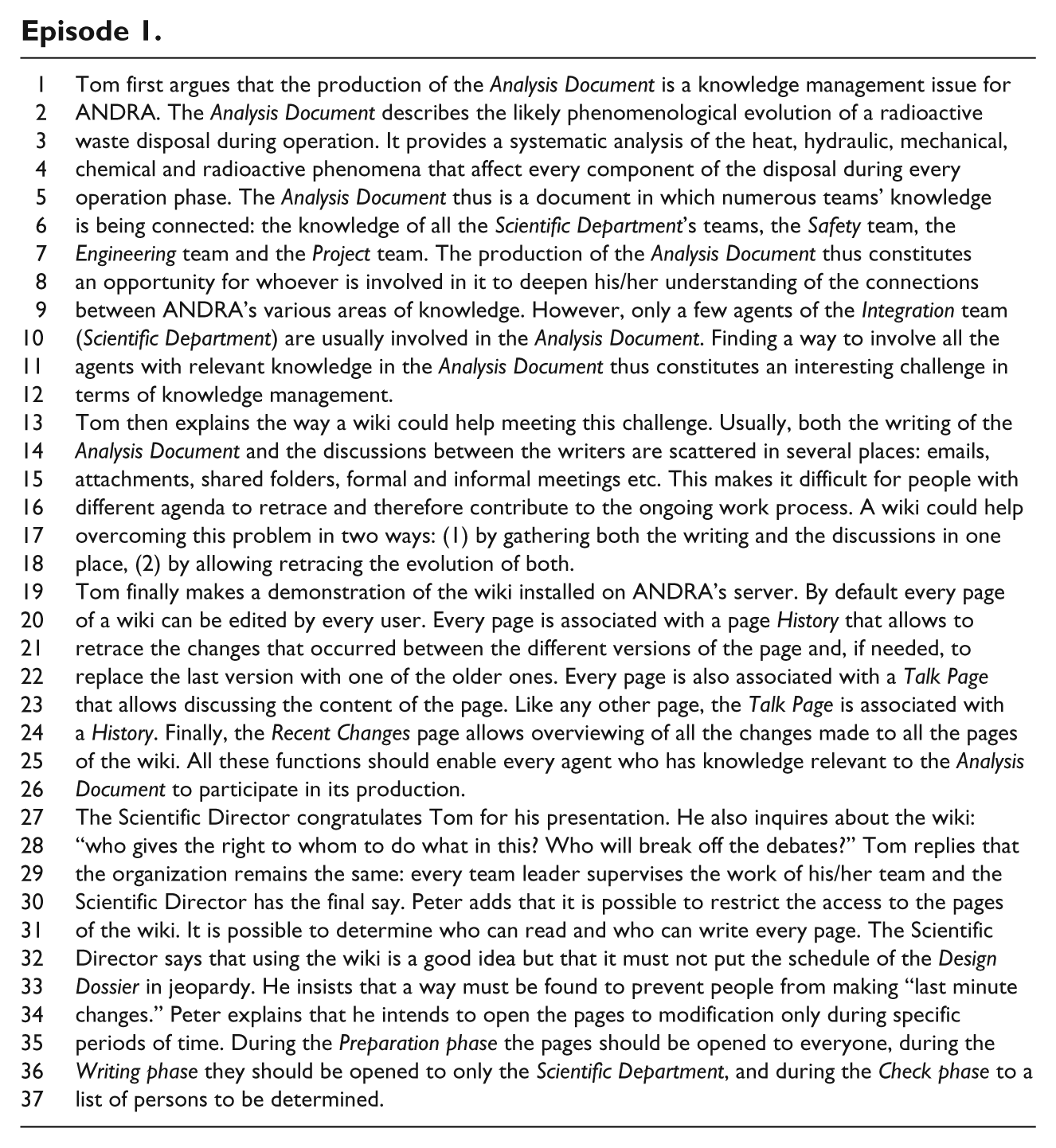
Tom, from lines 1 to 18, positions the wiki as speaking to three matters of concern: (a) work process centralization: the wiki is what allows “gathering both the writing and the discussions in one place” (l. 17-18); (b) work process traceability: it is what allows “retracing the evolution of both” (l. 18); and (c) knowledge management: the wiki is what allows every agent to contribute to the Analysis Document, and thus to “deepen [their] understanding of the connections between ANDRA’s various areas of knowledge” (l. 8-9). Here, the wiki is characterized first by its capacity to speak simultaneously to all three concerns. However, at this stage, this capacity could be deemed purely discursive or rhetorical by the audience in the sense that it is only what Tom says it is.
The demonstration of the wiki, from lines 19 to 26, is meant to show that what Tom says is confirmed by what the wiki in front of them can do. And indeed, the diverse functions of the wiki, the editable pages, the page histories, the talk pages, the recent changes, tend to confirm Tom’s version of the wiki. However, these same functions also appear to say, or to lead Tom to say a bit more than what he previously presented. The first thing that the demonstration illustrates is that “by default every page of a wiki can be edited by every user” (l. 19-20). What remains implicit throughout Tom’s demonstration is that every function of the wiki is accessible to every user. The wiki is thus characterized by the fact that it gives everyone (by default) equal means to both write and control the others’ writing (notably by allowing everyone “to replace the last version [of any page] with one of [its] older [versions],” l. 22). The demonstration of the wiki thus gives voice to a concern for complete horizontality between the participants. The wiki that is now emerging through this demonstration is, therefore, different from the one described at the beginning of the presentation. It is a tool that speaks not only to questions of knowledge management, work process centralization, and work process traceability, but also to issues related to participants’ equal rights of access.
The scientific director seems to have noted this additional concern. His first questions are, “Who gives the right to whom to do what in this? Who will break off the debates?” (l. 28). By asking these questions, the scientific director expresses a concern for vertical authority, which is supposed to prompt his intervention. He indirectly asserts the necessity that someone be given a special right with regard to the wiki, one of stopping the debates between the participants. The scientific director quickly links his concern for vertical authority with one for timing control. As he says, what risks putting “the schedule of the Design Dossier in jeopardy” is notably that people may make “last-minute changes” to the Analysis Document (l. 32-34). Having someone with the power to prevent this situation from happening is a guarantee that the schedule will be respected. We could thus say that the scientific director is making the concern for vertical authority speak to problems of timing control (thus reinforcing the authority and importance of this concern).
A negotiation then starts to determine the place that vertical authority should occupy in the wiki. Tom’s response to the scientific director is “[with the wiki,] the organization remains the same: every team leader supervises the work of his/her team and the Scientific Director has the final say” (l. 29-30). This answer does not directly address the scientific director’s point. The scientific director wants to know how vertical authority will translate inside the wiki. Tom’s answer is that the wiki will not affect vertical authority outside the wiki. This answer aims both to address the scientific director’s concern for vertical authority (and timing control) and to protect the horizontality inside the wiki. It could be paraphrased as follows: “decision making processes should remain entirely horizontal in the wiki and usual vertical processes should be used only in case horizontal processes fail.”
Peter’s answer, lines 30 to 31 and 34 to 37, is quite different from Tom’s. As he says, the principle of vertical authority can be directly implemented in the wiki by defining who can access which page(s) at which time. His idea is thus to modify the settings of the wiki so that the wiki itself distinguishes two levels of users: (a) those who are asked to edit certain pages at a certain time and (b) those who determine who can access which pages at which time. In other words, the idea here is that the wiki would allow sharing of the work on the Analysis Document but not the control of the work. In short, Peter’s proposal more directly addresses the scientific director’s concern by shattering the idea of complete horizontality between the participants so that the wiki itself, in this case, can speak not only to questions of knowledge management, work process centralization, and work process traceability, but also to questions of vertical authority, and hence, of timing control. Such is the mode of existence in which the wiki appears to stabilize itself at the end of the meeting.
The wiki, or more broadly the de-compartmentalization model proposed through it, is a complex hybrid entity. It is made of (a) spokespersons (Tom, Peter, and to some extent, the scientific director) who voice, question, use, and demonstrate its features and functions; (b) documents (the Analysis Document and the Design Dossier) that are supposed to be its final products; (c) hard-coded functions (editable pages, access control, etc.) that define its functioning; and (d) a series of principles (centralization, knowledge management, vertical authority, etc.) that the wiki might speak to or not. None of these various entities (or matters) can be said to be either material or social. They are always already both. For instance, the principle of centralization is social in the sense that it is what is supposed to relate Tom with both the wiki and the scientific director. But it is also already material in the sense that it is one of the elements that is supposed to support (or substantiate) this particular relation. Similarly, the editable pages of the wiki are social as they are supposed to relate Tom with the principles of equal writing rights, centralization, knowledge management, and the scientific director. But they are also already material—they are precisely what is supposed to support this relation.
Although we can differentiate the material and the social as two aspects of the same thing, this distinction does not play any role in our analysis. That is, it does not serve to account for the differences that are made (or enacted) during this episode. However, by not placing the entities we encountered in a priori separate ontological categories, we have been able to freely retrace how they connect with (or disconnect from) one another, thus precisely accounting for differences that are made in terms of weight (or level of mattering) between some of them. Let us take, for instance, the concern for participants’ equal right to both write and control each other’s writing. This concern certainly matters in Tom’s presentation where it is connected to the functions of the wiki (i.e., the editable pages, the page histories, the talk pages, the recent changes) and, through them, to concerns for knowledge management, work centralization, and traceability. However, these connections collapse when the scientific director’s concerns for vertical control connect with concerns for timing control and functions of access management. This later coalition of matters ends up being the one that “really” matters in the constitution of the wiki as a de-compartmentalization tool because it manages to resist Tom’s attempt to disconnect it.
The Subtleties of Collective Writing
To understand why the wiki failed to work as a de-compartmentalization tool, we look at a meeting in February 2009, a few days after the official start of the Analysis Document writing phase. The purpose of this meeting was to discuss the coordination between the diverse writers involved. Present at the meeting were members of the Integration team that was in charge of the Analysis Document (Peter, Elisa, and Alice) and members of other teams of the Scientific Department (Simon, Alex, Sam, and James) who the scientific director had asked to contribute to the Analysis Document.

At the beginning of this sequence, Peter positions the collective writing of the Analysis Document (i.e., the de-compartmentalization process) as speaking to a concern for equality between the participants. As he says, doing “something really collective” (l. 1) means that there should not be “big involvement gaps from one person to another” (l. 1-2); “it shouldn’t be a 90 10” (l. 7). However, this definition of collective writing is immediately dismissed by Elisa and Simon. According to them, “there will necessarily be big gaps” (l. 4) between the participants. To Peter’s concern for how things should be, they reply with how things “will” be (l. 4) and how they “are” (l. 6). They thus position themselves as speaking to a concern for both reality and experience (they know how things truly function).
Then Simon substantiates this position by speaking in the name of his team’s mission (the mid-term report), that the reason his team will not be able to contribute much to the Analysis Document is conflicts in schedules (l. 9-11). This explanation allows Simon to again manifest his concern for experience and reality (i.e., how, in his experience, things really work in this organization). By announcing that he is “going to be really basic” (l. 8), he indicates that he is somehow forced to situate the debate at a lower level so as to make himself understood by his interlocutor. He thereby introduces a sort of teacher/pupil asymmetry between himself and Peter, implying that a certain form of experience is supposed to speak through him (and not through Peter).
Simon then claims that the collision between the agendas of the mid-term report and the Analysis Document is “obvious” (l. 10), and thus no need to mention the other documents they have to write (l. 12), which is a way to stage reality as speaking for itself. Finally, through his call to “not delude [themselves]” (l. 11), Simon also presents himself as speaking for reality. In summary, Elisa and Simon re-qualify the “really collective” writing as something that collides with the mid-term report schedule and thereby with both reality and their experience of it.
However, Peter is not ready to give up his position. He points out that “[they] are all on the same boat there” (l. 13). According to him, everyone should make the same effort because everyone is facing the same situation (having to write several documents within tight schedules). This assertion reinforces Peter’s call for a “really collective” writing. It is now not only Peter who is asking that a minimum of equality be respected between the contributors, but also the contributors’ situation itself. In other words, it is as if he were saying that the situation (being on the same boat) was indeed dictating that everyone do his or her share.
This view of the situation and what it is supposed to say is immediately refuted by Elisa and Simon (l. 15-18). They answer almost simultaneously by repeating “no” and return Peter’s point against him, Elisa by adding, “no precisely” (l. 16), and Simon by repeating what Peter said in a negative form: “we’re not all on the same boat” (l. 17). Elisa then confirms Simon’s words: “no indeed” (l. 18). There certainly is a strong emotional response here, something that almost carries a sense of outrage, of scandal. It seems that something powerful is leading them to react. This “something” is then made explicit by Simon (l. 21-26). Everyone cannot make the same effort for the Analysis Document because the Analysis Document is not everyone’s priority “mission.”
It is interesting to focus on the way Simon presents his explanation. He first uses the example of Sam to illustrate his point (l. 23-24), then a comparison that stages Peter himself: “this is as if for example John was to fetch you to work on the design concepts” (l. 24-25). This argumentative move allows Simon to generalize his point. He is no longer speaking only out of concern for his team’s mission (the mid-term report), but out of concern for everyone’s mission, including Peter’s. In other words, this is now the very notion of mission allocation (as well as people’s emotional attachment to it) that speaks against Peter’s version of collective writing.
However Peter is still not ready to give up his position. He too can summon a voice that is bigger than his: “as the Scientific Director said in introduction on Friday ‘I asked you to save time in your agendas one year ago’ and he said ‘I am asking you not to derogate from it’ word for word” (l. 27-31). We note here that Peter takes great care to authenticate the voice of the scientific director. He gives the precise time of the utterance, he uses direct speech, the borders of which are clearly delimited, and he explicitly says that he is quoting “word for word” (l. 30). By doing this, Peter is pointing at the figure of hierarchical authority that is attached to the scientific director’s voice. He therefore makes the collective writing, this time, speak to a concern for the respect of the scientific director’s authority.
This argument triggers another emotional reaction. Several participants start laughing and talking simultaneously to the point that parts of what they say are inaudible (l. 31, 33, and 39). They all say they cannot do what is asked from them, referring here again to the time constraints they have to deal with. But something else is also being voiced here. Sam and Simon both make their point by presenting absurd situations. They stage an “empty” document (l. 34), a tautological speech (“if you had told me a year ago ( . . . ) [I]’d tell [you] ‘yeah you told me a year ago’,” l. 36-38), and a “week” that contains 15 days (l. 36-37). The figure that is summoned through these absurd situations appears, again, to be reality itself. In short, the collective writing is once again re-qualified as what contradicts the time constraints of the mid-term report and thereby reality, as experienced and lived by this people.
However, this time, this position poses a problem as it implies that the scientific director himself is ignoring reality and literally “deluding himself.” This is precisely what Simon and Elisa hurry to deny by speaking, this time, for the scientific director: “he is not deluding himself, ( . . . ) he can’t say the contrary, he can’t say anything else” (l. 44-46). The scientific director, they suggest, is both (a) the one who knows that what he is asking is not entirely feasible and (b) the one whose function is, to some extent, forcing him to ask what he is asking. In other words, if the scientific director is asking everyone to substantially contribute to the Analysis Document, it is not because he truly expects everyone to do so. It is because he wants to indicate the direction in which his department should strive to go.
In short, to restore the consistency of their argumentation, Simon and Elisa are led to venture that the collective writing is, in fact, speaking to two opposing concerns: (a) an unrealistic one, everyone should equally contribute to the document; and (b) a realistic one, everyone should do what he/she can do depending on his or her priority missions. It is precisely this managerial double-speak that Elisa and James are reenacting and playing with when they say: “let’s not delude ourselves, who’s going to write the Analysis Document? I have a rather precise idea” (l. 46-47), “this will be a
As we can see, a collective writing endeavor is quite a complex hybrid entity. It is made of (a) spokespersons (Peter, Simon, Elisa, etc.) who voice, assess, and question the various ways it should be planned and carried out; (b) documents (the mid-term reports, the Analysis Document, the Design Dossier) that may or may not be its final products; and (c) a series of seemingly more abstract beings (such as equal contribution, mission allocation, reality, a situation, or a managerial double-speak) that this entity might speak to or not.
Like in the previous episode, all these entities are always both social and material. The mid-term reports, for instance, are quite social in the sense that they are supposed to relate Simon with his team, their schedules as well as their experience and sense of reality. They are also material in the sense that they are one of the things that support (and substantiate) this particular relation. Similarly, the principle of equal contribution is social in the sense that it is supposed to relate Peter’s team with Simon’s team, their respective workload and schedules as well as the scientific director’s requests. It is also already material as it contributes to support (and substantiate) this relation.
Here again, our definition of the social and the material as two inseparable aspects of any element of reality allowed us to avoid placing the entities we encountered into ontologically separate categories. We have thus been able to freely retrace how these entities connect with and disconnect from one another, thus precisely accounting for the way some of them managed to augment in terms of weight or importance at the expense of others. The idea of equal contribution, for instance, certainly matters in Peter’s argumentation where it connects to what both the contributors’ situation and the scientific director’s request dictate. However, as explained by the other interlocutors, this coalition of matters dissolves when one takes into account another coalition of matters, one that features some of the participants’ experience and sense of reality, specific schedules, the very notion of mission allocation, as well as a feeling of outrage and a managerial double-speak. This latter coalition is the one that ends up mattering the most in the collective writing endeavor precisely because it manages to resist Peter’s attempts to disconnect it.
Discussion
Somewhat paradoxically, the value of the concept of matters of concern is that it says very little on the nature of a matter of concern. It says only two things: (a) A matter of concern is both something that people speak about (or for or to) and something that makes them speak; (2) A matter of concern is always both social (it is what relates people to one another) and material (it is the cause and substance of these relations). Beyond this, the nature of a matter of concern is entirely relational, which means that it depends on the web of relations in which it is constituted. However, this ontological poverty is precisely what gives this concept its analytical richness.
Indeed, it forces the analyst to retrace the web of relations by which a given matter of concern acquires determinate properties and borders, including, as we saw, a determinate level of mattering. If the analysis had to rely on predefined ontological categories that separate the social and the material, the web of relations of matters of concern would risk being truncated, and so would their respective level of mattering.
For instance, although the “Web 2.0 Self-Organization Culture” is often cited in this literature as a source of inspiration for organizational wikis (see for instance Caby-Guillet et al., 2009, p. 204; Holtzblatt et al., 2010, p. 4662; Stocker et al., 2012, pp. 317-319), it remains difficult to know to what extent it actually matters in the de-compartmentalization process proposed to the organizational members. What we found in our analysis of the first episode is that the concern for “self-organization” (i.e., participants’ equal rights to write and control each other’s writing) matters very little in ANDRA’s case. It certainly matters in Tom’s presentation where it is smoothly connected to the functions of the wiki and, through them, to concerns for knowledge management, work centralization, and traceability. However, as we saw, these connections collapsed as soon as concerns for vertical control connect with concerns for timing control and functions of access management.
Similarly, although “the perception of the wiki as extra work” is sometimes identified in the literature as one of the “factors” that impede “broader usage of the wiki for knowledge sharing” (see, notably, Holtzblatt et al., 2010, pp. 4666-4667), it remains unclear to what extent this factor actually matters. What we found in our analysis of the second episode is that the “perception of the wiki as extra work” can matter a lot when it connects to concerns for specific schedules, the very concept of mission allocation, a certain managerial double-speak, as well as people’s experience and sense of reality. In fact, it is then substantial enough to resist concerns for equal contribution, what a situation seems to dictate, as well as the official request of a director.
We cannot say to what extent the case of ANDRA might be representative of other deployments of wikis in organizations. Our objective, is of a more theoretical and methodological order—to show that we can more precisely account for what matters in technological projects in organizations by analyzing the matters of concern that are expressed during such projects. Furthermore, it is important to note that our approach significantly departs from that of Orlikowski (2007). If both approaches share the same premise, that is, that the material and the social are constitutively entangled, the analytical apparatuses built upon this premise are radically different. The main difference is that Orlikowski’s analytical apparatus tends to contradict the very premise it builds upon, whereas ours, we believe, does not.
It is important to see that the only way to account for the constitutive entanglements of the material and the social is to focus on situations where the social and the material are supposed to be separate, only to realize that they are not. For instance, the reason Barad’s (2007) work is so compelling is that it focuses on physics experiments that deal with the very nature of materiality. It is only by showing that this nature changes depending on the specifics of the experimental apparatus that Barad is able to account for the entanglements of the material and the social.
However, such situations are rather rare, and they are certainly not the kind we encounter in technological projects in organizations. That is, the development of these projects rarely involves attempts to separate the material and the social. This means that it is impossible to account for the constitutive entanglements of the material and the social in these projects. This is a point that Orlikowski (2007) seems to have overlooked entirely, because her sociomaterial approach aims precisely to show these entanglements in both technologies and organizations.
Orlikowski’s (2007) approach is all the more problematic as it cannot but reproduce the very separation it intends to avoid—to account for the constitutive entanglements of the material and the social by showing how one thing becomes entangled with another presupposes that one of them was material and the other social before they became entangled. The constitutive entanglement of the material and the social in our approach essentially means that any attempt to separate the material and the social can only lead to the reduction and distortion of the very phenomena we try to account for. In other words, it is a warning against the habit of separating the material and the social and a call to embrace a fully relational ontology. As we saw, if the concept of matters of concern has been instrumental in illuminating what mattered in the failure of ANDRA’s wiki to work as a de-compartmentalization tool, it is precisely because it remains faithful to this call.
At this point, one could wonder about the difference between our sociomaterial approach and a social constructivist approach. If our approach does not allow us to separate the material and the social, then how do we know that we are not only dealing with the social? In other words, what is the difference between what we have called matters of concern and what Tim Kuhn (2006), for instance, calls discursive resources? One way to answer this question is to wonder what a purely social, that is, a social without materiality, would look like. How could there be human relations without bodies, sounds, papers, screens and the long list of things that are more or less transformed or designed by human beings? Of course, one could retort that all these things become social the minute a human being starts interacting with them, which means that all we are dealing with is always the socially transformed (or constructed) version of these things. But why should it follow that when something becomes social it stops being material?
This is where the difference between matters of concern and discursive resources lies. When something, whatever it may be, starts animating a conversation, it certainly becomes discursive but it would be a mistake to reduce it to a purely discursive (or social) entity. For instance, if Simon’s sense of reality makes a difference in his discussion with Peter, this is precisely because it is not something that is made only of semiotic or discursive matter. It makes a difference because it is made of specific schedules and missions, of his particular experience of organizational work, and of requests that he knows can be met and requests that he knows cannot be met.
The difference is a matter of agency. Although useful, the notion of discursive resources (Kuhn, 2006) tends to portray the things that people mobilize in their speech as discursive (or social) entities, thus potentially depriving them from any real agency (they do only what people make them do, because they are presented as resources). The notion of matters of concern avoids such a reduction by emphasizing that these things too have agency, that is, they have their own weight of mattering (they may do what people make them do but they may also resist them). This is a subtle but essential difference that, we believe, allows us to propose a relational ontology capable of going beyond the sterile opposition between techno-centric versus human-centered perspectives.
By taking into account all the matters of concern that express themselves in conversations (and not only the people who voice them), we were able to show how some concerns came to matter more than others by speaking to, for, with, through, or against each other. Analyzing conversations thus becomes a key way by which we can explore how the world, in all its embodiments, materialization, and incarnations, comes to express itself in what people say and do. It is this relational world that organizational communication scholars are well equipped to explore.
Footnotes
Acknowledgements
We would like to thank all the members of the scientific department of the French National Agency for Radioactive Waste Management (ANDRA) for helping us to carry out this research.
Declaration of Conflicting Interests
The author(s) declared no potential conflicts of interest with respect to the research, authorship, and/or publication of this article.
Funding
The author(s) received no financial support for the research, authorship, and/or publication of this article.