



Abstract
This study examines the proposed and utilized decision-making processes of an interagency taskforce formed to create a strategic plan for addressing substance abuse concerns. Analysis of data obtained through prolonged observation, interviews, and document collection indicated that, although the planned structure remained relatively intact, the taskforce deviated from planned decision-making processes in the procedures and decision-making criteria utilized. These deviations were justified through retrospective rationality and strategic ambiguity. Although prior research has described decision making using rational, satisficing, and garbage can models, the theoretical implications of this study point to a renewed understanding of collaborative decision making combining these approaches. Ultimately, this study illustrates how the characteristics of a loosely coupled, bona fide interorganizational group both enabled and constrained the decision-making process. Accordingly, practitioners and scholars alike should consider the advantages and limitations of retrospective rationality and strategic ambiguity across a variety of group and organizational contexts.
Interorganizational collaborations are commonplace in the United States. For-profit organizations often form collaborations to gain a competitive edge (Barringer & Harrison, 2000), and nonprofits collaborate to pool resources to achieve organizational goals (Guo & Acar, 2005). Increasingly, funding agencies (e.g., National Science Foundation, Industry and University Cooperative Research Centers) require collaboration as a funding condition (Sonnenwald, 2007). Some federal agencies require collaboration at the state level as a funding condition to address health and safety issues when a single agency cannot adequately address the problem.
Scholars from various fields have examined collaborations. Most examine why organizations choose to collaborate, offer advice for achieving successful collaborations while avoiding pitfalls, and discuss the perceived benefits organizations receive from collaborations (e.g., Sowa, 2008). More recently, organizational communication scholars have turned their attention to emphasizing communication and dialogue in collaborative efforts (e.g., Keyton, Ford, & Smith, 2008; Koschmann, Kuhn, & Pfarrer, 2012). Missing from this research is an analysis of how groups make decisions collectively during the collaborative process.
Although there is a wealth of research on group decision making, recent scholarship has focused on decision making by temporary, zero-history groups in laboratory settings (e.g., Baumann & Bonner, 2013), on groups making decisions concerning internal organizational issues (e.g., Baraldi, 2013), and on business strategy (for a review, see Papadakis, Thanos, & Barwise, 2010). There is little research examining group decision-making processes that occur when multiple organizations collaborate. Thus, the present investigation considers how traditional models of decision making can be used to examine an interagency decision-making process from a bona fide group perspective, which emphasizes examining groups in their natural setting (Keyton & Stallworth, 2003; Putnam & Stohl, 1996; Stohl & Walker, 2002).
Interorganizational Collaborations
Researchers from a variety of fields have examined the ways organizations work together through interorganizational relationships (IORs). As Miller, Scott, Stage, and Birkholt (1995) explained, IORs are “relatively enduring linkages” involving two or more organizations and existing in a variety of forms such as networks, alliances, and joint ventures (p. 681). Beyond a basic definition, Barringer and Harrison (2000) distinguished between IORs that are tightly coupled (i.e., formal structures such as joint ownership) and those that are loosely coupled (i.e., informal structures such as exchange relationships).
Other research has focused on issues of control and coordination in IORs, as well as issues of understanding (Miller et al., 1995; Vlaar, Van den Bosch, & Volberda, 2006). Collaborative efforts likely face problems of (mis)understanding stemming from differences between organizations, including unique cultures, diverse past experiences, and differing motivations. Vlaar et al. (2006) argued that problems of understanding can be overcome by engaging in formalization, or “constructive clarification by which particular versions of reality are created, clarified, sustained and modified” (p. 1629). This clarification process can occur in four ways: purposefully focusing involved parties’ attention, facilitating deliberation and reflection, initiating and maintaining interaction, and reducing errors in judgment or use of biases. Each of these actions helps promote a common understanding among organizations and, thus, mitigate problems associated with misunderstandings.
Taking a communication perspective, Keyton et al. (2008) proposed a mesolevel model of collaboration to describe the simultaneous discourse occurring at multiple levels when organizations work together. The authors examined a collaboration in which members from multiple agencies teamed together with a coordinating agency. Thus, communication occurred at three levels: among team members, among teams and the coordinating agency, and between the collaboration and the public. From this perspective, communication both creates and modifies collaboration. Heath (2007) substantiated this claim by explaining how meaningful dialogic moments can be the catalyst to long-lasting, meaningful changes in collaborative efforts.
By examining multiple levels, Keyton et al. (2008) were able to recognize that “collaboration structure is messier and more complex than previously acknowledged” given the difficulty for coordinating agencies to create and monitor a communication structure, due in part to constantly changing memberships. This observation acknowledges that authentic decision-making groups typically have fluctuating membership, interdependence, and indefinite boundaries, which is consistent with a bona fide group perspective (Keyton & Stallworth, 2003; Putnam & Stohl, 1996; Stohl & Walker, 2002). In fact, Cooper and Shumate (2012) successfully applied the bona fide perspective to a collaboration network, emphasizing that collaborations are “embedded in a complex environment that enables some configurations and constrains others” and that the relationships in IORs are mutually influential (p. 647).
The complexity of IORs suggests that it is difficult, if not impossible, to plan every aspect of the decision-making process. Deviations from proposed processes are likely. A communication perspective can provide a deeper understanding of decision making at multiple levels and the complex relationships that might shape how unplanned processes emerge. Despite the growing research on IORs, little is known about the decision-making processes occurring in groups of representatives from collaborating organizations. Most existing literature has an organizational-level or macro focus rather than a close analysis of how collaboration participants actually make decisions. Thus, research needs to inform theory on the nature, key features, and potential problems with the decision-making process associated with IORs.
Group Decision-Making Models
Group decision-making research has developed considerably over the last century. However, scholars in this field often attribute its genesis to the decision-making model of John Dewey (1910). This model suggests that decision makers should follow five steps to make effective (i.e., rational) decisions: (a) define and limit the problem, (b) establish criteria for evaluating a solution, (c) suggest and consider alternative solutions, (d) consider the advantages and disadvantages of various solutions, and (e) implement the best solution.
Although the rational model was conceptualized for individual decision making, most prescriptive models for improving group decision making are variations on this basic model (Nutt, 2011). For example, vigilant interaction theory reiterates the importance of three of these five steps while emphasizing the maintenance of quality to avoid poor decisions (Hirokawa & Rost, 1992). Thus, research efforts often focus on improving one aspect of these steps, such as the consideration of alternative solutions through brainstorming (e.g., Kohn, Paulus, & Choi, 2011). These efforts are problematic in actual decision-making groups because they assume factors that frequently do not occur. For example, individuals may not be committed to making an optimal decision, information for making such a decision may be unavailable, the group may not operate independently, and the consequences of decisions may be unknown (Zey, 1992).
By contrast, some scholars argue that decision making frequently falls short of rational or optimal decision making. Due to limitations such as bounded rationality, groups often adopt the first acceptable or satisfactory decision, a process known as satisficing (Simon, 1957). Satisficing is particularly common when tasks are difficult and/or decision maker motivation and ability are low (Rainey, Ronquillo, & Avellaneda, 2010). Factors such as time constraints, information overload (an indefinite amount of potentially relevant information), and physical constraints (e.g., fatigue) can lead to reduced effort or early termination of the process (Agosto, 2002). Furthermore, a recent study demonstrated that less optimal decisions may be reached simply due to a lack of awareness of group members’ expertise (Baumann & Bonner, 2013). Each of these factors is likely to be present (and perhaps magnified) in IORs. However, an argument can be made that satisficing is a rational response to such conditions, given the lack of benefit for the additional cost of trying to maximize decision making (Connolly, 1980).
Other scholars consider decision making even less rational than satisficing, describing it as occurring haphazardly or almost randomly. The garbage can model of decision making suggests that decisions occur somewhat randomly when streams of solutions, problems, and participants flow together rather fortuitously and then choices are made that solve problems (Cohen, March, & Olsen, 1972). The model has been criticized for overlooking important issues such as political or structural factors that influence decision-making processes (Rainey et al., 2010). However, Kalu (2005) more recently applied the garbage can model to public policy reform, ultimately determining the model captured the essence of a muddled process. In fact, this model most closely aligns with recent work that examined decision making through the lens of a constitutive view of communication (Castor, 2005). From this perspective, decision making is understood as a meaning-making process and the characteristics of that process can both enable and constrain the group’s progress (Tracy & Standerfer, 2003).
Research Questions
As we have demonstrated, the traditional rational, satisficing, and garbage can decision-making models continue to provide important insights into group decision making. However, none of these lines of research has explored the decision-making processes that occur in an interagency collaboration that involves multiple layers of committees and organizational representatives working together under time constraints. Participants in such collaborations likely aspire to achieve some sort of rational decision-making process, if for no other reason than it is often important to create the appearance of rationality to stakeholders (Connolly, 1980). In fact, by planning to follow a rational decision-making process, a collaboration is utilizing formalization (Vlaar et al., 2006) by creating and clarifying a certain interorganizational reality (i.e., focusing attention, facilitating deliberation, maintaining interaction, and reducing errors). As rational decision-making models indicate, this process might include creating structures that would lead to considering a range of alternatives with certain criteria for addressing the issue. To explore this possibility, we addressed the following question:
Although the design of the interagency decision-making process is likely to be based on presenting the appearance of a rational, systematic decision-making process (Connolly, 1980), some conditions that lead to less than optimal decision making likely exist (Zey, 1992). For example, motivation to achieve optimal decisions likely varies across agencies and participants (Oliver, 1990). Furthermore, from a bona fide group perspective, changing membership and fluctuating roles in the collaboration may lead to particular problems or solutions receiving different levels of attention (Keyton & Stallworth, 2003; Stohl & Walker, 2002).
In addition, certain political and financial exigencies within and between agencies, along with pressure from time constraints, may sway decisions away from optimal choices and toward choices that favor one agency over another, lead to satisfactory choices (i.e., satisficing), or even produce decisions somewhat haphazardly. Finally, as Vlaar et al. (2006) explained, simple misunderstandings that frequently occur during collaboration likely negatively influence the planned process. As a result, the actual decision-making processes may deviate significantly from what is proposed. Thus, the second research question we addressed was as follows:
Method
After we received Institutional Review Board approval, the State Safety Agency (SSA, a pseudonym), the coordinating agency for this observed collaboration, provided us access to the interagency taskforce described below and all its activities. We use descriptors, pseudonyms, and occasionally ambiguous language to maintain participant confidentiality.
Health and Safety Taskforce (HSTF)
A state executive appointed the HSTF, comprised of agency heads from 10 government and nonprofit organizations, to address statewide health and safety concerns related to substance abuse. Because these issues crossed agency lines, SSA’s directive was to coordinate HSTF activities. Working under a deadline for plan submission, HSTF was to consult with representatives from state agencies, community organizations, and individual providers to develop a statewide plan to submit for approval and eventual implementation. As such, this collaboration exhibits the Keyton et al. (2008) mesolevel communicative model of collaboration, as collaboration occurred among consulting group members, among consulting groups at HSTF meetings, and publicly between HSTF and community constituents. HSTF meetings, along with the corresponding consulting group meetings described below, served as the research site over a 10-month period.
Data Collection
Observation
Directed by SSA, HSTF set up seven consulting groups comprised of representatives from related organizations. Consulting group specialty areas included administration, communications, deterrence and education, law enforcement, prosecution and adjudication, strategic planning and program management, and treatment. Consulting groups met separately from HSTF, although HSTF members were invited to the meetings and often attended. Conversely, consulting group members (particularly group leaders) often attended HSTF meetings. Five consulting groups met once and two met twice, for a total of nine meetings. We attended six consulting group meetings but were unable to attend three due to schedule conflicts and/or lack of notification. We also attended one meeting organized by SSA specifically for consulting group leaders and all six HSTF meetings held within the 10-month decision-making/plan development stage. Consulting groups met primarily within the first 2 months whereas HSTF meetings were interspersed throughout the 10-month period.
At least two research team members attended each observed meeting. At initial meetings, we were introduced as researchers studying the group’s decision-making process. When seated with group members at a table, we took scratch notes (i.e., brief notes on paper) and head notes (i.e., consciously remembered details, impressions, or evaluations; Lindlof & Taylor, 2011). When seated away from the group as observers, we took extensive notes on laptops. We rarely interacted with participants during meetings but occasionally had casual conversations with SSA leaders before or after meetings. After each meeting, research team members created separate fieldnotes that combined their scratch notes, head notes, and computer notes. We combined these separate notes into one comprehensive set of fieldnotes per meeting. These notes describing 13 meetings over 10 months resulted in 322 pages of single-spaced fieldnotes.
Interviews
Based on meeting attendance lists provided by SSA, we requested interviews via email of all consulting group members and leaders (n = 48), with a goal of interviewing the leader and at least one other member of each consulting group. This process resulted in 23 interviews with consulting group participants. We also interviewed two SSA representatives who participated in almost all consulting group and HSTF meetings. Finally, we attempted to interview all HSTF members. Six of the 10 HSTF members agreed and one member requested we interview a proxy instead. We created three separate interview protocols (available upon request): one for consulting group members and leaders, one for SSA representatives, and one for HSTF members. Questions focused on various aspects of the HSTF process. Example questions included, “What was your understanding of the process by which your group’s ideas may be implemented?” and “Describe what you think will be the process of moving from the meetings to the actual presentation of a statewide plan.”
Because the individuals interviewed were public officials and state employees, we wrote fieldnotes during interviews to foster less guarded interviews and to alleviate concerns about recordings becoming public. In total, we conducted 31 interviews with representatives from 23 different agencies. Interviewees were predominately male (74.2%) with an average agency tenure of 14.03 years (SD = 10.57 years, range = 2 months to 31.5 years) and an average tenure of 6.04 years (SD = 6.42 years, range = 2 months to 26 years) in their current positions. During the interviews, which were conducted via phone (n = 29) or in person (n = 2), researchers attempted to write down verbatim quotes for important ideas (with participant permission) and fieldnotes for other ideas. This process resulted in 130 single-spaced pages of interview data.
Document collection
We collected various HSTF documents as a supplemental source of data. Examples included a detailed recommendation list that was adapted by SSA from a previous technical assessment, any documents used at meetings (e.g., agendas, proposals, modifications), and the final HSTF strategic plan. Document collection and analysis contextualized data from interviews and observation.
Data Analysis
Fieldnote and interview data
We coded and analyzed all observation and interview fieldnote data together using a modified constant comparative analysis consisting of five steps: (a) data reduction, (b) unitizing, (c) open coding, (d) focused coding, and (e) axial coding (Corbin & Strauss, 2008). For data reduction, we read the data repeatedly looking for passages related to the research questions. During unitizing, we divided passages into separate units if they represented more than one idea or theme. Units varied in length from a few words to paragraphs.
During open coding, we gave each unit an initial code. First, two research team members independently coded approximately 10% of the data. These coders met to reach consensus and create focused codes. During this process, we used a modified constant comparison method (Corbin & Strauss, 2008) to group units together that represented examples of the same concepts or themes. This process was cyclical rather than linear as we separated or combined categories until they seemed mutually exclusive. Then, using this list of focused codes, at least two coders coded the remaining data independently, meeting afterward to discuss any disagreements and reach consensus. Finally, axial coding involved looking for interrelationships between categories in relation to the research questions. For each of the five data analysis steps, at least two researchers were involved to provide a validation check throughout the process.
Documents
Analysis of collected documents supplemented fieldnote analysis primarily by the tracking of changes over multiple document iterations. For example, group members extensively utilized the initial list of recommendations provided by SSA from a technical assessment. The group decision-making process transformed the initial recommendations through a sequence of revisions that led to the final HSTF plan. We tracked this process detailing changes made to the initial recommendations, including deletions and additions.
Validation
Creswell (2007) recommended qualitative researchers use a minimum of two validation methods to demonstrate the veracity or credibility of their findings. We used three. First, we used prolonged engagement and persistent observation in the field to gain an understanding of the HSTF process over 10 months. Second, we triangulated data collection, utilizing observation, interviews, and document analysis to gain multiple perspectives of the process. Third, we present thick, rich description of findings; by providing quotes from interviews and fieldnotes, readers can determine the validity of our claims and their transferability to other contexts.
Results
RQ1: Proposed Decision-Making and Communication Processes
HSTF’s goal was to devise a plan to reduce substance abuse. The decision-making structure included HSTF as the primary group with seven consulting groups consisting of relevant experts who were to make recommendations to HSTF concerning specific areas within the larger problem. Opening announcements at initial meetings showed the planned processes. For example, a coordinating leader from SSA made the following opening announcement at the first meeting of one consulting group: [The State] conducted an assessment of where it was last year to see what we do that works and what gaps exist. This resulted in the 66 recommendations in our report, including 17 priority ones. We are not bound by the document and can recommend any evidence-based ideas to [HSTF]. They will prioritize and make a recommendation to the State. A growing problem is prescription drugs.
This example represents three important aspects of the proposed decision-making process: (a) it described a general group structure to use when crafting a statewide plan, (b) it suggested basic procedures to use, and (c) it suggested decision-making criteria (see Table 1). Although each aspect is described separately below, they were fairly interdependent during group interactions.
Summary of Findings.
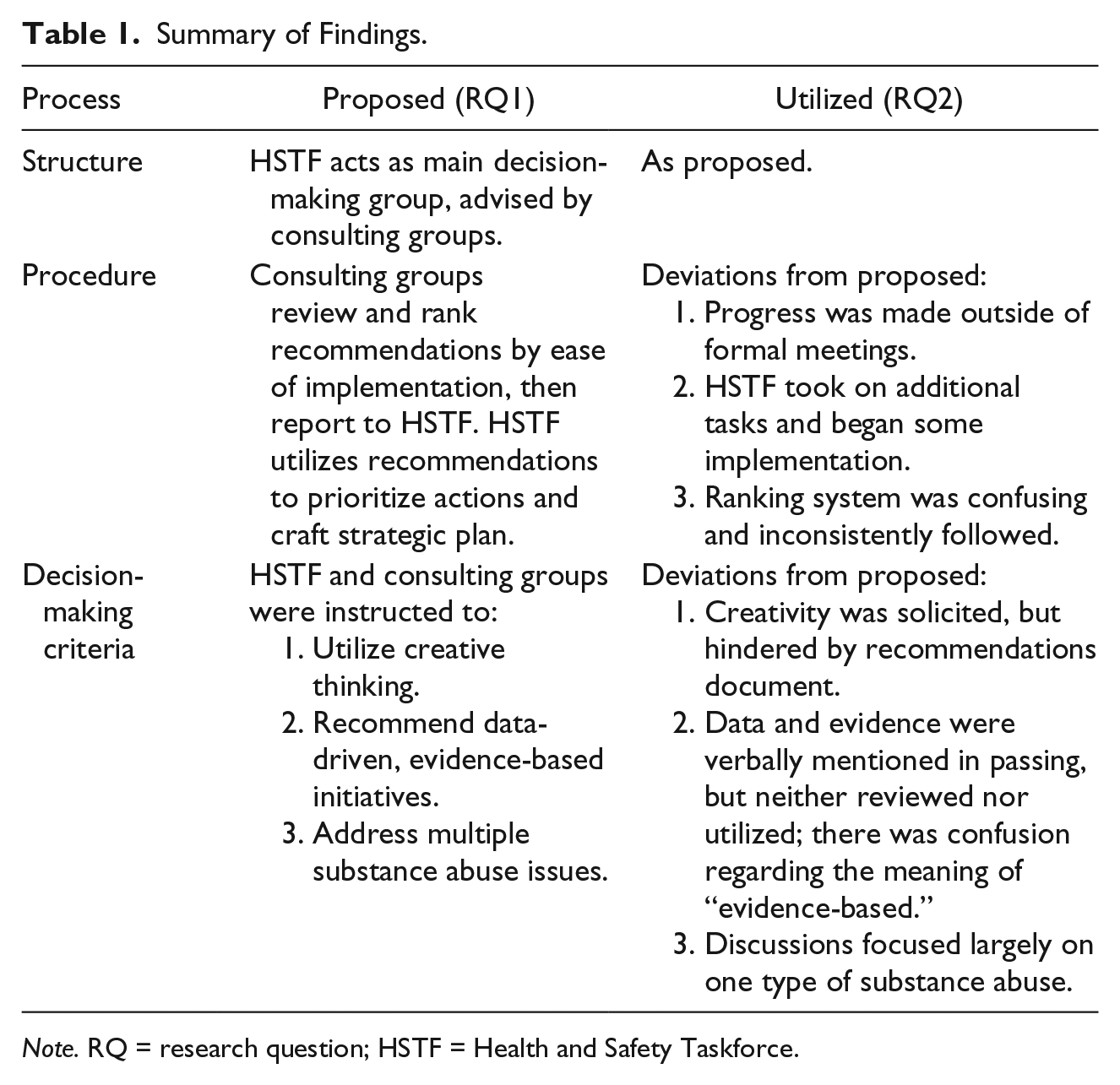
Note. RQ = research question; HSTF = Health and Safety Taskforce.
Structure
This introduction indicated that the primary decision-making group was HSTF. The 10 HSTF members represented agencies with active roles in substance abuse programs and policies. HSTF members should attend all HSTF meetings or send representatives and participate actively in the process. HSTF was charged with prioritizing recommendations in the form of a strategic plan. Throughout the process, seven consulting groups would advise HSTF. Consulting groups were composed of area experts, including at least one HSTF member with appropriate expertise. For example, the HSTF law enforcement representative served on the law enforcement consulting group along with other experts involved with enforcing substance abuse laws. SSA facilitated all HSTF operations, including administrative duties (e.g., scheduling, distributing information, compiling reports). A senior SSA member was also a member of HSTF, and other key SSA associates were highly involved in the HSTF process.
Procedure
The consulting groups were to review recommendations from the technical assessment of the existing substance abuse program. Members should consider recommendations that were relevant to their specialty area, discussing viability, potential problems, and potential for changes/expansions. Each group’s leader was responsible for reporting results to HSTF.
Consulting groups were also responsible for “ranking” recommendations. SSA leaders explicitly described this procedure as categorizing recommendations into one of four ranks according to the action needed for implementation: (a) can be satisfied by one agency; (b) HSTF can address in the near or long term; (c) HSTF could influence change, but political support is needed; or (d) does not meet the first three criteria, to be saved for future consideration. This system, referred to as “ranking,” designated who needed to work on a particular recommendation or when it should be pursued, but did not prioritize them by importance.
Overall, this ranking system reflected the ease of recommendation implementation, reflecting SSA’s emphasis on making quick progress and gaining early momentum as a means of generating excitement. One key SSA representative informed us after an initial meeting: [SSA] wants [HSTF] to achieve early success, even if small, to gain momentum and help foster coordination and commitment. [The SSA coordinator] mentioned the importance of “picking the low-hanging fruit” to gain momentum, and then working on larger-scale ideas, like those that would require new legislation.
Furthermore, to maintain momentum, this SSA representative invited all consulting group members, not just leaders, to remain engaged in the HSTF process by attending HSTF meetings and offering ideas and perspectives.
Decision-making criteria
The introduction above also emphasized important decision-making criteria for the process. First, creative problem solving was important to the proposed process. SSA emphasized that consulting groups should not be constrained by the assessment recommendations. Consulting groups were encouraged to create additional recommendations not covered by the assessment and eliminate ones that seemed unnecessary or inappropriate.
The introduction included a second criterion: Recommendations should be “data-driven or evidence-based.” Various leaders repeated this language on multiple occasions, suggesting that participants should not use personal feelings and anecdotes to justify decisions. Instead, they should make recommendations using logical arguments based on empirical research.
The third criterion suggested that recommendations should address substance abuse due to multiple causes. In justifying the need for HSTF, opening remarks often discussed the “perfect storm”—how the confluence of varying types of substance abuse was increasingly responsible for safety problems. SSA reported that the state had one of the highest rates of abuse of both legal and illegal substances. Safety concerns often resulted from the combination of legal and illegal drug abuse, especially in an aging baby-boomer population.
In summary, the proposed structure and process (see Table 1) included HSTF as the primary decision-making group responsible for crafting a statewide strategic plan. HSTF was to use seven consulting groups that were charged with developing creative recommendations. Consulting groups should recommend evidence-based solutions to address a broad range of substance abuse issues. They would categorize recommendations according to ease of implementation, and HSTF would prioritize them in their final strategic plan.
RQ2: Utilized Decision-Making and Communication Processes
Whereas RQ1 addressed the proposed processes for HSTF, RQ2 was concerned with the processes ultimately used. To understand the characteristics of the HSTF process, we investigated the structure, procedures, and the decision-making criteria actually utilized that ultimately affected HSTF outcomes (see Table 1).
Structure
Most aspects of the proposed structure materialized in the utilized structure. For example, one to three HSTF members participated in each consulting group, creating communication links to HSTF, but two HSTF members did not participate in any consulting groups. Each consulting group had a designated leader, one of whom was also an HSTF member. There were overlapping consulting group memberships by some leaders and group members. Finally, two SSA representatives who were central to the process attended all meetings.
Overall, the structure allowed consulting groups of experts to develop recommendations for the statewide plan and communicate them to HSTF. For example, one group member stated, “Everyone who is on HSTF comes from a specific field, so they have valuable information, but they don’t know about all the other fields. The consulting groups were necessary for that.” All interviewees seemed to understand the advisory role of consulting groups, often referencing this overall structure in interviews. However, even though cross-agency collaboration was encouraged by the proposed structure, very little cross-consulting group collaboration occurred. One interviewee commented on this lack of cross-group collaboration: I haven’t been able to interact with the other [consulting] groups. I think it might have been beneficial for an interaction to take place because someone somewhere along the line is going to have to take all this work and compile it, so it would have been nice if we’d actually had interactions with the other groups.
In this way, SSA facilitated the development of somewhat overlapping and embedded networks to support HSTF across agencies, but not across groups. Ultimately, HSTF made recommendations based on a structure that was consistent with what was proposed.
Procedure
HSTF operated differently than the proposed procedures in three important ways. These deviations included (a) making progress and decisions outside of formal meetings, (b) taking on additional decision-making tasks and discussing implementation for specific initiatives prior to finalizing a formal plan, and (c) confusing and inconsistently using the procedure for ranking or prioritizing recommendations.
Progress outside of formal meetings
Fieldnotes and interviews suggested that significant work occurred away from formal meetings. For example, at one consulting group meeting, an SSA representative announced that he would “meet with other group members next week.” At an HSTF meeting, another SSA representative commented, “We will be behind the scenes, contacting people to look at this stuff.” This behind-the-scenes work shows the importance of developing and leveraging informal networks to gather and integrate information.
In justifying work outside of designated meetings, one SSA representative discussed the group’s deadline in an interview: There is no time to conduct all of the official actions within a meeting. There are so many parts and issues that there’s no way to discuss them all at a meeting. Dialogue has to occur between practitioners—people who do the job and know the problems—before they can be discussed in a formal setting. Clearly, the majority of the work has to be done offline and then presented back as recommendations.
Here the SSA representative clearly states that because of the logistical challenges of collaboration and the need to submit a plan by the appointed deadline, much of the work needed to occur between scheduled meetings.
When asked in interviews about work outside the meetings, HSTF members typically responded in one of three ways.
There are obviously things being done outside of those meetings and we don’t know about them until we’re actually there. I guess that’s okay. But maybe we should be kept in the loop a little bit more. I do interact with a lot of people outside of those meeting[s], but we don’t necessarily discuss the consulting group[s]. There’s no way that people can accomplish all of the work that has to be done in the meetings. We’d have to meet every two weeks or more. So a lot of it has to happen through phone calls, emails, and private meetings. If we had more meetings . . . people would quit coming. And if people quit coming, we’re dead in the water. So the behind-the-scenes stuff is absolutely necessary. A necessary evil.
Individuals such as P1 had no firsthand knowledge of work accomplished outside the meetings but suspected it occurred based on changes between meetings. P1 expressed wanting to be informed about that work. Individuals such as P2 acknowledged work outside meetings but downplayed the idea that they addressed HSTF issues. Individuals such as P3 saw outside work as necessary to complete the process in a timely manner.
Overall, participants recognized it was impractical to accomplish all the work in formal meetings. Many individuals, including HSTF leaders, saw making decisions away from the meetings as necessary to develop a comprehensive plan on time. Through this process of work completed outside of meetings, the ideas that SSA leadership supported became part of the recommended plan. These ideas likely represented the opinions of some (perhaps even all) HSTF members, who eventually endorsed and supported the plan.
Taking on additional decision-making tasks and discussing implementation
HSTF’s primary responsibility involved presenting a comprehensive strategic plan for approval before implementing any specific initiatives. However, HSTF discussed, evaluated, and implemented some initiatives before finalizing the plan.
First, HSTF discussed in detail an integrative initiative focused on first offenders a few months before submitting the final plan. SSA developed this initiative outside of meetings with input from various involved individuals and presented it at the third HSTF meeting for discussion. In general, this initiative would send offenders through a new “workflow process” that simultaneously addressed both administrative and judicial issues. Although this initiative was not mentioned explicitly in the final HSTF strategic plan, that plan did list as a key recommendation that the current administrative system should be integrated with the current judicial system for substance abuse offenders. This example shows how the decision-making process involved the development of a detailed initiative before finalizing a general plan.
Second, SSA received federal funding to support HSTF and to fund agencies developing new substance abuse initiatives. SSA indicated to us that their original intent was to use HSTF to facilitate requests for proposals and to have HSTF acknowledge that proposals addressed one or more recommendations from the state’s previous assessment. However, after discussing HSTF’s role in the process, an HSTF member expressed uneasiness with this process and wanted the group to more formally review and approve funding proposals. Although this was not SSA’s original directive, HSTF became formally involved in approving funding proposals. The primary reason for this particular HSTF meeting was to work on the strategic plan. Although acknowledging grant proposals was originally a secondary reason for the meeting, a substantial amount of the time was devoted to reviewing grant proposals, with formal presentations made to HSTF, and HSTF voting on the proposals.
Confusing and inconsistent procedure for ranking recommendations
There was considerable confusion in meetings concerning what it meant to rank recommendations. The stated intent was that rankings would categorize recommendations according to ease of implementation. Due to a lack of shared understanding of “ranking,” some individuals did not initially make a distinction between categorizing and prioritizing recommendations. For example, the following occurred in a consulting group meeting: [The group leader] suggested making a list of what we had recommended, emailing it out, and then using Survey Monkey to rank them for priorities. The SSA coordinator then pointed out that they really only needed to rank them as level 1, 2, 3, 4 and that it was up to HSTF members to actually prioritize them.
Similar confusion occurred in several consulting group meetings, suggesting that groups thought they would prioritize (i.e., rank order) recommendations when they really were only charged with categorizing (i.e., “ranking”) them. This restricted procedure of categorizing limited the input of the group in setting decision-making priorities.
Although consulting groups only categorized recommendations, the HSTF leader asked group leaders to identify “key recommendations” at the next HSTF meeting. This request was inconsistent with the directive to consulting groups. By directing leaders to identify “key recommendations,” HSTF asked them to designate (or prioritize) their groups’ most important recommendations. This request suggests HSTF leadership was also confused about the ranking procedure. Consulting group leaders then had to prioritize recommendations extemporaneously. It was difficult to discern if they reported the priorities of their groups or their personal opinions.
Interviewees reinforced the problems surrounding the “ranking” terminology. For example, a consulting group member said in an interview that the goal was “to prioritize [recommendations] for HSTF.” Participants had to be reminded at almost every meeting that ranking only involved categorizing by ease of implementation. Ultimately, consulting groups did not prioritize recommendations. Instead, consulting group leaders prioritized them in an impromptu manner at an HSTF meeting.
The analysis of the utilized procedures shows the importance of SSA working outside of formal meetings to ensure timely progress. However, the lack of consistent, clear understanding of the ranking procedure hindered consulting groups’ ability to provide valuable input into HSTF’s decision making. In addition, SSA took an instrumental role in presenting and pursuing implementation of specific initiatives before a finalized strategic plan. HSTF also evaluated and funded specific initiatives prior to plan completion. The decision-making process was not a linear one whereby general ideas and recommendations were first proposed and discussed, then a formal comprehensive plan was composed and approved, and then specific initiatives subsequently pursued. Instead, decision making was a complex and dynamic process.
Decision-making criteria
It was in the use of decision-making criteria that the actual HSTF process seemed to deviate most from the proposed process. We explain below how each decision-making criterion functioned differently than planned.
Creative thinking
At most consulting group meetings, leaders attempted to solicit creative ideas beyond the original list of assessment recommendations. Exemplifying a typical response, one interviewee commented, “Clearly we weren’t limited by the recommendations. Having the recommendations there kept us on track but didn’t restrict our discussion.” This criterion opened the discussion to all available options. For example, after discussing and amending the recommendations related to their area, one consulting group leader asked for “other ideas.” One member then contributed several new ideas, including new training programs for industries typically affected by substance abuse. This idea made it into the group’s recommendations to HSTF and ultimately into the final strategic plan. Interviews confirmed that most participants felt comfortable voicing their opinions when they desired to do so.
Despite encouragement to be creative, however, most consulting groups were “kept on track” by the assessment recommendations and provided few new ideas. In interviews, some consulting group members mentioned that the recommendations document restricted participation and discussion. One participant explained, “It seemed like it was already predetermined what they [SSA] wanted. It sort of stifled some discussion.”
Overall, the assessment recommendations seemed to constrain discussion in most meetings and limited input from experts in the field. According to our document analysis, many groups only deleted recommendations, often without adding any, with the net result being that the final plan largely reflected the original technical assessment. Our analysis revealed that only two of the seven consulting groups significantly changed their sections. Perhaps because of this creative input, both groups seemed to have more influence on the final plan. Other groups largely discussed and “ranked” existing recommendations, having limited impact on the final plan. They primarily reinforced recommendations from the original assessment.
Data-driven, evidence-based
Leaders periodically reminded consulting groups and HSTF members to adopt “evidence-based and data-driven programs.” Participants gave this criterion verbal support multiple times. For example, fieldnotes of one meeting described how “one member mentioned that evidenced-based programs are important; programs focusing on scare tactics should be avoided.” SSA representatives often encouraged groups to reference evidenced-based, empirically supported practices. Individuals commonly voiced agreement that adopting evidence-based programs was important.
Despite agreeing on the need for evidence-based programs, two main problems inhibited following this criterion. First, individuals often asked for but never received or discussed actual evidence. For example, at one meeting, “one of the members asked if there was data that has broken down offenders by occupation.” Rather than providing evidence, group members agreed that typical offenders were lower level or underemployed employees. At another meeting, members accepted without evidence that another state’s media program was more effective than the current national campaign. At the final meeting, HSTF pursued an adaptation of that state’s media program without presenting or discussing any information regarding its effectiveness.
Although these examples suggest participants largely ignored the need for evidence-based programs, interviews indicated that was not necessarily the case. First, various participants sought data outside of meetings but typically data were unavailable. For example, one SSA representative stated in an interview, “I was surprised by the lack of information we have. We request information from certain agencies across the state and the data they do have doesn’t mesh with anyone else’s.” Thus, participants were aware of the inconsistent use of data across agencies and were often unable to access or use data that might have benefited discussions.
In addition, the meaning of “evidence-based” was not well articulated and eventually largely ignored. For instance, at one HSTF meeting, the following exchange occurred: What do we mean by “evidence-based” programs? We’re not suggesting a mandate on what is evidence-based. I think this panel wants to encourage programs that have been shown to have an effect. [I’m] concerned that “evidence-based” might close the door on new or more locally developed programs. I don’t think this wording constrains them although our agency has a definition of what “evidence-based” is. [Then it’s] up to this entity to decide [what is] evidence-based.
This exchange indicates the disputed definition of evidence-based programs. The consulting group leader makes a distinction between “evidence-based programs” and “programs that have worked in the past.” An SSA representative suggested that HSTF define the term for itself.
In another example, one HSTF member spoke in favor of an agency that conducts Testimonial Discussion Groups (TDGs) as offender intervention.
[Member] then gave a brief speech on why [TDGs] were important and effective. He said it was the best deterrent for first time offenders . . . He also recalled one individual telling him that the [TDG] he attended was what changed his behavior, not any of the other legal proceedings.
Here, the HSTF member claims that evidence supports the effectiveness of TDGs. However, a consulting group leader had reported previously that there was no evidence in support of TDGs’ effectiveness. The HSTF member referenced in the excerpt above also substitutes personal anecdotes for empirical evidence. Given the inconsistency in the use of “evidence-based” terminology, it was unsurprising that an agency that conducted TDGs received HSTF funding despite little empirical support for their effectiveness.
In the end, rather than adopting evidence-based programs, HSTF supported programs that members believed were effective and often considered personal anecdotes as compelling support for programs. In addition, HSTF members adopted programs or recommendations supported by vocal or passionate members without much discussion from others. Nevertheless, the final strategic plan included language regarding the importance of “data-driven” and “evidence-based” initiatives. In fact, many recommendations were consistent with published reports of effective countermeasures against substance abuse, but this largely reflected the initial assessment report recommending evidence-based initiatives rather than changes made by the taskforce.
Broad issues
Although HSTF was charged with addressing multiple, broad substance abuse issues, the majority of the discussions and recommendations were largely narrowed to the abuse of one substance—alcohol. An interaction at an HSTF meeting recognized that the group largely focused on alcohol abuse: HSTF Chair: Is there anything coming from that group regarding testing for drugs? Because this is an issue in this state. Consulting Group Member: We used to have some of that wording added to that [recommendation] before. SSA Representative: That wording was removed at a previous meeting per your recommendation.
This exchange illustrates that HSTF members were aware they should address issues beyond alcohol abuse, but that they decided to leave out other substance abuse issues. At several meetings, the entire discussion concerned alcohol abuse. Ultimately, all new recommendations added to the plan related exclusively to alcohol abuse.
Some interviews provided more detail about HSTF’s focus on alcohol over other legal and illegal substances. One interviewee indicated her agency was limited to addressing alcohol abuse given a lack of resources to address other substance abuse; another explained that alcohol is more easily identifiable in substance abuse cases. Another HSTF member also clarified: I think that the group fully acknowledges that it’s not only alcohol. But the reason the conversation always goes around to alcohol is that we know more; we already have systems in place that can be bent or modified to address it. We are going for changes with HSTF that can be handled immediately and have the most impact. We certainly have not forgotten about the other issues.
As this statement indicates, the narrow focus on alcohol occurred primarily because it was considered the only way to create immediate change. Participants viewed drug-related substance abuse programs as initiatives to address in the future.
Another example of narrowing discussion was the previously mentioned integrative initiative for first-time offenders. The SSA representative presenting the initiative explicitly stated, “The primary focus behind this system is that 100% of second offenders were first offenders at some point.” In spite of such justifications, multiple participants expressed concerns in meetings and in interviews about the wisdom of focusing on first offenders.
Interestingly, despite this narrow focus during the process, the final plan included general substance abuse language. The rationale for adopting broader recommendations in the new plan included the same alcohol and other legal and illegal substance abuse issues that SSA described as the “Perfect Storm” of concerns in initial meetings. The plan itself frequently mentioned broad substance abuse issues, which was largely because the original assessment recommendations included such wording and so the document retained that wording. Relatively little discussion of substances other than alcohol occurred throughout the process.
Overall, HSTF deviated from their plans by utilizing existing recommendations from the technical assessment rather than employing creative thinking, by supporting recommendations that lacked evidence and support, and by failing to address the multiple, broad substance abuse issues facing the state. Together with HSTF’s deviations from the proposed procedure, these findings indicate the complexity and dynamic nature of interagency decision making.
Discussion
To understand decision making in an IOR context, we examined the processes a statewide interagency taskforce proposed to use when developing a strategic plan vis-à-vis the processes they actually used. The results indicated significant variations between what leaders initially proposed and what actually occurred. We illustrate below what these findings contribute to our theoretical and practical understanding of decision-making processes in this IOR and similar collaboration contexts.
Implications for Theory
Research has shown that groups tend to utilize a variety of decision-making processes in concert with one another (Langley, Mintzberg, Pitcher, Posada, & Saint-Macary, 1995). The interagency taskforce examined in this study exhibited instances of three traditional decision-making models, all of which continue to be utilized by contemporary decision-making scholars (Nutt & Wilson, 2010): rational (Dewey, 1910), satisficing (Simon, 1957), and garbage can decision making (Cohen et al., 1972). Components of each model characterize aspects of the collaborative decision-making process that HSTF used to craft and approve its strategic plan.
First, the taskforce proposed following a rational process at early meetings when it created the general structure of specialty consulting groups advising the main taskforce. The suggested decision-making criteria (encourage creativity, use evidence-based logic, and examine wide-ranging causes and solutions) were also rational, mimicking the steps outlined by scholars for effective, rational decision making, as well as Vlaar et al.’s (2006) process of formalization for collaborations. Given that IORs are particularly prone to issues of (mis)understanding caused by participants representing various organizational cultures and norms, this study’s results illustrate how a collaborative group might benefit from a proposed rational process. Such a formalization process focuses participants’ attention, facilitates ongoing deliberation, initiates interaction, and attempts to reduce errors in judgment (Vlaar et al., 2006).
Adhering to the proposed rational process, however, was not always viable. Deviations from the proposed process often occurred due to issues such as insufficient information or data, impending deadlines (hence, the need to make progress outside of meetings), and distance or schedule constraints that inhibited full group participation. Many of these issues, particularly those inhibiting full participation, are indicative of the nature of collaborative bona fide groups (Cooper & Shumate, 2012). Thus, it may be that collaborative decision-making groups are more susceptible to issues leading to deviations from planned processes.
In the case of HSTF, these deviations from proposed rational plans represent instances of satisficing due to bounded rationality (Rainey et al., 2010). For example, when HSTF discussed funding an agency that conducted TDGs, the group engaged in satisficing when they accepted one HSTF member’s personal anecdotes as “evidence” of TDGs being successful. The taskforce ultimately deemed TDGs as acceptable or satisfactory despite the previously planned, rational use of data-driven, evidence-based decisions. As such, satisficing became part of the group’s meaning-making process as decisions were made (Castor, 2005; Tracy & Standerfer, 2003).
Accomplishing work informally outside of meetings reflects another way HSTF engaged in satisficing. During interviews, individuals retrospectively rationalized work outside of meetings as necessary due to time constraints and the collaborative nature of the group (i.e., participants were not centrally located within one organization and were, therefore, unable to interact as often as decision-making groups in single organizations might). In a similar vein, SSA’s emphasis on making quick progress and gaining early momentum to build confidence in and commitment to the taskforce helped set the stage for satisficing. In particular, HSTF chose to focus their immediate efforts on alcohol abuse despite recognizing the gravity of the broader substance abuse problem. These examples are consistent with the notion that groups often act first, monitor and adjust, and then retrospectively rationalize their efforts when trying to achieve strategic changes (Mintzberg & Westley, 2010).
HSTF proposed a generally rational decision-making plan, but the interagency taskforce progressed toward formulating a strategic plan using satisficing as necessary within bounded rationality. However, given time constraints and the impossibility of knowing if additional efforts would actually improve the final proposal, a satisficing approach to decision making may have been the rational thing to do (Connolly, 1980). It may be that decision making in the context of an IOR lends itself to more satisficing than might be expected in a traditional, singular organizational context. Thus, satisficing can serve to both enable and constrain the decision-making process of an IOR.
Furthermore, HSTF was a relatively loosely coupled collaboration, which might have presented more barriers to rational decision making than a tightly coupled group (Barringer & Harrison, 2000). In a more formal collaborative effort, groups might have the resources to overcome constraints such as lack of data or competing time commitments. Future research on bona fide collaborative groups should consider the characteristics of an IOR that serve as preconditions for satisficing, and scholars and practitioners alike must consider the risks and benefits of satisficing in collaborative decision making.
Characteristics of the garbage can decision-making model also appeared during HSTF’s processes. This model describes the process as flowing together rather haphazardly through streams of problems, solutions, and participant interactions (Rainey et al., 2010). In one example from an early HSTF meeting, consulting group leaders were prepared to report all their group’s recommendations ranked according to how easily they could be implemented. However, the HSTF chair asked them without warning to provide their “top priority” recommendations, despite the fact that leaders were explicitly instructed previously not to prioritize recommendations. Group leaders prioritized recommendations in an impromptu manner without consulting other group members. This interaction was a deviation from the proposed rational process and was not an instance of satisficing or accepting a plausible/viable solution. Instead, the priority recommendations introduced (many of which were ultimately retained in the final strategic plan) were done so haphazardly because of unplanned interactions. This deviation from planned processes represents a meaningful dialogic moment (Heath, 2007) that led to long-lasting changes in HSTF’s collaborative effort and strategic plan. This finding illustrates how instances of garbage can decision making in IORs can influence outcomes in meaningful ways.
Two other examples of the garbage can model were also apparent in this study. First, taskforce leaders allowed for a spontaneous change to the planned agenda during one meeting when members asked to be involved more formally in the funding process for awarding grant money to agencies. Second, the taskforce began working on implementation of an integrative initiative that focused only on first-time substance abuse offenders. The taskforce was entrenched in the decision-making phase that would ultimately lead to their strategic plan; the implementation of that plan was understood by all involved to occur upon completion and submission of the plan. Thus, by engaging in implementation planning for a specific recommendation and by changing the taskforce procedures related to funding rather unexpectedly, the taskforce deviated from its rational plan in a seemingly haphazard manner.
However, interviews with HSTF leaders explained the potential reasoning behind these deviations from the proposed, rational process. First, leaders allowed for changes to planned agendas as a means of giving HSTF members more autonomy, influence, and control to avoid the appearance of a predetermined strategic plan. Second, the early work on a particular recommendation was a means of gaining momentum to generate excitement. As such, the use of seemingly haphazard decision-making processes allowed HSTF leaders to overcome issues typically associated with collaborative efforts in bona fide groups, such as lack of buy-in and concerns with autonomy (Cooper & Shumate, 2012; Miller et al., 1995).
Finding evidence of all three decision-making models extends the work of Langley et al. (1995). These authors posit that decision making is an iterative process fluctuating between sequential (rational) and anarchical (garbage can) processes. Our results suggest that the process was even more complex given the interorganizational nature of this bona fide group. The process fluctuated between rational, satisficing, and garbage can decision making and used retrospective rationality to address time constraints and other obstacles common in collaborations.
In addition to these three decision-making models being apparent throughout the process, strategically ambiguous communication was also used to manage the process. Eisenberg (1984) coined the phrase strategic ambiguity to describe how organizational members often utilize purposefully vague language to encourage the agreement and compliance of other members. The use of strategically ambiguous language by taskforce members such as “TDGs are generally effective” allowed others to deem a given opinion or decision acceptable. Essentially, strategic ambiguity as a communication strategy facilitated satisficing or haphazard decision making while maintaining the appearance of rationality. Given the implausibility of implementing a fully rational model of decision making while achieving full agreement in bona fide collaborative groups, future research should examine whether strategic ambiguity in other collaborative contexts also facilitates satisficing and retrospective rationality.
Last, strategic ambiguity was also evident in HSTF’s discussion (or lack thereof) of the broad issues surrounding substance abuse concerns. With rare exceptions, interactions in meetings focused on alcohol abuse. With this narrow focus, the IOR deviated from the proposed rational process by satisficing. Yet, the language utilized in the final strategic plan was ambiguous enough to allow for the inclusion of a broad range of substance abuse issues as originally indicated by the proposed process. Ambiguity allowed the group to claim success in addressing the broader issues of the “perfect storm” without actually doing so. Furthermore, strategic ambiguity allows for adaptation and change over time in organizational action (Eisenberg, 1984). For HSTF, ambiguous language in the final plan allows future actions to focus on a variety of substances, even though decisions were made while primarily focusing on alcohol. Therefore, the results presented here illustrate how strategic ambiguity might allow collaborative decision-making groups to claim unanimous agreement and goal attainment, even when actual processes reflect differences.
Implications for Practitioners
This study provides valuable practical implications for managing and leading decision making in IORs. First, leaders should recognize the need for flexibility throughout the decision-making process and avoid insisting upon “rational” decision making. Adhering to a rational plan will not always be possible or beneficial, particularly in a collaborative context. Leaders of collaborative groups can achieve such flexibility by willingly changing planned processes, deviating from agendas, or giving participants more autonomy with certain decisions.
Second, although flexibility is useful, leaders should be mindful of decisions or actions that could cause a deviation from the proposed processes. The results of this study illustrate how such deviations might unintentionally set the stage for satisficing or garbage can decision making. For example, asking individuals for on-the-spot opinions (as HSTF’s chair did of consulting group leaders) will likely result in suggestions that are not well developed or that do not truly represent the collaborative nature of the group. By maintaining such mindfulness, leaders of collaborative decision-making groups will likely be able to make informed decisions with regard to when deviations from planned processes are useful and when they are detrimental.
Third, using strategic ambiguity might be beneficial in IORs given the need for agreement and compliance across multiple organizations and in response to the changing membership issues that come along with bona fide groups (Keyton & Stallworth, 2003). That is, practitioners can propose a rational process described in ambiguous terms that is useful for gaining agreement and participation from all representatives involved in the IOR. Moreover, the use of strategic ambiguity will again be beneficial when the decision-making group diverges from a rational or planned process; strategic ambiguity can allow leaders to rationalize retrospectively their group’s decisions (Rainey et al., 2010).
Last, this study presents a number of implications with regard to the use of creativity in collaborative decision making. Leaders of collaborations need to be conscious of opportunities for innovation by using creative thinking as a decision-making criterion, particularly when collaborative decisions will ultimately lead to social change. It is important to emphasize verbally that creative thinking is desirable, as the leaders of HSTF often did, even if such creative input is not always maximized. Only through emphasizing creativity can social innovation occur (Grimm, Fox, Baines, & Albertson, 2013).
Furthermore, it is important to codify innovations and creative ideas (Harrisson & Laberge, 2002). Including new ideas, even ostensibly odd ones, in documents and plans, provides the opportunity for real innovation and change to occur through the collaborative effort. Moreover, commitment to the IOR could be enhanced if progress is documented in a way that simultaneously emphasizes the overall unity of the IOR while recognizing the unique contributions of the collaborators. Doing so develops an overarching IOR identity while underscoring the individual identities of contributing organizations, which is key to social innovation (Brewer, 2012; Harrisson & Laberge, 2002). We observed this in HSTF’s structure and procedures involving the use of consulting groups explicitly arranged according to the areas of expertise of the contributing organizations.
Limitations
The present study is not without limitations. First, this study examined the unique first-time efforts of an interagency taskforce attempting to address a statewide health and safety concern due to rising substance abuse problems. To do so, this study utilized observations and interviews as a primary means of data collection. Therefore, these findings may not generalize to all IORs or collaborative decision-making groups. Although we utilized a number of strategies throughout the research process to ensure qualitative rigor and verify claims, the findings presented here should be applied with care to other contexts. Future research should explore the nuances of decision making in a wide range of collaborative efforts and should consider utilizing multiple means of data collection and analysis.
Furthermore, the use of three traditional models of decision making (rational, satisficing, and garbage can) created a better understanding of decision making in this collaborative context. However, given the influence of time, distance, and schedule constraints apparent in this particular IOR context, additional research is necessary to understand whether components of these traditional decision-making models might be apparent more often or more prominently in IORs compared with traditionally studied decision-making efforts in singular groups and organizations or in lab settings. We encourage research leading to a renewed understanding of how each traditional model of decision making might be utilized together by collaborative groups working on complex problems with limited resources, allowing for new theoretical insights into the collaborative decision-making process.
Conclusion
This study extended previous theoretical understanding of decision making in a collaborative process and provided valuable practical implications for managing and leading IORs. Ultimately, the decision-making process of this interagency taskforce utilized components from a variety of traditional decision-making models. Using strategically ambiguous language, taskforce leaders proposed a relatively rational structure and process. As the group moved forward in their decision making, however, following a rational process was not always viable. Thus, the IOR utilized satisficing, again facilitated by strategic ambiguity, as a means of making decisions. Finally, moments or instances of relatively haphazard or garbage can decision making also punctuated the process. Although the actual process did not follow a rational or phase model, the taskforce presented the resulting strategic plan in rational, optimal terms through strategic ambiguity. As such, the use of retrospective rationality and strategic ambiguity went hand-in-hand, allowing the taskforce to arrive at decisions that appeared to be rational, yet was ambiguous enough to produce agreement among participating organizations.
Footnotes
Declaration of Conflicting Interests
The author(s) declared no potential conflicts of interest with respect to the research, authorship, and/or publication of this article.
Funding
The author(s) disclosed receipt of the following financial support for the research, authorship, and/or publication of this article: The authors wish to thank the U.S. National Safety Council for funding awarded to Eric Anthony Day and Michael W. Kramer in support of this research.