



Abstract
When evaluating an applicant online, individuals are often concurrently exposed to a diverse cross-section of self- and other-generated information with varying relevance to the candidate’s actual job skills. Moreover, these various data may not always be internally consistent. Utilizing profiles on the microtask site Fiverr, a fully-crossed 2 × 2 × 2 experiment (N= 92) tested main and interaction effects of exposure positively- and negatively-valenced (1) self-generated task-relevant, (2) self-generated task-irrlevant photographic, and (3) other-generated task-relevant information, all within the same stimulus. Contrast analyses results support significant interactions among cues on perceptions of an applicants’ employability and person-job fit. The significant two- and three-way interactions are discussed with respect to warranting theory and the halo effect, and practical implications for applicants and employers are presented.
Introduction
Microtask sites have rapidly proliferated, affecting electronic commerce and the contingent workforce. Sites such as Fiverr, GigBucks, EasyShift, and Amazon Mechanical Turk facilitate millions of transactions monthly between individuals and service providers (Lee, Webb, & Ge, 2014) who complete brief tasks for small, one-time financial compensation. These microtasks include composing songs or jingles, crafting a résumé, designing a logo, and providing voice-over services. Particularly on microtasking sites, where individuals seeking to hire (i.e., employers) a contractor (i.e., applicant) typically have no prior knowledge of the contractor, employers form impressions and make decisions based solely on the limited information available on the applicant’s online profile. Similar to conventional hiring contexts (see Gilmore & Ferris, 1989; Morrow, 1990; Saks & Ashforth, 1997), this information should affect perceptions of an applicant and subsequently employability, but online, this information can widely vary by author, job relevance, and valence, affecting employers’ impression formation process.
Unlike conventional postindustrial hiring materials and processes, social media readily convey and converge multiple types and sources of information about an individual (see Walther, Tong, DeAndrea, Carr, & Van Der Heide, 2011). Profiles contain concomitant information that can vary in its (a) source, (b) valence, and (c) relevance to the actual job and job skills for which the applicant is being considered. This study explored the relative effects of information from three common information sources found on these sites on perceivers’ attributions of the service provider: self-generated task-relevant claims, self-generated task-irrelevant pictures, and others’ task-relevant reviews. Results reveal all three information sources affected perceptions of an applicant’s employability and person–job fit, but information from others’ task-relevant reviews exerted a stronger effect on perceptions of employability and person–job fit than did information from self-generated task-relevant claims, while task-irrelevant self-generated pictures exerted the weakest (but still significant) effect. This interaction is complex when one of the three cues offers dissonant information from the other two, resulting in tensions among attributions.
Applicant Claims and Employer Perceptions
Assessing and Hiring Contingent Workers From Online Information
When hiring, employers seek to learn about applicants to reduce their uncertainty regarding candidates’ potential knowledge, skills, and abilities (KSAs) and personalities to predict future behavior and success if hired. Assessment of an applicant’s KSAs guides employers’ attributions of person–job (P-J) fit—the perception an individual is capable of the job-related tasks associated with a particular job or position (Kristof-Brown, 2000). Perceptions of P-J fit in turn can affect perceptions of an individual’s employability (Cable & Judge, 1996). Although assessment of applicants for conventional jobs has received substantive research, considerably less attention has been given to the assessment and hiring of contingent workers—individuals hired without expectations of long-term employment and whose work times and flows can vary in a nonsystematic manner (Connelly & Gallagher, 2004).
An additional concern and paucity in the current literature is understanding a new type of contingent worker: the microtasker. Typically, contingent workers have included independent contractors hired for specific long- or short-term projects but without the expectation of sustained employment, seasonal help, or temporary employees (Connelly & Gallagher, 2004; Kalleberg, 2000). However, microtasking sites enable a new type of contingent worker: an individual external to the organization hired to perform a specific task but without formally joining the organization. In addition to having a different relationship with the employer than other types of contingent workers (Bauer, Truxillo, Mansfield, & Erdogan, 2012), and perhaps being guided by different employment laws and practices (Horney, 2016), microtaskers are also unique in that they are identified, assessed, and perform their job duties entirely online. Online, the myriad of information (often from multiple sources) available about a job applicant can substantively affect how an employer perceives an applicant (Carr, 2016), even if the applicant is a microtasker. Three types of information sources are common in microtasking sites, and in professional network sites (PNSs; for example, LinkedIn, Xing) more broadly: (a) self-generated task-relevant claims, (b) self-generated pictures, and (c) other-generated task-relevant claims.
Self-generated task-relevant claims
Task-relevant claims (i.e., espousing or evidencing job-related KSAs) made by an individual influence potential employers’ perceptions of a job applicant’s P-J fit. Observers perceive targets making positive task-relevant claims as significantly more competent, task attractive, employable, and with greater P-J fit than targets making negative task-relevant claims (Carr & Walther, 2014). Thus, self-presentation of task-relevant KSAs should influence attributions consistent with the valence of the claim.
Self-generated pictures
An individual’s self-selected profile picture is also incorporated into others’ perceptions of the target, including perceptions of P-J fit and employability. On the medical advice site WebMD.com, doctors are perceived as more credible and trustworthy when depicted wearing a lab coat compared with those wearing business attire (D’Angelo & Van Der Heide, 2016). Similarly, job candidates depicted wearing glasses in a profile picture are perceived as more employable (van der Land, Willemsen, & Unkel, 2015). Thus, pictorial self-generated cues can affect others’ task-related attributions about an applicant, even when appearance is unrelated to KSAs or P-J fit for the job or task under consideration.
Other-generated task-relevant claims
Others’ claims about a target can also influence employers’ attributions of a target. Typically in PNSs, others’ statements regarding a target are tied to the target’s KSAs, often taking the form of a review of the target’s work experience or prior performance. Several studies have noted others’ statements of a target’s KSAs, such as an instructor’s ability to convey class content (Edwards, Edwards, Qing, & Qahl, 2007) or example workplace behaviors (Knouse, 1983), strongly affect perceptions of the target’s work performance and P-J fit. Therefore, other-generated task-relevant claims can affect attributions.
Hypothesized main effects
Self-generated task-relevant information, self-selected pictures, and third-party references should all, therefore, directly influence perceiver’s attributions of a profile holder’s actual characteristics, so that the valence of information in each of these three correlate with subsequent task-relevant attributions. These expectations guide three initial subhypotheses:
Because online information sources about a target rarely appear in isolation (see DeAndrea, Van Der Heide, Vendemia, & Vang, 2015), it is also important to study concurrent information sources. In addition to increased natural validity, the ability of multiple cues to be internally congruent or discordant raises new concerns. What happens, for example, when a recording artist sounds good and is recommended by others but is pictorially depicted as homely? Alternately, what about an attractive vocalist who sounds terrible and received poor reviews? Given its focus on using online information to guide attributions of a target, warranting theory is appropriate to understand theoretically how employers form impressions of a target from various online information sources, both in isolation and when presented concurrently.
Interactions Among Claims
Warranting theory
Warranting theory, advanced by Walther and Parks (2002), explains how individuals make attributions about others based on online information. An online cue has greater warranting value if it increases a perceiver’s belief that the target individual possesses offline the characteristics or attributes espoused to be held online. Addressing the boundary conditions of warranting theory, Parks (2011) noted online information has greater warranting value when presented in a public and social channel, enabling (though not requiring) others to support or refute an individual’s claim. DeAndrea (2014) further noted the ability of a user to (a) control what information is visible to, and accessible by, others; and (b) modify the statements of third parties that may additionally limit the warranting value of information.
Self-generated versus other-generated claims
A central tenant of warranting theory is that third-party statements are less likely to be influenced by an individual, affording them greater warranting value (DeAndrea, 2014). Thus, warranting theory posits other-generated information about a target exerts greater influence on subsequent attributions than self-generated information. The strength of third-party information on attributions has been identified for perceptions of social attractiveness (Antheunis & Schouten, 2011; Walther, Van Der Heide, Hamel, & Shulman, 2009) and professionalism (Carr & Stefaniak, 2012). We, therefore, predict third-party information (i.e., references) more strongly influences a perceiver’s belief the target individual actually possesses those skills than information generated by the target directly.
The halo effect and self-generated task-relevant versus task-irrelevant claims
More nuanced may be the relative effects of information generated by the applicant, but that may vary in the information’s relevance to the applicant’s KSAs. Although both influence an employer’s perceptions, task-relevant claims may exert a stronger influence than task-irrelevant claims, the latter of which may exert a halo effect to augment attributions from other sources. The halo effect refers to a cognitive bias wherein positive attributions of a target are overlaid onto subsequent attributions (Nisbett & Wilson, 1977), such as when attractive people are subsequently perceived to be more intelligent, credible, or competent. Perceivers experiencing a halo effect mitigate potential shortcomings for physically attractive individuals while accentuating the similar shortcomings for less attractive targets.
Dion, Berscheid, and Walster (1972) found that, absent other cues, individuals evaluated physically attractive targets more positively than unattractive targets, regardless of the sex of the evaluator in relation to the target. These evaluations differed across several attributions, including perceived social desirability, occupational status, and social and professional happiness. More recently and directly, Schouten, Antheunis, Abeele, and Van Lith (2015) found that individuals exposed to résumés and social network site profile pictures depicting either positive (i.e., grammatically correct, well-formatted résumés and professional profile photographs) or negative (i.e., grammatically erred and structurally unsound résumé and unprofessional profile photographs) reported complex attributions regarding the target’s conscientiousness, competence, intelligence, and likelihood of getting offered an interview and job. Exposure to an unprofessional profile photo reduced initial positive attributions from a professional résumé, and a positive profile photo mitigated initial negative attributions from an unprofessional résumé. Notably, the photograph’s effect never completely overrode the main effect of the résumé’s quality. These results suggest task-irrelevant information may merely augment the effect of task-relevant data.
Full interaction
Finally, these main and interaction effects suggest a relative weighting of online information in a perceiver’s ultimate attributions of a target individual. Our final hypothesis addresses the full interaction and relative influence of all three sources of information:
Method
Participants
Ninety-two students recruited from a mid-sized Midwestern university completed this research for course (extra) credit commensurate with class policies. Participants were an average of 21.36 (SD = 3.90 years) years of age and predominantly female (n = 75, 81%). Although student samples have been criticized (McNemar, 1946), young adults’ perceptions and reported effects are relevant to the experience of many Fiverr users because they are (a) frequent contractors of microtask services (Ge, Caverlee, & Lee, 2015; Lee et al., 2014) and (b) the population responsible for hiring for the organization utilized in this study. Between-groups analyses revealed no significant difference on key study variables based on sex, which was, therefore, not included in analyses.
Procedures
Participants participated in an online experiment in which they were prompted that the university’s student radio station was looking for a new announcer to voice station identification and station breaks, and that participants would be looking at a profile of one of the final candidates and polled regarding their opinions of the target individual. Following this prompt, participants were automatically redirected via a randomizer script to view one of eight PNS profiles. In all conditions, the profile (see Figure 1) contained a profile picture, an audio sample, and two third-party references. Profiles were HTML-encoded entries modified from actual Fiverr profiles and embedded in the online survey engine. Once participants carefully examined the professional profile, they were directed to a survey instrument to assess their perceptions and attitudes toward the professional they had observed.

Example stimuli, depicting attractive photo, and negative review condition.
Design
This study used a 2 (positive vs. negative self-generated KSAs) × 2 (attractive vs. unattractive photo) × 2 (positive vs. negative reviews) fully crossed experimental design, resulting in eight experimental stimuli. Because the procedures asked participants to consider an individual for a radio voice-over job, the quality of self-generated task-relevant cues was operationalized by manipulating the quality of the sample audio file embedded in the Fiverr profile for the voice-over artist under consideration. A male research confederate recorded two 26-s versions of the same audio track containing an identical 55-word promotional radio spot. Audio files were embedded in multimedia players within the stimuli, and participants clicked on a “Play” button to listen to the audio clip. In the positive KSAs condition, the file contained a normal-quality (119 Kbps) vocally dynamic recording with inaudible breaths and natural, conversational tone, and pacing. In the negative KSAs condition, the file contained was of low quality (81 Kbps), and contained several broadcasting errors, including audible breaths, odd pauses, monotone delivery, and a verbal gaffe requiring restatement. The quality of both audio files was validated by an outside radio industry expert. In this way, the good audio condition reflected positive self-generated KSAs while the bad audio condition reflected negative KSAs.
Candidate photographic self-representation was operationalized by manipulating the profile photograph embedded in the Fiverr profile—the only cue to the target’s physical attributes. Two headshots were drawn from the Chicago Face Database (chicagofaces.org), both depicting males who shared most demographics (e.g., age, race, hair color) but differed in physical attractiveness. These visual cues were embedded in the stimuli.
Other-generated task-relevant information was operationalized by manipulating the valence of two review statements about the target’s KSAs and embedded in the Fiverr profile. Reviews were based on actual Fiverr reviews, modified to be similar in word length but with different valences between conditions. Positive reviews read, “He nailed it! I ran the same script by 4 different Fiverr users. Each one was OK, but this was the only one that was really good. Hire him!” and “The experience in his voice shows.” Negative reviews read, “He botched it! I ran the same script by 4 different Fiverr users. Each one was really good, but this was the only one that was barely OK. Don’t hire him!” and “The inexperience in his voice shows.”
Dependent Measures
The target’s person–job fit was assessed using Cable and Judge’s (1996) four-item scale assessing the extent to which the target is perceived to have the skill set necessary to execute the job to which she or he is applying. A sample item was, “This applicant’s personal abilities and education provide a good match with the demands that this job would place on them,” and the scale was reliable, α = .81.
Employability was measured using Adkins, Russell, and Werbell’s (1994) four-item, seven-point semantic differential scale with anchor points including, low employability (1) and high employability (7). A sample item included, “Do you think people in the candidate’s job field will feel this candidate is very employable (will receive many job offers)?” and the scale demonstrated high reliability, α = .94, with greater means indicating greater perceived hirability. Finally, participants completed demographic items.
Analysis
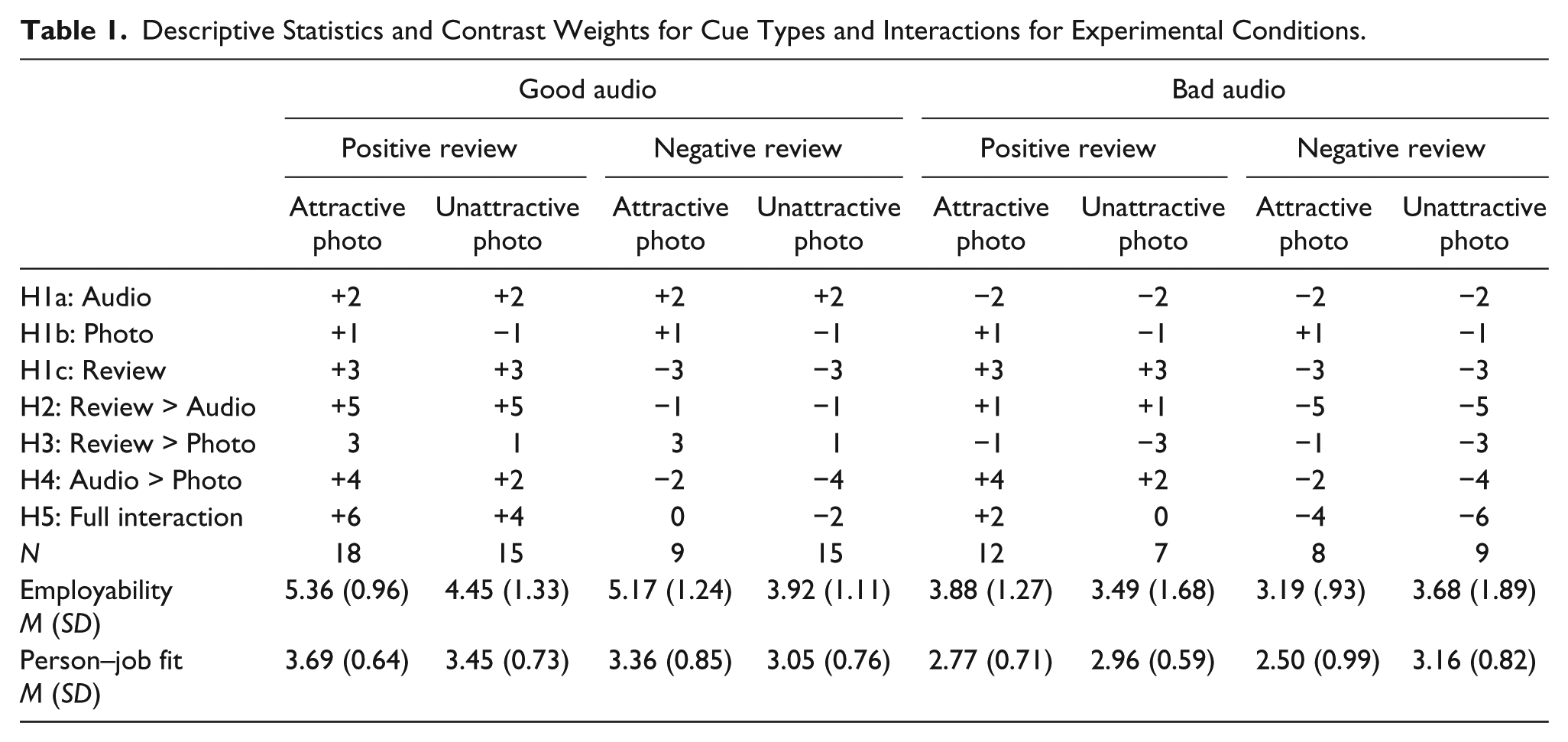
Contrast analyses were conducted to test hypotheses regarding effects of various information sources on attributions of the target’s (a) employability and (b) person–job fit. Contrast analysis is effective to test specific, directional effects, particularly of the a priori interaction effects among variables (Rosenthal & Rosnow, 1985), more so than an undirected ANOVA. The 2 × 2 × 2 design of the experiment called for eight contrast weights to be specified, determined by considering the hypothesized influence of each factor in each cell, and testing for interaction effects by adding preliminary weights into a combined set of weights reflecting all factors and orthogonal tests (see Table 1).
Descriptive Statistics and Contrast Weights for Cue Types and Interactions for Experimental Conditions.
Hypothesis Tests
H1 predicts individuals form more positive employment-related impressions of a target when presented with positively valenced information. Contrast analysis supported H1a, demonstrating positively valenced self-generated information resulted in more positive perceptions of both employability, t(85) = 4.18, p < .001 (one-tailed), rcontrast = .41, and person–job fit, t(85) = 3.76, p < .001 (one-tailed), rcontrast = .38. Analysis supported H1b’s predicted attributions from profile photographs were supported for employability, t(85) = 1.84, p = .03 (one-tailed), rcontrast = .20, but not for person–job fit, t(85) = .043, p = .48 (one-tailed), rcontrast < .01. Finally, the valence of third-party task-relevant reviews did not affect perceptions of employability, t(85) = 1.10, p = .14 (one-tailed), rcontrast = .12, but did affect person–job fit, t(85) = 1.72, p = .045 (one-tailed), rcontrast = .18. Thus, H1a was supported while H1b and H1c received mixed support.
H2 predicts other-generated task-relevant information exerts stronger, additive effects to self-generated information related to the applicant’s job tasks. Contrast weights were assigned to reflect this prediction, adding the preliminary contrast weights assigned to the respective audio and review cells. Analysis supported the hypothesis that other-generated information demonstrates stronger effects for both employability, t(85) = 3.32, p < .001 (one-tailed), rcontrast = .34, and person–job fit, t(85) = 3.61, p < .001 (one-tailed), rcontrast = .36, than self-generated information.
H3 predicts an interaction effect of photographic self-presentation and other-generated task-relevant information, whereby photographic information can attenuate or accentuate the effects of other-generated information, so that reviews demonstrate a stronger, additive effect with photographs. H3 was supported for both employability, t(85) = 1.71, p = .045 (one-tailed), rcontrast = .18, and person–job fit, t(85) = 1.73, p = .044 (one-tailed), rcontrast = .18.
H4 predicts an interaction effect of self-generated task-relevant information and photographic self-presentation, demonstrating additive effects with greater weight given to task-relevant information. H4 was supported for both employability, t(85) = 4.38, p < .001 (one-tailed), rcontrast = .43, and person–job fit, t(85) = 3.25, p < .001 (one-tailed), rcontrast = .33.
H5 predicts a three-way interaction effect of self-generated task-relevant information, photographic self-presentation, and other-generated task-relevant information. H5 was supported for both employability, t(85) = 3.79, p < .001 (one-tailed), rcontrast = .38, and person–job fit, t(85) = 3.57, p < .001 (one-tailed), rcontrast = .36. Consistent with prior hypotheses, other-generated information had the strongest effect, self-generated task-relevant information demonstrated a moderate effect, and physical attractiveness had the weakest effect. All effects were additive and consistent with the valence of the information.
Discussion
This study explored how various online cues affect perceptions of a job candidate in a microtask site. In doing so, it responds to the development of the “gig economy” around services such as Fiverr, both for independent employment and integration into larger organizational structures (Campbell, 2016) and the increasing integration of online information into hiring processes (Carr, 2016). The study also identified how multiple concurrent—sometimes dissonant—cues affect employers’ perceptions of a job candidate, extending prior work into the effects of isolated information sources on perceptions of an individual’s employability. Theoretically, results suggest the warranting effect may be stronger than the halo effect when making evaluations, at least within the context of hiring in the “gig economy.”
Cueing Employability in Microtask Sites
A critical contribution of this research is its extension of hiring and applicant assessment research into microtask sites. Although research has long explored and well documented the process behind assessing a potential new full-time employee (see Gilmore & Ferris, 1989; Morrow, 1990; Saks & Ashforth, 1997), few have explored the assessment and hiring of temporary or contractual workers (for a notable exception, see De Cuyper & De Witte, 2010), and certainly not microtasks (Connelly & Gallagher, 2004). This study provides foundational research into the assessment of workers in a microtask site. In a hiring environment where employers need not commit significant financial, temporal, or legal resources to hiring an individual, how do evaluators form impressions to make hiring decisions?
Unlike hiring for full-time permanent jobs, where employers may seek to verify self-presentations or assess multiple dimensions of personnel fit (see Berkelaar & Buzzanell, 2015; Roulin, Bangerter, & Levashina, 2015), employers contracting individuals via a microtask site have different priorities. Employers may seek only candidates who demonstrate the job skills needed for the contract, depreciating valid concerns around the candidate’s personality, attitudes, physical attributes, honesty, or other factors that may be more meaningful for sustained employment. When contracting a Fiverr gig, these different priorities may thus reflect an evaluation process—including the weighting of various information cues—different from evaluating applicants for conventional, full-time jobs and the need for multiple forms of fit (Kristof-Brown, Zimmerman, & Johnson, 2005). Indeed, findings reveal the strongest influence on perceptions stemmed from third-party reviews, likely due to their resilience against the target’s strategic manipulation findings, consistent with similar effects identified on consumer behaviors via sites such as eBay (Resnick, Zeckhauser, Swanson, & Lockwood, 2006) and Yelp (DeAndrea et al., 2015). This stronger valuation of third-party recommendations also distinguishes the present results of hiring in Fiverr from findings in conventional hiring practices, where an applicant’s interview and the employer’s subsequent assessment of the applicant’s P-J fit are often the strongest predictors of employability, even over third-party recommendations via references (Judge, Cable, & Higgins, 2001).
Warranting and Halo Effects
An additional contribution of this work is its theoretical explanations for how employers make sense of various online information cues to form impressions of applicants and guide hiring decisions. Online information sources are rarely evaluated in isolation (DeAndrea, 2014); rather, perceivers experience complex interactions of sources and valences of information to form perceptions of applicants. Our results indicate that perceivers stratify the glut of information available online, (a) weighting task-relevant information over task-irrelevant information such as photos and (b) within task-relevant information, weighting cues generated by others over self-generated cues to form impressions of the target job candidate.
Other-generated information likely exerts greater influence on attributions than self-generated information due to the target’s inability to control others’ reviews, consistent with warranting theory (Walther & Parks, 2002). Unlike conventional hiring contexts in which individuals can strategically present only references who will provide favorable reviews, Fiverr users cannot directly influence the content of reviews on their profiles beyond the quality of work provided in their gigs, thereby increasing the relative strength of other-generated information over self-generated information on organizationally salient attributes, including P-J fit and employability.
The present results also replicate prior findings (e.g., Gilmore, Beehr, & Love, 1986) that attractive individuals enjoy a halo effect, layering more favorable attributions onto attractive targets, even when the attributions (i.e., employability, P-J fit) are not directly tied to physical attractiveness. Although statistically significant, the photograph cue in the present study exerted only a small effect (rcontrast = .20 and < .01), comparable with prior effect sizes in employment research (e.g., ω2 = .02; Morrow, McElroy, Stamper, & Wilson, 1990). Perhaps task-relevant information had larger effects (rcontrast = .41 and .38) on employers’ perceptions and hiring decisions. Practically, being unattractive did not make the voice-over artist objectively unhirable; it merely decreased his employability and perceived P-J fit relative to a similarly skilled aesthetically pleasing candidate. Unlike conventional hiring processes, wherein employers are often initially unable to see (or legally discouraged from seeing) an applicant, employers should thus be mindful of the attributions they may unfairly overlay onto applicants online, where pictorial and other cues not related to the job may be readily available and concurrently presented. Likewise, applicants should consider strategically selecting and presenting themselves—even photographically—online, to take advantage of the more positive attributions that are made to attractive individuals. Putting one’s best face forward may thus be more than an adage, and indeed be even more important in a digital environment rife with identifying information (Carr, 2016).
Consonant and Dissonant Cues
Finally, this study explored the relative effect of consonant and dissonant cues on impressions of employability, particularly relevant online given the abundance of potentially disparate messages (see Walther, DeAndrea, Kim, & Anthony, 2010). When applicant cues were inconsistent, consonant weaker cues cumulatively exerted greater influence on attributions than the sole discrepant strong cue. For example, targets exposed to an unattractive profile with a good audio clip and bad reviews still reported some of the most positive perceptions of the target’s employability and P-J fit.
Thus, employers’ assimilation of information about an applicant appears to be a balance of quantity and relevance. Highly relevant cues to an individual’s actual task-relevant abilities mattered most in impression formation. Task-irrelevant information exerted a smaller main effect that could mitigate but not negate the effect of a single task-relevant cue. Consequently, abundant positively valenced information about a target may foster positive employer perceptions, even when the applicant has not presented task-relevant information to suggest she or he possesses the requisite KSAs.
Future Directions
The present research used an experimental design to carefully control and assess three specific sources of influence, but in doing so constrained other naturally varying and related concepts. First, Fiverr inherently negates market effects: All Fiverr microtasks are US$5, controlling for variance in costs associated with hiring any candidate. In conventional hiring, pay is commensurate with experience, job skills, and market forces (Cable & Judge, 1994), adding an additional factor to be considered when hiring an applicant. Future work should explore how market demand and costs of hiring a desired applicant may be balanced against job qualifications, particularly when hired as a full-time employee rather than a contracted gig. Second, undergraduate students were sampled as participants in this study. Although student samples typically do not suffer the generalizability concerns with which they are associated (Greenberg, 1987), our participants admittedly had little experience with hiring. Future work can expand on this work and its generalizability by utilizing a more conventional hiring scenario and/or employing a sampling frame with greater hiring experience (e.g., human resource professionals). Moreover, further work should ask how employers make long-term employment decisions (rather than contingent independent contractors) based on online profile information that may supplement and help validate or refute information found in applications or résumés (see Berkelaar & Buzzanell, 2015; Roulin et al., 2015), and likewise scale the present study to PNSs more broadly. Finally, this study made the assumption that cues from the various information sources were present. Future work may seek to understand the effects of absent cues, suggesting low technological self-efficacy or strategic identity management.
Conclusion
Given the multiple—sometimes disparate—cues often available in a single channel, how do employers make sense of different information sources to form impressions and ultimately guide employment decisions? Does it matter if a vocal performer, factory worker, or accountant is handsome or homely? Particularly in cue-rich online environments, where individuals can exert some control over their self-presented professional identities, such questions are particularly relevant. Within the context of microtask sites, this study reveals other-generated information exerts the greatest influence on perceivers’ attributions of a job seekers skills and employability, consistent with warranting theory. Driven by the halo effect, results further demonstrate perceptions from task-relevant cues can be moderated by task-irrelevant cues such as photographs, so that attractive targets receive a boost in perceptions while unattractive targets’ attributions are attenuated. Photographs may help boost an attractive gig worker’s chance of being contracted, but only if concurrent information suggests the individual is able to competently complete tasks associated with the gig. Ultimately, although one’s task-irrelevant qualities (i.e., physical attractiveness) will not inherently (dis)qualify her or him from being selected, those same attributes may strategically bolster other identity claims made concurrently via the same channel.
Footnotes
Acknowledgements
The authors would like to thank the three anonymous reviewers and the editor, Dr. Sias, for their helpful contributions to the revisions of this work.
Declaration of Conflicting Interests
The author(s) declared no potential conflicts of interest with respect to the research, authorship, and/or publication of this article.
Funding
The author(s) received no financial support for the research, authorship, and/or publication of this article.