



Abstract
Organizations have been diversifying their workforce to better respond to fast-changing environments. However, research has indicated that the effects of diversity can vary by a number of contextual influences. This study examines the differential impacts of functional, geographical, and hierarchical diversity on expertise awareness, knowledge transfer, and knowledge acquisition during a large-scale organizational change. The analysis of full network data (N = 211) collected from a multinational high-tech organization demonstrated that (a) geographical diversity was negatively associated with expertise awareness and knowledge sharing, (b) functional diversity was negatively related to expertise awareness, (c) hierarchical diversity had a positive effect on knowledge acquisition and expertise awareness, and (d) emotionally close ties contributed to expertise awareness and knowledge sharing. The findings indicate that hierarchical diversity and emotional closeness can promote knowledge sharing when members face new demands in the midst of organizational change.
Keywords
Impact of Diversity on Knowledge Sharing During Organizational Change
Organizations have been increasingly diversifying their workforce to enhance their adaptability and responsiveness in ever-changing environments (T. Cummings & Worley, 2015). Popular press and market analysts often tout the virtue of diversity, claiming that greater workplace diversity leads to more financial returns and better-informed decisions (Hunt, Layton, & Prince, 2014). Especially in knowledge-intensive industries, workers must collaborate with others in different knowledge areas, job functions, or cultures to obtain diverse perspectives and information in times of need. Despite organizational efforts to attract and retain diverse talents, it is incredibly difficult to manage team diversity. Furthermore, prior scholarship on diversity provides conflicting and inconsistent findings regarding the impact of diversity on work outcomes (for a review, see Horwitz & Horwitz, 2007; Stahl, Maznevski, Voigt, & Jonsen, 2010).
When organizational members experience a large-scale organizational change—fraught with uncertainty and equivocality—the pressures to deal with diversity add another layer of complexity to their work. For instance, facing ambiguity about the future, members are more likely to develop biases toward out-group members and create subgroups based on diversity attributes (Terry, 2001). Research on international mergers and acquisitions has revealed that diversity in organizational cultures can hinder identity formation and social integration during the postacquisition period, which subsequently hamper performance (Stahl & Voigt, 2008) and knowledge transfer (Vaara, Sarala, Stahl, & Björkman, 2010). Greater diversity may also complicate the processes of knowledge sharing particularly in the midst of organizational change, yet little research has been conducted in this area.
This study examines the effects of diversity on knowledge sharing and expertise awareness during a large-scale restructuring in a global high-tech organization. Specifically, this study focuses on functional, geographical, and hierarchical diversity to investigate the differential impacts of diversity on knowledge sharing. This study maintains that different types of diversity may lead to contrasting outcomes; in particular, an elevated level of diversity may function as challenges rather than resources when organizational members need to handle a number of new demands in a fluctuating environment. To investigate these relationships, this study draws on a social network perspective to capture the extent of diversity of one’s actual communication network, which is not necessarily confined to team boundaries.
Social Network Approach to Diversity
Much research has examined the effects of diversity on various organizational outcomes (for a review, see Stahl et al., 2010; Williams & O’Reilly, 1998). Diversity has been defined as “the distribution of differences among the members of a unit with respect to a common attribute” (Harrison & Klein, 2007, p. 1200), and the very same attribute (e.g., function, tenure, ethnicity) can operate as a mechanism for social division or knowledge exchange, contingent upon situational factors. Traditionally, diversity has been examined as team composition, drawing on different social categories such as demographic variables. However, individual members form and maintain connections within and beyond the assigned team as interteam collaboration has increased particularly in a distributed work setting (e.g., task coordination between offshore and headquarter employees). To address this issue, the social network approach investigates the composition of individuals’ communication networks to capture their interaction patterns beyond their respective team. Hence, it can provide a deeper understanding of how organizational members experience diversity within their networks (Gibson, Huang, Kirkman, & Shapiro, 2014). The analysis of one’s network constitution is particularly useful for understanding knowledge sharing because informal network structure and relational quality are closely intertwined (Borgatti & Cross, 2003; Reagans & McEvily, 2003).
Integrating traditional diversity scholarship and a social network perspective, Reagans (2013) recently proposed a future research avenue, which he called diversity as connections, to advance our understanding of the relationships between diversity attributes, network connections with in/out-group members, and organizational outcomes. Responding to this call, this study investigates diversity of individual networks regarding three aspects—job functions, hierarchical levels, and locations—and its impact on knowledge sharing and expertise awareness in the midst of a large-scale structural change within a multinational organization. By examining the functional, geographical, and hierarchical diversity of one’s communication network in a postrestructuring environment, this study elucidates the differential impacts of diversity on the quality of knowledge sharing and expertise awareness.
Functional Diversity
Functional diversity refers to the distribution of organizational members across relevant functional categories (Bunderson & Sutcliffe, 2002). Functional diversity has been widely studied as one of the task-related diversity attributes in contrast to biodemographic markers (for a review, see Horwitz & Horwitz, 2007). Specialized functional areas can be the sources of differentiation and in-group biases that may thwart team collaboration efforts because organizational members highly identify with their job role and career, which underpin their professional identity and commitment (Milliken & Martins, 1996). Specifically, given that knowledge transfer implies costs such as investments in time and effort (Reagans & McEvily, 2003), differential expertise may hamper or delay the process of knowledge transfer. Organizational members in disparate knowledge domains may be less motivated to transfer knowledge when they perceive it to be difficult due to nonoverlapping functional backgrounds (Bunderson & Sutcliffe, 2002). Dougherty (1992) also argued that communicating with others in different expertise is equivalent to navigating different “thought worlds” across interpretive barriers, which further increases associated costs and constrains joint learning. Indeed, research shows that specialized languages and situated understanding can hinder exchanging knowledge beyond functional and occupational boundaries (Bechky, 2003).
Functional diversity may also have a negative impact on knowledge acquisition. It is particularly challenging to obtain useful knowledge across multiple functional areas because people may have a limited ability to accept and respond to others’ expert knowledge as a novice (Cronin & Weingart, 2007). Furthermore, high network diversity that spans various knowledge areas can increase communication flows from different sources, and such overload and complexity of information actually prevented individuals from locating useful knowledge (Aral & van Alstyne, 2011). Thus, functional diversity, while potentially beneficial, is likely to preclude effective knowledge transfer and acquisition unless organizational members engage in coordinated effort to build a shared understanding. Hence, the following hypothesis is presented:
Organizational members may also experience difficulties understanding the expertise of others in different functional areas. When workers maintain functionally diverse social networks, the accurate recognition of others’ expertise is critical for effective collaborative work. However, achieving expertise awareness can be challenging, particularly in a changing environment in which members lack shared experiences. Without a shared history, one’s expertise is not readily apparent to others, and the ability to recognize or utilize each other’s expertise is shaped by interaction styles (Littlepage & Mueller, 1997). Individuals tend to draw on stereotypes associated with diversity attributes to infer relative knowledge of others and distribute knowledge responsibilities in the early phase of work (Hollingshead & Fraidin, 2003; Yoon & Hollingshead, 2010). However, because actual expertise may be different from the initial perception, continued learning of others’ work is crucial for expertise mapping (Hollingshead & Brandon, 2003). In a postrestructuring environment, organizational members are not provided with sufficient opportunities for long-term engagement, which is essential to validate their initial perception (Wegner, Erber, & Raymond, 1991). Hence, workers who have functionally diverse social networks may face greater barriers to understanding their coworkers’ expertise, hypothesized as follows.
Geographical Diversity
Geographical diversity refers to the extent to which members are dispersed across multiple locations. Distributed collaboration entails much effort to negotiate common ground, define coordination protocols, and overcome obstacles associated with differences in time, culture, and contexts (Olson & Olson, 2000). These challenges become particularly salient in knowledge transfer. Geographical boundaries often give rise to the mutual knowledge problem (Cramton, 2001) stemming from the uneven distribution of information and the failure to share and retain contextual knowledge across different locations. Sole and Edmondson (2002) also argue that dispersed workers first need to recognize and adjust for locale-specific practices to identify situated knowledge—the knowledge embedded in social and physical contexts that reinforces location boundaries—before transferring their knowledge. Distributed workers tend to have far greater understanding of their own context than others’ contexts; furthermore, they cannot readily describe local knowledge as it is often taken for granted (Gibbs, Kim, & Boyraz, 2017; Gibson & Gibbs, 2006). Thus, transferring knowledge across geographical boundaries involves a range of additional efforts to identify and contextualize local knowledge.
Geographical diversity is also likely to hamper the acquisition of useful knowledge particularly when members have not created and maintained common ground. In globally distributed teams, members are likely to face challenges regarding processing and aggregating received knowledge, especially if it is uncodified (Stanko & Gibson, 2009). Moreover, geographical boundaries in multinational organizations often overlap with national or cultural boundaries. Cultural differences contribute to a lack of understanding of norms and values that impede full acquisition of knowledge shared from people in other locations (Mowery, Oxley, & Silverman, 1996; van Wijk, Jansen, & Lyles, 2008). National diversity can also provide a potential source for misunderstanding, stereotyping, and disagreement, all of which in turn hinder knowledge acquisition (Adler, 1986; Kirkman & Shapiro, 1997). Overall, geographical diversity has been found to be negatively associated with knowledge sharing (for a review, see de Guinea, Webster, & Staples, 2012). Thus, the following hypothesis is presented:
Geographical dispersion is also negatively related to the awareness of expertise. Because expertise awareness develops primarily through informal communication and shared experiences, the lack of proximity may inhibit the understanding of others’ expertise (Fulk, Monge, & Hollingshead, 2005). Unlike distributed workers, collocated employees are able to observe each other’s work practices to vicariously learn about others’ specialties; namely, unobtrusive monitoring of colleagues’ behaviors helps workers discern expertise cues and understand different levels of their colleagues’ expertise. In line with this, Littlepage and Mueller (1997) found that in-person interactions strongly influence perception of expertise. In distributed work groups, remote workers are thus likely to have difficulties understanding other members’ expertise (Su, 2012). When one’s network contacts are dispersed across multiple locations, it may be increasingly challenging to understand their expertise. Furthermore, expertise of members in different cultures was not equally recognized in intercultural groups, despite similar levels of expertise among group members (Bazarova & Yuan, 2013). This discussion leads to the following hypothesis:
Hierarchical Diversity
Hierarchical diversity has received relatively little attention from diversity researchers. This is mainly because diversity scholarship concentrates on the composition of a team, which does not display much variance in terms of hierarchical levels (i.e., a team is a basic unit that consists of one supervisor and several members). However, hierarchical diversity in one’s network—namely, one’s contacts that cut across various hierarchical levels—can provide distinctive advantages for knowledge sharing. Given that the flow of information, ideas, and resources is conditioned by organizational hierarchy (Salancik, 1995), maintaining a network across hierarchical boundaries may help employees exchange knowledge more effectively than others whose networks are limited only to similar hierarchical ranks or status.
Indeed, vertical communication produces different benefits for knowledge sharing as opposed to horizontal communication (Knight et al., 1999). As supervisors and peers tend to provide different information content, having multiple sources that span hierarchical levels can be conducive to achieving balanced knowledge about a new environment, contributing to an enhanced understanding of others and others’ work (Miller & Jablin, 1991). The improved understanding of their surroundings can enable employees to better approach others to effectively convey their knowledge and provide necessary information. In particular, when hierarchies serve as a system to exert authority and limit knowledge transfer (Conner & Prahalad, 1996), social networks that cut across hierarchical boundaries may offer unique advantages in accessing and disseminating knowledge.
In addition, because high-status employees may be more knowledgeable about organizational strategies, plans, and changes, connections with managers and high-level executives can facilitate acquisition of needed resources and adequate information. In particular, those from upper management tend to be privy to certain information and can provide other members with experience, legitimation, and more relevant information (Brass, 1984; J. N. Cummings, 2004). Highlighting the benefits of unique information and diverse perspectives, Cross and Cummings (2014) demonstrated that connections across multiple hierarchical levels are positively related to individual performance especially in knowledge work. In the context of organizational change, relationships across hierarchical levels can help employees obtain valuable knowledge to adapt to new work arrangements. Also, managers and executives can better understand members’ experiences and stay informed of team progress through regular communication with them. Although empirical research on hierarchical diversity is still nascent, this study posits that input from different hierarchical positions may promote one’s ability to provide knowledge, obtain useful knowledge, and understand others’ expertise. Hence, the following hypothesis is proposed:
Method
Research Context
This study was conducted at Enterprise Solutions (pseudonym), a multinational high-tech organization that builds software for data management, product design, and product development. Its headquarters are located in the United States, and its regional offices are dispersed in South America, East Asia, South Asia, Eastern Europe, and Western Europe. The company’s divisions are by and large structured around its major product lines or services. Each division consists of different departments that focus on specific functions—engineering, user experience, localization, developer support, sales, and evangelism, to name a few. Most high-level executives and product managers are employed at headquarters, collaborating with team members dispersed in multiple locations. In particular, employees at the core engineering centers in the United States, South America, and Eastern Europe should collaborate across regions and functions. Other regional offices may have a different business focus such as sales and marketing.
In October 2014, Enterprise Solutions implemented a company-wide structural change that merged multiple divisions to facilitate cross-specialty collaboration. Reflecting this change, new division heads were assigned and teams were reconfigured, resulting in changes in reporting structures. The integration of different divisions and groups was part of the company’s strategic plan for enhancing cross-functional interactions to make teams “holistically accountable” and support “more fluid movement” between teams, which would make knowledge sharing “much faster and more efficient within the same group” than across departments. 1 For example, developer support engineers, who had belonged to a separate division before the change, were assigned to the same division with developers. By deploying related work groups under the same division, high-level executives anticipated that boundary-spanning interactions would be promoted and improved.
Data Collection
A company-wide online survey was conducted approximately 1 month after the structural change. The author directly distributed the survey to all 275 full-time employees across regions and closely coordinated with the CEO and higher executives to ensure participation from employees. The CEO sent out an email announcement to everyone to encourage participation; additionally, the author emailed weekly reminders while the survey remained open. Employees were informed that participation was voluntary, individual responses would not be disclosed, and the data would be kept confidential. Over a 1-month period, 224 employees completed the survey, yielding an 81.45% completion rate.
To capture full network data, the author obtained the most up-to-date version of the company roster from the vice president of human resource management. The roster was accurate except that some employees’ legal names were different from the names actually used. The author revised those cases before survey implementation. Respondents were provided with the complete roster of employees to identify their knowledge-sharing network. The network questionnaire employed a sociometric choice format to have participants choose their knowledge-sharing contacts: They were asked to select (a) people who acted as a critical source of task-related knowledge and (b) people for whom they have been a critical source of task-related knowledge (Reagans & McEvily, 2003). Respondents were allowed to nominate their knowledge-sharing ties without limitations. After respondents selected their knowledge-sharing contacts from the roster, they answered a series of questions about the quality of knowledge transfer as well as acquisition and their awareness of expertise regarding each alter. The author also obtained node attributes data directly from the company roster and organization charts, which included the information about employees’ location, job role, department, division, and hierarchical levels. Because this study’s primary concern is knowledge sharing for collaborative task accomplishment, all core job functions that jointly work and coordinate were included in the analysis. 2 This process created a directed, complete network data set of 211 respondents.
Measures
Ease of knowledge transfer
Ease of knowledge transfer refers to the extent to which the knowledge source can effectively convey ideas or concepts to the recipient. A modified form of Reagans and McEvily’s (2003) three-item scale, which investigates whether network diversity can enhance the quality of knowledge transfer, was used. Scale items include “it would be easy for me to explain to this person a key idea in my area of expertise,” “it would be easy for me to explain to this person about new developments in my area of expertise,” and “this person’s expertise makes it easy for me to explain a key idea in my area of expertise.” All three items were measured with a 5-point Likert-type scale, ranging from strongly disagree to strongly agree (M = 4.20, SD = 0.58, α = .92). Each focal actor i was asked to rate each alter j based on this scale; an average of all responses was used to create an aggregated measure.
Acquisition of useful knowledge
Knowledge acquisition refers to the degree to which respondents were able to obtain useful knowledge from each nominated alter. Drawing on the scale developed by Levin and Cross (2004), the current study selected three items related to project effectiveness. Respondents were asked to rate to what extent the received knowledge was helpful in terms of the contribution to “client satisfaction,” “overall team performance,” as well as “quality of project and service.” Each item was measured with a 5-point Likert-type scale, ranging from strongly disagree to strongly agree (M = 4.24, SD = 0.51, α = .86). Each focal actor i was asked to rate each alter j based on this scale; in turn, an average of all answers was used to create an aggregated variable.
Confirmatory factor analysis (CFA) was performed using AMOS version 22 to assess the construct validity of two scales above. The CFA model fit was determined based on the following goodness-of-fit indices: (a) the chi-square to the degrees of freedom ratio is less than three, (b) the comparative fit index (CFI) is higher than .95, and (c) the root mean square error of approximation (RMSEA) is less than .06 (Browne & Cudeck, 1993; Hu & Bentler, 1995; Kline, 2015). The results demonstrated that the model provided a good fit for the data: χ2/df = 1.57, CFI = .99, RMSEA = .06.
Expertise awareness
Awareness of others’ expertise refers to a focal actor’s understanding of a given individual’s knowledge. Borgatti and Cross’s (2003) one-item measure was used: “I understand this person’s knowledge and skills. This does not necessarily mean that I have these skills or am knowledgeable in these domains, but that I understand what skills this person has and domains they are knowledgeable in.” It was assessed based on a 5-point Likert-type scale, ranging from strongly disagree to strongly agree (M = 4.31, SD = 0.64).
Diversity
Network diversity was operationalized as network range, which was originally proposed by Burt (1983). The node attributes such as job functions, locations, and hierarchical levels were treated as diversity attributes and used to compute functional, geographical, and hierarchical diversity of one’s network. Network diversity is defined as ndi, calculated as follows:
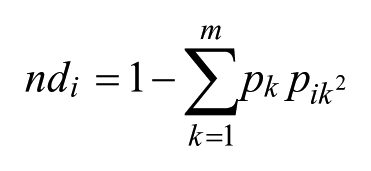
where pk describes the intensity of relations between individuals within the attribute k, and pik indicates the strength of the connection from person i to attribute k. In the above formula, pk is defined as follows:
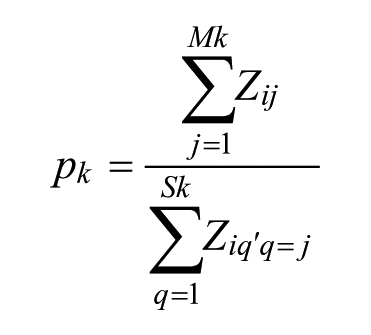
where Sk is the number of contacts identified by participants in attribute k, Mk is the number of respondents in attribute k, Ziq is the connections between an individual in attribute k to any contact, and Zij is the intensity of relations between an individual in attribute k to another member in the same attribute, namely, the proportion of interaction represented by connections. In turn, pik is defined as follows:

where Nk is the number of contacts that participant i mentioned from attribute k, and Ziq is the intensity of the relationship that participant i has with contact q. Thus, the values of network diversity range from zero to one.
Overall, the more one’s connections spread across different functions, locations, and hierarchical levels and the more weak ties exist within each group, the higher one’s network diversity is. Participants’ functions, locations, and levels were extracted from the company roster (for demographics, see Table 1).
Participant Demographics (n = 211).

Control variables
Five control variables were identified and included in the model drawing on extant literature. Tie strength was considered because the role of strong ties in knowledge sharing has been a key research concern among network scholars (Granovetter, 1983; Krackhardt, 1992). In particular, researchers have demonstrated that strong ties support expertise exchange (Yuan, Fulk, Monge, & Contractor, 2010) and facilitate knowledge sharing, especially when knowledge is complex (Hansen, 1999). Granovetter (1973) proposed that tie strength is a function of the amount of time spent, emotional intensity, and reciprocal services. In line with this, the current study employed communication frequency and emotional closeness as proxies for the strength of ties, following Hansen (1999)’s approach. Participants were asked to indicate communication frequency (1 = a few times a year, 5 = a few times a day) regarding each contact (M = 3.06, SD = 0.74). In turn, participants rated emotional closeness (1 = distant, 5 = very close) for each contact (M =3.23, SD = 0.89). Next, betweenness centrality, ego network size, and ego network density were added to the model because they have been reported as significant predictors of knowledge sharing and expertise awareness (Borgatti & Cross, 2003; Cross & Cummings, 2004). Given that both network positions (e.g., centralities) and network characteristics (e.g., density) are closely associated with knowledge and information sharing (Hansen, 2002; Lee, Kim, & Piercy, in press; Reagans & McEvily, 2003), the aforementioned network variables were included in the model to ascertain their relationships with the dependent variables.
Analysis
As a preliminary step, descriptive analysis and bivariate correlation analysis were performed (see Table 2). Independent variables showed very low or moderate levels of correlations with one another; hence, they were included in the analysis models. Independent and dependent variables generally showed significant correlations. As a primary analysis, multiple linear regressions were conducted to test hypotheses. In all three models that predict knowledge transfer, knowledge acquisition, and expertise awareness, diversity variables were added to the models after control variables.
Descriptive Statistics and Bivariate Correlations.
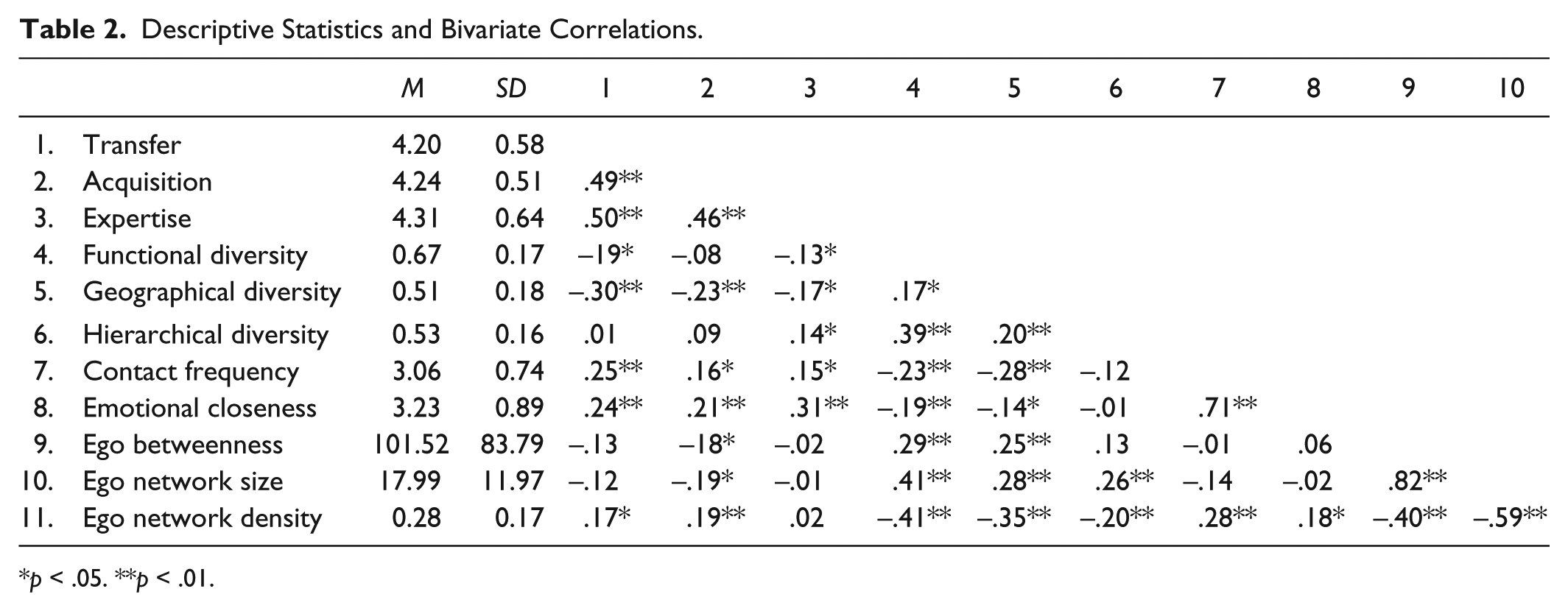
p < .05. **p < .01.
Results
The results of regression analyses are outlined in Table 3. The first model examines the impact of network diversity on the ease of knowledge transfer. Results indicate that geographical diversity was negatively associated with knowledge transfer, whereas functional and hierarchical diversity did not have significant effects. Thus, H2a was supported; H1a and H3a were not supported. The second model tested the effects of network diversity on the acquisition of useful knowledge. As predicted, geographical diversity again had a negative relationship with the reception of useful knowledge, whereas hierarchical diversity had a positive relationship. However, the effect of functional diversity on knowledge acquisition was not significant. Hence, H2b and H3b were supported. The third model investigated the connections between network diversity and expertise awareness. H1c, H2c, and H3c were all supported. Functional diversity and geographical diversity displayed negative relationships with the awareness of expertise; by contrast, hierarchical diversity was positively linked to expertise awareness.
Regressions Predicting Knowledge Sharing Outcomes.
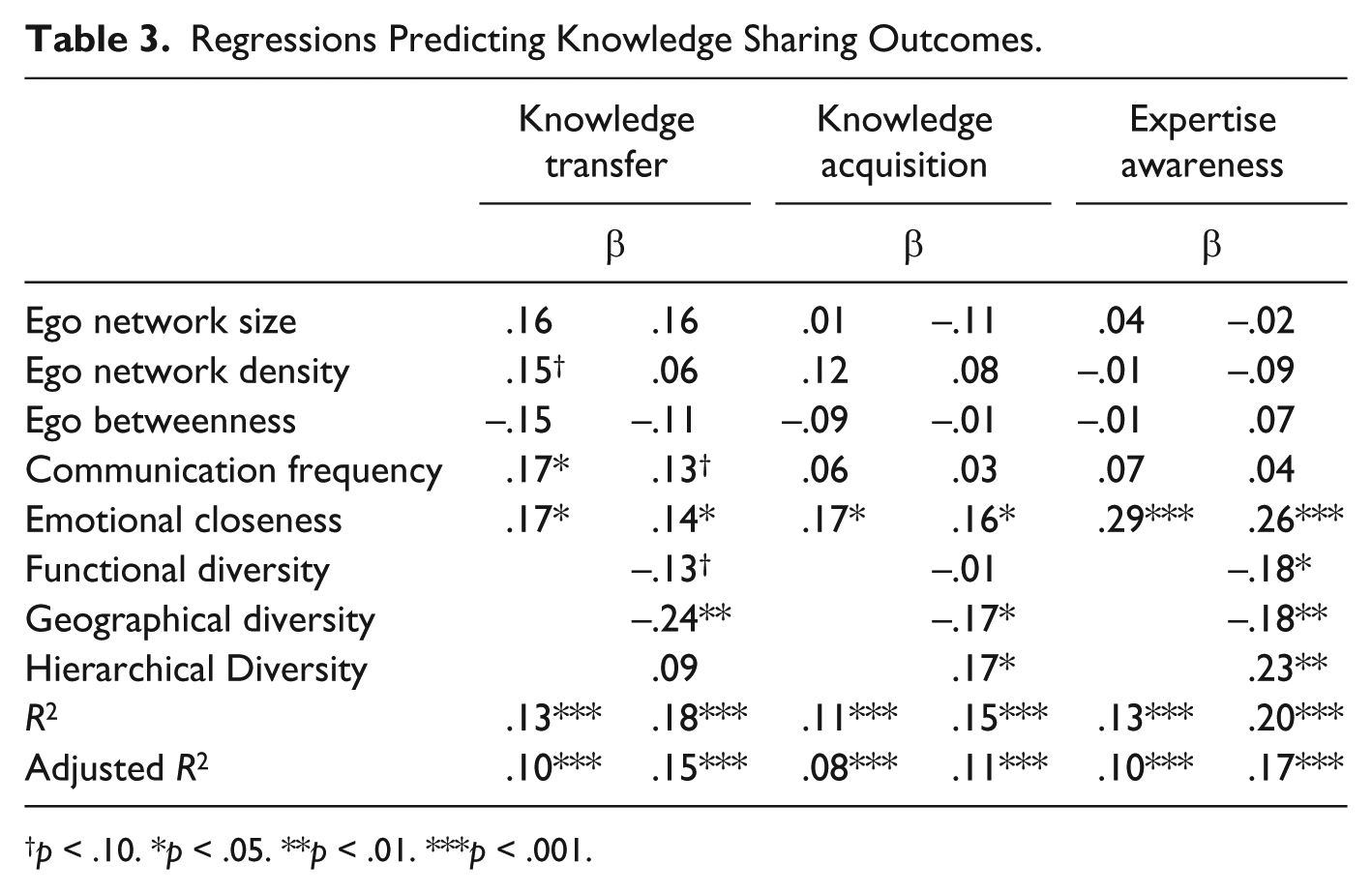
p < .10. *p < .05. **p < .01. ***p < .001.
Notably, in all three models, emotional closeness was positively associated with dependent variables, implying that strong ties played a central role in knowledge sharing in the midst of a large-scale organizational change. However, communication frequency did not contribute to knowledge sharing outcomes. Finally, the ego network variables of betweenness centrality, ego network density, and ego network size were not significantly related to the dependent variables.
Discussion
Diversity is a double-edged sword. A series of meta-analyses have reported that the effects of diversity on organizational outcomes are mixed or inconsistent—Empirical findings show positive, negative, or no significant impact of diversity on performance, creativity, cohesion, or satisfaction (for a review, see Stahl et al., 2010; Webber & Donahue, 2001; Williams & O’Reilly, 1998). To untangle this problem, scholars have developed different approaches to conceptualizing and operationalizing diversity. Advancing this line of work, this study sought a deeper understanding of the impact of diversity on knowledge-sharing outcomes by employing a social network perspective. Analyses revealed that the diversity of organizational members’ networks had multifaceted effects on expertise awareness as well as knowledge transfer and acquisition in models controlled for communication frequency, emotional closeness, as well as network centralities and density. Specifically, differences in function and location were found to be a challenge for effective knowledge sharing: The more connections organizational members forge and maintain across functional and geographical boundaries, the more likely it is that the quality of their knowledge sharing and expertise awareness suffers. On the contrary, if organizational members form relationships that span different hierarchical levels, such connections are more likely to enhance the quality of expertise awareness and knowledge acquisition.
The findings underscore that different types of diversity may generate contrasting effects. Typically, network diversity has been found as a positive factor in knowledge transfer as well as acquisition (Reagans & Zuckerman, 2011; Tsai, 2001). Increased connections to diverse groups provide opportunities to get exposed to different perspectives and information, which can subsequently enhance the ability to convey their knowledge to various groups, acquire needed knowledge, and promote knowledge transfer. However, the findings of this study demonstrate that the implications of network diversity should be understood in conjunction with different network attributes and situational factors—Forging and maintaining far-reaching networks may function as a constraint rather than an advantage in a postrestructuring environment. Indeed, outcomes of diversity are contingent upon various contextual influences (Adler, 1986; Argote, McEvily, & Reagans, 2003), including structural effects and communication climate. To understand the results of the current study, it is important to take into consideration the role of organizational change in reconfiguring existing structures and work alignment. Organizational change—from strategic adaptation to market changes to a large-scale restructuring—may affect the characteristics of communication networks, and in turn, the changing nature of networks may reshape members’ perceptions about their communication quality and knowledge-sharing practices.
Organizational change can be conceived as novel situations. A novel situation in an organizational setting refers to a variety of new demands, such as changes in task alignment, redefined dependencies among members, alteration of work routines, or increased external pressures, all of which will require team members to revisit existing assumptions about their work and relationships with others (Majchrzak, More, & Faraj, 2012). The company-wide restructuring implemented at Enterprise Solutions included merging multiple divisions, reconfiguring reporting structures (and concomitant promotion of some members), and changes in team membership and task boundaries. Although the impact of organizational change on members’ work life might differ, it is likely that all members were going through a process of adjustment. When organizational members face novelty, knowledge sharing across units and specialties becomes particularly complex (Carlile & Rebentisch, 2003). Communicating specialized knowledge with new collaboration partners, transferring accumulated information from one unit to another (that shares no prior history), and modulating the process to accommodate new routines may surface a number of challenges that must be jointly resolved. As such, in the midst of change, increased external orientation is not necessarily beneficial for work. Instead, employees should concentrate on fostering relationships with coworkers, establishing mutually agreed routines and making sense of their new roles and responsibilities. Furthermore, in complex and uncertain situations, strong ties are more likely to willingly assist (Krackhardt, 1992) and generate more productive knowledge-sharing outcomes than external or weak ties (Hansen, 2002).
The findings of this study clearly demonstrate the differential impacts of strong ties and boundary-crossing ties on knowledge sharing in the context of organizational change. First, results support the idea that communicating with strong ties leads to more effective knowledge transfer as well as acquisition in a turbulent setting. More specifically, greater emotional closeness was positively associated with expertise awareness, knowledge transfer, and knowledge acquisition, whereas communication frequency did not show significant relationships. This can be explained by the changes in communication patterns after organizational restructuring. For example, workers may need to increase contacts with newly assigned collaboration partners to learn about their work and build common ground. In this case, frequent communications may not necessarily reflect tie strength. In contrast, results indicate that employees may benefit from emotionally close ties for knowledge sharing in a postrestructuring environment. Close ties can help members align their individual behaviors and team goals, which generates consistency at work (Reagans et al., 2012). When members are required to handle ongoing changes that significantly affect their task, knowledge sharing with intimate ties can be more efficient, whereas communicating with weak ties may increase complexity and ambiguity. Moreover, closer relationships are likely to already have a shared language that is a fundamental condition for effective knowledge exchange (R. A. Weber & Camerer, 2003). Hence, greater emotional closeness with one’s ties can help them surmount knowledge-sharing obstacles stemming from organizational change.
Next, findings demonstrate that hierarchical diversity of organizational members’ network is also associated with positive knowledge-sharing outcomes. Organizational members may reach out to people in high-status positions to obtain a more accurate picture of changing landscapes and to better understand their expected roles. Likewise, the implementers of change, such as executives and division heads, will benefit from contacts with team members to become informed of their adjustment process and solicit responses about revamped work design. Indeed, implementers and internal stakeholders likely develop communication strategies to disseminate new procedures and collect members’ interpretations about the change effort (Lewis, 2011). Thus, contrary to spanning boundaries across functions or locations, communication across hierarchical levels may help workers integrate knowledge in response to change. Faraj and Yan (2009) argued that workers in uncertain situations will engage in boundary-spanning behaviors for the purpose of information gathering, network building, or general reconnaissance and mapping. Soliciting input across hierarchical levels also reflects a similar interest of employees who desire to make sense of ongoing changes and acquire needed information to adapt to environmental volatility. Overall, the results of this study confirm that increased connections across hierarchical levels facilitate effective knowledge sharing during organizational change.
Third, functional diversity of organizational members’ networks was negatively related to expertise awareness; namely, employees who maintained more diverse contacts in different functional departments actually failed to understand others’ expertise. A substantial body of research has argued that cross-functional communication raises significant challenges for knowledge work and expertise recognition. When new practices are implemented, a lack of prior history and common experience impedes learning from each other (Tucker, Nembhard, & Edmondson, 2007). Reorganization of work also leads to lack of awareness about others’ work and expertise, particularly in different teams (Leonardi & Treem, 2012). While experiencing organizational or environmental changes that impose potential coordination challenges, forming and maintaining connections across different job functions may heighten complexity and disagreement that subsequently preclude expertise awareness.
Finally, geographical diversity of organizational members’ networks was negatively associated with the quality of knowledge sharing. In this study, geographical diversity was intertwined with another factor that impinges on knowledge-sharing behaviors: Each office of Enterprise Solutions was located in a different country. Therefore, physical barriers and national diversity may have jointly influenced knowledge-sharing outcomes. Although the current study did not delve into whether members perceived cultural differences as a significant obstacle for knowledge exchange, potential effects of national diversity should be taken into account. Cultural diversity leads to process losses through task conflict and decreased social integration (Stahl et al., 2010), which may bring about more adverse influences in the context of organizational restructuring. It is especially daunting for distributed workers to stay informed of recent changes and concomitant outcomes that occur in other locations (e.g., new routines, procedures, and localized practices). This implies that organizational members may not be able to successfully exchange knowledge across locations immediately after the organizational change. To harness the benefits of diverse perspectives from different locations, a long-term endeavor to lubricate cross-location communication would be required.
Theoretical and Practical Implications
This study contributes to the scholarship of diversity and knowledge sharing in three ways. First, by linking diversity and knowledge-sharing research, this study elaborates on the multifaceted impacts of diversity on organizational outcomes. Although the implications of diversity for performance outcomes have received substantial scholarly attention, its impact on knowledge-sharing behaviors has been underexamined. Given that knowledge sharing and expertise recognition can also affect performance outcomes, this study adds significant insight into how diversity improves or impedes the quality of work. Furthermore, mutual understanding and common ground have been viewed as the building blocks of knowledge sharing; hence, the ways in which organizational members perceive, interpret, and manage diversity should be investigated more in the context of knowledge sharing because diverse perspectives that originate from multiple group memberships and histories can shape the process of building a consensus or a common course of action.
Second, drawing on a social network perspective, this study assesses the level of diversity as the boundary-spanning connections of an individual’s task-related communication network instead of team composition. This approach helps researchers grasp a more nuanced picture of diversity based on one’s social network; namely, members may experience different levels of diversity depending on their work relationships and interdependence even if they belong to the same team, which affects the nature of knowledge-sharing networks (M. S. Weber & Kim, 2015). The relational view moves beyond the relatively simple notion of subgroups and enables a fine-grained analysis of diversity attributes considering external members as well (Reagans & Zuckerman, 2011; van Knippenberg & Schippers, 2007). Taking advantage of the social network approach, the current study examined the configuration of an individual’s network in terms of job functions, hierarchical levels, and geographic locations that represent differential impacts of boundary-crossing relationships.
Finally, this study shows that the implications of boundary-spanning and knowledge-sharing behaviors should be understood in tandem with the ramifications of organizational change. Network characteristics may yield disparate knowledge-sharing outcomes during structural change: Employees who have more strong ties will exchange knowledge more successfully than others who maintain far-reaching networks across functions and locations. This implies that diversity militates against cross-boundary knowledge sharing when members encounter new collaboration challenges. The findings stress the positive role of cohesion, rather than network range, in successful communicative outcomes in the midst of change. This study calls for further research in the area of organizational change—how organizational members deal with uncertainty and complexity, forge new connections, and address communication challenges to eventually realize the desired goals of the change.
The findings of this study also offer important practical implications. In the current study, Enterprise Solutions restructured their teams and hierarchy in hopes for improved cross-boundary communication; however, their expectations had not been realized at the time of data collection. Although diversity can exert a positive influence on various organizational outcomes, practitioners should acknowledge that diverse teams may experience difficulty developing relationships and negotiating common ground (Ancona & Caldwell, 1992). Positive benefits accrue once team members figure out how to jointly overcome the challenges associated with diversity (Mannix & Neale, 2005). Thus, it is crucial to create and maintain an organizational climate in which members embrace diversity to capitalize on members’ knowledge, expertise, and different viewpoints. Executives and managers may consider offering workshops to promote the understanding of workplace diversity and its implications. Also, managers should overhaul their day-to-day communication channels and activities to identify a way to improve cross-boundary exchanges.
Practitioners may also need to invest efforts in mitigating the negative outcomes of functional and geographical diversity. Specifically, how organizational members interpret and carry out the change effort over time will likely affect work outcomes. Although it is not a simple task for management to effectively convey their intentions and expectations, ongoing efforts to achieve “buy-in” from employees may alleviate adverse effects resulting from change. As this study found a positive impact of communication across hierarchical levels, change implementers are advised to consider the potentially powerful roles of middle-level leaders in framing and advocating the rationale of new initiatives proposed by top management (Lewis, 1999). Policy makers may also want to examine short-term and long-term implications of organizational change for knowledge integration. When members experience structural turbulence and need to renew their work routines and relationships under time pressure, managers should facilitate coordination as well as the standardization of team processes.
Limitations and Future Directions
The findings of this study are based on a quantitative cross-sectional study. A second wave of the survey at a different point in time would provide insights into whether the negative influence of diversity is a short-term detriment resulting from restructuring or a more grounded problem that indicates a lack of mutual understanding across boundaries. Examining long-term effects of organizational change can yield significant insight into knowledge-sharing patterns as network reconfigurations are likely to have a considerable impact on power, influence, and work processes (Susskind, 2007). A series of similar surveys can examine whether and how long-term interactions enhance expertise awareness and knowledge sharing, enabling an in-depth understanding of the impacts of diversity on knowledge work in a postrestructuring setting.
Because extant work indicates that the influences of diversity may vary by a range of contextual factors and communicative interactions, it is important to qualitatively examine the interplay between the different types of diversity and other environmental characteristics. Functional, geographical, and hierarchical diversity may engender differential challenges depending on organizational structures, cultures, and practices. Qualitative interviews and observations can enrich our understanding of the mechanisms through which a particular type of diversity hinders or promotes expertise recognition and knowledge exchange. Especially in global organizations, geographical diversity may be investigated in conjunction with cultural diversity given that regional boundaries often overlap with national borders. Future research should also examine the role of technologies in facilitating/hindering the processes of knowledge sharing across functional, regional, and hierarchical boundaries. In particular, advanced knowledge management systems may help individuals overcome the impediments of cross-location sharing by offering various ways to store, exchange, and retrieve a complex set of knowledge (Heinz & Rice, 2009).
Conclusion
Integrating knowledge across different boundaries is a challenging managerial task. To achieve the potential benefits of diversity, organizational members should consider situational factors and disparate outcomes of boundary-spanning behaviors. Especially in the context of organizational change, functional and geographical diversity may preclude effective knowledge sharing when organizational members encounter new collaboration challenges resulting from a lack of common ground. However, turning to strong ties and members at different hierarchical levels can enhance the quality of knowledge sharing. The findings suggest that diverse connections can promote knowledge sharing only after organizational members establish a shared understanding and coordinated routines.
Footnotes
Acknowledgements
The author appreciates the valuable feedback from Craig Scott, Matthew Weber, Katya Ognyanova, George Barnett, and Andy Pilny. The author also thanks Patricia Sias, Vernon Miller, and the three anonymous reviewers for their helpful suggestions.
Declaration of Conflicting Interests
The author(s) declared no potential conflicts of interest with respect to the research, authorship, and/or publication of this article.
Funding
The author(s) received no financial support for the research, authorship, and/or publication of this article.