



Abstract
In today’s changing environment, employees’ voice behavior can enhance organizational effectiveness. This study tests an integrative model linking proactive personality, leader–member exchange (LMX), voice behavior, and employee–supervisor sex (dis)similarity. Sex (dis)similarity is posited as a moderator. Results showed proactive personality was positively related to both voice behavior and LMX quality, and LMX quality was positively related to voice behavior. LMX quality partially mediated the relationship between proactive personality and voice behavior. Employee–supervisor sex (dis)similarity moderated the effect of LMX quality on voice behavior. Employees working in higher quality LMX relationships with supervisors of dissimilar sex exhibited more voice behavior.
Keywords
Introduction
Employees’ voice behavior not only enhances team effectiveness, it may also enhance overall organizational performance (Morrison, 2011; Van Dyne & LePine, 1998). Voice behavior refers to employees’ verbal communication that challenges the status quo to improve the work situation (Van Dyne & LePine, 1998). Several personal attributes such as locus of control, self-esteem, the five-factor model of personality, and proactive personality are linked to voice behavior (e.g., Seibert, Kraimer, & Crant, 2001). However, studies investigating the link of proactive personality and voice behavior have emphasized the direct personality-voice effect (Fuller & Marler, 2009; Seibert et al., 2001), while ignoring potential indirect paths.
Scholars suggest that the effects of personality on work-related outcomes are more clearly depicted by mediating or moderating variables (e.g., Bakker, Tims, & Derks, 2012; Thompson, 2005). Scholars also have argued that individual proactivity may not operate in a social vacuum (Thompson, 2005). Botero and Van Dyne (2009) suggest that various team contextual factors may influence the link. Furthermore, proactive personalities can improve performance by developing strong relationships at work (Thompson, 2005). The present study proposes an indirect effect of proactive personality on voice behavior via leader–member exchange (LMX) relationship quality. LMX refers to the quality of an employee–supervisor relationship (Graen & Uhl-Bien, 1995). This study also proposes that the relationship between LMX quality and voice behavior may be moderated by employee–supervisor sex (dis)similarity (Bakar, Jian, & Fairhurst, 2014; Figure 1).
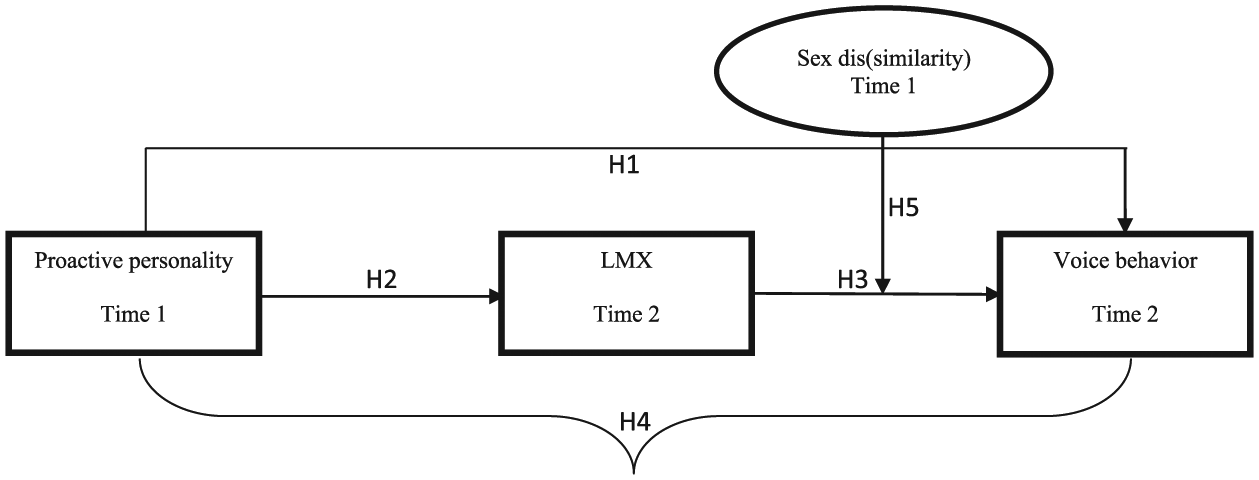
Research framework.
Literature Review and Hypotheses
Proactive Personality, LMX, and Voice Behavior
Proactive personality refers to a tendency toward taking actions to change one’s environment (Bateman & Crant, 1993). Intrinsically encouraged by their personality attributes, proactive personalities are inclined to have strong personal initiative to challenge work environments (Bateman & Crant, 1999). To improve their work conditions (Crant, Kim, & Wang, 2011), proactive employees demonstrate voice behavior more frequently than less proactive employees (Seibert et al., 2001). Thus, this study proposes as follows:
Research suggests that proactive individuals are able to develop and maintain interpersonal relationships (Fuller & Marler, 2009). Proactive personality may correspond to the need for secure relatedness with other parties and initiate useful relationships that provide valuable information in an environment (Bateman & Crant, 1993; Thompson, 2005). A supervisor may develop different types of exchange relationships with each member in their team (Bakar et al., 2014; Li, Liang, & Crant, 2010). However, proactive employees are more motivated than non-proactive employees to build and maintain relationships with their supervisors (Bateman & Crant, 1993; Crant, 2000). Consistent with social exchange theory, this action may lead to a positive response from the other parties concerned, such as supervisors who may appreciate the action by giving similar responses. Accordingly, employees with higher proactive personality may be more likely to develop high-quality LMX relationships. Thus, this study proposes as follows:
Social exchange relationships in organizations can promote constructive member behavior (Cropanzano & Mitchell, 2005). Similarly, the social exchange currencies perspective proposes that members’ perceived oneness with their organizations based on a good social exchange relationship may influence their voluntary contributions (Tavares, van Knippenberg, & van Dick, 2016). A high-quality LMX is characterized by mutual support, trust, and sense of mutual obligation between the member and the leader (Graen & Uhl-Bien, 1995). This may encourage employees to express their concerns (Botero & Van Dyne, 2009). Compared with other extra-role behaviors (e.g., organizational citizenship behavior, affiliative extra-role behavior), voice may be perceived as a risky behavior because it could lead to disagreements with others or undesirable consequences such as negative self-image, harm to relationships, and career impediment (Hsiung, 2012; Liu, Zhu, & Yang, 2010; Morrison, 2011). A high-quality LMX may reduce the perceived risk of voice (i.e., challenging the status quo), because of high levels of trust between the relationship partners (see Botero & Van Dyne, 2009). Thus, employees in high-quality LMX relationships may focus less on personal risk, and more on the interest of organizations, and thereby, voice their concerns (Hsiung, 2012). Thus, this study proposes as follows:
LMX as a Mediator
As previously discussed, the influence of proactive personality on work outcomes can be better understood through the assessment of mediational relationships (e.g., Bakker et al., 2012; Brown, Cober, Kane, Levy, & Shalhoop, 2006; Li et al., 2010; Thompson, 2005). Based on social capital theory, Thompson (2005) proposed that proactive employees are more capable of developing social relationships within their organizations and obtaining resources derived from the social relationships than are non-proactive employees (see also Gong, Cheung, Wang, & Huang, 2012). Specifically, proactive personalities are more motivated to develop high-quality LMX relationships because they understand the value of such relationships with their supervisors (e.g., who control important resources or influence their career, Fuller & Marler, 2009; Li et al., 2010). A high-quality LMX relationship can also be a favorable arena to further influence the workplace environment (Li et al., 2010; Thompson, 2005). Proactive employees may perceive high-quality LMX relationships as not only providing a positive and satisfying relationship (Graen & Uhl-Bien, 1995) but also offering valuable work-related information, knowledge, experience, and mentoring (Fuller & Marler, 2009; Gong et al., 2012; Li et al., 2010). Moreover, the open communication and information sharing that occurs in such relationships may strengthen the employees’ ability to constructively voice (Botero & Van Dyne, 2009). Therefore, proactive personality may promote the development of LMX quality, which in turn fosters voice behavior. Thus, this study proposes as follows:
Sex (Dis)similarity as a Moderator
Social categorization theory explains how and when people define themselves as individuals and group members, which may affect their self-perception (“I” to “we”) and behavior (Hogg, Turner, & Davidson, 1990). Meanwhile, the relational demography perspective suggests that demographic dissimilarities (i.e., in sex, race, age, education, etc.) in a vertical dyad relationship may lead to negative/positive outcomes (Bakar et al., 2014; Bakar & McCann, 2014; Tsui, Egan, & O’Reilly, 1992; Tsui, Porter, & Egan, 2002). Tsui et al. (2002) found that employee–supervisor sex similarity was positively related to employees’ extra-role behavior, including their willingness to express innovative suggestions. Employees might be willing to go the extra mile when they like their supervisors (Tsui et al., 2002) or when they perceive themselves in the same demographic category as their supervisors (Bakar & McCann, 2014). Bakar et al. (2014) also found negative direct effects of leader–subordinate sex dissimilarity on in-role and extra-role performance. However, the effects of heterogeneity in teams on outcome variables (i.e., positive or negative) may occur only in specific contexts (Bakar et al., 2014). They also found that sex dissimilarity and LMX agreement (i.e., the degree to which a leader and subordinate agree in the evaluation of their relational quality) had positive joint effects on both variables. Faultline theory similarly suggests that a combination of team members’ attributes may influence the behavior and performance of the team members (Lau & Murnighan, 1998). Based on the theory, a work found a negative effect of the gender faultline (i.e., a hypothetical dividing line based on gender) on loyal behavior (Chung et al., 2015). On the contrary, the authors also discovered a positive joint effect of the gender faultline and diversity climate on the behavior.
Employee–supervisor sex dis(similarity) may influence the relationship between LMX quality and voice behavior. Sex is an important factor influencing how a person perceives and evaluates. For example, Goldsmith and Dun (1997) found that in communicating various problems, women were likely to be more emphatic and emotionally oriented than men. They also found that women talked more about solutions for the problems than did men. Thus, employee–supervisor sex dissimilarity may evoke disagreements over ideas (Bezrukova, Thatcher, & Jehn, 2006). Consistent with social categorization theory and the relational demography perspective, this study suggests that sex dissimilarity is less likely to encourage voice behavior, particularly at a low LMX quality. Employees may categorize themselves as being different from their supervisors, and dysfunctional conflicts are likely to occur when differing opinions are expressed (de Wit, Greer, & Jehn, 2012). In a low-quality LMX relationship characterized by low levels of trust, sex dissimilarity may degrade the positive climate necessary for voice behavior.
In contrast, such conflicts are less likely to emerge in high-quality LMX relationships because such relationships are less likely to be characterized by perceived interpersonal dominance (Youngquist, 2009). In high-quality LMX relationships, employees are aware of differences, but these differences may not become a focus. The differences are not activated (i.e., faultline theory; Pearsall, Ellis, & Evans, 2008) because “we” rather than “I” is prioritized (Hogg et al., 1990). Instead of raising destructive conflicts, divergent views emerging from sex dissimilarity will likely avoid redundancy, while synergy may be encouraged (i.e., self-categorization theory; Hogg et al., 1990; Holtzman & Anderberg, 2011). It is therefore likely that sex dissimilarity in high-quality LMX relationships may stimulate a dynamic and constructive atmosphere for voice behavior (Bakar et al., 2014; Chung et al., 2015; Tsui et al., 2002). Thus, this study proposes as follows:
Method
Respondents and Procedure
The research population comprised alumni of a college located in Indonesia. The college has five study programs focusing on management and accounting (undergraduate and graduate) and had approximately 12,000 alumni at the time of the study. An online survey was distributed to alumni working as employees. To eliminate systematic error variance, social researchers should separate the assessment of the independent and dependent variables at different times (Podsakoff, MacKenzie, Lee, & Podsakoff, 2003). Therefore, two surveys at a 4-month interval were conducted. The particular time interval should avoid short-term memory of the previous items (i.e., long enough) and the effects of possible change events during the time interval (i.e., short enough; de Lange, Taris, Kompier, Houtman, & Bongers, 2003; Podsakoff et al., 2003). Because the questionnaire was written in Indonesian, a translation–retranslation procedure was conducted to ensure that the translated and original version were equivalent. First, the original English version was translated into Indonesian. Second, the translated version was translated back to English by a certified translator. Third, both English versions were compared and adjustments made as needed.
The questionnaire was distributed to 620 alumni. The respondents were asked to complete a proactive personality scale and report their and their supervisors’ sex. They also indicated whether they were taking part in teams (i.e., a yes/no question) and the number of years working with the current teams. In all, 336 respondents completed the survey for a 54% response rate. Nine respondents were not working in teams, thus dropped in the next survey. In the second survey, the respondents were asked to complete the LMX and voice behavior scales. A total of 215 respondents completed the second survey. The respondents’ names and/or initials were used to match the data from both surveys. All data from the second survey could be matched with the data obtained from the first survey. Fifty-four percent of respondents were men (N = 116). The average age and team tenure (in years) were 30.81 (SD = 6.34) and 3.13 (SD = 2.98), respectively.
Measures
Proactive personality
Proactive personality was assessed using Seibert, Crant, and Kraimer’s (1999) 10-item scale. A sample item is, “I am constantly on the lookout for new ways to improve my life.” All items were operationalized using a 5-point Likert-type scale from strongly disagree (1) to strongly agree (5); α = .88.
LMX
LMX was assessed using Graen and Uhl-Bien’s (1995) seven-item scale. A sample question is, “How well does your leader understand your job problems and needs?” All items were operationalized using a 5-point Likert-type scale from not a bit (1) to a great deal (5); α = .84.
Voice behavior
Voice behavior was assessed using Van Dyne and LePine’s (1998) six-item scale. A sample item is, “I develop and make recommendations concerning issues that affect this work group.” All items were operationalized using a 5-point Likert-type scale from strongly disagree (1) to strongly agree (5); α = .75.
Employee–supervisor sex (dis)similarity
Employees were grouped based on sex similarity/dissimilarity. Sex similarity was coded as 0, if an employee and his or her supervisor were the same sex and 1 if an employee’s sex was different from his or her supervisor (see Bakar et al., 2014, for a review). A total of 83 employees (39%) worked with supervisors of the opposite sex.
Convergent and Discriminant Validity Analyses for the Study Variables
A confirmatory factor analysis using AMOS software was conducted to evaluate a three-factor measurement model (i.e., each variable was independent). The goodness-of-fit statistics for the three-factor model were χ2 = 258.55 (p = .01); df = 211; χ2/ df = 1.23; goodness of fit index (GFI) = .91; comparative fit index (CFI) = .97; and root mean square error of approximation (RMSEA) = .03, demonstrating a satisfactory fit. All items were also associated with their corresponding factors at p < .001. Two 2-factor measurement models were also evaluated. In the first two-factor model, proactive personality and LMX were combined, and voice behavior was independent, χ2 = 592.98 (p = .000); df = 214; χ2/ df = 2.77; GFI = .78; CFI = .78; and RMSEA = .09. In the second two-factor model, proactive personality and voice behavior were combined, and LMX was independent, χ2 = 346.10 (p = .000); df = 213; χ2 / df = 1.63; GFI = .87; CFI = .92; RMSEA = .05. The baseline model was much better than the two alternatives, exhibiting both the convergent and discriminant validity of the variables.
Results
Table 1 shows the means, standard deviations, and bivariate correlations among variables. The correlation coefficients among proactive personality, LMX, and voice behavior were all positive and statistically significant.
Means, Standard Deviations, and Correlations.
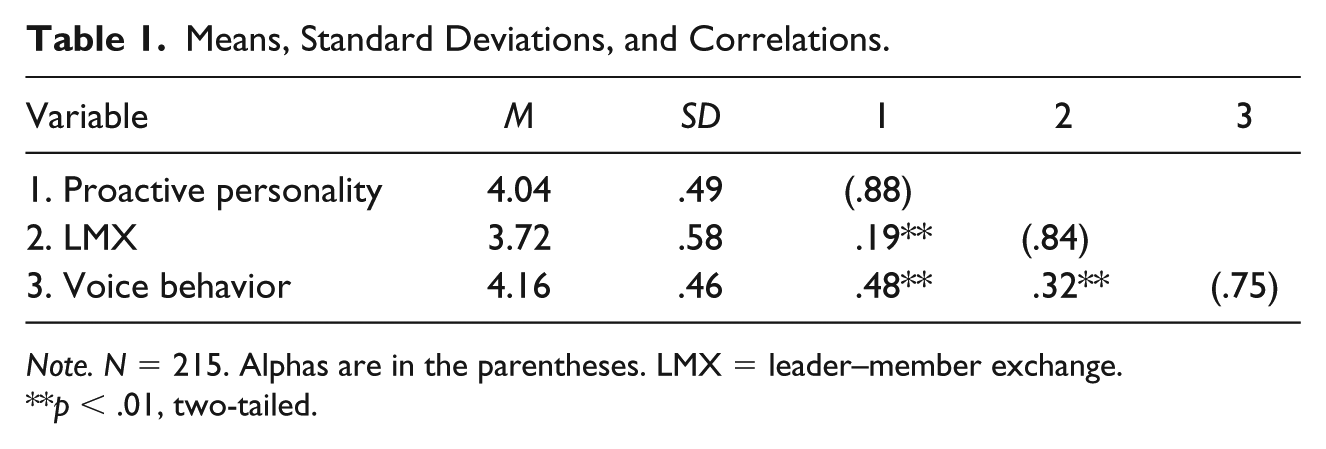
Note. N = 215. Alphas are in the parentheses. LMX = leader–member exchange.
p < .01, two-tailed.
Direct and Mediating Effects
Hierarchical linear modeling (HLM) was performed to examine the direct and mediating relationships. H1 and H2 predicted proactive personality would be positively related to voice behavior (H1) and LMX quality (H2). As shown in Table 2, results reveal positive relationships between proactive personality and voice behavior (β = .45, p < .001, Model 1) and LMX quality (β = .22, p < .01, Model 2). H1 and H2 were supported. H3 predicted LMX quality would be positively related to voice behavior. This hypothesis was supported, β = .25, p < .001, Model 3.
HLM Analysis of Individual-Level Relationships: The Direct and Mediating Effects.
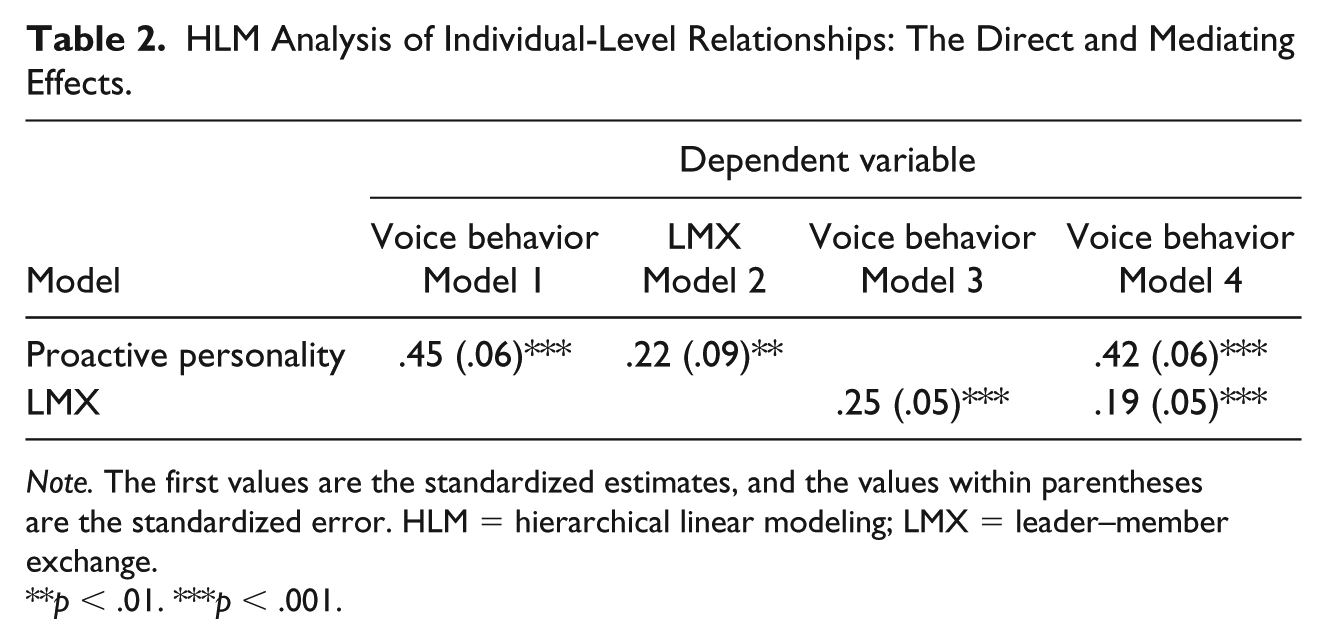
Note. The first values are the standardized estimates, and the values within parentheses are the standardized error. HLM = hierarchical linear modeling; LMX = leader–member exchange.
p < .01. ***p < .001.
H4 predicted that LMX quality would partially mediate the relationship between proactive personality and voice behavior. The first three conditions for the mediation were met: Proactive personality was associated with voice behavior (H1), proactive personality was associated with LMX quality (H2), and LMX was associated with voice behavior (H3; Baron & Kenny, 1986). In Model 4, when proactive personality and LMX were included together, the relationship between proactive personality and voice behavior decreased in strength (from β = .45, p < .001 to β = .42, p < .001). The results demonstrated a partial mediating effect of LMX (H4; Baron & Kenny, 1986). As suggested by Hayes (2009), to validate the mediating effect of LMX, a bootstrapping technique using AMOS software was also conducted. The results indicated that the standardized indirect effect of proactive personality on voice behavior was .05 (p = .03, 2,000 resamples, 95% confidence interval (CI) = [.004, .090]). The goodness-of-fit statistics for the structural model were χ2 = 287.29 (p = .029); χ2 / df = 1.24; GFI = .91; CFI = .97; and RMSEA = .03, exhibiting satisfactory model fit.
The Moderating Effect of Sex (Dis)similarity
H5 predicted a positive joint effect of LMX and sex (dis)similarity on voice behavior. Specifically, in higher quality LMX relationships, employees working with supervisors of dissimilar sex were expected to demonstrate more voice than those working with supervisors of the same sex (H5). The hypothesis was examined with an HLM analysis involving individual- and team-level variables. As shown in Table 3, sex (dis)similarity was negatively related to voice behavior (–.84, p < .01, Model 5). Employees working with supervisors of dissimilar sex reported less voice behavior than those working with supervisors of similar sex. However, the interaction term (Sex [Dis]similarity × LMX) was positively related to voice behavior (.22, p < .01, Model 5). The moderating effect of employee–supervisor sex (dis)similarity was demonstrated. Thus, H5 was supported.
HLM Analysis of Cross-Level Relationships: The Moderating Effect of Sex Similarity.
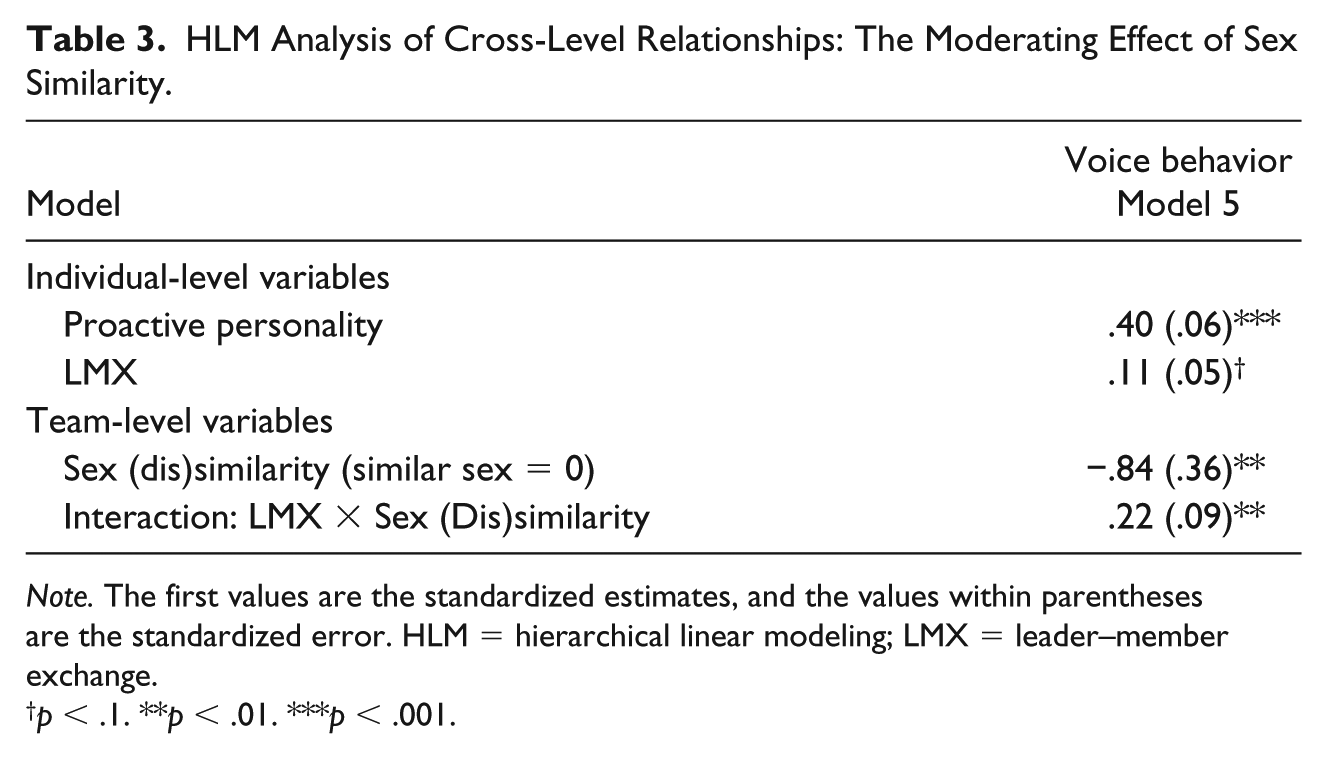
Note. The first values are the standardized estimates, and the values within parentheses are the standardized error. HLM = hierarchical linear modeling; LMX = leader–member exchange.
p < .1. **p < .01. ***p < .001.
Figure 2 illustrates this interaction effect. In low-quality LMX relationships, the voice behavior of employees working with supervisors of dissimilar sex was lower than that of those working with supervisors of similar sex. In contrast, in high-quality LMX relationships, employees working with supervisors of dissimilar sex reported a higher level of voice behavior than those working with supervisors of similar sex.
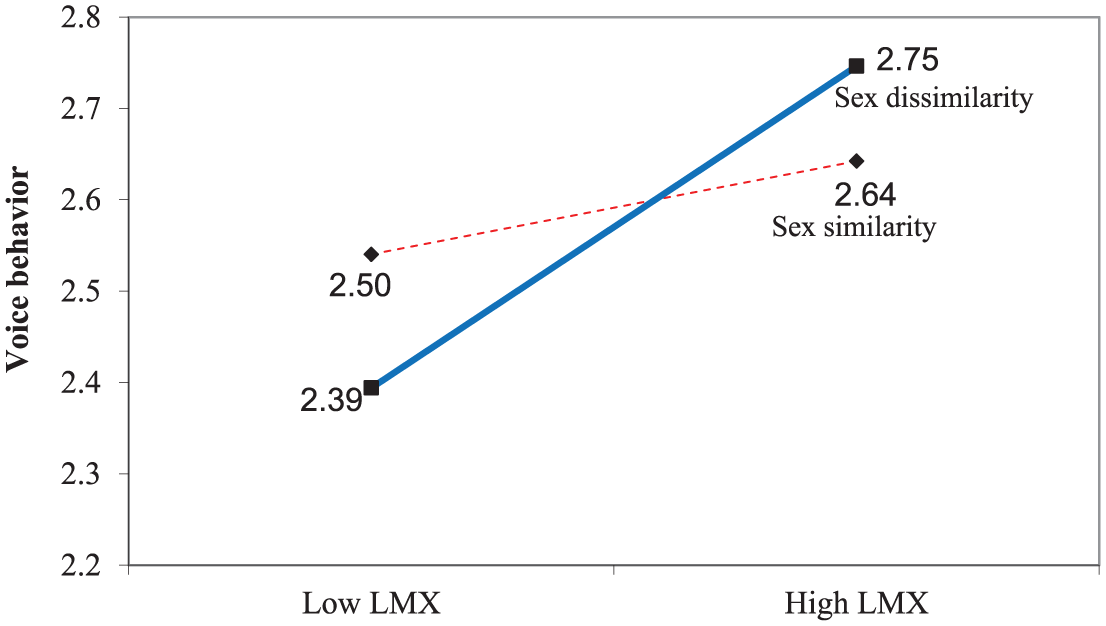
Interaction lines for the moderating effect of sex dis(similarity).
Discussion
Contributions
This study investigated the relationships among proactive personality, LMX quality, voice behavior, and sex (dis)similarity. It contributes to theory and literature in several ways. First, the study demonstrates a positive relationship between proactive personality and voice behavior. Previous research has attempted to theorize and investigate this link, but failed to obtain empirical evidence (see Seibert et al., 2001, for a review). Second, results of the present study support the process view of proactivity (Crant, 2000; Thompson, 2005) by demonstrating the process through which proactive personality via LMX quality is linked to voice behavior. Thus, this study is consistent with previous research indicating the ability of proactive people to develop social exchange relationships in groups in which they are involved (Fuller & Marler, 2009) and the importance of the quality of exchange relationships for voice behavior (Botero & Van Dyne, 2009; Shih & Wijaya, 2017). Third, this study demonstrates links between employee–supervisor sex (dis)similarity, LMX quality, and voice behavior. Specifically, results suggest the dis(similarity) may encourage or attenuate employee voice behavior, subject to LMX quality. The findings are consistent with prior work suggesting that team diversity attributes may be beneficial if they are activated within supporting conditions (e.g., Bakar et al., 2014; Chung et al., 2015). This study thus offers an understanding of the advantages of team heterogeneity.
This study also contributes to practice. First, results indicate proactive employees tend to engage in more voice behavior than less proactive employees. In a highly competitive environment, enhancing organizational adaptive posture is crucial (Fuller & Marler, 2009). Organizations rely on constructive ideas from proactive employees to develop organizational learning capability, adaptability (Morrison, 2011), and creativity (Gong et al., 2012). Second, this study suggests that organizational practitioners should improve efforts toward enhancing LMX relationships. Because proactive personalities can stimulate the development of LMX quality, practitioners might consider including proactive employees on work teams. Practitioners should also improve the role of team leaders, especially when they need to develop the relationships with less proactive subordinates. In this case, team leaders should develop communication skills to develop high-quality relationships with subordinate employees (Graen & Uhl-Bien, 1995). Third, the findings of this study suggest that organizations may reap useful ideas from employees working with supervisors of different sex in a high-quality LMX environment. Managers may thus realize that employee–supervisor sex dissimilarity is not always an obstacle for team effectiveness (see Bakar & McCann, 2014, for a review). The findings of this study suggest that in high-quality LMX relationships, employees working with the same or different sex supervisors may perform higher levels of voice behavior. The results suggest the importance of improving LMX quality for all to stimulate employee voice.
Limitations and Future Directions
Although this study employed a cross-lagged research design, it used a single-rater method for all measures. Future research should involve multiple raters. Because prior research has mostly employed self-assessment methods for measuring voice behavior (e.g., Botero & Van Dyne, 2009; Hsiung, 2012), future research may employ supervisors or teammates (Liu et al., 2010). Supervisors should acknowledge the extent to which each subordinate is willing to express his or her voice. Liu et al. suggest that teammates may offer more accurate predictions about voice behavior of their counterparts, because they (as raters) are less likely to be influenced by the impression management of the employees. In addition, because of the use of a cross-sectional design, the findings do not indicate cause–effect relationships. They should be interpreted with caution. Second, in this study, LMX was only assessed by the employees (Botero & Van Dyne, 2009; Hsiung, 2012). To obtain more accurate data of this variable, future research may consider both employees and their supervisors in assessing the LMX quality (Bakar et al., 2014).
Future work addressing this topic could examine whether the proactive personality of team leaders influences LMX quality and subordinates’ voice behavior. Future research should also examine potential links between congruence of employee–leader proactive personality (Zhang, Wang, & Shi, 2012) to employee voice behavior. The present study examined the moderating role of employee–supervisor sex (dis)similarity between LMX quality and voice behavior. Future research examining the effect of sex (dis)similarity in different cultural contexts would provide useful insights (Tsui et al., 2002). The effect of sex dis(similarity) might be lessened in cultures that emphasize equality of roles between men and women.
Footnotes
Acknowledgements
I thank Editor-in-Chief Dr. Patricia M. Sias, Associate Editor Dr. C. Erik Timmerman, and the three anonymous reviewers for their useful comments and suggestions.
Declaration of Conflicting Interests
The author(s) declared no potential conflicts of interest with respect to the research, authorship, and/or publication of this article.
Funding
The author(s) received no financial support for the research, authorship, and/or publication of this article.