




Abstract
Researchers have become increasingly interested in the strategic value of transparency in corporate social responsibility (CSR) communication in recent years. However, transparency research in CSR communication is still scarce. In particular, little research has examined whether the effects of transparency may depend on contextual factors, such as whether an organization is associated with a stigmatized industry. Grounded on legitimacy theory, this experiment examined the effect of CSR messages on supportive communication intent, purchase intent, and skepticism. Results reveal a main effect of transparency on purchase intent and a main effect of stigmatization on skepticism. Most importantly, there was an interaction, such that a higher level of transparency reduced skepticism when a more stigmatized industry was involved. The results contribute to further contextualizing transparency and CSR research.
Introduction
Organizations in core stigmatized industries such as tobacco and alcohol are relevant to corporate social responsibility (CSR) because their products and services are perceived as socially undesirable (e.g., Byrne, 2010). CSR communication is intended to provide shared understanding between organizations and the public (Kent & Taylor, 2016) to address the public’s growing skepticism toward organizations (e.g., Rim & Kim, 2016). Transparent CSR communication in core stigmatized industries involves an even higher level of skepticism toward their businesses and thus CSR communication and, therefore, provides a useful platform for exploring the strategic value of transparent CSR communication.
Scholars have increasingly emphasized the value of transparency in CSR communication (Coombs & Holladay, 2013). However, empirical studies of strategic message transparency remain rare, especially in relation to a broader context of organization types. As a result, strategic transparency research is undertheorized (Lee & Boynton, 2017). This study tests the effect of different levels of transparent CSR messages upon supportive communication intent, purchase intent, and skepticism toward CSR messages while taking into consideration the level of industry stigmatization.
Core Stigmatized Industries and CSR
Although there is no universally accepted definition, industry stigmatization is generally conceptualized in terms of core business outputs (e.g., alcohol), operational routines (e.g., mining practices), and negative events (e.g., scandals) that conflict with “endorsed standards of corporate behavior” (Grougiou, Dedoulis, & Leventis, 2016, p. 906; see also, for example, Vergne, 2012). Most definitions focus on the negative impact of core business outputs such as products or services on users or society, presumably on a scientific basis. In contrast, only a few definitions invoke specific abstract standards such as religious or moral principles, decency, or vice (see Oh, Bae, & Kim, 2017 for a list of related definitions).
Stigmatized status labels such as firms possessing “a fundamental, deep-seated flaw that deindividuates and discredits the organization” (Devers, Dewett, Mishina, & Belsito, 2009, p. 157), bringing severe obstacles for the organizations’ survival. These include heightened risk of litigation, stricter government regulations, and consumer boycotts (Grougiou et al., 2016). CSR has been suggested as an effective communication strategy to deal with industry stigmatization (e.g., Wolfe & Blithe, 2015). Recent studies show that stigmatized industries provide CSR information more actively than nonstigmatized industries to signal their conformity to social values (Grougiou et al., 2016), and increase advertising expenditures to engage in CSR activities (Oh et al., 2017).
The problematic characteristics of stigmatized industries, however, render their CSR communication fundamentally challenging. Specifically, the conflict between CSR initiatives to support various social causes on one hand and the negativity attached to stigmatization on the other has invited a vigorous debate over how such companies’ CSR communication should be perceived. Critics denounce such CSR communication as manipulative and untrustworthy (e.g., Cai, Jo, & Pan, 2012). Similarly, the World Health Organization (2003) announced that the idea of social responsibility in the tobacco industry was an inherent contradiction (Palazzo & Richter, 2005).
Stigmatized industries provide a useful platform for investigating CSR communication, because their uniquely controversial nature presents a clear case in which to test the effects of CSR in the context of high skepticism and low trust (e.g., Cai et al., 2012). Specifically, we focus on “core” stigmatized industries that are so labeled based on their products or services. These industries pose a far greater challenge due to the permanent nature of their stigma than industries stigmatized for other reasons (e.g., event based).
Transparency and CSR
Most transparency research has focused on the positive value of information, as demonstrated by the emphasis on amount or quality of information provided (e.g., Albu & Wehmeier, 2014; Christensen & Cheney, 2015). Scholars have criticized this approach, however, because it neglects the “dark side” of information provision, namely, shadowing the untold aspects (Christensen & Cheney, 2015) or sustaining the power nexus rather than challenging it (Flyverbom, Christensen, & Hansen, 2015). The criticism also highlights the untenable assumption that information is always objective (Coombs & Holladay, 2013).
Alternative views toward transparency emphasize responsiveness over simple information provision by looking not only at the amount of information provided, but also at the degree of participation of stakeholders and the degree of accountability of the investigated organization (Rawlins, 2009). Rawlins (2009), for example, suggested going beyond mere information disclosure by defining transparency in terms of substantial information, participation, and accountability to make transparency more meaningful. These elements informed the operationalization of transparency in this study.
A fundamental transparency issue pertains to the intrinsic versus strategic value of transparent communication. To date, research on transparency in the communication domain has focused more on intrinsic value and produced conceptual discussions of its definitions and social roles, neglecting a theoretically driven exploration of the strategic value of transparency (Lee & Boynton, 2017). Communication scholars, for example, have predominantly approached transparency as a normative CSR ideal, which may contribute to making CSR disclosure more substantive and ethical rather than a strategic concept for organizational purposes (Coombs & Holladay, 2013).
As a context through which to explore the strategic value of transparency in CSR communication, we draw from recent propositions in transparency research to encompass noninformational considerations such as organization types and characteristics (e.g., Lee & Boynton, 2017).
Organizational Legitimacy
We draw heavily from organizational legitimacy literature, which focuses on socially constructed systems of norms, values, beliefs, and definitions (Suchman, 1995). In essence, legitimacy emerges through an organizational process of justifying actions to various stakeholders (Hudson, 2001). Thus, satisfying stakeholders’ expectations becomes crucial for an organization’s legitimization, social acceptance, and, ultimately, survival.
Organizational legitimacy provides a useful framework for understanding the challenges to CSR activities from stigmatized industries (e.g., Miller & Michelson, 2013). The broad range of organizational legitimacy, which includes the statuses of accepted, proper, debated, or illegitimate (Deephouse, Bundy, Tost, & Suchman, 2017), is especially instructive in conceptualizing industry stigmatization in this study. Echoing this rationale, we view industry stigmatization as a volatile concept with varying degrees (e.g., more vs. less stigmatized) rather than dichotomous (e.g., stigmatized vs. nonstigmatized).
Research indicates that CSR activities of stigmatized industries are fundamentally different from those of nonstigmatized industries, with respect to, for example, the direction of effect (e.g., Oh et al., 2017). Hill (2001) argued that most CSR engagement of stigmatized industries would further “alienate the organization from the rest of society, resulting in reduced reputation, increased costs, and decreasing shareholder value through erosion of its license to operate” (p. 32). Similarly, Palazzo and Richter (2005) suggested that conventional CSR strategies such as benevolence nurture stigmatized industries’ problems rather than enhance their legitimacy. Oh et al. (2017) found that when stigmatized companies engaged in more CSR-related advertising, their financial performance vulnerability increased. El Ghoul, Guedhami, Kwok, and Mishra (2011) found that controversial industries’ participation in CSR initiatives increased the cost of raising capital, while that of nonstigmatized industries decreased it. With regard to consumer response, Steltenpool and Verhoeven (2012) found that more explicit CSR information in the alcohol industry led to negative results in terms of attitude toward the organization, purchase intent, corporate reputation, and skepticism. Much research thus indicates less effective or even negative impact of CSR engagements in stigmatized industries as compared with nonstigmatized industries (cf. Cai et al., 2012; Jo & Na, 2012).
Hypotheses
Based on the literature reviewed, we propose the following hypotheses. These hypotheses address the effect of transparent CSR communication and the stigmatization of a company on three variables that are frequently examined in strategic communication research: supportive communication intent, which is defined as “individuals’ intention to actively engage in information-seeking behaviors and word-of-mouth communication behaviors, with the aim of demonstrating their interest and support for the company” (Kim, 2017), together with purchase intent, and skepticism toward CSR messages.
In addition to testing the direct effect of the level of transparency in CSR communication, and the degree of industry stigmatization, we expect that the degree of industry stigmatization will moderate the effects of the level of transparency in CSR communication on supportive communication intent, purchase intent, and skeptical attitude. The proposed interaction between the level of transparency in CSR communication and the degree of industry stigmatization is based on the expectation suggested by the reviewed literature that participants will judge more harshly in the high transparent condition when a more stigmatized company is involved.
Method
Overview
The design was a 2 (degree of stigmatization: more vs. less) × 2 (level of transparency: high vs. low) between-subjects posttest-only experiment with random assignment to condition. Participants were recruited through Amazon Mechanical Turk (MTurk) to participate in a study delivered through Qualtrics. After accessing the study, participants completed an online consent form and were directed to the questionnaire. The study was reviewed by the institutional review board at the university where the research was completed.
Participants and Procedure
Only subjects aged 18 years or older were recruited through MTurk in exchange for compensation of US$1.00. A total of 120 adults were initially recruited from MTurk. After excluding those participants who did not complete the survey, or who spent less than 2 min, a final sample of 110 participants was gathered (59.2% male, average age = 33.4 years).
The opening screen informed participants that the purpose of the study was to learn how consumers respond to a company’s online communication. Participants were told they were going to see a page of a company’s website. They were then exposed to the stimulus, which showed a brief description of the company followed by the social cause—child obesity reduction—that the fictitious organization (e.g., a hamburger chain or a cereal company, depending on the experimental condition) was supporting and how the organization was implementing its CSR campaign. Next, participants evaluated the company and completed other measures. Participants were then thanked and debriefed.
Stimuli Development
Four stimuli were used to represent the two levels each of stigmatization and transparency. Two types of companies, a hamburger chain and a cereal manufacturer, were chosen to represent more-stigmatized and less-stigmatized industries in the food and beverage sector, given each industry’s relevance to the issue of child obesity (e.g., Nixon et al., 2015) as well as the difference in the degree of stigmatization. Fast food companies, including hamburger chains, have been criticized for the increasing rate of child obesity, resulting in their frequent categorization as a stigmatized industry (e.g., Ban, 2016; Newman, Howlett, & Burton, 2014). Cereal manufacturers, by contrast, although they have sometimes garnered suspicion concerning their relationship to child obesity, have not been as severely criticized (e.g., Wootan & Ludwig, 2012). Thus, we deemed the two types of industries appropriate for the purposes of this study due to their relevance to child obesity and the difference in degree of stigmatization.
A pretest confirmed the different degrees of stigmatization. In the pretest, 124 participants from Amazon MTurk responded to a web-based questionnaire. Participants were asked to evaluate the impact of certain products/services on a 7-point Likert-type scale (1 = extremely negative, 7 = extremely positive). The products/services included hamburgers, pizza, alcoholic beverages, tobacco products, gambling, weapons, organic juice, and cereal products. A paired samples t test showed a significant difference in stigmatization between hamburgers (M = 3.58, SD = 1.36) and cereal products (M = 4.42, SD = 1.44), t (123) = −5.26, p < .001. Respondents evaluated hamburger products as significantly more negative in their impact on people than cereal products.
The stimulus consisted of a three-part message. The first part provided a brief description of the fictitious company (e.g., name, product). The second part highlighted the social cause the organization was sponsoring—the fight against child obesity. The third part contained information about the company’s CSR efforts and was the focus of the transparency manipulation.
Consistent with previous work (Kim & Lee, 2018), the transparency condition was manipulated based on Rawlins’ (2009) transparency instrument. The high transparency condition included the exact amount of money the company had donated to the cause and explained that the company’s efforts were recognized and endorsed by a specific third-party civic organization with its name provided. Contact information, including an email address, phone number, and feedback plan specific to the CSR program, was provided, inviting people’s participation. In the low transparency condition, the stimulus stated that the company had made monetary donations to the cause without citing an exact amount. It also stated that the company was recognized for its support of the cause, but did not cite a specific third-party organization. No contact information for further queries specific to the CSR program was provided beyond the company’s general contact information.
Except for the level of transparency and stigmatization, all other elements in the stimulus, including the position and size of visual images and layout of written information, were constant across all four conditions.
Independent Variables and Manipulations
Transparency
Transparency was operationally defined with two levels (high and low), which differed in terms of the message features described above. The levels were dummy coded 0 = high and 1 = low for analysis. As a manipulation check item, participants were asked to evaluate the company’s level of transparent communication in terms of its CSR initiatives using the following statements chosen from Rawlins’ transparency measurement (Rawlins, 2009): the company (a) “provides information that can be objectively confirmed,” (b) “provides information that is complete,” (c) “asks the opinions of people like me in making decisions,” and (d) “is prompt when responding to requests for information,” with high scores indicating a high level of transparent communication: (1 = strongly disagree, 7 = strongly agree): α = .85, M = 4.44, SD = 1.14.
Stigmatization
Organization type by stigmatization was operationally defined with two levels: more stigmatized (hamburger company) and less stigmatized (cereal company). For analysis, these were dummy coded as 0 = more stigmatized and 1 = less stigmatized. To check if the experimental conditions for the company’s stigma were being manipulated successfully, the perceived stigma of the company was measured using a 7-point semantic differential scale for the following words: (a) extremely bad/extremely good, (b) extremely unfavorable/extremely favorable, (c) extremely negative/extremely positive, and (d) extremely not likable/extremely likable. An overall stigma measure was created by averaging the four items, with high scores indicating a low level of stigmatization: α = .98, M = 4.52, SD = 1.56.
Dependent Measures and Covariates
Dependent measures and covariates were assessed using 7-point Likert-type scales. See Table 1 for items for these measures. 1
Items Used for Dependent Measures and Covariate.

Supportive communication intent was measured by using three items from a 7-point Likert-type scale drawn from Y. Kim (2017). A composite measure of supportive communication intent was created by averaging the three items, with high scores indicating a high level of support: α = .90, M = 4.62, SD = 1.49.
Purchase intent was measured by using three items from a 7-point semantic differential scale drawn from Mohr and Webb (2005). A composite measure of purchase intent was created by averaging the three items, with high scores indicating a high level of purchase intent: α = .96, M = 4.73, SD = 1.44.
Skepticism was measured by using four items from a 7-point Likert-type scale drawn from Skarmeas and Leonidou (2013). After reverse-coding appropriate items, a composite measure of skepticism was created by averaging the four items, with high scores indicating a high level of skepticism: α = .91, M = 3.43, SD = 1.27.
Concern over child obesity, as a covariate, was measured by using five items from a 7-point Likert-type scale drawn from Abdul-Muhmin, (2007). An overall concern over child obesity measure was created by averaging these five items, with a high score indicating high levels of concern: α = .89, M = 5.00, SD = 1.28. Concern over child obesity was significantly correlated with supportive communication intent (r = .45, p < .01), purchase intent (r = .19, p < .01), and skepticism (r = .23, p < .05).
Results
Preliminary Analyses
Manipulation checks were done with a two-way ANOVA. The first ANOVA indicated a main effect of stigmatization, F(1, 106) = 13.08, p < .001, η2 = .10, confirming that those participants in the higher stigma condition (M = 4.01, SD = 1.70) felt higher stigmatization of the organization compared with participants in the lower stigma condition (M = 5.05, SD = 1.19). Although the contrast was significant and in the predicted direction, the mean of the hamburger company indicates that industry may not be as stigmatized as perhaps some other types of companies. However, the ANOVA results were deemed appropriate for the purposes of this study, as this study intended to test the message effects in consideration of the different levels of stigmatization (e.g., more vs. less stigmatized).The second ANOVA confirmed a main effect of transparency, F(1, 106) = 5.09, p < .05, η2 = .04, suggesting that participants in the high transparency condition (M = 4.66, SD = 1.08) perceived the CSR message as having a higher degree of transparency than the participants in the low transparency condition (M = 4.22, SD = 1.17). Together, these results indicated that the manipulations of stigmatization and transparency were successful. The correlation matrix for dependent variables and covariate appears in Table 2.
Correlations and Descriptive Statistics of Dependent Variables and Covariate.
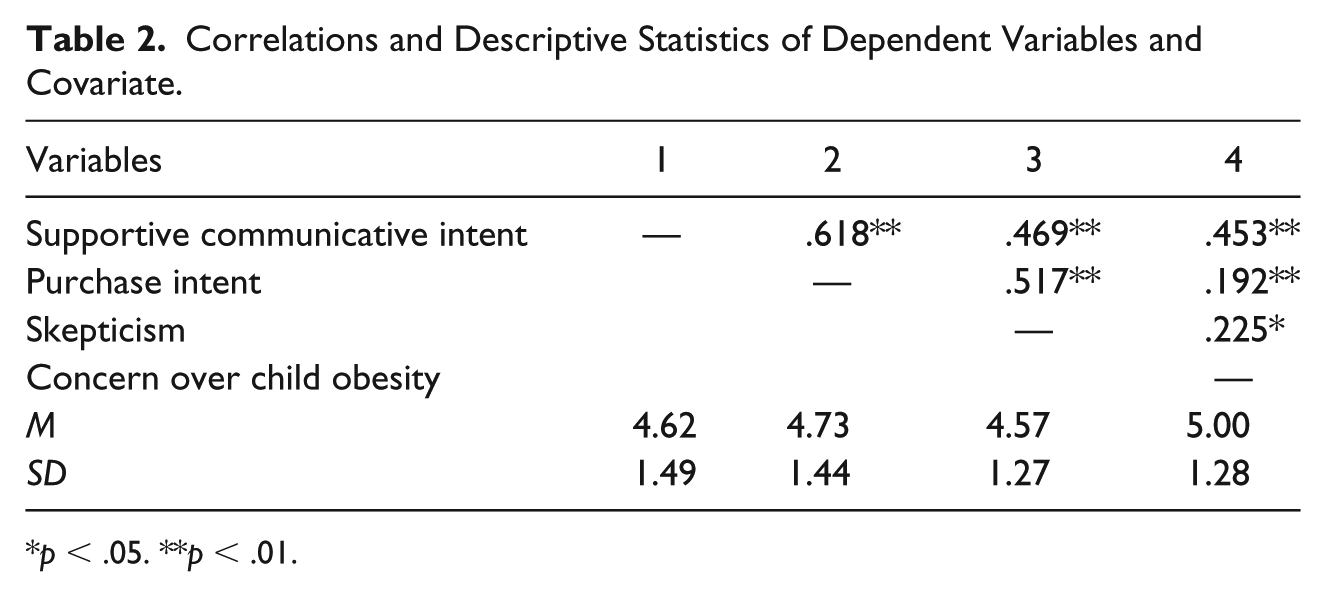
p < .05. **p < .01.
Tests
A series of two-way ANCOVAs was performed to test the main effects of transparency and the company’s stigmatization, as well as the interaction of those variables, on supportive communication intent, purchase intent, and skeptical attitude, controlling for concern for obesity.
Hypotheses regarding transparency
H1 predicted that high (vs. low) transparency in CSR communication would result in stronger supportive communication intent (H1a), stronger purchase intent (H1b), and a less skeptical attitude toward CSR messages (H1c). For H1a, the main effect of transparency on supportive communication intent was not significant: F(1, 104) = 1.56, ns, η2 = .01. However, for H1b, a main effect of transparency on purchase intent emerged: F(1, 104) = 5.18, p < .05, η2 = .05. Participants showed greater purchase intent when the CSR message contained a high level of transparency (M = 5.06, SD = 1.32) than when the CSR message contained a low level of transparency (M = 4.42, SD = 1.49). For H1c, a main effect of transparency on skepticism did not emerge: F(1, 104) = 2.75, ns, η2 = .02. Thus, H1b was supported, but H1a and H1c were not.
Hypotheses regarding stigmatization
H2 predicted that messages from organizations representing less stigmatized (vs. more stigmatized) industries would result in stronger supportive communication intent (H2a), stronger purchase intent (H2b), and a less skeptical attitude toward CSR messages (H2c). For H2a, the main effect of stigmatization on supportive communication intent was not significant: F(1, 104) = .67, ns, η2 = .01. For H2b, no main effect of stigmatization on purchase intent was evident: F(1, 104) = .30, ns, η2 = .00. For H2c, however, a main effect of stigmatization on skepticism was evident: F(1, 104) = 6.00, p < .05, η2 = .05. Participants showed less skepticism when the company was less stigmatized (M = 3.15, SD = 1.23) than when the company was more stigmatized (M = 3.72, SD = 1.25). Thus, H2c was supported, but H2a and H2b were not.
Hypotheses regarding the interaction of transparency and stigmatization
H3 predicted that transparency and organization type would interact, such that a high level of transparent CSR communication would show a lower level of effectiveness for more stigmatized companies than for less stigmatized companies in terms of supportive communication intent (H3a), purchase intent (H3b), and skepticism (H3c). For H3a and H3b, no interaction effects between transparency and stigmatization were found with regard to supportive communication intent and purchase intent, F(1, 104) = 1.57, ns, η2 = .01. For H3c, however, a two-way interaction emerged between transparency and stigmatization with regard to skepticism: F(1, 104) = 6.21, p < .05, η2 = .05 (see Table 3).
Skepticism as a Function of Stigmatization and Transparency.
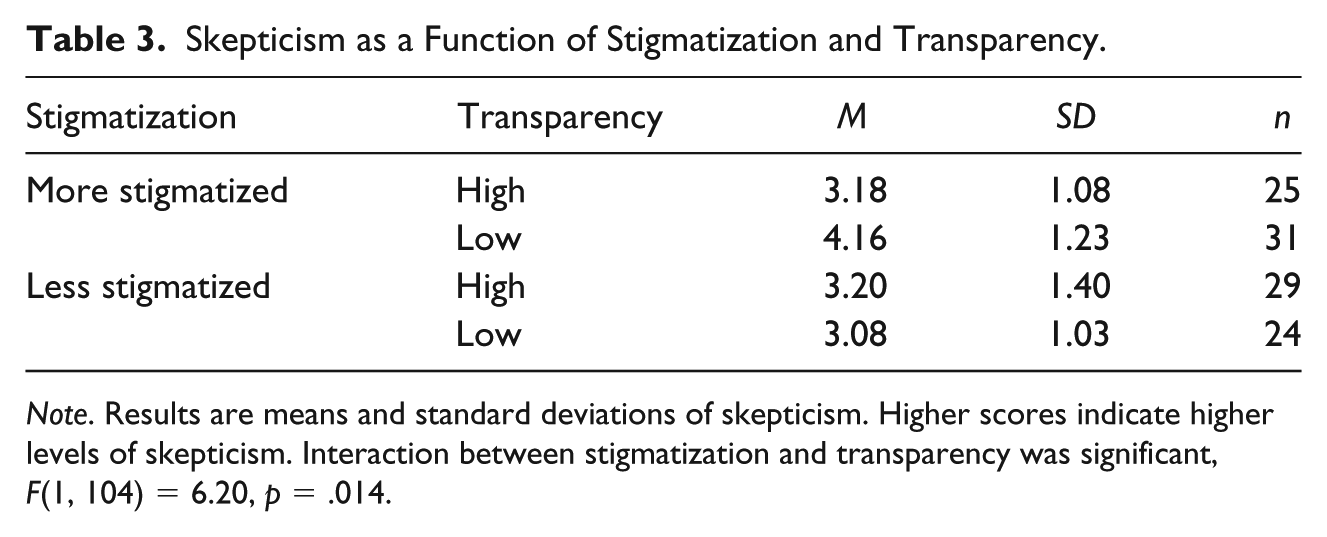
Note. Results are means and standard deviations of skepticism. Higher scores indicate higher levels of skepticism. Interaction between stigmatization and transparency was significant, F(1, 104) = 6.20, p = .014.
To examine the interaction, a simple effects post hoc test indicated that the stigmatization moderated the primary effect of transparency, because transparency had a main effect in the more stigmatized condition, F(1, 53) = 9.36, p < .01, η2 = .15, but not in the less stigmatized condition, F(1, 53) = .41, ns, η2 = .01 (see Table 4). That is, the CSR message with a high level of transparency resulted in a lower level of skepticism (M = 3.18, SD = 1.08) than the CSR message with a low level of transparency (M = 4.16, SD = 1.23), but only if the company was more stigmatized (see Figure 1).
Simple Effects Post Hoc Tests for Two-Way Interaction Between Stigmatization and Transparency on Skepticism.
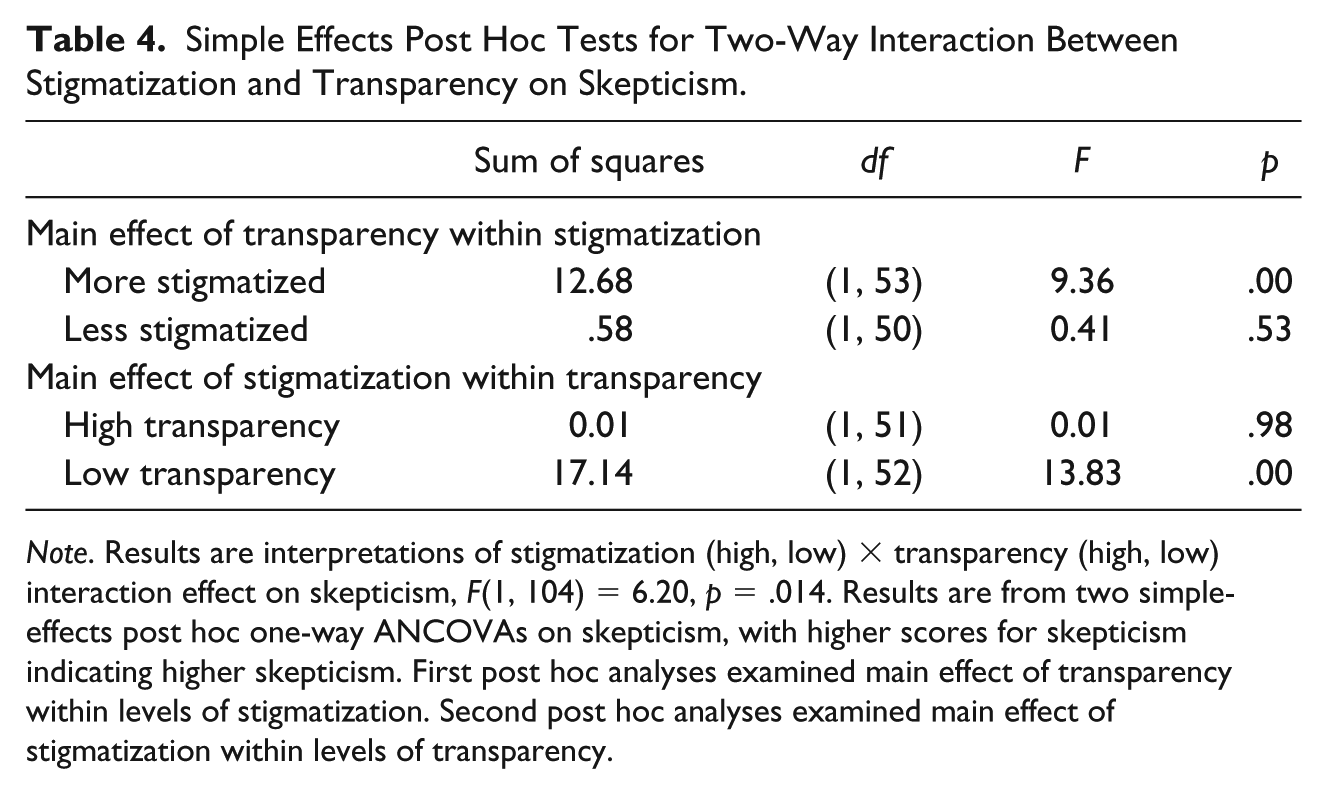
Note. Results are interpretations of stigmatization (high, low) × transparency (high, low) interaction effect on skepticism, F(1, 104) = 6.20, p = .014. Results are from two simple-effects post hoc one-way ANCOVAs on skepticism, with higher scores for skepticism indicating higher skepticism. First post hoc analyses examined main effect of transparency within levels of stigmatization. Second post hoc analyses examined main effect of stigmatization within levels of transparency.

Interaction effect between stigmatization and transparency on skepticism.
Discussion
CSR communication is a significant topic in the research of stigmatized industries because it can provide a platform for managing the public’s negative reactions toward these industries. It may, however, backfire by ironically damaging the efforts of these industries to manage their negative evaluations, rendering the use of CSR in these industries fundamentally challenging. This study contributes to this literature by focusing on the construction of CSR messages in terms of different levels of transparency.
Most significantly, the findings suggest that transparency provides strategic effectiveness in reducing skepticism for more stigmatized industries but not for less stigmatized industries. This adds insight to the debate over strategic CSR communication in more stigmatized industries by providing one potential explanation of the conflicting findings in the literature, as well as a useful communication strategy. To date, most legitimacy literature indicates the counterproductiveness (in terms of financial implications) of CSR engagement in these industries, (e.g., Oh et al., 2017) (cf. Cai et al., 2012). Our results suggest that careful strategic construction of CSR messages that integrates a higher level of transparency can significantly reduce skepticism in stigmatized industries’ CSR communication, enhancing the strategic value of their CSR communication.
The differing effectiveness of transparency in reducing skepticism depending on the degree of industry stigmatization is also congruent with the ideas advanced in Lee and Boynton’s (2017) theoretical perspective on organizational transparency, which suggests the significance of organizational characteristics. They emphasize the relevance of organizational types in the discussion of transparency, proposing that “various organizational types and their unique purposes invoke different expectations and perceptions toward transparency” (p. 242). This study supports their proposition by showing how different degrees of industry stigmatization, a significant consideration in categorizing organizations, can influence the effectiveness of transparent CSR communication.
Practically, these findings may help more stigmatized industries strategically manage their CSR communication by integrating transparency. Organizations situated in more stigmatized industries might consider integrating a higher level of transparency in their CSR communication to reduce the public’s skepticism. More specifically, these organizations should consider not only how substantial information should be provided, but also how to ensure accountability while inviting stakeholders’ participation in their CSR programs (Rawlins, 2009). The message content details used in this study for a high level of transparency (e.g., amount of donations, partnering with an independent civic organization to evaluate the CSR program, inviting stakeholders’ participations through CSR-specific communication channels), suggest ways to enhance transparency of CSR messages. Furthermore, the conceptualization of transparency in this study (substantial information, accountability, and participation) suggests the high level of organizational effort and commitment required to achieve message transparency. To construct effective transparent CSR messages, organizations must, for example, submit to a verification and accountability process, as well as to be accessible and open for stakeholders’ participation in the process (Rawlins, 2009). In light of this, organizations in more stigmatized industries should seriously evaluate their current level of commitment to CSR programs to fully integrate transparency into their CSR practices.
Although this study used fictitious companies in the stimuli to avoid potential confounds, it may have also elicited less vivid impressions, potentially decreasing the likelihood of detecting differences. Future research looking at factors associated with actual companies, such as history, reputation, and identity, would provide useful insights. This study employed a very specific context concerning the types of industries as well as the CSR theme to be evaluated. Future research considering a broad spectrum of stigmatized industries and CSR themes is needed to assess the generalizability of this study’s findings. Although the operationalization of transparency in this study is based on current literature, different future manipulations that consider different contexts of stigmatization (e.g., event-based stigmas) may produce different results. Because the concepts of industry stigmatization and organizational legitimacy involve different and sometimes conflicting values and interests, future studies should address presumably changing standards and rationales as well as the public’s evaluations of industry stigmatization.
Footnotes
Declaration of Conflicting Interests
The author(s) declared no potential conflicts of interest with respect to the research, authorship, and/or publication of this article.
Funding
The author(s) received no financial support for the research, authorship, and/or publication of this article.