



Abstract
Employees can provide invaluable input to organizations when they can freely express their opinions at work. Employees, however, may not believe that it is safe or efficacious to voice their concerns. How features of communication channels affect employees’ safety and efficacy perceptions is largely ignored in existing voice models. Therefore, this study seeks to understand how the anonymity and visibility affordances of a communication channel influence employees’ safety and efficacy perceptions, and, thus, their intention to engage in prohibitive voice at work. Two between-subjects experiments were conducted to test how these channel affordances affect voicing behavior in organizations. The results indicate that the more anonymous and less visible participants perceive a voicing channel to be, the safer and the more efficacious they evaluate the channel. Theoretical and practical implications, limitations, and future research directions are discussed.
Introduction
Establishing proper communication channels so employees can voice suggestions may simultaneously curb organizational malpractices and increase employees’ organizational commitment and job satisfaction (Gorden, Infante, & Graham, 1988; Holland, Pyman, Cooper, & Teicher, 2011). By encouraging participative decision making, organizations can foster a more effective and efficient working environment (Tailby, Richardson, Upchurch, Danford, & Stewart, 2007). The willingness of employees to communicate ideas encourages organizational learning (Edmondson, 1999, 2003) because suggestions from employees help organizations better survive and prosper (Detert & Burris, 2007; Morrison & Milliken, 2000). Voicing channels are also critical for employee well-being. The #MeToo movement is a prominent example of what can happen when employees fear speaking out in workplace environments. That so much sexual harassment and abuse was silenced for so long speaks to the importance of providing safe and effective communication channels for organizational members to voice their concerns.
Employee voice refers to the opinion-expressing behaviors of an employee in an organizational setting (Lavelle, Gunnigle, & McDonnell, 2010; Pyman, Cooper, Teicher, & Holland, 2006; Van Dyne, Ang, & Botero, 2003). Researchers agree that employees may be more willing to voice their opinions if they believe that their job status and work relationships will not be negatively impacted (safety) and their voice will bring about intended effects (efficacy; Ashford, Rothbard, Piderit, & Dutton, 1998; Morrison, 2011, 2014). When employees plan to critique (prohibitive voice) their organization, they prefer certain communication channels over others (Lee, 2010; Liang, Farh, & Farh, 2012; Ruck & Welch, 2012). However, it remains unclear how specific affordances of communication channels affect employees’ safety and efficacy perceptions, and ultimately their prohibitive voicing intentions.
The term affordance refers to a perception about how an object can be used (Gibson, 1979; Norman, 1990). Organizational communication scholars have examined how the perceived affordances of communication technologies can influence the likelihood of technology adoption (Treem & Leonardi, 2012; Zammuto, Griffith, Majchrzak, Dougherty, & Faraj, 2007). This study adopts an affordance perspective to investigate how employees’ perceptions regarding the anonymity and visibility affordances of an online voicing platform affect their safety and efficacy perceptions, and, thus, their prohibitive voicing intentions via the platform.
We begin by reviewing research on prohibitive voice, focusing on two key antecedents that explain/predict voicing behavior in organizations: voicing safety and voicing efficacy. Next, we outline how two perceived affordances of prohibitive voicing channels (i.e., anonymity and visibility) can affect prohibitive voicing intentions by influencing perceptions of safety and efficacy. We test our predictions across two experiments and discuss how our results inform the current literature on prohibitive voicing behavior in organizations.
Voice and Communication Channels
Prohibitive Employee Voice
Employee voice is an important topic in organizational communication because it focuses beyond mere managerial interest to concerns about everyone in an organization: how every employee could contribute to their organizations and how voice could benefit the well-being of employees and the organizations (Mumby & Stohl, 1996). Liang and colleagues (2012) delineate how employees can voice promotive or prohibitive feedback. For instance, when employees express new ideas to improve specific aspects of their organizations, they are providing promotive voice. When employees express concerns about existing practices or want to stop the organization from further malpractice, they are engaging in prohibitive voice.
We focused on factors that can inhibit or encourage prohibitive voicing intentions in organizations for two reasons. First, prohibitive voice often serves an impetus or basis for promotive voice. That is, suggested improvements (promotive voice) are usually made based on the unsatisfactory evaluation of a situation or the identification of a problem (prohibitive voice). Second, prohibitive voice is far more challenging and risker than promotive voice. Pointing out the faults of an organization usually involves pointing out derelictions of duties or shortcomings of coworkers, which can cause various negative consequences to the employee who voices the concerns (Liang et al., 2012; Wei, Zhang, & Chen, 2015). Fear of these negative consequences may limit this form of communication in organizations, and it is not fully understood how employees’ perceptions of voicing channels might ameliorate or exacerbate this problem.
Antecedents of Prohibitive Voicing Intention—Safety and Efficacy
Several theoretical models have been proposed to understand the antecedents and outcomes of employee voicing behavior (Ashford et al., 1998; Morrison, 2011, 2014). Most recently, Morrison (2014) provides a comprehensive view of the antecedents and outcomes of organization voicing behaviors. In an informal setting, Morrison (2014) argues that voice is caused by a latent voice opportunity and influenced by several motivators and inhibitors. The content of the voice, the way voice is raised, and to whom the voice is targeted influence both individual and organizational outcomes (Infante & Gorden, 1991).
Before actually engaging in voicing behaviors, employees are likely to envision how the voicing process will unfold, to consider possible communication methods they could use, and to evaluate the respective consequences of choosing a particular channel (Kassing, 1998, 2011). Thus, employees’ evaluations of available voicing channels may be an important antecedent of voicing behavior. More specifically, employees may contemplate how safe and efficacious voicing channels are when deciding whether to voice their concerns. Morrison (2011) echoes Ashford and colleagues’ (1998) model in her Model of Employee Voice, which emphasizes the importance of perceived safety and perceived efficacy. Perceived safety of voice refers to the person’s subjective evaluation of the risks and negative consequences of upward communication. Perceived efficacy refers to the employee’s subjective evaluation of the effectiveness of the communication.
Perceived safety
Prior to voicing their opinions, employees are assumed to evaluate whether it would be safe to communicate with their supervisors, to actively assess the consequences of their voicing behaviors, and to calculate whether there will be any potential repercussions (Burris, 2012; Detert & Burris, 2007; Kassing, 2011; Morrison, 2014). Prohibitive voice, in particular, is considered a risky behavior (Kassing, 2011). As such, perceptions of safety are critical predictors of prohibitive voicing intentions (Liang et al., 2012; Wei et al., 2015). Voicing prohibitive messages may lead to interpersonal conflict with managers and other organizational members (Burris, 2012; Kassing, 1998). Accordingly, when contemplating prohibitive voice, employees often fear potential negative repercussions, such as losing their jobs, being labeled negatively, and hurting their chances for promotion (Milliken, Morrison, & Hewlin, 2003). Safe environments are consistently and positively correlated with employees’ intention to voice (Chughtai, 2016; Fuller, Barnett, Hester, Relyea, & Frey, 2007). Employees are more willing to voice if they perceive the environment to be safe.
Perceived efficacy
Perceived efficacy of voicing behavior refers to whether employees believe their suggestions will have the intended effect and bring expected changes to the organization (Bandura, 1994; Morrison, 2011, 2014). When employees are deciding whether to communicate, they actively evaluate the possibilities of their actions being successful—whether their opinions will be communicated to the proper level, whether their input will be valued, and whether their suggestions will make a difference to the organization (Ajzen, 1991; Ashford et al., 1998). Research suggests that employees are more willing to express their concerns if they believe that their suggestions will be heard and valued (Ashford et al., 1998; Infante & Gorden, 1991; Morrison, 2011, 2014). Likewise, employees are more likely to remain silent if they believe their voice will not be valued or cause the intended change (Milliken et al., 2003).
Channels for Prohibitive Voicing—An Affordance Perspective
Communication channels may also influence employee upward communication (Housel & Davis, 1977). However, why individuals prefer certain channels for voicing remains unclear. The perceived affordance approach provides important insights into why and how people use new communication technology in organizations such as intra-organizational social networking systems (Fulk & Yuan, 2013), social media (Majchrzak, Faraj, Kane, & Azad, 2013; Treem & Leonardi, 2012), and crowdsourcing tools (Aten & Thomas, 2016). Similarly, an affordance perspective can provide insight regarding the use of organizational voicing channels.
Gibson (1979) uses the term affordance to describe the inherent function of an object/technology. From this definition, technology affordances exist independently from users’ perceptions; they are features, attributes, or capabilities of communication channels (Eveland, 2003; Sundar, 2008; Tao & Bucy, 2007). In contrast, Norman (1990) emphasizes the notion of perceived affordances, which refers to users’ subjective evaluations of the action possibilities enabled by technology. This perceptual-oriented approach to examining channel affordances has been endorsed by many communication scholars (e.g., Evans, Pearce, Vitak, & Treem, 2017; Faraj & Azad, 2012; Gibbs, Rozaidi, & Eisenberg, 2013) because it recognizes that people can perceive the same technology differently, and, as a result, interact or be affected by the technology differently (yet in ways that can be systematically understood). In this study, we examine how differences in the perceived anonymity and visibility of a voicing channel affect important antecedents (i.e., safety and efficacy) of prohibitive voicing intentions.
Evans and colleagues (2017) stress the importance of distinguishing outcomes that stem from perceptions of affordances from the actual perceptions people have about the functionality of communication technologies. In this study, the outcome variables (i.e., safety and efficacy perceptions, prohibitive voicing intentions) are clearly distinguished by-products of two specific perceived affordances of a voicing channel (Figure 1). In other words, the degree to which employees perceive that a communication platform affords anonymity and visibility is expected to influence their safety and efficacy perceptions and, in turn, their prohibitive voicing intentions.
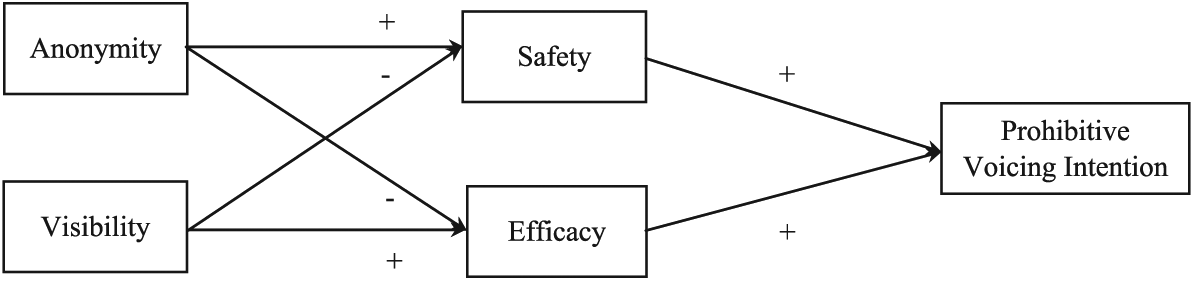
Expected relationships between variables.
Anonymity
Anonymity refers to “the degree to which a communicator perceives the message source as unknown or unspecified” (Scott, 1998, p. 387). The afforded anonymity of a communication channel is, therefore, defined as the degree to which the communication channel is perceived to allow users’ identities to remain unrevealed during the communication process (Scott, 1998; Scott & Rains, 2005). New communication technologies create both challenges and opportunities for workers (Rains & Scott, 2007). On one hand, workplace technologies make surveillance or monitoring easier than ever, which creates challenges for employees to trust their organizations who might truly wish to promote a degree of anonymity. On the other hand, it is easy for people to create a fake identity to express their opinions.
Researchers argue that when people believe they can communicate anonymously, they feel less vulnerable and tend to voice more (Johansson & Carey, 2016; Kaplan, Pany, Samuels, & Zhang, 2009; Klaas, Olson-Buchanan, & Ward, 2012; Suler, 2004). However, most research on voicing in organizations focuses on voicing behavior that is officially documented or makes the employees identifiable (Botero & Van Dyne, 2009; Burris, 2012). Anonymous communication methods are, nevertheless, common in many organizations. Many employees have used one of the following anonymous communication systems: unidentified suggestion box (35.9%), caller-identification blocking phone calls (35.7%), anonymous written feedback (31%), or anonymous phone calls (28.2%; Scott & Rains, 2005).
Providing employees anonymity when voicing their concerns to upper management reduces employees’ perceived risks of upward communication (Kaplan et al., 2009). Because using anonymous communication channels disconnects their identities from the message they want to communicate, anonymity helps reduce employees’ exposure to potential negative consequences of voice, such as being labeled as troublemakers (Milliken et al., 2003; Scott & Rains, 2005). In the field of auditing and accounting, for example, anonymous reporting channels increased fraud reporting behaviors in organizations because anonymity reduces the perceived personal cost of voicing (Gao, Greenberg, & Wong-On-Wing, 2015; Johansson & Carey, 2016).
Given the expected positive correlation between safety perceptions and prohibitive voicing intentions, we predict the following indirect effect:
Although anonymity can benefit employees by not revealing their identities to message receivers, from the receivers’ perspective, anonymity may decrease the credibility of the information (Kaplan et al., 2009; Rains & Scott, 2007; Scott, Rains, & Haseki, 2011), and, thus, decrease the perceived efficacy of the voice (Rains & Scott, 2007; Scott, 1998). Receivers might mistrust information from anonymous sources for several reasons. First, the validity of messages from unidentifiable sources is often questioned (Scott et al., 2011). When the message writer does not want to be connected with the message, the person might not want to be held accountable for the message. Research suggests that when senders are not held accountable for their messages, they are more likely to be deceptive (DeAndrea, Tong, Liang, Levine, & Walther, 2012), harming the credibility of those messages. Second, to conceal their identity, individuals may need to avoid disclosing critical information, such as the name of a work group, and the date and location of an event. The lack of such information makes it harder for management to take effective action, rendering the voice less useful. Finally, anonymous messages make it harder to communicate with the message sender and ask for clarification if the reader wants to investigate the issue further. Especially when the issue involved is a complicated one, the chance of effectively and successfully voicing a specific concern is very low (Klaas et al., 2012). When considering the efficacy of a message, message senders often consider the receivers’ perspective (Dholakia, Zhao, Dholakia, & Fortin, 2001). As outlined above, receivers might be skeptical of anonymous messages. Thus, when employees voice through highly anonymous channels, they will perceive such communication to be less effective.
Given the expected positive correlation between efficacy perceptions and prohibitive voicing intentions, we predict the following indirect effect:
Visibility
Visibility refers to the perceived scope of message receivers of an employee’s voice through a particular communication medium (Leonardi, 2014). Consistent with this definition, this study focuses on the perceived ease with which people can access online messages (Treem & Leonardi, 2012). A channel with a high degree of perceived visibility reaches a wide audience, whereas a channel perceived to be less visible has a more limited audience. Talking face-to-face to a supervisor may be perceived to be a less visible event, whereas posting to the Internet is considered a highly visible event. A voicing audience can range from an individual supervisor, to a group of workers, to all members on an organizational wiki, to anyone who accesses an online job discussion forum.
Employees are likely to minimize the size of their voicing audience for safety reasons. Employees normally raise their concerns to their direct supervisors (Detert & Treviño, 2010) because the employees expose themselves to several risks when they make their concerns more visible. Specifically, employees can face career punishment when higher level members disagree with or disapprove of their critiques. Employees are also concerned with damaging workplace relationships with their peers (Milliken et al., 2003). Voicing concerns through highly visible channels exposes workers to negative consequences from members at all levels of an organization.
Given the expected positive correlation between safety perceptions and prohibitive voicing intentions, we predict the following indirect effect:
The perceived visibility of voice messages should also influence employees’ prohibitive voicing intentions via their perceptions of efficacy (Morrison, 2011; Piderit & Ashford, 2003). It is important for employees to locate the right voicing audience to make their suggestions effective (Morrison, 2011). Direct supervisors are the most popular targets of voicing behaviors because they are usually knowledgeable about organizational decisions and have the power to address concerns, such as job assignments or pay adjustments (Adelman, 2012; Botero & Van Dyne, 2009; Detert & Burris, 2007). However, if messages are visible to a limited number of organizational members, the potential for messages to be ignored increases. As such, employees may consider including other communication targets in addition to their direct supervisors (Piderit & Ashford, 2003). Raising a concern to a wider audience can increase the importance, urgency, and validity of the message, thus, increasing the likelihood that the concern is appropriately addressed.
Given the expected positive correlation between efficacy perceptions and prohibitive voicing intentions, we predict the following indirect effect:
Method
Research Design Overview
A 2 (anonymity level) × 2 (visibility level) between-subjects experiment was conducted with two different samples. We first conducted the study with a sample of college students. To strengthen the external validity of the results, we then conducted a direct replication with a more diverse general population sample to mitigate any concerns that our findings were unique to a single sample of college students (see Stroebe & Strack, 2014). The method for each study is identical; we describe and report the results for the student sample first (Study 1) and then the general population sample (Study 2). An experimental approach was adopted to examine how specific perceived voicing channel affordances affect important antecedents of prohibitive voicing in organizations. Specifically, we used experimental vignettes to test our hypotheses.
Procedure and Stimulus Material
Participants were informed that they would be answering questions about a current or previous job for this study. To participate, participants must have had at least one job with a supervisor at some point in their lives. After consent was obtained, participants were asked questions about their current job or a specific job they previously held. This was done to increase the external and ecological validity of the study. Specifically, participants reported the nature of their work and listed a specific complaint they actually have/had about their work. Given the circumstances surrounding their own personal experience, participants were asked to imagine that their company was planning to use an online platform to gather employee concerns. See the appendix for the complete wording of each vignette condition.
Measures
Work-related questions
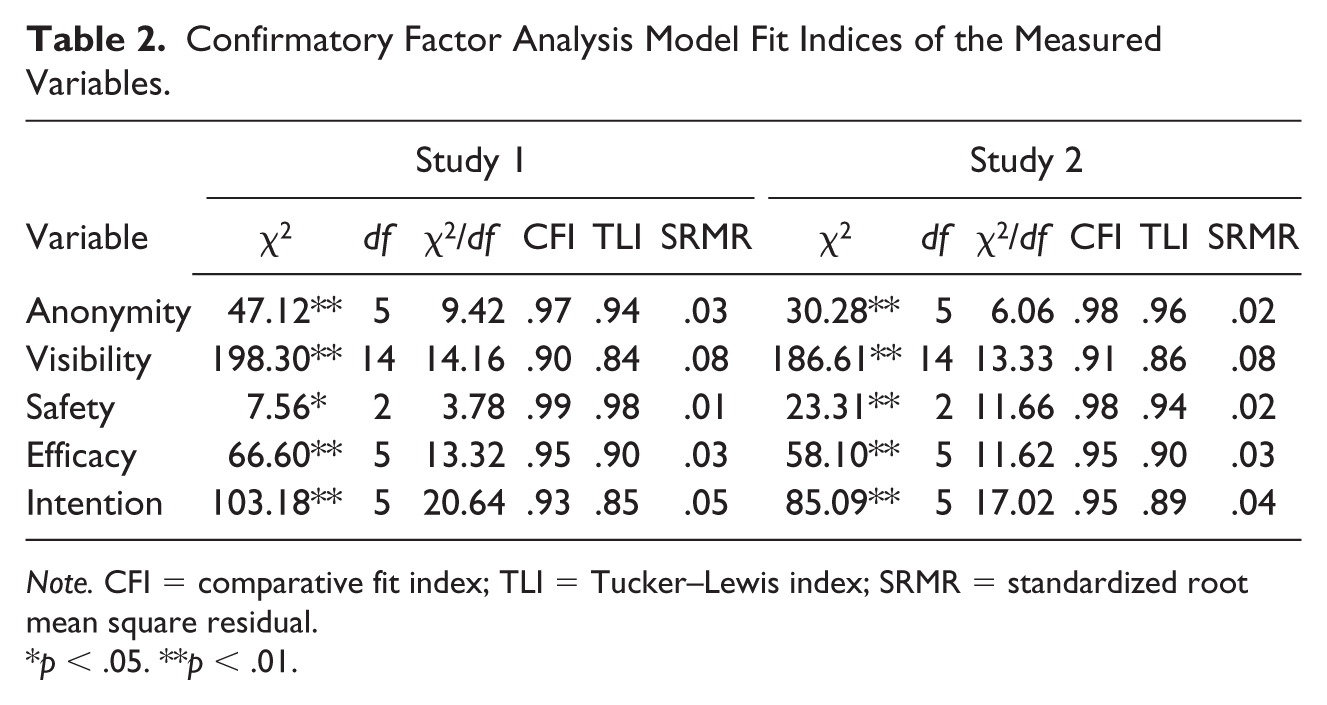
First, participants were asked what kind of job they had(ve), followed by a blank box. Second they were asked how long, in terms of years and months, they have been holding the job. Then, they were asked how satisfied they were with their job (1 = extremely dissatisfied to 7 = extremely satisfied). Last, participants were asked to report a problem or complaint they had about their job. For all of the following scales reported below, we conducted confirmatory factor analyses and assessed scale reliability via Cronbach’s alpha. Table 1 contains factor loadings and alpha estimates for each scale, and Table 2 provides model fit statistics for each scale.
Item Loadings and Cronbach’s α.
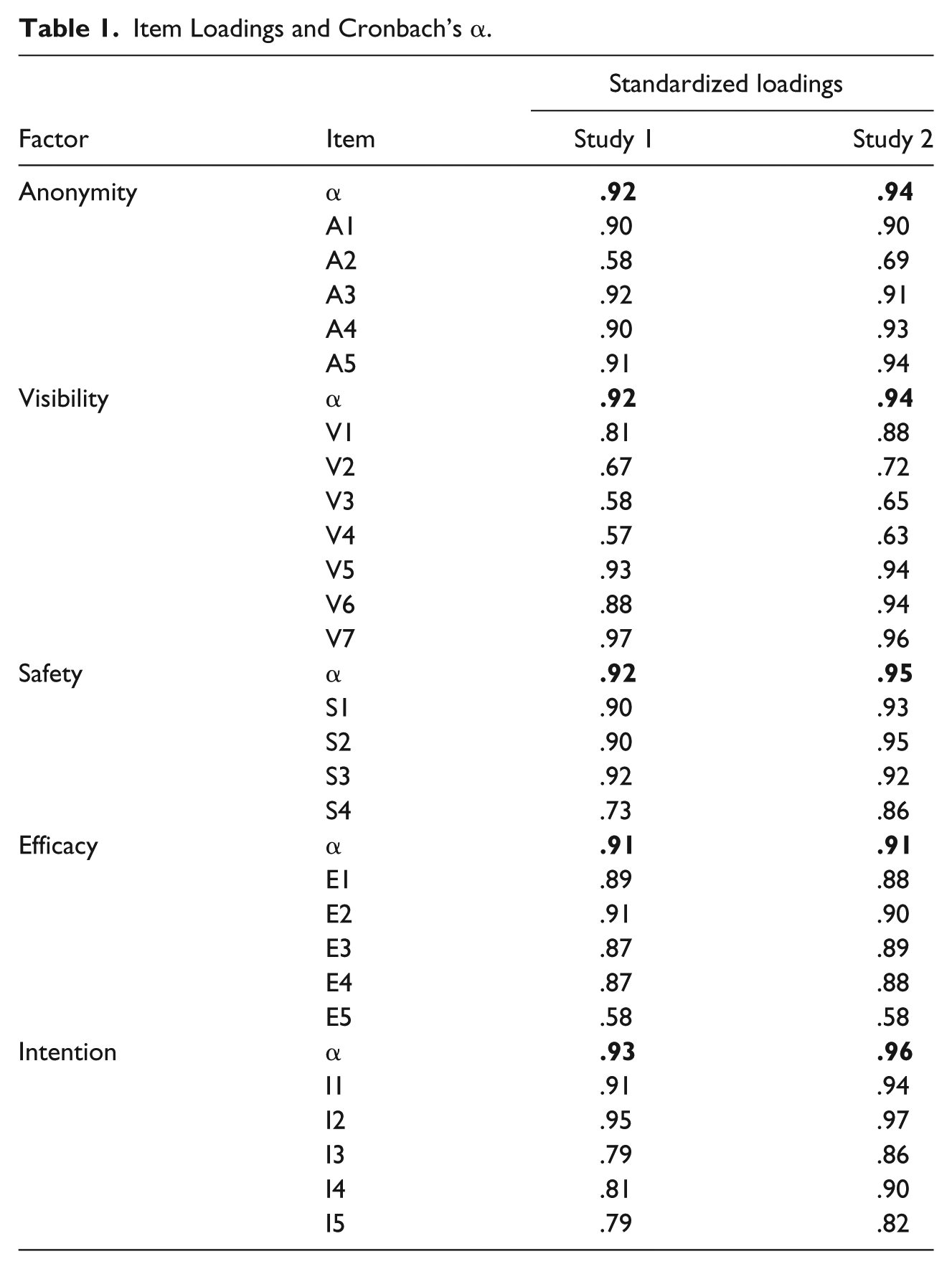
Confirmatory Factor Analysis Model Fit Indices of the Measured Variables.
Note. CFI = comparative fit index; TLI = Tucker–Lewis index; SRMR = standardized root mean square residual.
p < .05. **p < .01.
Manipulation checks (perceived affordances)
Perceived anonymity was measured with five items that were adapted from Fox and McEwan’s (2017) anonymity scale. A sample statement was, “The online platform allows me to remain anonymous” (1 = strongly disagree to 7 = strongly agree). Perceived visibility was measured with 7 items including “Any concern posted on the online platform could be seen by a lot of people” (1 = strongly disagree to 7 = strongly agree).
Prohibitive voicing intention
Prohibitive voicing intention refers to the participants’ likelihood of using the platform to voice their concerns. It was measured with five items including “How likely would it be for you to use this platform” (1 = very unlikely to 7 = very likely).
Perceived safety
Perceived safety refers to the degree to which employees can express their true feelings without negative consequences. It was measured with four items developed from Milliken and colleagues’ (2003) qualitative work. A sample item was “Voicing my concerns on this platform will put me at risk” (1 = strongly disagree to 7 = strongly agree).
Perceived efficacy
Perceived efficacy was measured with five items that were adapted from the probability of selling success scale (Ashford et al., 1998) and the perceived futility of voice scale (Burris, Detert, & Chiaburu, 2008). A sample item was “I am confident that by using this online platform, I could get important people at work to pay attention to my concerns” (1 = strongly disagree to 7 = strongly agree).
Study 1
Sample
In total, 300 students recruited from a Midwestern university participated to earn course credit. Participants were an average age of 20.94 (SD = 2.45 years) and predominantly female (66.80%). Participants reported their race/ethnicity as follows: White/Caucasian (n = 231), Asian or Asian American (n = 24), Black or African American (n = 18), Hispanic (n = 16), and Other (n = 11). On average, participants worked in the job they responded about for 18 months (M = 17.99, SD = 17.64). On average, they were slightly satisfied with their jobs (M = 5.23, SD = 1.56). Participants’ industries include dining, digital marketing, telecommunication, retail, and nonprofit organizations. Most participants were holding contemporary and entry-level jobs, such as front-desk assistant, restaurant server, sales associates, and interns. Their prohibitive voice included complaints about their supervisors (unreliable, unfair, and unorganized management), their coworkers (incompetence, offensive communication), and their job (boring assignments, low salary).
Results
Before conducting the primary analyses, we examined if participants who responded about a current job differed from participants who responded about a past job on the prohibitive voicing intention scale. An independent t test showed that there was no statistically significant difference, t(298) = −0.77, p = .44, between the 237 participants who responded about their current jobs, M = 3.74, SD = 1.71, and the 63 participants who responded about a previous job, M = 3.92, SD = 1.64. Thus, all participants were grouped together for further analyses.
For the primary analyses, we first conducted manipulation checks to see whether the manipulated features of the platform influenced participants’ anonymity and visibility perceptions as expected. Then, we used ANOVAs to examine the effects of the anonymity and visibility inductions on perceptions of safety and efficacy. Finally, we tested the indirect effects of the anonymity and visibility inductions on participants’ prohibitive voicing intention through safety and efficacy perceptions using the macro PROCESS (Hayes, 2013). Table 3 presents the correlation matrix for all key variables.
Zero-Order Correlations, M, and SD.
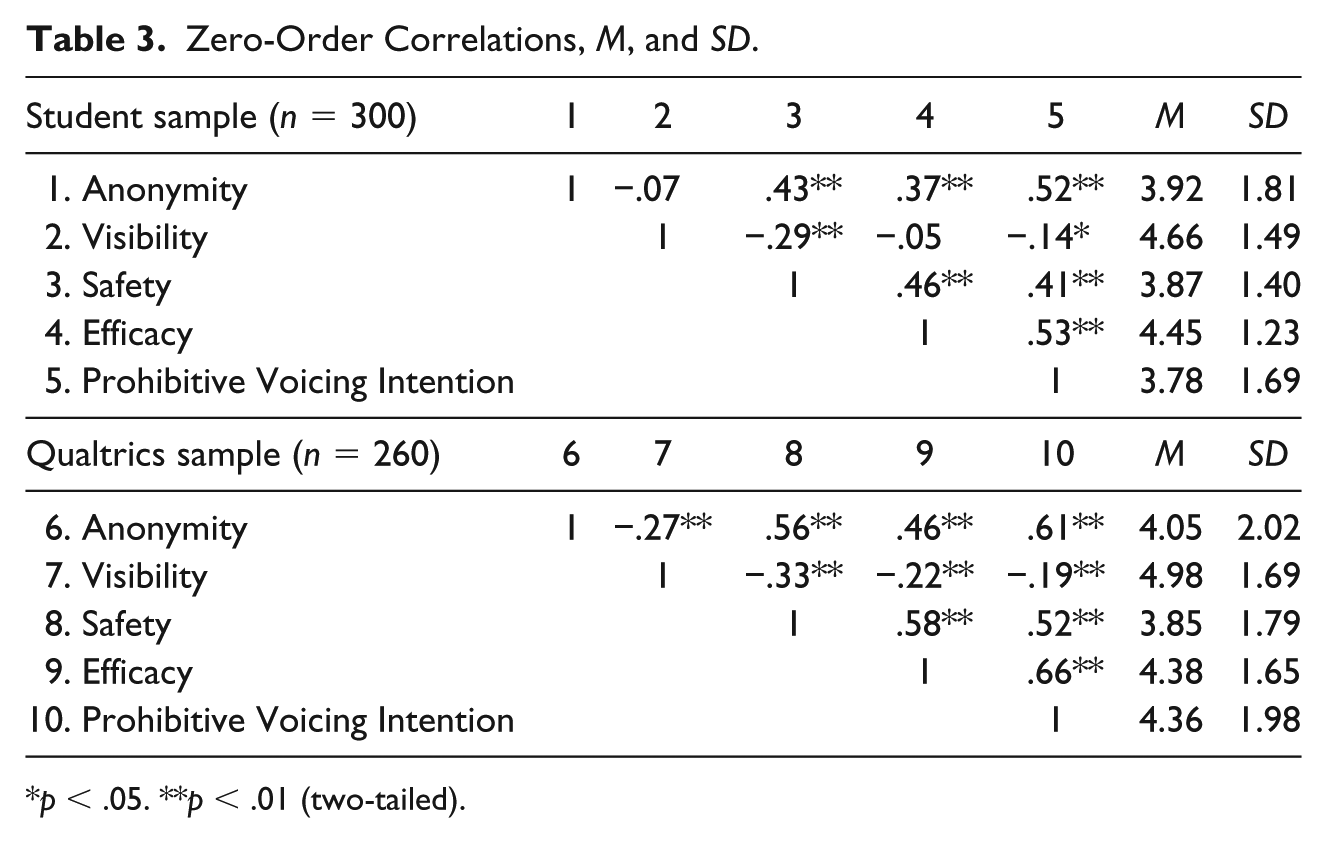
p < .05. **p < .01 (two-tailed).
Both the anonymity and the visibility manipulations were successful. Participants who were not required to verify their identity (high-anonymity condition), M = 5.05, SD = 1.12, perceived the platform to be significantly more anonymous than participants who needed to verify their identity (low-anonymity condition), M = 2.65, SD = 1.58, F(1, 298) = 234.18, p < .001, η2 = .44. Participants in the private condition, M = 3.86, SD = 1.31, perceived the online platform to be less visible than those in the public condition, M = 5.37, SD = 1.26, F(1, 298) = 102.43, p < .001, η2 = .26.
H1a predicted that when participants perceived the online platform to afford more anonymous communication, they would evaluate the platform to be safer. This hypothesis was supported by these data. Participants in the high-anonymity group, M = 4.37, SD = 1.32, perceived the platform to be significantly safer than those in the low-anonymity group, M = 3.31, SD = 1.27, F(1, 296) = 51.66, p < .001, η2 = .15. H1b predicted high anonymity would lead to higher prohibitive voicing intentions, mediated through increased safety perceptions. H1b was also supported. The results indicated a statistically significant indirect effect via perceptions of safety, point estimate = 0.43, 95% confidence interval (CI) = [0.24, 0.66]. See Figure 2 for the β coefficients.
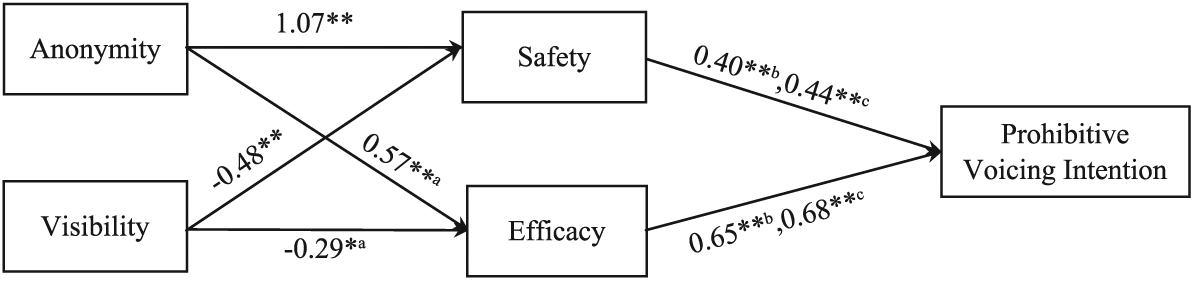
β coefficients of mediation relationships for student sample (Study 1).
H2a predicted that when participants perceived the online platform to be highly anonymous, they would evaluate the platform to be less efficacious. This hypothesis was not confirmed. Participants in the high-anonymity group, M = 4.72, SD = 1.17, perceived the platform to be significantly more efficacious than those in the low-anonymity group, M = 4.15, SD = 1.24, F(1, 297) = 17.16, p < .001, η2 = .06. H2b proposed that high anonymity leads to a lower prohibitive voicing intention via reduced efficacy perceptions. These data showed a statistically significant indirect effect of anonymity on prohibitive voicing intention via efficacy, point estimate = 0.37, 95% CI = [0.19, 0.59]. H2b was not supported, as the statistically significant indirect effect was not in the predicted direction.
H3a predicted that when participants believed that their messages were highly visible, they would view the platform to be less safe. Participants in the high-visibility group, M = 3.64, SD = 1.39, perceived the platform to be significantly less safe than those in the low-visibility group, M = 4.12, SD = 1.38, F(1, 296) = 11.25, p = .001, η2 = .04. H3a was supported. H3b proposed an indirect effect of the visibility induction on prohibitive voicing intention via safety perceptions. Supporting H3b, a statistically significant indirect effect was found, point estimate = −0.21, 95% CI = [−0.39, −0.07].
H4a predicted that when participants believed the platform to be highly visible, they would evaluate the platform to be more efficacious. Participants in the public condition, M = 4.32, SD = 1.19, actually perceived the channel to be significantly less effective than those in the private condition, M = 4.61, SD = 1.27, F(1, 297) = 4.55, p = .03, η2 = .02. Thus, H4a was not supported. H4b proposed an indirect effect of visibility on prohibitive voicing intention via efficacy perceptions. These data confirmed a statistically significant indirect effect, point estimate = −0.20, 95% CI = [−0.39, −0.01], but not in the predicted direction.
Finally, although interaction effects were not predicted, we explored their existence nonetheless. The anonymity and visibility inductions did not interact to affect safety perceptions, F(1, 296) = 0.13, p = .72, or efficacy perceptions, F(1, 297) = 0.05, p = .82. See Table 4 for prohibitive voicing intentions of each condition.
Prohibitive Voicing Intentions of Each Condition.

Note. Conditions with different subscripts are significantly different at .05 level. No comparison is made between different samples.
Study 2
Sample
Because most college students are working at the lower level of an organization, their experiences may differ from those who have been working in a field for a longer period. To increase the external validity of this research, Study 2 was conducted to replicate the findings with a nonstudent sample. In total, 260 participants were collected from a Qualtrics participant panel. Participants were an average age of 48.66 (SD = 16.11 years) and predominantly female (67.69%). Participants reported their race/ethnicity as follows: White/Caucasian (n = 233), Black or African American (n = 12), Asian or Asian American (n = 6), Hispanic (n = 5), and Other (n = 4). Most participants had either a high school diploma (41.15%) or a bachelor’s degree (31.53%), and the rest reported a Master’s degree or higher (11.92%), an associate’s degree (8.85%), or other (6.55%). On average, participants worked in the job they responded about for 9 years and 9 months (M = 117.12, SD = 115.05). On average, they were slightly satisfied with their job (M = 5.14, SD = 1.85). Again, see Table 1 for factor loadings and reliability estimates and Table 2 for model fit indices for each scale. Participants came from a wide variety of industries including the military, software development, education, entertainment, and healthcare. In addition to complaints about their supervisors, coworkers, and jobs, as mentioned in Study 1, participants in Study 2 added some complaints about their subordinates and clients who were described as irresponsible, gossipy, and unethical.
Results
Before conducting the primary analyses, we examined if participants who responded about a current job differed from participants who responded about a past job on the prohibitive voicing intention scale. An independent t test showed that there was no statistically significant difference t(258) = −1.32, p = .19 between the 138 participants who responded about their current jobs, M = 4.21, SD = 2.02, and the 122 participants who responded about a previous job, M = 4.53, SD = 1.93. Thus, all participants were grouped together for further analyses. Table 3 presents the correlation matrix for all key variables.
As in Study 1, both the anonymity and the visibility manipulations were successful. Participants who were not required to verify their identity (high-anonymity condition), M = 5.07, SD = 1.47, perceived the platform to be significantly more anonymous than participants who needed to verify their identity (low-anonymity condition), M = 2.95, SD = 1.95, F(1, 258) = 98.66, p < .001, η2 = .28. Participants in the private condition, M = 4.06, SD = 1.62, perceived the online platform to be less visible than those in the public condition, M = 5.89, SD = 1.19, F(1, 258) = 108.02, p < .001, η2 = .30.
H1a predicted that when participants perceived the online platform to afford more anonymous communication, they would evaluate the platform to be safer. This hypothesis was supported by these data. Participants in the high-anonymity group, M = 4.37, SD = 1.73, perceived the platform to be significantly safer than those in the low-anonymity group, M = 3.29, SD = 1.68, F(1, 259) = 27.10, p < .001, η2 = .10. H1b predicted that greater anonymity would lead to higher prohibitive voicing intentions through increased safety perceptions. H1b was also confirmed. The results indicated a statistically significant indirect effect via perceptions of safety, point estimate = 0.55, 95% CI = [0.32, 0.83]. See Figure 3 for the β coefficients.
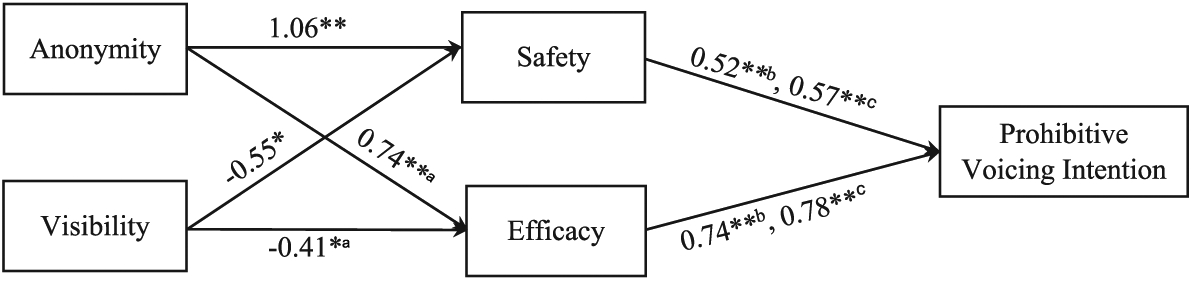
β coefficients of mediation relationships for Qualtrics sample (Study 2).
H2a predicted that when participants perceived the online platform to be highly anonymous, they would evaluate the platform to be less efficacious. This hypothesis was not confirmed. Participants in the high-anonymity group, M = 4.73, SD = 1.50, perceived the platform to be significantly more efficacious than those in the low-anonymity group, M = 4.01, SD = 1.73, F(1, 259) = 12.96, p < .001, η2 = .05. H2b proposed that greater anonymity leads to a lower prohibitive voicing intention via reduced efficacy perceptions. These data showed a statistically significant indirect effect of anonymity on prohibitive voicing intention via efficacy, point estimate = 0.54, 95% CI = [0.25, 0.85]. H2b was not supported, as the statistically significant indirect effect was not in the predicted direction.
H3a predicted that when participants believed that their messages were highly visible, they would view the platform to be less safe. Participants in the high-visibility group, M = 3.56, SD = 1.81, perceived the platform to be significantly less safe than those in the low-visibility group, M = 4.13, SD = 1.72, F(1, 259) = 7.92, p = .005, η2 = .03. H3a was supported. H3b proposed an indirect effect of the visibility induction on prohibitive voicing intention via safety perceptions. Supporting H3b, a statistically significant indirect effect was found, point estimate = −0.32, 95% CI = [−0.58, −0.07].
H4a predicted that when participants believed the platform to be highly visible, they would evaluate the platform to be more efficacious. Participants in the public condition, M = 4.19, SD = 1.77, actually perceived the channel to be significantly less efficacious than those in the private condition, M = 4.58, SD = 1.50, F(1, 259) = 4.07, p = .05, η2 = .02. Thus, H4a was not supported. H4b proposed an indirect effect of visibility on prohibitive voicing intention via efficacy perceptions. These data confirmed a statistically significant indirect effect, point estimate = −0.32, 95% CI = [−0.65, −0.01], but not in the predicted direction.
Finally, although interaction effects were not predicted, we explored their existence nonetheless. The anonymity and visibility inductions did not interact to affect safety perceptions, F(1, 259) = 0.07, p =.79, or efficacy perceptions F(1, 259) = 0.49, p = .49. See Table 4 for prohibitive voicing intentions of each condition.
Discussion
The current study examined how the perceived anonymity and visibility affordances of a communication channel influence employees’ perceptions about the safety and efficacy of using the channel to voice job-related concerns. The results indicate that the degree to which a voicing platform is perceived to afford users anonymity and make their complaints visible influences users’ perceptions about the safety and efficacy of using the voicing platform and their intention to make a prohibitive voice.
Related to the anonymity induction, whether or not the voicing platform required participants to verify their identities affected how anonymous they would feel when using the platform. Participants in the no verification condition viewed the online platform to be much more anonymous, believed the platform to be safer and more effective, and, in turn, were more likely to use the platform to voice. In terms of the visibility manipulation, whether participants’ concerns were only visible to a small or large group of people affected visibility perceptions as intended. Relative to the high-visibility condition, participants in the low-visibility condition believed that the platform was safer and more effective for voicing concerns, and had stronger intentions to use the platform.
Although our results were largely consistent with our hypotheses regarding how perceived anonymity and visibility affordances affect prohibitive voicing through safety perceptions, these perceived affordances affected efficacy perceptions in unanticipated ways. In both studies, the results indicated that anonymity perceptions positively affected perceptions of efficacy, and visibility perceptions negatively affected perceptions of efficacy. We assumed increased anonymity would call out the sender’s credibility and inhibit receivers from responding with follow-up questions, thus, making the platform less effective. We expected greater visibility would provide more opportunities for people to see and address concerns, thus, making the platform more effective. We provide three explanations to account for these results.
The first reason may have to do with the quality of anonymous messages. Results from both studies suggest that the more anonymous a message could be, the more efficacious it is perceived to be. Research suggests that when people are afforded anonymity, they tend to engage in higher levels of self-disclosure (Joinson, 2001; Raufman & Shahak, 2017; Suler, 2004) and have a better control of the information that they would like to disclose (Scott, 1998). As such, when employees can hide their identities during the voicing process, they may be more confident about the communication process, focus more on their genuine thoughts, provide a more detailed description of the situation, and finally perceive the message to be more convincing and efficacious.
The second reason might revolve around employees’ safety perceptions. Unlike the equal status of safety and efficacy in Morrison’s (2011) model, employees might have based evaluations of efficacy of the platform on their safety perceptions. If the voicing channel is perceived to be unsafe, people may not be able to envision themselves using the platform and perceive it to be ineffective; the platform cannot provide benefits unless people are willing to use it. Results from both studies showed that making identifiable and public comments are perceived to be unsafe. Although making the critique visible to more people increases the amount of people who ostensibly can respond to the concern, a greater audience corresponds with more potential targets who may retaliate. Accordingly, posting complaints or critiques on a platform where information is widely visible will not be regarded as efficacious because it increases perceived risk and decreases the likelihood of actually voicing concerns; safety may be an antecedent of efficacy.
The third reason may relate to the relationship between efficacy perceptions and voicing intentions. In previous research, perceived efficacy is a causal determinant of voicing intentions (Ashford et al., 1998; Klaas et al., 2012; Morrison, 2011). This means that before employees decide whether to make a prohibitive voice, they have evaluated the efficacy of their behavior. Given the definition of efficacy, which refers to the effectiveness and consequences of the behavior, however, it may be hard for participants to estimate the efficacy of their behavior without envisioning themselves in the voicing process first. The contradicting results may suggest that the voicing intention is considered as a prerequisite of the evaluation of efficacy. Participants’ intention to use the platform may mediate the relationship between the affordances and their evaluation of efficacy of the platform, rather than the other way around. Future research should investigate this possibility.
Theoretical Implications
By adding new antecedents to existing voice models, this study provides a more complete understanding of the voicing process. If employees want to express their concerns at work, they must do so through some communication channel. Thus, the selection of a voicing channel is an inevitable part of the voicing process. How communication channels influence voicing intentions is largely ignored in previous models (Ashford et al., 1998; Morrison, 2011, 2014; Mowbray, Wilkinson, & Tse, 2015). By adding to the existing predictors of the voicing process, such as leadership styles (Detert & Treviño, 2010) and working climate (Frazier & Fainshmidt, 2012), the current study helps explain more variance in voicing intentions. That is, when scholars seek reasons for behavioral differences in voicing, they could gain insight by considering perceived channel differences. In addition to increased explanatory power, these new variables in the voice models might also provide additional predictive power. By incorporating perceived communication affordance variables concerning perceived communication affordances, the models should be able to more accurately predict employees’ voicing intentions and behaviors.
Overall, this research provides support for approaching technology uses and effects in organizations from a more voluntaristic stance by focusing on the role that people’s interpretations of communication technology play in organizational communication (see Leonardi & Barley, 2008). The results support the notion that it is not simply technological artifacts or features of technology that affect workplace behavior but workers’ perceptions of technology that meaningfully affect organizational communication. This study stresses the role of people’s subjective understanding of the communication medium in molding their own subsequent voicing behaviors and the normative voicing behavior of an organization.
Practical Implications
When companies wish to gather opinions from their employees, they usually have many options. Among the options available, management should directly consider how employees might evaluate the anonymity and visibility of possible voicing channels. The results show that allowing employees to remain anonymous and limiting the number of people who will hear their complaints can give employees a stronger sense of safety and increase their efficacy perceptions about a voicing platform. In cases where the existing communication channels are not functioning as intended, management should seek to understand the factors that are inhibiting the voicing process. Notably, management might consider the degree to which there is a mismatch between management’s perceptions about voicing channels and their employees’ perceptions about available voicing channels. If privacy concerns or mistrust exist within an organization, concerted efforts might be needed to convince workers that voicing channels truly are anonymous and that messages will only be viewed by a select group of individuals whom employees trust to keep messages confidential and to treat complaints ethically (i.e., Human Resources representatives).
Findings of the current research could be applied not only to other forms of organizational dissent, such as whistleblowing and employee resistance, but also to a wide variety of topics/issues. For instance, participants in our study mentioned wanting to voice concerns about the following issues: unreasonable job assignments, emotional burnout, incompetent supervisors and coworkers, unfair salary and treatment, problems with the structure of the company, and the lack of career advancement opportunities. In each situation, if managers want to listen to their employees, they can facilitate communication by creating voicing channels that employees perceive to be safe and efficacious. Given (a) the diversity that existed within samples (e.g., types of employment, complaints, organizational structure, employee satisfaction) and across samples (e.g., age, ethnicity, work experience, types of employment, status in organizations, educational experience) and (b) the relative consistency of the effects across the two studies, the results provide a foundation for managerial staff to facilitate various sorts of employee concerns.
Limitations and Future Research Directions
Our study design limits the external validity of the research. To test causal relationships between affordances and participants’ safety and efficacy perceptions, stimulus materials in this study needed to be presented as clearly and as relatably as possible to most participants. Thus, participants were required to read a paragraph and instructed to imagine that their company was to implement an online platform with specified features. It is possible that participants would view the creation of a voicing platform at their place of work as unlikely, especially in the case of student workers where more participants had entry-level positions. In addition, it is possible that participants responded to our proposed scenario in a way that is different from how they would truly act if the situation really did occur at their work because the latter situation involves the potential for negative repercussions; research findings generally show stronger prohibitive voicing intentions than what occurs in real situations (Mesmer-Magnus & Viswesvaran, 2005). These hypothetical situations are, however, helpful for scholars to investigate complicated relationships among important variables that affect the voicing process. Future research using field experiments would provide useful insights.
Future research should also examine factors that moderate the effect of visibility perceptions on voicing intentions. Visibility refers to the scope of viewers of a message. The more a channel limits the size of an audience, the less visible it is. However, visibility perceptions do not directly consider the relationship between the message sender and receiver. Thus, communicating to a few supervisors or a few peers might be viewed as having the same effect on the visibility of the message. However, research furthermore shows that different message recipients can affect employees’ voicing intentions (Liu, Tangirala, & Ramanujam, 2013). Kassing (1998) proposed three types of employee dissent, which is a concept very close to prohibitive voice. Employees could voice their dissent upwardly, laterally, and externally. In these situations, employees’ safety and efficacy evaluations may differ though the visibility of the message remains the same. Future research could also explore how visibility concerns might be heightened or more salient among workers with a longer tenure or higher status in an organization. Perceptions of visibility tended to correlate more strongly with other variables in Study 2 than in Study 1, suggesting this possibility.
This research examined voice intentions within an organization. However, the application of the findings can extend to voice communication that transcends organizational boundaries. For instance, counterinstitutional websites are alternative platforms for employees to express their work-related concerns outside of their own organization (Gossett & Kilker, 2006). The perceived efficacy of prohibitive voicing might be influenced not only by whether corrective changes will be made within the organization but also whether their messages will help others outside of the organization. In addition to these counterinstitutional websites, people could also make job-related comments on social networking sites such as Facebook, Twitter, and Instagram (Marwick & boyd, 2011). In the case of the #MeToo movement, enhanced visibility was used to force organizations to respond to claims that were either ignored or silenced for years. However, the movement also highlights how victims were at least partially silenced due to fears over the potential retribution that might occur. Lacking such internal voicing platforms, people may disclose horrific work-related treatments (e.g., sexual harassment and sexual assault) to other external communication media.
Conclusion
To conclude, by adopting an affordance perspective, this article makes an important theoretical contribution by establishing the causal relationship between anonymity and visibility perceptions and outcome variables such as safety and efficacy perceptions. This article also offers tangible communication strategies and advice to decision makers in organizations, or in society in a much boarder sense, to establish proper communication channels, to cultivate people’s perceptions toward these channels, to increase employees’ participation and satisfaction at work, and to establish well-functioning organizations.
Footnotes
Appendix
Declaration of Conflicting Interests
The author(s) declared no potential conflicts of interest with respect to the research, authorship, and/or publication of this article.
Funding
The author(s) received no financial support for the research, authorship, and/or publication of this article.
