




Abstract
Recent studies have established a relationship between social media use and organizational identification, but scholars have yet to understand how communication through social media might foster individuals’ identification. To fill that gap, I use structuration theory to investigate the identification process by analyzing an organizational hashtag: #EXSTpride. Framed by three key elements of the structurational model of identification—duality of structure, situated activity, and regionalization of structures—this qualitative analysis of posts using #EXSTpride reveals the reciprocal relationship between identity (structure) and identification (system). I conclude by (a) theorizing organizational hashtags as house organs 2.0 and (b) proffering practical and discursive consciousness to the structurational model of identification.
Cross-disciplinary research has extensively explored organizational identification, which occurs when members define themselves, in part, in terms of their organizational attachments. Scholars have shown the fundamental role of communication in shaping, expressing, and sustaining organizational identity and identification (e.g., Albert & Whetten, 1985; Scott & Stephens, 2009). However, social media are dramatically changing how organizations and their members communicate, and thus, how organizational attachments are fostered. Many house organs that researchers once investigated (Cheney, 1983; DiSanza & Bullis, 1999) are now disseminated through organizations’ internal or external social media. Interactions that helped members develop a sense of “consubstantiality” or sameness (Chaput et al., 2011) increasingly take place on platforms like Slack, Twitter, Facebook, and Instagram. Emerging research demonstrates the relationship between social media use and organizational identification (Bartels et al., 2014; Sias, 2017; van Zoonen & Treem, 2019). However, existing studies tell us little about how communication through social media might foster organizational identification.
To fill that gap, my study investigates the identification process by analyzing a hashtag created for the use of an organization and its members to signal specific organizational identities. Broadly speaking, hashtags involve “keywords preceded by the # sign,” which social media users employ to direct their messages to interested followers (Marwick & boyd, 2011, p. 121). Here, I explore what I call organizational hashtags—a hashtag created by organizational stakeholders for a specific purpose. Organizational hashtags might invoke the company’s name (e.g., #Apple), convey a specific corporate initiative (e.g., #ShareACoke, #MakeMeWhole), or encourage interaction with the brand (e.g., #TargetStyle, #MyWestElm).
Albu and Etter (2016) have acknowledged that “organizations use hashtags, such as the hashtag #LetsDoLunch by Domino’s Pizza, to communicate desired identities to a wide number of internal and external audiences” (p. 7). Specifically, their analysis of hashtags created by two different companies demonstrated how hashtags define the organization and its actors but can also be used by nonorganizational members to reconfigure the organization.
Thus, organizational hashtags are powerful; yet, scholars understand little about the role hashtags play in the organizational identification process of individual members. To frame this exploration, I turn to Scott et al.’s (1998) structurational model of identification. Below, I explain this framework and three key elements of the model—duality of structure, situated activity, and regionalization of structures—which align with three research questions posed to investigate the identification process on social media. Through a qualitative thematic analysis of an organizational hashtag, this project extends the structurational model of identification into contemporary organizational communication.
The Structurational Model of Identification
The structurational model of identification (Scott et al., 1998) provides a framework for understanding the reciprocal relationship between individuals’ identities and identifications. Scott et al.’s theory of identification stems from Giddens’ structuration theory (1984), which posits that identities are structures that are both enacted by, and shape, individuals’ identifications. In their conceptual piece, Scott et al. (1998) invoke three elements of structuration theory and apply them to the overall identification process: duality of structure, situated activity, and regionalization of structures.
Duality of Structure
Giddens (1984) called the duality of structure one of the central propositions of his structuration theory. This concept proposes that “the rules and resources drawn upon in the production and reproduction of social action are at the same time the means of system reproduction” (Giddens, 1984, p. 19). More simply, social life involves a recursive relationship between structures (sets of rules and resources) and systems (situated activities of agents).
Drawing on this notion, Scott et al. (1998) present identification as a process involving both structure and system. As a structure, identity provides the anchor of who we are and how we should interact with others. As a system, identification involves the enactment of identity and the interaction with others that expresses belongingness. A mutually implicative relationship exists between identity and identification.
The identity/identification duality could also explain how the identification process unfolds over social media through organizational hashtags, because they simultaneously invite the process of attachment (as systems; posting) and create a product of that process (as structures; posts with the organizational hashtag). Using an organizational hashtag is an enactment of an organizationally based identity via interaction on social media. That action invokes the process of identification, particularly if the hashtag involves a collective pronoun or statement of pride, common ways people express belongingness. Simultaneously, posting an organizational hashtag creates a product: a visibly situated identity presented on social media. In other words, individuals’ social media accounts serve as a representation of their identity, and the very act of posting to social media is related to the creation of the self. To understand how the duality of identity and identification might unfold through organizational hashtags, I propose the following research question: RQ1: How are individuals’ identities/identifications expressed dialectically through an organizational hashtag?
Situated Activity
Giddens’s (1984) theory also discusses the concept of locale: “the use of space to provide the settings of interaction” (emphasis removed, p. 118). Locales, Giddens says, are typically physical, such as a room in a house or an entire city, with definite boundaries where activities occur.
In their situated-action view of identification, Scott et al. (1998) suggest that interactions in different locales “provide the context for identifications” (p. 322). Locales and situated activities contextualize the identities people use and reproduce in identification. Thus, identifications are situated and fluctuate over time. Identification also varies depending on who individuals are talking to (Scott & Stephens, 2009) and by communication situation (Stephens & Dailey, 2012).
Social media offer a unique opportunity to understand situated identifications, because posts can implicitly and explicitly draw attention to activities. A post’s background image (e.g., a park), tagged location (e.g., “City Park”), or caption (e.g., “I love city park!”) signal locales which might contextualize and enact identities. Social media users likely use and interpret organizational hashtags differently, depending on the identities/identifications invoked during various activities. Thus, I ask: RQ2: How do locales and situated activities associated with an organizational hashtag (re)produce identities/identifications?
Regionalization of Structures
Locales connect to another construct in structuration theory: regionalization. Locales have different regions. My kitchen has a range for cooking, an island for eating, and a corner for our kids’ art table. Each of those regions is critical in constituting the contexts of various interactions occurring in different spaces and at different times in our kitchen.
Scott et al. (1998) borrow Giddens’s notion of regionalization to describe how interaction (and identification) differs across time and space. All of us claim different identities (e.g., professor, mother, spouse, etc.) for unique purposes. Throughout organizational membership, individuals enact multiple identities and identifications which may be “nested” or embedded within one another, complicating the identification process (Meisenbach & Kramer, 2014).
Identity regionalization might also occur on social media which allow users to convey multiple identities. Interactions on Instagram, Facebook, and the like blur boundaries between work and personal life (Bartels et al., 2014). Individuals present a certain extent of their personal, group, organizational, and occupational or professional identities on social media because people use social media for work and to communicate with friends in the same collapsed context (Marwick & boyd, 2011; van Zoonen & Treem, 2019).
Similarly, organizational hashtags may shape and be shaped by different regionalized identities/identifications. Studies have illustrated how the same organizational hashtag can be used both for and against organizations (e.g., Albu & Etter, 2016). However, research has yet to demonstrate how such hashtags might be used to promote individuals’ front regions or “‘positive’ identifications” as well as back regions or “more ‘negative’ disidentifications” (Scott et al., 1998, p. 315). Because social media use is, at its core, an act of self-presentation, the identities/identifications we present on social media offer a multidimensional view of ourselves. Therefore, the final research question seeks to understand the role of multiple identities in individuals’ use of organizational hashtags: RQ3: What different compatible and/or opposing identities/identifications are expressed through an organizational hashtag?
Method
Data Collection
To answer these research questions, I analyzed a university’s organizational hashtag on Instagram, which included the University’s abbreviated name and the word “pride” (anonymized as Example State University and #EXSTpride). In 2019, a research assistant searched the hashtag and created a database of 150 (of 684 possible) posts using #EXSTpride, recording various aspects of each post (e.g., date, detailed image description, caption, location, etc.). The research assistant added posts to the database in the order they appeared on her timeline, determined by Instagram’s algorithm. The 150 posts spanned three and a half years of content using #EXSTpride.
Data Analysis
I qualitatively coded the images and texts of posts with the hashtag #EXSTpride using a phronetic iterative process (Tracy, 2020) which “alternates between emic, or emergent, readings of the data and an etic use of existing models, explanations, and other theories” (Tracy, 2020, p. 209). Data analysis involved drawing on existing theory and research while simultaneously paying careful attention to the emergent data. In other words, I entered data analysis with several sensitizing concepts from structuration theory and the structurational model of identification, and I alternated between these prevailing theories, on one hand, and the words and images seemingly used to express and create identification with #EXSTpride on the other hand.
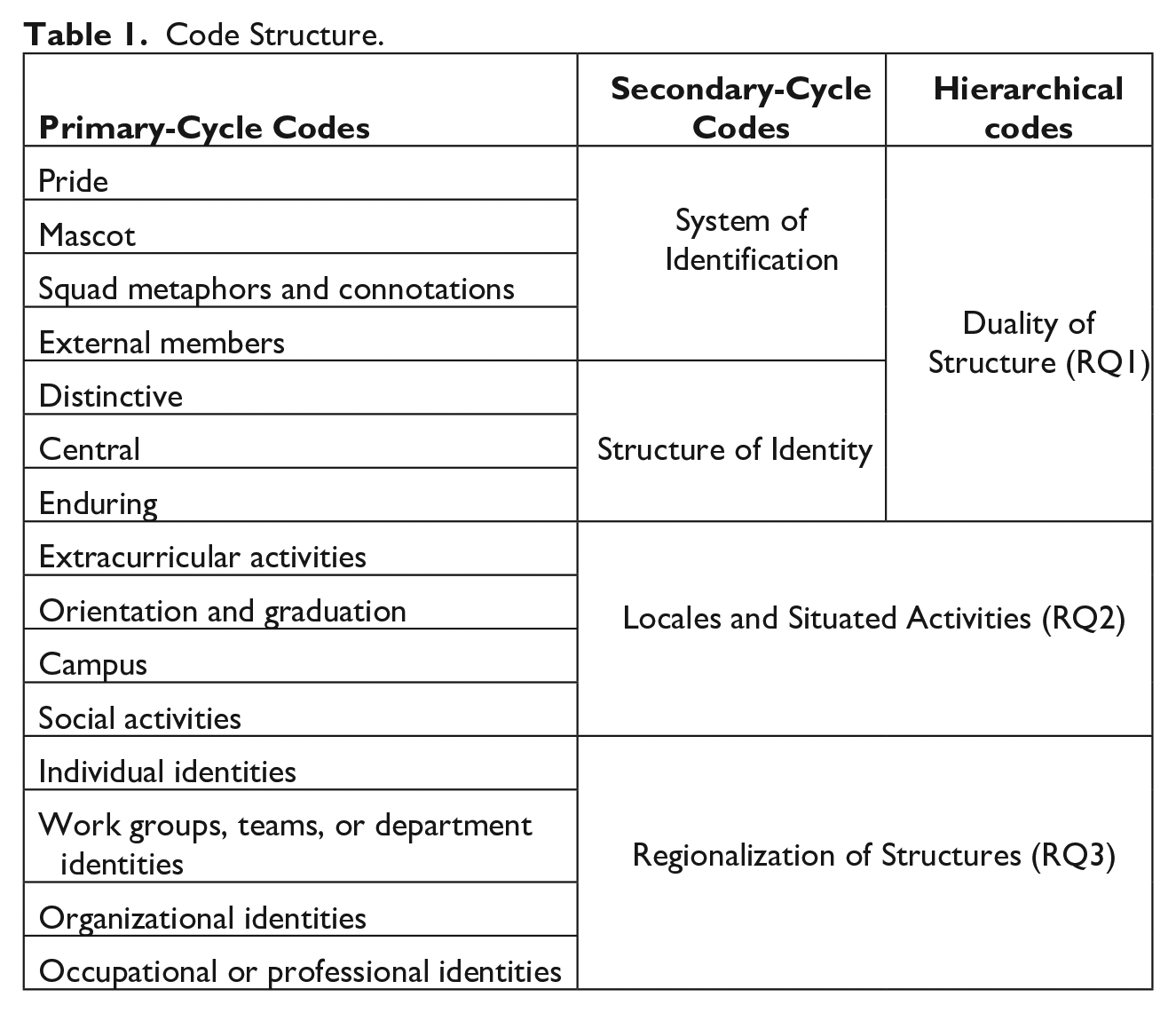
I crafted a codebook in which I coded emerging themes or “categories” (Charmaz, 2014) from both the image descriptions (e.g., “holding up the hand sign”) and/or captions (e.g., “I love my new home”) of each post. At first, these primary-cycle codes were largely descriptive in nature (e.g., “starting freshman year”). I used constant comparisons to group data and modified code definitions to accommodate new data or create new codes (Corbin & Strauss, 2008). Over time, through secondary-cycle coding, I synthesized and organized those initial categories (e.g., “orientation”) into broader, more interpretive themes, called hierarchical codes (e.g., “situated activities”) (Tracy, 2020). I stopped creating new codes after post 114 in the database, and I felt confident I had reached data saturation at post 150. Table 1 presents the final code structure, explained next.
Code Structure.
Exploring #EXSTpride Through the Structurational Model of Identification
Below, I present the findings in three sections that align with the three research questions posed, which ask about the duality of structure (RQ1), locales and situated activities (RQ2), and regionalization of structures (RQ3) within #EXSTpride.
Duality of Structure
Posts using #EXSTpride demonstrated how the attachment process involves both system and structure. Although these components are presented separately for the purpose of analysis, keep in mind that there is a mutually implicative relationship between the system of identification and the structure of identity.
System of Identification
The system of identification occurred in users’ posts with #EXSTpride, involving clear expressions of identification. For example, posts used the word “we” instead of “they,” consubstantial language that signals identification (Cheney, 1983; DiSanza & Bullis, 1999). One post even read “Define yourself. Class of 2019,” suggesting that the user aligns her identity with her graduating class.
In addition, the social system of identification can be seen through the pride users communicated in posts using #EXSTpride. For example, one user posted a collage of images: students posed on the football field, himself with the mascot, and the University’s “palms up” hand sign (a pseudonym) held in front of a group of students during orientation. The post stated, “Feeling full of Eagle Pride. Fly Eagles!” Even other hashtags alongside #EXSTpride signaled this sense of attachment, including phrases like “#ProudAlum,” “#EaglesAreProud,” “#ProudToBeAnEagle, and “#EaglePride.”
As these hashtags suggest, another frequent way that social practices communicated identification was by defining oneself in terms of the school’s Eagle mascot (also a pseudonym). For example, one post depicted two students who appear to be at orientation with their “palms up,” the post avowing, “It’s a good day to be an Eagle,” paired with two Eagle emojis. Indeed, many posts using #EXSTpride added bird-related emojis to symbolize the mascot. Moreover, users seemed particularly proud of pictures with the mascot. As one user asked, “What’s better than a selfie with Evan the Eagle?”
Squad metaphors and connotations (e.g., home, squad, family) were a common expression of identification in both images and captions. For instance, in a post captioned “Game-day squad,” four stomach-baring students stand close together, arms wrapped around a man. In true game-day fashion, they are holding beers, and the “squad” appears ready for a tailgate party.
Interestingly, the duality of structure reveals how posts using #EXSTpride from external members—other organizations or even competitors—capitalized on identifications through the system of identification. For example, a local bank cashed in on the opportunity to use #EXSTpride by posting a photo of a child wearing one of their University-colored shirts and the caption, “Look out future #EXST Eagle and [bank] member coming through.” Several photographers also capitalized on #EXSTpride, posting pictures of graduating students and encouraging other seniors to “book your session soon while spots are still available.” Although #EXSTpride was not “hijacked” in the same way that other nonorganizational members have taken over organizational hashtags (Albu & Etter, 2016, p. 24), this finding does parallel research pointing to organizations’ lack of control over hashtags.
Structure of Identity
The structure of identity exists in the collection of posts that use #EXSTpride. The compilation of posts serves as a structure of the organization’s identity, helping to anchor and define the organization. When a user searches #EXSTpride, the composite of posts using the hashtag conveys the rules and resources of the organization. Posts contained the University’s colors (or related shades), and several images featured the school’s mascot and hand signs. The amalgamation of posts expresses organizational rules: “what is supposed to be done . . . procedures of action . . . techniques or general procedures” (Giddens, 1984, p. 21), which guide subsequent users’ posts. Users’ posts (as systems of identification) both emerge from structure and reinforce the structure of identity. In short, by looking at how past users have employed #EXSTpride, future users know what content “fits” into the conversation. As evidence of this, only one post used #EXSTpride to reference a LGBTQ pride parade, which was not the focus of the organizational hashtag. Looking at prior #EXSTpride posts offers social media users a tacit recipe for how to act.
A deeper dive into the organizational hashtag helps demonstrate this process, illustrating that the structure of identity is primarily the organization’s identity. This structure functions as an identity anchor, and posts portray the University’s identity as distinctive, central, and enduring—three criteria theorized previously (Albert & Whetten, 1985).
Posts using #EXSTpride help continually construct the organization’s identity by highlighting the University as distinctive. For example, one student posted a video of a mariachi band performing live music in a campus dining hall. The caption asked, “Does your school have mariachi players in your dining halls?” Other posts referenced one of the school’s distinguished alumni, a resource that seemed to serve as a source of distinctiveness and pride. Notably, one post depicted a young student and (likely) her mother, smiling at the camera while their elbows rest on the shoulders of the famous alum’s statue on campus. Posts like these differentiate the organization from others and communicate an organizational niche that helps to define the organization and its members.
The central character or essence of the organization is also depicted through #EXSTpride posts. A great deal of posts referenced the state specifically and its well-known symbols, songs, and traditions. One post read, “[State] is where we are from. We take pride in it.” As a central feature of the school, the state was a prominent theme throughout #EXSTpride posts I examined. Another post indicated, “@EXST students really do make a big splash. And that’s good for [State].”
Finally, the enduring nature of the organization’s identity is demonstrated and reconstituted through the hashtag #EXSTpride. The uniform nature of posts over time, including the repeated colors and artifacts, communicate the school’s temporal continuity. Posts from alumni and upperclassmen students also help structure the University’s identity as enduring. One #FlashbackFriday post featured a black and white picture of the college’s football team in the middle of an offensive play, bragging: “Notice how many guys it took to get one of our players down [smirking face emoji]. . . let’s go out there this weekend & cheer on how far our football program has come since then. [football emoji] #EXSTfootball #flyeagles #EXSTvsUSA #[region][state].” These #EXSTpride posts reveal threads of the organization’s identity that remain constant over time.
In sum, pictures of the organization’s resources, including organizational members (mostly young, smiling students) and the physical elements of the campus (football stadium and campus monuments) revealed material conditions that users can drew upon in their posts. Different from Giddens’s (1984) conceptualization of structure as internal to agents (existing only in memory traces), the collection of posts comprising #EXSTpride serve as a stock of mutual knowledge, publicly displaying the structure of the organization’s identity. Rather than hidden in individuals’ consciousness, “structure” on social media lives as an external, evolving manifestation that users regularly reconstitute through posts.
Locales and Situated Activities
Posts using #EXSTpride draw attention to locales activities that (re)produce identification. One of the most common situated activities connected to #EXSTpride in the posts I examined were extracurricular activities, including sports, band, and ROTC. For example, one post shared their experiences at “band camp,” complemented by a smiling selfie from band members holding instruments.
Finally, orientation and graduation posts highlighted boundary passages as a meaningful turning point for students’ identification. One post showed a student splashing in a University fountain with a black graduation cap. This post mentioned, “T-24 days until graduation [graduation emoji]. Thank you so much [photographer’s name] for running around campus with me and being silly and helping capture my time here at my favorite place [red heart emoji]. . .”
Furthermore, the University’s campus itself appeared to be a locale of situated activity, as posts with #EXSTpride frequently featured iconic sites on campus. All but two posts that tagged a location occurred at the University or in the college’s town. One wide-shot, artistic photo, for instance, showed a skater, leaping through the air under a well-known architectural feature on campus.
Finally, social activities were pervasive in the posts I examined, including posts of students hugging and hanging out in groups, while mentioning words like “squad” and “friends.” For example, three young women posed in University-colored shirts with Greek letters as the poster explained her excitement to be wearing “stitch shirts w/my beautiful littles [sorority sisters]! [red heart emoji] [state symbol emoji] [palms up emoji] #[Sorority].” These situated activities confirm prior findings that social media use strengthens acculturation-related activities (Thom-Santelli et al., 2011), and extend that work beyond enterprise social media to show how socialization efforts also transpire via personal social media use.
Regionalization of Structures
Giddens’s (1984) regionalization of structures provides insight into how multiple identities and identifications are expressed through #EXSTpride. This analysis confirmed the “four especially relevant identities in organizational life” (Scott et al., 1998, p. 313): individual, work group, organizational, and occupational or professional.
First, individual posts examined were personal statements focusing on posters’ individual identities: “personal interests that put the individual’s well-being above more social considerations” (Scott et al., 1998, p. 313). Sample individualized posts read, “All I do is win, win, win #EXST20,” and “I am truly excited to start college on Monday. Even though I know it’s going to be hard, I will get it done! GO EAGLES! #EXST #EXST20 #EXSTmovein #eagles #flyeagles #goeagles #[state symbol].” These posts elucidate the role of individuals’ identities in their connection to organizations.
Second, posts highlighted work groups, teams, or department identities, “where the interests of an immediate and acting group are strongly considered” (Scott et al., 1998, p. 313). For instance, one post depicted 16 smiling college students, packed in the Theater Department’s black-box show area. The poster wrote, “My directing 1 class. So proud of these mad geniuses.”
Third, organizational identities were also evident in posts using #EXSTpride. Here, the interests of the University as an organization were most salient (Scott et al., 1998). For example, one student posted a selfie in her room, showing off her outfit and sharing “I absolutely love this school [heart eyes emoji].”
Fourth, the #EXSTpride posts I examined also signaled occupational or professional identities. Several users chose #EXSTpride to communicate their occupational attachment as a(n) (incoming or outgoing) college student. One swimsuit-wearing student flashed a peace sign to the camera with the campus river flowing behind her. She lamented, “When you’re college AF [as fuck; a slang term to characterize something in the extreme] . . .”
Beyond representing a variety of identities, #EXSTpride allows for overlap between identities, as many posts clearly demonstrated multiple identities co-existing. For example, posts exemplifying individual identities were often compatible with hashtags highlighting group (e.g., #EXST20, #freshman) and organizational identification (e.g., #EXST, #goeagles). Opposing identities were also present, as one post displayed a student who conveys a neutral attachment with schoolwork but nonetheless expressed a sense of belongingness to the University: “Schools kinda whatever but these eagles sure aren’t! These 4 years are gonna be an adventure and I’m super excited!! [palms up emoji] Fly Eagles.” This finding adds to previous quantitative work demonstrating how organizational identification increases employees’ propensity to overlap their personal and professional identities online (Fieseler et al., 2014). Of note, individuals did not share any ambivalent or disidentification posts. All posts using the hashtag were overwhelmingly positive, highlighting front regions of individuals’ identities.
Discussion
The current study provides a contemporary view of an individual’s identification process via social media use. In doing so, it elucidates an organizational hashtag’s communicative role in the identification process. This project explains the recursiveness between the system of identification and the structure of identity, demonstrates how posts draw attention to several activities that (re)produce identification, and illuminates how multiple identities worked in both compatible and opposing ways through #EXSTpride. By exploring Scott et al.’s (1998) theory of identification in the context of social media, this work contributes to scholarship by (a) theorizing organizational hashtag use as house organs 2.0 and (b) proffering practical and discursive consciousness to the structurational model of identification.
Theorizing Organizational Hashtag Use as House Organs 2.0
Early scholarship exploring identification analyzed house organs to show how organizational materials, like magazines and newsletters, communicated and induced identification (Cheney, 1983; DiSanza & Bullis, 1999). Similar to past studies, this project demonstrates how an organizational hashtag communicates identity and induces identification through both images and text. However, I theorize organizational hashtag use as a new kind of house organ.
Rather than being created by the organization, social media allow for house organs 2.0, which hail not only from leaders; they are co-created by stakeholders—including organizational members (current, prospective, and past), consumers, and even outsiders. By using organizational hashtags, stakeholders are not only identifying with the house organs, but creating them, too. In short, individuals experiencing identification are creating the very material that identifies them. Through social media, the identification process then becomes a form of prosumption: a portmanteau word combining “production” and “consumption.” Although Alvin Toffler coined the term prosumption in 1980—well before the advent of social media—scholars have more recently applied the concept to user-generated or Web 2.0 content, which would not exist without prosumers (Ritzer et al., 2012). By way of prosumption, co-created house organs are unique in that all stakeholders have the opportunity to communicate the organization’s identity and contribute to the identification process through organizational hashtags.
House organs 2.0 connect to and extend the concept of auto-communication: the notion that an organization’s external communication affects the organization’s identity. Past scholarship has primarily explored auto-communication in the context of marketing (e.g., advertisements) and corporate artifacts (e.g., mission statements), demonstrating how externally directed organizational messages can reinforce identification internally (for review, see Cheney et al., 2013). Organizational hashtag use expands our understanding of auto-communication, because individual stakeholders, in addition to organizations, are co-creating messages that self-communicate to promote identification.
Proffering Practical and Discursive Consciousness to the Structurational Model of Identification
This project extends Scott et al.’s (1998) model by demonstrating how the identification process unfolds over social media. Beyond an empirical validation of this theory in a new context, this research also demonstrates the role of practical and discursive consciousness, which are central features of Giddens’s work but not accounted for in the model of identification. Discursive consciousness is the coherent account we give ourselves of our reasons and goals for action. In short, it is explainable consciousness, involving “being able to put things into words” (Giddens, 1984, p. 45). Practical consciousness, on the other hand, involves a tacit knowledgeability, as when we will often act “without being able to express” what we know (Giddens, 1984, p. 49). This second form of reflexivity involves the unexplainable routines we execute without analytic attention.
Although Scott et al. (1998) do not address discursive and practical consciousness in their model, if we follow Giddens’s theorizing, most identity and identification work likely take place in one’s practical consciousness. Take, for example, Scott et al.’s (1998) extended example of John, whose identities as an associate professor and father both shape and are shaped by his social interactions in his daily life. Most of John’s actions need no explanation or critical evaluation.
Organizational hashtags like #EXSTpride extend the model, because structure (identity) and system (identification) are recursively ordered through discursive consciousness—that is, explicit claims of attachment. Through posting images and captions, individuals are accounting the organization’s identity and putting their identification into words. The hashtag #EXSTpride offers a discursive account of their action. The hashtag signals the social media post as both a marker of the organization’s identity and an expression of the individual’s identification. Because of this, users share a common, explicit understanding of the hashtag’s meaning, and very few posts deviate from it. As previously mentioned, only one examined post deviated in its use of #EXSTpride to talk about LGBTQ pride. In this way, the current study shows the role of discursive consciousness in implicating identity (structure) and identification (action).
Practical Contributions
This study’s findings illuminate several practical implications of organizational hashtags. First, these hashtags can benefit organizations by fostering identification and extending the reach of organizational identification beyond current employees or members. Managers and leaders should recognize the power of organizational hashtags in the process of identification—which can encompass prospective members, organizational alumni, consumers, competitors, and other outsiders—and might consider current or potential hashtags for stakeholders to express identities/identifications in their unique organizations. Particularly as more people work from home, organizations should consider how social media might sustain organizational bonds. In addition to organizationally driven technologies (e.g., email, Slack, etc.), members’ personal social media use might also be an avenue for creating and fostering identification. This is important, because identification leads to beneficial organizational and individual outcomes, like increased participation (for review, see Cheney et al., 2013).
Second, results from this research can influence organizational practices by distributing the work of fostering identification. Instead of employing entire teams of writers or social media content creators, leaders can rely on other stakeholders to promulgate the organization’s identity and the identification process. Recognizing the identification process on social media as a form of prosumption, managers can crowdsource identification efforts. Just as companies recruit brand ambassadors, leaders can enlist stakeholders to function as identity/identification ambassadors. Because of the structure of identity that exists in the collection of organizational hashtag posts, ambassadors will know what content to post that aligns with the existing narrative.
Limitations and Future Directions
Although my project focused solely on one institution and a singular hashtag, it provides a strong foundation for future work. Additional research should explore other organizational hashtags, such as those I have seen for products (e.g., #HARLEYpride), stores (e.g., #HEBproud), and military branches (e.g., #ARMYpride). Moreover, I analyzed only public posts; subsequent work might investigate users’ private posts with #EXSTpride or similar hashtags, which may convey disidentification. In the current study, no public #EXSTpride posts disparaged the organization or signaled back regions or more “negative” identifications. Future work should explore how organizational hashtags might function as a means of concertive control—a peer-based form of influence that has long served as a byproduct of identification and has recently been theorized as operating in online communities (Gibbs et al., 2021). Because the hashtag contained the word “pride,” it would contradict social norms if posters complained, showed disrespect, or scorned the organization. In this way, certain organizational hashtags might have the power to silence non-confirming identities, increasing the organization’s control over members and nonmembers.
In addition, interviews with social media users about their hashtag use could uncover insight about the identification process on social media, particularly acts of resistance and self-censored identities/identifications. Building upon research demonstrating how counter-institutional hashtags create a form of collective resistance (Kirkwood et al., 2019), future work might explore how counter-institutional hashtags could provide a voice for counter-identities/identifications.
In conclusion, this study helps explain how communication through social media fosters identification. Organizational hashtags help (re)produce identities and users’ attachments, further demonstrating the pivotal role of technology in organizational life.
Footnotes
Acknowledgements
I would like to acknowledge Rebecca Meisenbach’s expert editorial guidance and the anonymous reviewers’ detailed comments on this manuscript. I am also grateful for Rebecca Gill, who provided such constructive suggestions as a respondent for this paper when it was presented at the International Communication Association’s 2021 virtual conference. Finally, I would like to thank Ashley Barrett, Sean Dyhre, Kelli Lahasky, and John Trimble for helping shape this article.
Declaration of Conflicting Interests
The author(s) declared no potential conflicts of interest with respect to the research, authorship, and/or publication of this article.
Funding
The author(s) received no financial support for the research, authorship, and/or publication of this article.
