




Abstract
This study uses moral outrage to create a triadic appraisal of crises for situational crisis communication theory (SCCT). The addition of moral outrage improves the theory with an eye toward enhancing its application to the practice of crisis communication. The authors argue that adding moral outrage resulted in a needed reconceptualization of the preventable crisis cluster in SCCT identified by earlier researchers. Moral outrage becomes a third factor stakeholders utilize to assess crisis threats along with (1) determining if the situation is negative and (2) evaluations of crisis responsibility. The results of the study indicate that the preventable crisis cluster should be treated as three distinct sub-clusters. We argue that this triadic appraisal of crisis threat improves SCCT theoretically and has implications for the practice of crisis communication.
Organizational crises are of interest to researchers from a variety of disciplines interested in organizational studies because of their potential disruption to organizational goals and damage to stakeholder relationships. A crisis can be defined as the perceived violation of salient “stakeholder expectations that can create negative outcomes for stakeholders and/or the organization” (Coombs, 2023, p. 4). One critical concern in crisis research is understanding how crisis response strategies ameliorate the negative effects of crises (Bundy et al., 2017). Crisis response strategies are the “set of coordinated communication and actions used to influence evaluators’ crisis perceptions” (Bundy & Pfarrer, 2015, p. 346) and represent an essential element of crisis communication that can reduce the disruption of organizational goals and damage to stakeholder relations associated with a crisis. Situational crisis communication theory (SCCT) was among the first prescriptive crisis communication theories that sought to chart the terrain of crisis communication by explaining the effects of crisis response strategies and creating guidance for their use. SCCT has become a foundational crisis communication theory widely used by researchers and practitioners (e.g., Avery et al., 2010; Coombs et al., 2021).
While we understand a great deal about how crisis response strategies can enhance crisis responses (Ulmer, 2012), recent research suggests an emerging gap in our understanding of crisis communication showing the limitations of SCCT and exposing uncharted territory for crisis communication. Recently, Coombs and Tachkova (2019) suggested that moral outrage, a distinct emotion that can be evoked by some crisis types, acts as a boundary condition for SCCT because the theory’s communication guidance no longer holds when a crisis produces moral outrage. They suggested a revision of SCCT could provide one means of mapping this uncharted territory of crisis communication. Coombs (2020) echoed the need to explore the effects of moral outrage and to integrate it into SCCT. The focus of this research project is to answer this call to integrate moral outrage into SCCT thereby expanding its analytic utility and improving its guidance for crisis managers.
We argue that the best way to integrate moral outrage into SCCT is through the reconceptualizing the preventable crisis cluster by adding moral outrage to crisis assessments. Any change to the conceptualization of the crisis clusters has a significant effect upon SCCT because the theory is predicated largely upon crisis types. The reconceptualization we propose here begins with a review of SCCT to provide context for problematizing the preventable crisis cluster. Our focus then shifts to the study which seeks to justify the reconceptualization followed by a discussion of the results and the implications for crisis communication theory and practice.
Literature Review: Essentials of SCCT
Crisis communication is the enactment of crisis management—how those principles and practices that guide efforts designed to lessen the negative effects of a crisis are brought to life (Coombs, 2023). Crisis communication research has focused on exploring the effects of crisis response strategies (Bundy et al., 2017) including efforts to identify optimal crisis responses that maximizes the benefits to stakeholders and the organization in crisis (Claeys & Coombs, 2020). SCCT is among the dominant theories for unpacking the effects of crisis response strategies (Coombs et al., 2021), and before we consider its possible revision it is important to review the theory’s key elements. In this section we review the foundation of SCCT in attribution theory, the connection between crisis responsibility and crisis types, how SCCT conceptualizes crisis response strategies, and the organization crisis outcomes associated with SCCT.
Foundation of SCCT: Attribution theory
SCCT’s development was motivated by the lack of theoretical connections between the conceptualizations of crisis types and crisis response strategies that were appearing in the literature (Coombs, 1995; 2020). SCCT used attribution theory (Weiner, 1986) to link crisis types and crisis response strategies. Attribution theory posits that people search for the causes of events, especially negative ones. Attributions tend to focus either on the people involved in the event (internal factors) or situational factors (external factors) as the causal source. Weiner (1986) concentrated on stability (isolated or regular occurrence), locus of control (internal or external), and controllability (person can or cannot control the causes) as the primary factors that shaped attributions of responsibility. Attributions of responsibility matter because they evoke emotions and affect behaviors. Crises are negative events likely to create a need for attributions of responsibility. Moreover, there are various crisis types and they can vary in the amount responsibility people will attribute to the organization in crisis. Crisis responses vary in their focus on crisis victims (those harmed by the crisis) and the level of responsibility the organization accepts for the crisis (Coombs, 1995; 2020).
Crisis Responsibility and Crisis Types
In SCCT, assessing crisis responsibility is a two-step process. The first step is to determine the crisis type being faced. Crisis types are frames for how most stakeholders are likely to interpret the crisis and provide the base for the anticipated attributions of crisis responsibility. The crisis type is how most, but not necessarily all, stakeholders will perceive the crisis. The second step is to consider if there are any contextual modifiers such as a history of past crises or a prior negative reputation (Eaddy & Jin, 2018). Contextual modifiers can increase attributions of crisis responsibility (Coombs, 2007). Crisis types are foundational to SCCT because they are a critical element for assessing crisis responsibility. SCCT seeks to simplify the first step in crisis response by clustering crisis types, making it easier to identify the potential level of crisis responsibility a crisis is likely to generate.
Within SCCT, stakeholder attributions of crisis responsibility are used to form three clusters of crisis types: victim, accidental, and preventable. The victim crisis cluster has very low attributions of crisis responsibility and the organization in crisis is a victim of the crisis as well. Examples of victim crises include product tampering and workplace violence. The accidental crisis cluster has minimal attributions of crisis responsibility. Examples of accidental crises are product harm or industrial accidents caused by technical errors. In technical-error crises, the situation is caused by the mechanical failure of equipment or glitches in software. The preventable crisis cluster involves very strong attributions of crisis responsibility. Examples of preventable crises include product harm caused by human error and management knowingly placing stakeholders at risk (Coombs & Holladay, 2002). Accidental and prevental crises are differentiated by mutability, defined as the ability to alter the antecedents to an event in a way that allows an outcome to be undone. Crisis communication research has shown people can easily imagine a different outcome to a preventable crisis that avoids the negative outcomes but find it very difficult to mutate accidental crises. It is easier to undo a crisis when people perceive it as preventable and crisis responsibility is a strong indicator of such perceptions (Coombs & Holladay, 2010).
Crisis Response Strategies
It is critical to begin the discussion of crisis response strategies by first differentiating between instructing information, adjusting information, and reputation-oriented crisis response strategies (Coombs, 2020; Sturges, 1994). Instructing information involves telling people how to protect themselves from a crisis (e.g., a recall announcement that says not to eat contaminated food products). Adjusting information helps people to cope psychologically with a crisis (e.g., expressions of concern or steps take to prevent a repeat of a crisis) (Sturges, 1994). Sturges (1994) argued that crisis managers must address instructing and adjusting information before undertaking efforts to repair reputations. SCCT, drawing from Sturges (1994), advises that the first crisis response in any crisis situation must be the ethical base response, a combination of instructing and adjusting information that focuses on victim concerns. The ethical base response is stakeholder-focused because it seeks to address their needs during the crisis. It is natural for crisis managers to combine instructing and adjusting information (Holladay, 2009).
SCCT drew upon the existing crisis scholarship and Benoit’s (1995) image repair theory to develop a comprehensive list of reputation-oriented crisis response strategies. Crisis response strategies are arrayed from defensive to accommodative. Accommodative strategies are perceived as taking more responsibility for the crisis, focusing more on the crisis victims than the defensive crisis response strategies (Coombs & Holladay, 2002). Crisis communication research has found that reputation-oriented crisis response strategies cluster into three primary and one secondary posture that could be placed on a continuum from defensive to accommodative. The denial posture tries to escape crisis responsibility, the diminish posture seeks to limit crisis responsibility, and the rebuild posture embraces crisis responsibility. The bolstering posture is secondary and can be used in addition to any other crisis response. The denial and diminish postures are more defensive because they seek to defend the organization in crisis. The rebuild posture is highly accommodative because it addresses victim concerns. The bolstering posture is largely neutral as it reminds people of past organizational good works or praises those helping with a crisis rather than addressing crisis responsibility (Coombs, 2007; 2023).
As perceptions of crisis responsibility intensify, crisis managers need to use increasingly more accommodative crisis response strategies in combination with the ethical base response. The ethical base response is the optimal crisis response for victim and accidental crises as long as there are no contextual modifiers (such as crisis history) that would intensify attributions of crisis responsibility (Coombs, 2020; 2023). SCCT posits that whenever crisis responsibility is high, through either a preventable crisis or when contextual modifiers increase attributions of crisis responsibility, an accommodative reputation management strategy such as apology and/or compensation should be used along with the ethical base response (Coombs, 2023).
Organizational Crisis Outcomes
SCCT’s original conceptualization focused on reputation as the outcome for crisis communication (Coombs, 1995). However, other crisis research has suggested additional organizational crisis outcomes to consider including purchase intention, anger, and word-of-mouth (see Coombs, 2007). Purchase intention was added due to the influence by the crisis research in marketing (Coombs & Holladay, 2007). Anger was added because of the role of affect in attribution theory (Coombs & Holladay, 2005; Jorgensen, 1996). Word-of-mouth was added as a function of social media’s influence on crisis communication (Liu et al., 2011; Schultz et al., 2011). Post-crisis reputation, word-of-mouth, purchase intention, and anger are now common organizational crisis outcome variables in SCCT scholarship (e.g., Coombs & Tachkova, 2019) and other crisis communication research (e.g., Beldad et al., 2018; Hegner et al., 2016).
Moral Outrage: The Need to Revise Crisis Appraisals
Problematizing builds theory through reconceptualizing existing theoretical concepts (Colquitt & Zapata-Phelan, 2007). Researchers problematize a concept by exploring a weakness in the theory. To problematize a concept, researchers must understand the research domain and be open-minded to possible changes. In this section, we explore the need to problematize the conceptualization of crisis appraisal.
Past SCCT writings have noted the value in reconsidering the conceptualization of crisis types, the starting point for crisis appraisals. Coombs (2015) noted the potential value of the distinction between integrity-based and competence-based crisis when conceptualizing crisis types. The integrity-based crisis was considered unique because it demonstrates a disregard for morality. Coombs and Tachkova (2019) explored the effects of moral outrage on crisis communication, leading them to question the structure of the preventable crisis cluster. They suggested that a triadic appraisal of crises may provide new insights. SCCT is based on the dual appraisal of the situation being negative and attributions of crisis responsibility. Coombs (2020) reiterated the need to integrate moral outrage into SCCT and the potential implications for reconceptualize the preventable crisis cluster citing both trust violation research and the proposed triadic appraisal as a rationale. We now turn to what that reconceptualization might entail.
Scansis and Moral Outrage
The term scansis denotes a special situation when a “crisis transmogrifies into a scandal” (Coombs et al., 2018, p. 181) and represents the fusion of an organizational crisis and a scandal. Scandal is a term that can have many meanings, though scandals and crises are often wrongly treated as interchangeable. Hence, the term scansis was created to denote the distinct situation when a crisis becomes a scandal (Coombs et al., 2018). A defining characteristic of both a scandal and a scansis is moral outrage. Sass and Crosbie (2013) posit that a scandal is constituted in public outrage triggered by some deviation from accepted practices. Moreover, scandals create the felt need for punishment (Grebe, 2012). Not all deviations will provoke moral outrage; hence, revelations of deviations alone do not create a scandal (Verbalyte, 2018). Moral outrage is necessary for a situation to be considered a scandal but not sufficient. Scandals also require a high level of awareness driven by media exposure and framing (Entman, 2012).
Moral outrage is defined as the “negative affect directed toward another in response to a norm violation” (Ginther et al., 2021, p. 2). While akin to anger, moral outrage is a distinct and powerful emotion. Personal anger involves reactions to harm to oneself while empathetic anger is caused by harm to others one cares about. Moral outrage is caused by harm to others in general. Moreover, the actions creating the harm must be perceived as intentional, must illustrate injustice (unfair treatment), and must be motivated by greed (Antonetti & Maklan, 2016). Furthermore, with moral outrage, there is a powerful felt need to punish the offender in some way. Moral outrage gives rise to third-party punishment (TPP) provided by a neutral party (Ginther et al., 2021). In TTP, the punisher knows about the violation but is uninvolved in the incident. In an organizational crisis, any form of non-victim stakeholders can be a source of TTP (Coombs, 2023).
Cognitive appraisal theory is a collection of theories that seek to explain how emotions are evoked. Cognitive appraisal theorists posit that appraisal factors in a situation will produce predictable emotions. Specific cues in a situation will generate predictable emotions related by the appraisal pattern (Lazarus, 1991). For instance, appraisals of blocked goals and intentional actions should produce anger (Silvia & Brown, 2007). The appraisal factors for moral outrage are intentional actions, injustice (unfairness), and greed (Antonetti & Maklan, 2016).
Recent scansis research has found none of the anticipated positive effects for the accommodative crisis responses suggested by SCCT. For example, Coombs and Tachkova (2019) found that, in a scansis, the use of a highly accommodative response compared to a more defensive response had no effect on the common post-crisis outcomes of reputation, purchase intention, anger, or negative word-of-mouth. These results suggest that moral outrage could be a boundary condition for SCCT’s communicative prescriptions.
Implications of Moral Outrage for Crisis Assessment
Given the lack of intentionality in the victim and accidental crisis clusters, these are not germane to the discussion of moral outrage. In contrast, preventable crises have been connected to intentionality and is sometimes called the intentional crisis cluster. However, there are reasons to believe the three crisis types could be distinct from one another if we look beyond crisis responsibility. Moral outrage has the potential to distinguish between human-error, management misconduct, and scansis crises and provide a revision to crisis types, the foundational element of SCCT. Our initial hypothesis is:
The injustice and greed components of moral outrage will produce distinct crisis grouping for the crisis types found in the preventable crisis cluster. If the factors of injustice and greed provide separation between the three preventable crises, the next step is to explore more fully how those difference relate to moral outrage. Human-error crises produce strong attributions of crisis responsibility but should be low in terms of intentionality. As Coombs (2015) observed, human-error crises reflect a competency-based situation similar to trust violations. A trust violation occurs when those expectations are violated. As noted in the introduction, a crisis can be defined as a violation of stakeholder expectations (Coombs, 2023), hence, there are strong parallels between the trust violation (interpersonal relationships) and crisis literatures (stakeholder-organizational relationships). The trust violation literature draws a distinction between competence-based and integrity-based trust violations. Competence is “the degree to which one possess the technical and interpersonal skills required for a job” (Kim et al., 2006, p. 51). Integrity is “the degree to which one adheres to a set of principles that is considered acceptable” (Kim et al., 2006, p. 51). Coombs (2015) argued that management misconduct shows a disregard for morals, making them a variant of an integrity violation. Prior research has shown the viability of applying trust violation insights to crisis communication (Coombs et al., 2016). Management misconduct crises reflect an integrity violation while human-error crises are more of a competence violation. Moral outrage can provide a means for drawing a distinction between human-error and management misconduct crises that does not emerge when crisis responsibility attributions are used as the comparison factor. This possible distinction leads to our second hypothesis:
If there are differences between the three preventable crisis types, moral outrage will provide a distinct separation between human-error and management misconduct crises. The final hypothesis concerns the relationship between scansis and the other preventable crisis types. Coombs (2020) speculatively placed scansis in the preventable crisis cluster because the actions precipitating the situation do create strong attributions of crisis responsibility (the situation is perceived as intentional). Coombs and Tachkova (2019) speculated that the perception of moral outrage helps establish scansis as a distinct crisis type. The third hypothesis centers on how scansis relates to the other two preventable crisis types:
If there are differences between the three preventable crisis types, scansis will produce the strongest perceptions of moral outrage.
The Triadic Appraisal Study
Design and Materials
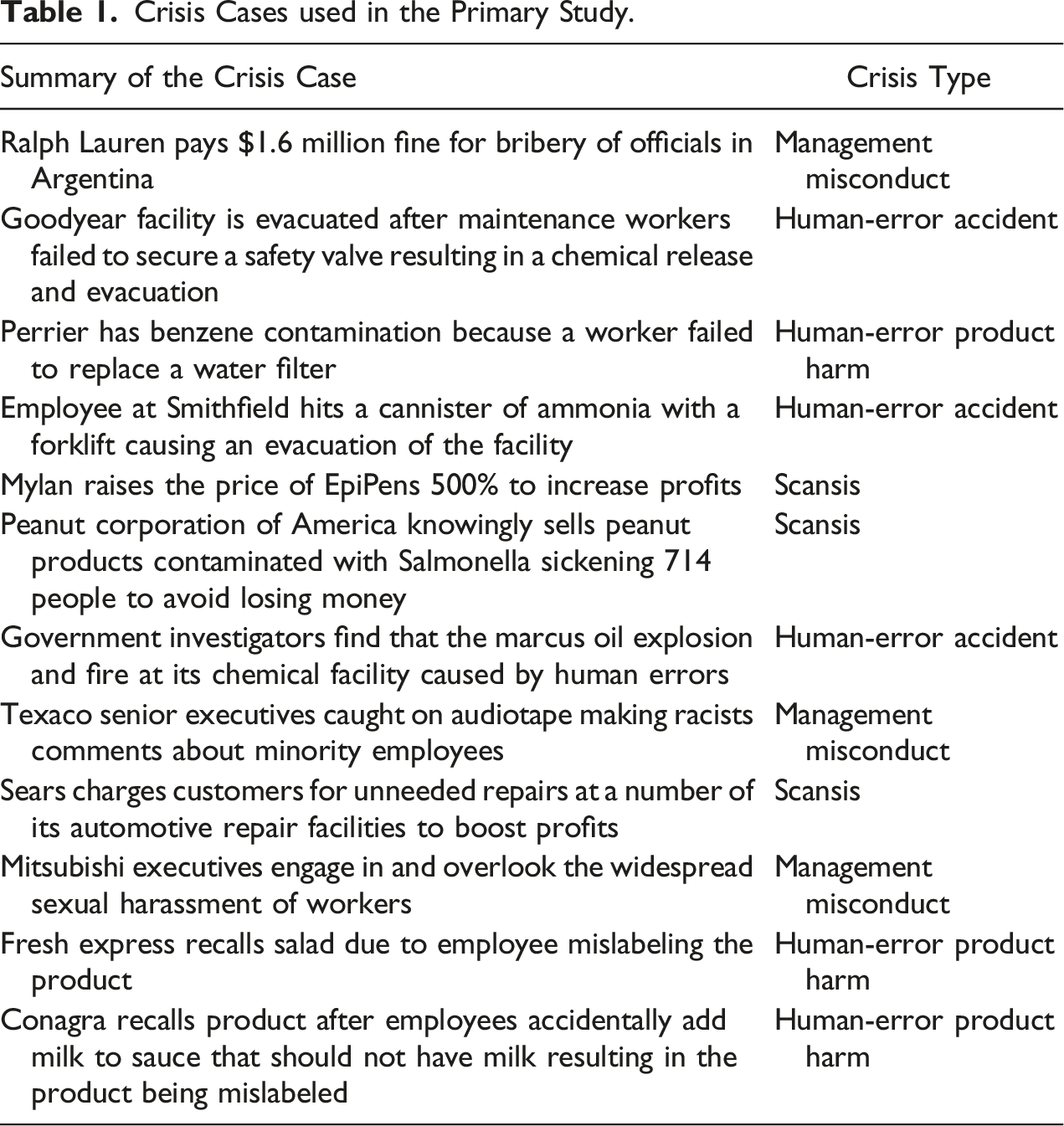
Crisis scenarios were constructed using actual news stories about the crisis events including the actual name of the organization-in-crisis. No additional text was created but some text was removed to be sure the stories reflected the key characteristics of each crisis type. Human-error accidents had to feature a mistake made by an employee as the reason for the accident. Human-error product harm had to identify an employee mistake as the reason the product became dangerous. Management misconduct crises had to involve purposeful actions that the managers knew violated rules or regulations. The story had to specify intentionality of the actions and not identify increased profits as a reason for the actions. Scansis crisis had to involve intentional violations that were specified to be driven by a desire to increase profits (greed). Such violations were a form of moral violation because they ran counter to how stakeholders should be treated.
A pilot study was conducted using eight crisis cases composed of two scansis cases, three management misconduct crises, two human-error accidents, and one human-error product harm. The results found that moral outrage did seem to work to create three separate clusters of crises (human-error, management misconduct, and scansis). However, the results and manipulation checks indicated three cases needed to be reconsidered.
Crisis Cases used in the Primary Study.
Measures
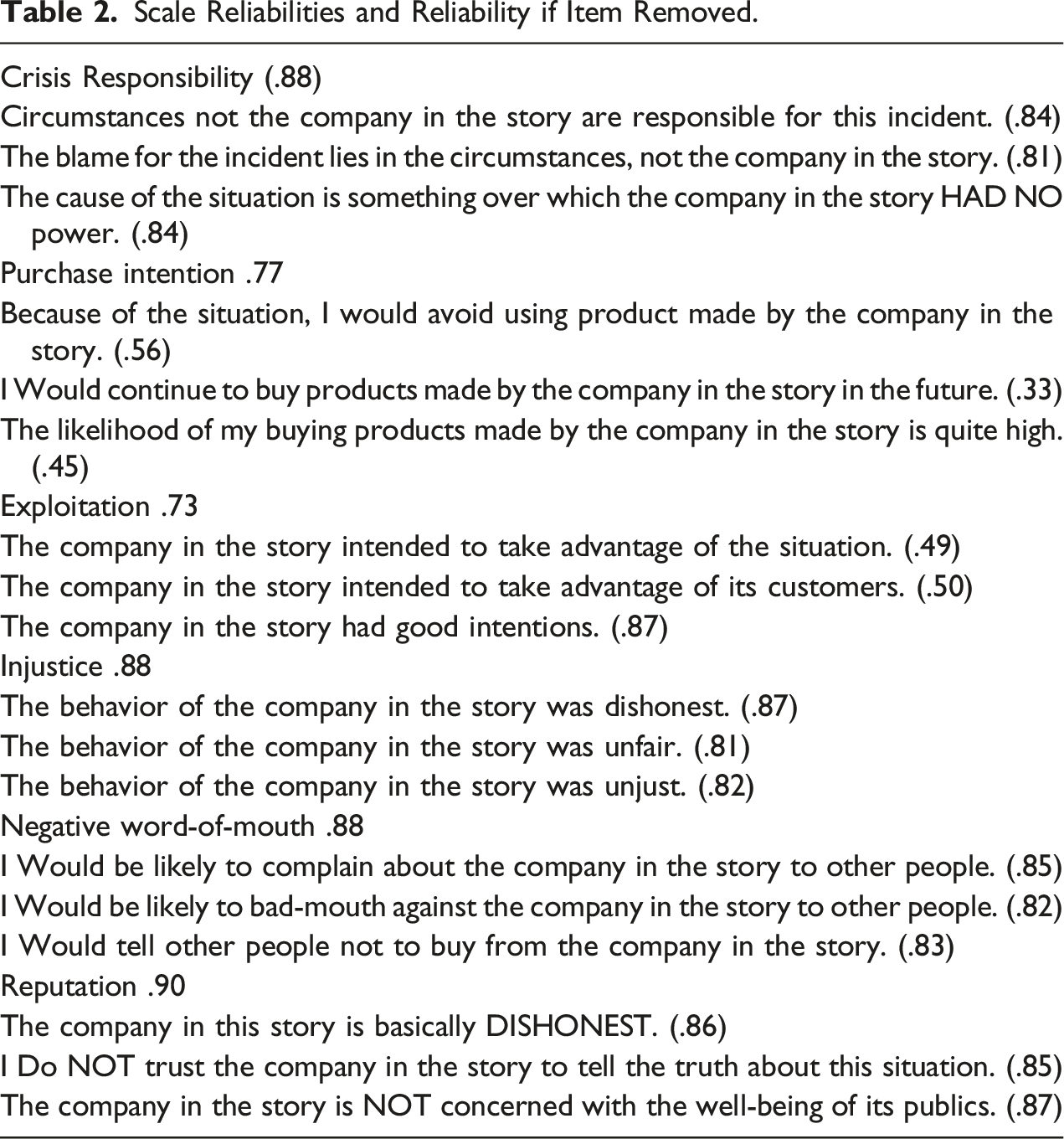
Scale Reliabilities and Reliability if Item Removed.
Participants
The research participants were 740 U.S. residents recruited by the SurveyMonkey respondent pool. SurveyMonkey maintains a pool of approximately 30 million respondents, representative of the U.S. population. Respondent pools such as SurveyMonkey enabled us to use a non-student sample. The age breakdown of the respondents was 25–29 years old (21%, n = 156), 30–44 years old (27%, n = 200), 45–59 years old (42%, n = 310), and 60–65 years old (10%, n = 74). The sample was 55% percent female (n = 407) and 45% percent male (n = 333).
Procedures
After receiving IRB approval, the survey was administered online through SurveyMonkey. The compensation per participant was 50 cents being donated to the participant’s designated charity. Participants were informed that the study was concerned with perceptions of organizations. Because the actual organization’s name was used in the case, we included a pre-test to check the prior reputation for the organization. People were then randomly assigned to read one of the twelve crisis scenarios (news articles) and complete the survey following the news article. Completion of the survey took less than 15 minutes. The prior reputations for all twelve organizations were all assessed as close to the mid-point on the seven-point scale.
Analysis and Results
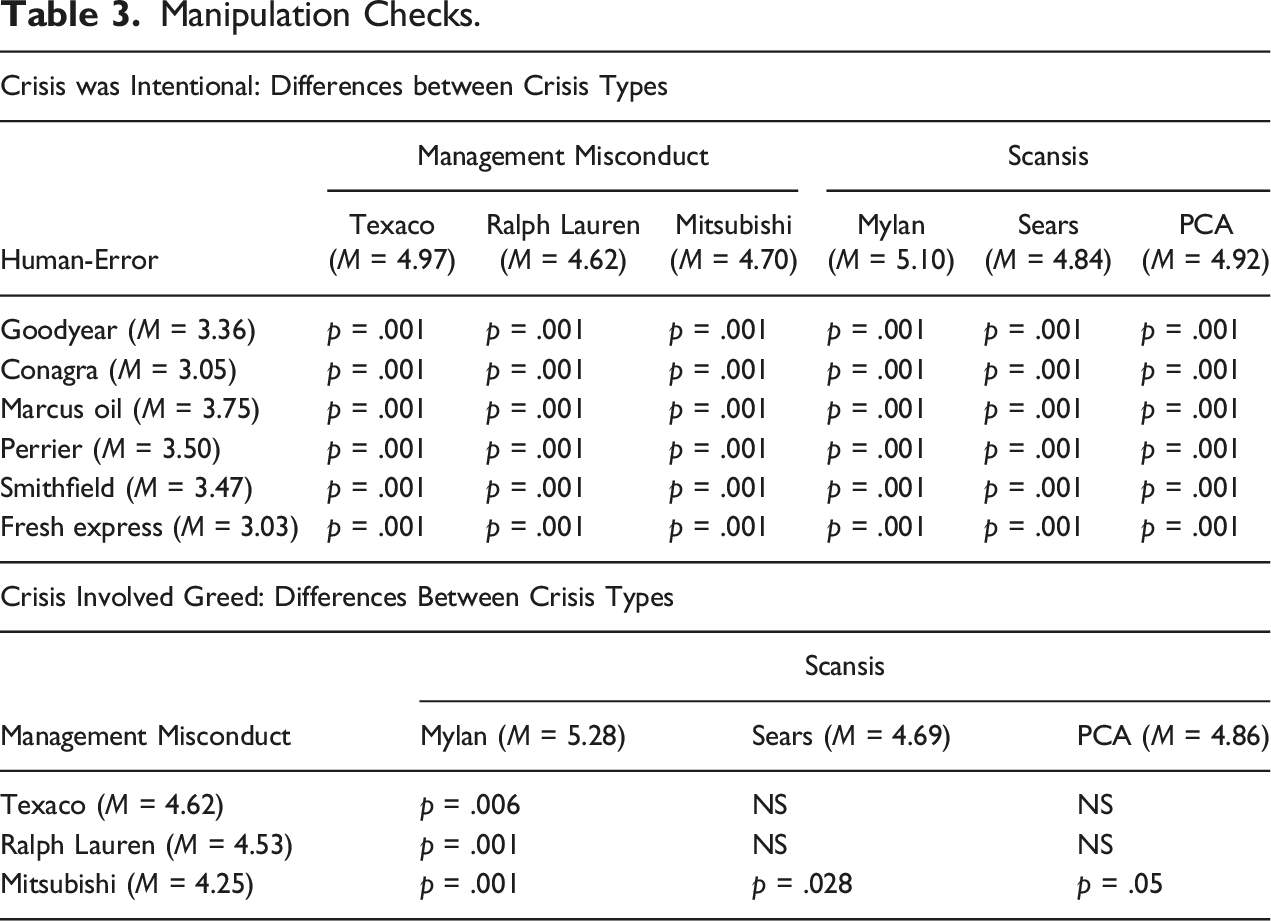
Manipulation Checks.
The study focused on determining the relationship between the three crisis types in the preventable crisis cluster. Hierarchical cluster analysis was used to assess the groupings of the crisis types, allowing us to assess H1 and to provide a foundation for answering hypotheses 2 and 3. Cluster analysis is a commonly used exploratory technique to discover how cases group together and determining if items are related to one another (classification) (Punj & Stewart, 1983). Hierarchical cluster analysis, the most popular form of clustering, works by connecting cases that are closely related to one another; the agglomerative or bottom-up method of hierarchical clustering was used in the analysis. This method begins by treating each case as a separate cluster then joining the two closest clusters together. Multiple iterations of merging are conducted until a single cluster is formed. The agglomerative results are graphically presented in a dendrogram, a tree-like graph that shows the merging process. The challenge for the researchers is to determine the how many clusters best capture the data and if this pattern makes sense. There are no set rules for how many clusters best represent the data; hierarchical clustering always finds a pattern but that does not mean the pattern is meaningful (Patel et al., 2015).
For this study, the crisis types were the cases. Justice and greed were the variables selected to create the clusters because these two variables are associated with the assessment of moral outrage. Based upon the mean scores for the twelve crisis cases for greed and injustice, the dendrogram in Figure 1 was generated that mapped the clustering process. The next step is to interpret the dendrogram. Dendrogram for 12 crisis cases.
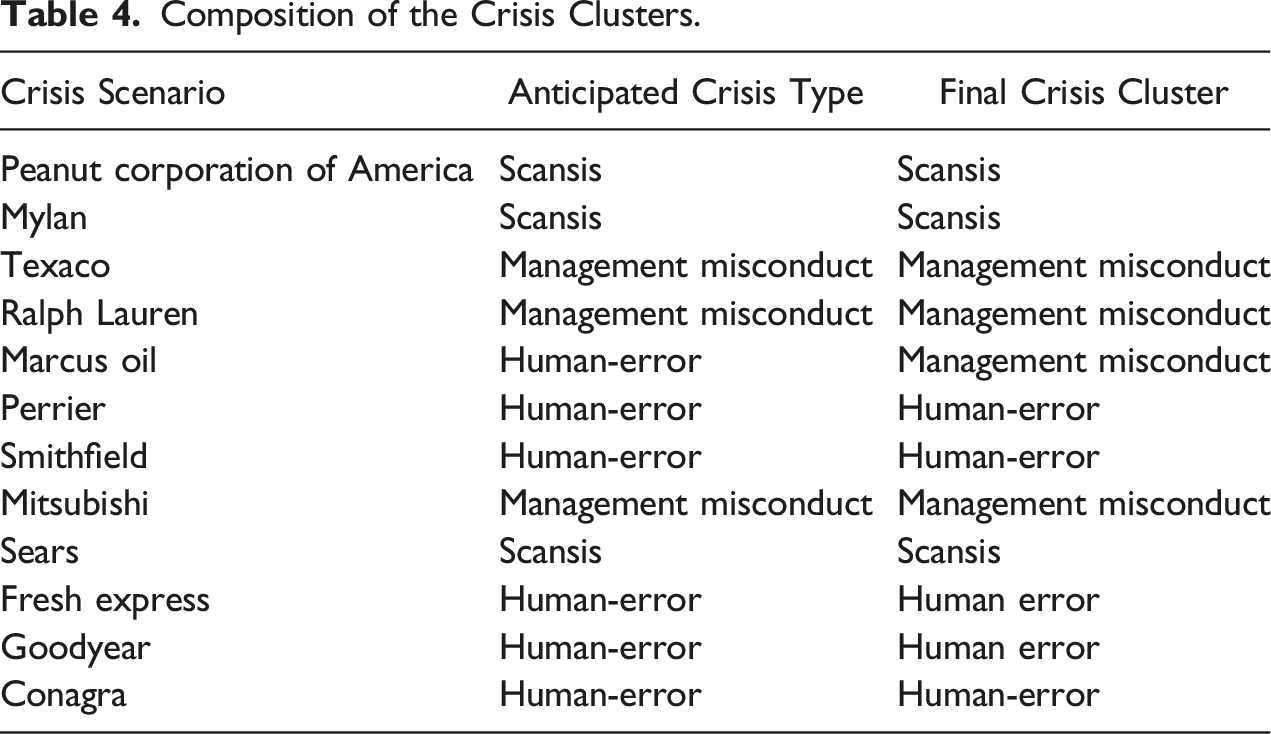
Interpreting the dendrogram involves an interpretive process of selecting the optimal number of clusters for capturing the pattern in the data. From the dendrogram created in the hierarchical cluster analysis, the possible number of clusters ranged from four to two. The dendrogram indicated that there was a four-cluster solution after two stages, a three-cluster solution after three stages, and a two-cluster solution after six stages. In the four-cluster solution, the Sears crisis case stood alone in a cluster. The three-cluster solution closely reflected the anticipated groupings of the crisis types. The three-cluster solution was then tested to determine if those clusters were distinct from one another using three common outcome variables in crisis communication research: (1) organizational reputation, (2) purchase intention, and (3) negative word-of-mouth (Coombs, 2023). The optimal number of clusters was determined by comparing the cluster scores for the three crisis outcomes using one-way analysis of variance. When there are significance differences between the outcome variables, this is evidence that that clusters are distinct.
A MANOVA analysis, controlling for gender and prior reputation, showed that the differences between the post-crisis reputation scores were significant different (F (2,736) = 84.42, p < .001, ῃ2 = .19, Power = 1.00) for the three-cluster solution. We controlled for gender and prior reputation because both have proven to affect crisis perceptions (e.g., Coombs & Holladay, 2006; Mano-Negen & Sheaffer, 2004). Post hoc analyses using the Dunnett’s C post hoc criterion for significance indicated that the post-crisis reputation score was significantly higher in the human-error sub-cluster (M = 4.45, SD = 1.27) than in either the management misconduct (M = 3.61; SD = 1.78) or the scansis (M = 3.01, SD = 1.34) sub-clusters. In addition, the post-crisis reputation score was significantly higher in the management misconduct than the scansis sub-cluster. A MANOVA analysis, controlling for gender and prior reputation, showed that the differences between the negative word-of-mouth scores were significant (F (2,736) = 65.56, p < .001, ῃ2 = .15, Power = 1.00) for the three-cluster solution. Post hoc analyses using the Dunnett’s C post hoc criterion for significance indicated that the purchase intention score was significantly higher in the human-error sub-cluster (M = 4.36, SD = 1.09) than either the management misconduct (M = 3.80; SD = 1.17) or the scansis (M = 3.26, SD = 1.29) sub-clusters. In addition, the negative word-of-mouth score was significantly higher in the management misconduct than the scansis sub-cluster. A MANOVA analysis, controlling for gender and prior reputation, showed that the differences between the purchase intention scores were significant (F (2,736) = 55.81, p < .001, ῃ2 = .13, Power = 1.00) for the three-cluster solution. Post hoc analyses using the Dunnett’s C post hoc criterion for significance indicated that the negative word-of-mouth score was significantly lower in the human-error sub-cluster (M = 3.37, SD = 1.23) than either the management misconduct (M = 4.09; SD = 1.27) or the scansis (M = 4.67; SD = 1.37) sub-clusters. In addition, the purchase intention score was significantly lower in the management misconduct than the scansis sub-cluster.
Composition of the Crisis Clusters.
H2 and H3 were tested using information from the cluster analysis and MANOVAs to determine if there were significant differences between the crisis clusters for the variables related to moral outrage. H2 posited a separation between human-error and management misconduct crises similar to the distinction between competence and integrity trust violations when compared using the moral outrage variables. The management misconduct (integrity) cluster reported the second highest score for injustice (M = 4.28, SD = 1.13), greed (M = 4.43, SD = .99), and moral outrage (M = 4.46; SD = 1.19). The human-error (competence) cluster reported the lowest score of injustice (M = 3.09; SD = 1.11), greed (M = 3.36, SD = .93), and moral outrage (M = 3.61, SD = 1.45). The Dunnett’s C post hoc criterion for significance indicated a significant difference between the human-error and management misconduct clusters for injustice, greed, and moral outrage. H2 was supported because moral outrage differentiated between human-error crises (competence) and management misconduct crises (integrity) consistent with the trust violation distinction between competence and integrity.
H3 argued that scansis would produce the strongest perceptions of moral outrage. The MANOVA results, controlling for gender and prior reputation, found a significant difference between the three clusters for injustice (F (2,362) = 67.38, p < .001, partial eta square = .27, power = 1.00), greed (F (2,362) = 77.55, p < .001, partial eta square = .30, power = 1.00), and moral outrage (F (2,362) = 29.49, p < .001, partial eta square = .14, power = 1.00). Post hoc analyses using the Dunnett’s C post hoc criterion for significance indicated all three clusters were significantly different from one another for injustice, greed, and moral outrage. The results of the analyses indicate that scansis was distinct from the other two clusters. Moreover, the scansis cluster generated the highest overall score for injustice (M = 4.85, SD = 1.19) and greed (M = 5.18, SD = 1.31), the two key factors that should promote moral outrage, as well as producing the strongest perceptions of moral outrage (M = 4.93, SD = 1.45). H3 was supported because scansis produced the strongest perceptions of moral outrage among the crises in the preventable crisis cluster.
Discussion
While all crises in the preventable crisis cluster produce strong attributions of crisis responsibility, thereby posing a serious threat to an organization (Coombs, 2007), research using moral outrage raised concerns about SCCT’s conceptualization of crises in the preventable crisis cluster. Coombs and Tachkova (2019) have suggest a need to refine the preventable crisis cluster using moral outrage as third crisis appraisal within SCCT. This study sought to move beyond speculation to providing evidence for a triadic appraisal process in SCCT using moral outrage, an emotion that is a function of injustice (unfairness) and greed (exploitation) (Antonetti & Maklan, 2016). The study involved having people evaluate 12 different crisis cases for injustice and greed. The crisis cases included human-error, management misconduct, and scansis crises. Hierarchical cluster analysis was then used to group those crises and to help answer the study’s three hypotheses.
H1 tested if scansis emerged as a distinct crisis type producing the strongest perceptions of moral outrage. The hierarchical cluster analysis indicated scansis was distinct from human-error and management misconduct crises while a MANOVA found scansis crises produced the strongest perceptions of moral outrage. H2 examined if moral outrage provides a clear separation between human-error and management misconduct crises. The hierarchical cluster and MANOVA analyses supported the contention that moral outrage creates a distinction between human-error and management misconduct crises. H3 used the hierarchical cluster analysis to demonstrate the preventable crises is comprised of three distinct crisis groupings when moral outrage is used as the differentiating factor. Together, the results from testing the three hypotheses support Coombs and Tachkova’s (2019) speculation that SCCT would benefit from utilizing a triadic appraisal involving moral outrage as the third appraisal following the appraisals of whether the situation is negative and attributions of crisis responsibility. In a crisis, moral outrage is established as a useful way to assess how serious stakeholders perceive the situation to be.
Limitations
There is an artificial nature to how the data was collected in this study. People were exposed to crises and then asked their reactions instead of naturally encountering the crisis material. Moreover, the respondents were not crisis victims. However, most organizational stakeholders are not crisis victims but are still affected by the crisis and how an organization manages a crisis (Coombs, 2023). Nevertheless, moral outrage should lead non-victims to be motivated to engage in TPP toward the organization-in-crisis. Both purchase intention and negative word-of-mouth are forms of TPP stakeholders can use against an organization. We did not measure desire for punishment in this study but that could be a useful variable for further unpacking the differences between the sub-clusters.
The manipulation checks indicated that the separation between the management misconduct and scansis crisis types was not as clear as desired. The perceptions of exploitation for Sears and PCA (two scansis crises) were not different from Ralph Lauren and Mitsubishi (two management misconduct crises). It could be that management misconduct crises created an implied sense of exploitation even when explicit exploitation cues are missing. Ideally, the manipulation checks would have found a sharper distinction between four crisis cases.
Conclusion
SCCT is predicated upon the assessment of the crisis situation with crisis types being the foundational element of that appraisal. The crisis appraisal determines the optimal crisis response and even the salient crisis outcomes. It was essential to verify the utility of crisis responsibility for identifying crisis types in SCCT before exploring the effects of crisis response strategies on select crisis outcomes. Hence, changing the conceptualization of crisis types has a significant effect on SCCT. Coombs and Tachkova (2019) have advocated for reconceptualizing SCCT’s crisis types by positing that moral outrage is a boundary condition for SCCT and that the theory would benefit from adding moral outrage as a third appraisal factor in SCCT. The current study tested the utility of moral outrage as an appraisal factor for crises. The results support the idea that moral outrage creates unique assessments of the three crisis types that comprise the preventable crisis cluster in SCCT. Moral outrage effectively differentiated between human-error, management misconduct, and scansis crises. The triadic appraisal has significant implications for crisis communication theory and practice because it alters SCCT’s foundational element of crisis types.
For theory, the results map the boundary condition moral outrage creates for SCCT. The distinction between human-error and management misconduct crises appears to be the boundary. Conceptually, human-error and management misconduct crises should be different, but SCCT’s reliance on crisis responsibility as key to crisis appraisal failed to capture a clear separation between the two. Moreover, preliminary results indicate SCCT’s recommendations for the benefits of accommodative strategies in the preventable crisis cluster hold for human-error crises but not for management misconduct crises (Tachkova & Coombs, 2022). Coupled with the failure of the accommodative strategies to have a positive effect on outcomes in scansis crises (Coombs & Tachkova, 2019), moral outrage appears to establish a boundary condition for SCCT. Within the preventable crisis cluster, SCCT’s communicative recommendations do not seem to be valid beyond human-error crises due to the moral outrage evoked by management misconduct and scansis crises.
Incorporating moral outrage as a boundary condition contributes to crisis communication theory by demanding a reconsideration of what constitutes an optimal crisis response and what are valuable crisis outcomes to assess. In turn, the revised theory has implications for the practice of public relations. Research must explore which crisis response strategies are optimal for management misconduct and scansis crises. Moral outrage-related crises are uncharted territory for crisis communication because we do not fully understand which crisis response strategies can help stakeholders and organizations when crises evoke moral outrage. We need such insights if research is to provide useful, evidence-based guidance for crisis communicators.
Researchers also must question the crisis outcomes commonly used in crisis communication research such as post-crisis reputation, purchase intention, and negative word-of-mouth intentions. However, moral outrage seems to prevent crisis response strategies from having a positive effect on these three crisis outcomes (Coombs & Tachkova, 2019). Moral outrage creates a need for punishment, specifically third-party punishment (TPP). Purchase intention and negative word-of-mouth intentions can be viewed as forms of TPP. If there is a need for TPP because of moral outrage, it is unreasonable to think the crisis response will improve these outcomes It may be that value congruence becomes a more salient crisis outcome because moral outrage can cause disidentification when stakeholders realize their values are very different from that of the organization-in-crisis (Devers et al., 2009). Researchers and practitioners should consider value congruence as an essential crisis outcome.
The results presented in this study demonstrate that the preventable crisis cluster is composed of three distinct sub-clusters when moral outrage is added as a third appraisal of a crisis. The re-conceptualization is an alteration of the crisis types, a foundational element of SCCT. There are compelling reasons to expand SCCT’s explanatory power to include crises that produce strong feelings of moral outrage. The Crisis Communication Think Tank at the University of Georgia has documented the occurrence of sticky crises, crises that are particularly difficult to manage, and the criticality of understanding those crises. Scansis has been identified as one form of sticky crisis (Coombs et al., 2020). Moreover, SCCT has long argued that management misconduct crises are the most difficult to manage (Coombs, 2007; 2023). The Institute for Crisis Management (ICM) regularly finds that management misconduct crises are among the most reported crises in the media (ICM, 2020). Crises that produce strong perceptions of moral outrage are common problems that crisis managers do and will continue to encounter.
Using moral outrage to reconceptualize the preventable crisis cluster is the first step toward enhancing SCCT’s ability to provide guidance for moral outrage-related crises (Coombs et al., 2020). SCCT built its original crisis communication guidance on an understanding of the crisis situation based upon attributions of crisis responsibility driven by the crisis type. Through the reconceptualization of SCCT as triadic appraisal, we now understand the need to refine the theory’s guidance predicated upon perceptions of moral outrage evoked by a crisis. We must consider the unique nature of moral outrage-related crises in the future development of crisis communication theory and its translation into guidance for crisis communicators.
Footnotes
Declaration of Conflicting Interests
The author(s) declared no potential conflicts of interest with respect to the research, authorship, and/or publication of this article.
Funding
The author(s) received no financial support for the research, authorship, and/or publication of this article.
