



Abstract
In their article “Predicting Elections with Twitter: What 140 Characters Reveal About Political Sentiment,” the authors Andranik Tumasjan, Timm O. Sprenger, Philipp G. Sandner, and Isabell M. Welpe (TSSW) the authors claim that it would be possible to predict election outcomes in Germany by examining the relative frequency of the mentions of political parties in Twitter messages posted during the election campaign. In this response we show that the results of TSSW are contingent on arbitrary choices of the authors. We demonstrate that as of yet the relative frequency of mentions of German political parties in Twitter message allows no prediction of election results.
Predicting election outcomes has become some kind of a cottage industry in the social sciences in previous years. In their article, “Predicting Elections with Twitter: What 140 Characters Reveal About Political Sentiment,” the authors Andranik Tumasjan, Timm O. Sprenger, Philipp G. Sandner, and Isabell M. Welpe (TSSW) join the ranks of election forecasters with an innovative proposal. In particular, they suggest that the relative frequency of party mentions on the microblogging platform Twitter predicts the outcome of German elections: the mere number of tweets mentioning a political party can be considered a plausible reflection of the vote share and its predictive power even comes close to traditional election polls (Tumasjan, Sprenger, Sander, & Welpe, 2010, p. 183).
This conclusion fits quite nicely into prior research suggesting that user inputs in online services are useful indicators of offline trends. Be it the tracking of influenza or consumer prices based on search terms (Choi & Varian, 2009; Ginsberg et al., 2009), the inference of relationships between people based on their phone records (Eagle, Pentland, & Lazer, 2009), or the structure of TV events or the box office of movies based on the real-time comments on Twitter (Asur & Huberman, 2010; Shamma, Kennedy, & Churchill, 2010). These interactions between users of online services leave traces which in turn might allow us to gain a deeper understanding of the social dynamics that produced them (Lazer et al., 2009, p. 721). Thus, the general idea that there might be a connection between political Twitter messages and the offline political process is not as far-fetched as it might sound.
Yet, a prediction instrument is useful for the scientific community only if there are clear and well-grounded rules how to employ it. Otherwise scholars will not be able to utilize it to predict future elections. In this regard, however, TSSW’s article turns out to be somewhat lacking. In particular, the authors do not specify several details and make arbitrary choices without giving any substantive account. What is more, the results of their analysis appear to critically depend on these choices as we shall demonstrate empirically. 1
And the Winner is—the Pirate Party
In the run-up to the 2009 German election, we collected a data set comprising all Twitter messages of users whose tweets at least once contained the name of a German party or a politically loaded keyword. 2 Unfortunately, TSSW are somewhat vague on their procedure of data collection. They do not specify whether they, for example, queried the Twitter application programming interface (API), whether they scraped webpages, whether they utilized Really Simple Syndication (RSS) feeds of saved searches, or whether they used third-party applications. As a result, we do not know in which way their mode of data collection differs from the procedure we employed. That there is a difference in data collection cannot be disputed, however, since the absolute number of party mentions we collected from August 13 to September 19, 2009, is much larger than the number of mentions measured by TSSW (see bottom row in Table 1 ). This considerable difference suggests that analyses of Twitter messages should specify the details of data collection. In particular, a new method for election prediction cannot be widely applied if it is unclear how to replicate it.
Aggregate Counts of Party Mentions in TSSW Data and in Our Data

Despite the difference in absolute numbers, however, the results on the relative frequencies of party mentions resemble each other quite closely. To be sure, the proportion of mentions of the Social Democrats (SPD) is considerably lower in our data than in the TSSW data, whereas the opposite holds for the proportion of mentions of the Greens. In general, however, the two distributions are quite similar. The mean absolute difference between both distributions is 2.18. When comparing the vote shares of the six parties included in the TSSW analysis to the proportion of Twitter mentions, the TSSW data exhibit a mean absolute difference of 1.65 percentage points, while our data yield a difference of 1.51 percentage points. We thus conclude that that our data set, while not identical, exhibits similar patterns as the TSSW data set. We are therefore confident that the analyses reported below would yield similar results when performed with the TSSW data, rather than ours.
The first issue, we would like to raise, concerns the identification of the parties whose mentions should be counted to create an election prediction. TSSW chose to include six parties, the Christian Democrats (CDU), Christian Social Democrats (CSU), SPD, Liberals (FDP), The Left (Die Linke), and the Green Party (Grüne). They do not make transparent the reasoning behind this choice, however. Giving no account or rules, obviously, limits the applicability of the proposed instrument for election prediction in other elections. What is more, TSSW’s actual choice does not fit nicely with the claims that “the mere number of messages reflects the election result” and “Twitter can be seen as a valid real-time indicator of political sentiment”(p. 184). While these claims suggest that Twitter reflects political sentiment, irrespective of which political party is concerned, TSSW include only those parties that entered German parliament in 2009.
To test whether the results of TSSW’s method depend upon which parties are included, we repeated our analysis including a seventh party, namely the Pirate Party (Piraten). This party mounted considerable support in online forums, blogs, and on Twitter in the run-up of the German election of 2009. The online presence of the supporters of the Pirate Party led to widespread speculation in German media and academia if online channels would profoundly change political participation in Germany (see, e.g., Bartels, 2009; Becker, 2009; Grabowsky, 2009; Knop, 2009; Teevs, 2009; Zolleis, Prokopf, & Strauch, 2010). Against this backdrop, excluding the Pirate Party is not an obvious choice.
As Table 2 indicates, including the Pirate Party alters the results considerably. Accordingly, the Pirate Party gained the largest proportion of party mentions and, given TSSW’s line of reasoning, would have been the winner of the 2009 German federal election. It would be the major partner in a governing coalition and probably even provide the German chancellor. In the end, however, the Pirate Party managed to gather only some 2% of the votes. So, it is no surprise that the MAE of the prediction rises to more than 9 percentage points. As a result, adding a single political party to the analysis decreases the predictive power tremendously. The performance of the TSSW method thus depends critically upon the exclusion of certain parties for whom the instrument performs poorly—without specifying any criteria.
Parties’ Vote Shares and Proportions of Twitter Mentions Including the Pirate Party
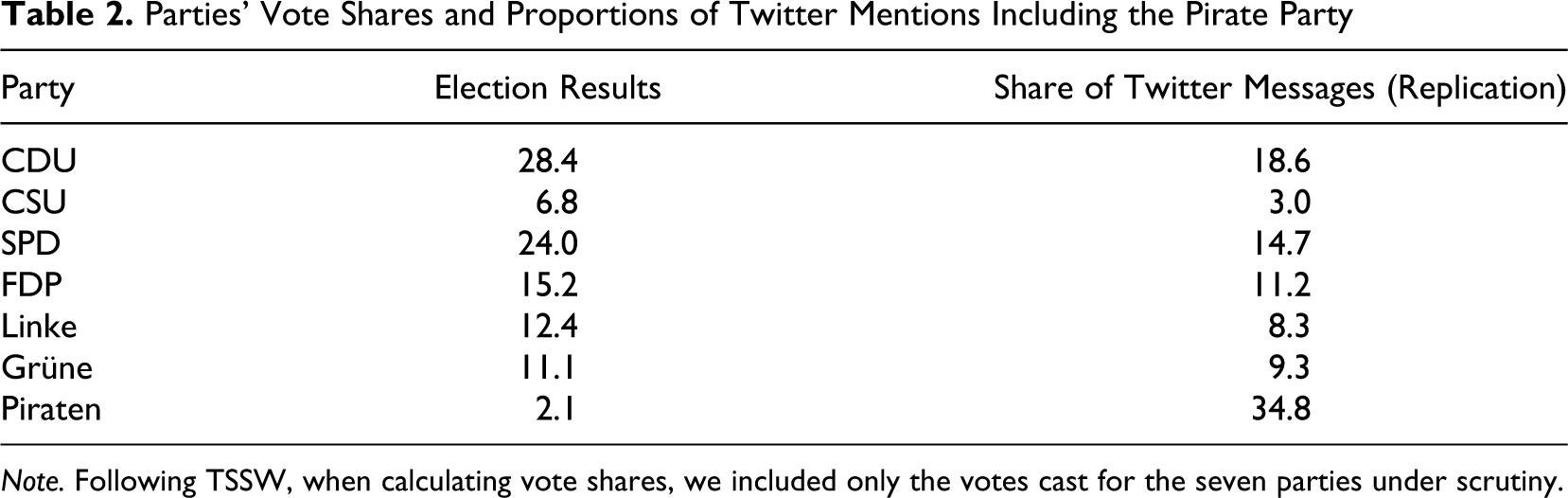
Note. Following TSSW, when calculating vote shares, we included only the votes cast for the seven parties under scrutiny.
Yet, TSSW might object that before the 2009 federal election pundits and scholars alike deemed the Pirate Party as incapable of entering German parliament in the upcoming election. Given this knowledge, they—so the argument might go—deliberately excluded the Pirate Party from their analysis. This objection raises two issues, however. To begin with, the authors should make plainly clear the rules that led them to this decision. Otherwise, their method cannot be applied to future elections. Moreover, this counterargument raises the question from which source TSSW’s pre-election knowledge concerning the Pirate Party nonviability stemmed. They probably relied, inter alia, on the results of public opinion surveys and deemed them sufficiently valid indicators of the election outcome. If results of polls played a role in deciding upon the inclusion of particular parties, the TSSW method is dependent on public opinion surveys. It is thus not an independent tool for election prediction and can hardly “complement traditional methods of political forecasting” (p. 184). 3
Consequently, we suggest that a valid methodological approach should be capable of explaining a substantial amount of the data and it should specify its limitations. For the study of electronic communication channels in general and Twitter in particular, this means that one should be careful not to start with a narrow scope. Otherwise, for example, by excluding channel-specific aspects (such as the Pirate Party) which are potentially meaningful, one runs the risk of producing biased results.
What a Difference a Day Makes
The second issue we would like to raise concerns the period during which TSSW gathered their data. For their analysis, TSSW collected Twitter messages containing the names of six political parties that were published between August 13 and September 19, 2009 (p. 180). They do not give any account of why they decided to choose this period. Moreover, a closer look at the period does not give any hint at which reasoning led the authors to choose it. August 13 is a Thursday, with no particular significance in the campaign. Their data collection stops on a Saturday 5 weeks later, on September 19. This date, 8 days before the election on September 27, is also a date with no obvious significance in the campaign. As with the choice of parties, the lack of explicit or implicit rules poses a problem for scholars who would like to apply the method to future elections.
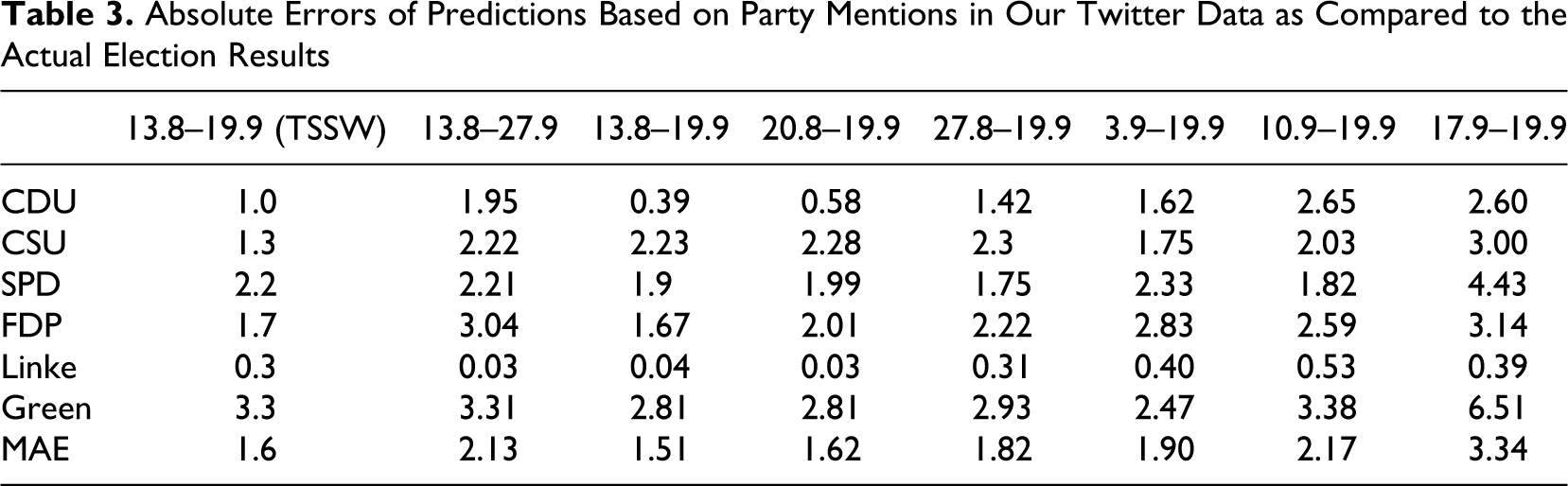
Leaving the rules for choosing a time frame unspecified would be no problem if counting party mentions in the Twittersphere led to identical results, irrespective of which period is chosen. To address this issue empirically, we calculated absolute errors (prediction based on mentions of the names of the parties in our Twitter data as compared to the actual election results) and the MAE of the complete prediction for different time periods. 4 The results reported in Table 3 show that the absolute errors between predictions based on mentions of party names in our replication data are far from stable and vary for each party depending heavily on the time frame. The same is also true for the MAE of all predictions. Especially interesting is the fact that the MAE of all predictions for an analysis of Twitter messages sent between August 13 and September 27, the day of the election, produces a MAE of 2.13 percentage points which is significantly higher than the MAE for the TSSW time frame (1.51). Including only eight additional days results in a considerable increase in the mean absolute difference. The results thus depend considerably on the period under scrutiny. It is thus particularly unfortunate that TSSW did not specify any rule of how to determine the correct period.
Absolute Errors of Predictions Based on Party Mentions in Our Twitter Data as Compared to the Actual Election Results
As with the issue of the Pirate Party, we want to stress the importance of reasonably chosen and well-documented sampling decisions. For any kind of aggregate data analysis, it is highly desirable that the measured results be as stable as possible against modifications of the data time frame. Data sets that exhibit significant variance and/or trends should be carefully investigated. The assumption that Twitter mood mirrors some kind of public sentiment should thus be tested against the worst cases of a data set. If any significant differences are found, it should be worthwhile to try and explain them.
Conclusion
In their article, TSSW claim that “the mere number of tweets mentioning a political party can be considered a plausible reflection of the vote share and its predictive power even comes close to traditional election polls.” Our analysis demonstrates that this conclusion is not warranted for several reasons. The authors did not specify well-grounded rules for data collection in general and the choice of parties and the correct period in particular. Scholars will thus not be able to apply TSSW’s method to future elections. Moreover, the performance of their indicator varies over time as well as it critically hinges upon which subset of the German party system is covered. The number of party mentions in the Twittersphere is thus not a valid indicator of offline political sentiment or even of future election outcomes. All in all, the TSSW article did not make outcomes of German federal elections more predictable.
Footnotes
The authors declared no potential conflicts of interests with respect to the authorship and/or publication of this article.
The authors received no financial support for the research and/or authorship of this article.