



Abstract
This article presents the results of an exploratory study examining attitudes toward broadband advocacy, as related to attitudes toward and use of information and communication technologies (ICTs) and a variety of other personal, political, and professional characteristics. A random sample (n = 297) of licensed social workers in Michigan was surveyed. There is a growing body of literature indicating that access to broadband Internet is an important element of the digital divide, especially in the United States, which after having led in this area has fallen behind. Findings from this study indicate significant relationships between willingness to engage in broadband advocacy and political views, attitudes toward and use of ICTs, and knowledge about broadband. The implications for a profession focused on social justice and advocacy on behalf of vulnerable populations are explored.
Introduction
Social workers have a commitment to promoting social justice and social change on behalf of the populations they work with, particularly to enhance individuals’ capacities to address their own needs (National Association of Social Workers [NASW], 1996). In the 21st century, it is increasingly clear that access to appropriate information and communication technology (ICT) and the broadband infrastructure supporting it is essential to the kind of capacity development that respects a real level of self-determination and advances participation in the broader democratic society. Social workers should be at the forefront of efforts to decrease the digital divide. Yet, while the social work literature has discussed ICT as a tool for advocacy (Queiro, McNutt, & Campbell, 2003) and a component of curriculum (Coe Regan & Freddolino, 2008), it has not adequately addressed what has rapidly become a central part of clients’ lives and professional practice (Perron, Taylor, Glass, & Margerum-Leys, 2010). Beyond the use of ICT, there is even less on access to the infrastructure that supports ICT.
The social work literature stands in contrast to social work's professional organizations in this regard. The NASW’s Executive Director, Elizabeth Clark, has compared broadband access to services such as water, sewer, electricity, and phones, stating “Broadband is just as important,” especially in an environment where “Many services are becoming accessible online only” (Pace, 2010, p. 6). Perron, Taylor, Glass, and Margerum-Leys (2010) argue that use of ICT is not only advantageous in terms of best practices but may actually be “necessary for ensuring the delivery of ethical social work practice” (p. 5). Social work’s professional organizations have seized on the importance of this emerging paradigm. In 2010, the NASW joined with the Leadership Conference on Civil and Human Rights in support of the Federal Communications Commissions’ (FCC) national broadband plan, which seeks to bring affordable access to broadband speeds of at least 100 megabits per second to 100 million homes. The FCC states that approximately 26 million Americans live in areas underserved by broadband and has demonstrated that a lack of broadband access disproportionately affects many of the populations social workers work with, including the disabled, those in rural and low-income areas, older adults, minorities, and tribal members (FCC, 2011).
This article examines practitioner attitudes toward broadband access, particularly whether populations have the right to access in the form of appropriate broadband infrastructure and asserts that a lack of such access is a form of social exclusion and social injustice (Yu, 2006). The framework here relies broadly on the literature examining ICT and social inclusion and exclusion (Hick, 2006; Rooksby & Weckert, 2007; Selwyn, 2002; Wong, Law, Fung, & Lam, 2009; Wong, Law, Fung, & Lee, 2010) as well as the literature on social development theory (Midgley, 1995), which emphasize that social development in terms of social capital and inclusion is intimately intertwined with economic development and the overall prosperity of societies. This study aims to examine the understanding of broadband, and whether social work practitioners view access to broadband as something that should be mediated by the market or guaranteed by the government as a public good (Steyaert & Gould, 2009). A review of the literature is followed by an examination of what factors might influence those attitudes, and a set of hypotheses based on these factors. This is followed by an overview of methods used in the study and results. The key findings are discussed, and implications for the profession and for future research are considered.
Literature Review
There are several major schools of thought on access to ICT as an issue of social justice. One is built around the idea of the information itself, and stands on the shoulders of earlier concepts of information inequality such as literacy movements and, in the 1970s, knowledge gap theory (Hüsing & Selhofer, 2002; Vehovar, Sicherl, Hüsing, & Dolnicar, 2006). This body of research focuses on how, for example, Internet use varies across populations. Another major school of thought is more concerned with actual access to the technologies that make the communication and information exchange possible (Yu, 2006), including issues related to high-speed Internet connectivity. The term most used in the literature to describe both phenomena is “the digital divide.” As a concept, the digital divide has existed since the mid-1990s and is generally conceived of as comprising both access to digital resources and use of the same resources, which are often referred to as the “first-level” digital divide and the “second-level” digital divide, respectively (Attewell, 2001; López-Sintas, Filimon, & García-Álvarez, 2010). Increasingly, access to broadband is seen as a critical component in the “access” aspect of the digital divide.
While the idea may seem quite straightforward as a concept to be studied, the digital divide continues to lack a clear and robust theoretical foundation (Yu, 2006). There are a variety of interpretive frameworks and theories used to understand and conceptualize the digital divide.
One framework has been to examine the political ramifications of unequal access (Norris, 2001; Sæbø, Rose, & Molka-Danielsen, 2010; Shelley et al., 2004). This framework explores the role that access to information and the ability to communicate one’s perspectives plays in the proper functioning of democratic processes. There is also a very large body of literature within the field of political science on ICT and participation in democracy that analyzes aspects such as the use of websites in electoral campaigns.
In contrast to the above literature on access to ICT infrastructure and the corresponding impacts on outcomes and participation in political discourse, this study examines the role of politics as a motivation for broadband advocacy. In his 2011 State of the Union address, President Obama addressed the digital divide directly, stating, “Our infrastructure used to be the best, but our lead has slipped. South Korean homes now have greater Internet access than we do.” According to a joint report released by the Communications Workers of America and the Congressional Black Caucus Institute 21st Century Council (2010), the United States is not only behind South Korea but is 15th in the world in terms of broadband subscription and has fallen to 25th in the world in terms of the actual download speeds available on U.S. networks. The Obama administration has made some efforts to address this: A national broadband map was developed over five years at a cost of $200 million, and is part of a $7.2 billion commitment the administration has made to strengthen broadband access (Severson, 2011).
The success of South Korea, and other nations such as Japan, in the area of broadband has been correctly summarized as “nothing short of stunning” (Kushida & Oh, 2007, p. 482). In only 4 years (1998–2002), South Korea went from no broadband to the global leader in terms of market penetration (Kushida & Oh, 2007). Kushida and Oh (2007), point out that in both Korea and Japan, the government played a key role in the success of broadband, in both setting goals and “strategic liberalization” of the broadband markets (p. 503).
Similar debates about the role of government in providing broadband infrastructure have also occurred in countries like Australia, where some labeled the proposed National Broadband Network (NBN) “The defining issue in Australian politics in 2010” (Gerrand, 2010, p. 52.1). In Australia, the Liberal Party has advocated a “leave it to the market” approach while the Nationals, pointing to a variety of market failures, have proposed a subsidized government-led approach to ensure access for all (Gerrand, 2010). At stake is the question of whether the digital divide is fundamentally an issue of haves versus have-nots that can only be fully addressed through governmental policy, or whether the market alone will be able to fill the gap, and as those skeptical of the construct have argued, the issue is really only one of “have-nows” versus “have-laters” (Shelley et al., 2004, p. 257).
In addition to a political approach to the digital divide, the literature highlights a variety of other personal considerations that may influence, and be influenced by, access. These include social and cultural examinations and frequently discuss the relationship between the digital divide and social capital (Pruijt, 2002; Tapia & Ortiz, 2010). One emerging theory in this area is a social theory of Internet use, which suggests, “social space and the Internet use space are interrelated” (López-Sintas et al., 2010, p. 14). From this perspective, the higher need for social and informational linkages among both the young and the affluent is directly related to higher adoption and use of ICT.
A related framework views the issue primarily in economic terms (Attewell, 2001; Femminis, 2002; Larrison, Nackerud, & Risler, 2002; Liu, 2010; Queiro et al., 2003; Wilson, Wallin, & Reiser, 2003; Yu, 2006). This perspective examines the economic impact of a lack of access to ICT in terms of categories like consumption and employment opportunities, with particular concern for how the poor may be disproportionately left behind in both ICT access and use, and the economic consequences that may result. Not considered here but related to this economic lens is the wide body of literature on globalization and the digital divide between the developed and developing world (Drori, 2010; Drori & Jang, 2003; Fairchild & Quansah, 2007; Liu, 2010), as the scope of this study is limited to the United States and, particularly, to licensed social workers in Michigan.
The issue of information inequality can be construed in political, personal, or economic terms, and these are all valid and important lenses to apply. Yu (2006) offers one potential model to integrate some of these conceptualizations of the digital divide under what is called information poverty. Information poverty understands that a variety of factors influence access, including as discussed, political, personal, and economic factors (Yu, 2006). In framing access to broadband infrastructure as a social justice concern, this article posits information poverty as a form of social exclusion.
Social exclusion is a difficult to define, and even more difficult to operationalize. This study will use the following definition of social exclusion: An individual is socially excluded if (a) he or she is geographically resident in a society but (b) for reasons beyond his or her control, he or she cannot participate in the normal activities of citizens in that society and (c) he or she would like to so participate. (Burchardt, Le Grand, & Piachaud, 1999, p. 229)
Factors Associated With Broadband Advocacy
Factors that might influence social worker’s attitudes toward broadband advocacy include the professional, the political, and the personal. The first two are fairly straightforward. Social work at the level of professional organizations has been quite clear in its support of broadband access, even while some have argued that social work has an antitechnology bias within practice (Steyaert & Gould, 2009). In terms of political influences, President Obama has been equally clear in his support, and an expansion of government in any area tends to align more with Democratic values. The potential interaction of personal characteristics is more complicated.
In order to examine which other personal factors might be associated with practitioner attitudes toward broadband advocacy, this study took a broad approach, using elements from Yu’s (2006) framework of “information poverty” and the conceptual framework of digital divide indicators (Barzilai-Nahon, 2006). Both frameworks indicate that ICT use, access, affordability, and other sociodemographic factors are all related to attitudes toward something like broadband access. These factors are examined further in the paragraphs that follow.
Personal ICT use may affect willingness to advocate for broadband access. However, the meaning of ICT is itself contested (Richardson, 2006). This study examines elements of both work-related and personal ICT use, which is considered by many the most important variable to describe the use of ICT (Billon, Lera-Lopez, & Marco, 2010; Hüsing & Selhofer, 2002). The study examines ICT use in both work and personal settings as it relates to the willingness to advocate specifically for personal access to broadband in the home. In line with the social work ethical principle of self-determination, the emphasis on personal access within the home, as opposed to at a local library or other facility, reflects the concept of “autonomy of use” in the ICT literature (Barzilai-Nahon, 2006, p. 274).
Use is clearly intimately related to access. There are a wide variety of conceptualizations of what “access” to broadband entails and a range of opinions as to how much access is actually achievable. Some have labeled the concept of obtaining universal access a “fallacy” (Selwyn, 2002, p. 11). In a 2002 report from the National Telecommunications and Information Administration (NTIA) entitled “A Nation Online,” access was defined as “from any location” including home, work, and public. This study examines attitudes toward broadband access in the home, which is where the majority of Americans (65%) access broadband (FCC, 2011). Increasingly, however, access is about more than strict coverage, it is also about quality, usually measured in terms of bandwidth. This study examines access to, and understanding of, broadband. Given that understanding of broadband was a variable to be measured, the survey instrument did not include a definition, but broadband has been defined in the national broadband map (http://www.broadbandmap.gov/), as access to Asymmetric XDSL, Symmetric XDSL, other copper wireline, cable modem-docsis 3.0, cable modem-other, fiber to the end user, terrestrial fixed wireless, or terrestrial mobile wireless with 768 kbps or greater for download speeds, and 200 kbps or higher for upload speeds.
Related to access is affordability. Even if a home is wired for broadband, without the financial resources to pay for services, residents will not truly have access. When the literature examines affordability, it typically looks at levels of household income as opposed to individual income, reflective of the fact that some members of households may have excellent access despite little or no personal income (Wong et al., 2010).
Alongside household income, a variety of other sociodemographic characteristics may influence both ICT use and willingness to advocate access to broadband infrastructure. Many of the social theories for explaining the second-level digital divide are based on status within society. Specific articles have emphasized the importance of examining age (Livingstone & Helsper, 2007), gender (Royal, 2008), place of residence, and household size. López-Sintas et al. (2010) examined “indicators of socioeconomic and cultural capital” such as occupational status and education level (p. 6). Other studies have examined race, language, and disabilities, which are also “significant predictors of IT access and familiarity, even controlling for socioeconomic status” (Shelley et al., 2004, p. 258). A systematic review found that the usual control variables in this category were income, level of education, type of household, age, gender, race, and language (Vehovar et al., 2006). Based on a review of the literature, sociodemographic variables used in this study include age, gender, race, and household income.
Hypotheses
This study examines the following hypotheses related to professional, political, and personal characteristics and broadband advocacy: There will be a relationship between professional identity as a social worker and willingness to advocate for broadband access. Social work has issued clear policy statements on broadband access, and the problem disproportionately affects populations social workers have ethical obligations towards. If professional identity is the most salient factor, given that the sample is all social workers, only factors directly related to professional identity, such as years of practice or highest degree attained, will influence attitudes. There will be a relationship between a practitioner’s self-identified political party affiliation and political views and their willingness to advocate for others’ access. In as much as the issue has been explicitly politicized, or reflects deeper political beliefs about an expansion of rights, being a Democrat or politically liberal may increase willingness to advocate for access. There will be a relationship between practitioners’ personal use of ICT and their willingness to advocate for broadband access. Those who use ICT more are more likely to be familiar with broadband, understand its benefits, and may be inclined to support extending those benefits to others. There will be a relationship between practitioners’ personal understanding of broadband and their willingness to advocate for other’s access. Similar to the above, those who are familiar with the benefits of broadband may support extending those benefits. There will be a relationship between a practitioner’s household income and their willingness to advocate for others’ access. Those with less household income, and therefore less ability to secure broadband through the open market, may be more inclined to support government intervention to guarantee access. There will be a relationship between a practitioner’s age, gender, race/ethnicity, and location and their willingness to advocate for others’ access inasmuch as these factors moderate individuals’ use of or familiarity with broadband or currently lack access to broadband.
Methodology
Research Design
The study was observational and exploratory. As such, the study utilized a nonexperimental cross-sectional survey design. The measures that looked specifically at attitudes related to advocacy for broadband Internet access were part of a larger study examining the use of and attitudes toward, ICTs among licensed social workers in Michigan.
Participants
The sample was drawn from a list obtained from the Michigan Department of Community Health’s Bureau of Health Professions. The list was comprised of 18,672 individuals with either a Licensed Masters in Social Work (LMSW) or Licensed Bachelors in Social Work (LBSW) in the State of Michigan. Out of a random sample of 686, a total of 297 completed surveys were received, and 31 surveys were returned to sender, resulting in a final response rate of 45.3% (n = 297). For this study, analysis was limited to respondents who answered all of the items of interest (described below), resulting in a final analytic sample of n = 186.
The sample consisted of mostly women (78.0%, n = 145). This is in line with demographics for the NASW, whose membership is 79% female (NASW, 2003). The majority of participants (69.9%, n = 130), were either married, or in a domestic partnership or civil union, while 15.6% were single, 11.8% divorced, 2.2% widowed, and 0.5% separated. The sample was majority White, (87.1%, n = 162), followed by African American (9.7%, n = 18), and Hispanic/Latino (1.6%, n = 3). An additional 1.6% identified as American Indian or Alaska Native, Asian, or Multiracial.
Participants ranged in age from 29 to 86 (M age = 50.5 years), with 61.3% over the age of 45, and had been practicing social work for an average of just over 21 years. The majority of participants (86.0%, n = 160) reported being currently employed in a social work position, 9.1% (n = 17) reported being employed in a nonsocial work position, 3.2% (n = 6) reported being unemployed, and 4.3% (n = 8) reported being retired. Educationally, 32.3% (n = 60) participants indicated having attained a BSW degree, 76.3% (n = 142) an MSW degree, and 1 individual a PhD. In addition to social work degrees, 22.6% (n = 42) participants indicated having attained another degree. A majority (62.9%, n = 117) reported annual household income of at least $70,000, with 31.7% (n = 59) reporting over $100,000 in annual household income.
Procedures
Individuals in the sample were mailed a pre-notice letter in July of 2011, 1 week prior to the survey itself. The following week, the sample was mailed a cover letter outlining the voluntary nature of participation, along with the survey instrument itself, and a self-addressed return envelope with a first-class stamp. One week after the cover letter and instrument were mailed, a thank you postcard with a reminder to complete the survey if it had not already been completed was mailed to the sample. Participants received no incentive for responding.
Measures
This study utilized two preexisting measures along with three original items and a variety of items examining basic demographic information. The measures discussed here represented only a portion of the larger survey instrument. As mentioned above, other measures examined attitudes toward, and use of, ICT by licensed social workers in Michigan.
Knowledge of broadband was measured using a modified form of Dwivedi and Irani’s (2009) Knowledge subscale of the larger Factors of Broadband Adoption and Non-Adoption scale. The original Cronbach’s α for the broadband knowledge subscale was .82 (Dwivedi, Choudrie, & Brinkman, 2006), after listwise deletion this study found a Cronbach’s α of .91 (valid n = 233).
Overall attitudes toward technology were measured using Teo’s 16 item (2010) Technology Acceptance Measure (TAM). Internal reliability tests among pre-service teachers yielded an overall α coefficient of .88 (Teo, 2010). After listwise deletion this study found a Cronbach’s α of .89 (valid n = 282).
In addition to these two measures, three additional items were generated to specifically measure attitudes related to social work advocacy for broadband Internet access. The three items are as follows: Everyone should have access to broadband/high-speed Internet in their home. The government should provide the physical infrastructure necessary to ensure access to broadband/high-speed Internet in the home. I am likely to advocate for broadband/high-speed Internet access in my community.
Although these items were generated specifically for this study, after listwise deletion they generated a Cronbach’s α of .82 for both the total valid sample (n = 262) and the analysis sample (n = 186) and are used as a scale in the analysis.
Alongside these measures, and the demographic information indicated above, the survey instrument asked about political party and political views. Additional items identified whether individuals lived in an urban, suburban, or rural area, and whether they worked in an urban, suburban, or rural area.
Analysis
For the purposes of this study, the dependent variable was the total broadband advocacy score, calculated by combining responses on the three individual questions listed above. Independent variables for analysis included the broadband knowledge score, TAM score, overall ICT use, political party affiliation, political views, years of practice, where one lives, age, gender, race, and household income. Bivariate analysis on means was conducted with total broadband advocacy score using correlations and analysis of variance (ANOVA). Multivariate analyses were conducted using ordinary least squares regression.
Results
Descriptives
Descriptive results are displayed in Table 1.
Sociodemographic Characteristics and Broadband Advocacy (n = 186).
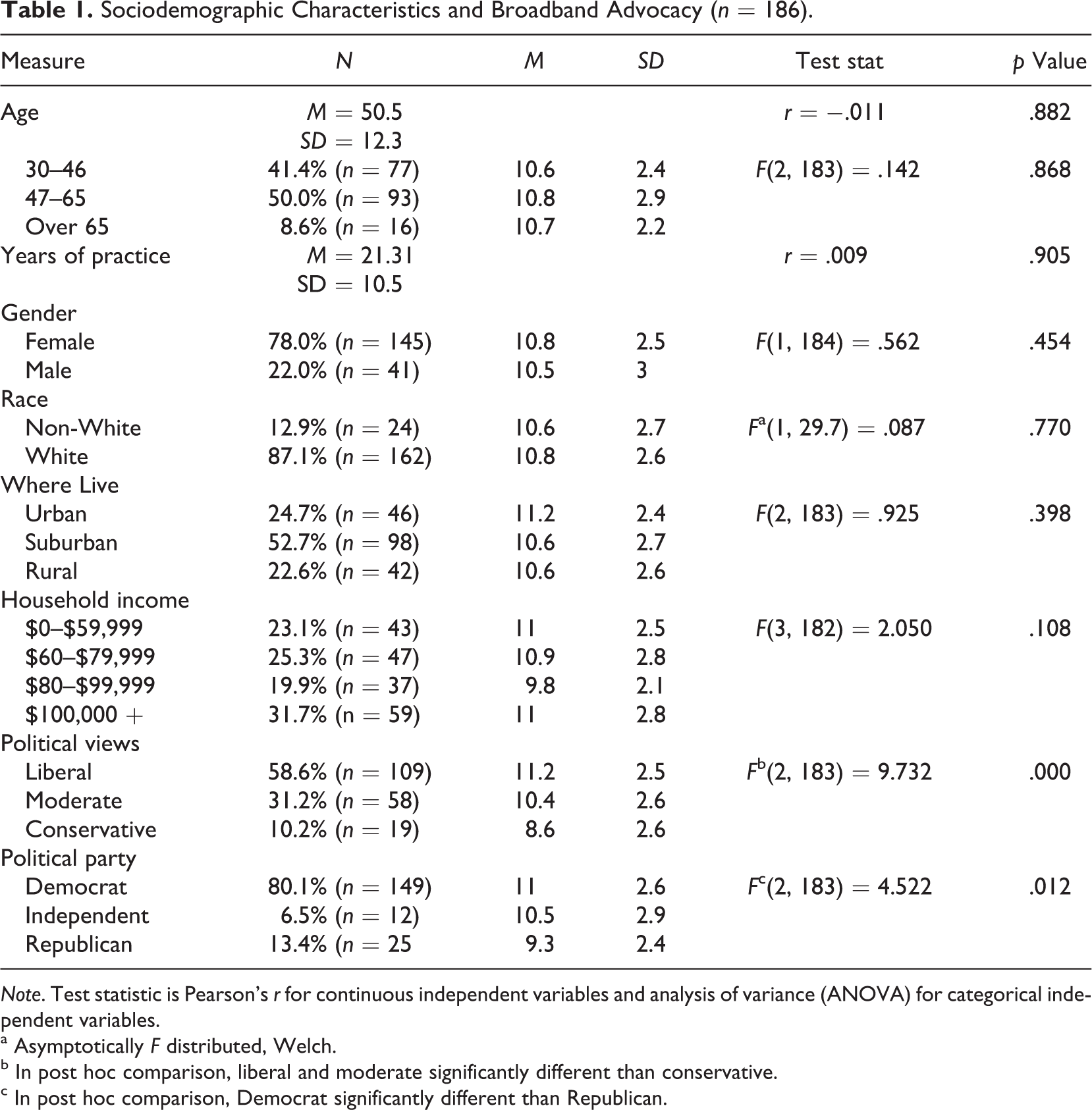
Note. Test statistic is Pearson’s r for continuous independent variables and analysis of variance (ANOVA) for categorical independent variables.
a Asymptotically F distributed, Welch.
b In post hoc comparison, liberal and moderate significantly different than conservative.
c In post hoc comparison, Democrat significantly different than Republican.
Bivariate Analyses
Respondents missing on one or more of the variables of interest varied significantly from those included in the final analysis in terms of age, overall ICT use, TAM score, and political party affiliation. Those with missing responses were older (n = 98, M = 55.2, SD = 10.7) than respondents (n =186, M = 50.5, SD = 12.3; t = −3.307, p = .002), reported using technology less (n = 77, M = 27.5, SD = 6.1) than respondents (n = 186, M = 29.2, SD = 6.1; t = 1.975, p = .050), and had lower TAM scores (n = 106, M = 56.2, SD = 10.7) than respondents (n =186, M = 59.3, SD = 8.6; t = 2.704, p = .007). A higher proportion of those with missing data on broadband access variables identified themselves as Republican, 24.2% vs. 13.4% of sample; χ2(2, n = 277) = 6.730, p = .035; and conservative, 20.4% vs. 10.2% of the sample; χ2(2, n = 284) = 9.821, p = .007. There were no significant differences in terms of broadband knowledge, gender, race/ethnicity, household income, or place of residence.
Scores on the broadband advocacy measures ranged from 3 to 15 (M = 10.7, SD = 2.6). Willingness to advocate for broadband access was positively correlated to knowledge and understanding of broadband (r = .460, p < .000), overall attitudes toward technology (r = .376, p < .000), and to overall ICT use (r = .288, p < .000).
Analysis of the relationship with political party using a one-way ANOVA, F(2, 183) = 4.522, p = .012, indicated that significant differences existed in willingness to advocate for broadband access along party lines. Post hoc comparisons using the Tukey honestly significant difference (HSD) test indicated that the mean score for those identifying as a Democrat (M = 11.0, SD = 2.6) was significantly higher than those identifying as Republican (M = 9.3, SD = 2.4), with p = .009. Independents did not differ significantly from either Democrats or Republicans. Analysis of political views and broadband advocacy using the categories liberal, moderate, and conservative found an even stronger relationship, F(2, 183) = 9.732, p = .000. Post hoc comparisons using the Tukey HSD test indicated that the mean score for those identifying as liberal (M = 11.2, SD = 2.5) was significantly higher than conservatives (M = 8.6, SD = 2.6) at the p = .000 level. Moderates (M = 10.4, SD = 2.6) were also statistically significantly higher than conservatives, with p = .015 (Table 2). No significant differences were found for the other demographic factors examined.
Scale Scores and Broadband Advocacy.
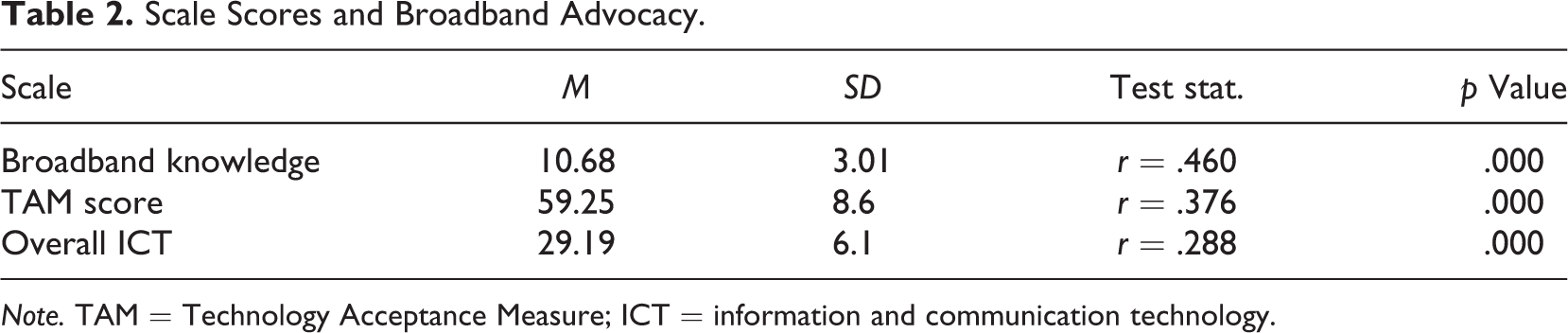
Note. TAM = Technology Acceptance Measure; ICT = information and communication technology.
Multivariate Analysis
Multivariate analysis was conducted using a standard multiple regression examining broadband advocacy as related to overall TAM score, broadband knowledge, overall ICT use, and political views after controlling for age, gender, race, and household income. Political party was eliminated from the model because it correlated too closely with political views. Preliminary analyses were conducted to ensure no violation of the assumptions of normality, linearity, multicollinearity, and homoscedasticity. The total variance explained by the model was 36.7%, with an F(11, 174) = 9.168, p < .000.
As demonstrated in Table 3, greater broadband knowledge, higher overall scores on both the TAM and ICT, and liberal political views (compared to conservative views) are significantly associated with greater willingness to advocate for broadband access, even after controlling for age, gender, race, and household income. Although significant in bivariate analysis, moderate political views are no longer statistically significant. Broadband knowledge explained the largest amount of variance (33.5%) followed by politically liberal views (28.0%).
Hierarchical Multivariate Linear Regression Results Predicting Willingness to Advocate for Broadband Access.a
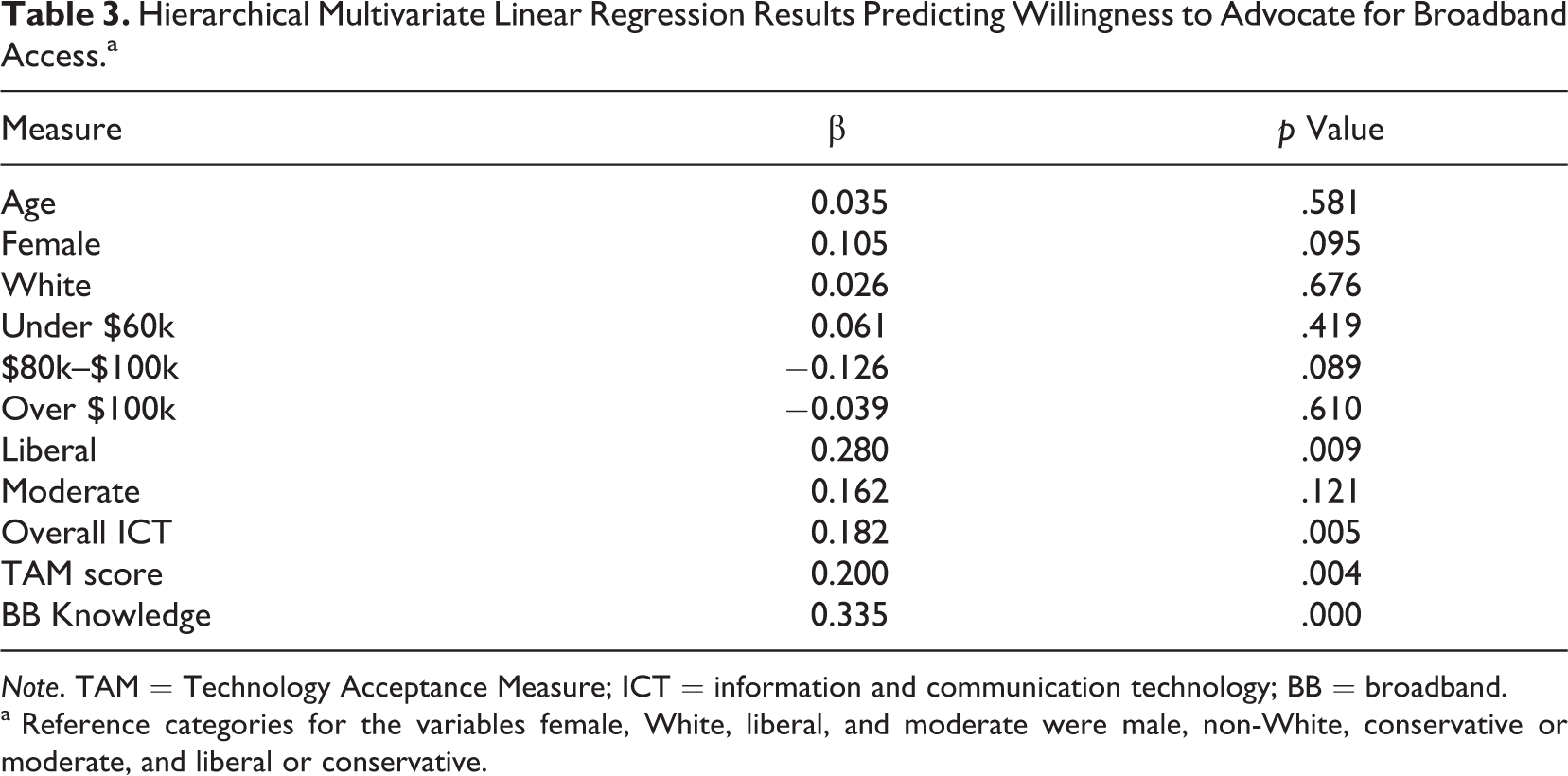
Note. TAM = Technology Acceptance Measure; ICT = information and communication technology; BB = broadband.
a Reference categories for the variables female, White, liberal, and moderate were male, non-White, conservative or moderate, and liberal or conservative.
Discussion
The findings indicate that broadband advocacy is moderated by personal and political characteristics and suggest, although further study is needed in this area, a more limited role for professional identity. They support hypotheses about the relationship between willingness to engage in broadband advocacy and political views, attitudes toward and use of technology, and understanding of broadband but did not support any of the hypotheses related to other sociodemographic information such as location, age, gender, race, or household income. These findings contribute to filling the gap in the literature on how personal characteristics and professional identities, here specifically among social workers, intersect with attitudes toward access elements of the digital divide.
At the same time, further research is needed to continue to explore how professional identity as a social worker intersects with attitudes toward broadband access. How, for example, do practice setting and specialization intersect with advocacy? Are social workers with macro specializations in community organizing or policy more likely to advocate for broadband access than interpersonal clinicians? A related area of further research is how client interactions may impact social worker’s attitudes. Are practitioners seeing the effects of a lack of access within their client populations? Are clients missing out on job opportunities, not accessing medical information, or having difficulty staying in touch with family members? Bringing experiences with clients into this research would move knowledge of the benefits of broadband beyond the self, and create a fuller picture of the role that professional identity has in access advocacy.
The results of the study demonstrated that understanding what broadband is, and how it differs from “narrow band” technologies like dial-up, was the most salient factor when it came to attitudes toward broadband advocacy. This would seem consistent with the basic idea that it is difficult to advocate for something you cannot even explain. Alongside understanding broadband technology specifically, overall use of, and attitudes toward technology broadly, also influenced advocacy. Those who reported using ICTs more often, and had more positive attitudes toward them, were more inclined to support access for others. If social work does have an antitechnology bias in practice, as the NASW itself has acknowledged (NASW, 2009), these findings indicate that it is possible that this bias is limiting the profession’s advocacy efforts on the issue of broadband access.
Social work must continue to move to embrace new technologies and develop competency with ICT. Perron et al. (2010) tie such competency to social work values and ethics, stating that competency with ICT “will position social workers at all levels of practice to help advance the lives of disenfranchised and disadvantaged persons through greater access to education, knowledge, and other resources” (p. 78). These results provide empirical evidence to support this assertion, demonstrating that familiarity with and use of ICT are directly linked to advocacy efforts to increase access to disenfranchised and disadvantaged persons. Further research is needed to understand more specifically what types of ICT use encourage advocacy. For example, are social workers who use more bandwidth intensive technologies like video-conferencing or voice over Internet protocols (VoIP) more likely to advocate for broadband access than those using basic e-mail?
Political views and political party affiliation also influenced willingness to advocate for broadband access, consistent with the literature on the position of broadband within political debates about the role of government and what sorts of goods can reasonably be categorized as “rights.” Indeed, as Johnson (2011) pointed out in Australia, wrapped up in the politics of broadband are “issue(s) ranging from neoliberalism, globalisation and social inclusion to conceptions of market failure and the rising power of Asia” (p. 3). Many of these issues were implicit in President Obama’s 2011 state of the union address, which in addition to pointing out the strides Asian nations have made in this area, addressed themes of social inclusion:
Within the next five years, we’ll make it possible for businesses to deploy the next generation of high-speed wireless coverage to 98 percent of all Americans. This isn’t just about faster Internet or fewer dropped calls. It’s about connecting every part of America to the digital age.
The NASW has used similar language in its own policy statements, declaring that the NASW (2009) supports “advocacy efforts for the efficiency and efficacy of technology on the profession and its clients” and “adequate resources to ensure the availability and accessibility of basic technology to all members of society, especially in rural and underserved areas” (p. 340).
Social work as a profession has often been assumed to operate from a more politically liberal perspective, even if this assumption is not often made explicit (Rosenwald, 2006). So for many, it is probably unsurprising that the NASWs policy statements align closely with a Democratic president’s remarks. However, as this study reinforced, social workers are not universally liberal. In the sample examined here, 58.6% identified as liberal, as compared with 31.2% moderate and 10.2% conservative. These findings are remarkably consistent with an examination of a similarly sized sample drawn from Maryland’s social work license board (n = 558, analytic sample = 294), where 55.2% ranked themselves somewhere between liberal and radical left, 34.4% moderate, and 10.4% indicated being conservative or very conservative (Rosewald, 2006). Rosenwald (2006) states that the conversation about political ideology in social work has been “barely audible” (p. 125), a position that has been echoed by the editor of the Journal of Social Work Education (Galambos, 2009). This study helps raise the level of that conversation, both by pointing out similar levels of political diversity and by highlighting potential areas of conflict between that political diversity and the policy positions of social work’s professional body. Social work must continue to dialog on issues of political tolerance within the profession (Galambos, 2009). How united social workers should be around policy issues with political overtones remains an open question and one worth considering directly.
Limitations
An important limitation on the findings presented here is that the items constituting the broadband advocacy score are new. While the items demonstrated a high degree of internal reliability, further psychometric testing should be conducted to examine whether these results are replicable.
Given the sample size and response rate, the results should be seen as relatively generalizable within the population of licensed social workers in Michigan, however, the particular analysis presented here was also potentially limited by the large number of respondents who either skipped or chose not to respond to relevant items (n = 111). Of this number, a significant portion were missing responses on one or both of the broadband specific items examined in this article, although a higher number (n = 64) were missing values on the broadband knowledge items than broadband advocacy scores (n = 35).
As discussed above, nonresponders on the broadband items were, as a group, more conservative. It is possible that this nonresponse bias could either overestimate or underestimate the relationship between political views and broadband advocacy. It is conceivable that the nonresponders would have added greater variation to the relatively small number of conservative responders and that the absence of this variability overstates the findings. However, it is also possible, and perhaps more probable, that the decision to not respond may itself have been influenced by political views, that more conservative individuals may have been disinclined to answer questions they perceived as politically liberal in nature, thus underestimating the true relationship between political views and broadband advocacy.
Conclusion
Social work at the grassroots level, despite its commitments to social justice and advocacy and professional policy positions, has not spoken with a clear and united voice when it comes to broadband access, instead breaking down over issues of personal understanding and political opinions. While this issue is not necessarily unique in that regard, and the profession has split politically around a variety of other controversial issues, this reality remains something that practitioners and educators must wrestle within the context of commitments to advocacy on behalf of oppressed populations and social justice. In a Howard University commencement address in the year 2000, then FCC Chairman William E. Kennard declared, “I believe that ensuring that all Americans have access to technology is the civil rights challenge of this new millennium.” Broadband is a key component of that access. However, over a decade into the new millennium, many licensed social workers in Michigan either were unaware of broadband and its benefits or saw this issue through politically tinged lenses. If a lack of access to broadband is indeed a form of social exclusion, social work must examine how it impacts clients, and continue to wrestle with how to respond as a profession.
Footnotes
Acknowledgment
The author would like to thank Dr. Amanda Woodward for her assistance in the preparation of this manuscript.
Declaration of Conflicting Interests
The author declared no potential conflicts of interest with respect to the research, authorship, and/or publication of this article.
Funding
The author disclosed receipt of the following financial support for the research, authorship, and/or publication of this article: This research was supported in part by funding from the Michigan State University School of Social Work.