




Abstract
Results of the present survey (n = 888) suggest that having strong social ties (or bonding social capital) fosters generalized trust, in support of conflict theory. There was no link between bridging social capital, or one’s more diverse ties, and trust. Facebook use was found to have an indirect but positive influence on trust through levels of bonding social capital. Civic engagement was also positively related to trust through the same measure of bonding social capital, allowing like-minded members of civic groups to connect, which spilled over to trust. Neither Facebook use nor civic engagement directly influenced generalized trust. This study suggests the viability of both physical (civic) and digital (Facebook) modes of reengaging trust in an ever-diversifying society. The “virtuous circle,” in which social trust and civic engagement prop one another up in a reciprocal fashion, instead looks like a figure eight here. Each measure indirectly boosted the other by first growing bonding social capital. When considered alongside divergent findings from Canada, this appears to be an American response to the increasing size of racial minority groups. Hispanic citizens make up the same portion of the American population as do all minority groups in Canada combined. These findings then represent a White reaction to an increasing Hispanic presence in America. Bounded solidarity in the form of strong, homogenous ties is shown as the path to trust in this setting.
Contact or Conflict?
America was founded as a melting pot, a country built by immigrants, and its citizenship continues to diversify. The 2010 census shows the largest increase has been in minority groups, with more than half of the U.S. population growth from 2000 to 2010 coming from the Hispanic demographic. The number of citizens who self-identify as Hispanic/Latino grew by 43% through the decade, moving from 35 million to more than 50 million (U.S. Census Bureau, 2011). The White population increased by 12.1 million in the same period, but this was mostly a function of Whites who also self-identify as Hispanic or Latino. The Asian population went from 10.2 million in 2000 to 14.7 million in 2010, currently 5% of the total population, while Black residents increased to 42 million, now 13.6% of the population (U.S. Census Bureau, 2011). To keep pace with this increasing multiculturalism, research has looked at the ways in which diversity can encourage, or undermine, social cohesion. In 2007, Robert Putnam asked whether an “increase in ethnic and social heterogeneity in virtually all advanced countries” would undermine feelings of trust (p. 137). What he found stateside was disheartening.
“The more ethnically diverse the people we live around, the less we trust” (Putnam, 2007, p. 147). Citizens withdraw in these diverse settings, and social anomie becomes the norm (Putnam, 2007). Not only do they trust less, but residents are also less inclined to join civic groups or volunteer their time, reducing their odds of interacting with their increasingly diverse neighbors (Costa & Kahn, 2003; Stolle, Soroka, & Johnston, 2008). They “hunker down—that is, to pull in like a turtle” (Putnam, 2007, p. 149). Residents feel less politically efficacious and less confident in their government (Costa & Kahn, 2003; Putnam, 2007). These tendencies echo the claims of conflict theory, where proximity to diverse others enhances the in-group/out-group distinction. Feelings of cooperation wane, replaced by perceived threat, and people stick closely to their own racial group (Oliver & Wong, 2003; Portes, 1998). In America, trust retreats in the face of diversity, and our neighbors regress into crude generalizations. Putnam (2007) believes, “The central challenge for modern, diversifying societies is to create a new, broader sense of ‘we’” (p. 139). To that end, Stolle and Harell (2013) found an exception to diversity’s negative influence on trust. Using the 2003 Canadian General Social Survey (GSS), more diversity in a social network undermined trust in every cohort but one—young adults. For 16- to 25-year-olds, contact with diverse others had a significant, sspositive influence on trust. Youth may provide the best opportunity for breaking the cycle, and the present study tests this using an American sample.
Young adults are highly active on social networking sites, and 18- to 29-year-olds are particularly well represented (Duggan & Brenner, 2012). These sites are good for creating and maintaining social connections, and young people are the most adaptable to these new technologies (Rogers, 2003). Facebook has specifically been linked to larger stores of bonding and bridging social capital—or to having more strong and weak ties at one’s disposal (Ellison, Steinfeld, & Lampe, 2007; Valenzuela, Park, & Kee, 2009). This is no accident, as the medium offers a cheap, reliable way of maintaining social ties (Rogers, 2003). Valenzuela, Park, and Kee (2009) also found a positive association between Facebook and trust, as avid users had more faith in the trustworthiness of the average person. Yet, this link didn’t hold in a recent replication study (Bouchillon, 2013). To pursue this tentative connection between new media and social capital, the present research asks whether Facebook’s influence on trust operates indirectly, promoting these feelings by first activating social ties through the site (Ellison et al., 2007). Measures for both similar and diverse social connections are included here, to explicitly test the claims of contact theory against those of conflict. Measures of civic engagement and Facebook use are also included, to discern whether social networking can have a similar influence on trust to that of community involvement. Ultimately, the mediating role of strong ties through sustained interaction is suggested, both online and offline, and the virtuous circle contorts its shape.
Trust and Diversity
Social Capital, as It Stands
Conceptually, social capital represents the individual connections a person holds. It takes a number of empirical forms, among them civic engagement, institutional trust, social connectedness, and social trust (Putnam, 2000; Zhang, Johnson, Seltzer, & Bichard, 2010). Collectively, these are the features of social life, the networks we construct “that facilitate coordination and cooperation for mutual benefit” (Putnam, 2007, p. 67). For Coleman (1998), social capital is best defined by its function. Above all else, it’s “productive, making possible the achievement of certain ends that in its absence would not be possible” (p. 98). It allows people to work together for the common good. Putnam (2000) earmarked generalized trust as a key indicator of social capital, the “lubricant” of social interaction (p. 135). This is trust, or distrust, in the average person; a belief in the notion that people, by and large, should be trusted. Trust in this form works to “sustain a cooperative social climate,” helping facilitate collective action (Zmerli & Newton, 2008, p. 706). Inversely, an absence of trust limits how efficacious civic efforts can be. The measure of generalized trust included here serves as a barometer for the climate of interaction—for how open people are to connecting. Volunteering and joining civic groups are the actualized forms of these feelings.
Bridging social capital is the strength of weak ties for Granovetter (1973), those heterogeneous social connections that link diverse individuals. Founded on the heterophily principle, weak ties exist between people who differ in some significant way. These differences are often racial but can also be in terms of the resources one can access (Nan Lin, 1999). Weak ties allow us to reach upward in the social structure, for goods that are otherwise out of reach (Lin & Dumin, 1986). Bridging social capital, the type that draws upon these weak ties, is thus important for “getting ahead” (De Souza, 1998, p. 11). It provides new information and life chances (Burt, 1992; Coleman, 1988). Bridging can even make the in-group/out-group distinction less salient, allowing trust to generalize beyond our present network. Bridging ties make us feel like part of a larger community, and bridging social capital represents our sustained interaction with diverse others (Bourdieu, 1986; Williams, 2006). These connections may exist between so-called weak ties, “but what they lack in depth they make up for in breadth,” as these linkages cleave “ethnic, racial, or religious boundaries” (Stolle et al., 2008, p. 60; Williams, 2006).
Bridging social capital is harder to grow than its counterpart of bonding social capital, or strong ties that reinforce a person’s identity in lieu of expanding it (Putnam, 2000). This bonding form of social capital is especially good at mobilizing solidarity among like-minded citizens, potent for building political dynasties. While “bridging social capital can generate broader identities and reciprocity,” bonding instead “bolsters our narrower selves” (Putnam, 2000, p. 22–23). It stems from the homophily principle, the assumption that strong ties link similar individuals. Bonding social capital binds together people of the same race, class, and political sentiment—those “who are alike” (Stolle et al., 2008, p. 60). A society of only bonding would be utterly fragmented, with disparate factions constantly in conflict (Putnam & Feldstein, 2003). Yet, bonding social capital needn’t always be bad, and familial ties are also of the bonded sort. Bonding becomes problematic only when it’s “superglued” to excess; that is, when bonding doesn’t lead to bridging, when mutual support and associations are restricted to a certain racial group (Putnam, 2000). Uslaner (2002) claims, “We bond with our friends and people like ourselves. We form bridges with people who are different from ourselves” (p. 27). Taken together, bridging and bonding social capital represent the diversity of one’s social ties, or a lack thereof.
Generalized Trust
Aside from being an indicator of macro-level social capital, generalized trust as a concept grew out of psychology and game theory. Succinctly defined as “the assured reliance of another’s integrity,” this definition is evident in prisoner’s dilemma experiments, a good example of trust in action (Held, 1968, p. 157). In these studies, two subjects are forced to work together without seeing the other. Each must stand trial for a crime. If one testifies against the other, the witness goes free while the partner gets a 3-year sentence. If both testify, they each get 2 years. If neither testifies, both get 1-year sentences. Trust in the prisoner’s dilemma setting then is the expectation that one’s accomplice will behave in a cooperative fashion, choosing not to testify. When the game is played only once, trust is in its generalized form, the belief that people can be trusted on aggregate. From this, I trust my unknown partner to act cooperatively and not testify, and I behave in a similar fashion, initiating a cycle of cooperation and trust. “If cooperators expect other people to cooperate—and experimental research suggests they do—they are more likely to engage in cooperative endeavors, setting in motion a ‘virtuous’ circle in which trust promotes cooperation and cooperation promotes trust” (Brehm & Rahn, 1997, p. 1002).
The measure of generalized trust often used an indicator of social capital dates back to Rosenberg (1957) and his “Faith in People” scale. The first of his trust questions is still the most widely used today, asking, “In general, would you say the average person can be trusted, or you can’t be too careful in dealing with people?” (Wrightsman, 1991, pp. 405–406). This measure of generalized trust is founded upon what Uslaner (2002) dubs moralistic trust, or faith in human nature from an optimistic worldview. “We can’t base trust in strangers on their trustworthiness, because there is no way for us to know whether they are honorable” (Uslaner, 2002, p. 15). Instead, moralistic trusters follow the Golden Rule, giving people the benefit of the doubt, presuming others are honorable without requiring proof. They trust, despite a lack of evidence that they should, and moralistic trust is thus a stable trait, “largely resistant to the ups and downs of daily life” (Uslaner, 2002, p. 25). Moralistic trust, and the generalized trust it underlies, both encompass trust in the “average” person, one who has become increasingly diverse. Two theories best account for this relationship between diversity and generalized trust.
Contact and Conflict
Contact theory asserts that as social networks grow more diverse, they become more tolerant and cohesive. “As we have more contact with people who are unlike us, we overcome our initial hesitation and ignorance and come to trust them” (Putnam, 2007, p. 141). Originating with Gordon Allport in the 50s, contact with diversity is thought to reduce feelings of racial prejudice (Allport, 1954). Through cooperative contact with diverse others, anxiety from interaction dissipates, and people come to empathize (Pettigrew & Tropp, 2008). An absence of direct contact with diversity reinforces feelings of prejudice. Under contact theory, it’s diverse interactions that bolster generalized trust, the sort that “transcends group boundaries,” while homogenous milieus undermine it (Stolle et al., 2008, p. 59). Contact theory was initially included within the social capital literature, until research began to suggest an alternative.
“For progressives, the contact theory is alluring, but I think it is fair to say that most empirical studies have tended to instead support the so-called conflict theory” (Putnam, 2007, p. 142). Conflict theory asserts that as neighborhoods grow more racially diverse, they trust less. Coming into contact with ethnoracial diversity causes feelings of threat, provoking “increased negative orientations toward those who are different” (Oliver & Wong, 2003; Stolle & Harell, 2013, p. 43). This “threat dynamic” undermines trust in the average person (Alesina & La Ferrara, 2002; Stolle et al., 2008). Increasing diversity at the community level, which would seem to carry with it greater potential for bridging social capital, has been negatively associated with generalized trust time and again (Alesina & La Ferrara, 2002; Costa & Kahn, 2003; Putnam, 2007; Stolle et al., 2008). Putnam (2007) finds residents in diverse neighbors trust everyone less, including those of their own race. He claims, “The more we are brought into physical proximity with people of another race or ethnic background, the more we stick to ‘our own’ and the less we trust the ‘other’” (Putnam, 2007, p. 142).
Too often, researchers simply assume contact with heterogeneous others from increasing levels of community diversity. But if the tendency is to isolate oneself and withdraw in such settings, then this isn’t an assumption we can make. As social capital must be maintained through the “unceasing effort of sociability,” the bonding/bridging distinction can offer a solution (Bourdieu, 1986, p. 250). Bonding and bridging capture both the diversity of our ties and the interactions that sustain them. So measures of bonding and bridging social capital don’t have to assume contact with diversity simply by way of proximity—they include the interactions directly. From the wealth of support conflict theory finds in past research, this study phrases its hypotheses expecting more of the same. Having diverse social ties should undermine trust, just as having homogenous ties should foster it. Bonding and bridging social capital are here used as measures of the similarity and diversity of ties one maintains.
Civic Engagement in the Community
The physical community has traditionally been the site of connecting. Joining civic groups and volunteering are often associated with trust in the literature, and taking active roles in the community allows people “to gain positive experiences with others, fostering global assessments of increased faith” (Brehm & Rahn, 1997; Putnam, 2000; Shah, 1998, p. 490). These measures prop one another up through the virtuous circle, as joiners come to trust through group interaction, and trusters join, self-selecting into more diverse civic groups (Stolle, 1998). Conceptually, civic engagement is distinct from political participation, referring instead “to people’s connections with the life of their communities” (Putnam, 1995, p. 665). Costa and Kahn (2003) call it group participation. Fukuyama (1995) refers to it as spontaneous sociability. Broadly, it’s an inclination for interacting, for going beyond one’s prescriptive ties to make new ones. Volunteering and holding memberships in civic groups serve as operationalized forms of this proclivity for engagement. Americans were historically joiners, and it follows, trusters, until both measures began to slump in the ‘60s (Putnam, 2000). Andersen, Curtis, and Grabb (2006) compared levels of engagement across four democracies—Canada, the Netherlands, the United Kingdom, and the United States—but only found them decreasing in America. “Members of any given generation are investing as much time in organizational activity as they ever were, but each successive generation is investing less” (Putnam, 2000, p. 62). The work of Paxton (1999) highlights similar declines in trust, and losses in the virtuous circle are in this way self-undermining. Declining memberships erode trust, and withering trust makes people less likely to join.
A number of studies have worked to better understand this virtuous circle. Shah (1998) found more-involved members of the community tend to trust, but trust doesn’t always lead them to join. Brehm and Rahn (1997) found support for both paths, but the more robust direction was from engagement to trust. Uslaner (2002) concurred, as greater trust tended to flow from civic engagement, “especially those forms that connect us to people who are different from ourselves” (p. 26). Stolle (1998, 2001) agreed, as she also found both paths to be significant, with engagement again having the stronger influence on trust. “Face-to-face interaction, positive and repeated cooperation experiences, and exchange within the group life are mentioned as necessary preconditions for social capital to thrive and to be productive” (Stolle, 1998, p. 501). Joining voluntary associations increases these interactions, allowing people to develop their social ties (Stolle, 1998). And these informal social ties are, in turn, a good predictor of generalized trust (Glanville, Andersson, & Paxton, 2013). Joining groups can offer sustained interpersonal involvement, and these “informal social interactions should increase one’s sense that other’s can be trusted” (Glanville et al., 2013, p. 3). This link between socialization and trust even held across seven different countries, as socializing more frequently led to an increase in generalized trust across all of them (Delhey & Newton, 2003). Civic groups afford us the social connections, and the process of connecting spills over to trust (Li, Pickles, & Savage, 2005; Putnam, 2000).
And the virtuous circle travels both ways, as trusters are also more inclined to join civic groups (Putnam, 2000; Stolle, 1998). Even before the decision to join groups, generalized trusters are more apt at converting everyday interactions into active social connections (Yamagishi & Yamagishi, 1994). People who trust are “more comfortable forming ties to others,” as trust provides the “booster power” for navigating social uncertainty, a veritable “springboard” for social network expansion (Glanville et al., 2013, p. 12; Yamagishi, Kikuchi, & Kosugi, 1999; Yamagishi & Yamagishi, 1994, p. 160). Generalized trust is especially critical for connecting with unknown others, and this “cognitive bias” toward believing in people can help broaden our social networks (Yamagishi et al., 1999, p. 157; Yamagishi & Yamgishi, 1994). New ties yield information benefits in the form of new opportunities (Burt, 1992; Coleman, 1988). For trust to drive engagement then, a person must make connections, and it’s through active social ties they hear about opportunities to engage and join groups (Burt, 1992; Granovetter, 1973). Abstract trust in mankind is well and good, but if the holder remains isolated and autonomous, new chances for joining never reach them. Trust that fails to connect never realizes its full potential (Granovetter, 1977; Uslaner, 2002).
Social ties are then both a precursor for and an outcome of trust and civic engagement—the veritable heart of the virtuous circle. The influence of joining on trust depends on connections activated within the group. “Free riders” who join only for the benefits of membership, doing as little as possible to contribute, don’t see gains in trust from this absence of connecting (Portes, 1998). And trusters who are isolated and withdrawn never stumble upon new opportunities for engagement either. They too fail to connect, and the information benefits of social capital are never realized for them (Coleman, 1988). Within conflict theory, gains in trust are a function of connecting with homogeneity, but under contact theory, trust comes from exposure to diversity. Civic groups can house both types of social ties, facilitating “the development of social networks” both similar and diverse (Jennings & Stoker, 2004, p. 343; Stolle, 1998). And trusting within everyday interactions can also extend a person’s social network, providing them with more strong and weak ties on which to draw (Uslaner, 2002; Yamagishi & Yamagishi, 1994). It stands to reason that the virtuous circle flows bidirectionally through the ties one maintains. To test this, both directions are considered at present—the path from civic engagement to trust through bonding and bridging, and the return, from trust to engagement mediated by these same measures. Results can suggest whether similar or diverse ties are more important for the virtuous circle, supporting either contact or conflict theory as it exists in the physical community.
Media’s Influence
Two decades ago, Putnam (1995) placed some of the blame for declining social capital on media forms that allowed for the individualizing of citizen leisure time. He found time spent reading the newspaper led to higher levels of trust and civic engagement, while time spent watching TV resulted in less of each (Putnam, 2000). Shah (1998) believed TV’s influence on social capital was contingent on what a person watched (p. 491). Watching social dramas like Law & Order fostered engagement in his study, while science-fiction programs undermined it (Shah, 1998). Watching sitcoms like Seinfeld and Friends heightened viewer trust, while total time spent in front of the TV eroded these feelings (Shah, 1998). Moy and Scheufele (2000) found watching hard news on TV could also hinder trust by depicting the world as a cruel, unforgiving place. Overall, results suggest that television’s influence depends on what the viewer consumes.
Putnam (2000) also cited the Internet as a possible source of increasing citizen autonomy, but “the tougher question is whether that flow of information itself fosters social capital and genuine community” (p. 172). Early results suggest it does, as study has linked Internet use to more engaged, more-trusting citizenry (Gil de Zuniga & Valenzuela, 2011; Shah, Kwak, & Holbert, 2001; Zhang et al., 2010). But like TV, the Internet also has a highly contextual relationship with social capital. Information exchange online—sending e-mails and doing research—encourages trust and joining (Shah et al., 2001). Using the Internet for gaming undercuts both measures of social capital. These Internet effects even hinge the age of the Internet user. For Generation X, information exchange online was the most important media variable for civic engagement, but it simultaneously undermined feelings of trust (Shah et al., 2001). For baby boomers, this same measure was a positive predictor of trust. And for the Civic Generation, information exchange online led them to join local groups (Shah et al., 2001). As it stands, social capital effects from mass media can vary not only by medium and content, but also with the age and the cultural upbringing of the consumer.
With the advent of social media, individuals can now interact with their acquaintances online, forging new ones by the very process. Which is to say, social networking sites have a part to play in social capital growth, allowing “individuals to develop norms of trust and reciprocity,” while also driving community involvement through social connections (Valenzuela et al., 2009, p. 877). Valenzuela et al. (2009) found Facebook can encourage people to join civic organizations, while joining groups on Facebook worked to galvanize political participation offline. Ellison, Steinfeld, and Lampe (2007) showed Facebook is also associated with larger amounts of bonding and bridging social capital, as avid users had more active social ties. Steinfeld, Ellison, and Lampe (2008) even demonstrated causation, as Facebook use at Time 1 predicted levels of bridging social capital a year later. The reverse didn’t hold, as bridging social capital was not a predictor of Facebook use longitudinally, further supporting the network’s causal role in the process of connecting. Facebook has even been linked to higher levels of generalized trust, suggesting the medium can provide for a cooperative social climate (Valenzuela et al., 2009). Still, this association didn’t appear in a replication study, as Facebook use was unrelated to trust in the present sample (Bouchillon, 2013).
To pursue this tentative link between Facebook and social capital, the present study asks whether the medium’s influence on trust operates indirectly, similar to that of civic engagement. Both modes of interaction allow for the formation of bonding and bridging social capital, one of which should spill over to trust, depending on whether contact or conflict finds support. The influence of diversity on trust “so prevalent in existing research can be mediated by social ties” (Stolle et al., 2008, p. 57). The present study looks at Facebook’s role in generating trust by way of diversifying connections. Facebook allows users to maintain strong and weak ties, but which type is more important for trusting? Under contact theory, bridging social capital would mediate this relationship, and connecting with diverse others online should pay dividends in generalized trust. But conflict theory asserts it’s by interacting with strong ties, and the absence of more diverse ones, that people come to trust. Thus, to support conflict, bonding social capital would mediate Facebook’s influence on trust.
Method
Sample
To address these hypotheses and research questions, a survey of undergraduate students at a major state university in the southwest was conducted. Existing research depicts college as a time of both crystallizing attitude opinions and broader socialization (Niemi & Hepburn, 1995). Assessing the influence of diversity on trust at this crucial time can suggest new directions for social capital theory. Stolle and Harell (2013) found diversity had a positive association with trust, but only within younger Canadian cohorts. In the present study, a convenience sample of American undergraduates was used to look for this association, to discern whether contact or conflict best explains the relationship between diversity and trust in the United States.
Links to the survey were distributed through undergraduate courses and e-mail LISTSERV at a state university in the southwest. Participants were directed to a 66-item self-administered survey through Qualtrics. Between January 21 and March 7 of this year, 957 students began the survey, with 913 completions. After culling those “click-through” respondents who took less than 2 min to complete the survey, and those who took more than 2 hr, a sample of 888 responses remained. The average response time was 15 min, with a trimmed mean of 11 min after removing outliers. Eight participants were chosen at random to receive US$25 cash as incentive for participation. The sample was 63.6% women and 35.1% men. In all, 18.7% were Hispanic or Latino, which resembles 2010 Census data, in which the U.S. population was 17% Hispanic/Latino (U.S. Census Bureau, 2012); 69.4% of respondents were White (Non-Hispanic or Latino), and this group is slightly overrepresented. Non-Hispanic Whites are currently 63% of the total U.S. population (U.S. Census Bureau, 2012); 5.5% of respondents were Black, and this group is underrepresented in the present study. Blacks make up 13.1% of the U.S. population (U.S. Census Bureau, 2012); 4.3% of respondents here were Asian, 2.6% were American Indians, and 0.2% were Native Hawaiians or Pacific islanders, all in line with census parameters (U.S. Census Bureau, 2012); 1.7% of the respondents were Biracial, which is also akin to census breakdowns (U.S. Census Bureau, 2012).
Independent Measures
Party ID and Strength of Partisanship
Both measures were drawn from the American National Election Studies (Weisberg, 1999, p. 685). Respondents were asked two questions. First, (a) Generally speaking, do you usually think of yourself as a Republican, an Independent, a Democrat, or what? The second question depended on respondent answers to the first. If they self-identified as Republican or Democrat, question (b) asked, Would you call yourself a strong (Republican/Democrat) or not a very strong (Republic/Democrat)? Those who identified as Independents were instead asked, (c) Do you think of yourself as closer to the Democrat or Republican party? Those respondents who identified as either “strong” Democrats or Republicans were coded as strongly partisan. Those who responded as “not very strong” constituents of these two parties were coded as weakly partisan. Finally, all Independents, including leaners, were coded as nonpartisan. These two measures—party ID and strength of partisanship—were represented with dummy variables in regression models.
Political Participation
Six items were drawn from the National Election Studies (Brady, 1999, p. 745). Respondents were asked whether in the past year they had (a) worked or volunteered for a political party or candidate, (b) worn a campaign button, put a bumper sticker on their car, or placed a campaign sign in their yard, (c) tried to persuade someone to vote for their preferred candidate, (d) attended a campaign function to support a candidate, (e) given money to a candidate or party, and (f) signed a petition for a cause or candidate. Responses were added together to create the summated political participation scale (Cronbach’s
Intensity of Facebook Usage
This study drew intensity of Facebook usage items from Ellison et al. (2007). Two self-reported assessments of Facebook behavior were first asked, measuring the respondent’s number of Facebook friends and the amount of time they spent on Facebook in a typical day. The first item read (a) about how many total Facebook friends do you have, and choices ranged from “10 or fewer friends” to “More than 400 friends” along an 8-point scale. The second item asked, (b) In the past week, on average, about how many minutes per day have you spent on Facebook? Choices fell along a 5-point scale, ranging from “less than 10 minutes” to “more than 3 hours.” Additionally, 6 attitudinal items were included to assess respondent sentiments toward Facebook along a 5-point Likert scale. These items stated (a) Facebook is part of my everyday activity, (b) I am proud to tell people I am on Facebook, (c) Facebook has become part of my daily routine, (d) I feel out of touch when I haven’t logged into Facebook for a day, (e) I feel I am part of the Facebook community at my campus, and (f) I would be sorry if Facebook shut down. As these items assessed Facebook usage along different response scales, individual items were first standardized before being averaged to create the intensity of Facebook usage index (Cronbach’s α = .84, M = .001, SD = .69).
Bonding Social Capital
This index came from Ellison et al. (2007), and responses to five statements were given on a 5-item Likert-type scale. The statements included (a) there are several people at (school) I can trust to solve my problems, (b) If I needed an emergency loan of $100, I know someone at (school) I can turn to, (c) There is someone at (school) I can turn to for advice about making very important decisions, (d) The people I interact with at (school) would be good job references for me, and (e) I do not know people at (school) well enough to get them to do anything important (reverse coded). Items a, b, c and d were averaged to create the bonding social capital scale (Cronbach’s
Bridging Social Capital
These items also come from Ellison et al. (2007). Responses to 9 items were recorded on a 5-point Likert-type scale. The statements were (a) I feel I am part of the (school) community, (b) I am interested in what goes on at (school), (c) (school) is a good place to be, (d) I would be willing to contribute money to (school) after graduation, (e) interacting with people at (school) makes me want to try new things, (f) Interacting with people at (school) makes me feel like a part of a larger community, (g) I am willing to spend time to support general (school) activities, (h) At (school), I come into contact with new people all the time, and (i) Interacting with people at (school) reminds me that everyone in the world is connected. Responses were average to create the bridging social capital index (Cronbach’s
Dependent Measures
Civic Engagement
Items were drawn from Putnam (2000), measuring respondent involvement in the community across five areas: doing volunteer work, working on a community project, contributing money to a social group or cause, working on behalf of a social group or cause, and going to a community or neighborhood meeting. Where Putnam plotted responses across an 8-item Likert scale, this was truncated for the present research. Respondents were asked to report how frequently they engaged in each activity along a 5-point Likert-type scale ranging from never, once, once a month, once a week, to everyday. Responses were combined to form the civic engagement scale (Cronbach’s
Generalized Trust
This index comes from Valenzuela et al. (2009), who adapted the original Faith in People scale (Rosenberg, 1957). This generalized faith in others was measured across 6 items using a 5-point scale from 1 (never) to 5 (all of the time). The statements were (a) generally speaking, would you say that people can be trusted, (b) People try to take advantage of you if they get the chance (reverse coded), (c) People try to be fair, (d) You can’t be too careful in dealing with people (reverse coded), (e) People try to be helpful, and (f) people are just looking out for themselves (reverse coded). Responses were averaged to create an index of generalized trust (Cronbach’s
Results
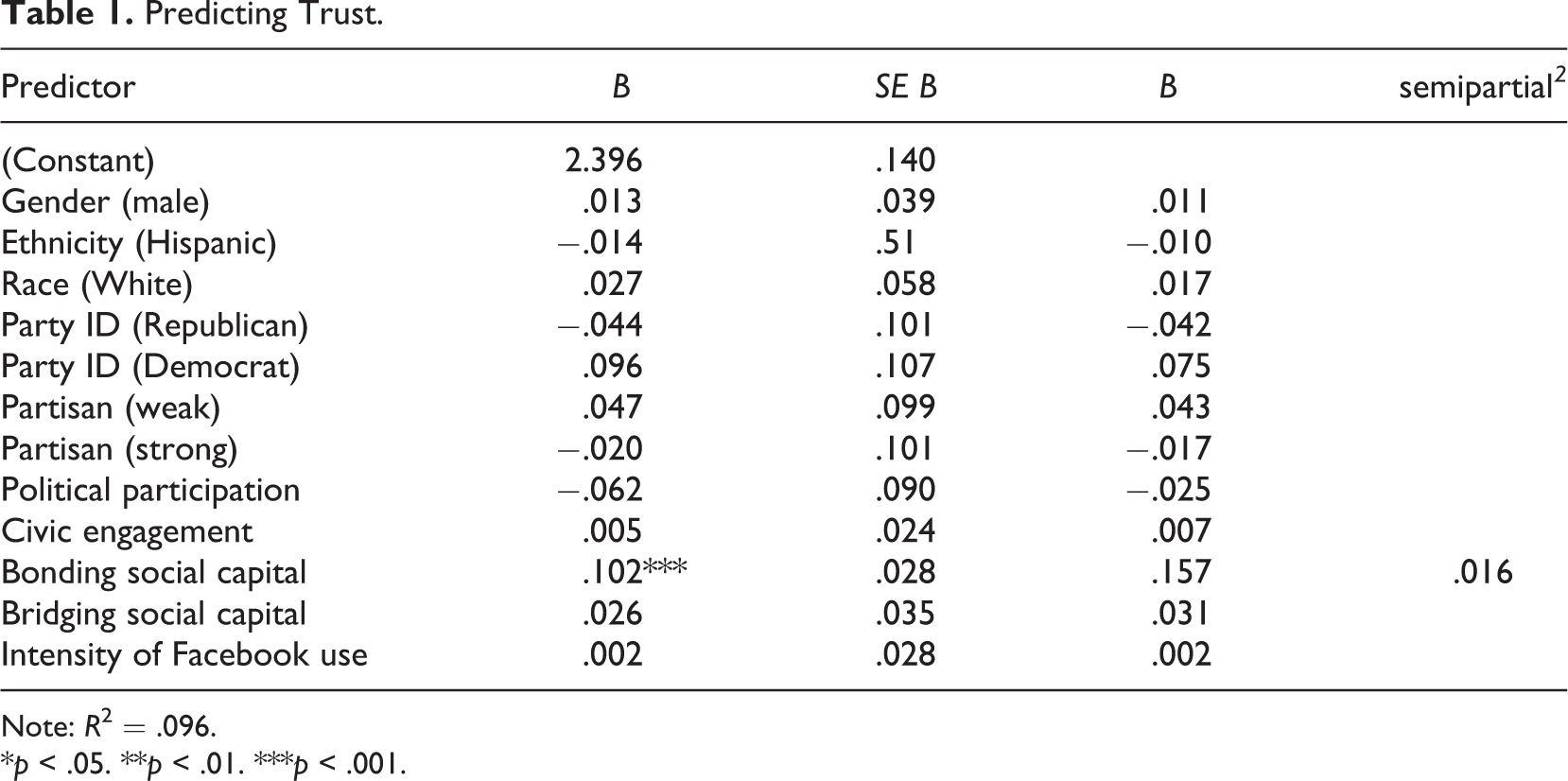
Hypothesis 1 theorized that after controlling for demographic, political, and social capital variables in the full model, bridging social capital would be negatively associated with generalized trust. A multiple regression analysis was conducted, and results indicate that bridging capital is not related to generalized trust (B = .026, p = .459). Hypothesis 1 is not supported, as having more diverse social connections did not influence generalized trust in the present sample. Table 1 presents an index of the full regression.
Predicting Trust.
Note: R 2 = .096.
*p < .05. **p < .01. ***p < .001.
Hypothesis 2 asserted that bonding social capital would be positively related to generalized trust in the full model. Results of the forced entry regression suggest that bonding social capital did have a positive association with generalized trust, after controlling for demographic, political, and social capital variables (B = .102, p < .001). Hypothesis 2 finds support, and having more homogenous social connections is associated with higher levels of generalized trust (see Table 1).
Hypothesis 3 believed civic engagement would be positively related to generalized trust. To address this, a multiple regression analysis was used. There was not a significant relationship between civic engagement and generalized trust (B = .005, p = .849). Hypothesis 3 is not supported (see Table 1).
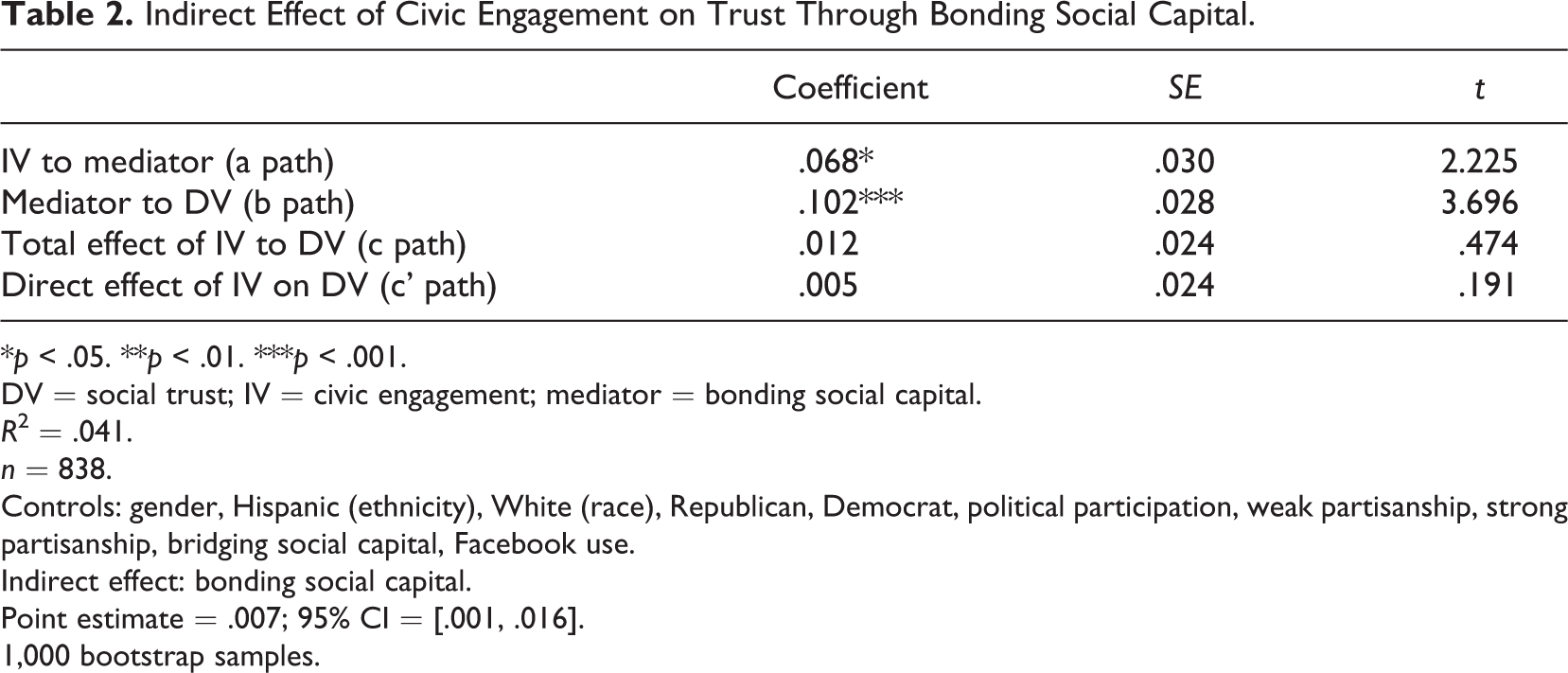
Research Question 1 asked whether civic engagement indirectly influenced generalized trust through (a) bonding or (b) bridging social capital. To discern the mediating influence of bonding social capital (Research Question 1a), the INDIRECT macro was used (Preacher & Hayes, 2008). Controls for demographics, party ID, political partisanship and participation, bridging social capital, and Facebook use were included. Results suggest civic engagement did not have a significant total effect on generalized trust (B = .012, p = .636). However, results do show civic engagement had a significant indirect effect on generalized trust through bonding social capital. Individuals who are more active in their communities develop larger stores of active strong ties, which is associated with an increase in generalized trust (point estimate = .007, 95% confidence interval [CI]: [.001, .016]). The indirect effect is presented in Table 2.
Indirect Effect of Civic Engagement on Trust Through Bonding Social Capital.
*p < .05. **p < .01. ***p < .001. DV = social trust; IV = civic engagement; mediator = bonding social capital.
R 2 = .041.
n = 838.
Controls: gender, Hispanic (ethnicity), White (race), Republican, Democrat, political participation, weak partisanship, strong partisanship, bridging social capital, Facebook use.
Indirect effect: bonding social capital.
Point estimate = .007; 95% CI = [.001, .016].
1,000 bootstrap samples.
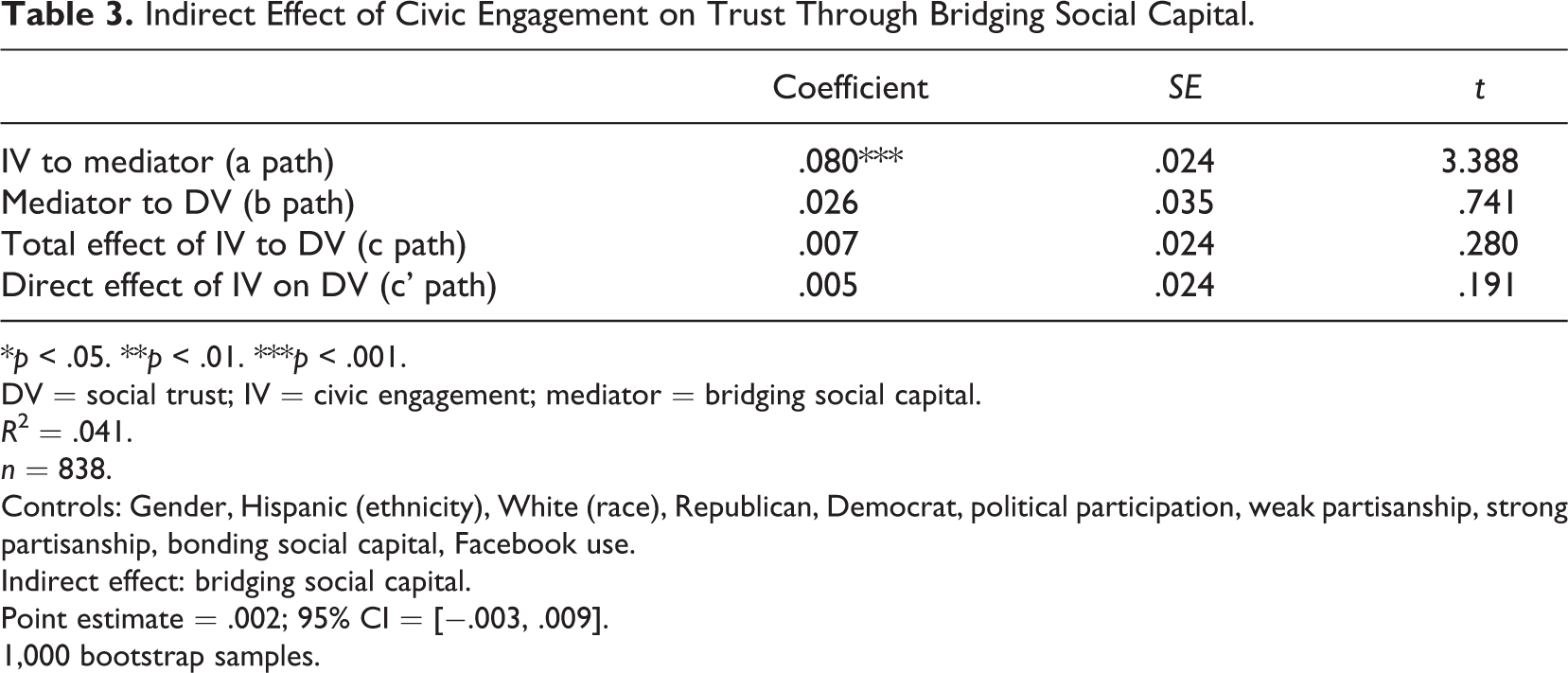
To answer Research Question 1b, or whether bridging social capital mediated the link between civic engagement and trust, the INDIRECT macro was again used. Using the same covariates, civic engagement did not have a significant total effect on generalized trust (B = .007, p = .780). Civic engagement did not have a significant indirect effect on trust through bridging social capital either. Although individuals who participate more readily in their physical communities do form more diverse social connections, this was not associated with an increase in generalized trust (point estimate = .002, 95% CI: [−.003, .009]). Results are presented in Table 3.
Indirect Effect of Civic Engagement on Trust Through Bridging Social Capital.
*p < .05. **p < .01. ***p < .001. DV = social trust; IV = civic engagement; mediator = bridging social capital.
R 2 = .041.
n = 838.
Controls: Gender, Hispanic (ethnicity), White (race), Republican, Democrat, political participation, weak partisanship, strong partisanship, bonding social capital, Facebook use.
Indirect effect: bridging social capital.
Point estimate = .002; 95% CI = [−.003, .009].
1,000 bootstrap samples.
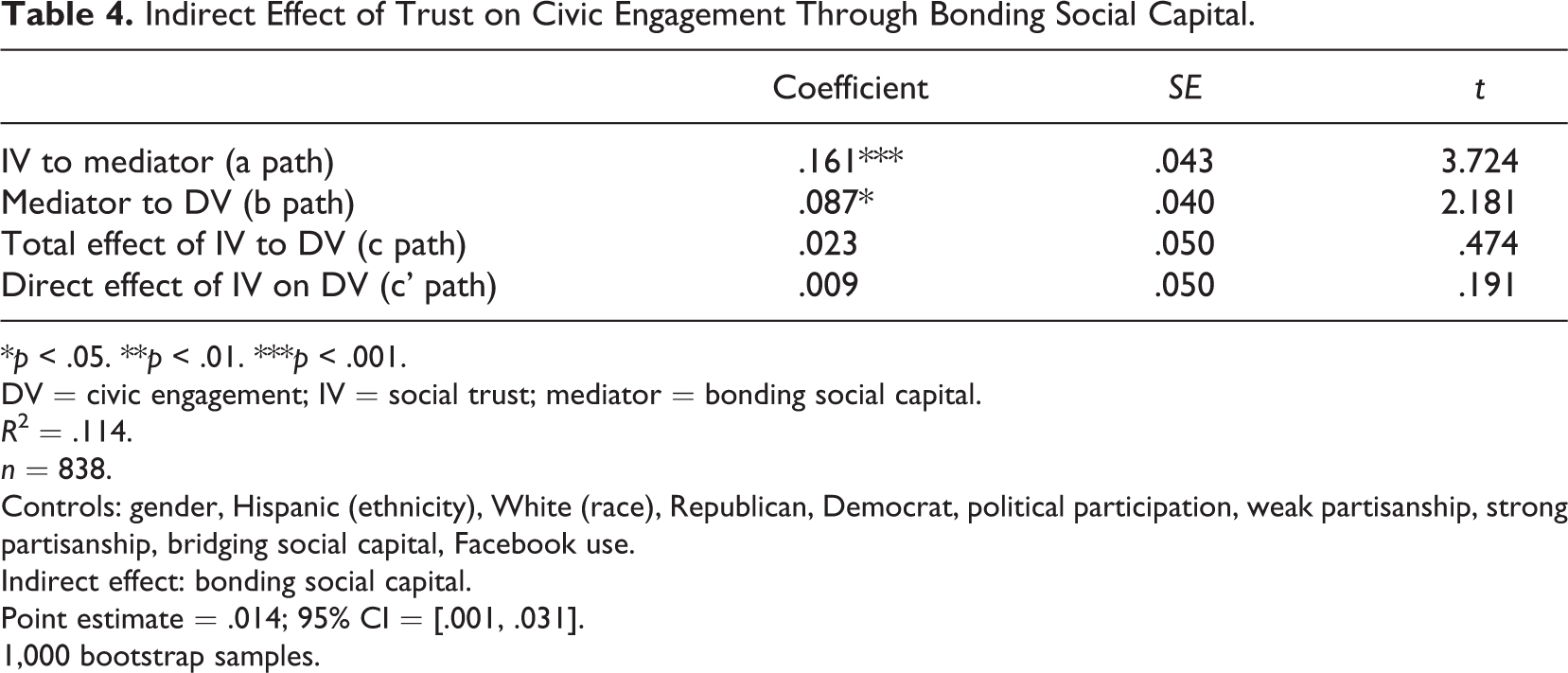
Research Question 2 tested the inverse of Research Question 1, asking whether (a) bonding or (b) bridging social capital also mediated the path from trust to engagement. Research Question 2a focused on bonding social capital as a potential mediator, and after controlling for demographics, party ID, political partisanship and participation, bridging social capital, and Facebook use, results of the INDIRECT macro show generalized trust did not have a significant total effect on civic engagement (B = .023, p = .636). Yet, trust did have an indirect effect on civic engagement through bonding social capital. Individuals who are more trusting of the average person form more strong ties, which are associated with an increase in civic engagement (point estimate = .014, 95% CI: [.001, .031). Table 4 presents the indirect results.
Indirect Effect of Trust on Civic Engagement Through Bonding Social Capital.
*p < .05. **p < .01. ***p < .001.
DV = civic engagement; IV = social trust; mediator = bonding social capital.
R 2 = .114.
n = 838.
Controls: gender, Hispanic (ethnicity), White (race), Republican, Democrat, political participation, weak partisanship, strong partisanship, bridging social capital, Facebook use.
Indirect effect: bonding social capital.
Point estimate = .014; 95% CI = [.001, .031].
1,000 bootstrap samples.
To answer Research Question 2b, or if bridging social capital mediated the path from social trust to civic engagement, the INDIRECT macro was used. After including controls, social trust did not have a significant total effect on civic engagement (B = .014, p = .780). Trust did not have an indirect effect on engagement through bridging social capital either. Individuals who are more socially trusting do enjoy larger stores of bridging social capital, holding more diverse ties, but this is not associated with an increase in civic engagement (point estimate = .004, 95% CI: [−.07, .019]). Table 5 provides an index of the indirect test.
Indirect Effect of Trust on Civic Engagement Through Bridging Social Capital.
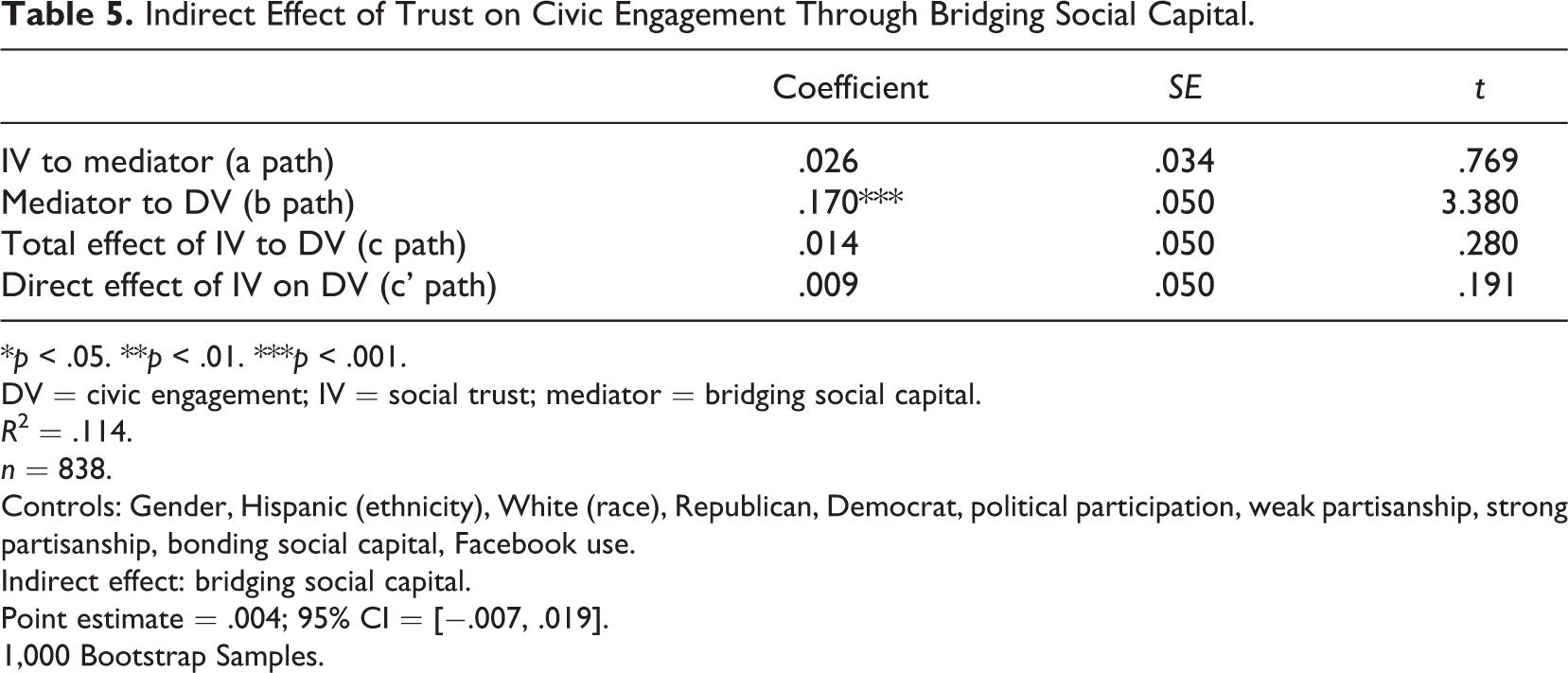
*p < .05. **p < .01. ***p < .001.
DV = civic engagement; IV = social trust; mediator = bridging social capital.
R 2 = .114.
n = 838.
Controls: Gender, Hispanic (ethnicity), White (race), Republican, Democrat, political participation, weak partisanship, strong partisanship, bonding social capital, Facebook use.
Indirect effect: bridging social capital.
Point estimate = .004; 95% CI = [−.007, .019].
1,000 Bootstrap Samples.
Research Question 3 asked whether Facebook use indirectly influenced social trust through (a) bonding or (b) bridging social capital. To address Research Question 3a, or the mediating influence of bonding capital, the INDIRECT macro was used. After controlling for demographics, party ID, political partisanship and participation, civic engagement, and bridging social capital, results indicate that intensity of Facebook use did not have a significant total effect on generalized trust (B = .018, p = .510). However, results do suggest that intensity of Facebook use has a significant indirect effect on trust through bonding social capital. That is, more avid Facebook users grow larger stores of bonding social capital, developing their strong ties, which is associated with an increase in generalized trust (point estimate = .017, 95% CI: [.008, .031]). Table 6 presents the indirect effect.
Indirect Effect of Facebook Usage on Trust Through Bonding Social Capital.

*p < .05. **p < .01. ***p < .001.
Note. DV = social trust; IV = Facebook usage; Mediator = bonding social capital.
R 2 = .041.
n = 838.
Controls: Gender, Hispanic (Ethnicity), White (Race), Republican, Democrat, political participation, weak partisanship, strong partisanship, civic engagement, bridging social capital.
Indirect effect: bonding social capital.
Point estimate = .017; 95% CI: [.008, .031].
1,000 bootstrap samples.
Finally, the INDIRECT macro was used to pinpoint any indirect link between Facebook use and generalized trust through bridging social capital (Research Question 3b). After including the covariates, results indicate that intensity of Facebook usage did not have a significant total effect on trust (B = .004, p = .879). Facebook use did not have an indirect effect on generalized trust through bridging social capital either. More frequent Facebook users did grow their bridging social ties by using the network, but this was not associated with gains in generalized trust (point estimate = .002, CI: [−.003, .011). Table 7 depicts the results.
Indirect Effect of Facebook Usage on Trust through Bridging Social Capital.

*p < .05. **p < .01. ***p < .001.
DV = social trust; IV = Facebook usage; mediator = bridging social capital.
R 2 = .041.
n = 838.
Controls: gender, Hispanic (ethnicity), White (race), Republican, Democrat, political participation, weak partisanship, strong partisanship, civic engagement, bonding social capital.
Indirect effect: bridging social capital.
Point estimate = .002; 95% CI: [−.003, .011].
1,000 bootstrap samples.
Discussion
In the present study, interacting with strong ties was the path to generalized trust. The reason appears grounded in conflict theory, as the lack of a “threat” dynamic from reduced exposure to diversity allowed bonding social capitalists to trust in the average person. This could be a function of varying perceptions of who the average person actually is. Surrounded by strong, homogeneous ties, we come to perceive of the world as not so different, not so diverse, allowing trust to generalize beyond those who we interact with at present. While Uslaner (2002) claims generalized trust measures “how inclusive your moral community is,” it may instead measure how similar I perceive the “average person” to be to myself (p. 27). That is, bonding social capitalists are more likely to think of themselves as the average person, and holding mostly strong ties can make the world seem like a uniform place (Burt, 1992; Granovetter, 1977). Walling oneself off in this way allows trust to bloom, even within diverse settings where one minority group is especially salient. Yet, the benefits these strong ties offer “in terms of increased social harmony may come at the cost of making, in the long run, the melting pot fail, possibly countervailing any short run increase in trust” (Alesina & La Ferrara, 2002, p. 213). Here, homogenous connections indeed spur an increase in trust, but whether these gains are “short run” remains to be seen. Overall, conflict theory finds support, but only in the positive influence of homogeneity on trust. Increased interactions with diversity did nothing to undermine trust, as conflict theory claims it should, or to foster trust, as contact theory asserts it does.
It’s interesting that for Stolle and Harell (2013), social network diversity fostered trust within 16- to 25-year-old respondents. But in the present study, bridging social capital was unrelated to trust within a similar age group. Their measure of network diversity asked about contact with friends from a “visibly different” race over the past month (Stolle & Harell, 2013, p. 49). The bonding/bridging measures used here tap into more sustained interactions with social ties, even those who aren’t necessarily “friends,” but who can still be mobilized on our behalf. These findings then differ from past results as a function of the difference between social network diversity and bonding/bridging social capital, or between those who we consider to be our friends and those who we interact with more generally. Also, Stolle and Harell used the 2003 Canadian GSS to draw their conclusions. But Canada was, and is, a mostly homogenous country in terms of racial and ethnic groups (Canadian Council on Social Development [CCSD], 2001; Statistics Canada, 2011). At the time of the 2003 GSS, only 13.4% of Canadian residents were from a visible minority group, compared to the United States where Hispanics alone are 16.3% of the population (CCSD, 2001; U.S. Census Bureau, 2011). Even if we add in the Canadian Aboriginal population (3.3% of the total population), the percentage of visible minority groups in Canada is still nearly identical to the percentage of Hispanics in America alone (CCSD, 2001; U.S. Census Bureau, 2011). Minority groups are more salient in the United States, and one minority group (Hispanics) has the same visibility as do all the minority groups in Canada combined. While interactions with diverse friends can grow trust during youth in Canada, homogenous ties are more important for generalizing trust during youth stateside. This is likely a function of out-group size. Interacting with diversity may lead to generalized trust, but only in those societies in which the visibility of diverse others is limited. In communities where diversity is more apparent, where certain minority groups are more salient in everyday life, bonding is the path to generalized trust. In Canada, contact theory describes the relationship between diversity and trust for young people; while in America, conflict theory is the prevailing tendency. Results suggest the melting pot has soured, now brewing a vat of bounded solidarity in which strong ties give one the means to trust.
The virtuous circle, or the notion that trust and civic engagement reinforce one another, looks somewhat distended here. There was no direct influence of engagement on trust or vice versa, but both indirect effects, when channeled through bonding social capital, were significant. More trusting individuals grow larger stores of both bridging and bonding social capital, but bonding is what leads them to engage in their communities. At the same time, individuals who are more active in their communities similarly grow their bonding and bridging social capital; but again, strong ties are the ones with a spillover effect on generalized trust. The virtuous circle may instead be a figure eight, and the mutual benefits of engagement and trust here depend on the mediating influence of bonding social capital. Participating in one’s community no longer drives trust; and trusters are no longer joiners, at least within this sample. Yet, trusters who augment their social connections with strong ties take more active roles in their physical communities. And more involved members of the community form strong ties through their involvements, learning to trust.
Facebook can indirectly grow levels of trust as well, in a similar fashion to that of civic engagement. While neither measure directly fostered trust, more active members in the community and on Facebook grew their social ties through these modes of connecting. Strong ties in the form of bonding social capital were the more important type for generalizing trust, supporting aspects of conflict theory both online and offline. Whether younger generations are more inclined to foster connections through social media than within their physical community remains to be seen. But sites like Facebook do make it easier for introverted users to step outside their comfort zones and interact (Donath & Boyd, 2004; Steinfeld, Ellison, & Lampe, 2008). Like the physical community, social networking sites are thus a crucible for connecting, and it follows, for social capital. Despite Putnam’s fears about the Internet as a potentially individualizing medium, social networking can supplement, not supplant, our connections. Still, it’s homogenous ties that serve as a boon to trust, especially in social settings where distinct minority groups are more noticeable. Vital questions about how to square increasing diversity with trust remain.
Limitations and Future Directions
The present study uses a volunteer sample of college undergraduates, and these findings do not generalize. Supporting these results within a broader, more representative sample is the next step, one that includes a wider swath of age groups and ethnicities. Longitudinal data will ultimately be necessary to show social media's causal influence on social capital. As the current model accounts for only 10% of the variance in generalized trust, there are other latent predictors of trust not included here. Once these other variables are incorporated into regression models, significance levels identified in the present study are subject to change. Another limitation is that bonding and bridging social capital needn’t be mutually exclusive. Putnam asserts a positive association between the two, and research has supported this (Ellison et al., 2007). Controlling for the influence of bonding when measuring the mediating potential of bridging, and vice versa, speaks to this limitation. But the overriding relationship between homogeneity and diversity—whether growing strong ties leads us to develop weak ties, or instead crowds them out—is an open question.
Non-Hispanic Whites are slightly overrepresented here, while Blacks are underrepresented. Still, this remains a diverse sample, as the overall percentage of visible minorities within the sample is akin to U.S. Census data for the broader population (U.S. Census Bureau, 2012). Here, diverse contacts had no effect on generalized trust, and this may be a function of the sample. Both the sample and the college from which it’s drawn are diverse, but mostly in terms of one group—Hispanics. Bonding may be the path to generalized trust when one minority group is far and away the most visible in the community, as a possible response to the threat dynamic. Oliver and Wong (2003) claim, “A superordinate group (e.g. whites) becomes more racially hostile as the size of a proximate subordinate group increases, which putatively threatens the former’s economic and social privilege” (p. 568). The findings in the present study then represent a mostly white response to an increasing Hispanic presence. Bounded solidarity, and the bonding social capital it entails, is a likely response in such two-group settings (Portes, 1998). And walling oneself off by way of strong ties overrides the threat dynamic here, leading to generalized trust.
The present study contributes both physical (civic) and digital (Facebook) modes of reengaging trust, though each operates more indirectly than previously thought (Putnam, 2000; Valenzuela et al., 2009). The use of structural equation modeling to map the influence of physical and digital forms of connecting on generalized trust would prove beneficial, and bringing in a measure of particular trust bounded to distinct racial groups could further contextualize these findings. And as new social networking sites emerge daily, keeping tabs on which sites provide the best opportunity for connecting, for growing social capital, is no small task. Facebook’s influence on social capital doesn’t generalize to other social networking sites, as each medium is unique in the way in which it fosters connections. The influence of other new media forms on social capital is yet to be seen.
Footnotes
Declaration of Conflicting Interests
The author declared no potential conflicts of interest with respect to the research, authorship, and/or publication of this article.
Funding
The author received no financial support for the research, authorship, and/or publication of this article.