




Abstract
In a very short time span, Twitter has become a major force in modern societies and also in the production of news by journalists. How journalists use Twitter is studied extensively, particularly on a small scale (i.e., qualitative research, specific events, mostly descriptive). However, studies on how Twitter has impacted journalism as a whole are relatively scarce. This study focuses on the adoption of Twitter and its emerging community network structure in the Netherlands. Using the social network data of 2,152 journalists as retrieved from Twitter, analysis shows that the social network among journalists is well connected. The journalists who are extremely popular are also able to influence the flow of information through the network more than others (cf. gatekeeper role). Still, even though gatekeeping positions in the network are present due to the absence of specific relations, and the network consists of eight tightly knit network communities, the entire network is very well connected. The adoption of Twitter as a microblogging and networking service over time indicated that adoption increased particularly in early 2009. The possible consequences of these tightly knit communities for the production of news are discussed in terms of pack journalism, echo chambers, and information cascades.
Introduction: Changing Journalism
Journalism has always been and still is a field in which technology is an integral part (Pavlik, 2000). One of the latest tools journalists have embraced is Twitter. It is considered an important instrument for the rapid diffusion of news, whether by media professionals, such as journalists, or ordinary citizens, illustrated by numerous examples, such as the airplane crash in the Hudson River (Beaumont, 2009), the earthquake and tsunami in Japan 2011 (Sakaki, Okazaki, & Matsuo, 2010), and the London riots of 2011 (Vis, 2013). Most of the Twitter posts about these unforeseen events were generated by citizens often present at or interested in the event. Picked up by journalists, these news facts are distributed across the Twitter sphere at enormous speed. Twitter is also used for live coverage of planned major occasions—such as court sessions (where cameras—at least in the Netherlands—are often not allowed), sports’ events (e.g., the Olympic Games, Eurovision song contest)—as well as minor events. It shows that Twitter is a very important tool for the distribution of news. It now seems almost unthinkable for journalists to do without some kind of microblogging tool. Apart from using Twitter to tap into society’s professional and amateur news sources, journalists can use Twitter to stay updated on their peers’ and colleagues’ activities and opinions. Twitter then serves as a tool for peer reference to measure one’s own opinions and behavior against that of one’s professional peers. As such, journalists develop networks of professional sources and peers to help and guide them in their daily work. Specifically, this study focuses on journalists’ online social networks to uncover (a) journalists’ online social networks, (b) determine the strategic positions journalists occupy online, enabling them to affect the flow of information, and (c) the existence of journalistic communities of interest.
The Dutch news media system operates at the national, regional (i.e., provincial), and local level (i.e., municipalities). There are three major publishers (Telegraaf Media Groep, Mecom, and De Persgroep) having 86.2% of the entire readership market (Dutch Media Authority, 2013, p. 63). There are nine national newspaper titles to choose from at the national level (circulation: 1.855.182). At the regional and local level (18 titles, circulation: 1.198.591), there is mostly one dominant publisher issuing only one regional newspaper title (Dutch Media Authority, 2013, p. 68; Het Oplage Instituut, 2013). News on television is provided by Public Service Broadcasting (PBS) (NOS Journaal) and commercial stations (RTL Nieuws and Hart van Nederland). In the newspaper industry, the decline in subscriptions starts in the 70s of the last century and is exacerbated by the rise of the Internet. Newspaper publishers mostly fail to increase, or at least stabilize, the number of subscribers of newspapers. Newspaper publishers try to counterattack the decline in readership by introducing e-papers and apps for smartphones and tablet, using different subscription models. However, data show that these cannot yet compensate for the decline in readership (Dutch Media Authority, 2013). At the same time, some newspaper publishers suffered considerable financial losses due to takeovers by venture capitalists (PCM by APAX, cf. Gerechtshof Amsterdam, 2010) or companies public companies (Wegener by Mecom, cf. Sweney, 2012). On the Internet, there are three dominant news sites: NU.nl (Sanoma), Telegraaf.nl (Telegraaf Media Groep), and NOS.nl (PBS NOS; Dutch Media Authority, 2013).
Network Journalism and Social Media
The aforementioned developments led to financial cutbacks, downsizing in human capital and mergers, particularly of newspaper publishers and newspaper titles, leading to increased job mobility and increased self-employment among journalists. The consequences for journalists were that the news organization as such, as an employer having a long-lasting relation with the journalist, became less relevant. It also involved new ways of working, such as no longer being confined to the boundaries of the organization. This shift from vertical integration to horizontal (cf. Castells, 2010) on the network enterprise and the transformation of work), particularly at the individual level of the employee, ultimately led to a shift from enterprise journalism to network journalism: journalists are no longer part of a traditional and continuing professional community clearly delineated by the boundaries of a news enterprise and a specific medium. Instead, even though social networks were always part of a journalist’s daily work but in a limited way (Anderson, Bell, & Shirky, 2012, p. 32–33), journalists’ network relations grew and transcend these traditional organizational boundaries (Castells, 2010; Edstrom & Ladendorf, 2012). This process is increased because of the aforementioned increased level of self-employed journalists taking (multiple) assignments from different news organizations. Nevertheless, these journalists are still members of professional groups that are considered as sharing certain values and norms, even though the level of professionalism in journalism is still a debated issue (see McQuail, 2013).
Despite the many definitions of network journalism (cf. Bardoel & Deuze, 2001; Beckett, 2010; Jarvis, 2006; Wardle & Williams, 2008), some common ground is found in these, such as collaboration, linking and connecting, sharing, focus on process, interactivity, convergence of core competencies, and empowering the audience. These definitions refer to the elements that constitute what we now know as Web 2.0—the ability to share information easily, to connect to others online, and to collaborate across great geographical distances over the Net, among others (see Cormode & Krishnamurthy, 2008). Other studies that focus on networks in journalism look at how news stories are connected on the web through hyperlinking (Tremayne, 2004). These perspectives on network journalism draw their inspiration, to some extent, from social capital theory (Bourdieu, 1986; Coleman, 1988) and its applications to the online realm of personal and professional resources (Hess, 2013).
Some (cf. Kwak, Lee, Park, & Moon, 2010) question whether Twitter is either a news medium or a social network. Hermida (2010), on the other hand, argues that the use of social media (e.g., Twitter) creates an awareness system—an “always-on system”—leading to a mental model of news and events that surround people in general and journalists in particular. In this context, the value lies not in the individual tweet but in the mental portrayal based on many tweets over time. A good example of how Twitter may serve as an awareness system is the study by Meraz and Papacharissi (2013) on the 2011 Egyptian protests, using tweets to reconstruct communication networks as well as assessing the framing of events during the protests. Others perform what is known as semantic network analysis on Twitter data (cf. Cho & Shin, 2014), quantitative content analysis (semantic network analysis) using the network approach (cf. Vergeer, Lim, & Park, 2011), while others use a ethnographic network approach on the development of a news story (Anderson, 2010). Although we underline that Twitter can be seen as a news medium, an awareness system, and a semantic network, in our study we will specifically look at Twitter from a social network perspective: A core social network that can be used as an infrastructure by which communication and information can be disseminated much like the conversational communication model (cf. Bordewijk & Van Kaam, 1986) that differs from traditional news media using mass distribution from a central point (cf. allocution model by Bordewijk & Van Kaam, 1986). However, before continuing, we will first outline how the network approach has been applied to journalism as network journalism.
Journalists as Peers and Sources in Networks
Apart from the awareness system metaphor for Twitter, social media are characterized by their social networking capabilities. Connecting is a fundamental element of the Internet, and especially social media, not merely hyperlinking between webpages on different websites or sending status update into the Twitter sphere is essential, it also entails connecting to significant others (e.g., one’s peers, the audience, or a community). The special case of connecting with other journalists (one’s peers) can be viewed from two perspectives—professional orientations and social capital theory.
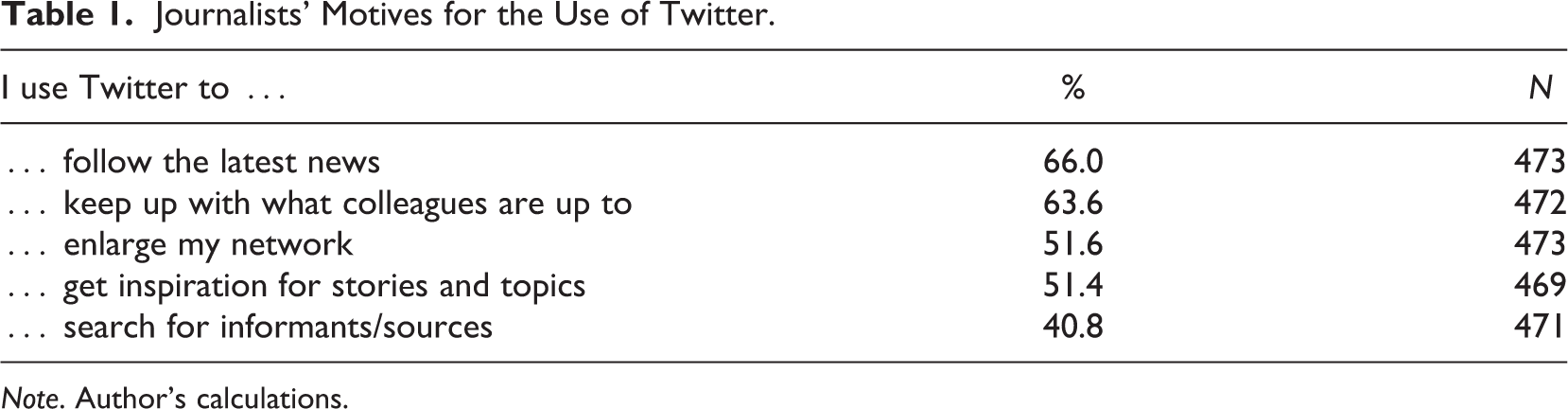
Donsbach (2004) distinguishes three types of orientations journalists have on other journalists. The first of these involves social interaction on the job; the second one involves observing what other journalists publish, thus providing a reference on what is news and what is not. The third orientation—an extension of the first—involves social interaction among journalists outside of their own news organization. These three orientations view journalists as peers for guidance in evaluating their journalistic decisions and behavior in the news production process. Empirical evidence concerning these orientations can be derived from a survey among Dutch journalists on their motives for using Twitter in the news production process (Hermans, Vergeer, & Pleijter, 2011). Of those who use Twitter (i.e., 47.6% of the sample), journalists indicated using Twitter predominantly to track the latest news (66.0%; see Table 1), implying the use of Twitter as a news medium. However, it is notable that the second most often mentioned motive for the use of Twitter is keeping informed on other journalists’ activities (63.6%). This use of Twitter refers to tracking journalists as a news source or as peers for guidance or reference. So, if peers as reference groups or as sources are considered as important motives for journalists to use Twitter, the question is how the multitude of journalistic relations on Twitter shapes the online social network of journalists in the Netherlands.
Journalists’ Motives for the Use of Twitter.
Note. Author’s calculations.
For people to join the professional group of journalists, some kind of socialization needs to take place. This secondary socialization process can occur in several stages (McQuail, 2013; Singer, 2004). The first stage of professional socialization takes place during vocational training (e.g., schools of journalism) where students are educated to become journalists. Vocational training is not the only way, and not even mandatory in the Netherlands: 41.4% of journalists have had vocational training in their profession (Hermans, Vergeer, & Pleijter, 2011). The second stage involves on-the-job training. It involves learning “best practice” routines within the news organization from their professional colleagues. As McQuail (2013, p. 162) states, their work environment socializes journalists in terms of the requirements and expectations of the workplace and the culture of the news organization. At the same time, journalists discuss and evaluate news decisions, which in the long run will result in more or less stable patterns of action on how to produce news. This is substantiated in research by Gravengaard and Rimestad (2012) on news production—for example, in editorial meetings or on the work floor—as well as after news production (e.g., pointing out factual errors to each other). After having had vocational training and training on the job, journalists still can keep track of other journalists’ activities for the aforementioned guidance but also for competitive reasons. The question then is how these connections create and shape the entire journalistic network of social relations.
Journalistic connections can be considered ties between people that can act as sources for reference and for news. To make sense of these relations, I refer to social capital theory (Bourdieu, 1986; Coleman, 1988). Particularly Coleman’s and Putnam’s approach to social capital (based on the rational choice theory) is applicable to this field. Putnam (2000, p. 22) distinguishes between bridging and bonding relations where bonding refers to strong—mostly reciprocal—relations between people within certain homogeneous groups; bridging refers to weaker ties between people of different tightly knit groups. Bonding coincides with having a strong feeling of common identity with the group one belongs to, maybe even ties that are taken for granted (cf. Tönnies’ Gemeinschaft, 2010). In journalism, this identity may refer to a professional identity in several ways. One such group may be delineated by the boundaries of the news organization, having a long-standing history, particularly when having a strong reputation (cf. quality newspapers). Other types of groups may be based on the professional identity by being a (specific type) journalist as safeguard for society or by having the identity derived from the geographical community for which one works or in which one resides. The distinction in bonding and bridging by Putnam is important because it is applicable to the question where social capital is located. Coleman argues that social capital is located in close ties and tight networks, where actors bond and have a shared identity. Burt (2001), on the other hand, argues that it is particularly the weak ties that can act as bridges between groups and communities constitute as social capital (cf. Granovetter, 1973).
Given the vast amount of material available through the Internet, one would expect journalists to search for sources from everywhere. However, to journalists not all sources are equal. Journalists have professional needs for specific information that not all sources can provide and not all sources are equally trustworthy. Furthermore, research has shown that people’s networks show strong indications of assortative mixing: people are more likely to connect to other people who are similar than to people who are dissimilar to them (McPherson, Smith-Lovin, & Cook, 2001). These communities may provide many benefits (cf. Coleman’s aforementioned conceptualization of social capital), such as efficiency through information and news provided by trusted sources (cf. Putnam, 2000), collaboration, increase in experience, and the wisdom of the crowds, for instance in wiki production (Keegan, Gergle, & Contractor, 2013). These communities may take different forms. Communities can be seen as social groups that share a particular commonality. For instance, journalists—at least the traditional ones—mostly share values and norms on how journalism and news production should take place. The organizational community consists of journalists who work for the same organization, sharing the mission of that news organization to produce news that fits the identity and reputation of the news organization. The geographical community refers to journalists working in and for a specific region with specific interests typical of that region. Basically, these communities can all be seen as special cases of communities of interest.
Network Positions and the Dissemination of News
Given the existence of bridging and bonding ties, what are the implications for the production of news? First of all, these ties can serve as channels for the flow of information: Several scholars of social capital mention information provision or diffusion as an important aspect of social capital (Burt, 1999; Coleman, 1988; Lin, 1999). According to Lin (1999, p. 31), social capital facilitates the flow of information for opportunities and choices. Depending on the structure of networks, specific nodes can utilize information in a certain way to achieve certain goals (Burt, 1999; Hess, 2013). This can take place in a number of ways. The first way to disseminate information is when a journalist is very popular and “center stage”: these journalists have a large following (indegree) on Twitter resulting in a potentially large reach of their tweets. Basically, this is similar to the mass media model in which an instance is at the center and reaches an enormous audience at once and directly (cf. the allocution model by Bordewijk & Van Kaam, 1986). The work of Barabási and Albert (1999) on networks suggests that the distribution of the indegree across journalists, resembling a power law function, indicates the presence of preferential attachment in a growing network, producing scale-free networks. In scale-free networks, the probability of connecting with others does not follow the uniform or normal distribution but increases with a higher indegree of the node with whom to connect. This results in “the rich gets richer” phenomenon and ultimately to a network centered on a few popular journalists. This process ultimately should result in the power law distribution of the indegree. The second type of position is the so-called structural hole in the network: nodes (e.g., journalists) in this position can utilize the absence of relations between its neighbors to his or her own benefit. This is called brokerage and can be typified by the tertius strategy, “(…) induce and exploit competition or rivalry between the two others who are not directly related” (Burt, 2001; De Nooy, Mrvar, & Batagelj, 2011, p. 167; Hess, 2013). One of the types of brokerage is the gatekeeper role of journalists: nodes occupying a particular position in the network (i.e., betweenness) have the power to halt information and prevent it from flowing any further through the network or alter the information in such a way that it is transferred in a transformed manner (Shoemaker & Vos, 2009; White & Borgatti, 1994).
This study aims to create more insight into how in the hands of journalists Twitter creates a network structure that may affect how journalists produce news. The particular focus is on journalists’ professional social networks, being the social infrastructure that carries the flows of communication and information. To locate the sources of power, we will look at individual positions of journalists in terms of prestige and brokerage (gatekeeping and betweenness) but also at structural differences between media types and journalistic communities. We will look at specific positions journalists hold in the network, and which global and local structures emerge. In that respect, this study will focus on the structural aspects of the networks and ignore the actual content that may be distributed between these journalists using these networks. We will conclude the empirical analysis with a longitudinal analysis of how these community networks have grown over time.
Data
Sample
Using Twitter’s Application Programming Interface (API) (cf. Sams, Lim, & Park, 2011), network data from journalists’ Twitter accounts were collected in late 2012 by sampling well-known and highly visible journalists on Twitter. This initial sample was subsequently used to find additional less prominent, less well-known journalists. Because the API delivers the entire ego network for each journalist including nonjournalists, nonjournalists were removed from the sample. To identify Twitter users as journalists, we analyzed their profile description by looking for indications whether the person is working in the news producing industry (e.g., indicated by words such as “journalist,” “reporter,” “editor,” “news,” and other synonyms thereof). This means that this network consists of people who publicly presented themselves online as working in the news industry.
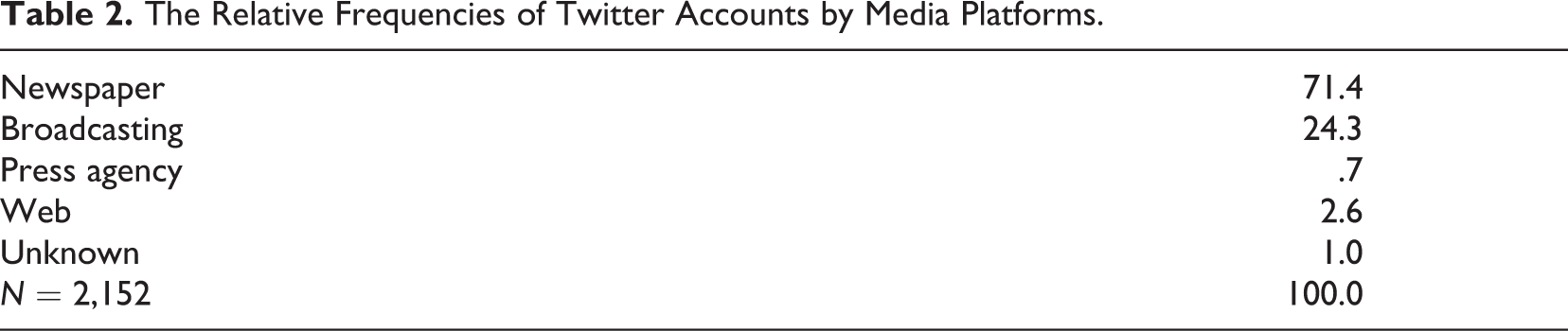
Table 2 shows the relative distribution of journalists across media types listed, showing that the vast majority of journalists on Twitter works for newspapers (71.4%). Broadcasting makes up 24.3% of all Twitter accounts. Journalists working exclusively for the web make up only 2.6%, and journalists working for one of the Dutch press agencies are less than 1%.
The Relative Frequencies of Twitter Accounts by Media Platforms.
Measurements and Method
The entire network is analyzed using social network analysis software Pajek64 3.12 (Batagelj & Mrvar, s.d.; De Nooy et al., 2011), UCINET 6 (Borgatti, Everett, & Freeman, 2002), Statistical Package for the Social Sciences 21, and R 3.03.
The centrality measurements for network positions are the following. To assess the popularity of journalists in the network is determined by the indegree, which in this case is the number of followers of the journalists. Proximity prestige is also based on the indegree but takes into account indirect relations and the distances of these relations. To examine the existence of structural holes in the network (i.e., the neighbors of a journalist are themselves unconnected), we will look at the aggregated constraints of journalists. To assess the gatekeeper position, we use betweenness centrality, which determines a vertex’s proportion of all geodesics (i.e., shortest path between two vertices) which includes this vertex. The higher this proportion, the more exclusively the information needs to pass through this vertex.
To assess to what extent there is a process of preferential attachment shaping the network, we assess whether the network relations conform to the power law function, using Gillespie’s (2013) R poweRlaw package.
Although it is very difficult to assess to what extent follower–following relations on Twitter are bridging or bonding relations, it is possible to assess whether there are tightly knit communities in a larger network. In order to do this, we use two methods: to assess the extent of assortative mixing (homophily), we calculate the E-I index (Krackhardt & Stern, 1988) for each news organization, as implemented in UCINET 6. To search for tightly knit communities, we use VOSmapping as implemented in Pajek (Van Eck, Waltman, Dekker, & Van Den Berg, 2010).
Results
General Network Characteristics
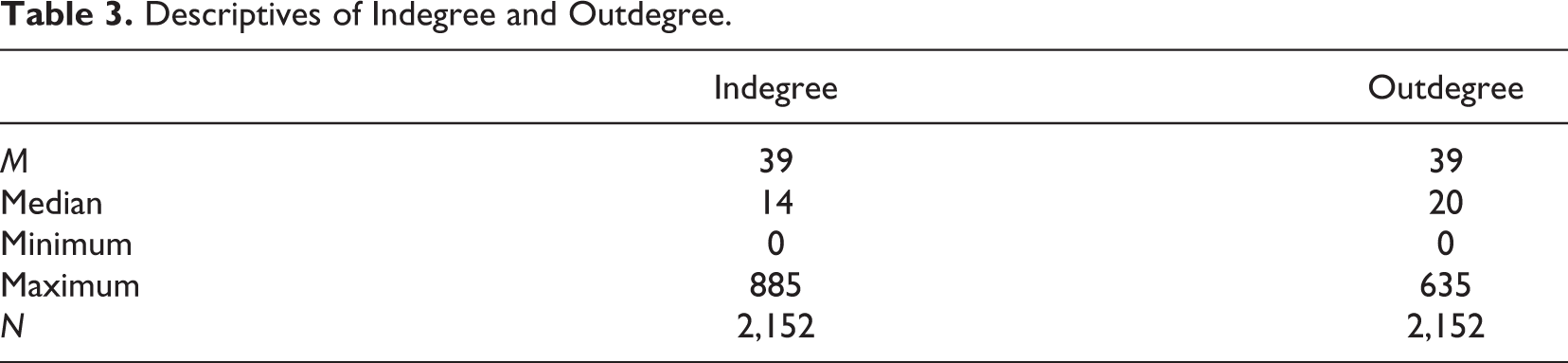
The Twitter network of 2,152 Dutch journalists from 146 news organizations consists of 84,103 relations. Table 3 shows the general network characteristics of the journalists’ online network. The indegree has a mean of 39 and a median indegree of 14, while the average outdegree is 39 and the median outdegree is 20. The density of the network is .018 meaning that 1.8% of all possible connections between journalists are actually present. This seems low. However, this network is strongly connected: 89.2% of journalists belong to a single strong component, meaning that they are at least directly or indirectly connected to other journalists. At the organizational level, the network is fully connected (i.e., a single strongly connected component). This implies that there is a considerable chance that information can find its way through the entire network of journalists: Information (i.e., a tweet) originating from one journalist potentially can reach almost 90% by retweeting.
Descriptives of Indegree and Outdegree.
As demonstrated frequently, distributions of the hyperlinks on websites approximate a so-called power law distribution (Barabási & Albert, 1999). A power law distribution
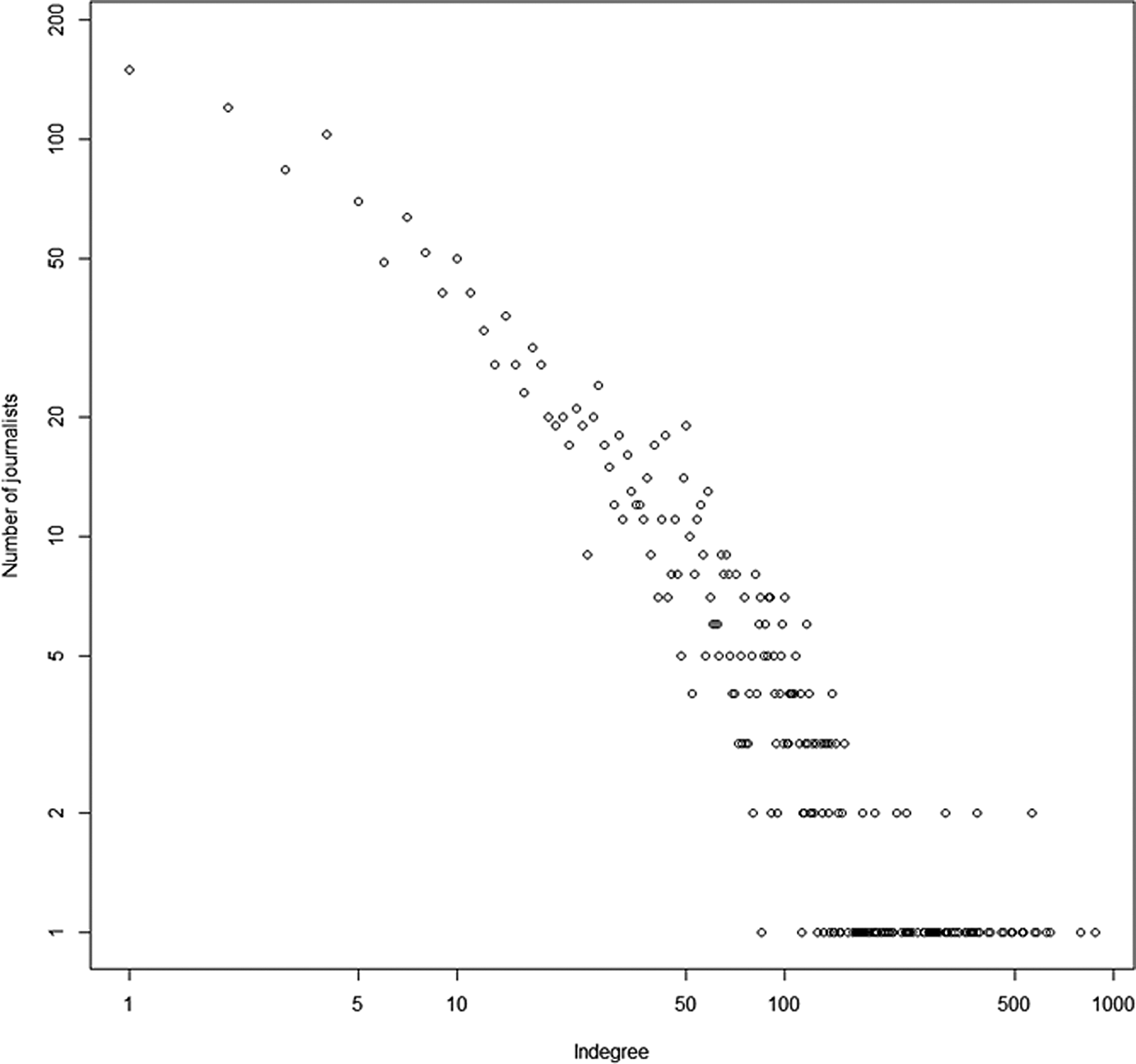
Distribution of indegree of journalists on Twitter.
The Power to Influence the Flow of Information
To assess to what degree journalists can control information, we look at their indegree and proximity prestige, whether there are so-called structural holes that could be utilized for their own benefit and particularly their betweenness position.
The journalists most followed by their peers (see Figure 2) are Bert Wagendorp (Volkskrant), Eelco Bosch van Rosenthal (NOS), Sylvia Witteman (Volkskrant), Rob Wijnberg (NRC.Next), Erik Mouthaan (RTL), Sascha de Boer (NOS), Jos Heymans (RTL), and Philip Remarque (Volkskrant). These are predominantly journalists working for large and reputable newspapers and television news programs. Journalists working for other smaller news organizations are considerably less popular. The large number of outliers of newspaper and broadcasting journalists indicates that for these groups a heavy-tailed distribution is present. The indegree distribution for journalists in the branches of press agency and the web show less heavy-tailed distributions. This suggests that journalists who work for large news organizations also attract more followers than journalists working for smaller organizations, as such replicating the economic power of news organizations in the social media realm.
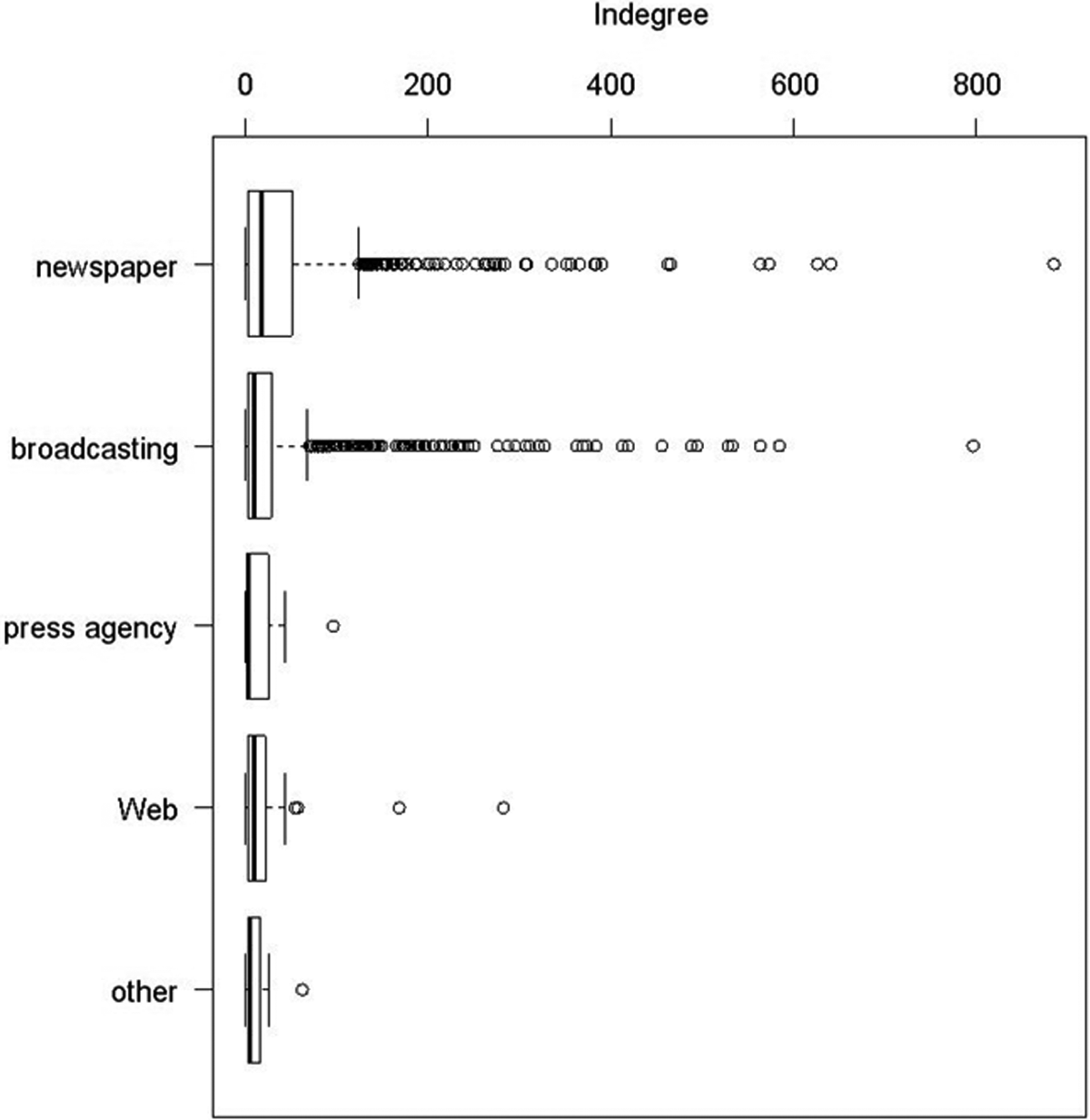
Indegree of journalists by media platforms.
Looking at the most prestigious journalists (Figure 3, cf. proximity prestige), we see that these are only found in newspapers and broadcasting. Most striking is that some of the most prestigious journalists are newspaper columnists (e.g., Bert Wagendorp, Sylvia Witteman). Other prestigious newspaper journalists are political TV journalist Jos Heymans (RTL) and Natalie Righton (correspondent in Afghanistan). In broadcasting, there only two notable extreme prestigious journalists, political TV journalist Frits Wester (RTL) and TV journalist Edo Bosch van Rosenthal (NOS).
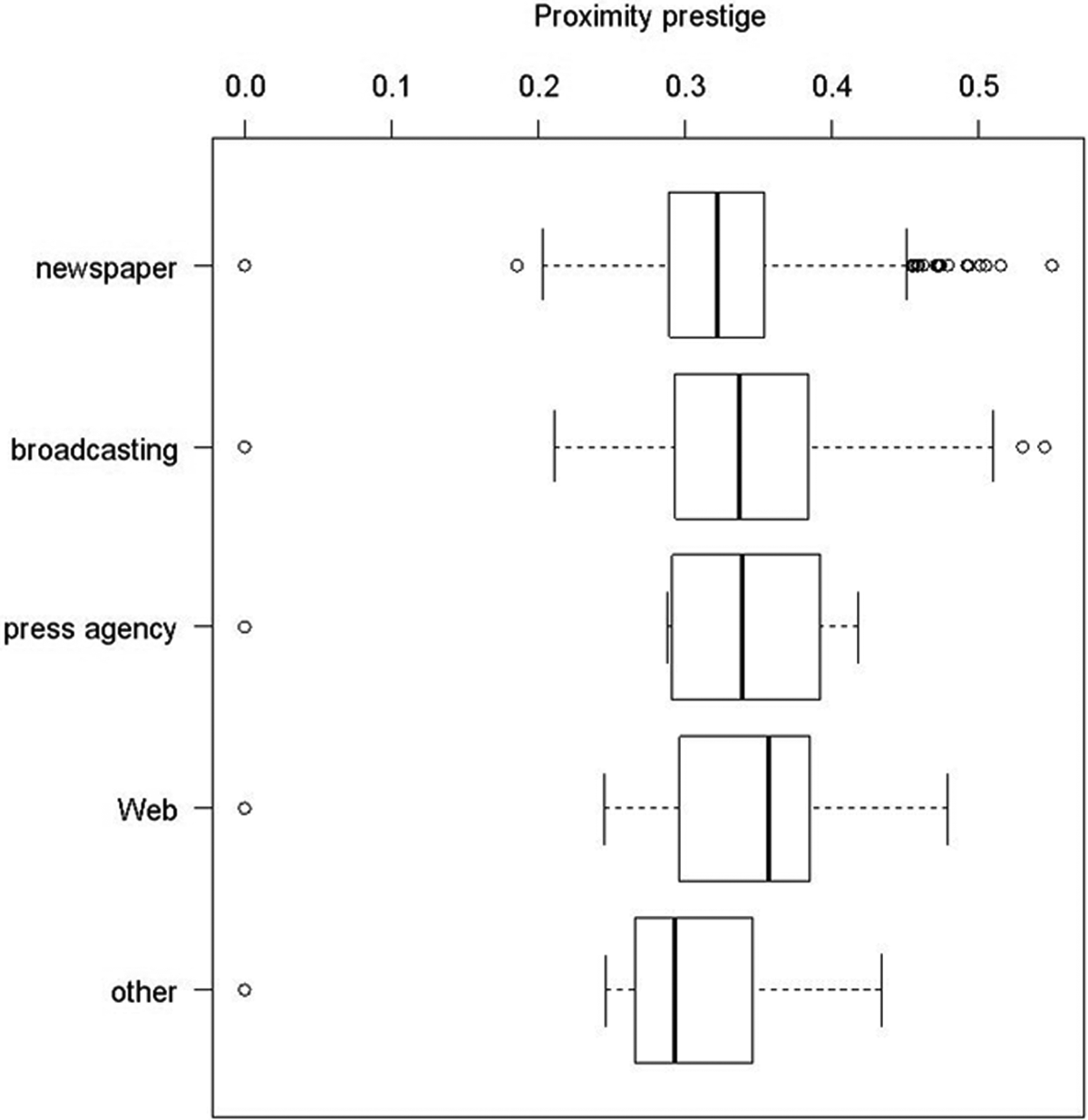
Proximity prestige of journalists by media platforms.
As for journalists’ ability to control the flow of information as gatekeepers in the journalistic network, we see that the overall level of betweenness is very low (median = .000, standard deviation [SD] = .003), indicating there are many alternative communicative routes between journalists in the Twitter network. The only two journalists who score relatively high, but still quite low, are two Volkskrant journalists (Heleen van Lier: .090; Bert Wagendorp: .074), both very active on Twitter). This substantiates the earlier finding of the network mostly consisting of a large component where almost 90% of all journalists are connected to each other through at least one direct or indirect path.
To assess the existence of structural holes in the network, we calculated the aggregate constraints of nodes in the network (De Nooy et al., 2011). Journalists with lower aggregate constraints could potentially function as gatekeepers, controlling the flow of information (median = .071, SD = .202). Further analyses showed that these potential gatekeepers are likely to be early Twitter adopters (number of days since subscribing r = .220), have an extremely high indegree (r = .553), have a higher outdegree (r = .273), and have extremely high proximity degrees (r = .344, all correlations N = 2,152, p < .000).
Communities in Journalism
Homophily in News Organizations
To determine the extent to which journalists working within different organizations are focused inward or outward, we look at the level of homophily present in the network, based on the organization for which the journalists work. In this study, we look at journalists as sources or peers. As such they are likely to track external journalists to keep up with their peers and their activities (cf. weak ties and bridging), maybe even for competitive reasons. Journalists may also want to keep in touch with their peers within the organization (cf. strong ties and bonding), not for competitive reasons but for peer reference or socializing. Although we have information on general motives on the use of Twitter, we lack information as to whether this differs inside or outside the news organization. However, we can assess to what extent journalists show similarity relations within the organization or outside the organization by using the E-I index (Krackhardt & Stern, 1988).
Table 4 shows the Top 5 most and Top 5 least cohesive organizations. The most cohesive organizations (i.e., regional news organizations) show more linking inside than outside of the organization (hence E-I < 0). The Top 5 least cohesive news organizations link exclusively outside the news organization and not inside the organization.
Most and Least Cohesive News Organizations in Online Networks.
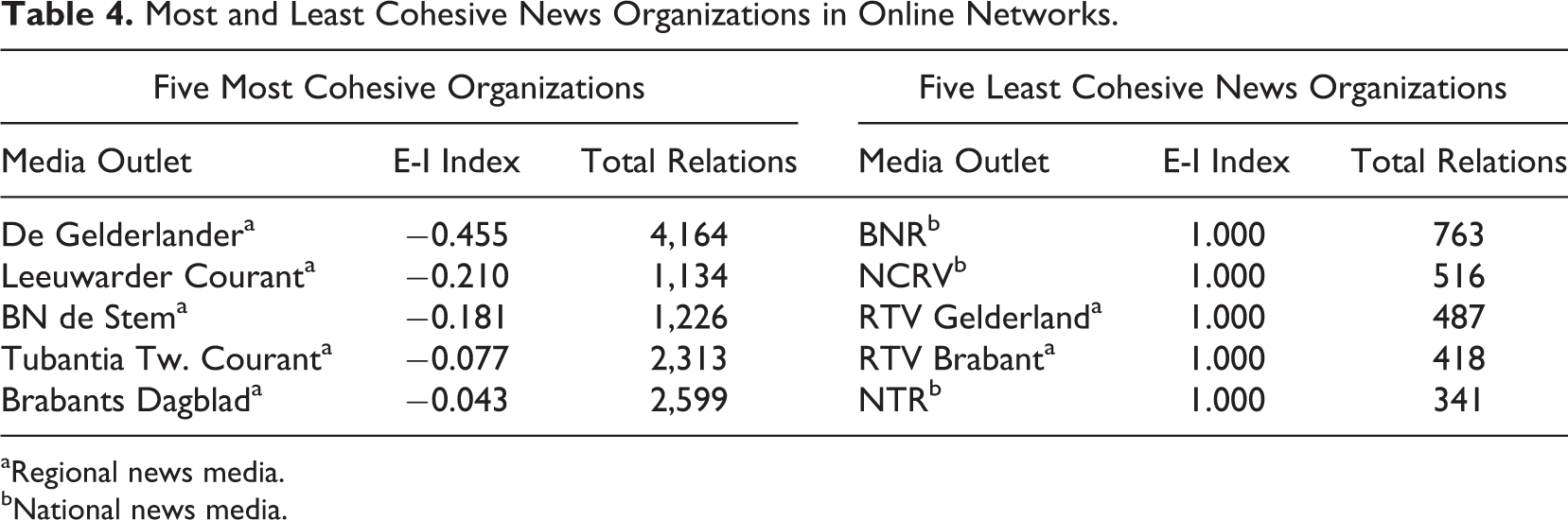
aRegional news media. bNational news media.
A variance analysis on the E-I index (see Table 5) shows that the mean cohesion measure for regional news organizations is .759 and for national news organizations is .920 (F = 9.59, df = 133, η = .26), indicating that in news organizations in general are connecting more outside than inside their news organization, but that journalists in national media on average are connecting even more outside than those working for regional and local news media. Whether this finding is evidence for the use of Twitter for competitive reasons is unclear. Journalists from national media need to cover news from across the nation as well as other countries, which imply diverse news events and involve great geographical distances, for which the use of information and communication technology—to convert these large geographical distances into small virtual distances—seems very obvious. Still, journalists working for the same organization have less need to keep in touch through Twitter, because they have more opportunities for face-to-face contact.
Online Social Networks as Journalism Communities
Although it seems tempting to talk about journalists in general, as a single group of media professionals, one can question whether journalists form a single homogeneous professional group. For instance, journalists work on different media platforms, in a large number of different media organizations, and are scattered across the country. Based on the network of relations between journalists on Twitter, an online social network can be converted to similarity data for visualization of communities using VOSmapping.
Cohesion in News Organization Online Networks.

Table 6 shows that (a) journalists’ networks do not make up one single large community but are comprised of several distinct and meaningful communities and (b) these communities can be considered as special cases of communities of interest—the geographical community. These communities of journalists show that, apart from the three national communities of journalists, all other communities have a clear relation to a specific geographical region in the Netherlands. A psychological mechanism that may operate here is the propinquity mechanism: interpersonal attraction due to physical proximity (Whittington, Owen-Smith, & Powell, 2009). It is also clear that within these communities, there are no clear subdivisions along the lines of media types, such as newspaper, broadcasting, and the Internet. Therefore, we conclude that journalists in search of news sources or peer reference cross the boundaries of different types of media.
Relative Distribution of Journalists Across Journalism Communities.
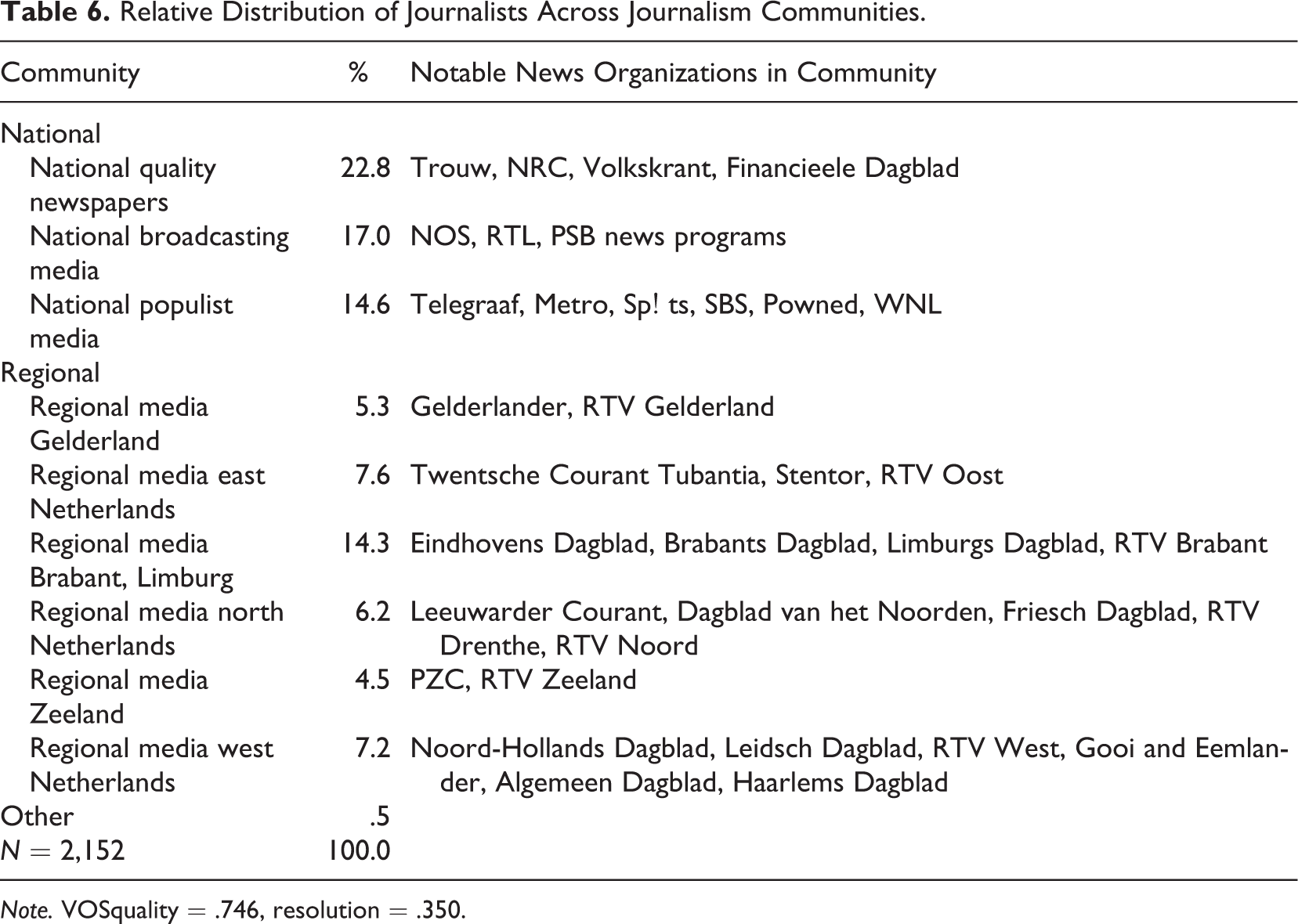
Note. VOSquality = .746, resolution = .350.
Figure 4 shows journalists’ indegree for all communities in the larger journalism network. It shows that all communities contain outliers, indicating that a significant portion of journalists in these communities have excessive numbers of followers. These journalists with exceptionally high levels of popularity and prestige are more easily detectable within these communities than when regular media platforms are considered (see Figure 2). It suggests that some degree of preferential attachment is present in these communities, even though the distribution of the indegree distribution deviates from the power law function.
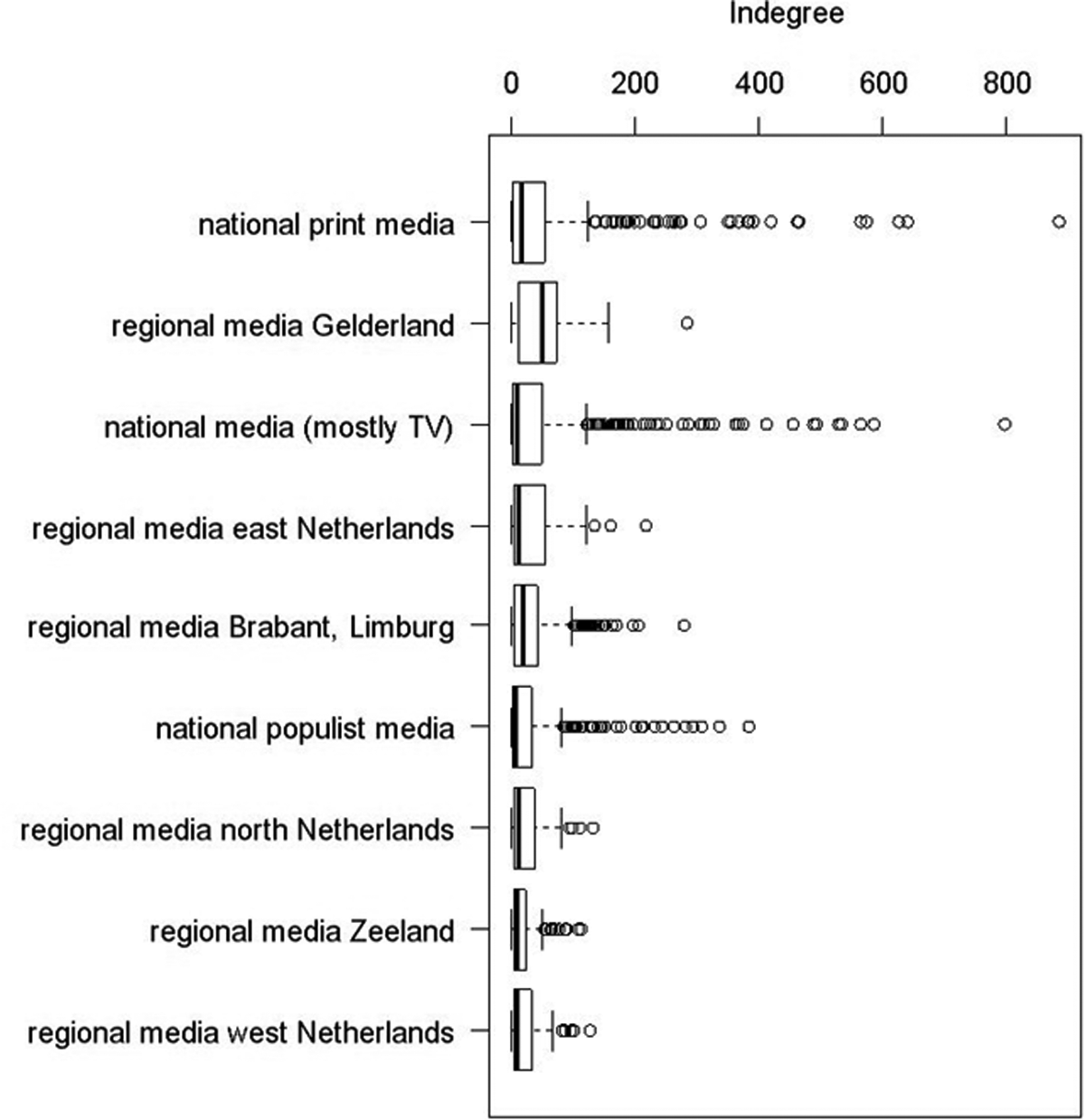
Indegree of journalists by community.
Figure 5 shows that six of the eight identified communities include exceptionally prestigious journalists. As could be expected, the communities of journalists working for national print media and for national TV media have particularly prestigious journalists. The other journalistic communities that are occupied by extremely prestigious journalists are regional media in the province of Gelderland, regional media in the eastern part of the Netherlands, regional media in the provinces of Brabant and Limburg, and regional media in the north of the Netherlands. It is striking that the two communities that lack any prestigious journalists—regional media in Zeeland and the regional media in the west of the Netherlands—are characterized as regions with one of the lowest and highest population densities in the Netherlands.

Proximity prestige of journalists by community.
Adoption of Microblogging
To assess how Twitter was adopted across platforms and communities, we look at the date these journalists subscribed to Twitter. Figures 6 and 7 show curves that roughly resemble the characteristic S curve of diffusion of innovations. There are two specific periods when Twitter apparently was adopted more rapidly by journalists. The first period consists of the first 6 months of 2009: The number of subscribers increased by more than 3% in each of these 6 months. February and March 2009 show particularly sharp increase of over 6% and 9% (March 2009 being the inflection point; acceleration rates for these months are, respectively, 2.65 and 3.07). The most likely explanation for this acceleration is the journalistic debate that emerged about Twitter after a Turkish Airlines plane crashed near Amsterdam Schiphol International Airport (“ASN Aircraft accident Boeing 737-8F2 TC-JGE Amsterdam-Schiphol International Airport [AMS],” s.d.). Many eyewitnesses and other people used Twitter to report on the crash. However, it turned out many claims about the death toll made on Twitter were largely overestimated, questioning the value of Twitter as a journalistic tool (Vereijken, 2009). Nevertheless, this increased attention for Twitter as a journalistic tool may have encouraged journalists to subscribe to Twitter and try it out. The 2009 growth spurt was primarily attributable to newspaper journalists, those working for national TV, and those in news media in the provinces of Gelderland, Brabant, and Limburg. The first 3 months of 2010 also show adoption rates of—at least—3%, but only in January showing a significant acceleration of 2%.
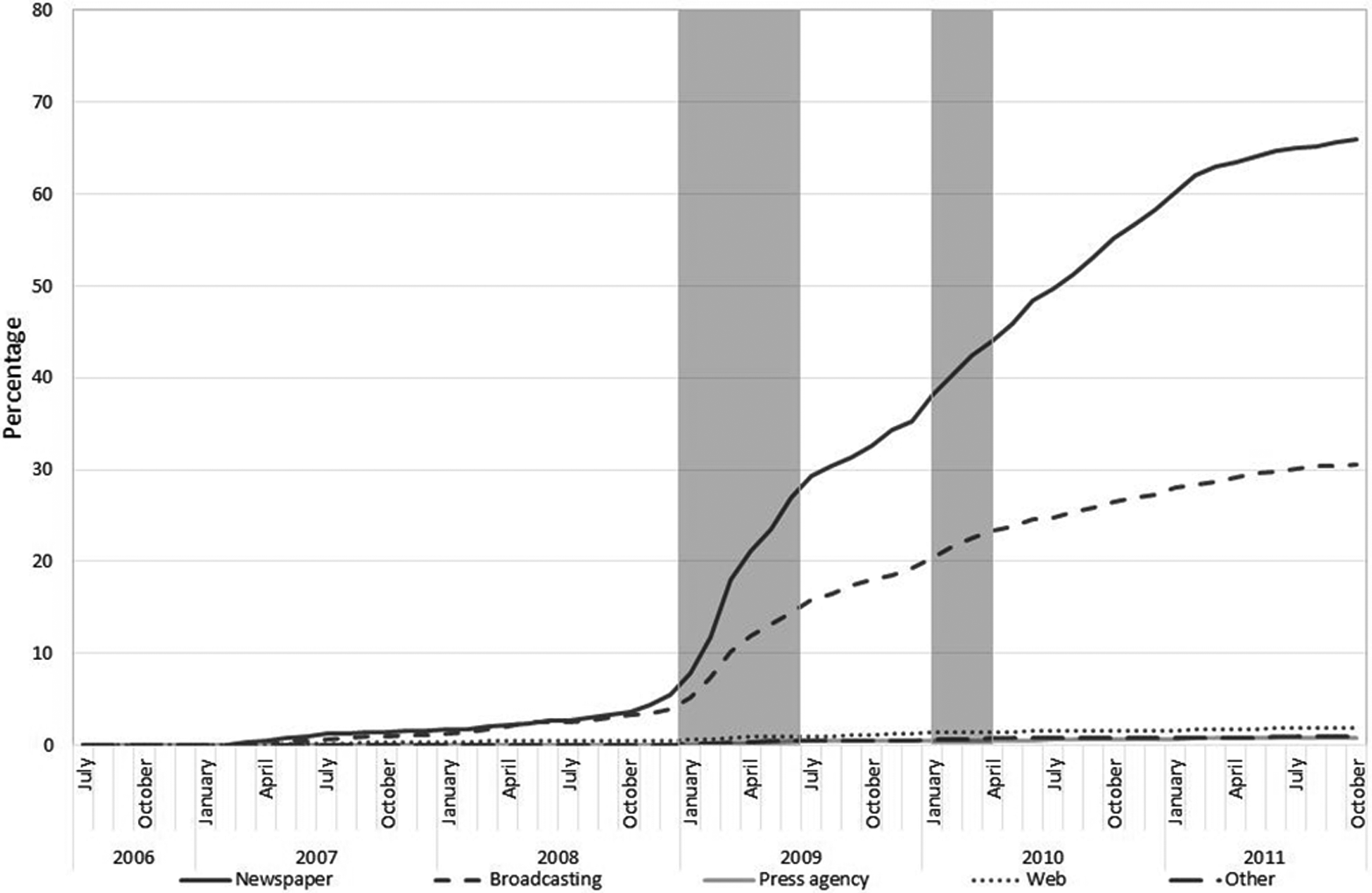
Adoption of Twitter by media platform (cumulative relative frequencies by month). Note. The shaded areas in the graph indicate periods with high rates of adoption.
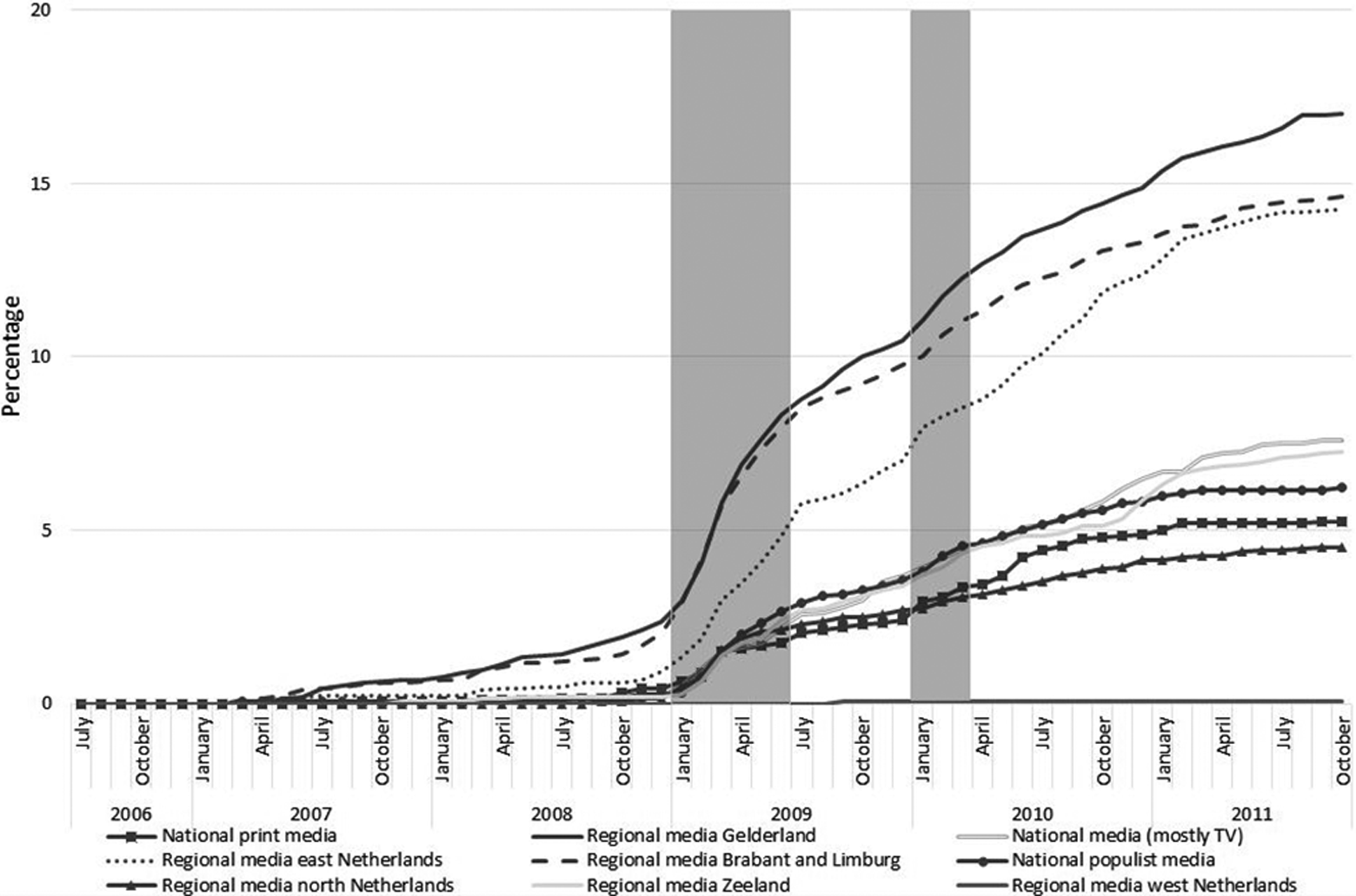
Adoption of Twitter by community (cumulative relative frequencies by month). Note. The shaded areas in the graph indicate periods with high rates of adoption.
Discussion
This study of journalists’ use of social media in the news production process, particularly online social networking, produced some notable findings. First, journalists set up online relations with their professional peers. These relations with peers are far from random for two reasons. Even though there is a heavy-tailed distribution of the indegree of journalists, it does not fit the power law function, suggesting that either the network is limited in growth or lacks the process of preferential attachment among journalists (cf. Barabási & Albert, 1999). In this case, it is most likely that the journalistic network is limited, given that the journalistic workforce cannot expand limitless. On the other hand, preferential attachment may well be present: new journalists using social media are likely to connect with highly visible and reputable journalists already present on social media.
The well-connected network of journalists consists of nine communities. This finding suggests that specifically journalists working for media providing news for the same geographical area connect among themselves and thus form regional journalistic communities. This finding is in support of homophily: Journalists who are similar are more likely to connect. An explanation for the existence of regional communities of journalists can be found in research on the relation between geographical distance between people and events that take place: the smaller people’s distance to these events, the more interest people have in these events (Lundberg, Bratfisch, & Ekman, 1972; Maclean & Pinna, 1958). So, even though electronic media may have weakened the relation between physical places and social situations in general (Meyrowitz, 1985), this applies most likely to locations outside of the physical reach of people, whereas the close-by social situations remain fundamental (cf. Vergeer, 1993).
This study has applied two network concepts to gain insight in how Twitter might be used for competitive reasons: betweenness and brokerage (structural holes). As for the strategic and powerful positions of journalists in the network, we found that the network shows some evidence of structural holes that journalists potentially could utilize as gatekeepers. At the same time, the level of betweenness shows that the network is well connected that there are mostly alternative ways for information to travel along network edges. Still, these structural holes are probably artifacts of how online social networks develop and that these structural holes exist by design or intention. There are a number of reasons why these positions are not created by design. The first reason for the existence of structural holes that these positions are attached to early adopting journalists with a higher indegree, suggesting that they are being followed on Twitter by otherwise relatively unconnected journalists. Furthermore, journalists controlling the information and communication flows are unlikely to happen due to the open structure of Twitter. Unlike Facebook and LinkedIn, where people can refuse to accept invitations to connect and thereby limiting the closure of networks, Twitter allows for asymmetrical social relations.
Besides the regional communities of journalists, broadcasting journalists are predominantly tied to organizations in the area of Hilversum (the Dutch broadcasting hub), and the headquarters of national newspapers that are predominantly located in Amsterdam (the nation’s capital). Given the absence of a true power law distribution, the small indications of preferential attachment only for national media, and the strong evidence of homophily, we conclude that the process of homophily seems dominant over the process of preferential attachment. What this means for the quality of the news these journalists produce is yet unclear. The absence of preferential attachment may be a good indicator that journalists do not rely on a few popular sources for producing news but most likely draw on a much wider range of sources. At the same time, given the existence of these tightly knit communities, in some circumstances, these communities may be dysfunctional for the production of news. For instance, groupthink—a concept developed by Janis (1982)—refers to a situation in which group members adopt the dominant opinion because of implicit or explicit peer pressure and ignore valuable information that conflicts with the dominant opinion. Groupthink takes place particularly when certain conditions are present—high group cohesion, insulation from experts, limited search and appraisal of information (e.g., under time pressure), operating under directed leadership, and experiencing conditions of high stress with low self-esteem and little hope of finding a better solution to a pressing problem than that favored by the leader or influential members (Turner & Pratkanis, 1998). This grim depiction pertains particularly to situations in which decisions have to be made about what is important, what is news, what to publish, and what not to publish. This is not to say that journalists in general and at all times show these characteristics. However, there are situations where the aforementioned conditions are likely to occur, such as in times of natural or man-made disasters. In journalism, the way groupthink may manifest itself is in media hypes (Vasterman, 2005) and pack journalism (Matusitz & Breen, 2012). Media hypes are defined as media-generated, wall-to-wall news waves, triggered by one specific event and enlarged by the self-reinforcing processes within the news production (cf. Vasterman, 2005, p. 515). This process of reinforcing may well be produced by the network characteristics of news production; whereas, the dissemination of information through social systems is mostly linear, particularly online social networks facilitate the diffusion of information through the entire network in an exponential manner. The result of the exponential dissemination of information is that the speed of information travels exponentially as well. Although speed is traditionally considered important in the process of news production, it has the drawback that verifying accuracy and credibility becomes a bottleneck. Retracting or correcting a false story becomes more difficult in the digital age: Once it is out there, it stays out there. Particularly the limited gatekeeper role journalists have on Twitter (cf. the low degree of betweenness) shows they have little power to change, correct, rectify, or even stop information from spreading. As said, these suggested processes of groupthink and pack journalism are very likely to emerge in tightly knit and homogeneous communities. A third phenomenon that could be tied to groupthink is “echo chambers” where news is circulated among a number of news platforms without fresh input from outside sources (Messner & Distaso, 2008).
Particularly because journalists have the societal task of controlling the actions of those in power, and informing citizens of what is relevant, for them a large diversity of news is important. Tightly knit and homogeneous communities threaten the provision of diverse and balanced news. Future research should determine what community characteristics and network structure characteristics are conducive to the emergence of these echo chambers and pack journalism. One approach to investigate echo chambers and pack journalism is mapping the communication networks and the flow of information through these networks as facilitated by the social networks identified in this study. Subsequently, the question arises as to the extent to which information is left intact or is mangled in the process of distribution through these actual communication networks. Do journalists replicate the information by simply retweeting, or do they rephrase or even frame the information in some way to produce original news content? And most importantly, does the meaning of the information change during the communication process as well? These questions relate to approaches of social contagion (Burt, 1987) and information cascades (Bikhchandani, Hirshleifer, & Welch, 1992). Social contagion refers to people coming in contact to share information and thereby spread this information throughout the entire system, in a similar way as the spread of diseases (cf. epidemiology). Depending on how people in the social system are connected, the spread of the information will proceed more or less quickly. Information cascades refer to how social behavior converges over time, based on other people’s actions and ignoring their own information.
As for the adoption of Twitter, the rapid growth of its use in journalism emerged specifically early 2009 and briefly repeated early 2010. This does not mean that the adoption of Twitter will level off. Younger generations of journalists (those who are more willing to adopt new technology)—in the coming decades—will replace retiring generations of journalists who were reluctant to adopt new technology. The expectation is that nearly the entire workforce of journalists will eventually have adopted some kind of microblogging tool. Particularly the fact that it is a networked service makes it an increasingly valuable tool for journalists.
Conclusion
Journalism and journalists not using new technology are unthinkable: handling and producing information in large quantities requires innovative technology. Nevertheless, whereas most traditional news organizations still have problems turning the Internet technology to their (financial) advantage, journalists seem to find their way and embrace social media easily. The use of social media may be perceived as beneficial from a journalist’s individual perceptive. The use of social media may also have unforeseen and unintended effects such as pack journalism, information cascades, and echo chambers. The problem with these macro processes is that these are difficult to detect from the individual—micro—perspective of the journalist. Journalists therefore have little means to take countermeasures to prevent these processes from occurring. Only in hindsight and from a macro perspective are these processes visible. This combined with the so-called lazy journalism that is associated with journalists’ use of social media may lead to Twitter as an awareness system that is biased and runs the risk of creating media hypes of societal events.
Even though this study uncovered tightly knit journalistic communities of online social relations, how this social infrastructure facilitates the flow of communication and information is yet unclear, even though there are promising case studies (cf. Meraz & Papacharissi, 2013). An analytical framework needs to be developed to address, for example, the role of specific issues that circulate within these networks, the role of the duration such an issue circulates in the network, or the role of journalists in specific network positions. Still, even such a framework needs to acknowledge that not all communication will traverse exclusively through an online (Twitter) network but also through face-to-face communication and other types of channels. On top of that, nonjournalists (i.e., nonprofessionals, regular citizens) are nowadays also sources of news and responsible for distributing news through social media networks. Still, Kwak, Lee, Park, and Moon (2010) show that Twitter networks of regular citizens show no power law distribution of followers as well as clear signs of homophily related to geography, quite similar to the network characteristics of the journalists in this study. So, focusing on journalists provides a partial but similar image of networks in general. The reasons for this similarity between journalists and regular citizens is that social media are very permeating professional and private life, ever present in the daily work of many journalists as well as regular citizens. Besides being used for professional purposes, Twitter is also used as personal and mobile media: they accompany the journalist everywhere he or she goes, whether in the role of the media professional or in the role of a private person. As such social media play a crucial role in the performance of journalists individually, strongly connected to peers mostly close by and somewhat outside their own organizations and regions. As such Twitter seems to be a fitting example of network journalism.
Footnotes
Declaration of Conflicting Interests
The authors declared no potential conflicts of interest with respect to the research, authorship, and/or publication of this article.
Funding
The authors received no financial support for the research, authorship, and/or publication of this article.