




Abstract
Concerns about a digital divide in U.S. politics that separates those who have and do not have access to technology have persisted for decades. Those concerns are prominent for immigrants and ethnoracial minorities who have tended to participate in politics, in general, and digital politics, in particular, at lower levels than others. Less attention has focused on the role representative nonprofits play in using technology to share political information and whether there is an institutional dimension to the digital divide. This article examines the adoption of social media by immigrant-serving nonprofits in the context of mobilization around elections. The findings suggest that responding organizations have adopted social media slowly and that key internal and external factors seem to relate to social media adoption. Hispanic American organizations were the fastest to adopt social media and have continued to be a technology leader. However, certain immigrant communities, especially the Asian American community, have been particularly slow to adopt social media suggesting that a digital divide exists within the population of immigrant-serving nonprofit organizations. These findings can be used by the leaders and managers of nonprofits to inform future decisions about the integration of technology into their operations.
The cultural dominance of Twitter, Facebook, and Instagram inside and outside politics has made headlines and nearly become stale news. Because of its low cost and apparent ease of use, candidates for office, activists, and many voters have been using social media for any number of political functions, including fund-raising, propaganda, and mobilization (Conway, Kenski, & Wang, 2013; Gulati & Williams, 2013; Karpf, 2012; Parmelee, 2014; Vining, 2011).
But concerns about a “digital divide” remain. Despite the ease of access to the Internet for many Americans, there are real reasons to believe that divisions exist within U.S. society between those who do and do not adopt and regularly use various forms of technology. These “first-level” issues are especially pressing for ethnoracial minorities and immigrants who have historically been divided from many other nondigital civic and political opportunities (Min, 2010). If a digital divide persists, these citizens risk being pushed further to the margins of civil society.
A related, but understudied, concern focuses on the social media usage of the organizations that represent immigrants in the United States. If civic- and community-based nonprofits are not adopting technology, then efforts to close the digital divide for individuals may be further hampered, as social media has become one of the primary ways that political, policy, and electoral information is shared. In fact, it may be that an institutional digital divide exists between nonprofit organizations that have and have not adopted technology. Given the role nonprofits play in political socialization, immigrant incorporation, and voter mobilization, we must ask are immigrant-serving nonprofit organizations embracing social media during election time? Are there differences in the adoption of technology by immigrant-serving nonprofits over time? And are there differences across immigrant community? This article aims to answer these questions with a mixed-method approach that links original survey data and archival content analysis on social media adoption. The findings show that nonprofits representing certain immigrant communities have adopted social media more quickly, perhaps the result of differences in the political identity of those communities and the extent to which nonprofits want to mirror these identities. The findings suggest greater awareness of the institutional aspects of the digital divide in politics and proactive steps that nonprofit managers and funders can take to close the divide in the future.
Literature Review of the Digital Divide
Ample research has demonstrated the lower levels of political participation of immigrants and ethnoracial minorities (Barreto, 2005; DeSipio, 2006). Low voter turnout has been a consistent problem among minority groups, especially Hispanic American, Asian American, and other primarily first-generation immigrants. According to the Brookings Institution, of the voting eligible population in 2012, White (64.1%) and African American (66.2%)—two ethnic groups with relatively low shares of foreign born—turnout was much higher than for other racial and ethnic groups, Hispanic American (44%) and Asian American (47%), for whom the foreign-born makeup much larger portions of the population (Frey, 2013). While it is true that not all Hispanic and Asian Americans are immigrants, three quarters (74%) of Asian Americans and a third (36%) of Hispanic Americans were born outside the United States. 1 A variety of factors explain these political disparities that range from limited access to electoral information, English-language deficiencies, and infrequent mobilization by political parties. The result of these factors is an electorate that is often only a poor representation of the actual racial and ethnic population of the country, many ethnic voters who maintain weak ties to civil society and political parties, and incomplete immigrant incorporation (Hajnal & Lee, 2011).
There were hopes that technology could lower barriers to politics, decrease the cost of collecting political information, and improve political participation. Such hopes have been largely unfulfilled, and since the late 1990s, scholars have substantiated concerns about a growing digital divide between those with and without access to technology and increasingly between the level of technology usage (van Deursen & van Dijk, 2014). The digital divide takes many forms, but one of the most consistent and problematic is what scholars call first-level issues related to ethnoracial minorities and immigrants, which is the focus of this article (Min, 2010). For example, Servon (2008) showed that in 2000, only a quarter of Hispanic Americans had access to the Internet, versus nearly 60% of the general population. Over time, some of this digital divide has narrowed. Hispanic Americans were the quickest community to abandon landline phones and adopt exclusively cell phone technology (Livingston, 2011). But differences still exist in the usage of technology for politics. In 2008, according to the Pew Center, compared to 58% of all white adults who were “online political users” (e.g., those who use the Internet for political purposes), only 52% of Hispanics were, and of Hispanic “Internet users” only 64% were, online political users compared to 76% of White Internet users. Furthermore, of the population of online political users, only 11% were Hispanic American compared to 73% who were White (Smith, 2009).
The Pew Center study did not report on Asian Americans, but other research has. Wong, Ramakrishnan, Lee, and Junn (2011) found that just 12% of Asian Americans participated in an “online” political act (i.e., signing an online petition or sharing political information in a social network) ranging from as high as 17% for Korean Americans to as low as 5% for Japanese Americans. In terms of sources of political information, 48% of their respondents did not use the Internet. The political digital divide may be particularly pronounced for some Asian American communities because of the larger percentage of older citizens.
Although we do not know everything about the nature of the digital divide, particularly as it relates to social media adoption and usage, most research points to inequities across ethnoracial groups. Hispanic and Asian Americans lag behind White and African Americans in terms of technology usage, particularly when it comes to politics. Since more informed and educated individuals are more likely to turn out to vote, those who do not have access to various forms of technology may remain uninformed and be systematically shut out of political participation. Thus, the persistence of the immigrant dimension of the digital divide threatens to hamper larger efforts to make the political system in the United States more equitable and political participation more democratic.
Conceptual Framework
Nonprofits have long played a part in helping to overcome these types of sociopolitical inequities through education, job training, and other services. I argue here that the bond between individual and organization also results in nonprofits providing a representative function or political voice for those they serve (Berry, 1999). In the case of immigrants—including undocumented residents, naturalized citizens, and second-generation immigrants—this function is provided by a specific set of organizations, what I refer to throughout the article as “immigrant-serving nonprofits.” Immigrant-serving nonprofits that provide primarily social services also represent their communities in formal and informal ways, sometimes through assertive advocacy in the policy arena, and in other cases in more subtle ways by simply sharing information with and about the community. As long as nonprofits abide by principles of nonpartisanship and limits on legally defined lobbying, any number of political and electoral activities are perfectly legal and consistent with the protected and prized 501(c)(3) Internal Revenue Service status. 2
Nonprofits and Social Media
Nonprofits use a variety of off-line tools to provide a voice for immigrants, including organizing public rallies, speaking at community forums, and writing opinion editorials, but since the mid-2000s, social media emerged as a viable online option. Organizations can use social media to represent the community to public officials and also use social media to provide the community with information about politics and elections. For the purpose of this study, social media is defined broadly as a set of digital tools or application that can be used to share information, including but not limited to Twitter, Instagram, or Facebook. Most are computer based but increasingly may be used on portable devices. Social media exists at the intersection of computer and communications technology and relies on the growing availability of the Internet starting in the mid-2000s. At least in theory, social media is best thought of as a multidirectional technology that allows the sharing of audio/visual information between nonprofit organizations and their constituents, not simply from one to the other in a unidirectional manner.
Using this broad definition of social media, during a political campaign, an immigrant-serving nonprofit organization might post the location of polling stations on its Facebook page, share pictures of voter registration events on its Instagram account, or remind registered voters that Election Day is near in multiple languages through Twitter. Latino Justice, the New York-based rights organization, used Twitter and Facebook in 2012 to “push viewers to the website” where more information could be found about policy, advocacy, and the election (based on interview with Tasha Moro, June, 2012). The constituents of an immigrant-serving nonprofit might also use the same social media technologies to relay concerns with the organization about voter regulations, express views on policy issues, and post pictures of participation in civic events.
To be clear, social media and political advocacy are distinct and separate activities for some organizations. Advocacy has been around for as long as organizations have been, and various political technologies have been incorporated into political strategies, including the use of fax machines, computer-based phone banks, and electronic mail. Social media is a much newer mechanism to that can be used to pursue advocacy. For some organizations the advocacy and social media may have little overlap in purpose or application, while for others social media and political advocacy intertwine in important ways. In fact, Guo and Saxton (2013) found high levels of Twitter usage, over three quarters of those in their study of nonprofits, but that social media was primarily an educational tool for most organization and social media usage for political mobilization was much less common. My argument here is not that social media is solely a tool of advocacy, rather that we might look to whether its adoption correlates with factors also known to be tied to politics to understand aspects of the institutional digital divide.
Factors that Relate to Nonprofit Adoption of Social Media
Therefore, drawing on existing research, I conceptualize the decisions immigrant-serving nonprofits make about adopting advocacy tactics and adopting social media as driven by similar factors, namely, internal organizational constraints and external pressures from the community served. Some research has been published about how nonprofits use social media and communications technology to connect to members and constituents (McNutt & Boland, 1999). Among large charitable organizations, a recent study showed that an astonishing 97% were using social media as early as in 2009 (Barnes & Mattson, 2010). That study, though, was of the largest 200 organizations, raising questions about whether the findings can be generalized to the vast majority of nonprofits that operate with limited resources and greater internal organizational constraints.
It may also be that immigrant-serving nonprofits behave in distinct ways from other nonprofits because of the particular sociopolitical characteristic of those they serve. For example, for nonprofits that serve immigrants, the sharing of information is particularly important because many undocumented residents and first-generation immigrants speak English as a second or third language and thus have few options to voice their own concerns or learn about their new home. Immigrants rely on civic associations, community groups, and a variety of other nonprofits to ease their transition to the United States and help social integration. Immigrant-serving nonprofits can provide information about social, language, and immigration services. But the bond formed between immigrant and nonprofit may survive long after naturalization so that for many first-generation immigrants, their associations with organizations last a lifetime and are passed down to second- and third-generation offspring for generations after arrival in the country. Those receiving educational services from a nonprofit school or food services during a period of unemployment, likely do not maintain these persistent ties. Thus, this deep and more permanent relationship that is so connected to representation makes immigrant-serving nonprofits distinct from other types of nonprofits that may provide more temporary or short-term assistance.
But immigrants are not a homogenous group, and this heterogeneity relates to political representation. Research shows that immigrants vary in terms of their political attitudes, beliefs in ethnic solidarity, and shared identity (Masuoka & Junn, 2013; Schmidt, Hero, Aoki, & Alex-Assensoh, 2010). For example, Grossmann (2011, 2012) showed that interest group representation varies by the political efficacy of the community: Communities with high levels of political efficacy tend to have the most robust representation in Washington and numerous political organizations. Strolovitch (2006) also found that interest groups that represent minorities often are the least active on issues affecting the most disadvantaged members, tending instead to emphasize more universal issues. But the research by Grossmann and Strolovich focused mainly at the national level. At the local level, Gleeson and Bloemraad (2012) documented the underrepresentation of immigrants in the population of nonprofits in California. Other research found that some immigrant communities, including Asian Americans, have many fewer nonprofits pursuing political advocacy that others, specifically compared to Hispanic Americans, who have a richer array of nonprofits with political aims (De Leon, Maronick, De Vita, & Boris, 2009). The authors attribute this to longer traditions of political activism in the Hispanic American community that encourage advocacy from their nonprofits. Thus, notwithstanding the need immigrants may have for representation and nonprofit services, differences exist in the array of nonprofits providing services, especially political and advocacy services. Later in this article, I assess whether these same interimmigrant differences exist for the adoption of social media.
Despite its apparent importance, there is scant research focused on the incorporation of social media for nonprofits that serve the political and civic needs of immigrants. Wilson (2011) addressed immigrant-serving nonprofit organizations and immigration policy debates but included little on communication tactics. And Andersen (2010) showed that few immigrant-serving nonprofit organizations pursued voter engagement, but she did not focus on social media. What then might explain social media adoption by immigrant-serving nonprofit organizations? Research on nonprofits in general suggests that internal institutional barriers are the primary explanation for the failure of some nonprofits to adopt social media. McNutt (2009) found that the top three barriers that social work advocacy organizations listed were expertise (69%), expense (63%), and equipment (43%). Nonprofit organizations that are more highly institutionalized—flushed with resources and run by a full-time paid staff—seem to adopt social media quickly, a pattern that is mirrored in research on adoption by candidates for office (Gulati & Williams, 2013). Unfortunately, many immigrant-serving nonprofit organizations, particularly those that are focused on advocacy, are run by dedicated volunteers rather than paid professional staff and also typically have extremely limited resources (Hung & Ong, 2012; Ramakrishnan & Viramontes, 2005). If institutionalization matters to social media usage, many immigrant-serving nonprofits may be left behind.
Other researchers find additional reasons for low adoption rates of technology, in general. In a study of minority-based nonprofits, Schneider (2003) argued that the barrier may not be access or expertise but time free for staff to use technology. As technology has shifted from the domain of computer scientists alone, nonexperts may have the capacity to use social media but may not have the time to do so. External factors also seem to matter. Nah and Saxton (2013) found that pressure from outside donors explained the adoption of technology: When donors are supportive of the use of technology, nonprofits are more likely to adopt. As such, if a nonprofit is responsive to those it serves—including those who donate money—then it may orient technology usage to what the community demands or act as a mirror of the community. Moreover, if certain immigrant communities demand more information or demand information delivered with new media and technology, then there may be different patterns of social media adoption and usage across communities. Communities that collectively believe they can affect political and policy outcomes—those with high levels of political efficacy—may be particularly attuned to and solicitous of civic information from their nonprofits. Much as Grossmann (2011) showed for political representation, in general, where the relatively higher level of political efficacy in the Hispanic American community is related to more robust political representation in Washington, it may also be the case that nonprofits that serve Hispanic Americans face stronger community demands for social media than those that serve Asian Americans who as a community have lower levels of political efficacy.
External pressures may also be driven by other nonprofits or what scholars call the diffusion of innovation (Gulati & Williams, 2013). Some nonprofits wait for others to adopt first (Waters, 2010). Early adopters of technology help late adopters—those averse to risk and change—figure out how to implement new technologies by going first. For nonprofits with limited resources, this strategy makes sense, as it limits the costs of experimentation and failure. However, this phenomenon raises questions for isolated nonprofits or those surrounded by others with weak cultures of early innovation. If a nonprofit does not have social media innovators in its network, then late adoption may never occur. For immigrant-serving nonprofit organizations in historic centers of immigration such as New York city, NY, or Los Angeles, CA, this may not be a problem but increasingly immigrants are residing in new gateway states and outside cities (Joassart-Marcelli, 2013). These places, for example, in rural Georgia or Tennessee, may be prone to the isolation that will work against nonprofits learning from others in their community.
Thus, the extant literature suggests an approach to conceptualizing nonprofit social media adoption that incorporates internal characteristics and external pressures. Because little in the literature has applied this approach to the work of immigrant-serving nonprofit organizations, it is unclear how well it fits this case. Serious questions remain, such as, are immigrant-serving nonprofit organizations incorporating social media? If so, are there differences in the adoption of technology immigrant-serving nonprofit organizations over time? And, are there differences across immigrant community? The following section draws on the findings of extant research on nonprofits to better understand how (a) internal characteristics of immigrant-serving nonprofit organizations and (b) certain external pressures from the community served relate to social media adoption. I describe the data collection and then the findings of the analysis used to answer the research questions.
Data Collection and Analysis
The data used for this analysis were collected following a two-step process: (1) a survey of immigrant-serving nonprofit organizations in six states and then (2) content analysis of the websites of respondents. First, the population of immigrant-serving nonprofit organizations was established using the Urban Institute National Center for Charitable Statistics database (See: http://nccs.urban.org/). The database contains the universe of nonprofit organizations that report to the Internal Revenue Service. The database does not include unincorporated organizations that are important but too different in terms of structure—they are unlikely to have a paid staff and operational data cannot be collected in consistent ways—to easily compare with incorporated organizations. I selected all the 501(c)(3) nonprofits in the six states and downloaded organizational information, including financial and nonfinancial variables. I explicitly chose to omit 501(c)(4) nonprofits because my focus is not at the national level of politics, where traditional interest groups are most numerous. Research shows that immigrants are severely underrepresented by interest groups at all levels of government, meaning there are relatively few of these types of nonprofits to consider and their operations are too different to easily compare 501(c)(3)s. Additionally, all the six states chosen (Florida, Illinois, Michigan, New Jersey, New York, and North Carolina) have large numbers of immigrants, but there is also variation between each state in the composition of the immigrant community. This permits an examination of a variety of 501(c)(3) immigrant-serving nonprofits, not just those that serve Hispanic-Americans or Asian-Americans, alone.
Second, I coded each organization for whether it provided services to immigrants. 3 Because organizations serve a variety of generations, and typically do not make distinctions between first- and second-generation constituents, or between legal status, I was not focused on the specific demographics of those each nonprofit served. I set out to cast a wide net that captured organizations that focus mainly on recent immigrants, refugees, and undocumented residents as well as those that serve established second- and third-generation citizens. These are critically important distinctions for political behavior research but less important for institutional studies of organizations that serve many different types of individual immigrants. 4
Third, following common practices in the field, I designed a survey consisting of a 6-item questionnaire (see Technical Appendix) that I sent by standard mail and e-mail to the executive director (or equivalent) of each organization on October 11, 2012. This date was chosen because it was far enough into the election for groups to have committed to whatever activity they would or would not do in the 2012 election but early enough so that the organization would not forget or neglect to mention activities if I surveyed them far after the election (Lin & Van Ryzin, 2012). After the survey was distributed, I conducted follow-up through e-mail and phone calls to encourage nonrespondents to complete the survey. Of the 1,149 nonprofits that were sent a survey, 22% ultimately completed the survey, a response rate that was lower than one would expect for individual surveys but on par with other survey research on nonprofits where published findings typically range from the low teens to 50%. 5 Further, by comparing respondents to nonrespondents along organizational variables attained from Internal Revenue Service data such as budget and age, there was little evidence of survey response bias. Respondents had on average US$473,813 in annual revenue, had been operating in 2012 for just under 17 years on average, and had on average 5.5 employees. The mean revenue of nonrespondents was US$683,935, the mean number of employees was 7.49, and the mean age of nonrespondents was 18 years, all somewhat more than that for respondents. 6
Fourth, with the responding organizations in place, we began the content analysis stage to capture social media usage. Because I wanted to ascertain social media adoption in the past, and institutional memory is often incomplete, I did not use the questionnaire to measure the adoption of social media. Instead, two student assistants took the responding nonprofits and identified the public website for each in four time periods, that is, 2010, 2011, 2012, and 2013. In order to do this, we coded the live website for each respondent that maintained a website in the fall 2012 and then again in fall 2013. We relied upon the archival website, http://www.archive.org, for coding of the 2010 and 2011 version of the website. Archive.org maintains an open-access archive of websites back to 1997, making it possible to examine most, although not all, earlier iterations of websites. 7
The student assistants used content analysis to code the “splash page” or main page of each website during 2010, first, for existence, and then for the evidence of social media adoption. 8 Once identified, if the website contained a link, reference, or associated content to Twitter, Facebook, or YouTube, the student coded it as 1 = social media, for those with no mention of one of these, it was coded as 0 = no social media. 9 With this method, we tracked the adoption of social media across the sample of immigrant-serving nonprofit organizations. 10 Although the focus of this study is on political representation, the coding scheme did not distinguish between social media adopted specifically for mobilization and that used for other purposes such as fund-raising or nonpolitical communication. Hence, I do not make the argument in the subsequent analysis that all respondents that have adopted social media have done so in order to register voters or publicize where to vote.
Measuring Social Media Adoption Over Time
Based on the survey and content analysis, it is possible to report the social media adoption rates for responding immigrant-serving nonprofit organizations. Across the array of respondents to the survey, a small percentage (15%) had adopted social media in the earliest time period, 2010 (See Table 1). Recall that Twitter and Facebook were only released to the public in 2006. The percentage of those who adopted social media grows for the full population of respondents to a third (30%) in 2011, to 41% during the 2012, and nearly half by 2013. Compared to other studies of nonprofits summarized earlier, this shows a much slower rate of adoption for this sample of immigrant-serving nonprofits than for large nonprofits and nonprofits in general.
Social Media Adoption in Responding Immigrant-Serving Nonprofit Organizations.

Note. Bivariate comparisons use the chi-square test.
*p value < .10. **p value < .05. ***p value < .01.
Measuring Social Media Adoption Across Internal Characteristics
More interesting than the general findings are the adoption rates by certain theoretically important internal characteristics. Previous research established resources and various aspects of institutionalization as related to nonprofit strategy, in general, and technology and social media adoption, in particular (Mosley, 2011). The findings from this survey corroborate the earlier research. Institutionalized immigrant-serving nonprofit respondents—those that had more than the mean number of three paid staff members—were statistically quicker to adopt social media than those that were not institutionalized. By 2012, more than half of the institutionalized immigrant-serving nonprofit respondents (62%) had adopted social media versus only a third (36%) of those that were not institutionalized. These differences are significant using a chi-square test at the p value < .05. A similar and statistically significant relationship existed for nonprofits with large resources that adopted social media technology at a faster rate than those with limited resources.
Internal characteristics seem to be related to social media adoption as was participation in the 2012 election. Respondents that were actively involved in the 2012 election, through registering voters, distributing policy briefs to candidates, or joining an electoral coalition, were coded as “involved” (40% of respondents) and if they reported none of those tactics, they were coded as “not involved” (60% of respondents). Those involved in the 2012 election were statistically more likely to adopt social media than those not involved. They did so earlier and a larger portion adopted social media through 2013. This is not a surprising finding and consistent with research (Suarez, 2009), but one that further establishes an association between the internal characteristics or orientation of nonprofits toward elections and adoption of social media.
Measuring Social Media Adoption Across Immigrant Community Served (External Pressure)
Perhaps most significant for the question of a digital divide in nonprofit representation is the evidence related to which immigrant community the respondent served, a measure of one aspect of external pressure. As seen in Figure 1, nonprofits that served Hispanic Americans (25% of respondents) were the quickest to adopt social media, statistically different from other respondents at the p value < .05 (The category of “other” refers to respondents that represent immigrants in general or ethnicities other than Asian, Hispanic, or Middle Eastern). Statistical significance is based on bivariate comparisons versus other respondents using the chi-square test. A larger percentage of Hispanic American organizations had adopted social media in 2010 and they maintain that margin through 2013 when nearly 60% had adopted social media. In comparison, Asian American nonprofits were the slowest to adopt social media and continue to lag behind in 2013, although the difference was significant at the p value < .10 only in 2010. Middle-Eastern American nonprofits were relatively slow to adopt, but they were not statistically different than other respondents. These findings suggest that there is an institutional dimension of the digital divide between nonprofits serving different immigrant communities, and this institutional digital divide mirrors some of the characteristics of the ethnoracial digital divide between individuals.
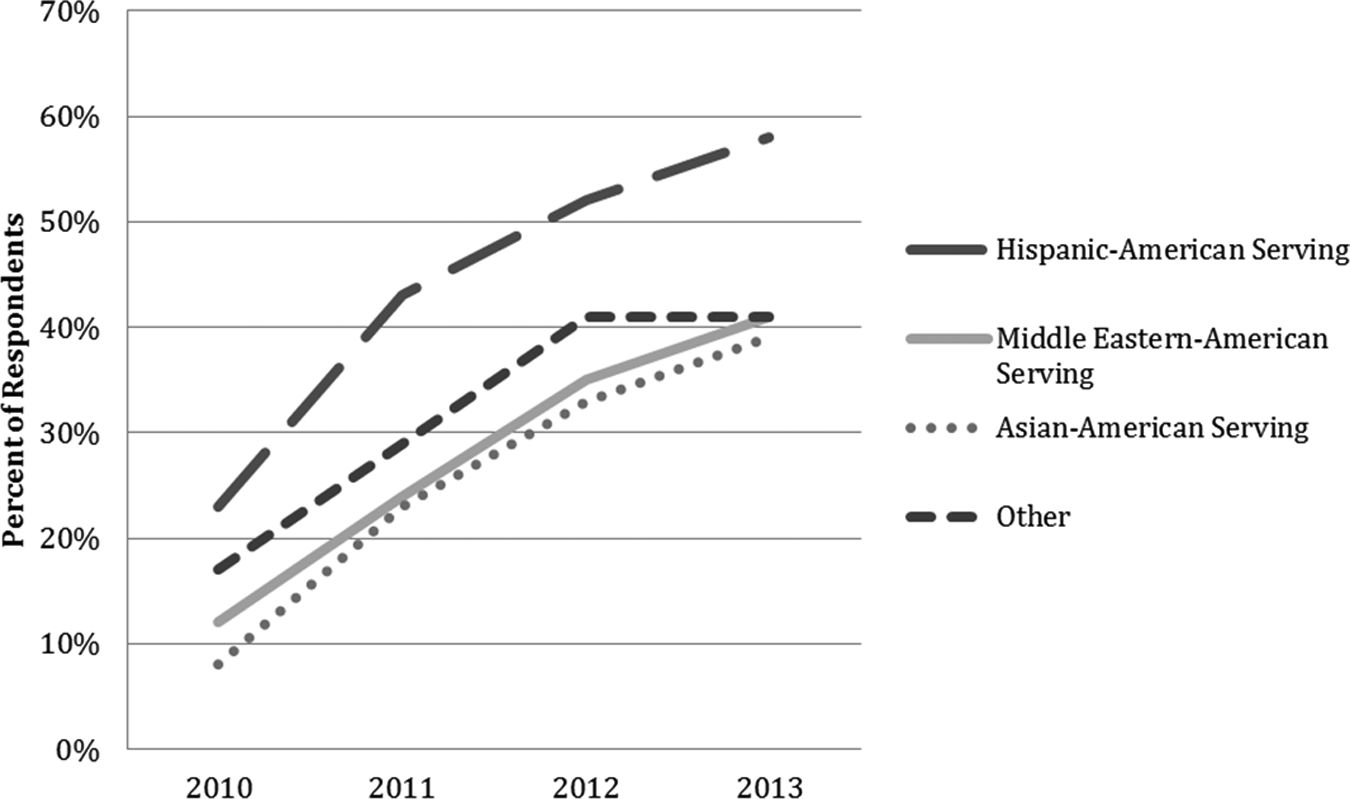
Adoption of social media by immigrant community and year.
Interpreting the Results
The results from the content analysis suggest internal and external explanations for the adoption of social media by immigrant-serving nonprofit organizations. To better understand the results, interviews with nonprofit managers were conducted prior to and following the election to better understand the qualitative dimensions of social media adoption. Navdeep Singh from the Sikh American Legal Defense and Education Fund (SALDEF) claimed in an interview that “technology is one of the biggest reasons we can do what we do, it has transformed advocacy, we now have the ability to send targeted emails, web stream the Town Hall, webinars on training for voter education and registration.” As with SALDEF, certain technologies multiply the opportunities for a small nonprofit to reach thousands of potential voters.
Technology, of course, is not for every group, particularly those that serve communities that are not regular users of social media. For example, Ali Najmi, cofounder of the New York city-based nonprofit of South-Asian Americans, SEVA-NY, argued “social media does not work well, you have a whole generation of people who aren’t on Facebook or Twitter, all the young people are, but those in the voter pool aren’t young.” Najmi’s group focuses on “old school canvassing, door-to-door, ethnic media outreach, creating events and a buzz on the ground” (based on interview with Ali Najmi, August 2, 2012). Ami Gandhi of South Asian American Policy & Research Institute described something very similar about the South Asian population in Chicago, “a lot of the eligible new voters in the South Asian community are seniors, particularly limited English, less likely to use technology (based on phone interview with Ami Gandhi, August 7, 2012).” In short, immigrant-serving nonprofit organizations have to adjust their utilization of technology to their constituents.
For other communities that are active users of social media, technology offers the chance for nonprofits to reach many more potential voters and a wider audience than without the benefits of technology. One of the keys to effectively using technology is to create a social media staff position within the organization. David Castillo of the National Council of La Raza (NCLR), one of the most prominent national Hispanic American organizations, was hired as the New Media Manager specifically to manage the social media work of the organization. He said that his position was a “relatively new position,” since in the past. social media had been done with an “ad-hoc approach, several different people were charged with social media … there were people with different responsibilities … not viewed as a priority (based on telephonic interview with David Castillo, July 17, 2012).” As a result, until he took over social media, “it could go days between tweets.” When Castillo consulted with other immigrant-serving nonprofit organizations, many local affiliates of NCLR, he recommended that “if they really want to invest time in social media, then they are going to have to make it a priority, even if that is an hour or thirty minutes a day … they have to prioritize it on a daily basis.”
Other nonprofit leaders provide additional context to understand the statistical results. Immigrant-serving nonprofit leaders are acutely aware of their constituents, what those constituents want, and ways to represent them with or without technology. They also acknowledge that resources and internal organizational factors related to the structure and mission of the organization matter too. Social media communications that are greatly effective for one nonprofit may be utterly useless for another.
Conclusion
The 2012 election was hailed as the moment immigrants captured a political voice in U.S. elections (Garcia Bedolla & Haynie, 2013). Hispanic American turnout, in particular, received great attention for how central it was in key swing states. Yet, despite this higher than normal overall turnout, relative Hispanic American and Asian American turnout remained low. One explanation for this is that voter mobilization remains sporadic. Mobilization by parties is usually focused on a handful of key races and often ignores large segments of the immigrant community. Thus, the role immigrant-serving nonprofit organizations play in providing political information to the community and mobilizing new voters, including through social media, is very critical.
The evidence from this research suggests that there is mixed adoption of social media by immigrant-serving nonprofit organizations. Just a few years ago, till 2010, a small fraction of the overall group of respondents had adopted social media; 4 years later, the adoption rate still hovers just less than 50%. Some nonprofits are impeded by internal factors such as the low degree of institutionalization and insufficient resources. In other cases, there is better news to report. Nonprofits that are most attuned to civic affairs and elections—although less than a half of the overall respondents—do seem willing to adopt social media.
But a digital divide appears when we compare different immigrant communities. The social media needs of Hispanic Americans are best served by nonprofits, perhaps due to the on average higher levels of political efficacy. These political attitudes may send a message to nonprofits that greater levels of civic engagement through off-line and online strategies, including social media adoption, are welcome. Nonprofits representing Asian Americans and Middle-Eastern Americans, however, have been relatively slow to adopt social media. This may be a reflection of the demographic realities of some Asian American and Middle-Eastern American communities that are older on average or less politically efficacious. These are understandable reasons for nonprofits not to adopt technology, but if we believe there is intrinsic value in technology usage, and that the digital divide is a political problem, then the failure to adopt social media suggests another reason why the country has not fulfilled the principles of a fully integrated and equitable democracy.
There are important practical lessons to be gleaned from these research findings. First, nonprofit managers who want to better represent their constituents, be they immigrants or nonimmigrants, have to be aware of the internal barriers. Even if social media applications do not need to be purchased, they are not cost free to use. To truly adopt social media, it may be necessary to dedicate a part-time staff member. For small nonprofits operated by volunteers, this may be entirely unimaginable. For larger nonprofits, current staff may not possess social media skills to implement a new communications plan and need additional training. There may be a need for a social movement similar to what McInerney (2014) described in his research on the Circuit Riders movement of the late 1990s. Circuit Riders observed the limited adoption of computer technology across the nonprofit sector, and linked philanthropic foundations to activist programmers in order to “wire” the nonprofit sector in the early years of the Internet. A coordinated social media effort between foundations, activists, and nonprofits might address the institutional digital divide described in this research.
Second, for managers of nonprofits who pursue missions that are not focused on advocacy, using social media to advocate for the community may be a worrying prospect. Deep concerns about losing the protected 501(c)(3) status compel some nonprofit organization managers to avoid even the mildest form of advocacy. But as long as social media advocacy during election time is done in a nonpartisan fashion, and attention is paid to restrictions on government grants, many avenues for participating in elections, including registering voters, translating materials, and educating candidates, are available to all 501(c)(3) nonprofit organizations. Managers, however, must balance the legal parameters they confront with the organizational pressures from board members and funders.
The findings from this research also point to new directions for research on nonprofit organizations. There is increasing interest in the political role played by 501(c)(3) organizations and the limits on what types of political actions they may take. Extant research on social media adoption by nonprofit organizations may have resulted in an overly optimistic view. This research has a more pessimistic story to tell, particularly as it relates to certain immigrant communities. Future research might pursue this issue with a greater focus on ways that immigrant-serving nonprofit organizations can overcome the internal and external barriers to social media adoption.
It is also important to use descriptive studies like this one to build more comprehensive theoretical models of nonprofit social media usage. This article suggests the outlines of a theoretical model and also directions for more rigorous multivariate statistical methods to understand social media adoption. It may be the case that certain internal and external factors interact in dynamic ways for which bivariate analysis cannot fully account. It may be that resources interact with an organization’s orientation toward politics and social media adoption. Organizations in better financial circumstances may be freer to pursue a broader mission that includes political advocacy, whereas organizations with few resources—a large portion of immigrant-serving nonprofits—may not be able to extend their activities into new directions such as adopting a social media strategy to represent the community. If this is the case, fears about a persistent digital divide in politics will continue into the future and continue to marginalize immigrants.
Future research should also expand the sample of nonprofits to additional states. Immigrants face very different state policy constraints in the United States: Some states are supportive of nonprofit participation in elections, but others, such as Michigan and Florida, are more circumspect or even hostile. The six states chosen for this study likely do not fully represent all of this diversity of state political context. Given the policy agenda of certain state and national policy makers to tighten immigration regulations and voting rules, there are likely immigrant-serving nonprofit organizations operating in quite hostile policy environments. More comprehensive data collection can better explain the harmful effects that these policy changes have on immigrants and the organizations that seek to provide them with a variety of services.
Footnotes
Appendix
Declaration of Conflicting Interests
The author declared no potential conflicts of interest with respect to the research, authorship, and/or publication of this article.
Funding
The author received no financial support for the research, authorship, and/or publication of this article.