



Abstract
The work we will be discussing here explores how government, industry, the university, and the citizens of a city can arrive through a participatory design approach at an increased and mutual understanding and a shared vision of a desired smart city of the future. Elaborating upon insights from transition management studies and from the quadruple-helix knowledge production model, our work proposes a participatory approach for prototyping future cities that embraces practice-oriented design research activities and thus aims for practical impact. We will report on two cases, GovJam and Hackday Data of the Crowds, in which stakeholders were able to acquire through participatory prototyping an understanding of the possibilities of technology in city services of the future. Results from these sessions show that participating stakeholders indeed gained a new perspective upon issues facing the city, due to an increased awareness and understanding of, and empathy for, the interests of other stakeholders. We also found indications that transfer of knowledge was taking place from the prototyping sessions to the daily practice of participants working in the public sector.
Introduction
The smart city is nowadays a widely discussed concept not only among academics, city governments, businesses, and citizens’ organizations but also in public media for general audiences. However, there is no generally agreed upon definition of a smart city. One of the first attempts was made by Hall et al. (2000), who defined the smart city as a vision of how innovations based on integrative and holistic approaches will be applied in cities of the future toward (self-monitoring) mega systems that help create a living and working environment which is clean, safe, and efficient. Smart sensors and monitoring systems will generate real-time data which will help shape the decision-making process of city management. At the time of writing, some 15 years later, extensive literature reviews show that the concept of smart cities encompasses an amalgam of viewpoints, domains, and dimensions, but that a unique definition still does not exist (Cocchia, 2014). However, there are a number of shared characteristics from which three dimensions can be derived: a technological dimension, based on the use of infrastructures; a human dimension, based on people, education, learning, and knowledge as key drivers; and an institutional dimension, based on governance and policy and as a result of the importance of cooperation between stakeholders and governments (Nam & Pardo, 2011). For the purposes of this study, and because it represents the activities of our research group at best, we prefer to use Dameri’s (2013, p. 2549) definition of a smart city: A smart city is a well-defined geographical area, in which high technologies such as ICT, logistic, energy production, and so on, cooperate to create benefits for citizens in terms of well-being, inclusion and participation, environmental quality, intelligent development; it is governed by a well-defined pool of subjects, able to state the rules and policy for the city government and development.
For example, Hollands’ critical review (2008) of the underlying assumptions of smart cities makes a distinction between entrepreneurial cities that focus on economic prosperity and competiveness and progressive smart cities that are sustainable and inclusive. Hollands (2008) argues that cities that wish to become progressive smart cities should focus first and foremost on people and the human-capital side of the equation, rather than believing that information technology by itself will automatically transform and improve cities. He also stresses the need to find a new balance of power in the use of information technology by businesses, government, communities, and the general public.
It has been questioned how, and to what extent, IoT technologies and Open Data developments actually contribute to democracy, participation, and public debate in cities (Brynskov et al., 2014). Neither corporations nor governments really have a comprehensive view of what a meaningful smart city should be, therefore governments are increasingly looking for ways to allow citizens to participate more actively in processes of decision and policy making. And while top-down approaches inviting citizens to participate often fail, grassroots initiatives often struggle to find corporate and governmental support.
This indicates a mismatch or gap between one stakeholder reaching out to other stakeholders who seem unapproachable, reluctant, or simply not interested in participating. In such situations, we see frictions between the diverging interests of technology providers, city governments, and citizens.
Governments struggle with, on one hand, budgetary considerations and on the other hand the need to modernize democratic structures. Citizen participation does not happen merely by putting it on the political agenda without welcoming bottom-up citizen initiatives and inviting equal cocreative partnership (Mulder, 2014). What is needed is a systematic change in the relationship between governments, citizens, and other stakeholders as well as a shared vision between these stakeholders on the future smart city.
Our research question is how government, industry, the university, and the citizens of a city can arrive through a participatory design approach at an increased and mutual understanding as well as a shared vision of a desired future smart city. We define mutual understanding as: Stakeholders understanding each other’s concerns and values in a given situation (whereas in the user-centred design paradigm, the focus is purely on end users). We define shared vision as the idea of a future situation in which the concerns and values of all stakeholders are addressed as comprehensively as possible, and in the event of conflicting interests, a negotiation takes place regarding the constraints of concerns and values.
Our assumption is that mismatches and frictions between stakeholders occur when the locus of control of initiative is concentrated in one particular stakeholder, so that other stakeholders feel less engaged or even reluctant to cooperate. Our participatory design approach aims to create a new situation in which initiative is a product of collaboration rather than emerging from a single stakeholder driven by a particular interest. We refer to this collaborative participation in the public domain as a participatory domain. This way, stakeholders can collaboratively envision desired future cities through an alignment of interests by means of participatory prototyping.
In the next section, we shall position our study in the context of a review of related research. Both transition management studies and the quadruple-helix knowledge production model provide insights into the dynamics of stakeholder relationships in complex innovations, similar to those found in the development of smart cities. Elaborating upon insights gained from related work, we will introduce Rotterdam Open Data (ROD) and outline our participatory design approach for prototyping future cities, which embraces practice-oriented design research activities, and thus aims for practical impact. Next, we report on two cases, Hackday Data of the Crowds and GovJam, in which stakeholders were able to acquire through participatory prototyping an understanding of the possibilities of technology in future city services. We will then reflect upon the findings and conclude with a discussion.
Related Work
An analysis of Future Internet scenarios shows that current developments in innovation and contemporary policy making tend to favor the model of the creation and consolidation of new monopolies above the model of open ecosystems that foster grassroots digital social innovation and entrepreneurship (Bria, 2014). In the interdisciplinary debate on the socioeconomic challenges of future Internet, experts, social scientists (including economists), and policy makers call for a more user-centric approach in the design of applications, by making it possible for users to influence and innovate applications/systems on an ongoing basis (Oostveen et al., 2012). The question here is how to involve different stakeholders in complex situations such as the development and implementation of IoT applications in smart cities, which in turn require changes in the relationships between governments, universities, industry, and citizens. In the following sections of this article, we will examine how insights from transition management studies and knowledge production studies have informed our approach toward participatory prototyping for smart cities.
Transition Management
One approach to understanding how to bring about this change in a sustainable way is provided by research in the field of transition management. Based on complex systems theory, transition management analyses processes and levels within complex societal systems. A transition is defined as “a structural societal change that is the result of economic, cultural, technological, institutional as well as environmental developments, which both influence and strengthen each other” (Rotmans, 2005, p. 11).
One way of dealing with complexity is the multilevel perspective (MLP; Geels, 2011; Kemp, Rip, & Schot, 2001), which is an analytical framework that distinguishes three analytical levels in societal systems, each corresponding to a different degree of structuration of local practices. These are niches, sociotechnical regimes, and an exogenous sociotechnical landscape. Each level has different degree of stability, but they are not necessarily nested or hierarchical. MLP focuses on actors in various groups, that is, on their strategies, resources, beliefs, and interactions. The sociotechnical landscape exists at the highest (macro) level, is not subject to direct influence, and is slowly changing (over decades). Niches exist at the lowest (micro) level, at which people experiment, invent new practices, and develop opportunities for change. Transitions take place at the middle level, the stable existing system with its routines and patterns that both accommodate and structure people’s activities. Transitions, as a result of the interaction of processes on all three levels, are defined as shifts from one regime to another regime, as illustrated in Figure 1 (Geels, 2011).

A dynamic multilevel perspective on technological transitions (Geels, 2011).
In transition management literature, Rotmans and Loorbach (2009) describe stakeholder groups or actors and their activities which are required in order to transform existing systems into desired future systems within a process of radical innovation in incremental steps. A key concept here is the focus on creative minds, strategists, and visionaries as front-runners who are able to generate emergent structures while still remaining dependent on traditional structures within existing institutions (Rotmans & Loorbach, 2009). Through a process of guided variation and selection, fruitful experiments in transition arenas can be scaled up through a series of incremental steps toward new structures (niches). In order to allow such transitions to take place, governments must learn how to facilitate processes of selection, emergence, coevolution, and self-organization (Rotmans & Loorbach, 2009). “Urban labs” have been mentioned as a means of initiating small-scale experiments (Nevens, Frantzeskaki, Gorissen, & Loorbach, 2013). The two events that we will be describing for the remainder of this article can be understood as a demonstration of an urban lab, in which front-runners from a quadruple helix of stakeholders experiment with new technological opportunities.
Quadruple Helix
The field of innovation studies provides another perspective for analyzing the relationship between government, industry, and university, in the production and diffusion of knowledge in innovation processes, known as the triple-helix model. This model explains structural developments in knowledge-based economies by analyzing university–industry–government relationships (Leydesdorff, 1995). The triple-helix model inspired the policy of Stichting Innovatie Alliantie (the Dutch research funding body for universities of applied sciences), which aims to stimulate direct valorization of knowledge in fields of practice. This policy has encouraged universities (research and education), governmental bodies, and industry to collaborate in triple-helix project consortiums. According to Leydesdorff and Deakin (2011), the triple-helix model can be used to demonstrate that the cultural development of the city toward a smart city is not a result of market economies alone but the outcome of government policies, academic leadership qualities, and corporate strategies. Leydesdorff and Etzkowitz (2003) have observed that since the triple helix consists of institutionalized domains which do not necessarily develop the knowledge required by society at large, involving the public domain in the formulation of new research questions and in reflecting upon the limitations of existing institutions can stimulate innovation. Carayannis and Campbell (2009, 2012) argue that within a “glocal” knowledge-based economy, all national innovation systems are influenced by culture and values as well as by the ways in which “public reality” is constructed and communicated by the media, thus the authors propose to integrate this “public” as the fourth helix into a quadruple-helix model. The increased importance of the public, the citizen, within this quadruple-helix model is consistent with the principles of participatory design. We embrace this approach in our design research projects within the city of Rotterdam, as we consider which stakeholders should be involved in design projects that aim for practical impact within local society, in order to arrive at what we call the participatory domain (Figure 2).
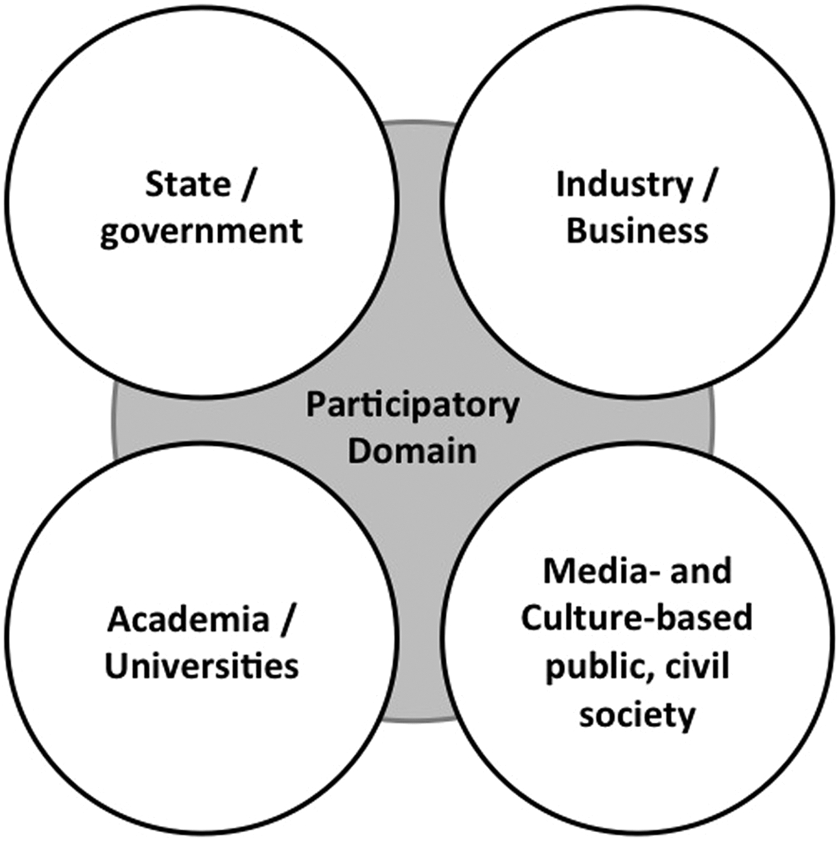
Quadruple helix in the participatory domain.
A Participatory Prototyping Approach
In accordance with the principles of the quadruple helix, the Research Centre Creating 010 (part of the Rotterdam University of Applied Sciences) has initiated ROD: a community and consortium of individuals from the fields of research, education, government, creative industry, and citizens, all joining forces to promote the value of opening up data which can then be reused in order to foster social and economic innovation and working together according to a cocreating paradigm. Public sector projects are developed at the intersection between interaction design and urban design and explore how citizen actions can influence local policy (Brynskov et al., 2014). However successful these projects may be, there are inevitable tensions in the conflicting agendas of departmental and institutional goals as well as mismatches between bottom-up initiatives and hierarchical urban policies (Brynskov et al., 2014). Conradie, Mulder, and Choenni (2012) describe an initial ROD pilot study which focused on the use of released public sector information and stimulated the exchange of ideas between partners. One of the conclusions of this study was that collaboration through cocreation is a promising approach, which leads us to the current participatory prototyping approach.
Based on previous experiences from cocreative collaborations between partners in the ROD projects, we elaborate in our work on this cocreative process, which has resulted in the participatory prototyping approach for smart cities (Van Waart, Mulder, & de Bont, 2015). Participatory prototyping for smart cities brings together two approaches: participatory design and design prototyping. Participatory design is a design approach in the tradition of participatory action research (Greenbaum & Loi, 2012; Whyte, 1991). Participatory design is a design which is done by, for, and with the end users, those who will actually be using the results of the design process (Greenbaum & Loi, 2012; Schuler & Namioka, 1993; Simonsen & Robertson, 2012). Participatory design is important in the early “fuzzy” front-end phase of the design process, which is where idea generation takes place (E. B.-N. Sanders & Stappers, 2008).
Prototyping in participatory design is considered as “a collaborative identification of possible futures, rooted in current practice but with the purpose of introducing change” (Brodersen, Dindler, & Iversen, 2008, p. 20). Prototyping nowadays occurs in different stages of the design process (Gill, Sanders, & Shim, 2011). Beyond merely creating artifacts, prototyping has become an important activity in the early stages of the design process as making “sense of the future” (E. B.-N. Sanders & Stappers, 2014).
Unlike many other design challenges, designing a smart city involves large-scale, complex urban innovations that exceed the span of the codesign relationship between designer and end user. Therefore, participatory prototyping for smart cities aims to involve all quadruple-helix stakeholders in collaboratively envisioning future applications of smart cities themselves by making prototypes. The role of the designer then also changes: Facilitating design by users rather than designing for users or with users, this in accordance with the future role of designers as described by L. Sanders and Stappers (2014). In the current study, the organizing design researchers do not act as participants but rather as facilitators or even as “scaffolders” of the design activities of the participants. In short, our proposed participatory prototyping approach for smart cities aims to:
improve (mutual) understanding between stakeholders (of each other’s concerns and values), contribute a shared vision among stakeholders of the applications in the future smart city which addresses the concerns of all stakeholders as comprehensively as possible, strengthen the social fabric of stakeholders in the city, in order to sustain future collaboration, and achieve the above through the collective creation of prototypes by stakeholders.
In the current study, we are exploring more in depth how to apply this approach in practice, while describing its effectiveness with regard to these aims. This approach does not presume to build a smart city within a few days; however, applying this approach in the two events described below can be seen as a first step toward a more sustainable practice of collaboration between stakeholders within the city. In the following sections, we will illustrate how this approach has been applied in two events organized in the context of ROD: 1-day to 3-day sessions of collaborative prototyping of technology and (open) data applications for future cities.
Case Study: Hackday Data of the Crowds
The Hackday Data of the Crowds (Hackday for short) event took place in Rotterdam on April 9, 2014. A hackday is a 1-day version of a hackathon (Briscoe & Mulligan, 2014). April 9th was declared the annual IoT day by the IoT council, a think tank for the IoT which aims to raise awareness regarding the societal impact of IoT developments. At the 1-day hackathon event, participants from industry, university, and government had the opportunity to freely explore their creativity in collaboration with like-minded colleagues and strangers, while gaining a better insight into the current possibilities of wearable technology in a world in which everything is increasingly digitally connected.
Motivation
The event was initiated by a researcher of the university, who contacted the creative director of an Internet design agency in order to jointly organize the 1-day event. Both shared a common interest in exploring the possibilities of personal data generation by means of wearable devices and in combining such crowdsourced data with open data in order to deliver a richer city experience to users of the service. A hackday would provide a diversity of concepts and prototypes and was expected to show possible applications of IoT and open data applications and to give participants an idea of how the design and deployment of such applications might contribute to the development of a smart city.
Aim
We initiated the Hackday in order to bring together people from universities, industry, governments, and citizens to jointly develop knowledge of the possibilities of existing smart wearable devices in combination with open data in a way that would enrich people’s experience of the city.
Tasks
In mixed teams, participants were challenged to create a concept and prototype in 1 day, in which (personal) data generated by a wearable device would be combined with open data in order to provide an enhanced experience of the city of Rotterdam to the user. Besides the concept and prototype, teams were asked to pitch a short presentation for a jury of experts that rewarded the best concept and prototype with a prize.
Participants
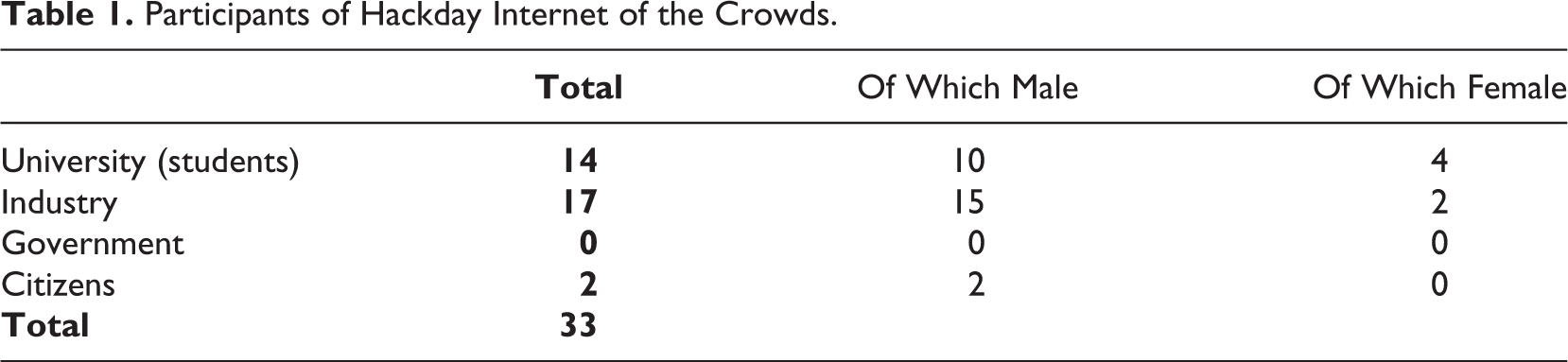
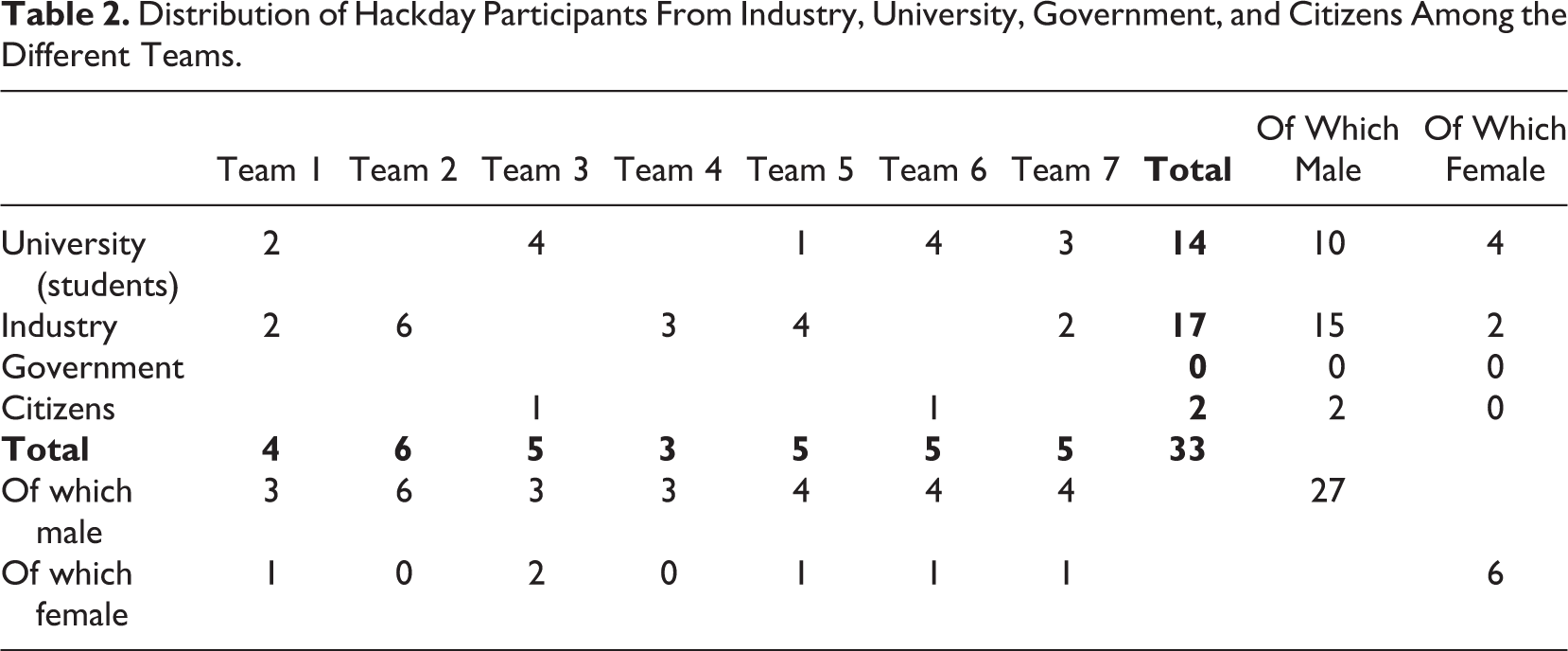
The university sent out invitations to businesses and public servants of the municipality of Rotterdam and other (semi-) public organizations. A short teaser video with an impression of the challenge was jointly produced in order to attract participants. A policy officer of the municipality of Rotterdam provided the budget for the teaser video production as well as a video registration of the event. This policy officer was motivated by her interest in promoting and advertizing the city’s creativity and innovation. At the venue, a parallel conference program of international speakers on the topic of IoT took place in a nearby room. A total of 33 participants attended the Hackday (see Tables 1 and 2 for details).
Participants of Hackday Internet of the Crowds.
Distribution of Hackday Participants From Industry, University, Government, and Citizens Among the Different Teams.
Procedure
The program starts at 9:00 a.m. and ends at 8:30 p.m. At the check-in, participants choose one of three badges: “coder,” “designer,” or “concepter/data expert.” Teams of participants are given a time frame of 10 hr from 9:30 a.m. to 7:30 p.m. in which to concept and finish their prototype. The tasks of the five moderators are timekeeping (helping the teams to deliver the concept and prototype on schedule), making sure the teams actually made things rather than just discussing issues and making sure all participants can act as full-fledged team members. Moderators inform the teams of the possibilities of the technology and critically question concepts and design choices made by the teams during the process but never approve or disapprove team decisions in a normative way. From 7:30 p.m. to 8:30 p.m., the teams pitch their concepts and prototypes to a jury of four experts in the field of IoT, open data, and urban planning. After the jury selects the winners, the prizes (Fitbits and gift coupons) are announced.
Data Collection
The outcomes of each team’s efforts were applied in the prototypes they used for the final presentation. A video report included a documentation of the overall process of the Hackday observations by the organizing design researchers, and interviews with several participants and jury members about how they experienced the day.
Results—Outcomes of the Hackday
Participants checked in and were welcomed by the organization and invited to pick one of three badges: coder, designer, or concepter. Before the program started, they mingled at the entrance of the hall. In the first half hour, after a brief word of welcome, the available data sets were presented by a representative of National Institute for Architecture, the Environmental Protection Agency of the Province of South Holland, and a department of the Municipality of Rotterdam, who were invited to provide data from their respective fields of architecture, air quality, and traffic, and to benefit from the results of the Hackday. Then, the Hackday organizers announced the challenge of the day. Participants were asked to form teams that included a mix of coders, designers, and concepters. Participants from three businesses insisted on remaining together as colleagues in a company team but, with the exception of one team, they all adopted an additional student as part of their team. All other participants, most of whom did not yet know each other, mingled in order to form mixed teams of coders, designers, and concepters. The participants formed seven teams. Table 1 shows the distribution of participants within the teams. This table also shows that only two private citizens participated and that no public servants participated. All participating students were bachelor students from interactive media and technology programs. We did not register the distribution of coders, designers, and concepters within the teams. A total of 33 participants took up the challenge.
The teams started concepting at approximately 10:00 a.m. and finished their concepting phase before lunch, after which they continued developing a prototype of their concept that would be suitable for presentation. The representative of the three organizations that provided the data sets remained available in order to answer questions about the data.
At approximately 7:00 p.m., the teams presented their concepts and prototypes in 3-min pitches to a jury consisting of four experts: one expert, author and EU advisor in the field of IoT, one expert of the Dutch Ministry of the Interior serving as an Open Data ambassador, one expert on urban development and societal transition, and one professional journalist and debate moderator with experience on issues of open data and urban development, who acted as jury chairperson.
The prototypes developed by the teams were Time Life, which combines personal data from a device with local air quality data, in order to compute in real time a user’s life expectancy; Ghost Runner, a Google Glass application that displays the location of another person (or even yourself) who was there previously; Open Data Gift, an application based on the understanding that IoT and Open Data are meaningless until they become useful for regular people; Audiopolis, a smartphone app that collects the music of other users passing by; Google Ship, a Google Glass application that allows inspectors of the Rotterdam port authority to visually represent virtual information about ships on location, combined with air quality data; Sante, an application that combines Fitbit data on sleep and movement with air quality data for improving the user’s health; and Bodyguard, a smartwatch application using data on public safety, street lighting, and green spaces in order to plan safe routes.
Interview Results
During the Hackday, the 13 participants of the winning teams and the 4 jury experts were interviewed about their experience of the Hackday. Participants from the industry mentioned the networking opportunity provided by this event, in which it was important to meet new people in order to gain new insights and expertise. Many of these participants saw the Hackday as a “fun day for experimenting” and for becoming familiar with technology (wearables) they had never encountered before. The participating businesses (technical and design Internet agencies) normally focus on websites and mobile apps rather than IoT applications for smart things and wearables, since there is no demand for these products from their existing clients. At the Hackday, however, industry participants could experiment freely with open data sets and wearables, and without restrictions from clients, to explore the conceptualization of new services and new ways of interaction design. One participant said that an event such as this is a place for experimentation and for exploring the world of tomorrow. Two agency directors indicated that, besides the individual professional development of the staff members they brought along, they also expected subsequent sharing of newly gained knowledge within their organization. One point of criticism voiced by industry participants was the lack of access to end users (private citizens).
One of the two citizen participants said that he experienced the Hackday as an engaging event and enjoyed collaborating with new people. For him this was an opportunity to familiarize himself with new technologies, which is something he doesn’t experience in his daily work.
The experts from the jury commented on the concepts and prototypes that were presented. The experts inquired as to how the applications would influence end-user experience and behavior. They mentioned the prototype Open Data gift as an excellent example of how the discussion on IoT, open data, and wearables is mainly dominated by experts within these fields of interest but is hardly a topic for citizens. This is an important consideration when government and industry wish to engage citizens in the development toward smart cities in which citizens are not merely consumers but active participants in society. Smart city systems are too important to be left to experts alone, and once a ubiquitous city system is in place, it cannot easily be altered again. The experts also pointed out that many currently available applications emphasize individual and internal use by people rather than facilitating connectedness and communication. They also stressed that designers and developers should question their own values when designing IoT applications and rethink the implications for end users of using their designs. The experts said they perceived the Hackday as an important event in this respect, allowing students of interaction design to become more aware, through hands-on prototyping, of their role and position in the development toward future cities.
The Rotterdam city alderman for higher education, innovation, and participation commented that the Hackday was a network-strengthening activity and that it was important to emphasize that improving services with available technologies and open data should be done in a human-centred way.
Case Study: GovJam
The GovJam was a 3-day, 48-hr event that took place from June 3 to 5, 2014. The concept of a GovJam is derived from the Global Service Jam and is specifically focused on the design and redesign of public services (Römer, Thallmaier, Hormes, Lawrence, & Habicht, 2011). Both Global Service Jam and GovJam are international events which take place in more than 100 cities worldwide, organized by local design communities in order to promote design thinking and service design.
Motivation
The event was initiated by a researcher of the university, inspired by the concept of GovJam and also by the enthusiasm of an acquaintance who works as a public servant. For the preparation of the event, the university researcher recruited the services of a one-man service design agency (a different agency than the one that worked on the Hackday). At a later stage, on a public servant also became part of the organizing team.
Aim
Much like the Hackday, the GovJam was expected to strengthen the relationship between the university and public servants of the municipality of Rotterdam. Both of the organizers wanted to demonstrate to public servants the potential of service design and design thinking for improving public services in the city. Citizens, as target groups for public services, were invited to attend the event, so that they could be consulted on issues affecting them.
Tasks
Participants from the university, the municipality of Rotterdam, and design agencies form teams that work on the design and redesign of public services. An important aspect of a jam is that everyone enjoys to participate. Therefore, all participants are “equal” whether they are students, public servants, or professional designers. Also participants are free to switch teams or to leave and rejoin the sessions. In the end, the teams are given the challenge to prototype a future (renewed) service. Halfway through the event, the teams present their progress to a jury (called Dragons) and receive feedback on the final day.
Participants
The university sent out invitations to design businesses, and the public servant who was co-organizing the event recruited colleagues from the municipal government. The event was also communicated to students and teaching staff through Internet channels and publicly advertized on a website and Facebook page. In the end, 47 participants registered, of which 37 actually attended the event (see Table 3 for details).
Distribution of GovJam Participants From Industry, University, Government, and Citizens.

Procedure
The program begins on the first day at 3:00 p.m. and ends on the third day at 3:00 p.m. The organizers welcome the participants and introduce the program. Participants are asked to pitch a case which is of interest to them. A public servant involved in the issue pitches the prepared cases. All participants are free to form a team with others to work on whichever case they prefer. The organizers act as moderators coaching the teams.
During the first evening, the participants are given a master class in service design. On the morning of the second day, the participants conduct field research (interviewing the target group). During the evening of the second day, the teams present their progress to a jury in the Dragons Jam. On the third day, all materials are digitalized and uploaded to the GovJam world server. There are occasional moments of review and peer presentations, and participants have the opportunity to take part in energizing exercises.
The tasks of the moderators are mainly timekeeping (helping the teams to deliver the concept and prototype on schedule), making sure the teams actually make things rather than just discussing issues, and making sure all participants can act as full-fledged team members. Moderators inform the teams of the design tools and methods and critically question concepts and design choices made by the teams during the process but never approve or disapprove team decisions in a normative way.
Data Collection
The outcomes of each team’s efforts were applied in the prototypes they used for the final presentation. A video report included a documentation of the overall process of the GovJam, observations by the organizing design researchers, and interviews with several participants and jury members about how they experienced the day.
Results
A total of 37 participants attended the event, although not all were present every day. At the beginning, participants pitched new cases, but at the end, all participants chose to work on the cases that had been prepared by the organizers. These cases were facilitating the reintegration of unemployed citizens in the labor market, improving communication between primary schools and the municipality, and improving regulatory inspections of the catering industry. Participants started in four mixed teams and then attended the service design master class where they learned the key concepts, methods, and tools of service design.
On the morning of the second day, the teams went out in the field to familiarize themselves with the experience of citizens as a target group of the specific service. Back in the creative space, the teams worked under pressure to develop concepts and select one of these for further elaboration. During the evening, the teams presented their work to a jury of Dragons, consisting of the city manager of Rotterdam, a strategist from an advertizing agency, a university research professor, and a business consultant. That evening was concluded with an informal drink. On the final day, the teams finalized their prototypes and uploaded all materials to the global GovJam server.
Interview Results
In personal communication during the event, the 11 participating public servants indicated that the service design tools they were learning about, and their conversations with citizens in the target groups, had brought them to think differently about the issues they were involved with. The city manager of Rotterdam was also interviewed and stressed the importance for public servants of collaborating with designers and creative practitioners in order to improve and modernize their services, while referring to shrinking government budgets as an important factor currently affecting governmental policy. The city manager also clearly stated his intention to participate in next year’s edition of the event. Participants from the design industry felt that the event had increased the appreciation among public servants of the mind-set and working methods of designers. After the event, public servants indicated that they had even started using drawings in their communications with others, rather than always writing text. Since the event took place, these public servants have advocated the service design approach for societal issues within their organization and succeeded in organizing an internal course on service design as part of their professionalization program.
Conclusions and Discussion
In order to explore the possibilities of participatory prototyping for improving the involvement and collaboration of various stakeholders in innovation processes for smart cities, we have applied our approach in two events, Hackday Data of the Crowds and GovJam. The aims of the participatory prototyping approach are to improve mutual understanding between stakeholders, to develop a shared vision among stakeholders, to strengthen the social fabric of stakeholders in the city, in order to sustain future collaboration, and to achieve the above through the collective creation of prototypes by stakeholders.
In two different events, Hackday and GovJam, we brought together participants from the university, industry, governments, and citizens. In both cases, we succeeded in engaging a sufficient number of participants from the industry and the university (although most university participants were students in the field of interaction and media design, lecturers and researchers were more difficult to engage). In both cases, the number of citizens and their role in the prototyping process was smaller than we had intended. For the Hackday, we had only indirect contact with citizens (only one was invited directly) or social organizations, and we did not send direct invitations for participation. General announcements of the event in social media attracted only a few citizens to participate. For the GovJam, we prepared meet-ups between participants of the GovJam and the target groups of the cases, which consisted of citizens. Thus, citizens were involved and consulted but did not actively participate in the prototyping process. Therefore, it was not possible to properly assess the role of citizens in the prototyping process of the GovJam.
Public servants were also not easily engaged in the events. At the Hackday, no public servants participated in the prototyping process. In the GovJam, however, a sufficient number of public servants participated in the event. In the preparation phase of Hackday, only people from the university and industry were part of the group of organizers. In the preparation of the GovJam, a public servant was also included in the group of organizers. This made it possible to prepare cases which would subsequently be worked on in the event and which were based on actual issues which public servants struggle with. Consulting these public servants during the preparation phase presented an opportunity to make clear to them the relevance of their participation, however this opportunity could have been used more consequently to stimulate them to participate in the GovJam. Additionally, the support of the city manager and his role as a member of the jury during the event made it possible for public servants to spend time participating in the event. Reflecting on the GovJam event, we conclude that the event was successful due to the efforts of people from the bottom up (i.e., the organizers and the public servants) as well as support from the city manager who valued the opportunity to allow his public servants to take part in this event for experimentation.
The results show that participants were able to realize prototypes that reflected their shared vision of future applications in smart cities, in teams, and within a time period of, respectively, 1 day and 3 days. The supervision of the participants’ design activities by the organizing design researchers was done in such a way that all members were perceived by the others as full-fledged participants, an approach that seemed to payoff. The fact that the event took place at a location that was not the domain of one of the stakeholders meant that all participants were outside of their “comfort zone,” which may also have contributed to collaboration on equal terms.
We conclude that in organizing prototyping sessions in the future, the involvement of public servants in the preparation of the event will be helpful in order to engage public servants as participants in the prototyping events. When actual city issues are addressed in the GovJam cases, a greater number of public servants are motivated to participate in the event and also have the opportunity to do so.
There should be an increased effort in engaging citizens to participate in the events. Participants of the triple helix from university, government, and industry all seem to have a professional interest in participating in the events; however, in the case of citizens, the fourth helix, it seems more difficult to inform them of the existence of the events or to make it possible for them to understand how they might benefit from the event. Previous studies have shown that the engagement of citizens may be increased by hosting the participatory prototyping event at a location closer to their living environment, in what is known as urban labs (Van Waart et al., 2015).
The participants who attended the events indicated that they appreciate the networking opportunities provided by these events. Meeting people from other fields is inspiring and stimulates collaboration during the event. In other words, the participatory prototyping approach as applied in these events seems to have contributed to the social fabric of stakeholders in the city.
Participants from the industry expressed that they felt free to experiment with new technologies and data, without restrictions from clients or daily work. They felt challenged to experiment and indicated they had been able to gain new knowledge of possibilities in future technological developments for smart cities. In the GovJam, in particular, public servants indicated that they had started thinking differently about issues they were involved with and felt compelled to deal with these issues from a design perspective. Also, the face-to-face encounter with people from the target groups (the citizens for whom they work) provided them with new insights into how citizens perceive issues differently than public servants do. Although citizens were not directly involved in the prototyping process, they did influence the way public servants thought during this process. We conclude that participatory prototyping events involving participants from all four parts of the quadruple helix show potential for knowledge production with regard to the development of future smart cities that account for the concerns and values of their stakeholders.
It can be concluded that the small-scale experiments described here nicely illustrated the desired interplay between top-down and bottom-up approaches, in accordance with the MLP described in transition management studies. This is not a straightforward observation; regular Hackathons and app contests are usually “coder meet-ups,” one-off events involving homogenous groups of participants. The case studies described here, however, involved a rich diversity of participants, covering a multiple helix. It can be concluded that the close collaboration between stakeholders in the participatory prototyping approach affects the perspective of the stakeholders on the issue at hand. Moreover, embracing the networking element may be a crucial element in allowing such cocreation events to guide practices of future city making. However, the big question in creating the smart city of the future will be how to scale up these practices and make them self-sustaining.
Footnotes
Declaration of Conflicting Interests
The authors declared no potential conflicts of interest with respect to the research, authorship, and/or publication of this article.
Funding
The authors received no financial support for the research, authorship, and/or publication of this article.