



Abstract
This study investigates the learning outcomes of a computer game, called Global Conflicts, simulating the Israeli–Palestinian conflict. The research compares learning outcomes of Israeli–Jewish, Palestinian, Turkish, and American undergraduate students, differentiating between direct and third parties to the conflict. Learning is measured by (1) knowledge acquisition about the conflict and (2) attitude change regarding the conflict. Findings show that participants acquired knowledge about the conflict after playing the game. The game minimized the knowledge gap between third parties to the conflict (Americans and Turks) but not between direct parties to the conflict. In addition, direct parties to the conflict did not change their attitudes toward the conflict and the Gaza operation of 2012, while the attitudes of third parties became more balanced. This study has implications for the scholarship on pedagogy and teaching assessment in the context of peacebuilding. It is part of a series of studies analyzing the effects of computerized simulations on peacebuilding, and further research is necessary to understand under what conditions technology can be used as an effective peacebuilding intervention.
We inquire about the learning outcomes of the computer game Global Conflicts (GC) that simulates the Israeli–Palestinian situation. We also examine whether learning about this conflict is context dependent by having students belonging to different national groups play the same conflict scenario. We measure learning by (1) the extent of change in participants’ knowledge about the conflict and (2) whether the participant’s attitude toward the conflict changed or not.
We differentiate between direct parties to the conflict (i.e., Israelis and Palestinians) and third parties to the conflict (i.e., Americans and Turks). Direct parties to the conflict are those who oppose one another and have direct stake in the outcome of the conflict. Third parties are those who adopt intermediate roles (e.g., Palmer, D’Orazio, Kenwick, & Lane, 2015). Both Turkey and the United States have rather unique relationships with Israel, and they are involved in the conflict to help the disputing parties manage or resolve it (e.g., Rynhold, 2015). Given that the nationality of the group receiving the information may influence learning outcomes, we expect that (a) game effects with regard to attitude change will be limited to third parties to the conflict, because Turkish and American participants may have less salient and weaker attitudes concerning the situation, as opposed to Palestinian and Israeli–Jewish participants who have stronger and more salient attitudes, which are more resistant to change (Eagly & Chaiken, 1998), and (b) game effects with regard to knowledge acquisition will be stronger for third parties than for direct parties, because the latter may have prior high levels of knowledge on the Israeli–Palestinian situation and so would not have much more to gain (Cuhadar & Kampf, 2014).
The GC Game
GC is an award-winning educational game developed by Serious Games Interactive in Denmark. The game consists of several different scenarios, each putting the player in a different context and requiring the deployment of different skills.
In the Israeli–Palestinian scenario (https://school.seriousgames.net/palestine-2/), the student plays the role of a Western reporter expected to produce a news report geared to the audience of one of the following newspapers: Israeli, Palestinian, or Western, based on the interviews the reporter conducts with various characters at the checkpoint. At the end of the game, the reporter gets to choose some of the quotes she collected throughout the interviews, including them in the final news report on which the reporter is evaluated. This game score indicates whether the report is placed in the front pages of the newspaper or in the back ones, whether the quotes reflect important pieces of information about the conflict, and whether the quotes are a good fit for the newspaper selected for the assignment. This score was determined by the developers based on a series of tests with international experts in order to keep the game neutral (e.g., Buch & Egenfeldt-Nielsen, 2007).
The conflict is a loaded and explosive issue, but the game challenges the player to keep her work neutral while gathering important information to be used in the news report. The neutrality of the game is obtained by (1) developing it after consulting with experts of journalism, education, and conflict resolution from Israel and Palestine as well as around the world and (2) presenting both sides in the conflict, trying to frame them in a balanced way (e.g., the hardships of both Israeli soldiers and Palestinian civilians at a checkpoint in the Palestinian territories, presenting them as individual people who are stressed for their security and suffering from the impossible situation). In fact, 70% of Israeli–Jewish and 65% of Palestinian undergraduate students who were asked to evaluate the neutrality of the game thought it presents a balanced view of the situation (e.g., Kampf & Cuhadar, 2015).
Using Computer Games in Teaching About Conflicts
Teaching in the conflict analysis and resolution field relies heavily on conflict simulations and games (Brown et al., 2003; Druckman, 2011; Druckman & Ebner, 2008; Movius, 2008; Wilkenfeld, Young, Queen, & Assal, 2005). Yet the effectiveness of role-plays and simulations has only recently been assessed in a systematic manner by researchers in the conflict resolution field (Brown et al., 2003; Druckman & Ebner, 2008; Loewenstein & Thompson, 2000; Movius, 2008; Torney-Purta, 1998).
Use of simulations was criticized on several grounds such as eliciting cultural stereotypes (Kersten, Koszegi, & Vetschera, 2003) and being artificial and not having any relevance to real life (Honeyman, Coben, & De Palo, 2009; Volkema, 2007). Simulations have also been criticized for having little or no transference of skills to real-life settings (Alexander & LeBaron, 2009; Loewenstein & Thompson, 2000; Movius, 2008; Nadler, Thompson, & Boven, 2003).
The use of computer games was rarely explored as one of the potential teaching methods to overcome some of the criticisms listed above. A significant advantage of computerized simulations could be to increase the real-life complexity in the game as well as reducing randomness due to decision-making taking place in a more structured and controlled environment (e.g., Wilkenfeld et al., 2005). In addition, since one of the most important aspects of using simulations is to increase motivation in the classroom, computer games certainly rank higher on that aspect as well, especially for young learners.
In recent years, specific computer games such as GC have been manufactured in order to teach students about different skills pertaining to conflicts. Despite the prevalence of games simulating conflicts, research on their effectiveness is still sparse, for the following reasons:
First, we know very little about the learning outcomes of computerized simulations. For instance, Gonzalez, Saner, and Eisenberg (2013) used PeaceMaker in an experimental study in order to examine whether it increased the understanding of students about the Israeli–Palestinian negotiations. They found that it contributed to learning about the conflict in a positive manner. Later on, Kampf and Cuhadar (2015) conducted an experimental study with GC comparing learning outcomes of more and less salient conflicts. They found that the game can be used as a peace education tool in order to teach young people a less stereotypical view of the situation.
In addition, we do not know much about the effectiveness of simulations in different cultural contexts. For instance, Cuhadar and Kampf (2014) conducted an experimental study on PeaceMaker, in which they assessed the effectiveness of the game in terms of both knowledge acquisition and attitude change including students from different cultural backgrounds (Israeli–Jewish, Palestinian, American, and Turkish). They concluded that the game contributed not only to the gaining of knowledge about the narratives of both sides in the conflict but also to attitude change, at least for those who were not direct parties to the conflict.
This study is part of a line of research examining the learning outcomes of computerized simulations of the Israeli–Palestinian conflict. In contrast to previous studies with GC that compared learning outcomes between direct parties and distant parties (e.g., Kampf & Cuhadar, 2015), this study compares learning outcomes between direct parties and third parties. Although PeaceMaker has already compared learning outcomes between direct parties and third parties to the conflict like this study, differing design models and pedagogical strategies of the two computerized simulations may make for distinguishable changes in their learning outcomes as elaborated below. It should be noted, however, that this study is a preliminary exploration of different learning outcomes between the two games as preparation for a future research that will compare them directly.
GC may be more effective than PeaceMaker with regard to attitude change because (1) GC may induce more immersion than PeaceMaker and can therefore be assumed to be more enjoyable, boosting players’ engagement and motivation (Fu, Su, & Yu, 2009), (2) GC presents more episodic framing to the conflict compared to PeaceMaker, focusing on the hardships of both Israelis and Palestinians at a checkpoint in the Palestinian territories, an experience which may produce empathy and identification with both sides, eliciting a more neutral perspective regarding the situation (e.g., Gross, 2008), and (3) in GC as compared to PeaceMaker, a player assumes the role of a more distant party to the conflict who is obliged to look at the situation from both perspectives and act according to norms of balance and objectivity (i.e., a Western reporter rather than the Israeli Prime Minister or the Palestinian President). Therefore, the player in GC may find it easier to look at the conflict through the lenses of both sides (e.g., Halperin, Pliskin, Saguy, Liebrman, & Gross, 2014; Halperin, Porat, Tamir, & Gross, 2013).
Research Hypotheses
Method
Participants
One hundred and forty undergraduate students ranging from sophomores to seniors participated in the study, including 40 Israeli–Jewish participants (23 female) from Tel Aviv University, 30 Palestinian students (17 female) from Al-Quds University, 40 American students (17 female) from Wichita State University, and 30 (12 female) Turkish students from Bilkent University. The students were from the departments of communication and political science participating in classes about political communication, and they were asked to participate as part of course requirements, receiving credit for participation. While using a sample of undergraduate students may limit the generalization of the findings, this study aims to show how computerized simulations can serve as a learning tool for youth—and undergraduate students may serve as a good example. In addition, previous studies (e.g., Kampf & Cuhadar, 2015) have already shown similar results among undergraduate students from other academic fields, so the field of study may not be a factor in explaining the results.
Design and Procedure
The data were collected in the first 3 months of 2013. No major events happened during this time that could bias the results.
The study took up to 3 hr and included four parts. First, participants were introduced to GC and played a short demo. Second, they filled in a short questionnaire. Third, they played a Western journalist in GC representing either an Israeli or a Palestinian newspaper. Finally, they filled in another short questionnaire.
Measures
As our measure of knowledge about the Israeli–Palestinian conflict, students were asked a battery of 21 open-ended and closed-ended knowledge questions on various political and historical aspects of the Israeli–Palestinian conflict varying in degrees of difficulty (e.g., “What is the meaning of the Nakba Day,” “what is the Green Line”). In order to measure knowledge acquisition, we focused on the number of correct answers.
In order to assess attitudes in the Israeli–Palestinian conflict, we used two measures. First, we examined what participants thought about the “rightness” of each side on key historical issues in the conflict, including water, refugees, borders, settlements, Jerusalem, and security using the following scale: (1) Palestinians are absolutely right, (2) Palestinians are somewhat right, (3) both sides are equally right, (4) Israelis are somewhat right, and (5) Israelis are absolutely right. This measure was selected because previous studies (e.g., Salomon, 2008) suggested it produced better attitude outcomes than other measures used in intractable conflicts like the Israeli–Palestinian situation.
A factor analysis indicated that in the pregame intervention, the six key issues were loaded on one factor explaining 65.18% of variance. Similarly, a factor analysis indicated that in the postgame intervention, the six key issues were loaded on one factor explaining 68.43% of variance. Therefore, the average of answers given on the six key issues was used as a measure of attitude change about key issues in the conflict.
The knowledge and attitudes measures have already been used in previous studies conducted with computerized simulations of the Israeli–Palestinian conflict (e.g., Cuhadar & Kampf, 2014; Kampf & Stolero, 2015) and are based on a questionnaire developed by conflict resolution scholars in Israel and Palestine (e.g., Maoz, 2011; Rosen & Salomon, 2011; Salomon, 2008).
The second attitude measure examined attitudes toward the Gaza operation by asking how “right” each side is regarding the Operation Pillar of Cloud in November 2012 (i.e., an 8-day operation of the Israeli Defense Forces against Hamas terror infrastructure in Gaza, resulting in many casualties on both sides), using the abovementioned scale. A similar measure was used in a previous study conducted with PeaceMaker with regard to Operation Cast Lead in December 2008 (Cuhadar & Kampf, 2014). The Gaza operation measure was used because this was a recent event at the time the study was conducted, receiving extensive media coverage and public debate, as opposed to the measure of key issues in the conflict focusing on long-lasting historical issues.
We measured the relevance of the Israeli–Palestinian conflict to the participant (the extent of attachment) because it can indicate attitude strength, which is closely related to taking a different perspective in the conflict (e.g., Eagly & Chaiken, 1998). This measure included questions about the degree (1) to which the participant cares about the Israeli–Palestinian conflict and (2) importance of the conflict to the participant’s country.
Finally, we measured political attitudes, religiosity, and frequency of news consumption, using standardized measures taken from studies of Israeli society and were validated in previous studies (e.g., Shamir & Rahat, 2015).
Given that playing the game may take a few hours, we had to minimize the questionnaire as much as possible using single questions to examine the different measures.
Results
GC and Knowledge Acquisition
The repeated measure analysis of variance (ANOVA) shows that after playing the game, both Palestinians (M = 16.02) and Israelis (M = 17.41) had higher levels of knowledge than before playing it (Palestinian M = 14.85, Israelis M = 15.99). Therefore, there was no difference between direct parties to the conflict in knowledge acquisition.
Turkish and American participants had higher levels of knowledge after playing the game (Turkish M = 8.73, American M = 8.69) than before playing it (Turkish M = 6.58, American M = 4.36). However, after playing the game, there was no difference between the two groups in their knowledge about the conflict. Therefore, the knowledge gap between the two groups was minimized.
Table 1 shows the effect of playing the game on knowledge outcomes (pre- and postgame, nationality, and the covariates), indicating that the participants acquired knowledge from playing the game and that there were differences in knowledge acquisition among the four groups. Therefore, Hypotheses 1a and 1b are supported.
Game Effects on Acquiring Knowledge About the Conflict (Analysis of Variance).

Note. MS = Mean Square.
GC and Attitudes Toward Key Issues in the Conflict
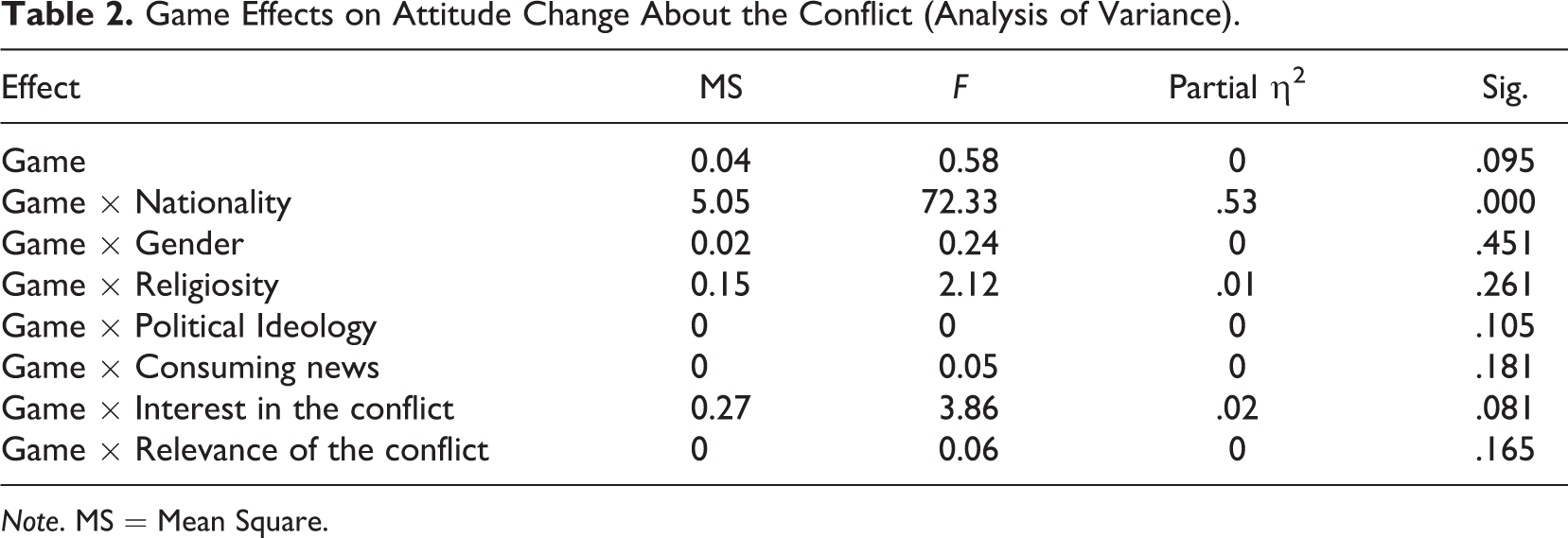
In the second hypothesis, we tested the effect of the game on attitude change focusing on long-lasting key historical issues and current events. The repeated measure ANOVA shows that Palestinians and Israelis did not change their attitudes toward key issues in the Israeli–Palestinian conflict and the Gaza operation after playing the game. Israelis retained pro-Israeli attitudes (before M = 3.24, after M = 3.27) and Palestinians retained pro-Palestinian attitudes (before M = 1.07, after M = 1.07) regarding key issues in the conflict. Similar results were obtained among Israelis (before M = 3.96, after M = 3.89) and Palestinians (before M = 1, after M = 1.08) regarding the Gaza operation.
Americans held pro-Israeli attitudes regarding key issues in the conflict (M = 3.74) and the Gaza operation (M = 3.52) before playing the game, but after playing it became more balanced (key issues M = 2.91, Gaza operation M = 2.9). Turkish participants held pro-Palestinian attitudes regarding key issues in the conflict (M = 1.86) and the Gaza operation (M = 1.46), but after playing it became more balanced (key issues M = 2.33, Gaza operation M = 1.88).
Tables 2 and 3 show that the difference between the four national groups in attitude outcomes is significant. Therefore, Hypothesis 2 is supported.
Game Effects on Attitude Change About the Conflict (Analysis of Variance).
Note. MS = Mean Square.
Game Effects on Change in Attitude Toward the Gaza Operation (Analysis of Variance).

Note. MS = Mean Square.
Discussion and Conclusions
Results suggested that GC significantly improved participants’ level of knowledge about the conflict, but the effect was stronger for American participants than for the other three groups of participants. In fact, the study indicated that the game narrowed the knowledge gap between American participants who held low levels of knowledge before playing the game and direct party participants who held high levels of knowledge before playing it. In contrast, the game did not further contribute to the knowledge outcomes of Turkish participants compared to direct party participants, because they gained the same amount of knowledge from the game, in contrast to American participants.
The American students came from a university in Kansas which is less related to the Israeli–Palestinian situation compared to those of the other participants. Therefore, the former were less knowledgeable than the latter before playing the game. Those holding low levels of knowledge have potentially more information to acquire than those holding higher levels. In addition, previous studies have indicated that new media are naturally conductive to learning for young people (Palfrey & Gasser, 2008) and therefore can narrow the knowledge gap in this group.
The study suggested that the game changed the attitudes of third-party participants concerning key issues in the conflict. It led Turkish and American participants to adopt a more balanced attitude compared with their pregame attitudes. In addition, third-party participants acquired a more balanced perspective toward the Gaza operation after playing GC, unlike the ethnocentric perspective of direct party participants (i.e., pro-Israeli or pro-Palestinian).
The game effects with regard to attitude change are limited to third parties because Turkish and American participants have less salient and weaker attitudes concerning the conflict, as opposed to Palestinian and Israeli–Jewish participants who have stronger and more salient attitudes. This finding is in line with research on attitude strength, which suggests that stronger attitudes are more resistant to change and lead to selective cognitive processing (Eagly & Chaiken, 1998).
Considering the mixed results obtained so far with regard to the effectiveness of simulations (e.g., Matz & Ebner, 2010; Movius, 2008), our findings suggest that the game not only contributed to the improvement of conflict-specific knowledge but also improved perspective taking, albeit in a limited manner. In order to transform simulation games of the Israeli–Palestinian conflict into attitude-changing tools even for direct parties to the conflict, a collaborative play may be more effective than single play, particularly including players of Israeli and Palestinian origin in order to challenge their interaction and game behavior (e.g., Kampf, 2014). Previous studies have already indicated the effectiveness of peace education projects including Israeli and Palestinian small groups in reducing intergroup differences and in bringing about changes in attitudes and stereotypes (e.g., Maoz, 2011; Salomon, 2008). Some of these projects were technology mediated (Amichai-Hamburger & McKenna, 2006; Ellis & Maoz, 2007; Hasler & Amichai-Hamburger, 2013; Mollov, 2006; Walther, 2009; Yablon & Katz, 2001), but only few were conducted on a gaming basis (e.g., Kampf, 2014).
Another implication for the pedagogy and learning scholarship in the context of peacebuilding is the importance of context in learning from simulations. In addition to the different learning outcomes we observed in different cultural contexts, GC has clearly shown that learning effects for direct parties to the conflict are different from those for third parties to the conflict. The effect of context on learning from simulations should perhaps encourage scholars of experiential teaching and learning in conflictual contexts to direct their attention to exploring the contingencies of effectiveness for simulations rather than adopting dichotomous research questions that ask whether simulations are useful or not. In fact, very few assessments have involved cross-cultural experimental studies about the effectiveness and usefulness of technology as a pedagogical tool in teaching about conflicts and peacebuilding, particularly in the context of intractable conflicts like the Israeli–Palestinian situation, and this should be further explored in the future.
The results examining the effectiveness of GC are promising in terms of showing that computer games can be used as part of peacebuilding training. Our results indicate that the game is useful not only in teaching a more complex view of the conflict to the parties, particularly to those who are direct parties to the conflict, but also in engendering attitude change, especially in the form of taking a more balanced perspective and being able to look at the conflict through both lenses. However, it is also important to note the different results obtained for direct party participants compared to third-party participants.
Although very promising, the study’s findings should be considered with caution and interpreted in light of the limited number of participants comprising of communication and political science undergraduate students who may be more interested in the conflict than the general public and fluent with the language of computer games (e.g., Palfrey & Gasser, 2008). The question is whether the game intervention studied here can be effectively applied to a larger and more heterogeneous population than undergraduate students, and it should be studied in future research.
Yet these findings may be especially important for young people on the Israeli–Palestinian divide for two key considerations. First, previous studies have already shown that Israeli–Jewish and Palestinian young people know almost nothing about what transpires on the other side of the Israeli–Palestinian divide, except for the limited and violent images constructed by the media and daily incidents (e.g., Wolfsfeld, Frosh, & Awabdy, 2008). Moreover, since these young people have never actually experienced a state of peace, they may not regard it as having a significant value for which a price should be paid. Therefore, the opportunity for young Israeli–Jewish and Palestinian people to learn about and to perhaps understand the “other” party, even if through computerized simulations like GC, is an issue of great importance in any process of reconciliation in the Middle East and an essential requirement for obtaining public support and legitimacy for any peace initiative.
Footnotes
Declaration of Conflicting Interests
The authors declared no potential conflicts of interest with respect to the research, authorship, and/or publication of this article.
Funding
The authors received no financial support for the research, authorship, and/or publication of this article.