




Abstract
Social networking sites (SNSs) facilitate self-expression and promote social connections. There has been growing scholarly attention to the affect-charged collectivities created online in the aftermath of disasters and mass traumas. This study was designed to examine how individuals affiliate in SNS-based commemoration of a mass trauma, taking advantage of a large Weibo (the Chinese equivalent of Twitter) data set which captures users’ responses over 4 years to the anniversary of the Nanjing massacre, a major traumatic event in Chinese history. Machine learning–based content analysis was combined with dyadic-level network analysis to examine the content Weibo users create and the conversational structures they formed. The results reveal that homophily, geographic proximity, and preferential attachment work in tandem with displays of emotion to influence the formation of online conversational ties. Expressions of negative emotions were found to facilitate or inhibit the homophily effect. Being exposed to the display of anger amplifies the homophily effect among the users, while sadness weakens it. The findings point to the importance of examining specific emotions rather than global (positive–negative) feelings in understanding the dynamics of SNS-based interaction.
Social media technologies today support the building of virtual networks that are creating a new fashion for solidarity in the aftermath of disasters and mass traumas (Margolin & Liao, 2018). In networked mourning and commemoration, social media users communicate their feelings publicly or semipublicly bringing out emotions which formerly might have been privately shared into online spaces and collective experience (Giaxoglou, Döveling, & Pitsillides, 2017). The availability of virtual memorials and online grief support groups has assisted in the formation of various peer-to-peer associations among the individuals who mourn, remember, and honor the deceased (Arthur, 2009). There is increasing scholarly attention to these new types of affect-charged collectivities created online. The “improvised” crowds possible with online social networks have enabled the creation of temporary and transient “affective publics” (Papacharissi, 2015) unconstrained by physical limitations. They pose an alternative to the conventional notion of a crowd by addressing gatherings in digital rather than physical space, where affiliation seems to be a declining function of spatial distance (Gruzd, Wellman, & Takhteyev, 2011).
The objective of this study is to examine how individuals affiliate in social networking site (SNS)-based commemoration of disasters and mass traumas, taking advantage of a large Weibo (the Chinese equivalent of Twitter) data set which captures users’ responses over 4 years to the anniversary of the Nanjing massacre, a major traumatic event in Chinese history. The configuration of an individual’s affiliation was assumed to reflect his or her choices of others perceived as appropriate as interaction partners along with external factors such as the types of individuals who are available for interaction (Rivera, Soderstrom, & Uzzi, 2010). It was also considered possible that preexisting social ties or aggregate social capital affects the development of subsequent preferences that may reinforce this opportunity structure (Scott & Carrington, 2011). In many cases, two or more mechanisms may together influence the formation of ties, but their effects cannot be disentangled unless each is carefully considered and examined in conjunction with the others. This study sought to delineate how such mechanisms might work in tandem to bind together SNS users in their commemoration of a mass trauma and how emotion might facilitate or inhibit the process.
Faced with an emotion-eliciting event, the urge to communicate openly about the event and convey emotional reactions—to socially share emotions—has been well-documented (Brans, van Mechelen, Rimé, & Verduyn, 2013). Prior studies have primarily focused on social sharing among relationally close group members in off-line contexts (Rimé, 2009). Only recently has scholarly attention turned to social sharing of emotions on SNSs from the perspective of affordances. SNSs may afford visibility and directedness which affect the way people share emotions with different individuals and groups. A study of emotion disclosure on Facebook found that users shared more intense and negative emotions in private messages than in network-visible communication, and that fewer personally relevant emotions were displayed in undirected status updates than in directed messages (Bazarova, Choi, Sosik, Cosley, & Whitlock, 2015). The norms of emotion disclosure may affect valenced responses on SNSs, and the diffusion of emotions in the SNS environment is faster and broader than that through traditional communication channels (Brady, Wills, Jost, Tucker, & Van Bavel, 2017). Emotional expression on SNSs often involves mobilizing affect as a transmittable and spreadable resource when an emotional event strikes collectively (Rimé, 2017). The spread of affect may quickly die out off-line when one recedes from the expresser, but the SNS environment can enable numerous sources for the sharing and transfer of feelings to others in a social group.
Scholarly work on networked emotions in digital cultures of participation and sharing, however, has not been keeping pace with these empirical observations (Giaxoglou et al., 2017). In this study, emotions were considered not only as private states individuated by SNS users’ expressive behavior but also as processes that arise from and affect their collective activities. By examining the patterns of expression and interaction among a large number of contributors to Weibo around the anniversaries of a mass trauma, this study was designed to shed light on how social and emotional processes shape the dynamics of exchanges and how ties form which bind individuals into a temporary community in mourning. Research on the social sharing of emotion suggests that encountering a common emotional event often triggers intense interactional exchange among the members of a social group, though less is known about their communication patterns (Rimé, 2009, 2017). The study of online activity triggered by a large-scale traumatic event such as the Nanjing massacre can offer markedly finer-grained documentation about how people react to such events and how they interact with others.
The Social Mechanisms of Tie Formation
Scholars have approached the organization of individuals into networks and groups using assortative perspectives that focus on the actors’ attributes, proximity perspectives that focus on the organization of social interaction embedded in place, and relational perspectives that focus on actors’ preexisting ties and resources (Rivera et al., 2010). Each of these three approaches seeks to explain the formation of relationships particularly at the level of network dyads, namely, how dyadic ties form and evolve among social actors.
Homophily
The homophily principle proposes that actors prefer to be connected to others they perceive as having attributes similar to their own (for a review, see Mcpherson, Smith-lovin, & Cook, 2001). The probability of two individuals sharing a network connection is known to correlate strongly with their similarity in terms of sociodemographic attributes such as level of education, gender, race, and age (Kossinets & Watts, 2009). The same principle has also been shown to apply to psychological attributes like beliefs and attitudes. Individuals tend to select their discussion partners by evaluating potential correspondents in terms of their expressed ideological preferences (Gu, Konana, Raghunathan, & Chen, 2014). Such segregation into like-minded clusters is believed to arise both from preference for similar others when forming links and from peer influence, making linked individuals more similar (Kossinets & Watts, 2009). Homophily may produce a shared attitude and a heightened desire for cognitive closure which results in polarization (Sunstein, 2009). Moreover, homophily is more likely to occur within groups on the ideological extremes rather than those nearer the center, as the individuals with more extreme positions often demonstrate stronger preferences for certainty and place more weight on encountering concurring opinions (Hogg, 2007). Individuals with low-level cross-cutting exposure are far less likely to perceive opposing viewpoints as legitimate, which has detrimental consequences for tolerance (Mutz, 2002).
Increasing the use of SNSs has granted new relevance to the question of attitude-based homophily. Attitude- or value-based homophily takes in a wide variety of internal states that are hard to measure in the real world but are measurable when digital traces are available. Sentiment labels, self-reported interest, and user-defined tags have been employed to quantify opinion difference and common memberships as measures of values homophily (Gu et al., 2014). Attitude homophily has important implications for the polarization of public opinion. SNSs may support the formation of an open forum which facilitates public deliberation, though they can decay into an echo chamber that fosters confirmation bias and amplifies people’s existing views (Colleoni, Rozza, & Arvidsson, 2014). The study’s first research hypothesis sets out to assess the extent to which Weibo participants exhibit homophily in their discussion of the Nanjing massacre.
Spatial proximity
The role of proximity in social activities has been a subject of scholarly attention for decades. Proximity is commonly treated as multidimensional, with spatial, temporal, and configurational characteristics (O’Leary & Cummings, 2007). There is a distinction made between spatial dispersion and contextual differentiation (Ambos & Ambos, 2009). Co-location refers to sharing of the same place, while co-setting refers to sharing a similar context. Among the multiple dimensions examined in prior empirical studies, the spatial dimension has received the most attention (Huang, Shen, & Contractor, 2013). From a methodological standpoint, spatial proximity is often operationalized as a dichotomous variable—being either co-located or dispersed. Abundant research has investigated the relationship between spatial proximity and the formation of social connections ranging from friendship and romantic relationships to cooperative relations and group collaboration. Scholars demonstrated that people who are spatially proximate will be more likely to establish and maintain a relationship (Brockmann, Hufnagel, & Geisel, 2006).
As the Internet facilitates interactions both near the home and across the distance, scholars have begun to research whether spatial proximity still operates within digitally mediated communication. Digital trace data have been employed to examine the impact of proximity. A study of e-mail networks among university students found that sharing a dormitory or living on the same floor increased the number of sent and received e-mails (Marmaros & Sacerdote, 2006). Leskovec and Horvitz (2007) found that an increase in geographic distance decreased the length and intensity of instant-message conversations among 180 million people worldwide. A study of a multiplayer online role-playing game showed that the players preferred others nearby when deciding with whom to collaborate online (Huang, Shen, & Contractor, 2013). It is reasonable to believe, therefore, that this impact of spatial proximity would also hold true for Weibo-supported interactions.
The rich getting richer
The concept of relative social “worth” suggests that an actor’s position in a social network can be defined in terms of the number and strength of the ties he or she maintains, the resources flowing through those ties, and the opportunities that are potentially available (Scott & Carrington, 2011). This supports a structuralist perspective which asserts that tangible resources (e.g., information) and intangible resources (e.g., trust) can both be conferred in part through actors’ positions in social networks. Empirical studies of computer-mediated networks support a rich-get-richer preferential attachment mechanism—social capital online reflects one’s stock of off-line and online resources already available (Alaa, Ahuja, & van der Schaar, 2017). Among other things, individuals with prior structural relationships and resources may be more likely to gain in popularity capital whereby others are more likely to link to them.
Following and follower relationships are considered to be one of SNSs’ most basic currencies—the basis for building social ties and getting access to various resources through network-informed associating (Hofer & Aubert, 2013). “Following” allows SNS users to articulate their social connections and to navigate those connections virtually rather than face-to-face (Ellison, Steinfield, & Lampe, 2011). The online visibility of a person’s multiple networks enables others to examine the links to and from that person and to determine whether to associate with him or her depending on which networks need to be tied. A study of South Korean politicians’ Twitter-based networking found that the more a politician is linked to others through communication, the more likely he is to have public followers (Yoon & Park, 2014). Network-informed associating can thus build social capital, which helps to create productive conversations on social media and provides opportunities to exchange knowledge (Majchrzak, Faraj, Kane, & Azad, 2013).
De Choudhury (2011) quantified Twitter users’ ego-network structures using the ratio of the number of a person’s followers to the number of others following them. The ratio was used as a measure of a user’s relative social “worth” and achieved status. Those with a higher ratio (i.e., more followers than followings) are considered to have greater social worth and higher status because of their privileged access to broadcasting resources (Yoon & Park, 2014). Kadushin (2012) has pointed out that the desire for rank or status is a strong motive for forming relationships on social networks. In a version of social climbing, individuals tend to connect with (or indeed defer to) those perceived as having higher status. While individuals of higher status are often sought-after targets for social connection, individuals of lower status have greater incentive to connect actively because they can probably benefit from going beyond local circles and forging bridges to a wider universe (Yoon & Park, 2014). Users with more followers than followings would thus be expected to receive disproportionate attention in SNS-based conversations; those with fewer followers than followings would have greater incentive to make new connections.
The Social Function of Emotions
Scholarly literature on emotions have primarily focused on their intrapersonal function—how the emotions experienced by individuals are interrelated with their own thoughts and actions (Levenson, 1999). However, emotions may also have an impact on the judgments and behavior of those who observe their display (Keltner & Haidt, 1999). From the social functional perspective, researchers have emphasized how emotions conveyed by individuals organize their interactions through social sharing (Rimé, 2017). Social media introduce a new context for such social sharing of emotions. SNSs inherently place various constraints on the ability to manage the extent and method of emotional disclosure, as its affordances of visibility and directedness constrain the process by collapsing multiple audience groups (Bazarova et al., 2015). For purposes of impression management, individuals consciously try to tailor the emotions they display, as they realize that displays of emotion influence others’ attitudes and behavior in response (Qiu, Lin, Ramsay, & Yang, 2012). Sharing emotions can prompt different reactions. Some users may be prepared to acknowledge such emotional displays and engage in an exchange of emotional and support resources, but others could see it as oversharing and seek to distance themselves from the expressers (Giaxoglou et al., 2017).
The Context of Reaction to Trauma Anniversaries
In sharing emotions about a traumatic event, studies have shown that people are inclined to express nearly all of their negative emotions, with the possible exception of shame (Rimé, 2009). The term “anniversary reaction” refers to unsettling feelings, thoughts, or memories that occur on the anniversary of a significant negative event (Bornstein & Clayton, 1972). Among the range of potential emotional responses, sadness has been the focus of abundant research studies (Morgan, Hill, Fox, Kingham, & Southwick, 1999). While flattened affect and sadness affect most people briefly after a trauma, some may find themselves clinically depressed or even suicidal. Anger is also a common reaction to trauma, especially as a response to events that seem unfair as a result of improper actions taken by an external agent (Amstadter & Vernon, 2008). Fear may also resurface around the anniversary of a trauma, leading to startled responses and vigilance about safety (Dalgleish & Power, 2004).
From a social psychological perspective, anniversary reaction has been explained in terms of appraisal theories of emotion and social identity theory. Appraisal theories of emotion (Frijda, 1986) focus on how the emotions experienced are interrelated to an individual’s own cognition and information processing. Social identity theory (Tajfel & Turner, 1979) posits that individuals’ sense of who they are derived in part from the groups with which they identify. Even if an event that affects the group has no direct effect on the individual observer, it triggers emotions in the same way as a self-relevant event. Studies of the September 11 terrorist attacks on the United States in 2001 and the March 11 terrorist bombing in Madrid in 2004 show that collective trauma elicits the social sharing of the emotional experience among those who identify with the groups concerned (Rimé, Paez, Kanyangara, & Yzerbyt, 2011). Such negative emotion sharing is associated with venting the emotion, soliciting understanding, enhancing social bonds, and receiving social support (Peters & Haslam, 2010).
Displays of Emotion and Elicited Affiliation
Grounded in the social–functional view of emotion, the notion of emotions as social information has been integrated with cognitive appraisal theories to explain how expressing emotions can influence affective/cognitive reactions in a group and eventually behavioral outcomes (van Kleef, Heerdink, & Homan, 2017). Expressing emotion permits group members to convey information about their appraisal of a situation and often carries implications about their position in relation to the objects involved (van Kleef, 2016). A considerable body of research has shown that displays of emotion may elicit affective reactions and/or cognitive inferences in others, which enables rapid social coordination (Keltner & Haidt, 1999). One stream of research has focused on affective reactions to the displays of emotions in groups, particularly emotional contagion. Empirical studies of face-to-face and computer-supported group interactions both found that a shared affective state often emerges as group members perceive and respond to emotions expressed by group members (e.g., Cheshin, Rafaeli, & Bos, 2011). Another notable stream of research has addressed the cognitive inference based on others’ expressions of emotion. Individuals may engage in a more purposive cognitive process when they refer to the emotions displayed by their interaction partners to inform their judgment of a situation (van Kleef et al., 2017). In sum, displays of emotion have robust effects on the dynamics of exchanges between the expresser and the observer.
A further question would be whether discrete emotions will lead to qualitatively different or similar dynamics of exchange. Positive emotionality has been found to be positively associated with empathy and prosocial behavior, whereas the effect of negative emotionality yields inconsistent findings (Eisenberg, Damon, & Lerner, 2011). Appraisal theorists posit that discrete negative emotions manifest themselves in distinct expressions and that action tendencies are produced by distinct constellations of evaluations (Weiner, 1986, 2006). A long line of scholarship has demonstrated that attributions of situational responsibility “produce feelings of sympathy or pity, which serve to stimulate helping behavior by activating feelings of sadness, pity, and fear” (Cassese & Weber, 2011, p. 66). When displaying fear, expressers signal submissiveness. As a case in point, Schachter (1959) documented the relationship between fear and affiliation: Fearful subjects are more likely than fearless ones to affiliate. Schachter adopted a social comparison explanation and argued that when confronting fear-provoking situations, people tend to seek social contact in order to figure out whether they are reacting appropriately based on the comparison with others. According to the fear reduction hypothesis, subjects affiliate with the expectation that an attachment to others will make them feel less anxious (Kirkpatrick & Shaver, 1988).
In the same vein, display of sadness is seen as affiliative because it signals a need for support. The tendency to seek social contact and share the sadness is often interpreted as an attempt to lessen a blockage (Brans, van Mechelen, Rimé, & Verduyn, 2014). For sadness, the core relational theme emphasizes that the loss is irrevocable and will never be recouped (Weiner, 1986). Experimental evidence suggests that sharing sadness may enable individuals to experience a certain empowerment and that it may evoke the feeling that coping is possible (Weiner, 2006). That is consistent with previous findings on the effects of expressing the emotions in the contexts of bereavement (Pennebaker, Zech, & Rimé, 2001) and marital separation (Sbarra, Boals, Mason, Larson, & Mehl, 2013).
Relative to fear and sadness, feelings of anger are associated with “other-blame”. That involves attributing a negative outcome to an external agent (Weiner, 2006). Anger is viewed as a nonaffiliative signal, and its effect is context-specific (Weiner, 1986, 2006). Several studies have shown that anger makes people want to share their feelings (Rimé, 2009). For example, it was found that angry people are motivated to talk to others and that they speak sooner about their anger experiences than about joyful ones (van Doorn, Zeelenberg, & Breugelmans, 2014). If the display of anger is not directed at the observer, it may often elicit emotional mimicry—being affectively empathic and appearing to share the emotional state (van der Schalk et al., 2011). Expressing anger can communicate to others that one disapproves of an event and that they should also disapprove. Displays of anger may thus mobilize collective support in opposing a situation which one finds unacceptable (Peters & Haslam, 2010). Taken together, the social sharing of fear, sadness, and anger—though through different mechanisms—can lead to more positive affect on both sides and thus a greater propensity to seek social contact.
Although a handful of research has investigated the social functions of emotional displays on SNSs (e.g., Bazarova et al., 2015), few studies have distinguished the emotional sharing with in-group members from that with out-group members. SNSs make it possible to compose messages that are visible to a large and diverse audience comprising members with varying levels of relational closeness and attitudinal similarity to the sharer (Giaxoglou et al., 2017). Studies have shown that individuals sometimes share indiscriminately, to whoever will listen, whereas at other times, they seek intimate or similar others (Burke & Develin, 2016). Some of the claimed benefits of social sharing (e.g., bolstering trust and attachment) indicate a need for an in-group member as the interaction partner, though other benefits (e.g., summoning up positive experiences) do not.
The affect theory of exchange (Lawler, 2001) suggests that if an exchange between two individuals generates pleasant emotions which each attributes to the interaction with the other, those two individuals will be more willing to interact with each other later on, perhaps generating a robust and long-lasting network tie. Actors are more likely to sense positive emotions in interactions with those socially proximate than with those more socially distant (Lawler & Thye, 2006). Empirical evidence both online and off-line indicates that people tend to restrict disclosing negative emotions to their in-group (Lin, Tov, & Qiu, 2014). It is suggested that the more like-minded the interaction partner, the more comfortable an expresser would be in displaying negative emotions.
Existing studies point to a broad perceptual bias whereby people are more receptive to in-group members and their displays of emotion (e.g., Avenanti, Sirigu, & Aglioti, 2010). Specifically, van der Schalk, Fischer, et al. (2011) found that people are more likely to understand and emulate displays of anger and fear when they are displayed by in-group members rather than by non-members. Sadness displays were also found to be mimicked to a greater extent if there is a higher level of intimacy or similarity between the expresser and the perceiver (Bourgeois & Hess, 2008). Although people may draw support from a variety of network ties, empathetic support typically arrives from the in-group when experiencing psychological distress (Burke & Develin, 2016). A study of Facebook users found that whereas people may share positive emotions regardless of their audience composition, people prefer to share negative emotions with a smaller segment of audience comprising just in-group members (Burke & Develin, 2016). Drawing on a large data set of tweets about polarizing public policy issues, a study of the online expression of moral emotions found that such content may spread more widely within ideologically similar in-group networks than to ideologically different out-groups (Brady et al., 2017). Any affiliation effect of negative emotion displays should be stronger among the like-minded than among the dissimilar individuals. As such we expect people may favor their in-group as their interaction partners when venting negative emotion (specifically sadness, anger, and fear), given their expectations about the extent to which the interaction partners would understand and accept their emotional displays.
Method
Data
The Nanjing massacre was an episode of mass killing, looting, and rape committed by Japanese troops after the fall of Nanjing, China’s capital, during the World War II (Gao & Alexander, 2012). Chinese today consider the massacre to be a traumatic national humiliation, and every year on December 13, the anniversary of Nanjing’s fall, a series of public activities are held to commemorate the event (Seo, 2008). Chinese netizens engage actively with online memorials through posts on Chinese social networking tools. Unlike the commemoration of World War II in Europe, where the conflict is very much relegated to the past, the Nanjing massacre remains a powerful reminder of both the atrocities themselves and of what is perceived as Japan’s subsequent whitewashing of its war crimes (Li & Huang, 2017).
“Nan jing da tu sha” (Nanjing massacre) was employed as a key word to retrieve posts on the topic from Sina Weibo. As of 2018, Sina Weibo has risen to 10th place in the global social media ranking based on the number of active users, one place above Twitter (We Are Social, 2018). The topic “Nanjing Massacre Public Memorial Day” had attracted more than 300,000 comments as of 2015. The period searched ranged from 1 week before to 1 week after the anniversary date (December 13) for each year from 2011 to 2014. This yielded 69,579 users contributing 80,587 posts in total.
Measurements
The user attributes region (based on the Chinese provinces), gender, followers (the number of followers a user has), and followings (the number of accounts a user follows) were compiled using data from the user profiles.
Connections
The dependent variable was the formation of conversation ties based on mention relationships—whether a user has mentioned another user in a Weibo post. Weibo participants use the @user syntax to reference or target a conversation to a specific user, alerting the mentioned person that he or she is being talked about. Previous findings point to the practice of addressing other users with @username as accurately representing the conversational aspects of a microblogging platform (Honeycutt & Herring, 2009). In a massively multiparticipant public environment like Weibo, use of mentions is viewed as an efficient way to establish and maintain conversational ties (Song, Dai, & Wang, 2016).
The extracted mentions were used to construct a binary and directed graph where the nodes represent Weibo users and the edges are the mention relationships. Mention relationships were measured by dyad and coded as a dummy variable, with 1 indicating that a user has mentioned another user in a post and 0 otherwise. This resulted in a total of 21,215 unique mentioned pairs. The total number of nodes involved in at least one mention relationship was 14,716. Mention relationships were the dependent variable in the main analysis, and all mentioned pairs and all possible unmentioned pairs of individuals were treated in the analysis. 1
Spatial proximity
The dyad-level variable Same_regionij was defined as equals to 1 if Weibo users i and j were from the same province in China and 0 otherwise. Same_regionij was used to quantify two users’ spatial proximity.
Attitude homophily
A machine learning approach was applied to categorize all the posts as either conveying a “negative” attitude toward the Nanjing massacre or “not negative.” Using the bag of words created from both negative and neutral words that frequently appeared in the whole data set, each post was represented as a feature vector. After this preprocessing, the actual classification was taken over by a support vector machine classifier (Kharde & Sonawane, 2016). A training set of 6,000 manually labeled posts was used to build a binary classification model using the Support Vector Machine (SVM) algorithm. Using the measure of Krippendorff’s α, reliability was .89. Considering that very few posts on this particular topic carried a positive tone, we adopted two possible outcomes “negative” or “not negative” rather than “positive,” “neutral,” or “negative”. An accuracy of 83% was achieved.
A particular user’s negativity score was then calculated as the mean negativity score of all of his or her posts. For example, if a user posted one nonnegative message and three negative messages over the study period, his negativity score would be 0.75. The negativity distance was calculated as the absolute value of the difference between two users’ negativity scores, and this was used as the variable negativity_distanceij that quantifies a pair’s attitudinal homophily.
Achieved status
Each user’s number of followers and the number of accounts they followed were used to develop an individual-level variable “follower–following ratio” which was taken as quantifying each user’s achieved status. The ratio was the user’s number of followers divided by the number of followings. The ratios were highly skewed, so a logarithmic transformation was applied in the analyses.
Display of emotion
The sentiment expressed in each post in which an @ appeared (indicating the formation of a mention relationship) was classified using MoodLens, an often-used emoticon-based sentiment analysis system for Weibo posts (Zhao et al., 2012). The sentiment classes used in this study were anger, sadness, fear, and “others.”
Analysis
To analyze statistically the factors predicting a conversational tie’s existing between two Weibo users, the presence of a mention tie was treated as the dependent variable on the dyadic level, and both individual-level and dyad-level variables were treated as independent variables. Logistic regression was chosen to model the formation of mention ties because all of the independent variables considered were individual attributes rather than structural properties (e.g., transitivity and reciprocity) and because the size of the mention network was relatively large.
The 4 years of data were modeled year-by-year to increase the robustness of the inferences in the face of temporal fluctuations and other factors such as sampling variation which could potentially influence the results. It is important to note that there was high turnover of active users over the 4 years studied. Ninety-six percent of the senders involved in a mention relationship appeared in only 1 year. So there was not much connection between the data for different years and each year’s mention networks can be regarded as completely different. The logistic regression models in each year were of the form:
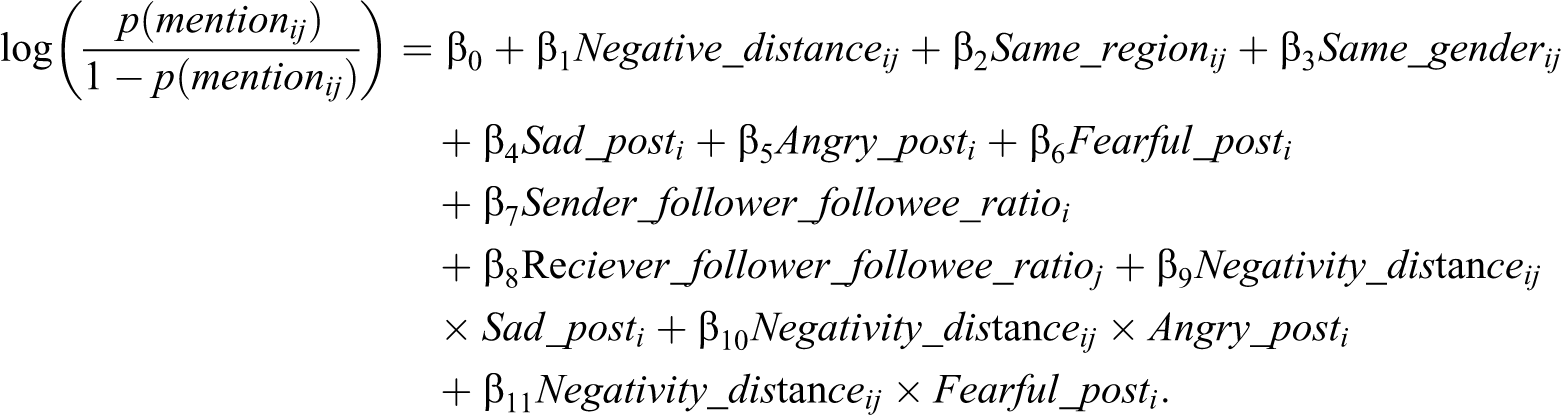
The unit of analysis was the dyad. Each observation involved a pair of users. For each pair, the subscript i represents the sender and j represents the receiver. The (logarithmic) odds of tie formation was the dependent variable. The dyad-level independent variables were negativity distance and same region. Others were at the individual level—type of emotion displayed, a sender’s follower–following ratio, and a receiver’s follower–following ratio. Same gender (where i and j were of the same gender) was included as a control variable.
Finally, to synthesize the results across the 4 years, a fixed-effects meta-analysis was conducted to calculate a combined coefficient for each of the independent variables based on the 4 years’ results from the logistic regressions (Borenstein, Hedges, & Rothstein, 2007).
Results
Figure 1 shows a frequency distribution for the emotions displayed in the posts of each year. Sad posts dominated for this topic, numbering 59,070 posts over 4 years, 73.3% of the total. Angry posts were less frequent (13,055 posts, 16.2%), followed by fearful posts (5,583 posts, 6.9%) and others.
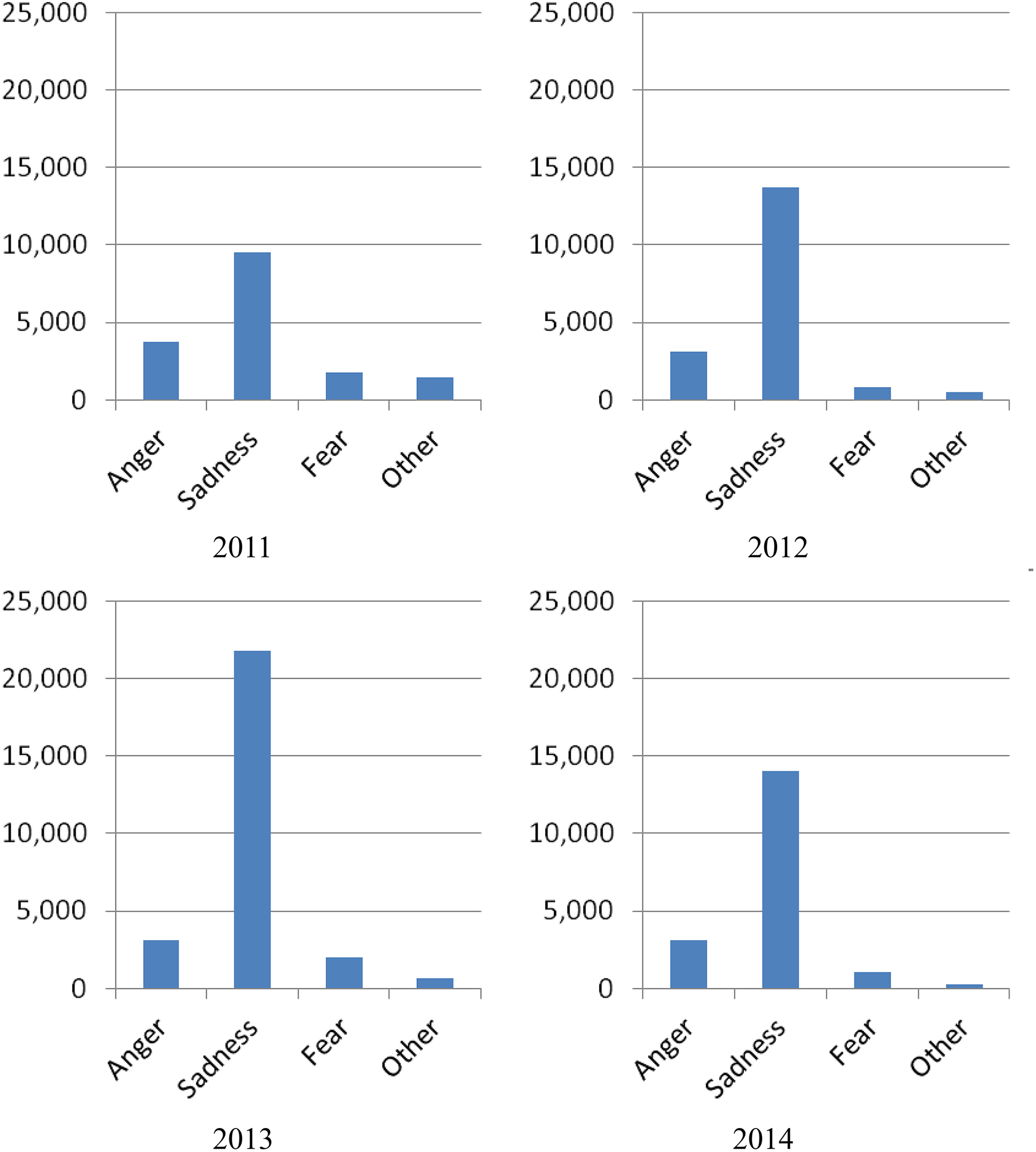
Emotions displayed in Weibo posts containing the term “Nan Jing Da Tu Sha” (Nanjing massacre).
About 62% of the users in the sample were male. Their mean negativity score was 0.38, showing there were more users of a neutral attitude than of negative attitude in their discussions of the Nanjing massacre. The distribution of the follower–following ratio was heavily skewed. Most of the users had fewer followers and more followings, though a small number had disproportionally large numbers of follower. A correlation test shows that gender, mean negativity score, and follower–following ratio generally were not intercorrelated, with correlations coefficients ranging from .001 to .02.
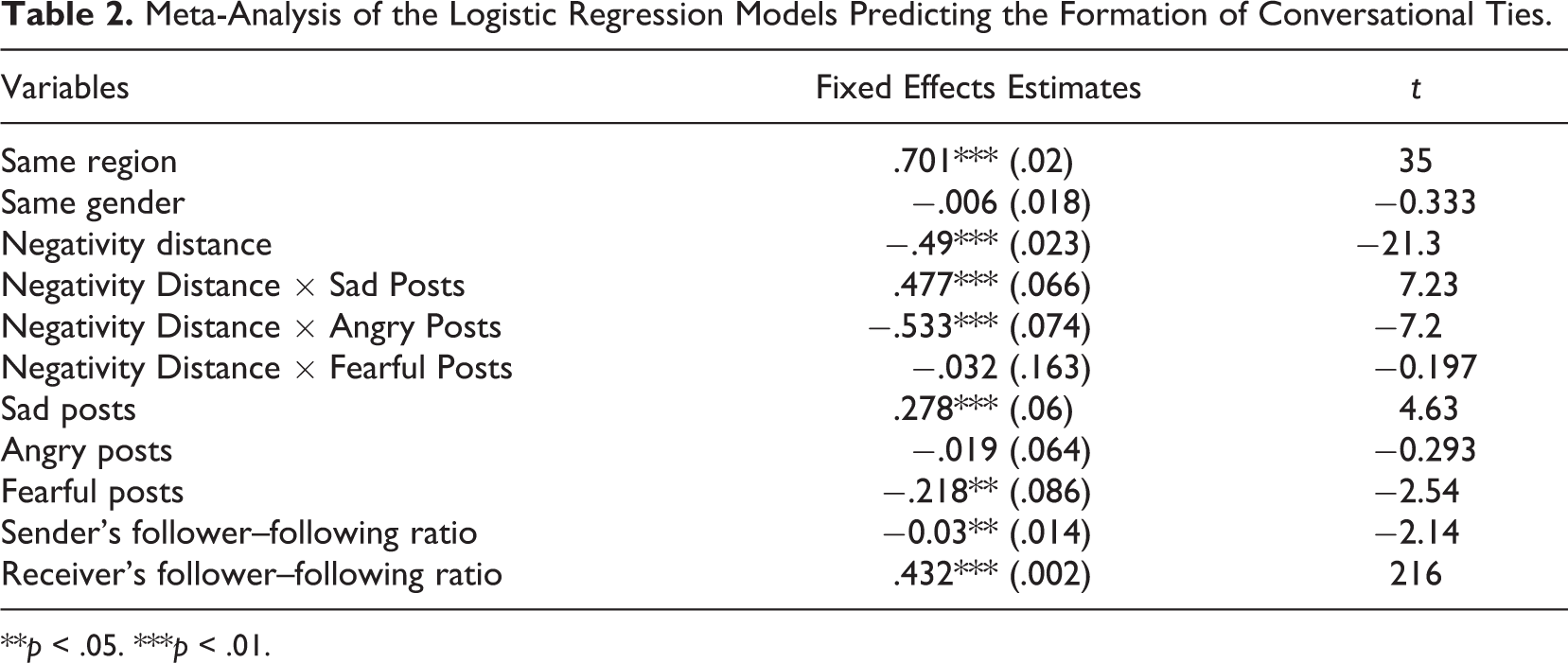
Table 1 presents the coefficients of the logistic regression models assessing the predictive power of spatial proximity, attitude homophily, achieved status, and displayed emotion for the formation of conversational ties. Table 2 presents the combined coefficient for each of the independent variables from the meta-analysis.
Coefficients of Logistic Regression Models Predicting the Formation of Conversational Ties.

**p < .05. ***p < .01.
Meta-Analysis of the Logistic Regression Models Predicting the Formation of Conversational Ties.
**p < .05. ***p < .01.
Table 1 shows a strong negative effect of negativity distance on formation of conversational ties, except in 2011 when neutral comments predominated. The meta-analysis results further confirmed that negativity distance had strong predictive power for the formation of conversational ties (β = −0.49, p < .0001). Users were more likely to form mention ties with those with a smaller negativity distance. Specifically, users were 1.63 times more likely to mention others demonstrating the same attitude (i.e., negativity_distance = 0) than those with completely different attitudes (i.e., negativity_distance = 1). Therefore, Hypothesis 1 is supported by the results.
Figure 2 provides a visual summary of how negative and nonnegative users communicate with the other categories and within their own opinion cluster. Figure 2a shows that negative users were consistently more active in initiating a conversational tie than nonnegative users in all 4 years. Whether negative users received a conversational tie more often than nonnegative users shows a less clear pattern (see Figure 2b). In 2011 and 2012, negative users received a conversational tie more frequently than nonnegative users, but in 2013 and 2014, they were mentioned less frequently. Figure 2c shows that mentions within the group of negative users were most frequent in all 4 years, outnumbering mentions within the group of nonnegative users and between the groups. Nonnegative users mentioned other nonnegative users much more often than they mentioned negative users, except in 2011. The graphs are supplemented by the data in Table 3 showing the total number of conversational connections between members with different attitudes and within each category. This demonstrates the extent to which both negative and nonnegative posters talk to their own “side” in the first instance and that both groups seek to connect with each other. Chi-squared tests were applied to test whether these conversational connection frequencies are significantly different, and the results confirm that people tend to form conversational connections with other like-minded people.

Users’ activity and interaction pattern by attitude (Density is defined by number of mentioned pairs divided by total number of possible pairs).
The χ2 Tests Comparing the Observed and Expected Number of Mentions Among Users With Different Attitudes.
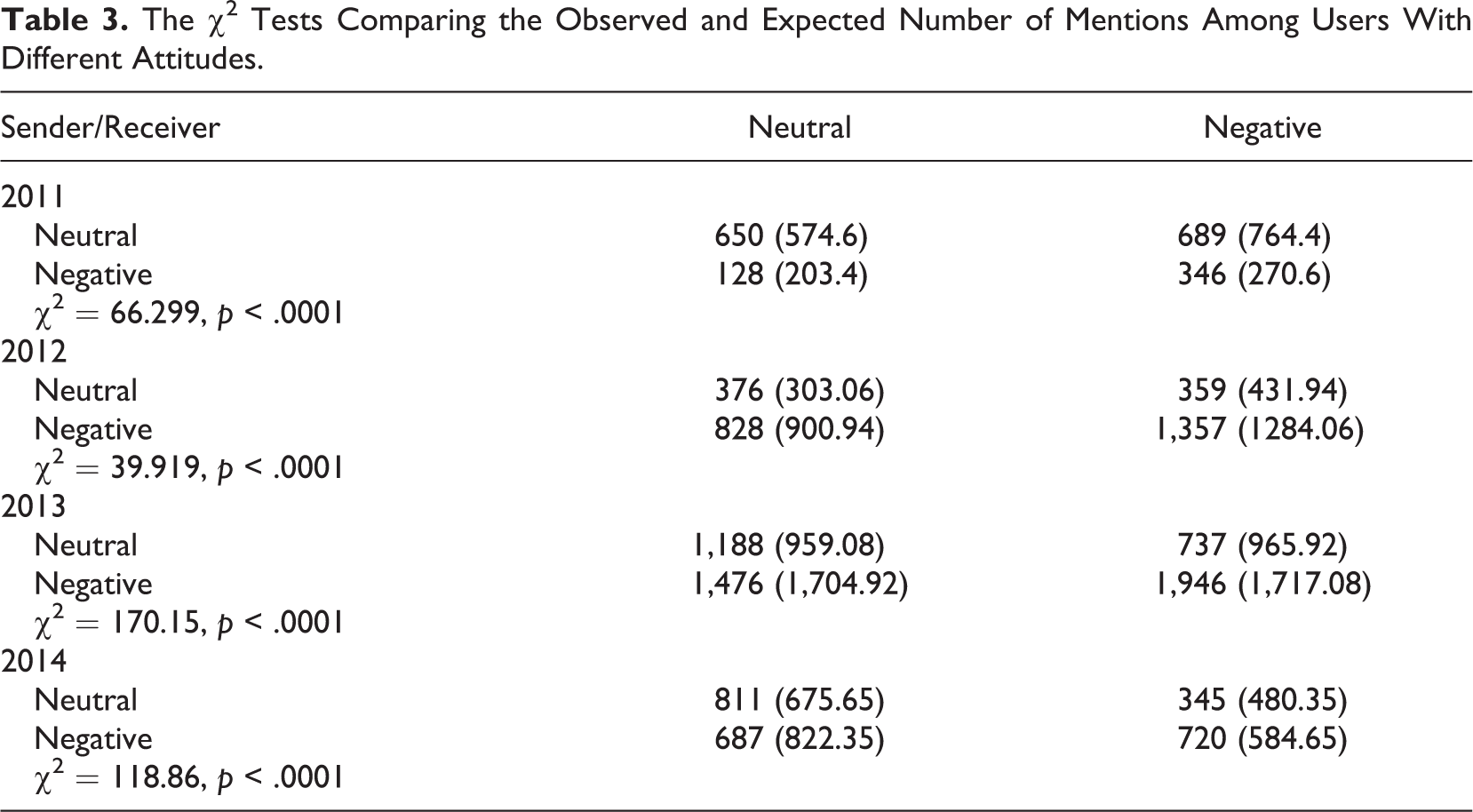
Table 1 also shows that inhabiting the same region is a strong predictor for the formation of a conversational tie, except in 2013. The meta-analysis results also confirmed this strong relationship (β = 0.701, p < .0001). That is, users were twice likely to mention those from the same region than those who come from a different one. Hypothesis 2 is therefore also supported by the results.
Hypothesis 3 addresses the influence of achieved status (indicated by the follower–following ratio) on the propensity to form a connective tie. The coefficients of the receiver’s follower–following ratio in Table 1 were positive and significant across the 4 years, and the meta-analysis results also show that the ratio has a significant relationship with the formation of a mention tie (β = 0.432, p < .0001), indicating that users with higher follower–following ratios were much more likely to receive a mention tie. Specifically, a unit increase in the logarithm of the follower–following ratio of the receiver predicts a 54% increase in the likelihood of receiving a mention tie. Therefore, Hypothesis 3a is strongly supported by the data.
On the other hand, Table 1 shows that the sender’s follower–following ratio coefficients fluctuated greatly and were only significantly negative in 2013. The meta-analysis results show that overall, the senders’ follower–following ratio only had a marginally significant negative effect on formation of a conversational tie (β = −0.03, p = .04). The data do not clearly support Hypothesis 3b.
Hypotheses 4a–c address the relationship between affiliation and sadness, anger, and fear. The display of sadness in posts showed a positive and significant relationship with the formation of conversational ties, except in 2014 (see Table 1). Overall, the relationship was positive and significant (β = 0.278, p < .0001; see Table 2). When sadness was displayed in a post, the likelihood of users forming a mention tie increased by 1.32 times. Thus, Hypothesis 4a is supported.
Displays of anger showed no such consistent effect, and the meta-analysis showed no significant relationship overall (β = −0.019, p = .38). Hypothesis 4b is not supported by the data.
As for the display of fear, it showed a significant relationship only in 2012. The combined effect (see Table 2) was also marginally negatively significant (β = −0.218, p = .016), indicating that displaying fear does not necessarily increase the propensity to connect with others. Thus, Hypothesis 4c is not supported.
Hypotheses 5a–c address the differential influence of emotion on the formation of conversational ties between attitudinally similar and dissimilar pairs. The coefficients of interaction terms relating sadness and attitude homophily were consistently positive over the 4 years (see Table 1), though in 2011 the relationship was not significant. The meta-analysis showed that overall, there was a positive interaction between displays of sadness and attitude homophily (β = 0.477, p < .0001). Users were less likely to connect with like-minded others when displaying sadness. Specifically, when there is no display of sadness, users were 2.26 times more likely to mention users demonstrating the same attitude (i.e., negativity_distance = 0) than users with completely different attitudes (i.e., negativity_distance = 1). In comparison, when sadness is displayed in a post, users were only 1.4 times more likely to mention users demonstrating the same attitude (i.e., negativity_distance = 0) than users with completely different attitudes (i.e., negativity_distance = 1). Thus, Hypothesis 5a is not supported.
The coefficients of the interaction terms including anger were, in contrast, consistently negative over the 4 years (see Table 1), though not significant in 2011. The meta-analysis showed a significant negative interaction between anger and attitude homophily (β = −0.533, p < .0001). Specifically, when there was no display of anger, users demonstrating the same attitude (i.e., negativity_distance = 0) are 1.44 times more likely to form mention ties than are users with completely different attitudes (i.e., negativity_distance = 1). In comparison, when anger was displayed in a post, users are 2.45 times more likely to form mention ties with those demonstrating the same attitude (i.e., negativity_distance = 0) than users with completely different attitudes (i.e., negativity_distance = 1). Thus, Hypothesis 5b is supported.
Finally, no consistent interaction effects between fear and attitude homophily were observed (see Table 1), and the meta-analysis results showed that the interaction between fear and attitude homophily was not significant (β = −0.032, p = .39). Hypothesis 5c is not, therefore, supported.
Gender homophily was also included in the modeling as a control variable, but it showed no consistent predictive power. The meta-analysis results showed that the effect of gender homohily was not significant (β = −0.006, p = .38).
The robustness of these findings was checked by performing several additional analyses. First, to rule out baseline networks (e.g., following relationships) as a possible confounding variable, the models were reevaluated including users’ following relationships as an additional control. 2 Then, to account for possible network interdependencies within individuals, the analysis was repeated by including geometrically weighted degree counts in our model, which assigns geometrically decreasing weights to degree counts and controls for degree distribution with a single term (Snijders et al. 2006). Third, to account for any possible core-periphery structure in the data (i.e., mention ties concentrated within a few individuals or a single region), the analysis was rerun using a subsample of the data which excluded users who had received a disproportionate number of @mention ties and those who came from the most common province (Jiangsu). Meta-analyses (see Appendix Table A1) showed that all of the key results proved robust in these additional analyses.
Discussion
This study situated human affective practice in the environment of SNS-based networks and investigated the socioemotional dynamics of the bonding that occurs around the anniversaries of a mass trauma. Although advances in information technology have led some scholars to declare “the death of the distance” (Cairncross, 1997), this study has shown that geographical distance still has a considerable impact on the structure of online relationship networks, at least in China. While many of the contributors on this particular topic were geographically distributed, a common province has a strong positive influence on the formation of conversational ties among them online. Whether or not conversation partners online are aware of each other’s off-line locations, sharing the same off-line location still somehow increased the likelihood that they would form a conversational tie. There is also robust statistical evidence that users with a higher follower–following ratio are much more likely to attract a conversational tie. That may be because users who are more followed than following benefit more from the resources made available through their relatively large audience, and accordingly, they are considered to have higher status. Social climbing may motivate users to affiliate with higher status others. The desire for rank is a strong motive to form relationships on social networks, as in the off-line world.
The principle of attitude homophily also holds true online. There is no evidence, however, of gender homophily. Despite the SNS affordance of accommodating varied and discordant voices and positions, this study found that individuals are more likely to connect with those showing similar attitudes. Further analysis of the conversational connections shows that groups on the ideological extremes exhibit stronger homophily than those at the center. Mentions within the group of negative users were the most frequent in all 4 years, outnumbering mentions within the group of nonnegative users and between the groups. Negative users were consistently more active in initiating a conversational tie than nonnegative users in all 4 years.
The results further indicate that the emotional environment effectively encourages or inhibits homophily. Experiencing anger amplifies the homophily effect among the users, while sadness weakens it. In other words, the affiliation effect of anger is stronger among those with similar attitudes (an in-group) than among dissimilar individuals (an out-group). Quite the contrary, the affiliation effect of sadness is weaker among those with similar attitudes than among dissimilar individuals. Although previous studies have shown that expressing emotions aids social transmission within political in-group networks more than out-group networks (e.g., Brady et al., 2017), they have left unresolved the impact of specific emotions. In this study, the in-group advantage was consistently observed only for anger, not for sadness or fear. People displaying anger are more likely to express it with in-group bias. Our results also contribute to recent discussions of the role of social media in creating a biased information environment. To the extent that anger increases people’s propensity to connect with the like-minded, it may help explain why anger and resentment are often displayed in “echo chambers,” tending to exacerbate ideological polarization.
User-generated content posted via Weibo presents diverse emotional responses to the Nanjing atrocities in the same space. Weibo users as a group displayed sadness, anger, and fear consistently over the 4 years despite substantial churn among the individuals involved. Sad posts dominated overwhelmingly for this topic, followed by anger and fear. The tenets of political psychology suggest that anger tends to be associated with blame. Those who mostly displayed sadness, by contrast, associated their feelings with loss. An emphasis on blame may activate more punitive attributions and spur action targeting perpetrators, promoting retaliation for example. Alternatively, an emphasis on loss may impel targeting victims to, for example, promote healing. The study’s results suggest that Weibo served primarily as a grieving space where individual users could express loss rather than attributing blame or expressing anger at the perpetrators.
Beyond the intrapersonal effects attributed to emotional expression, this study also considered the social function of emotional displays. Expressing emotion may encourage participation in a manner that supports the development of stronger person-to-person and person-group ties—particularly in the short term while emotions are felt intensely. The results of this study testify to the affiliation function of expressing specific emotions, consistent with a “two-step mechanism” through which discrete emotions in response to a shared event affect the formation of connections in social media crowds (Margolin & Liao, 2018). Our findings further suggest that this seems to apply primarily to sadness rather than anger or fear. Sadness elicits the motivation to seek attachment rather than isolation or individuation. When sadness is expressed in a post, the likelihood of forming a mention tie will increase, but when fear or anger is displayed, there is no such clear change in the likelihood. Expressing a negative emotion in a post does not necessarily increase users’ propensity to affiliate. Discrete emotions may have different implications for the organizing dynamic through which shared events restructure the person-to-person and person-to-group ties via individuals’ communicative behaviors. Attributing an emotion to social units renders it possible for individuals’ emotions to generate macro-level effects. Sharing sadness can lead individuals to seek interaction partners with whom exchanges generate pleasant feelings and to mobilize the joint efforts to lessen their psychological blockage. Emotional expression not only strengthens person-to-person ties, and it also indirectly strengthens person-to-group ties. Because of the SNS affordance of connecting users with one another, person-to-person ties, even among those casually connected SNS users, may suffice to foster and reinforce a sense of order in a large online network.
Considering emotions as a crucial factor in SNS-supported interactions might help to explain in what ways the dynamics of social cyber communities which differ from those of locality-based groups. The interconnected SNS environment facilitates self-expression and peer-to-peer sharing that is essential to building community relationships in the commemoration of traumatic events. Each user has individual agency similar to that of any other within the group, responding in real time to their contributions. Meanwhile, each individual user is facilitating and participating in a group experience—being influenced and exerting influence at the same time. Emotional expression has to be considered not only in the context of an individual user but in terms of the dynamics through which communicating emotion enhances or weakens interpersonal ties. Crowd members’ experiences of a shared event spur individual expressions of emotion which elicit interpersonal responses from other group members and affect the formation of conversational ties. It is interpersonal links that are the basis of integration and cohesion for a social media crowd.
Limitations and Future Directions
Although existing research suggests that discussions on Weibo are much more freewheeling than in other spaces hosting Chinese public discourse (Song et al., 2016), it should be noted that Weibo posts are actively censored and frequently deleted. That may affect the generalizability of these results to other SNSs. Therefore, we encourage replication elsewhere.
A second limitation is that the analysis did not allow exploring initiators’ reactions to feedback. Although such a measure was included in the initial analysis, it manifested itself in too few cases. Perhaps another method that relies more on self-reports, such as in-depth interviews or surveys with participants in Weibo-supported discussions, might yield greater insights into participants’ intentions and motivations in such discussions.
Conclusion
In contrast to traditional memorials with their “physical surety and agreed social rituals” (Arthur, 2009, p. 67), the interconnected SNS environment is making it possible to form conversational ties and share emotions among a much larger and more dispersed population—dispersed spatially, but also in terms of gender and status. Prior studies in off-line settings have demonstrated how individuals form networks and groups based on assortative, proximity, and relational considerations (Rivera et al., 2010). This study found that those perspectives remain valid in virtual worlds and shape the dynamics of exchange online. The findings have shown how homophily, proximity, and preferential attachment influence the formation of conversational ties online and how individuals’ display of emotions facilitates or inhibits the process. Emotions are not only anchored in social relations, they are also central to such social consequences as the dynamics of interpersonal connectivity that leads individuals to affiliate in response to an emotion-eliciting event.
Footnotes
Appendix A
Declaration of Conflicting Interests
The authors declared no potential conflicts of interest with respect to the research, authorship, and/or publication of this article.
Funding
The authors disclosed receipt of the following financial support for the research, authorship, and/or publication of this article: This work was supported by Faculty Research Grant of Hong Kong Baptist University (FRG2/15-16/066).