




Abstract
The present meta-analysis reviews English-language studies from 2005 to 2016 to investigate the relationship between social networking sites (SNSs) usage and mental health and to explore whether cultural background, measurement of usage, gender and age influence this relationship. A total of 63 studies and 144 effect sizes (positive indicators of mental health k = 62, negative indicators of mental health k = 82) were analyzed. We found that (1) SNSs usage was positively correlated with both positive and negative indicators of mental health, and no significant difference between these two mean correlations was found; (2) age did not moderate the relationship between SNSs usage and mental health; (3) SNSs usage was positively related to positive indicators for measures of social network size, while general use was positively related to negative indicators; (4) stronger correlations were found between SNSs usage and positive indicators of mental health in collectivist cultures than in individualistic cultures; (5) as percentage of female participants increased, a stronger relationship between social network sites and negative indicators of mental health was observed. This meta-analysis allows for integration of conclusions of past studies and establishes a clearer understanding of the relations between SNSs usage and mental health, including recognizing that complex factors (such as cultural background and gender) moderate these relations.
With the extensive prevalence of social networking sites (SNSs), issues on how SNSs affect the mental health of users have aroused scholarly attention (e.g., Shakya & Christakis, 2017). Prior studies have reached no clear conclusions. Some researchers had found that SNSs use can be beneficial for mental health (e.g., Apaolaza, Hartmann, Medina, Barrutia, & Echebarria, 2013; Liu & Yu, 2013). Others had reported adverse effects of SNSs (e.g., Appel, Gerlach, & Crusius, 2016). Yet other studies reported no significant associations between SNSs usage and mental health (e.g., Aarts, Peek, & Wouters, 2015). These inconsistent findings might be attributable to the differences in measures and in participants, which may have moderating effects on the relations between SNSs and mental health indicators (Kraut & Burke, 2015).
Different measurement methods may have an impact on the relationships between SNSs usage and mental health. However, even when similar indicators were used, the findings are still inconsistent sometimes (Jung, Song, & Vorderer, 2012; Kraut & Burke, 2015). This may be due to a heterogeneity (like gender and cultural background of the participants) of the samples under study. Generally, male and female show distinctive patterns of behaviors on SNSs (Pujazon-Zazik & Park, 2010; Shepherd, 2016). Furthermore, Kim, Sohn, and Choi (2011) found that Korean students use SNSs to gain social support, while American students use SNSs mainly for entertainment. These differences may lead to different effects on their mental health.
Although previous researchers had conducted a few meta-analyses focusing on the relations between SNSs use and well-being (e.g., Song et al., 2014; Wang, Chen, Yang, & Shuang, 2013 ), mostly have analyzed how general measures or network size affect the relations between variables. These studies did not investigate the potential role of indicators like the active and passive use of SNSs. Prior studies also aggregated the measures of mental well-being and mental ill-health by reversing the negative indicators of well-being (e.g., depression and loneliness; Huang, 2017). While this practice may facilitate the interpretations of findings, the practice ignores that positive and negative mental health indicators are not necessarily the reverse of each other as both states can be characterized by different components. A separate analysis of positive and negative mental health indicators can therefore offer a clearer and more accurate assessment of the association between SNSs usage and outcome variables. In addition, previous meta-analyses did not examine the effects of cultural factors on the relationship between SNSs usage and mental health. To gain a deeper understanding of such relationships, this meta-analysis integrated past studies related to SNSs and probed the effects of several potential moderating variables on these relationships between SNSs usage and negative as well as positive mental health indicators.
SNSs Usage and Mental Health
The dual model of mental health centers on two distinct factors: subjective well-being and psychopathology (Antaramian, Scott Huebner, Hills, & Valois, 2010; Greenspoon & Saklofske, 2001). These two factors correspond to the positive and negative indicators of mental health in many social media studies (e.g., Aarts et al., 2015; Ben-ezra et al., 2013). Positive indicators include subjective well-being (Chiu, Cheng, Huang, & Chen, 2013), life satisfaction (Hinsch & Sheldon, 2013), self-esteem (Gonzales & Hancock, 2011), and positive affect (Apaolaza, He, & Hartmann, 2014), while negative ones include depression (Datu, Valdez, & Datu, 2012), loneliness (Deters & Mehl, 2013), anxiety (Labrague, 2014), jealousy (Lin & Utz, 2015), as well as negative affect (Fardouly, Diedrichs, Vartanian, & Halliwell, 2015).
Some researchers had shown that a number of friends and social activities on these sites could relieve users’ loneliness and improve their mental health (Kim & Lee, 2011; Lou, 2009). This supported the augmentation hypothesis, which suggests that Internet use reinforces individuals’ interpersonal relationships, thereby enhancing their well-being (e.g., Ahn & Shin, 2013; Ellison, Steinfield, & Lampe, 2007). For introverted individuals, SNSs are comfortable platforms to express and manage themselves, thus improving their subjective well-being (Lee, Lee, & Kwon, 2011). This is a process similar to poor-get-richer hypothesis (Zywica & Danowski, 2008).
Nevertheless, some researchers have argued that SNSs usage may decrease users’ subjective well-being (Kontos, Emmons, Puleo, & Viswanath, 2010; Wang, Gaskin, Rost, & Gentile, 2017). The displacement hypothesis suggests that the reduction of feelings of affection and commitment in online communication leads to a rather superficial, weak interpersonal connection (Kraut, Patterson, & Lundmark, 1998; Valkenburg & Peter, 2007a; Yao & Zhong, 2014). SNSs are especially unlikely to have positive effects on well-being when it is used for nonsocializing purposes (Teppers, Luyckx, Klimstra, & Goossens, 2014), which may neither bring social benefits to the users nor help individuals gain emotional support (Ahn & Shin, 2013). Additionally, SNSs usage would lead to upward social comparison and subsequent envious emotions (Appel et al., 2016; Tandoc, Ferrucci, & Duffy, 2015), as well as fear of missing out (FoMO; Beyens, Frison, & Eggermont, 2016), and a sense of meaninglessness evoking from excessive use (Sagioglou & Greitemeyer, 2014). With this in mind, the study sought to elucidate the relationship between SNSs usage and users’ mental health.
Moderating Effects
The Type of SNSs Measures
One of the potential reasons of the discordance between previous studies’ interpretations regarding SNSs and well-being is likely the lack of detailed classification of the types of SNSs usage (e.g., Davenport, Bergman, Bergman, & Fearrington, 2014). Participants are often divided into two groups: SNSs users and nonusers (Ryan & Xenos, 2011; Sheldon, 2012), or they are grouped by time spent and frequency of SNSs usage (Sampasa-Kanyinga & Lewis, 2015; Teppers et al., 2014) or social network size (Lönnqvist & große Deters, 2016). Usually, general use is employed to assess individuals’ time and frequency of SNSs usage, while network size represents the number of friends the users have on these sites. Measuring SNSs usage with different indicators may yield different findings (Deters & Mehl, 2013; Frison & Eggermont, 2015).
Recently, researchers have started paying attention to the effects of different types of SNSs use on mental health, such as passive versus active SNSs use (Davenport et al., 2014; Frison & Eggermont, 2015). Passive usage means that an individual merely consumes the content produced by other people as a consumer, which often provokes jealousy (Krasnova, Wenninger, Widjaja, & Buxmann, 2013) and detrimental effects on user’s mental health (Davenport et al., 2014). Active usage refers to using the platform as a creator of content, which could strengthen the social closeness with friends (Neubaum & Krämer, 2015). Burke, Marlow, and Lento (2010) revealed that consuming Facebook content reduces individuals’ bridging and bonding social capital and intensifies feelings of loneliness, whereas direct communication enhances their well-being (Burke et al., 2010). The effects of SNSs usage on mental health thus depend on the type of use. Hence, we hypothesized that the type of SNSs measure moderates the relations between SNSs use and mental health. Specifically, the number of friends and active SNSs use should be positively correlated with mental health indicators; while passive use should be negatively associated with mental health indicators. With regard to the measurement of general use, no specific hypothesis could be formulated based on prior studies.
Cultural Background
Individualism or collectivism is an important dimension of cultural values (Hofstede, 1983). Individualism emphasizes the cultural concepts of independence, individual goals, and self-reliance. In contrast, collectivism stresses the concepts of groups, team goals, and interdependence (Hofstede, 1980, 2001). Most Western countries, such as the United States, Germany, and France, are inclined toward individualism, while the collectivist cultures primarily include Asian countries such as China, Korea, Singapore and Japan (e.g., Tang, Werner, & Karwowski, 2016).
Researchers have found that users from different cultures vary in their SNSs behaviors (Makri & Schlegelmilch, 2017), motivations (Peters, Winschiers-Theophilus, & Mennecke, 2015), and privacy concerns (Park, Jun, & Lee, 2015). Since members of a collectivist culture display a greater need for affiliation, whereas people from individualistic countries have a stronger need for self-presentation (Nadkarni & Hofmann, 2012), collectivistic participants used SNSs tended to gain social support from existing friends, while individualistic users may put greater emphasis on pursuing entertainment (Kim et al., 2011). Researchers have also found that American students spent more time using SNSs and had more friends on their SNSs than Chinese and Korean students (e.g., Jackson & Wang, 2013; Park, Jun, & Lee, 2013). This is because individuals in collectivist cultures tend to value family, friends, and groups whose social motives are likely to be most readily satisfied in the real world. However, individualists may show a tendency to focus on self over others and their social and nonsocial motives may be less easily satisfied in real life. Hence they may turn to virtual world, including SNSs (Jackson & Wang, 2013).
Currently, few cross-cultural studies have been conducted directly on the relationship between SNSs usage and mental health. However, given the different ways in which SNSs are used in individualistic and collectivistic cultures, the effects of SNSs use on mental health may differ depending on the culture in which the effects are studied. For instance, Sampasa-Kanyinga and Lewis (2015) found that Canadian adolescents who spend more than 2 hr on SNSs every day have significantly higher psychological distress and suicidal ideation than adolescents who spend fewer than 2 hr on SNSs each day. However, Lee et al. (2011) investigating college students in South Korea found no connection between the time spent using SNSs and well-being, but students with more friends on SNSs reported higher subjective well-being. Individuals in collectivistic cultures may thus bolster their social connections and gain social support by using SNSs (LaRose, Connolly, Lee, Li, & Hales, 2013). Given these differences observed between studies in individualistic versus collectivistic cultures, we hypothesized that cultural background of the participants in a study would moderate the relationship between SNSs usage and mental health. In particular, we theorized that the association between SNSs usage and positive mental health would be stronger in collectivistic than in individualistic cultures.
Gender and Age
Studies on SNSs and well-being differed not only in the cultural background of their participants but also in age and the relation of males to females. Males tended to use the entertainment features on SNSs (Blomfield Neira & Barber, 2014), while females preferred to engage in impression management through the profile pictures they post on SNSs (McAndrew & Jeong, 2012) and used SNSs to contact with others (Wang, Jackson, Gaskin, & Wang, 2014). Additionally, females tended to spend more time on SNSs and had more SNSs friends than males (Vosner, Bobek, Kokol, & Krecic, 2016). Frison and Eggermont (2015) found that women who are actively used Facebook gained online social support and thereby reduced their depressed mood. However, for men, the public type of active use was related to increased depressed mood. We therefore expected that a stronger positive association between SNSs usage and positive mental health would be observed among samples with higher proportion of female participants.
Besides gender, age has to be considered when analyzing the association between SNSs use and mental health. Online communication and intimacy among friends steadily increased with age, which subsequently influenced their SNSs usage outcomes perhaps (Valkenburg & Peter, 2007b). Most prior studies have been conducted with college students, the largest group of SNSs user (e.g., Tandoc et al., 2015). Nonetheless, other age groups use SNSs, and research has shown that older users normally had fewer friends on SNSs but higher quality friendships and a greater inclination to join online family activities than younger users (Chang, Choi, Bazarova, & Löckenhoff, 2015). Given these age differences, we expected a positive association between SNSs usage and positive mental health indicators among older adults, while the association between SNSs usage and positive mental health indicators would be negative among adolescents.
Method
Literature Search
We searched for relevant literature through reference tracking and database retrieval. First, we considered articles written in English from 2005 to December 2016. We searched within Web of Science, Elsevier SDOL, Springer, PsycINFO, and Google Scholar, key words were all possible combinations of terms of SNSs (online social networking, social media, Facebook, Twitter, MySpace, WeChat, and Qzone) and mental health (life satisfaction, depression, loneliness, anxiety, envy, self-esteem, positive affect, negative affect, and well-being). These mental health items have been widely used in previous research (e.g., Best, Manktelow, & Taylor, 2014; Pantic, 2014). Furthermore, the sites we chose are widely used and frequently studied in the literature. We also used the terms happiness, positive or negative emotions, jealousy, Instagram, RenRen, weibo, and KakaoTalk. However, a search using these terms yielded no additional results.
Inclusion Criteria
Only studies meeting the following criteria were chosen for inclusion: (a) published studies but not dissertations, master’s theses, conference presentations, or news reports in order to assure the quality of studies involved in the meta-analysis; (b) English as the publication language; (c) samples from general populations, but not samples which focused on special groups (like intellectual disabled, intellectually gifted, physical handicapped, etc.); (d) the SNSs usage was not problematic or addictive behaviors; (e) dependent variables were subjective well-being, including life satisfaction, depression, loneliness, anxiety, positive affect, or negative affect (social support and social capital were excluded); and (f) quantitative studies which reported a correlation or an effect size, which could be transformed into a correlation.
Included studies had to include measures of SNSs use and mental health and focus analytically on their association. A number of studies dealing with building or maintaining social capital or solely with SNSs usage and analysis of associated gratification were not included. We also excluded those studies that investigated the influence of personality traits or motivations on the SNSs usage, as this work emphasized individual differences concerning preferences for social media usage but not the relationship between SNSs usage and mental health. Online self-presentation or self-disclosure was treated as active SNSs usage in the current study based on prior research (Burke et al., 2010; Mehdizadeh, 2010).
Study Coding
All studies meeting the above inclusion criteria were coded (Online Appendix A). The coding comprised the following information: (a) author(s) and publication years, (b) number of participants, (c) age, (d) percentage of female participants, (e) cultural background (individualistic or collectivistic), (f) indicators of mental health, (g) measurement of SNSs, and (h) correlation coefficients (r). If a study had more than one sample, we coded all of them. As mental health consists of positive and negative indicators, we coded each separately based on the dual-factor model of mental health. Additionally, if a study reported more than one type of SNSs measure or mental health indicator, all correlation coefficients between SNSs measures and mental health were coded to examine the effects of measures of SNSs usage on different indicators of mental health. If multiple methods were used to measure the general SNSs use, such as Likert-type scale and ratio scale, we used the most statistically accurate one (e.g., SNSs intensity scale). If one sample not only reported the correlation between frequency of SNSs usage and mental health as well as the correlation between time spent and mental health, the mean value was used for effect sizes.
We included an experimental study (Deters & Mehl, 2013), which reported the correlation between active usage behaviors and loneliness in experimental groups. For longitudinal studies, we used the data collected at the last time point. We also sent e-mails to authors to clarify undefined (e.g., cultural background) or incomplete information (e.g., regression coefficients). The cultural background was coded according to the ethnicity of study participants. To minimize the coding errors, each study was coded by two researchers independently. The interrater reliability was κ = 0.96, and all disagreements were discussed until agreement was reached.
Age
Age was coded as adolescents (18 years old or below), adults (19–60 years old) and mixed age-group. All college samples—gathered from colleges and whose mean age is older than 18 years—were coded as adults and high school students who are younger than 18 years were coded as adolescents. Multiple ages were coded into mixed age-group, for example, the participants in Labrague (2014) were 10–25 years old and put into the mixed age-group.
Cultural background
According to the ethnicities of participants, the indicators of participants’ cultural background were coded as individualism, collectivism, or mixed culture. In present study, samples from America, Australia, Canada, and Europe were coded as individualistic, while participants from China, South Korea, and other Asian nations (e.g., Singapore) were coded as collectivistic groups. Mixed-culture group referred to participants from both collectivistic and individualistic culture (e.g., Davila et al., 2012).
The type of SNSs measures
We coded the measures of SNSs usage based on the definition of SNSs usage given by the authors of each study. The measures of SNSs usage were coded as general use, network size (i.e., the number of SNSs friends), active use, and passive use. General use was mainly measured according to the amount of time spent on SNSs and the frequency of SNSs use. Network size was ascertained via the amount of SNSs connections, including both mutual and unilateral relationships, such as Facebook friends and Twitter followers. Active usage included content production and interactive communication. Passive usage was defined as simple browsing behavior, without communicating with friends or producing contents by themselves.
Indicators of mental health
Mental health consists of positive and negative indicators and we coded each separately. The negative indicators included depression, loneliness, anxiety, envy, and negative affect, while the positive indicators comprised life satisfaction, well-being, self-esteem, and positive affect.
Data Analysis
We used Comprehensive Meta-Analysis 2.0 for data analysis. Heterogeneity test (Q tests) were conducted to examine whether the effect size varied among different studies. Hedges and Vevea (1998) suggested a random-effects model if the effects are heterogeneous. Contrariwise, if the homogeneity hypothesis is not rejected, a fixed-effects model should be applied. Since our meta-analysis was aimed to shed some light on the effects of moderating variables on the relationship between SNSs usage and mental health, a random-effects model was deemed to be more appropriate.
Results
Finally, 63 studies with 144 effect sizes were included in our analysis. Most of these included studies were identified via Web of Science and were well cited. Of these, 36 studies involved positive indicators of mental health (k = 62) and 42 studies reported negative indicators (k = 82). The meta-analysis comprised 50,682 participants (ranging from 26 to 2,463 participants), and the number of independent samples reported per study ranged from 1 to 6. Among the 63 studies, 42 studies were coded as being conducted in individualistic cultures, including the samples from the Netherlands, the United States, Canada, and as other English-speaking counties. Seventeen studies were coded as being conducted in collectivist countries including samples from China, Korea, Iran, the Philippines, and other Asian countries.
Publication Bias and Heterogeneity Test
We relied on a funnel plot to test possible publication bias. The distributions of effect sizes exhibited a symmetrical shape typical of nonbiased meta-analytic data sets, indicating no publication bias (Figure 1). Because the interpretation of a funnel plot is relatively subjective, we also calculated the Rosenthal’s fail-safe N fs. The results showed that there would need to be at least N fs = 2,465 studies with mean effect sizes of zero added to the analysis before the cumulative effect would become statistically nonsignificant. Moreover, as Rosenthal (1979) recommended, if N fs exceeded the tolerance value of 5k + 10 (where k is the number of effect sizes), no bias publication existed. Therefore, our data appeared to be resilient to publication bias (in present study k = 144).
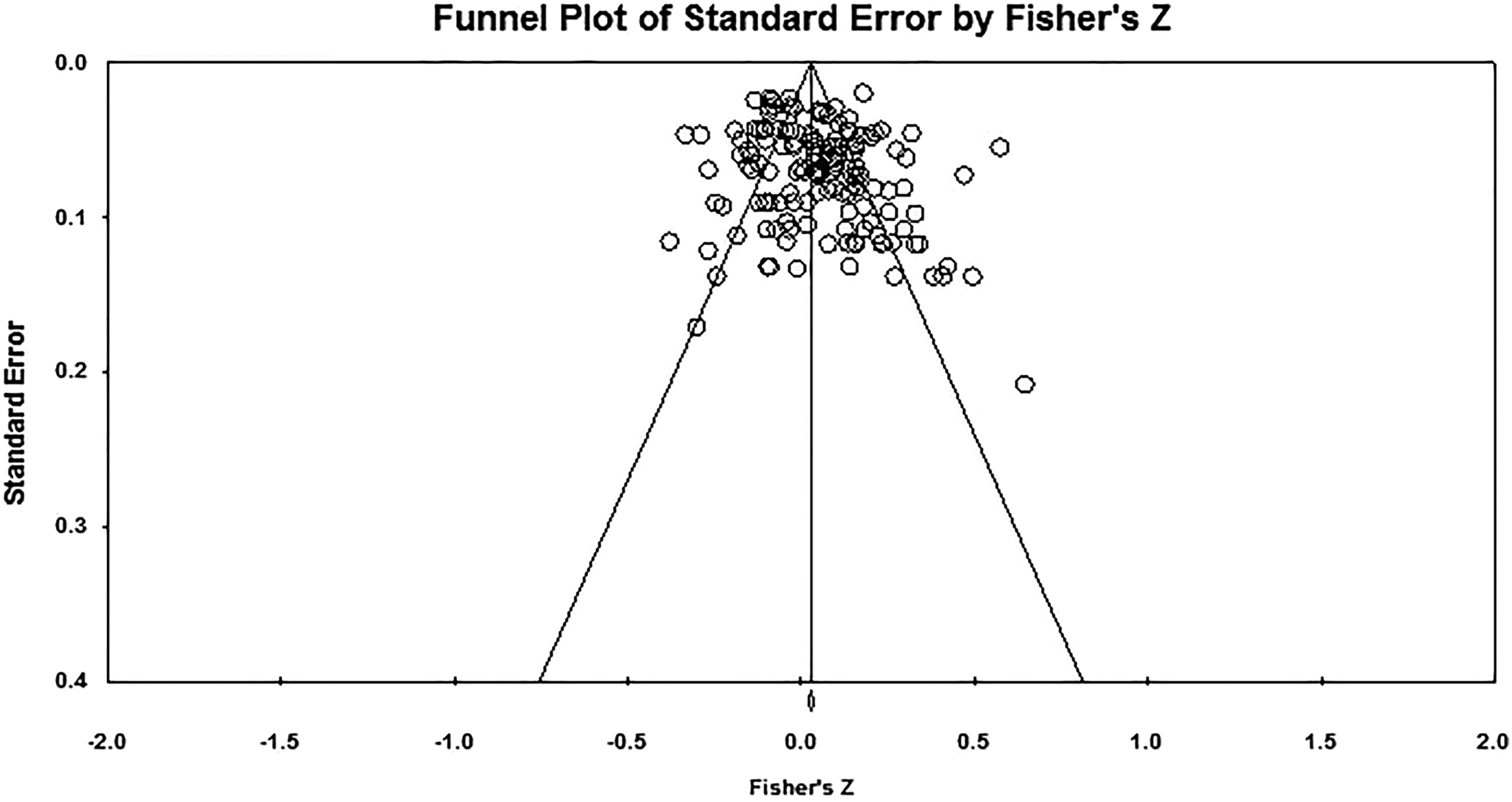
Funnel plot of the correlation between social networking sites usage and mental health.
The heterogeneity test was significant for both positive indicators (Q = 608.862, p < .001) and negative indicators of mental health (Q = 429.927, p < .001). The values of I-squared in positive and negative indicators of mental health respectively were 90% and 81%, indicating that the observed variances account for 90% and 81% of the total effect size variance. Since both of them exceeded the usual criteria of high heterogeneity (75%), we run a random-effects model (Borenstein, Hedges, & Rothstein, 2007).
Overall Relation
We found a very small mean positive correlations between overall SNSs usage and positive indicators (r = .045, z = 2.297, p = .021, 95% CI[.007, .083]) as well as a very small negative indicators of mental health (r = .061, z = 3.512, p < .001, 95% CI[.027, .094]; Online Appendix B). A Q test indicated no significant difference between the mean correlations with positive or negative mental health indicators (Q BET = 0.365, p = .546).
Moderating Analysis
The heterogeneity test was significant for positive and negative indicators of mental health, which indicated potential moderators. Post hoc contrasts were performed to determine which groups were significantly different. For continuous moderators, meta-regression analyses were used to test whether variation in the effect sizes was explained by the moderator (Howell & Howell, 2008). We addressed measurement of usage, cultural background, and age as categorical variables and proportion of female participants as a continuous variable.
Age
The result shows that the effect of age on the correlation between SNSs usage and positive indicators of mental health was not significant, Q BET(2, k = 62) = 0.501, p = .779 (see Online Appendix C). Nevertheless, the mean correlation between SNSs usage and positive indicators was significant for adults (r = .053, 95% CI[.004, .103], p = .034). In terms of negative indicators, although the effects were significant for both adolescents (r = .081, 95% CI[.006, .155], p = .034) and adults (r = .056, 95% CI[.022, .091], p = .002), we found no significant difference in the mean effect sizes of the correlation across the three age groups, Q BET(2, k = 82) = 0.435, p = .805 (see Online Appendix D).
The type of SNSs measures
Heterogeneity results revealed significant differences in the mean correlation between SNSs usage and mental health across four categories of measures of SNSs usage, Q BET(3, k = 62) = 11.352, p = .009 for the correlation between SNSs usage and positive indicators, and Q BET(3, k = 82) =10.603, p = .014 for SNSs usage and negative indicators. Specifically, the mean correlation between SNSs usage and positive indicators of mental health was significant for the network size group (r = .132, 95% CI[.054, .207], p = .001); also the mean correlation between SNSs usage and negative indicators was significant for the general use group (r = .105, 95% CI[.059, .151], p < .001). However, the effects of active and passive use were neither significant for the positive nor for the negative indicators (ps > .05).
Cultural background
The effect of cultural background on the correlation between SNSs usage and positive indicators of mental health was significant, Q BET(2, k = 62) = 6.961, p = .031. Specifically, the mean correlation between SNSs usage and positive indicators was significant in the collectivistic samples (r = .130, 95% CI[.051, .209], p = .001) but not for the individualistic samples (r = .017, 95% CI[−.034, .513], p = .513). Regarding the correlation between SNSs usage and negative indicators, the effect of cultural background was not significant, Q BET(2, k = 82) = 0.352, p = .046. The mean correlation for individualistic culture was significant (r = .061, 95% CI[.025, .098], p = .001), whereas the mean correlation for collectivistic culture was not significant (r = .046, 95% CI[−.017, .109], p = .154), although this difference between them was not significant.
To further examine the effect of SNSs measures on the relationship between SNSs usage and mental health in different cultural backgrounds, we conducted additional analyses. Regarding the correlation between SNSs usage and positive indicators, no statistical difference across four categories of usage measurement was observed in collectivistic culture samples, with Q BET(3, k = 18) = 7.209, p = .066. While in individualistic culture samples, the measurement of usage significantly influenced the mean effect sizes, with Q BET(3, k = 43) = 13.509, p = .004 (see Online Appendix E). Specifically, the mean correlation between SNSs usage and positive indicators of mental health was significant when SNSs usage was measured as general use (r = .114, 95% CI[.046, .181], p = .001), and it is significantly different from that in the collectivistic cultures, Q BET = 8.991, p = .003. However, the interactive effects of the other three SNSs measures and cultural backgrounds were insignificant (ps > .05).
The mean correlations between SNSs usage and negative indicators of mental health significantly differed across four categories of usage measurement both in collectivistic, Q BET(3, k = 19) = 8.446, p = .038, and individualistic cultures, Q BET(3, k = 55) = 8.370, p = .039 (see Online Appendix F). In collectivistic cultures, the mean correlation between general use and negative indicators was significant (r = .137, 95% CI[.043, .228], p = .004), while in individualistic cultures SNSs usage was positively correlated with negative indicators of mental health, for both measure of general use (r = .094, 95% CI[.034, .155], p = .002) and for passive use (r = .090, 95% CI[.013, .166], p = .023). As for the multiple moderation examining SNSs measures and cultural backgrounds, no significant interaction effects were found (ps > .05).
Gender
We used weighed regression analysis to test whether gender moderated the relationship between SNSs usage and mental health. The result shows that the moderation regression coefficient was not statistically significant for the relationship between SNSs usage and positive indicators of mental health, Q Model(1, k = 60) = 0.003, p = .953. However, gender moderated the correlation between SNSs usage and negative indicators, with Q Model(1, k = 78) = 12.889, p < .001 (see Online Appendix G). Specifically, as percentage of female participants increased, a stronger effect was observed. The mean correlations between SNSs usage and negative indicators were significant for all-female sample (r = .233, 95% CI[.127, .333], p = .001), while that effect was not significant for all-male sample (r = .138, 95% CI[−.019, .289], p = .084).
Discussion
We reviewed 63 empirical studies examining the relationship between SNSs usage and mental health and found that SNSs usage was correlated with both positive and negative indicators of mental health. Further, these small correlations depend on the operationalization of SNSs, the cultural background, and gender distribution of the samples. Our findings lend support to several theoretical models in literature, including the differential susceptibility to media effects model (Valkenburg & Peter, 2013), the displacement hypothesis (Kraut et al., 1998), and social compensation hypothesis (Valkenburg & Peter, 2007b; Zywica & Danowski, 2008).
Overall Relationship Between SNSs Usage and Mental Health
Dual associations between SNSs usage and mental health are in line with Mäntymäki and Islam (2016), who concluded that Facebook offers features enabling both positive (e.g., self-disclosure and interpersonal connectivity) and adverse gratifications (e.g., social surveillance and narcissism). When online behaviors contribute to connection and belonging by facilitating social connections, SNSs usage may enhance users’ psychological well-being (Burke et al., 2010; Steers, 2016). If people engage in disconnecting activities on SNSs, such as passing time or self-monitoring, it may lead to decreased life satisfaction (Steers, 2016; Tandoc et al., 2015).
Moderating Effect of the Measurement of SNSs Usage
We found that operationalization of SNSs usage moderated the correlation between SNSs usage and mental health, supporting our hypothesis. A positive correlation between SNSs usage and positive mental health indicators was obtained only when the SNSs usage was measured as network size. A positive correlation was revealed between SNSs usage and negative mental health indicators when general SNSs usage was measured. This is in line with the displacement hypothesis (Kraut et al., 1998). Spending time on SNSs may lead to information overload (Choi & Lim, 2016), online regret (Kaur, Dhir, Chen, & Rajala, 2016), and doing nothing meaningful (Sagioglou & Greitemeyer, 2014), which makes users feel exhausted and frustrated (Moreno et al., 2011). Which mechanisms may be most influential in this relation is a valuable question for future studies.
We found that SNSs network size correlated positively with positive indicators of mental health, which fits our hypothesis as well as previous findings (Best, Taylor, & Manktelow, 2015; Nabi, Prestin, & So, 2013). Online friends can offer emotional and practical support, especially for individuals who may lack social connections offline (Lee, Moore, Park, & Park, 2012). Users who have more online friends on their SNSs would obtain more bonding or bridging social capital, emotional aid, and companionship, as well as a stronger sense of belonging (Best et al., 2015; Wellman & Wortley, 1990).
We did not find a significant effect of active and passive use, which is not in line with our expectations. It is not clear whether types of SNSs may have an impact on these divergent forms of use. Some studies did not specify the type of SNSs (k = 21) or used Facebook as the research target (k = 101). We were therefore unable to test for differences between distinct SNSs platforms. However, since different SNSs have differential functions and features, the type of SNSs may also be an important variable that impacts SNSs measures. For example, Instagram focuses on sharing pictures and videos, while Twitter is concerned primarily with the sharing of information and words. Yang (2016) reported distinct effects of active and passive use on Instagram: Active usage was associated with higher level of loneliness, while the opposite was found for passive.
Moderating Effect of Cultural Background
We found a moderating effect of cultural background on the relationship between SNSs usage and positive but not negative mental health. A possible reason might be that negative affects resulting from using SNSs appears to be prevalent in both Western and Eastern countries. Users in both cultures reported experiencing negative affects due to social overload, waste of time, and regret (e.g., Peters et al., 2015; Sagioglou & Greitemeyer, 2014).
The mean correlation between SNSs usage and positive indicators was stronger in samples from collectivist cultures, which was consistent with our hypothesis. Previous research has demonstrated that a collectivistic cultural orientation can alleviate the negative effects of the demand for connections in social media (LaRose et al., 2013). A possible explanation is that individuals from collectivist cultures put more attention on obtaining social support from SNSs, while individualists emphasize seeking entertainment (Kim et al., 2011). Using SNSs for socializing is positively correlated with users’ well-being, whereas the use of entertainment has no such relation (Wang et al., 2014).
As for the multiple moderation examining SNSs measures and cultural backgrounds, we found the measurement of usage moderated the relation between SNSs usage and the positive indicators of mental health in individualistic cultures but not in collectivistic samples. Only SNSs usage represented by network size is positively correlated with users’ mental health in individualist samples; no such correlation was observed when the use of SNSs was measured by general, active, or passive use. Considering more detachment, self-reliance, and less interdependence, persons in individualistic cultures experience a higher level of loneliness than people in collectivist cultures (Triandis, Bontempo, Villareal, Asai, & Lucca, 1988). However, if they have more friends on SNSs (Jackson & Wang, 2013; Kim et al., 2011), they can obtain more bonding social capital (Chu & Choi, 2010), which may strengthen their existing offline relationships and alleviate the isolation and loneliness they experience in real life (Mahapatra & Schatz, 2015). In contrast, in collectivist cultures, we found a significantly positive correlation between SNSs usage and the positive indicators of mental health for the measure of general use and which is less positive in individualist samples. This finding is again in line with SNSs users in collectivist cultures using SNSs in a more social and thus beneficial manner (Wang et al., 2014).
Regarding the relationship between SNSs usage and negative indicators of mental health, the measurement of usage was found to be a significant moderator for both individualistic and collectivist cultures. The usage measured by factors related to general use was positively correlated with negative mental health, and this correlation was stronger in collectivist cultures. A possible reason may be that people in a collectivist society feel obliged to visit their friends’ web pages and respond to others’ requests for social support because they are influenced by the norms of reciprocity in SNSs (LaRose et al., 2013). For these people, social media use also brings them a greater burden (Choi & Lim, 2016; Kim & Yun, 2008). Besides, we found that in individualistic cultures, passive usage is positively correlated with the negative mental health, which was consistent with the prior findings (Steers, Wickham, & Acitelli, 2014; Verduyn et al., 2015). Research has shown that individuals often experience negative emotions such as envy and depression after passively browsing through information and pictures about others on SNSs (Krasnova, Widjaja, Buxmann, Wenninger, & Benbasat, 2015; Niu, Sun, Zhou, Kong, & Tian, 2016). No negative effect of this passive use was found in collectivist cultures. One possible reason behind this difference is that individualists who lack of social connections in real-life experience more loneliness and isolated feelings via using SNSs passively. On the other hand, since the majority of variables were typically measured via self-report, collectivistic participants may be restrained by the ethical norms of the society and exhibit a stronger social desirability effects than participants from more individualistic cultures (Lalwani, Shavitt, & Johnson, 2006). Previous literature indicated that some online behaviors like SNSs surveillance induced undesirable outcomes (Krasnova et al., 2015; Tandoc et al., 2015). For individuals from collectivist cultures, such unpleasant experiences are often deemed to be inconsistent with their cultural values, which may lead to inhibition of reporting such experiences.
In collectivist cultures, although usage time correlated significantly positive with both positive and negative indicators of mental health, its correlation with positive indicators was stronger. In individualistic cultures, measures of general use were positively correlated only with negative indicators. SNSs usage measured by general use has more advantages than disadvantages for collectivists. Yet, for those in individualistic cultures, general SNSs use solely results in detrimental effects.
Moderating Effects of Age and Gender
Age did not moderate the relationship between SNSs usage and mental health, which was accordance with previous research (Huang, 2010, 2017). College students are the subjects in most existing studies. Of these 63 studies, only 10 were related to adolescents, and 4 involved older adults. The insufficient age range among the studies hindered our investigation of the different effects of SNSs usage on different age groups. Another possible reason is that SNSs are gradually becoming prevalent and global communication platforms for both college students and high school students (Bonetti, Campbell, & Gilmore, 2010). Therefore, the universality and accessibility of SNSs for both age groups may continually reduce the difference between them.
The mean correlation between SNSs usage and positive indicators of mental health for adolescents was insignificant, while a significantly positive correlation between adolescents’ SNSs usage and negative indicators was found. Thus, it is evident that, for adolescents, the negative effects of SNSs are more prominent than the positive ones. This finding is in line with prior findings (Chang et al., 2015; McAndrew & Jeong, 2012). Pujazon-Zazik and Park (2010) held that unsupervised Internet use would lead to harmful consequences among adolescents, since Internet has the potential to place adolescents’ at significant risk. In comparison with adults, adolescents do not have enough skills to cope with Internet risks, which may increase the possibility of negative consequences of Internet use.
Gender moderated the relationship between SNSs usage and negative but not positive mental health indicators. As the percentage of females in the sample increased, a stronger effect size was observed. These findings suggest that females are more likely to experience negative consequences of SNSs usage. This is different from the finding in a recent meta-analysis study, which reported no significant gender effect (Huang, 2017). These contradictory findings may be due to our inclusion of multiple aspects of SNSs use. We not only took the usage time into consideration but also included three other indicators—the number of friends on SNSs, active use, and passive use.
Our result was consistent with many prior findings (Lin & Lu, 2011; Nesi & Prinstein, 2015). For example, Nesi and Prinstein (2015) discovered that the positive relationship between depression and the behaviors of social comparison and feedback-seeking in social media was more prominent for females. Females tend to browse others’ profiles more frequently than males (Pujazon-Zazik & Park, 2010), which may lead them to experience more upward social comparisons and more negative emotions (Blomfield Neira & Barber, 2014).
Research Strengths and Limitations
Our meta-analysis is the first to incorporate both positive and negative indicators of mental health to examine the relationship between SNSs usage and well-being. This study is, to our knowledge, the first to shed some light on the moderating effect of cultural backgrounds on the relationship between SNSs and mental health.
Although this study was conducted in accordance with standards and procedure related to meta-analyses, it has some limitations. Our analysis included only articles published in English. But we calculated Rosenthal’s fail-safe N, which led to the conclusion that our findings are resilient to publication bias. Second, as we measured effect sizes only with correlation coefficients, studies with incompletely reported results were excluded. Third, we used the gender distribution to investigate the gender effects on the correlation between SNSs usage and mental health, which seems a rather rudimentary but not necessarily an accurate proxy for the potential gender effects. Fourth, we considered mental health as negative and positive indicators, which contain a wide range of potential consequences and may lead us fail to observe conceivable specific facets of mental health. Although we had tried to classify the mental health indicators in a detailed way such as social emotions (loneliness and envy), general affectivity (positive and negative affect), psychopathological symptoms (depression and anxiety), and more general indicators (well-being, life satisfaction, and self-esteem), there are few studies referring to general affectivity with k = 11. Future studies should investigate the effect of SNSs usage on more specific type of mental health. Finally, this meta-analysis was mainly based on cross-sectional studies. Therefore, we cannot make any conclusions about the direction of effects and whether SNSs affect mental health or vice-versa.
Conclusions and Implications
Our meta-analysis aimed to deepen the understanding of the relationship between SNSs usage and mental health. SNSs use was shown to be both positively and negatively related to mental health. Overall, these relationships are small in terms of effect sizes and differ depending on the type of SNSs use and the users’ gender and cultural background. Larger social networks were associated with better mental health for participants, whereas general use was associated with poorer mental health. In addition, relationships between SNSs usage and mental health were more positive among individuals in collective cultures, in which SNSs tend to be used in a more social way than in individualistic cultures (Kim et al., 2011).
Supplemental Material
Online_Supplement - Cultural Background and Measurement of Usage Moderate the Association Between Social Networking Sites (SNSs) Usage and Mental Health: A Meta-Analysis
Online_Supplement for Cultural Background and Measurement of Usage Moderate the Association Between Social Networking Sites (SNSs) Usage and Mental Health: A Meta-Analysis by Xue-Qin Yin, Dian A. de Vries, Douglas A. Gentile and Jin-Liang Wang in Social Science Computer Review
Footnotes
Authors’ Note
All relevant data are within the article and its Online Supplement Files. More detailed information could be obtained from the corresponding author.
Declaration of Conflicting Interests
The authors declared no potential conflicts of interest with respect to the research, authorship, and/or publication of this article.
Funding
The authors disclosed receipt of the following financial support for the research, authorship, and/or publication of this article: This study has been supported by the Fund of Key Project (16SKB028) at Key Humanity Social Science Research Institute in Chongqing and by the Fundamental Research Funds for the Central Universities (no. SWU1609130).
Supplemental Material
Supplemental material for this article is available online.
References
Supplementary Material
Please find the following supplemental material available below.
For Open Access articles published under a Creative Commons License, all supplemental material carries the same license as the article it is associated with.
For non-Open Access articles published, all supplemental material carries a non-exclusive license, and permission requests for re-use of supplemental material or any part of supplemental material shall be sent directly to the copyright owner as specified in the copyright notice associated with the article.
