




Abstract
Mobile instant messaging (MIM) services have entirely changed the communication landscape from where it was a decade ago. They have taken communication among humans to the next level. However, despite their massive popularity among masses, we do not know of specific reasons that drive continuous use of MIM apps (e.g., LINE, WhatsApp, and Snapchat). The current study bridges this gap by investigating the continuation behavior in the context of a popular MIM app called LINE. The study developed a comprehensive framework using three popular consumer behavior theories, namely theory of planned behavior, flow experience theory, and consumption value theory. A total of 309 middle and late adolescent LINE users participated in an online survey. The analysis revealed that perceived ease of use (PEOU), functional value, and social value exert significant positive influences on users’ continuation intentions. The PEOU was found to have the strongest influence among all. Additionally, social influence was found to have the significant but negative influence on users’ continuation intentions. However, other factors (perceived enjoyment, concentration, telepresence, and perceived behavioral control) have no role in predicting continuation intentions. Furthermore, continuation intentions were found to have no impact on users’ actual LINE use related behavior. The findings of the present research offer several theoretical and managerial implications.
Keywords
Mobile instant messaging (MIM) apps (e.g., LINE, WhatsApp, Qzone, and WeChat) are revolutionizing the way people communicate with one another on a day-to-day basis. MIM is gaining more popularity among users as compared to other forms of online social networking (Porter, 2017). According to Durand (2016), the MIM apps are listed among the top 10 mobile apps whenever the rating of mobile apps is conducted. The volume of the messages sent over MIM has increased to 28.2 trillion in 2017 from 14.7 trillion in 2012 (Durand, 2016). MIM users will account for about 80% of the total number of smartphone users making up about 2 billion users, and percentage of MIM users will increase to 29.1% from 14.9% in 2014 (Birdsbeep, 2017). Practitioners anticipate that the ecosystems around MIM apps will get even more prominent than at present with every passing year. Furthermore, MIM apps are seen to have the potential to drive even higher user interaction in the coming years (Birdsbeep, 2017). There are a number of factors contributing to the rising popularity of MIM apps, namely increased penetration of smartphones, possibility of cheap and easy access to the Internet, users’ need and wish to stay connected in real time, support for multiple ways of connecting, richness of the provided experience, and the nature of MIM apps to adapt and adjust with the ever-evolving needs of their users, among other factors.
The presented research focuses on a popular MIM app known as LINE. This popular messaging app has gained enormous popularity since 2013 and is among the fastest growing apps among fast-emerging Asian countries (e.g., Taiwan, Thailand, and Indonesia; Hou, 2015; Warangkana, Sirion, & Howard, 2015). In Japan, LINE is the most popular app used by people from all age groups. According to Statista research, LINE has 70 million monthly active users in Japan alone (Statista, 2017). LINE has also been ranked as the top mobile app in the category of free apps in 40 countries including Japan, Singapore, Taiwan, and Thailand (Van De Bogart & Wichadee, 2015). At present, it has over 169 million monthly active users around the world (Smith, 2017).
Despite gaining immense popularity among users and impressive penetration rate in many Asian countries, MIM apps such as LINE face serious challenges related to a shrinking user base and revenue generation. According to media reports, LINE has experienced a decline in its user base that has shrunk from 170 million monthly active users in the first quarter to 169 million monthly active users during the second quarter in its four markets including Taiwan, Japan, Indonesia, and Thailand (Lomas, 2017). MIM apps face fierce competition from their counterparts mainly due to the similarity of provided functionality and associated low switching costs (Hou, 2015; Oghuma, Libaque-Saenz, Wong, & Chang, 2016). It has been known that retaining existing users is more economical for MIM service providers as compared to attracting new customers, which is considered almost 5 times more expensive (Kotler, 1974). In addition to this, consistent revenue generation is another challenge faced by almost all of the existing MIM apps. It should be noticed that most of the existing services provided by MIM operators are free of charge and they mainly rely on the revenues from digital advertising and sale of virtual goods (e.g., games and stickers). Due to this, despite having continuous growth in the traffic (i.e., the volume of the messages exchanged) and new subscriptions, the ratio of revenue generated by MIM apps to the total user base is deficient. According to Juniper Research (2014), revenue generated by MIM apps will be only 2% of the total revenue generated from instant messaging services. Based on the above argumentation, it is crucial for the MIM service providers to understand the customer retention, loyalty, and related behaviors, such as switching among different apps, since it is easy to switch from one operator to another because of users’ ever existing desire to try new MIM apps (Chang, Kim, Lee, & Park, 2014; Oghuma et al., 2016; Zhou & Lu, 2011).
Prior literature has investigated the different factors that influence why users continuously engage in MIM use (Deng, Lu, Wei, & Zhang, 2010; Hsieh & Tseng, 2017; Oghuma et al., 2016; Tseng, Cheng, Li, & Teng, 2017; Zhou & Lu, 2011). However, there is a lack of research focusing on specific MIM platforms (e.g., LINE) and user groups (e.g., middle and late adolescents). The adolescents as a user group are essential as they influence the adoption and usage-related decisions of their social circle and family (Lapowsky, 2014). They are recognized as trend followers who do not stick with just one brand (Lapowsky, 2014). Moreover, psychologists have agreed that middle and late adolescents are currently experiencing developmental changes related to their cognitive and social maturity (Leontjev, 1978; Piaget, 1970). Due to which, these user groups tend to experiment with their self-identity by using social networking sites (SNSs), including MIM apps (Dhir, 2016). Consequently, it becomes essential to accurately study the MIM use behavior of the primarily ignored user group of middle and late adolescents.
To address these open research gaps, the present study has investigated as what are the different factors that influence adolescent and late adolescents’ continuation intentions toward MIM apps (e.g., LINE). Furthermore, the present study examined how does continuation intentions influence daily time spent on MIM, the frequency of MIM use, and excessive MIM use. The main research objective of the present study is to understand as “why do people continuously use MIM apps.” A comprehensive research model was developed based on three popular theories, namely theory of consumption values, the theory of planned behavior (TPB), and flow theory. The research model was tested with a cross-sectional data collected from LINE users from Japan. Relatively, recent studies on MIM have investigated the factors influencing users’ continuation intentions toward MIM use (e.g., Gan, 2016; Gan, Liang, & Yu, 2017; Oghuma et al., 2016). However, it has rarely considered a comprehensive theoretical framework for investigating the continuance intentions. Moreover, limited prior literature has never examined those factors specified in the context of LINE, and it is possible that factors influencing users’ continuation intentions might differ from one MIM platform to another. Japan was chosen as the research context since Japan currently hosts the highest number of LINE users compared to the other countries where it has its presence (Dogtiev, 2018). In addition to this, the consideration of the unique user group of adolescents further adds to the list of possible contributions made by the presented research. This study concluded with significant theoretical and practical implications.
Background
Continuation Use of MIM
Prior literature on MIM apps has focused on general as well as specific MIM apps. Scholars have investigated different issues about the continued use of MIMS apps by utilizing different theoretical frameworks. Different research attempts have found different factors that exert direct as well as indirect influence on continuation use as well as intentions toward MIM apps. The details of the different research initiatives and their outcomes are discussed in the following sections. Initially, the studies that have investigated MIM at the general level are presented followed by the research attempts that have targeted specific MIM apps.
To begin with, Deng, Lu, Wei, and Zhang (2010) found that continued MIM use was predicted by satisfaction, switching costs, and trust. Moreover, service quality, functional, and social value also influence continued use via satisfaction. Zhou and Lu (2011) found that continued MIM use is determined directly by satisfaction and perceived usefulness, whereas network externality and flow experience influence indirectly. Tseng, Cheng, Li, and Teng (2017) found that functional, social, and self-expressive values influence the continued use of MIM. Additionally, different elements of media richness (e.g., multiple cues, immediate feedback, personal focus, and language variety) also influence continued use via a set of different considered values. An investigation by Sun et al. (2017) found that application of a push–pull-mooring framework revealed that fatigue with incumbent MIM pushes the user to switch, while subjective norms pull the users to switch to other alternative MIM apps. At the same time, inertia comprised of affective commitment, switching costs, and habit impose a negative influence on switching intentions. Wu, Lu, Gong, and Gupta (2017) found that active usage of MIM is derived from emotional attachment and functional dependence. MIM identification, design aesthetics, and mobility also exert indirect influence on MIM’s active usage via emotional attachment and functional dependence. Gan (2016) found that perceived user base, habit, and resistance to change have significant positive influence continuance intention toward MIM. Subsequently, Gan, Liang, and Yu (2017) found that continuation intentions toward MIM are influenced by user needs (affective and cognitive) and habit. Furthermore, prior usage and tension-release need were also found to have the influence on continuation intentions indirectly via habit. In sum, factors such as satisfaction, trust, user values, dependence on the app, habit, and resistance to change, among others, have direct effects on continuation intentions. On the other hand, network externality, flow experience, media richness elements, design aesthetics, and so on, have an indirect influence on continuation intentions.
To the best of our knowledge, at present, there are four empirical studies investigating customer loyalty concerning specific MIM apps (e.g., LINE, KakaoTalk, and WeChat). Firstly, Peng, Zhao, and Zhu (2016) utilized migration theory and found that monetary deprivation and functional deprivation make WeChat users migrate or switch between apps. Moreover, the obligations toward the network were found to exert indirect influence on users’ switching intentions. Oghuma, Libaque-Saenz, Wong, and Chang (2016) empirically found that users’ intention to continue using KakaoTalk is associated with usefulness, enjoyment, and satisfaction. Furthermore, user interface characteristics, service quality, and expectation confirmation also impact continuation intentions via satisfaction. Using media richness theory, Hsieh and Tseng (2017) found that the use of text and emoticons together generates the feeling of playfulness, which positively influences user loyalty and social interaction concerning LINE. Another recent study by C.-B. Zhang, Li, Wu, and Li (2017) found that social and hedonic values influence users’ intention to continue using WeChat. They found information and emotional values to not influence continuation intentions. Additionally, direct and indirect network externalities and social interaction ties have an indirect influence on continuation intentions. The studies as mentioned earlier that investigated specific MIM apps have provided insights into the complex structure beneath the continuation intentions on the app.
The TPB and MIM
The TPB is a popular social–psychological framework that has been widely used for understanding and explaining human behavior in the computer-mediated communication environment (Carter & Yeo, 2016; Cheung & To, 2016; Dhir, Khalil, Kaur & Rajala, 2018; Jiang et al., 2016; E. Kim, Lee, Sung, & Choi, 2016). According to the TPB, attitude, subjective norm, and perceived behavioral control (PBC) predict user intentions (Ajzen, 1985). Furthermore, user intentions, with or without PBC, actually predict the actual user behavior (Ajzen, 1991). In theory, attitude refers to the positive or negative evaluation of the considered behavior and subjective norm is defined as the importance of others (e.g., friends, family, or colleagues) in accepting or rejecting a given behavior; PBC refers to the perceived difficulty or ease of engaging a given act or behavior based on the past experiences (Ajzen, 1991; Pelling & White, 2009). In the TPB model, the relative influence of attitude, subjective norm, and PBC on user intentions varies across the context, situation, and behaviors (Ajzen, 1991). Finally, user intentions are defined as the willingness of any user to engage in a given act or behavior.
Previous MIM literature has made some attempts toward utilizing TPB for studying user intentions and use behavior (e.g., Ke & Li, 2009; Liang, Ling, Yeh & Lin, 2013; Lu, Zhou, & Wang, 2009). All three existing studies have utilized extended TPB for understanding the user behavior in an MIM environment. For example, Lu et al. (2009) have investigated the adoption-related behavior of users in the MIM context using TPB along with other theoretical frameworks (e.g., technology acceptance model and flow theory). Their study agreed with Ajzen’s (1991) TPB model that users’ attitude toward MIM, subjective norm, and PBC influence their behavioral intentions, which drive actual MIM usage. Ke and Li (2009) decomposed TPB for investigating factors affecting MIM adoption and reached the same conclusion. Similarly, Liang, Ling, Yeh, and Lin (2013) investigated the continuance intentions of users concerning mobile services by using TPB as one of the theoretical frameworks. They found the attitude, subjective norm, and PBC to influence continuation intentions in different contexts addressing users’ location, busyness, and mobile service type. In comparison to these existing studies, our present study has utilized the extended TPB-based model for studying the continuation intentions and use behavior of LINE, a popular MIM app among Japanese users.
Flow Theory and MIM
Flow theory is a dominant theoretical framework for understanding users’ continued intentions in the domain of technology use (Kaur, 2016a). It has been around for several decades and addresses a unique experience of users popularly known as flow experience. Csikszentmihalyi (1990) defined flow experience as a state of mind where people tend to get too much involved in an activity (enjoyable) that are unable to keep track of time spent and even their surroundings or environment (p. 4). Scholars have consistently shown the significant role of flow experience in influencing the user intentions and user behavior concerning the mobile SNS (or MIM in this study). Firstly, Zhou and Lu (2011) empirically found that flow experience influences continued use toward MIM apps. Gao and Bai (2014) also reported flow experience to have a significant influence on users’ continuation intentions. In a mobile gaming context, Su, Chiang, Lee, and Chang (2016) found flow experience to have a significant association with players’ continued use. Similarly, Lu et al. (2009) and a relatively recent investigation by Yoon, Jeong, and Rolland (2015) stated that flow experience has a significant influence on the users’ behavioral intentions toward the use of MIM.
Flow experience is comprised of different dimensions, namely clarity of goals, instant feedback, the balance of skills and challenges, perceived control, time distortion, a combination of awareness and action, autotelic experience, loss of self-consciousness, and concentration (Csikszentmihalyi, 1990). The prior consumer psychology and technology use literature has used different components to measure users’ flow experience. For example, Koufaris (2002) used perceived enjoyment, attention, and perceived control, while Hausman and Siekpe (2009) employed an additional component of a challenge. In comparison to these, Y. M. Guo and Poole (2009) measured flow experience using four different components in addition to the ones mentioned in the prior text, namely emergence of awareness and action, transcendence of self, autotelic experience, and time distortion.
The review of the prior literature on the flow theory revealed that perceived enjoyment and concentration are the principal components constituting flow experience (Koufaris, 2002; Zhou & Lu, 2011). This was one of the main reasons behind our decision to choose perceived enjoyment and concentration as the components for measuring flow experience in the present study. Our choice is also consistent with the prior literature on MIM apps. For example, scholars suggest that MIM apps have fun and entertainment elements associated with them (Lu et al., 2009; Yoon, Jeong, & Rolland, 2015). The intrinsic enjoyment derived from the use of an MIM app motivates users to continue the use. Moreover, the flow would be almost impossible to experience if the users are unable to concentrate on the tasks being performed on MIM. In addition to the enjoyment and concentration components, flow experience also consists of telepresence, a sensation of being present in a computer-mediated space (T. Kim & Biocca, 1997; Steuer, 1992). It is likely that MIM apps might give their users the feeling of being immersed in the app’s computer-mediated environment and being with their social circle without having any physical proximity. Consequently, the telepresence component was included as the part of flow experience in the present study.
Prior Information Systems (IS) literature investigating the significant role of flow experience in MIM environment has also considered PBC as one of the components of flow experience. Guo and Bai (2014) found that, in addition to enjoyment and concentration, the control component was found to influence users’ continuation intentions toward MIM positively. However, in the present study, control is already part of the components of TPB; therefore, control as part of flow experience was not considered.
Consumption Value Theory (CVT) and MIM
CVT is a popular theoretical framework for understanding the different possible factors that might affect consumer choices. The prior literature has used CVT for examining users’ choice behavior over smartphones (Bødker, Gimpel, & Hedman, 2009), mobile phone ringtones (Turel, Serenko, & Bontis, 2010), virtual items (Shang, Chen, & Huang, 2012), social media brand communities (Kaur, Dhir, Rajala, & Dwivedi, 2018), and social virtual worlds (Mäntymäki & Salo, 2015), among others. However, scholars have observed that CVT is not only applicable for understanding the consumer choice and decisions but also for understanding other forms of consumer behavior (e.g., loyalty, usage intentions; Z. Yang & Peterson, 2004). CVT constitutes of five different values: functional, conditional, social, emotional, and epistemic values (Sheth, Newman, & Gross, 1991). Sheth, Newman, and Gross (1991) suggest that all the different consumption values are independent of one another and make their own unique contribution in influencing consumers’ choice related behavior. Firstly, the functional value highlights the “functional, utilitarian, or physical performance” of an app. Secondly, social value measures the “association with one or more specific social groups.” Thirdly, emotional value refers to “an alternative’s capacity to arouse feelings or affective states.” Fourthly, epistemic value refers to the “curiosity, novelty, desire for knowledge.” Finally, conditional value regards “an alternative’s capacity as a result of the specific situation.”
Previous studies demonstrated how these values influence the user intentions as well as behavior. To begin with, H.-W. Kim, Gupta, and Koh (2011) investigated the role of functional, social, and emotional value in influencing the purchase of digital items in social networking communities. They pointed out that emotional value constituted of aesthetics and playfulness influenced the users’ purchase decisions. Furthermore, the social value was measured using social self-image expression and social relationship support, but only the former was significantly linked to users’ purchase intentions. Mäntymäki and Salo (2015) found that monetary, epistemic, social, functional, and emotional values drive teenagers’ purchasing behavior of virtual goods in social virtual worlds. Youn (2016) found that perceptions of social, hedonic, and utilitarian values influence the smartphone usage. Similarly, Zolkepli (2016) suggested that social, emotional, epistemic, and conditional values influence the user behavior concerning the use of mobile apps.
In the context of MIM environment, Turel, Serenko, and Bontis (2010) observed that value associated with usage of digital hedonic artifacts, such as MIM apps, actually derives the users’ intention to continue using them in future as well. Deng et al. (2010) found that functional and social values indirectly influence customer loyalty via customer satisfaction. In two recent studies, Tseng et al. (2017) found that functional and social values influence loyalty toward MIM, while C.-B. Zhang et al. (2017) found that social and hedonic values significantly influence continuation intentions toward WeChat. However, in comparison with the body of literature, CVT has not yet been applied widely to other MIM apps such as LINE. Due to this, it is not yet known as to which consumption values are positively associated with user intentions and actual user behavior specifically toward LINE. This research gap is addressed in the present study since CVT is utilized concerning a popular MIM app, that is, LINE.
The present research focuses only on two values, namely functional and social. The main reasons behind this choice were as follows: First, functional and social values are consistently shown to play an influential role in influencing consumer choice in the context of the usual mobile services as well as other computer-mediated communication contexts (Wang, Liao, & Yang, 2013; K. Yang & Jolly, 2009; J. Zhang & Mao, 2012; Zolkepli, 2016). Second, the practical or functional utility provided by any given mobile app is one of the main constituents of the value perceptions derived from it (Wang et al., 2013). Furthermore, user decisions related to the mobile app adoption and usage are also dependent on the way a user wants to be perceived among their social circle (Zolkepli, 2016). Consequently, both functional and social values are likely to play an influential role concerning MIM since it is also a form of mobile service.
Research Methods
Research Models
The primary research objective of the present study was to investigate the different factors that influence the continuation intentions toward MIM (i.e., LINE). Furthermore, the present research also examines whether the continuation intentions are positively associated with different types of actual MIM use behavior such as daily time spent, the frequency of use, and excessive MIM use. Toward the end, a comprehensive research model was developed by utilizing the three theories mentioned above, namely TPB, flow, and CVT to interpret the continuation intentions and actual user behavior of LINE. TPB acts as the baseline model and is composed of five main components, namely attitude (i.e., ease of use), subjective norm (i.e., social influence), PBC, user intentions, and actual user behavior. According to the original TPB, the first three components directly influence the user intentions, which subsequently influence the actual user behavior (i.e., daily LINE use, the frequency of LINE use, and excessive usage of LINE; see Figure 1). TPB was extended using the three main components of the flow experience theory (i.e., enjoyment, telepresence, and concentration) as well as two components of the CVT (i.e., functional and social values). This extension of the original model of TPB is consistent with the observation as well as the recommendation of the scholars who have suggested the need for an extension for improving the percentage of variance explained by the original model (Al-Debei, Al-Lozi, & Papazafeiropoulou, 2013; Armitage & Conner, 2001; Baker & White, 2010). We carefully selected the additional components to ensure that the parsimonious nature of the original TPB was not violated in the extension of the theory in using components of other theories. The different components of our research model were evaluated by the study participants using a 5-point response scale where 5 = always and 1 = never (see Table 1).
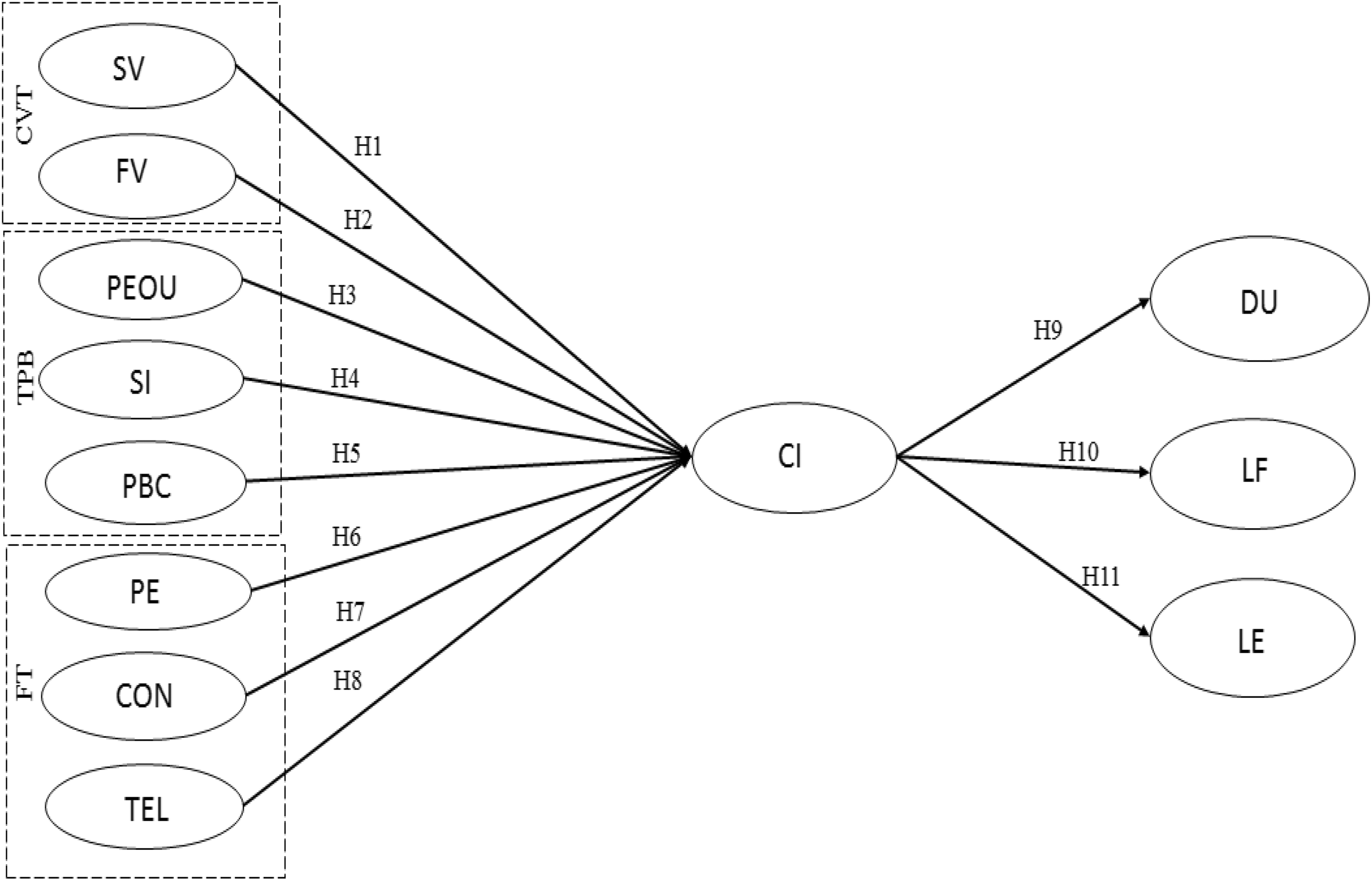
Our research model.
Summary of Study Measures and Measurement Items and Factor Loadings of the Structural and Measurement Model.
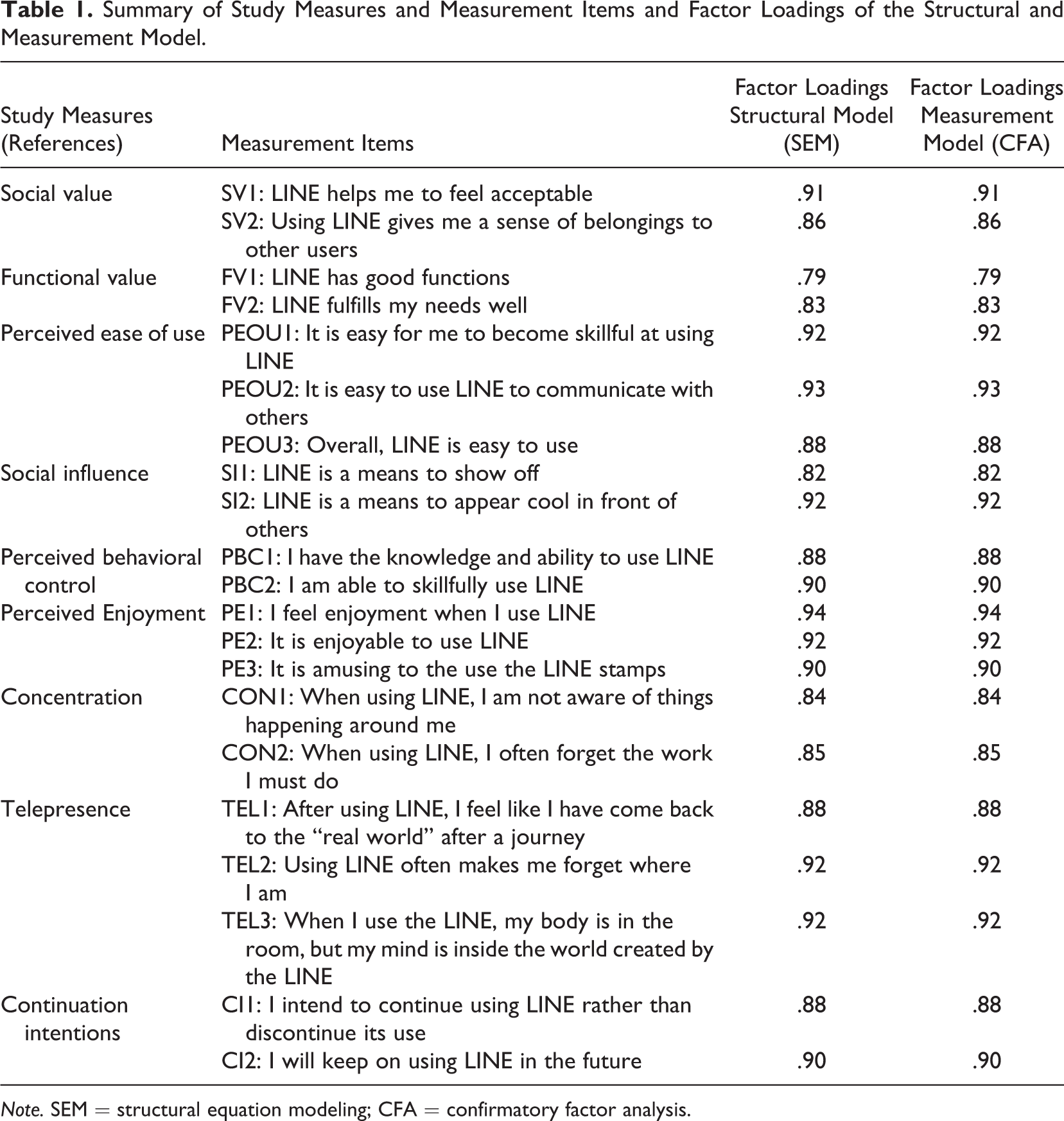
Note. SEM = structural equation modeling; CFA = confirmatory factor analysis.
Research Hypothesis
CVT: Social value and continuation intentions
It refers to the social value derived by the user through their technology use. Several prior studies have concluded that social value plays a significant role in influencing the consumer behavior (K. Yang & Jolly, 2009), such as the purchasing behavior of virtual goods in a social virtual world (Mäntymäki & Salo, 2015) and social networking communities (H.-W. Kim, Gupta, & Koh, 2011), smartphone usage (Youn, 2016), and usage-related decision-making in regard to mobile apps (Zolkepli, 2016). Due to this, it is likely that social value derived from LINE use has the significant positive association with the continuation intentions toward its use.
CVT: Functional value and continuation intentions
Functional value can be understood as the utilitarian benefit derived as a result of the technology. Prior literature on mobile services suggests that functional value plays a dominant role in influencing the consumers’ choice behavior (Wang et al., 2013; K. Yang & Jolly, 2009; J. Zhang & Mao, 2012). Mäntymäki and Salo (2015) found that functional value was significant in influencing teenagers’ purchase intentions for virtual goods, and Youn (2016) reasoned the influential role of functional (or utilitarian) value in smartphone usage. However, not all prior studies have shown consistent findings. For example, H.-W. Kim et al. (2011) found that functional value was insignificant in the case of purchase of digital items in the SNS communities. Likewise, Zolkepli (2016) suggested that functional value not influence users’ attitude and usage-related decisions. After careful examination of their methods, we suspect that choice of items for measuring functional value could be one of the prominent reasons behind its insignificant association with users’ intentions and behavior. Therefore, going by the findings of the majority of the prior IS literature, we hypothesize that functional value of LINE use has the significant positive association with the continuation intentions toward LINE use.
TPB: Perceived ease of use (PEOU)
The PEOU can be defined as the users’ perceptions concerning the effort required for performing different tasks on a given MIM platform. Prior literature suggests that PEOU has a positive association with user intention in an MIM context (Liu, Min, & Ji, 2011). Several studies have found that PEOU has direct (Atkinson & Kydd, 1997; Hamari & Koivisto, 2015; van der Heijden, 2004) as well as indirect (Kaba, 2018; Mäntymäki, Merikivi, Verhagen, Feldberg, & Rajala, 2014) relationship with continuation intentions. Based on the argumentation of the prior literature, we propose the following hypothesis.
TPB: Social influence
Prior literature has examined the significant role of the subjective norm in the adoption of different mobile services (Liu et al., 2011; Wei, Marthandan, Chong, Ooi, & Arumugam, 2009; Zhou & Li, 2014). In the context of an MIM environment, Liu, Min, and Ji (2011) found that social influence (e.g., the importance of the opinion of others), a form of the subjective norm to have a significant positive influence on the adoption-related user intentions. In the present study, the measure of social influence addresses the issues related to impression and identity management. The social influence measure has been derived from a recent study that has investigated the gratifications of new media (Dhir, Chen, & Chen 2017). According to scholars, social influence is essential for adolescents since it helps them to maintain positive identity, which could help them in creating favorable self-influence over significant others (Baker & White, 2010; Dhir, 2016). Similarly, scholars have also argued that having positive self-image among others is one of the favored activities of young people, for example, adolescents (Special & Li-Barber, 2012; Zhao, Grasmuck, & Martin, 2008). Due to this, we believe that “fashion” and “tendency to appear cool” are forms of social influence similar to “opinion of important others,” Thus, our social influence measure is likely to have a significant influence on the user behavior of MIM users. Therefore, we hypothesize as follows.
TPB: PBC
Prior IS literature suggests that PBC is an antecedent of the perceived consumer confidence in using a given technology or service that might influence (positively or negatively) its actual use in day-to-day routine (Lee & Chang, 2011). PBC accesses both internal factors (such as skills and ability) and external factors (such as acceptance, support, time, and availability of financial resources) in performing a given behavior or act (Ajzen, 2001). Prior literature on the mobile services has confirmed the dominant role of PBC in predicting user intentions. Liang et al. (2013) found that PBC influences the continuation of mobile service in general. Similarly, Guo and Bai (2014) also found that control (measured using a multidimensional flow measure) positively influences users’ continuation intentions toward mobile SNS. Based on the prior literature, we hypothesize that the PBC of using LINE has a significant positive association with the continuation intentions toward its use.
Flow: Enjoyment and continuance intention
Perceived enjoyment is defined as the extent to which a given service, product, or platform is perceived as fun, entertaining, and enjoyable to use (Venkatesh, 2000). Several prior studies have found a significant association between perceived enjoyment, component of flow experience, and continuation intentions of an information system. Mainly, Lu et al. (2009) found that flow experience operationalized as perceived enjoyment has an indirect influence on user intentions toward MIM apps via the attitude. Liu et al. (2011) concluded that perceived enjoyment has significant association with user intentions toward MIM adoption. Similar findings were revealed concerning the perceived enjoyment and user intentions concerning MIM apps by a recent study through the usage of multitheory approach (Yoon et al., 2015). Another study by Vazquez, Dennis, and Zhang (2017) found that pleasure or hedonic experiences (i.e., similar to perceived enjoyment) has a positive influence on the word of mouth intentions. Another study concerning the mobile game application also suggests that perceived enjoyment has a significant influence on player loyalty (Su, Chiang, Lee, & Chang, 2016). Due to the significant association of the perceived enjoyment in all these prior studies, we hypothesize that perceived enjoyment derived from LINE use has a significant positive association with the continuation intentions toward its use.
Flow: Concentration and continuation intentions
Concentration can be understood as the state of complete immersion (Ghani, Supnick, & Rooney, 1991). While using MIM apps, users tend to concentrate on chatting with others, due to which it is easier for them to enter a flow state (Lu et al., 2009). Prior MIM literature suggests a significant influence of concentration on the continuation intentions as well as the user behavior. Both, Lu et al. (2009) and Guo and Bai (2014) found that concentration has a direct influence on user intentions toward the use of MIM. The most recent study by Su et al. (2016) also suggests that concentration (or focused attention) has a significant positive influence on the loyalty of the mobile game application players. As such, we hypothesize that concentration toward LINE use has a significant positive association with the continuation intentions toward its use.
Flow: Telepresence and continuation intentions
Telepresence is defined as the feeling of believing to be part of the phenomenal environment that is created by a service, platform, or medium (T. Kim & Biocca, 1997). Telepresence is applicable in the MIM context because MIM users feel more connected to their social group and feel even more absorbed in the virtual world of MIM space when using MIM apps. To the best of our knowledge, no prior study has yet examined the influence of telepresence on the continuation intentions toward MIM use. However, we took knowledge from some emerging technology studies which have investigated the relationship between telepresence and user intentions. Z. Guo, Xiao, Toorn, Lai, and Seo (2016) found that telepresence has an indirect influence on continuation intentions via flow experience and perceived utilitarian and social values in context of online learning. Similarly, Rodríguez-Ardura and Meseguer-Artola (2016) found telepresence to have the direct positive influence on continuation intentions in an e-learning context. In the context of a social virtual world, Jung (2011) found telepresence to have a significant positive influence on continuation intentions. Due to the significant association of the telepresence and use intentions in the relevant literature, we hypothesize that telepresence of LINE use has a significant positive association with the continuation intentions toward its use.
Continuation intentions and use behavior
Use behavior refers to users’ actual behavior toward LINE. In the present study, user behavior is analyzed through the use of three different measures: daily LINE use, the frequency of LINE use, and excessive use of LINE. Daily LINE use refers to the number of hours a person uses LINE daily. The participants were requested to answer this question as an open-ended question. The frequency of LINE use measures the level of users’ frequency of LINE usage. It is measured on a 5-point response scale where 5 = many times per day, 4 = almost every day, 3 = once in every 2 or 3 days, 2 = once a week, and 1 = once a month. Finally, excessive LINE use reflects users’ perceptions regarding their LINE use to be excessive or not. This was measured using a 5-point response scale where 5 = always, 4 = frequently, 3 = sometimes, 2 = occasionally, and 1 = never (reserve coded). The TPB shows that user intentions have an influence on user behavior (Ajzen, 1991). This has been further validated over the years by different studies using TPB as their theoretical framework in different contexts. Specifically, Kaur (2016b) found continuation intentions to have a significant positive influence on users’ activities. Based on the relevant body of literature, we hypothesize the following hypotheses.
Research Methodology
Research Procedure and Participants
The data collection was conducted using an online survey of 309 Japanese middle and late adolescent LINE users. The study participants were 16–20 years old, where 72.5% (N = 224) were female LINE users with a mean age of 17.73 (SD = 1.02) years. The survey was prepared in Japanese by following back translation protocol. The survey was pilot tested with 10 participants representing the target user group, that is, late adolescent LINE users. The population with previous experience in LINE use was invited to participate in the present study. The ethics committee of the Department of Medicine at The University of Tokyo provided the ethical approval for conducting the study (No. 10882). Informed consent was obtained from the participants at the beginning of the survey through the instructions. Participation in the study was voluntary and completely anonymous. Moreover, the participants had the freedom to quit the study at any time.
Data Analysis
The data analysis was performed using statistical software, namely SPSS Version 24.0 and AMOS Version 23.0. To begin with, the fitness of the data was evaluated for ensuring its suitability for performing the analysis. In this regard, the skewness and kurtosis values for the items of the present study measures were evaluated for establishing the normalcy of the data. Additionally, Z-score for all the study items was examined in order to spot the presence of any potential outliers (Tabachnick & Fidell, 2007). The recommended threshold values for skewness and kurtosis for the items are to be between +1 and −1, while Z-score should be below the absolute value of 3.29. Following the preliminary investigation, a further analysis was performed using a two-step approach suggested by Anderson and Gerbing (1988). During the first step, the confirmatory factor analysis (CFA) was performed for examining the goodness of model fit indices, validity, and reliability of different study measures. This was followed by the second step, involving the examination of structural equation modeling (SEM) for establishing the validity of the proposed model.
Results
Measurement Model
First, the model fit of the measures was evaluated by performing the CFA of the measurement model. The measurement model was important to examine the presence or absence of fit between the considered theoretical framework and collected empirical data. The CFA was performed using the robust algorithm of maximum likelihood, and it returned good model fit (Reinartz, Haenlein, & Henseler, 2009). The model fit details are as follows: χ2/df (χ2 ratio degrees of freedom) = 1.73 (<3), comparative fit index (CFI) = .98 (>.90), Tucker–Lewis Index (TLI) = .97 (>.90), and root mean square error of approximation (RMSEA) = .05 (<.08; Browne & Cudeck, 1993; Byrne, 2010; Hair, Anderson, Tatham, & Black, 1998).
Validity and Reliability
As listed in Table 1, the items of all measures were adopted from previous studies and modified concerning LINE use. The content validity was supported by the previous studies and by CFA in the present study. Moreover, since the measures were intercorrelated according to the literature, convergent and discriminant validity was examined to clarify whether the measures were indeed measuring different constructs. The convergent validity was ensured through the following statistical tests. First, the average variance extracted (AVE) for all the study constructs and items loadings for them is greater than .50 (Anderson & Gerbing, 1988; Fornell & Larcker, 1981). Second, the values for the composite reliability for study constructs are higher than the recommended threshold value of .70 (Fornell & Larcker, 1981; see Table 2). The discriminant validity was established through three different statistical tests: (i) AVE values of the study constructs is higher than their corresponding values of average shared variance and maximum shared variance (Barclay, Higgins, & Thompson, 1995), (ii) the correlation between the different study constructs is less than .80 (Campbell & Fiske, 1959), and (iii) the correlation value of a study construct is less than the square root of its AVE value (Fornell & Larcker, 1981; see Table 2). Finally, the composite reliabilities ranged between .79 and .94. This adds to the reliability of the survey instrument.
Mean, Standard Deviation, Correlation Between Study Measures, Convergent, and Discriminant Validity.

Note. M = mean; SD = standard deviation; CR = composite reliability; AVE = average variance explained; MSV = maximum shared variance; ASV = average shared variance; SV = social value; PEOU = perceived ease of use; SI = social influence; PBC = perceived behavioral control; PE = perceived enjoyment; CON = concentration; TEL = telepresence; FV = functional value; CI = continuation intentions.
Structural Model
The structural model was evaluated using the SEM. This was necessary for investigating the validity of the different hypotheses. SEM returned the path coefficient values (β value) and the percentage of explained variance (R2). The β values are the basis for accepting or rejecting the validity of the proposed hypotheses. On the other hand, R2 values provide the percentage of variance explained for the dependent variable by various independent variables. The structural model returned good model fit with χ2/df = 2.15, CFI = .95, TLI = .94, and RMSEA = .06 (Browne & Cudeck, 1993; Byrne, 2010; Hair et al., 1998)
The study analysis reports that the study measures explained 81% of the variance in the users’ intention to continue using LINE. The analysis reveals support for only a few hypotheses (Table 3). The findings show that only social value (Hypothesis 1), functional value (Hypothesis 2), and PEOU (Hypothesis 3) are supported. On the other hand, other factors do not predict users’ intention to continue using LINE, namely PBC (Hypothesis 5), perceived enjoyment (Hypothesis 6), concentration (Hypothesis 7), and telepresence (Hypothesis 8). At the same time, social influence is found to have a significant but negative impact on continuation intention. As social influence was hypothesized to have the positive influence on continuation intention, thus, Hypothesis 4 stands rejected. The results also show that continuance intention has no influence on duration of the users’ time spent on LINE, the frequency of LINE use, and excessive usage of LINE. This leads to the rejection of Hypotheses 9–11. On the same note, the analysis reports that continuance intention explains almost null variance in the LINE’s actual use variables, namely daily usage of LINE (0%), the frequency of LINE use (1%), and excessive LINE use (1%). The ß values for the different hypotheses are presented in Figure 2.
Confirmation of the Hypotheses (H#).


Results of the structural equation modeling.
Discussion
The present study examines the reasons behind continuous engagement with MIM apps. This is important to understanding since MIM apps itself face critical problem of user retention. As mentioned previously, owing to the similarity of provided functionality and low switching costs, MIM apps are facing the tough challenge of motivating users to continue with their existing MIM service providers. The existing research has investigated the domain of use intentions in relation to MIM apps in general. However, the current study specifically investigates continuous use intentions toward specific MIM apps, which is currently rare. Furthermore, the prior literature lacks information about the behavior of adolescents concerning MIM apps. The present study bridges these research gaps in the existing literature by providing insights about adolescents’ continuance–related behavior concerning a popular MIM app, that is, LINE. Furthermore, the present study takes into consideration the extensive set of measures drawn from three popular theoretical frameworks (TPB, CVT, and flow). Additionally, the study also reports the influence of continuation intention on users’ actual MIM behavior. The study offers several theoretical and practical implications for the scholars as well as MIM service providers.
The study findings support both Hypotheses 1 and 2 which suggests social and functional values predict a user’s intention to continue using MIM. The significant relationship of functional value with continuation intention is consistent with some of the prior literature (Tseng et al., 2017; C.-B. Zhang, Li, Wu, & Li, 2017). At the same time, it also contradicts the existing literature where functional value is found to have no influence on user behavior in other information systems (H.-W. Kim et al., 2011; Zolkepli, 2016). On the other hand, the significant impact of social value on users’ continuation is in complete consistency with the prior literature (Tseng et al., 2017; C.-B. Zhang et al., 2017). In the present study, functional value is found to have a higher influence on continuation intentions as compared to social value. The functional and social values were found to have a significant influence on the continuation intentions as adolescents might be dependent on LINE for satisfying their communication-related functional as well as social needs. For example, getting an acceptable position within their social circle, being able to communicate in real time anytime, anywhere, and so on. The significant positive relation could also mean that LINE is fulfilling their functional and social needs well. Moreover, the prior literature has also reported that satisfaction of functional and social values plays a significant role in formulating positive user intentions in the mobile services context (Wang et al. 2013; Zolkepli, 2016).
The study findings support Hypothesis 3 which suggests that PEOU exerts significant positive influence on users’ continuation intentions. This is also consistent with the prior literature investigating the direct influence of PEOU on continuation intentions in the context of gamification services (Hamari & Kovisto, 2015). The age of participants plays a role in obtaining significant influence of PEOU on the continuation intentions toward LINE. The education-related activities take up a big chunk of adolescents’ effort and time (Johnson & Johnson, 1996). Hence, it is essential for them that the other activities performed by them using different information systems whose usage is voluntary (e.g., use of MIM apps like LINE) are easy to learn and use. This might explain to some extent the importance of the role of perceived use toward prediction of continuation intentions toward LINE.
Hypothesis 4 was not supported since social influence is found to exert the negative influence on users’ intention to continue using LINE. This means that, if a user uses LINE as a means to show off, then it has the negative influence on their intentions to continue using LINE. At the same time, it could also be interpreted that the show-off-related behavior does not foster continuance behavior in Japanese culture. This could also mean that show-off reduces loyalty and that they may pursue innovations rather than continuing on a specific app. This finding might not hold true for other cultural groups. This requires further investigation in the future to validate the global applicability of the negative relationship between social influence and continuance behavior.
The study findings do not support Hypotheses 5–8, that is, flow theory measures namely enjoyment, concentration, telepresence, and PBC, do not predict users’ intention to continue using LINE. As mentioned previously, control is also part of the flow experience. However, since it was considered as the part of the TPB, it was decided to exclude it from being a part of flow experience explicitly. Unlike other components of the TPB, PBC is found to not influence continuance intentions. However, it is found to have the same relationship with continuation intentions as other components of flow experience, that is, enjoyment, concentration, and telepresence. Such a situation can be interpreted as suggesting that flow experience does not influence predicting continuation intentions of adolescent MIM users. Flow experience refers to experiencing intrinsic enjoyment where utilitarian motives have no role. In other words, users tend to perform actions for the sake of the intrinsic enjoyment experienced as a result of performing the actions. This is also evident from the fact that functional values are found to have a prominent influence on users’ continuation intentions. The previous literature has reported flow experience to influence users’ loyalty toward MIM apps in general (Zhou & Lu, 2011). This might imply that flow experience might not influence continuation intentions for specific MIM apps like LINE in the present case. Another possible explanation could be that flow experience might not hold relevance toward predicting continuation because of different contextual settings, such as Japanese culture and age-group of participants.
The study hypotheses, namely Hypotheses 9–11, were not supported. This suggests that continuation intentions do not influence actual use behavior measured using three different measures, namely daily use, the frequency of use, and perceptions regarding excessive use. This suggests that people use LINE, but they do not pursue a high frequency of using. It might also be possible that continuation intentions do not impact these dimensions of user behavior. There could be other dimensions of user behavior which might share a significant association with continuation intentions, for example, the intensity of MIM use, the average duration of LINE sessions, and so on. The study findings also suggest the new definition of user behavior which should be validated in future research initiatives.
Study Implications
Theoretical Implications
The present study advances the existing theoretical understanding on continuation intentions in MIM apps in general and, specifically, a popular instant messaging app called LINE. The study offers several theoretical implications. To begin with, the current study extends the TPB using two popular consumer behavior theories, namely flow theory and the CVT. A combination of theories helped in generating a comprehensive research model for answering the underlying research questions. Second, the comprehensive research model of the current study was able to explain 81% of the variance in continuation intentions toward MIM use. The similar research model can be utilized in the context of other popular mobile services to understand the reasons behind continuous engagement of the people. Third, the current study has brought a newer understanding of the popular consumer behavior theories, namely TPB, the theory of consumption value, and flow theory. The study findings have shown that factors of PEOU, social influence, and functional and social values are significant predictors of adolescents’ intention to continue using LINE specifically and MIM in general. However, the flow theory measures were not able to explain any variance in the dependent variables. This might mean that flow experience is not crucial for continuance intentions of MIM. In addition to this, the current study has also pinpointed on the influential factors that drive the continuous engagement of people in different mobile services like MIM. Fourth, the knowledge generated by the current investigation enhances the existing knowledge on the postadoption behavior in an MIM context. The initial studies on MIM were usually targeting the adoption-related user behavior. Recently, researchers have started focusing on the postadoption behavior in MIM, such as loyalty, continuation intentions, and switching intentions. However, the majority of the studies focus on MIM in general. Few studies are addressing specific MIM apps (e.g., WeChat, KakoaTalk, and LINE). To the best of our knowledge, there is no study investigating the continuation intentions toward LINE app specifically. LINE is a popular instant messaging app with a large user base of 169 million monthly active users (Smith, 2017). In this regard, the present study makes a novel attempt at understanding continuation intentions toward LINE.
Practical Implications
The present study offers different practical implications for both scholars and practitioners. The MIM environment is surrounded by three significant challenges, namely low revenue, the similarity of service offerings, and competitive market. The present study offers suggestions to MIM service providers on the possible strategies aimed at creating a place in the dynamic and competitive market space. The study provides a concrete set of factors that influence users’ continuance intention toward MIM in general and in a specific apps context, such as LINE. Additionally, it also lists some of the factors that have no role in predicting users’ continuance intentions. In other words, the findings of the current study can help the MIM service operators in channeling their resources and reinventing their current focus for gaining the desired outcomes. Moreover, considering the competitive MIM marketplace, it is essential for service providers to be agile and versatile with regard to addressing the ever-changing needs and expectations of their customers. This can play a crucial role in deciding which MIM players sustain the competitive market space.
The study results reveal that PEOU is the most influential predictor of users’ continuance intentions. Hence, it is essential that the user interface of MIM service be easy to interact with. It is important to have a unique user interface given the similarity of the services offered by different service providers. Oghuma et al. (2016) also expressed that user interface could be the key differentiator factor among different MIM apps. To be precise, the different MIM service providers should focus on providing a user-friendly and unique user interface. Apart from ease of use, the functional value was found to be the second most influential predictor of MIMs continuation intentions. This means that service providers should focus on ensuring that users’ utilitarian needs through their MIM usage are satisfied. In other words, users will continue using MIM apps if they are functionally relevant to the users. The functional value could act as the guiding principle behind the development of future MIM features. Therefore, MIM service providers should invest in understanding different aspects of users’ functional value. Developing future offerings based on firsthand information about users’ expectations about functional value can help MIM service providers to differentiate from other service providers. This can help them in gaining an edge in the existing competitive market. MIM service providers should focus on satisfying the social needs of the users. The social value was found to be the third important factor in predicting users’ continuation intentions. The service providers should implement various strategies for ensuring the satisfaction of users’ social needs. For example, provision of stickers or emoticons promoting a sense of belongingness and acceptability among MIM users. Furthermore, the study results also informed MIM service providers to refrain themselves from involving in enhancing social influence and show-off-related factors. The increased focus on social influence can exert the negative influence on users’ continuation intentions.
The study suggests that all the previously mentioned factors (such as PEOU, functional value, and social value) should be stressed for fostering positive continuation intentions among adolescents toward MIM in general and LINE specifically. Adolescents are an important, but less studied, user group. As mentioned previously, it is essential for MIM service providers to examine adolescents’ behavior, since they have an influential role in the adoption and usage-related decisions of their friends, family, and social circle (Lapowsky, 2014). Additionally, they are not loyal to any specific brand and keep on switching from one service to another depending on the latest happenings (Lapowsky, 2014). To the best of our knowledge, none of the prior studies investigating continuous toward MIM use has placed a specific focus on adolescents.
Study Limitations and Future Work
The present study has two main limitations that should be addressed in future studies. First and foremost, the study represents the opinion of only one cultural and age-group. This might limit the findings of the study to some extent. Oghuma et al. (2016) expressed that the usage of MIM apps might differ across different cultures. Hence, future studies should focus on validating the findings of this study with other cultural groups as well as other age-groups within Japan and outside. Moreover, it would also be beneficial to confirm the findings with users from other MIM apps as well. We are of the opinion that the findings of the present study might have general applicability. Nonetheless, we encourage future research aimed at the exploration of cultural differences in the context of MIM usage. All the suggestions mentioned above can help in enhancing the universality of the study findings. Secondly, the study was conducted using the online survey, and so the respondents are self-selected, and data are self-reported. This might lead to getting responses of the users who are actively engaged with LINE. This could have potential influence or bias on the overall findings of the study. Hence, it would be beneficial to involve users with low activity levels on LINE in future. Furthermore, longitudinal research should be planned to ensure the global applicability of the study findings. Longitudinal research can also help in understanding how continuation intentions related to MIM usage in general and, LINE specifically, evolves over time. Finally, the future research could also explore the role of gender, age, and different individual characteristics (e.g., personal innovativeness and personality) in formulating users’ continuance intentions. The understanding of such factors can further enhance our existing knowledge about continuance intention toward MIM in general and specific apps like LINE.
Footnotes
Authors’ Note
The data used in this article may be obtained for scholarly and replication purposes by writing to the lead author at
Acknowledgements
We appreciate Prof Norito Kawakami, Department of Mental Health, Graduate School of Public Health, The University of Tokyo. This study was partly supported by MEXT KAKENHI Grant Number JP21119003, JSPS KAKENHI Grant Number JP16H06395, 16H06398, and 16K21720. In addition to this, we also acknowledge the support received from the Academy of Finland (Grant decision No 311191, 298098, 318452, 317752, 311550)
Declaration of Conflicting Interests
The authors declared no potential conflicts of interest with respect to the research, authorship, and/or publication of this article.
Funding
The authors received no financial support for the research, authorship, and/or publication of this article.