



Abstract
This volume highlights gender issues related to using digital media for online politics. The submissions offer a balanced perspective about the role of digital media; this tool can be used for social change or to limit social change. The submissions use qualitative and quantitative analyses of digital trace data and survey data to present a rich perspective on gender and online politics. The collection offers a cross-national perspective including research on China, Germany, Norway, Spain, the United States, and the United Kingdom.
This article is the introduction to the SSCR special issue on “Gender and Online Politics”, guest edited by Shelley Boulianne (MacEwan University), Karolina Koc-Michalska (Audencia Business School), & Thierry Vedel (Sciences Po).
At the beginning of 2018, Time magazine announced Silence Breakers as the 2017 Person of the Year. This recognition highlights the collective efforts to raise awareness of sexual violence. Social media was a critical tool for sharing women’s experiences of sexual violence, producing tens of millions of tweets and Facebook posts using #metoo and related hashtags. Beyond social media, metoo was used as a Google search in 196 countries (Langone, 2018). Across the globe, people were paying attention to sexual violence, but more broadly, women’s voices were being heard. These collective efforts raise important issues related to the struggle for gender equality. Is digital media an effective tool in this struggle for social change or is digital media a tool for those working against the cause of gender equality?
Content of the Special Issue
This special issue aims to describe the gendered experiences of online politics and understand its potential impact. This volume includes examples of digital media being used as a tool for creating communities of support related to sexual violence (Núñez Puente, D’Antonio Maceiras, & Fernández Romer, in press
; Suk et al., in press
) as well as a tool for feminism, more generally (Heger & Hoffmann,
Women are less likely to post online about politics, compared to men (Koc-Michalska et al., in press
; Van Duyn et al., in press
). Looking at online political engagement more broadly, women are less likely to participate, compared to men (Heger & Hoffmann,
The articles in this volume offer a variety of reasons for gender differences in participation in online politics, including that women are socialized not to discuss politics ( Southern & Harmer, in press ; Van Duyn et al., in press ) and women feel less efficacious about participating in politics (Heger & Hoffman, in press ). These articles also explore explanations beyond the individual. These submissions highlight the structural factors that might explain lower levels of political expression and participation, including cultural norms and inequalities in domestic responsibilities (Wagner et al., in press ) as well as inequalities in political representation and political institutions (Van Duyn et al., in press ; Wagner et al., in press ). In addition, the articles discuss important contextual factors to explain gender differences, including that women are viewed as less credible political commentators and political actors (Koc-Michalska et al., in press ; Southern & Harmer, in press ) as well as experiences of harassment ranging from unpleasant comments to abuse (Koc-Michalska et al., in press ; Nadim & Fladmoe, in press ; Southern & Harmer, in press ). The enduring gender inequalities likely relate to a combination of personal attributes and the larger social and political context.
The articles use qualitative and quantitative analysis as well as digital trace data and survey data. Despite differing data sources, the articles offer some consistency in findings. For example, Nadim and Fladmoe (in press
) find that men are more likely to receive unpleasant and hateful comments when using survey data of Norwegians; Southern and Harmer (in press
) offer similar findings in an analysis of tweets directed at British Members of Parliament. Both studies distinguish negative comments directed at one’s opinions or policy views, compared to negative comments directed toward one’s identity. This distinction is important for understanding the gendered experiences of online incivility (Nadim & Fladmoe, in press
; Southern & Harmer, in press
). Both studies explore harassment directed toward one’s race and sexual orientation, recognizing that these experiences are more complicated than the binary categories typically associated with gender (see discussion of third-wave feminism in Heger & Hoffmann,
Despite the challenges of using digital media for social change, women are using digital media for activism, particularly feminist-identifying women in Germany (Heger & Hoffman,
The collection offers consistent findings across a variety of national contexts (China, Germany, Norway, Spain, the United States, and the United Kingdom). The consistency of results reflects that the online sphere is very much a global sphere. As such, while some countries have more structural gender equality (e.g., Norway) than other countries, online experiences are not attached to a particular country’s structures or cultural norms. Trolls can reside within one’s country or outside one’s country; they may communicate in many different languages through Twitter and other digital media (Southern & Harmer, in press ). Suk et al. (in press ) identify a multilingual community connected by the metoo hashtag (see their appendix). Table 1 summarizes the submissions’ methodological approach, geographic focus, and key findings related to the theme.
Summary of Articles in the Special Issue.
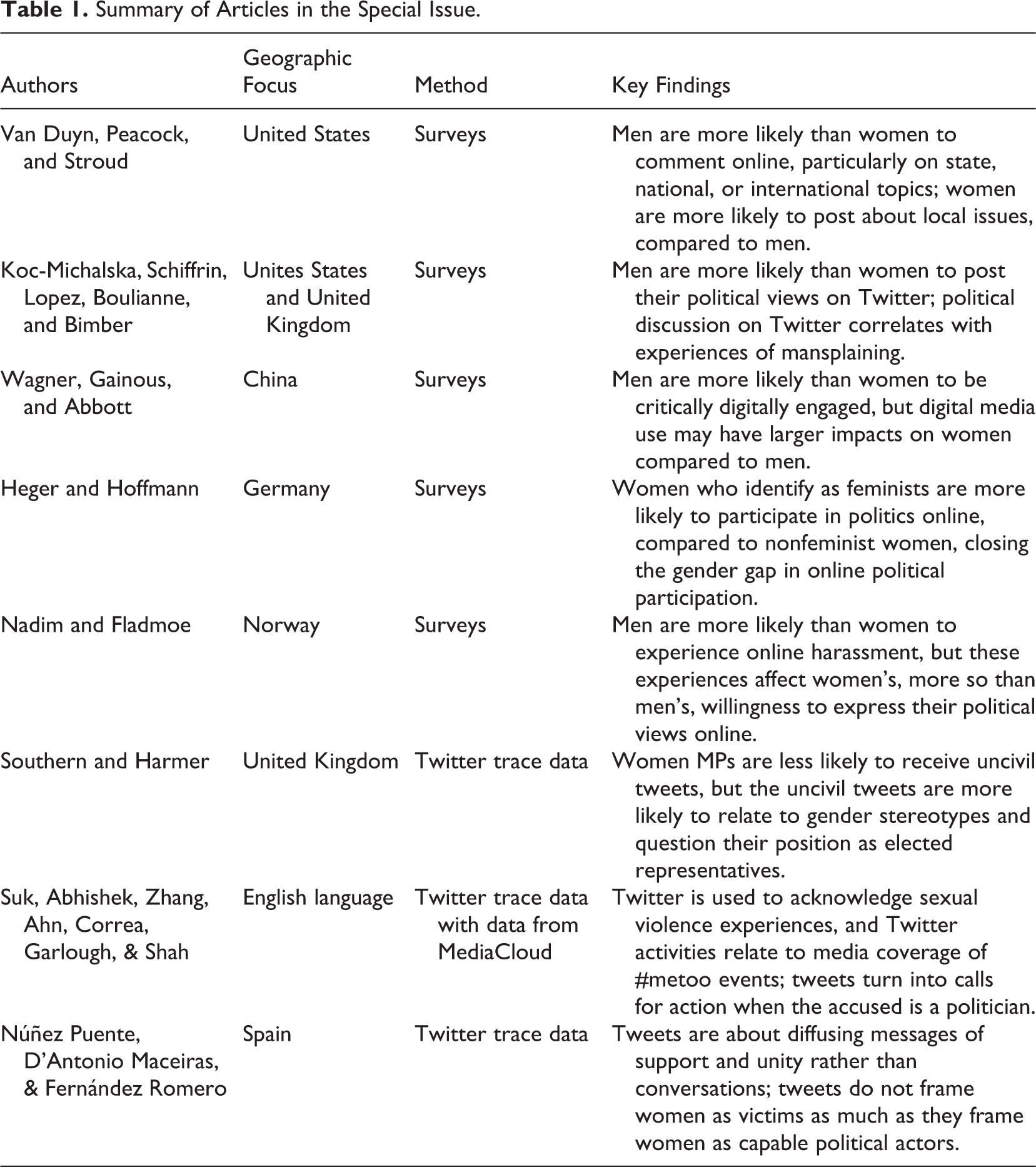
Van Duyn, Peacock, and Stroud (in press ) use two surveys to examine gender differences in the likelihood of posting to the comment sections of news websites in the United States. They find that perceived incivility reduces the likelihood of commenting on these sites, across a range of topics from local to international issues. Koc-Michalska et al. (in press ) examine platform differences in posting. They find that platform matters for the experience of mansplaining, as men posting on Twitter are more likely to be accused of mansplaining and women are more likely to be mansplained. Both papers demonstrate women’s reluctance to fully express their political opinions online (Koc-Michalska et al., in press ; Van Duyn et al., in press ).
Wagner et al. (in press
) examine online exposure to and exchange of critical information concerning the government in China. They find that distrusting traditional media is positively correlated with critical digital engagement. Heger and Hoffmann (
Nadim and Fladmoe (in press ) also use two Norwegian surveys to examine the range of negativity online, from unpleasant comments to harassment. They find that 17% of people reported unpleasant comments and 6% of people reported receiving hateful comments online. Southern and Harmer (in press ) also offer research on online incivility, however, from the elite point of view, focusing on Members of Parliament in the United Kingdom. They analyze an extensive number of tweets sent to MPs and find that less than 10% of tweets to U.K. MPs were uncivil.
The two final papers focus on the online activity within feminist hashtag activism. Suk et al. (in press ) identified 9,832 tweets that related to network acknowledgment of sexual violence experience and 5,569 tweets that related to activism, which point to demands for investigations and an end to violence. The communication evolves over time from network acknowledgment to activism discourse. Núñez Puente et al. (in press ) examine Twitter-based activism against gender-based violence connected with #8M movement in Spain. The research indicates that #8M served to disseminate information circumventing the invisibility of the topic rather than served a conversational purpose; approximately 1% of tweets were replies. The question, however, remains as to what extent the online discussion transfers into offline collective actions. There are many examples of perpetrators of sexual violence losing their jobs in the aftermath of these Twitter events (Núñez Puente et al., in press ; Suk et al., in press ; Wagner et al., in press ).
Summary
The special issue highlights gender issues related to using digital media for online politics. The submissions offer a balanced perspective about the role of digital media—this tool can be used for social change or to limit social change. The articles use qualitative and quantitative analyses of digital trace data and survey data to present a rich perspective on gender and online politics. The collection offers a cross-national perspective, including research on China, Germany, Norway, Spain, the United States, and the United Kingdom.
Footnotes
Declaration of Conflicting Interests
The authors declared no potential conflicts of interest with respect to the research, authorship, and/or publication of this article.
Funding
The authors received no financial support for the research, authorship, and/or publication of this article.