




Abstract
The aim of this study was to analyze the effect of an online affect management intervention on relationship conflict through the rate of growth of team resilience in virtual teams with diversity faultlines. Fifty-two 4-person teams participated in a randomized controlled trial design with repeated measures (i.e., three measurement occasions). Teams were randomly assigned to either an intervention designed to help them manage emotions in virtual teams or a control condition. Our findings showed that affect management can reduce the level of relationship conflict in virtual teams with diversity faultlines and that this effect can be explained by the pattern of change in team resilience in response to the intervention. This study contributes to past research on identifying ways to prevent or mitigate team conflicts arising from diversity faultlines.
Keywords
The rapid development of information and communication technologies and the globalization process have led to a growing prevalence of virtual teams in today’s organizations (Gibson et al., 2014). Virtual teams are groups of geographically dispersed people who work interdependently toward common goals, using technology to communicate and collaborate across time and space (DeSanctis & Monge, 1999). These teams have the ability to bring together a variety of knowledge and experience from individuals who are geographically distant (Batarseh et al., 2017), which contributes to making today’s organizations more diverse.
After 50 years of research, diversity has been shown to have potential benefits for creativity, innovation, and performance in teams and organizations (see van Knippenberg & Mell, 2016, for a review). For instance, diversity can benefit performance by preventing premature consensus while stimulating the elaboration of task-relevant information (van Knippenberg & Schippers, 2007). However, inconsistent findings in diversity research have led scholars to pay attention to team faultlines (Thatcher & Patel, 2011). Team faultlines are defined as hypothetical lines dividing the team into relatively homogeneous subgroups based on the alignment of multiple individual attributes (e.g., age, sex; Lau & Murnighan, 1998). Because team faultlines make social categories salient (Meyer & Schermuly, 2012), the resulting processes of inter-subgroup bias are likely to have harmful effects in virtual teams, such as an increase in relationship conflict (e.g., O’Leary & Mortensen, 2010; Polzer et al., 2006).
Defined as the awareness of interpersonal incompatibilities regarding personal issues (e.g., differences in personal traits, language, cultural practices) that are not task-related and produce feelings of tension and friction among team members (Jehn & Mannix, 2001), relationship conflict is harmful to group viability and performance (de Wit et al., 2012). In this context, affect management can be useful in reducing relationship conflict because it may limit subgroup formation and intergroup bias by effectively addressing potentially negative affective responses to team faultlines (Homan, 2019). However, although research is paying more attention to investigating how to prevent or mitigate conflicts in teams that have diversity faultlines (van der Kamp et al., 2015), the role played by affect management in this context has been neglected.
Therefore, to extend this stream of research, this study explores how an online affect management intervention can reduce relationship conflict in virtual teams affected by team faultlines. Online training was employed because this training delivery mode can be as effective as traditional classroom sessions (Sitzmann et al., 2006) while cutting costs and creating content that can be delivered anytime, anywhere, and on demand (DeRouin et al., 2004). Moreover, online training is widespread in an environment characterized by distributed work and intensive technology use (Kraiger, 2014). We also study the mediating role of team resilience in this relationship. More concretely, we examined the trajectory of growth of team resilience in response to the intervention and how the rate of growth of team resilience mediates the effect of the intervention on the level of relationship conflict.
The Effect of an Online Affect Management Intervention on Relationship Conflict in Virtual Teams with Diversity Faultlines
Following Marks et al. (2001), affect management can be defined as a process through which a team effectively manages members’ affect during task accomplishment. Affect management involves emotion regulation techniques such as calming members down, boosting team morale and cohesiveness among members, and providing empathy, with implications for team effectiveness. It can improve team performance by inducing, displaying, and sustaining a positive group climate (Meng et al., 2015), whereas it can keep unregulated negative emotions from resulting in low member satisfaction, reduced group cohesion, and reduced team commitment (Jehn, 1997).
An intervention to enhance a team’s capacity to effectively manage negative affective reactions to team faultlines can help to diminish relationship conflict (Homan, 2019). Similar to the process of de-categorization, an affect management intervention reduces the salience of in-group and out-group category distinctions by providing personalized interactions between members of the subgroups (Gaertner et al., 2010). More specifically, team members are presented with a situation where they have to deal with others’ affective reactions, which may lead members of the in-subgroup to interact with out-subgroup members as individuals rather than as members of the out-group. In this situation, it is more difficult to ignore the individual characteristics of members of the other subgroup, making depersonalization and evaluation based on social categories less likely and, consequently, reducing relationship conflict (Homan et al., 2007a).
In this study, we designed an intervention to deliver communication strategies that facilitate affect management in written computer-mediated communication, which was the communication medium used by our virtual teams. In such online settings, strategies to manage the timing of messaging can be used to avoid delays in responses (e.g., a team member says that they will take time to answer a question), which create frustration (Panteli & Fineman, 2005) and affect the impression formed by the recipient (e.g., an unresponsive partner is perceived as less credible; Kalman & Rafaeli, 2011). Emoticons can be employed to strengthen the positive emotional content of verbal messages in online written communication while softening the negative content (Derks et al., 2008). They are also useful for softening speech acts that can be interpreted as authoritative by the receiver, such as requests, corrections, rejections, and complaints, while strengthening expressions such as greetings, thanks, compliments, and positive appraisals (Skovholt et al., 2014).
Moreover, virtual teams need a positive group climate in order to reduce conflict and increase cooperation and perceived performance (Barsade, 2002). This positive climate can lead to adopting flexible and adaptive strategies when facing adversities, thus promoting better team performance in difficult situations (Meneghel et al., 2016). There are communication strategies that can help to create a positive group climate during group interactions, such as cheering on the team by making encouraging comments about its overall progress and performance or making supportive comments about other team members’ ideas and opinions (Rhee, 2007). A positive group climate can also be supported by providing new responses to the stimulus evaluations resulting from reappraisal strategies (Elfenbein, 2007).
In summary, our online intervention is designed to facilitate the use of socio-emotional cues and promote a positive group climate in online written communication. In the next section, we further explain our proposal, arguing that the effect of our online intervention on relationship conflict is mediated by the rate of growth of team resilience.
The Mediating Role of the Rate of Growth of Team Resilience in the Relationship Between an Online Affect Management Intervention and Relationship Conflict
Virtual teams have several advantages such as lower cost, no travel expenses, automatic capture of the discussion data, and connecting people regardless of their location (Underhill & Olmsted, 2003). However, they also face additional sources of stress that are inherent to the characteristics of distributed work, such as technical problems, spatial distance, temporal distance, and cultural diversity (Nurmi, 2011; Schneider et al., 2002). In these circumstances, resilience is a relevant psychological quality that allows people to withstand the stress that arises from challenges and adversity and bounce back strengthened and more resourceful (Stephens et al., 2013; Sutcliffe & Vogus, 2003). Although resilience has traditionally been defined at the individual level, it is also applied to teams and organizations (Bowers et al., 2017). Based on Marks et al.’s (2001) concept of an emergent state, some scholars (e.g., Bowers et al., 2017; Gucciardi et al., 2018) have recently started to view it as an emergent team phenomenon with a dynamic and multilevel nature. According to Gucciardi et al. (2018), team resilience emerges because of the accumulation of collective experiences in dealing with adverse events. In this study, we use this conception to define team resilience as an emergent state that entails shared beliefs about the team’s ability to positively face challenges and difficulties while reaching the team’s goals.
One of the factors that matters in team resilience is the quality of the relationships (Menenghel et al., 2016). A study by Stephens et al. (2013) showed that team resilience is enhanced when individuals have the feeling that they can express their true emotions and manage them in a constructive manner in the team. When team members can express (rather than suppressing) how they feel when faced with a challenge, they are able to collectively comprehend difficult situations and effectively respond to them (Carmeli et al., 2013). Furthermore, feeling positive emotions is particularly important for team resilience (Menenghel et al., 2016). Accordingly, we propose that our online affect management intervention can enhance team resilience because it allows team members to express their emotions, address them constructively, and build a positive group climate. All of this may help to develop a safe space in which to generate a broad array of responses to challenging situations, thus increasing team resilience (Stephens et al., 2013).
Research investigating the capacity of team resilience to foster the team’s ability to weather potential negative effects of team faultlines (i.e., increased levels of relationship conflict) is still lacking. However, in an increasingly diverse workplace, the formation of subgroups due to team faultlines can be a frequent source of adversity or challenge that teams have to deal with, as in the case of high levels of relationship conflict in fragmented teams (e.g., Polzer et al., 2006). Thus, the development of team resilience is important in order to face specific challenges of working in a team, such as relationship conflict and team faultlines (Stephens et al., 2013), while achieving better team performance (Menenghel et al., 2016).
Teams that are able to rebound from setbacks and challenges are more likely to be helpful toward other teammates and maintain open lines of communication rather than withdrawing from their team and focusing inward (Bowers et al., 2017; West et al., 2009). Accordingly, team resilience is likely to contribute to reducing the level of relational conflict produced by the division of the team into subgroups by making the team able to withstand potentially damaging effects of threatening situations. However, previous research has not found a significant relationship between team resilience and intragroup conflict (West et al., 2009). In contrast to West et al.’s study, we analyzed the growth rate of team resilience over three teamwork sessions. Hence, instead of using the level of team resilience, we use the growth rate of this variable to predict the level of relationship conflict at the end of the teamwork project. Examining the rate of growth of team resilience over time better reflects the nature of this emergent state, which results from the accumulation of collective experiences in dealing with challenges and difficulties while attaining team goals.
Overall, based on the previous rationale, we consider team resilience to be a central factor in explaining the effect of our online affect management intervention on relationship conflict. More specifically, we expect a mediating role of the growth of team resilience, so that our online intervention increases team resilience, which in turn reduces relationship conflict. We propose specific hypotheses in the next section.
This Study
In this study, we designed an intervention to deliver communication strategies that facilitate the use of socio-emotional cues and promote a positive group climate in online written communication. Thus, our online intervention may contribute to reducing relationship conflict in virtual teams with diversity faultlines by fostering personalized interactions between members of the subgroups and effectively managing affective reactions to team faultlines, while limiting the salience of in-group and out-group category distinctions (Chiu & Staples, 2013; Homan et al., 2007a).
Moreover, we examine whether the effect of our online intervention on relationship conflict is mediated by the rate of growth of team resilience (see Figure 1). An intervention for enhancing affect management may help the team to generate resources that can be used to face challenging situations. This set of resources consists of greater awareness of the way team members are feeling when dealing with difficult situations as well as strategies to manage emotions in a constructive manner (i.e., development of a positive group climate). These “affective resources” can help the team to accumulate positive collective experiences in facing challenges, thereby strengthening the growth of team resilience. Subsequently, the growth of team resilience can make the team better able to weather the harmful effects of the presence of subgroups in the team and work together more effectively than teams with less resilience, thus resulting in lower levels of relationship conflict. Based on this rationale, we expect the following:
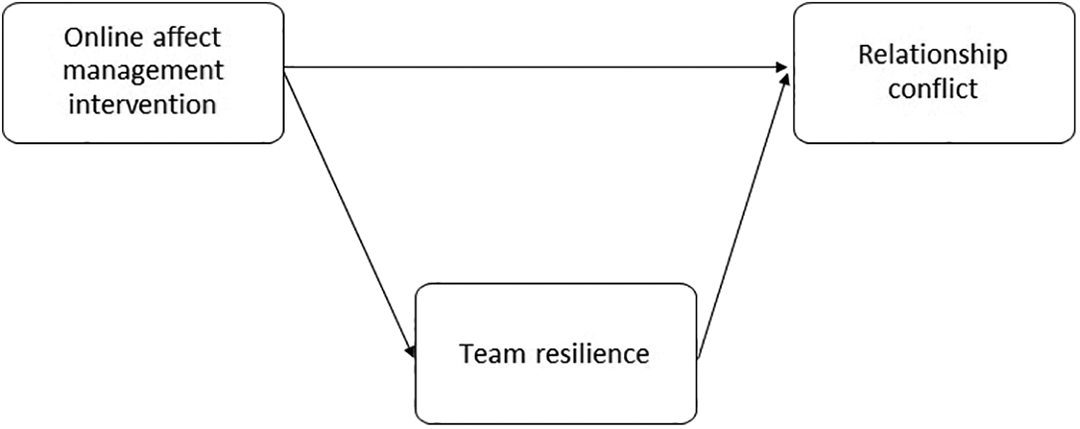
Research model.
Method
Participants
The sample consisted of 208 first-year students enrolled in organizational behavior studies in two universities in Spain. Students were organized in 52 teams of four members each. They were recruited by presenting the participation as a practice of innovative education that would help them to develop competences in working in virtual teams and improve their affect management. Their participation was an alternative way to fulfill the practical classes. The mean age of the sample was 20.90 years (SD = 5.31). The sample was composed of 69.2% women (N = 144) and 30.8% men (N = 64). These teams were stable during the experimental period. Participants did not know the objective of the study or the composition of their groups, so that they could not get in contact with the other members before the first session.
Design
This study utilized a 2 × 3 mixed factorial design: two between-subjects (affect management online intervention vs. no intervention) × three within-subjects (time of measurement: Sessions I–III). Thus, it follows that this experimental study used a randomized pre–post design with a control group method to test whether the conditions used really have an effect on team processes and results (Times 1 and 2). We added a follow-up session (Time 3) to evaluate the effects of the experimental conditions over time.
Participants were assigned to 1 of 52 four-person teams, but not completely randomly, so that team composition necessarily depended on the home university of the student (UV vs. US) and the adventure profile (bold vs. thoughtful) to create the faultline. This information was collected during the recruitment process. Thus, based on these two characteristics, we randomly assigned either two bold UV students and two thoughtful US students or two thoughtful UV students and two bold US students to each team. Once the teams were formed, they were randomly assigned to the experimental or control conditions.
Procedure
All the teams worked in synchronous computer communication settings in real time. The teams met weekly, participating in five sessions during approximately 1-month period, of which two sessions were for intervention. Team members interacted using an ad hoc electronic platform to create the virtual work context. The members had the chance to use different applications: visualization of videos and documents (always in a synchronized way), replying to group documents, using a chat with emojis, arranging the information from the experimental task, and completing online questionnaires.
Before starting the experiment, the participants had been briefly instructed about the use of this specific technology. The participants read and signed a participation form, based on the instructions of the ethics committee (i.e., the time availability for work and specific context). Moreover, a pilot study was carried out to test the time required to solve the tasks and the tools used on the software platform.
In each of the three work sessions, the teams had to resolve an intellective decision-making task, in accordance with the task models of McGrath (1984), which are also called “survival” tasks, but integrated with digital storytelling. The three tasks used consisted of survival situations where team members receive a list of items and objects they have to put in order depending on their usefulness for their survival (i.e., forest fire, survival in a bunker, and lost in the desert; e.g., Human Synergistics, 2003). Solutions for the task are developed first on an individual basis and then as a group. These tasks have a definitive solution provided by experts as an objective result with which to compare individual and team rankings. The fundamental requirement to solve this task type consists of analyzing the situation, combining the individual contributions, and developing an effective communication process. These tasks are frequently used in experimental studies on teamwork (e.g., Mennecke et al., 2000; van der Kleij et al., 2009), and they have been found to be very useful for team development (Pettit & Ferguson, 2017).
Similarly to other laboratory studies examining the effects of team faultlines (e.g., Homan et al., 2007b; Rico et al., 2012), we carried out experimental manipulations to divide the teams into two subgroups. To do so, it is necessary to align at least two characteristics in each subgroup. During the first work session, the formation of subgroups was obtained by aligning the following two characteristics: the home university (UV vs. US) and the adventure profile (bold vs. thoughtful). Assignment to the specific adventure profile (bold vs. thoughtful) was made with a questionnaire that was completed as a baseline for each participant. In it, the participants had to rate a list of adventure activities depending on their preferences. Some were related to a bold adventure profile that preferred risk (“James Bond” style) and others to a more thoughtful adventure profile (“Indiana Jones” style). We checked that the assignment to the specific adventure profile had the desired effect. In the case of the bold adventure profile, participants identified with the assigned profile (M = 4.39, SD = 1.22) more than with the other one, M = 3.95, SD = 1.34, t(103) = 2.39, p < .05. We found a similar pattern of results for the thoughtful adventure profile. Participants also identified with the assigned profile (M = 4.63, SD = 1.12) more than with the other one, M = 3.33, SD = 1.41, t(103) = 8.03, p < .001.
Moreover, based on the reviewed literature, especially articles by Rico et al. (2007) and Rico et al. (2012), the fragmentation was emphasized by using various elements. First, they communicated about their own profile and those of the other team members through their descriptions in the welcome text before the work in groups. Second, the colors and logos of the universities and the profile were visible throughout the work session. Third, a warm-up exercise before the work session had to be done in subgroups and consisted of the allocation of resources granted by the ministry to each university, without the possibility of using 50% for each university. Fourth, each experimental task had to be done in two parts, the first one individually and the second one with the group. During the first activation session, the first part was carried out in subgroups with the goal of strengthening the fragmentation. The objects that had to be put in order were distributed according to the subgroup, creating three subsets of elements. The group had all the necessary information but distributed in subgroups, and the first part of the task, instead of being individual, was performed by the subgroups.
Online Affect Management Intervention
The online affect management intervention consisted of two sessions held between a preintervention session (Time 1) and two postintervention sessions (Times 2 and 3). Specifically, the content of the first session was related to how to identify, express, and regulate emotions in virtual teams (i.e., paralanguage, time management, use of emoticons, intensification or softening of emotions), and the content of the second session referred to managing and regulating the affective work climate in virtual teams (i.e., strategies that can turn around any situation, offering rewards for efforts, acknowledging the contributions of others, support and motivation to achieve the team goal). Both sessions included individual and collective exercises that allowed the participants to put the content into practice. During the individual exercises, the participants acquired the content provided and practiced it through a series of exercises individually. In the collective exercises, the team worked online and practiced together, trying to reach an agreement about how to include the knowledge during the following work sessions. In both sessions, the individual exercises had to be performed on the work platform to ensure that no group member could start the collective exercises if the rest of the team members had not previously completed them individually.
All the groups participated in the same sessions, regardless of the experimental condition, but in a different order. Thus, participants in the experimental condition completed the following work plan: preintervention (Time 1); Affect Intervention 1, Affect Intervention 2, and postintervention (Time 2); and postintervention (Time 3). Participants in the control condition received affect management training in the end with the goal that all the students would receive the same training contents: preintervention (Time 1), postintervention (Time 2), postintervention (Time 3), Affect Management Intervention 1, and Affect Management Intervention 2.
Measures
Team resilience
This variable was measured by 3 items taken from Stephens et al. (2013). An example of an item is: “This team knows how to cope with challenges.” The items were measured on a 6-point Likert-type scale from I strongly disagree (1) to I strongly agree (6). The Cronbach’s αs for this scale were .95, .95, and .94 for Time 1, Time 2, and Time 3, respectively. Moreover, the team score was obtained by aggregating individual responses to the questionnaire at the team level. Following a referent-shift consensus model (Chan, 1998), it is important to demonstrate within-group agreement to justify aggregation. The rWG(J) index was used to assess within-group agreement (James et al., 1984). The mean of rWG(J) was .80 (SD = 0.26) for Time 1, .85 (SD = 0.24) for Time 2, and 0.83 (SD = 0.27) for Time 3. These values are above the cutoff criterion of .70 (LeBreton & Senter, 2008). We also calculated the intraclass correlation coefficient or ICC(1). This coefficient can be interpreted as the proportion of total variance that can be explained by group membership or as an index of interrater reliability (Bliese, 2000). ICC(1) was .07 for Time 1, .11 for Time 2, and .06 for Time 3. According to Bliese, these values are within the range of typical values found in applied research, ranging from .05 to .20.
Relationship conflict
It was measured by 3 items taken from Jehn and Mannix (2001). An example of an item is: “How much relationship tension is there in your work group?” The items were measured on a 5-point Likert-type scale ranging from 1 = not at all to 5 = a lot. The Cronbach’s αs for this scale were .84, .86, and .89 for Time 1, Time 2, and Time 3, respectively. Moreover, results of data aggregation analysis for relationship conflict were as follows: The mean of the rWG(J) was .90 (SD = 0.18), .86 (SD = 0.22), and .83 (SD = 0.28) for Time 1, Time 2, and Time 3, respectively. All these values were above .70. Moreover, ICC(1) was .18, .15, and .14 for Time 1, Time 2, and Time 3, respectively.
Statistical Plan
Analysis of covariance (ANCOVA) models were calculated to test Hypothesis 1 with SPSS, and latent growth curve models were calculated to test Hypotheses 2–4 with Mplus 7.4 (Muthén & Muthén, 1998-2015). The latent growth curve model allows us to analyze interteam variability of change in team resilience over time and examine the antecedents and consequences of change (Preacher et al., 2008). In our study, we examined our online affect management intervention as the antecedent of change in team resilience, whereas relationship conflict was the consequence of change. To do so, we first estimated two latent factors: the initial mean and the linear change factor. The initial level (intercept) is a constant for any given team across time, whereas the linear change factor (slope) describes team differences in the constant rate of mean-level change across the three measurement points. Linear growth is obtained by fixing the growth factor loadings at 0.0, 1.0, and 2.0.
The parameters of the model were estimated with maximum likelihood. We followed a sequence of increasingly complex nested models in which fixed effects were successively freed to vary in order to determine whether significant sources of between-team variance existed for the intercept and growth factor parameters (Bliese & Ployhart, 2002). Thus, we compared a baseline model, in which the intercept was fixed across all teams and the growth factor was fixed to zero, and a model in which the intercept was freed to vary across teams. Subsequently, a model in which the growth factor was freed to vary across all teams (Model 1) was compared with models that allowed only between-team variation in the intercepts. Nested models were compared using the χ2 difference test. Additionally, goodness-of-fit of the models was tested following the cutoff criteria of a comparative fit index and a Tucker–Lewis Index greater than 0.95 (Hu & Bentler, 1999) and a root mean square error of approximation of 0.08 or less (Browne & Cudeck, 1993).
Finally, we examined the effect of the online intervention on the rate of growth of team resilience (Model 2) and the effect of the rate of growth of team resilience on the level of relationship conflict (Model 3).
Results
Preliminary Analysis
Table 1 provides the means, standard deviations (SDs), and Pearson correlations for the aggregated scores of the variables measured in our study. We also calculated partial correlations by controlling for condition to check that the correlations among the dependent variables were not caused by the manipulation. To do so, we created a dummy variable in which teams in the intervention condition were assigned scores of 1 and the teams in the control condition were assigned scores of 0. As Table 1 shows, mean values indicate that team resilience increased over the three measurement points in the intervention condition, whereas it remained more or less stable in the control condition. Pearson correlations show a positive correlation between measurements of team resilience at Times 2 and 3. Furthermore, these measurements of team resilience correlated negatively with relationship conflict.
Means, Standard Deviations (SDs), and Intercorrelations.
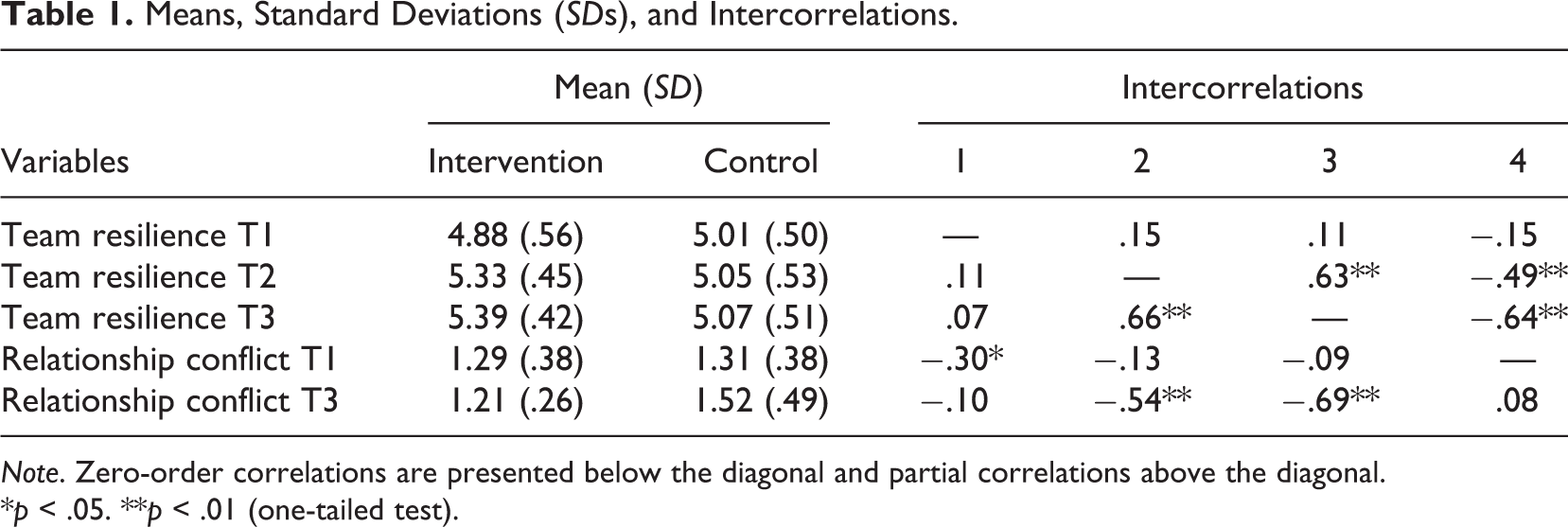
Note. Zero-order correlations are presented below the diagonal and partial correlations above the diagonal.
*p < .05. **p < .01 (one-tailed test).
Manipulation Check
We checked the manipulation of affect management with 10 items. An example of an item is: “In my team, we have used emojis to share our emotions.” The response scale ranged from 1 (not at all) to 4 (very much). The Cronbach’s αs were .81, .87, and .89 for Time 1, Time 2, and Time 3, respectively. Although we measured this manipulation check at the individual level, we aggregated members’ answers to the team level because individuals worked in teams, and so their answers were probably not independent (Bliese, 2000). Aggregation of data to the team level was justified, considering that we obtained the following results: The mean of the rWG(J) was .85 (SD = 0.11), .84 (SD = 0.12), .82 (SD = 0.16) for Time 1, Time 2, and Time 3, respectively; ICC(1) was .22, .37, and .38 for Time 1, Time 2, and Time 3, respectively. Results showed that this manipulation had the desired effect. Participants in the intervention condition indicated that they used affect management strategies with their respective teammates more often than in the control condition in Time 2, intervention: M = 2.84, SD = 0.47; control condition: M = 2.55, SD = 0.43; t(50) = 2.33, p < .05, and Time 3, intervention: M = 3.03, SD = 0.49; control condition: M = 2.57, SD = 0.40; t(50) = 3.73, p < .001. In Time 1 (preintervention session), there were no significant differences between conditions, intervention: M = 2.45, SD = 0.34; control condition: M = 2.59, SD = 0.38; t(50) = −1.40, p = ns.
Hypothesis Testing
The ANCOVA results showed that the level of relationship conflict was lower in the intervention condition than in the control condition in the postintervention session, Time 2, F(1, 49) = 11.61; p < .01, and in the follow-up session, Time 3, F(1, 49) = 8.01; p < .01, after controlling for the pre-intervention session (Time 1). The mean and SD for each condition and session are shown in Table 1.
Table 2 shows the results of the latent growth curve analysis. A positive slope in Model 1 indicates a linear rate of positive change in team resilience over the three experimental sessions (
Results of the Latent Growth Curve Model.
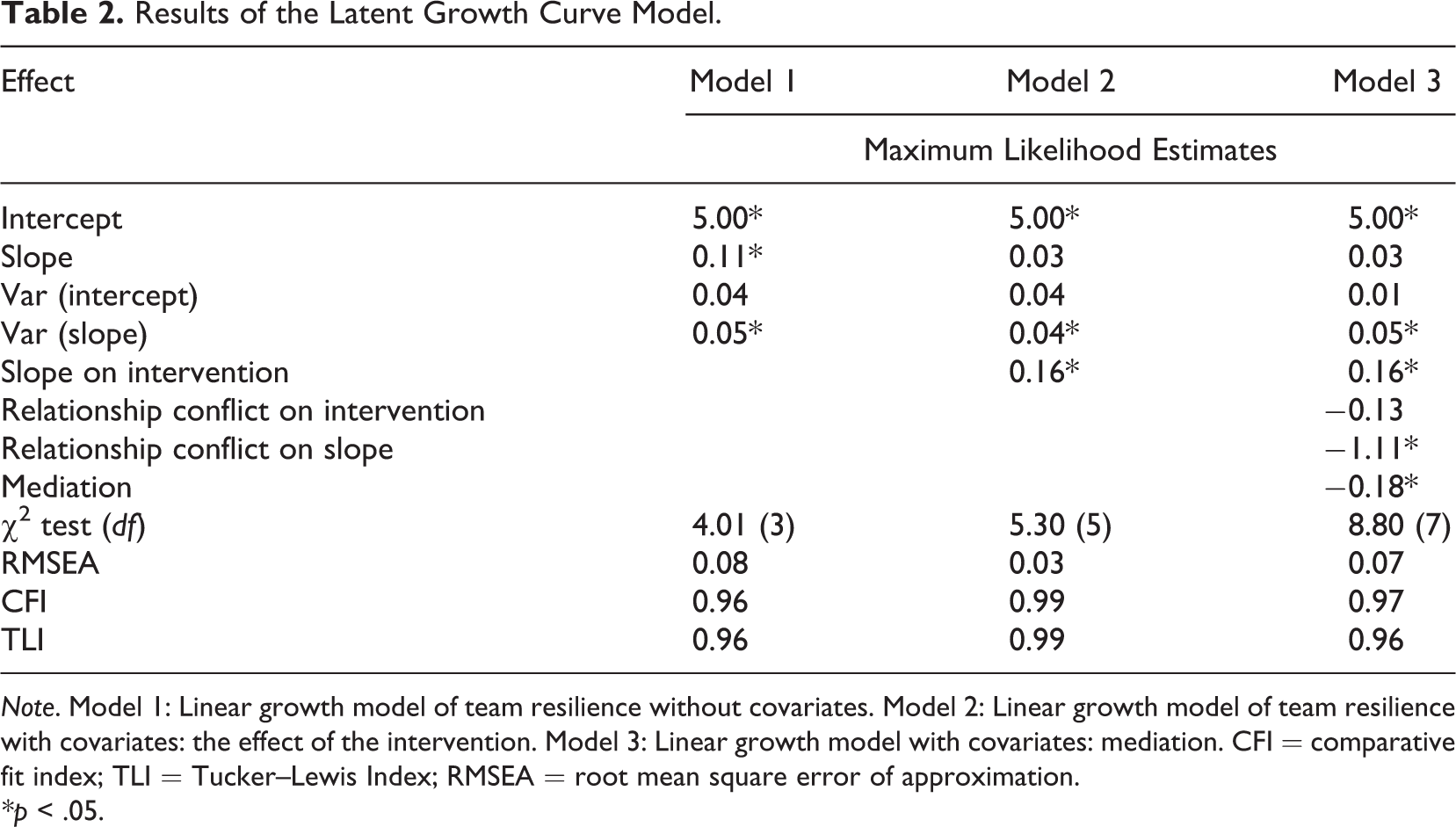
Note. Model 1: Linear growth model of team resilience without covariates. Model 2: Linear growth model of team resilience with covariates: the effect of the intervention. Model 3: Linear growth model with covariates: mediation. CFI = comparative fit index; TLI = Tucker–Lewis Index; RMSEA = root mean square error of approximation.
*p < .05.
Discussion
The aim of this study was to analyze the effect of an online affect management intervention on relationship conflict through the rate of growth of team resilience in virtual teams. Supporting Hypothesis 1, our data showed that our online intervention helped virtual teams to reduce relationship conflict under faultline conditions. Thus, this result suggests that it is important to train participants in affect management. In our study, this training specifically involved content about how to identify, express, and regulate emotions in virtual teams (i.e., paralanguage, time management, use of emoticons, intensifying or softening emotions). We also included communication strategies (i.e., strategies that can turn around any situation, offering rewards for efforts, acknowledging the contributions of others, support and motivation to achieve the team goal) to create a positive group climate during the group interaction.
Considering that our online affect management intervention can be conceived as a de-categorization strategy, we contribute to previous research examining whether promoting personalized interactions between subgroup members reduces the negative consequences of subgroup formation (e.g., Chiu & Staples, 2013; Homan et al., 2007a; Gaertner et al., 2010; Rico et al., 2012). This result is also consistent with research suggesting that written computer-mediated communication is not impersonal (Glikson & Erez, 2013; Walther & D’Addario, 2001). Instead, virtual teams that use this communication medium can benefit from an online intervention to appropriately manage available cues in written computer-mediated communication to convey socio-emotional information or relational communication (Derks et al., 2008; Kalman & Rafaeli, 2011; Panteli & Fineman, 2005; Skovholt et al., 2014).
In addition, our online intervention increased the rate of positive change in team resilience over the three experimental sessions, which empirically supports Hypothesis 2. Coinciding with Stephens et al. (2013), our results indicate that when individuals can express their emotions because others are responsive to them, team resilience is developed. Thus, the increase in the growth rate of team resilience in response to the online intervention shows that when team members express their emotions and manage them in a constructive manner, they become more capable of collectively dealing with challenging situations (Carmeli et al., 2013; Stephens et al., 2013).
We also found empirical support for Hypothesis 3 because the rate of growth of team resilience over the three experimental sessions reduced the levels of relationship conflict in fragmented virtual teams. The main contribution this result makes to previous research (e.g., Menenghel et al., 2016; Stephens et al., 2013) consists of showing that team resilience also makes the team more capable of dealing with internal sources of adversity or challenge, such as the formation of subgroups. This result suggests that resilient teams are more likely to be helpful to other teammates and maintain open lines of communication rather than withdrawing from their team and focusing inward (West et al., 2009). Furthermore, the significant result of the influence of the rate of growth of team resilience on relationship conflict shows the importance of studying emergent states from a temporal perspective (Bowers et al., 2017; Gucciardi et al., 2018). For instance, this approach allowed us to find a significant relationship between the rate of growth of team resilience and relationship conflict. This was not the case for West et al. (2009), whose findings did not empirically support the relationship between team resilience and intragroup conflict. Although more research is required on this matter, one plausible explanation is that examining the trajectories of change in team resilience reveals its dynamic nature. Therefore, this study contributes to past research by examining the relationship between team resilience and relationship conflict from a longitudinal approach.
Regarding the fourth hypothesis, our results showed that the rate of positive change in team resilience mediated the effect of the online affect management intervention on relationship conflict. Thus, Hypothesis 4 was supported by the data. This result indicates that our online intervention helped virtual teams to develop strategies to identify and manage affective responses in the team, thereby fostering the growth of team resilience. Subsequently, faster growth of team resilience led to less relationship conflict.
In summary, we contribute to previous research by suggesting that, in fragmented virtual teams, affect management is important to ameliorate the level of relationship conflict associated with the presence of subgroups (Polzer et al., 2006) and that an online intervention designed to improve affect management based on key findings about online written communication is effective for this purpose (Derks et al., 2008; Kalman & Rafaeli, 2011; Panteli & Fineman, 2005; Skovholt et al., 2014). We also showed that the operationalization of team resilience as an emergent state allowed us to confirm its dynamic nature (Bowers et al., 2017; Gucciardi et al., 2018). Unlike previous studies that have focused on the level of team resilience (West et al., 2009), we examined the growth of team resilience. Finally, we contribute to calls for more research on well-being in virtual teams (Gilson et al., 2015) from a positive perspective and using a collective approach. According to positive psychology (Seligman & Csikszentmihalyi, 2000), well-being is not just the lack of dysfunction (i.e., stress) but also the presence of positive states (i.e., team resilience).
Limitations and Future Research
This study presents some limitations and implications for future research. First, our results have some limitations in terms of external validity and generalizability to organizational settings because they were obtained with a sample of students. Although there is ample agreement about the capacity of experimental studies to address applied problems in this field (Dovidio & Gaertner, 2010), future studies should attempt to replicate our findings in real organizational contexts. Second, we did not analyze the transfer of an affect management online intervention to job performance. Because this transference is important in promoting organizational change (Kraiger, 2003), future studies should examine whether an online affect management intervention is effective in improving organizational results. Third, we studied newly formed virtual teams. Although our results provide a better understanding of how an online affect management intervention influences the rate of growth of team resilience and relationship conflict in virtual project teams, it is also necessary to study its effectiveness in long-term virtual teams. Fourth, we only used one specific electronic communication medium (e.g., electronic text-based chat), although virtual teams in organizations can use different types of communication technologies to cooperate, which can influence the data richness produced as a result of the medium itself (Abrams et al., 2015). Thus, our results should be tested in teams communicating through different communication media. Fifth, because team faultlines were a constant in our study, we should be careful not to conclude that our findings are due to team faultlines. Instead, given that the effect of team faultlines on relationship conflict has previously been shown (O’Leary & Mortensen, 2010; Polzer et al., 2006), our design allowed us to test the effects of an online affect management intervention on relationship conflict in faultline conditions. Even though we based our work on previous studies that examined how to minimize or overcome the detrimental effects of team faultlines under constant conditions of faultline strength (e.g., Homan et al., 2007b; Rico et al., 2012), future research should incorporate different faultline conditions (i.e., strong vs. weak faultlines) to assess whether an online affect management intervention can minimize or overcome the effect of faultline strength on the rate of growth of team resilience and relationship conflict. Finally, we have only focused on the negative side of diversity. However, we would like to point out that, in certain circumstances, the division of the team into subgroups may be relatively beneficial. A study by Bezrukova et al. (2012) showed that faultlines may operate as “healthy divides” that improve group performance in teams with cultural alignments that can influence the results across group and departmental levels. For example, dividing an overly cohesive team into subgroups can be beneficial for preventing groupthink. A subgroup division with an emphasis on constructive conflict (instead of relationship conflict) between subgroups may help teams to leverage members’ differences for effective group decision-making (O’Neill et al., 2020). However, we should be careful not to provoke distinct subgroup identities that may lead to strong relational conflict and competition across subgroups. Thus, more research is required to examine how to take advantage of the potential benefits of diversity while preventing the negative ones.
Practical Implications
The main practical implication of this study is that short-term project virtual teams, such as those studied here, can greatly benefit from the implementation of an online affect management intervention. Based on our findings, organizations can implement online training sessions to improve employees’ affect management skills through a web-based platform. Access to the instruction contents is available anytime and anywhere in an online platform, so that employees can individually manage their study and practice while agreeing with other teammates about a schedule for collective practice. Moreover, a simulation-based instruction method like ours, with different types of tasks, would make it possible to design different scenarios where employees can be trained to develop team resilience (Tichon & Mavin, 2017). Another practical implication is that this online intervention may help organizations to deal with the potential detrimental effects of team faultlines. Virtual teams bring together diverse knowledge and experience from individuals who are geographically distant, which can make it difficult to prevent subgroup formation. Thus, organizations may implement an online affect management intervention as a strategy to make virtual teams capable of dealing with team faultlines, thus avoiding the detrimental consequences of faultlines, such as relationship conflict, while improving team resources such as resilience.
In conclusion, the findings of this study showed that our affect management online intervention was effective in reducing the level of relationship conflict in virtual teams with diversity faultlines and that this effect can be explained by the pattern of change in team resilience in response to the intervention.
Footnotes
Data Availability
To access an anonymized version of the data presented in this article, please contact the corresponding author (Email:
Declaration of Conflicting Interests
The authors declared no potential conflicts of interest with respect to the research, authorship, and/or publication of this article.
Funding
The authors disclosed receipt of the following financial support for the research, authorship, and/or publication of this article: This work was supported by the Spanish Agency of Economy and Competitiveness [Grants PSI2013-48509-P and PSI2016-79351-P] and Valencian Council of Education, Culture and Sports [Grant PROMETEO 2016/138].
Software Information
The computer softwares used to obtain the reported results were SPSS 22.0 (SPSS, IBM, New York, NY) and Mplus 7.4 (Muthén & Muthén, 1998–2015).