



Abstract
Social media influentials play key roles in information creation and impact people’s crisis interpretations and behavioral intentions. Applying a multilevel perspective, this study examined how various social media influentials’ frame building was affected by crisis clusters and message characteristics. Social media influentials’ tweets were extracted from over a million tweets from eight crises. A random sample of 2,000 tweets was analyzed by content analysis. The results showed that social media influentials’ use of responsibility and topic frames was affected by both crisis-level factors (i.e., crisis origin and organization type) and message-level factors (i.e., communicative functions and types of influentials). These findings support the importance to understand the contextual factors that condition influentials' frame building on social media.
With the proliferation of information and communication technologies and the surge of networked public empowered by ICTs, social media have become essential platforms for communication during significant events such as crises. On social media platforms, various actors, such as news organizations, government agencies, nonprofit organizations, or individuals, can become influentials (Mirbabaie et al., 2020; van der Meer, 2018; Zhao, Zhan, & Liu, 2018). These influentials share key updates and unique opinions, provide the affected community with social support, and influence their followers’ beliefs, attitudes, and behaviors (Graham & Wright, 2014; Weeks et al., 2017; Zhao et al., 2019).
Most research on social media and crisis communication focuses on how people respond to organizations’ crisis response strategies delivered through different mediums using experiments (Austin et al., 2012; Kim & Cameron, 2011; Liu et al., 2016). Amid the emerging information and communication technologies and increasingly interconnected social media users, scholars have begun to study how influential content creators, including both organizations and individuals, strategically frame an actual crisis on social media (Gerken & van der Meer, 2019; van der Meer, 2018). However, many studies are based on a single case of crisis (Cheng & Cameron, 2018), such as a hurricane or a corporate crisis (Jin, 2020; Lachlan et al., 2016; Mak & Song, 2019), which largely limits the ecological validity of the findings. Analyzing social media data from multiple crises allows researchers to better understand the patterns of frame building across different clusters of crises.
The overreliance on a single case also constrains scholarly inquiry into how contextual factors related to the specific characteristics of a crisis (e.g., the origin of a crisis) affect influential frame building on social media in the crisis. For more systematic and generalizable understanding of frame usage related to social media influentials, this study adopts a multilevel perspective. Such a perspective enables scholars to investigate how social media influentials’ frame building can be shaped by both crisis-level and message-level factors simultaneously. In terms of crisis-level factors, four clusters of crises based on organization type and crisis origin were explicated based on the literature (Entman, 1993; Jin et al., 2014; Liu et al., 2015; Weimann, 2017). As such, a multilevel perspective to social media and crisis communication offers a more systematic and meaningful prediction of influential frame building in an emerging crisis.
Further, the literature predominantly focuses on how influence can be shaped by source characteristics (Liu et al., 2015; Martensen et al., 2018) or subjectively perceived message features (Vrontis et al., 2021). As different stakeholders have diverse expectations and evaluations related to an organization in a crisis (Singh et al., 2020), it becomes crucial to understand how objectively coded message characteristics, along with contextual factors, give rise to influence on social media. Such knowledge enables organizations and individuals to build and deliver more impactful messages on social media.
In sum, this study systematically tested how crisis-level and message-level factors affected influential frame building on social media. Influentials’ tweets were extracted from over a million tweets surrounding eight crises. Based on a random sample of 2,000 tweets from 468 influentials, the results showed the roles of both crisis-level factors (i.e., crisis origin and organization type) and message-level factors (i.e., communicative functions and types of influentials) in influential frame building on social media. These findings support the importance to consider diverse antecedents of influence at different levels for more nuanced understanding regarding influential frame building.
Defining Crises
Broadly defined, there are two types of crises: disasters (storms, wildfires, terrorist attacks) and organizational crises (governmental scandals, product safety) (Austin & Jin, 2018; Canel & Sanders, 2010; Coombs, 2018). Disasters and organizational crises impact different stakeholders and organizations to a varying degree, yet both involve disruptions of systems, violations of stakeholder expectations, and negative outcomes such as stress and anger (Coombs, 2018). Disasters can also lead to organizational crises when an organization fails to cope with the consequence of a disaster. An example would be utility companies failing to restore power in a devastating snowstorm. Based on the shared traits of different crises, Coombs (2018) defined crises as “perceived violation of salience stakeholder expectations that can create negative outcomes for stakeholders and/or the organization.” (p. 19)
Crises are defined based on the implications on the organizations and their stakeholders. To understand the impact of crisis clusters on influential frame building, this study includes four clusters of crises varying on organization type and crisis origin (Coombs, 2018; Jin et al., 2014). Regarding organization type, two types of organizations responsible for meeting different expectations of the stakeholders are considered: governmental versus private sector organizations. A governmental organization is primarily responsible for protecting the safety and well-being of the public in disasters whereas a private sector organization typically handles a corporate crisis to meet its stakeholders’ expectations. Crisis origin determines the extent to which an organization is perceived as being responsible for the harm, a key factor determining how organizations should conduct situational crisis communication (Coombs, 2007). Crisis origin depends on whether a crisis is originated from an internal (e.g., a company intentionally creates fraudulent accounts) or non-internal (e.g., a company responds to data breach) organizational issue.
Therefore, there are four clusters of crises: governmental crises due to an internal origin, governmental crises due to a non-internal origin, private sector crises due to an internal origin, and private sector crises due to a non-internal origin. The following sections discuss social media influence in different clusters of crises and various antecedents of social media influence.
Influence and Social Media
During crises, key information sources, such as traditional media, local and federal government, and prominent individuals, become influential content creators by providing users with crisis updates, relevant opinions, and social support (Liu et al., 2015; Weimann, 2017; Zhao et al., 2019). The social-mediated crisis communication (SMCC) model (Austin et al., 2012; Jin & Liu, 2010; Liu et al., 2016) explicates social media influence in the crisis context based on publics’ informational behaviors.
According to the SMCC model, social media influentials are defined as prominent sources who create and disseminate information to impact audiences’ perceptions and behaviors on social media during crises (Jin & Liu, 2010). Influentials, be it media outlets, organizations, or individual users, emerge during certain crises when they “are concerned about the crisis, have expertise on the crisis, and talk a lot about the crisis.” (Zhao, Zhan, & Liu, 2018, p. 551) However, social media influencers refer to third-party users who have established large followings and influence on audiences on social media (Delbaere et al., 2021; Singh et al., 2020). Organizations often collaborate with influencers such as YouTubers, bloggers, or celebrities to engage consumers in digital marketing.
Numerous studies support the key roles of social media influentials in both information creation and dissemination (Graham & Wright, 2014; Jin, 2020; Weeks et al., 2017; Zhao, Zhan, & Wong, 2018). The literature has also shown that crisis information from influential sources affects people’s crisis definitions and causal interpretations (van der Meer, 2018) and determines their protective behaviors (Jin et al., 2014; Liu et al., 2016). For example, van der Meer (2018) found that Twitter users typically rely on national media to define a crisis and identify the causes and consequences of the crisis.
Sources Characteristics and Influence
The communication literature has revealed the important role of source characteristics in affecting source influence (Freberg et al., 2011; Lazarsfeld et al., 1948; Liu and Jin, 2010; Vrontis et al., 2021). The two-step flow theory postulates that opinion leaders are influential individuals who affect how audiences interpret information from mass media (Lazarsfeld et al., 1948). According to Katz and Lazarsfeld (1955), opinion leadership is determined by one’s individual characters (e.g., personality and values), level of knowledge and expertise, position in a social network, and resources they can mobilize (Weeks et al., 2017; Winter & Neubaum, 2016).
The social impact theory prescribes that the impact of any information source on its audience depends on the importance and power of the source, the number of sources, and the closeness between the source and the audience (Latané, 1981). Miller and Brunner (2008) found that perceived influence is affected by source assertiveness and virtual presence online. In the social media context, scholars found that perceived influence can be affected by physical, social, and affective proximity (Perez-Vega et al., 2016). Similarly, the literature on source credibility and source attractiveness also explains how source characteristics are related to influence (Djafarova & Rushworth, 2017; McGuire, 1985). For example, source attractiveness and credibility increase consumers’ purchase intentions responding to social media influencer endorsement (Weismueller et al., 2020).
In the crisis context, the SMCC literature suggests that social media influentials emerge in specific crises when they are involved in the crisis, possess expertise regarding the crisis, and engage in extensive social media communication surrounding the crisis (Jin & Liu, 2010). In particular, Zhao, Zhan, and Liu (2018) found four dimensions of influence on social media: output, reactive outtake (e.g., number of shares), proactive outtake (e.g., positive references), and network positioning (e.g., degree centrality). This line of studies reveals that a source who provides relevant, rich, and credible crisis information on social media and is endorsed by peers is more likely to gain influence (Jin, 2020; Mak & Song, 2019).
Overall, the literature has supported the role of source characteristics in dictating influence on social media, particularly during crises. From a crisis communication perspective, it is crucial to go beyond source characteristics subjectively perceived by audiences (Vrontis et al., 2021) by examining how content characteristics objectively present in a message can promote message influence. Framing, a powerful communication paradigm (Borah, 2011; Entman, 1993), can be used to understand strategic content creation for gaining influence. In particular, this study focuses on how factors at different levels, including both crisis-level and message-level factors, contribute to influencing in the social media context.
Framing in Social Media Crisis Communication
To frame is to highlight certain aspects of an issue and make them more salient in the communication, so as to “promote a particular problem definition, causal interpretation, moral evaluation, and/or treatment recommendation” of the issue (Entman, 1993, p. 52). Frame building, namely how message frames are constructed, has been an important topic in framing research (Scheufele, 1999). A key issue in framing research is how frame building can be affected by internal factors (e.g., one’s perceptions like political orientations) and external factors (e.g., social norms or contextual characteristics) (Borah, 2011; van der Meer, 2018).
There are two types of message frames, issue-specific and generic frames (Brüggemann & D’Angelo, 2018). Issue-specific frames are tailored to the unique characteristics of a topic and can only be used to contextualize the topic, whereas generic frames transcend the context of a topic and are generalizable across topics. Generic frames are important for generating framing theories generalizable across various contexts and for comparing the effects of framing for different issues (e.g., de Vreese & Lecheler, 2012). To understand frame building across crises, different types of generic frames are discussed as follows.
Frame Building by Social Media Influentials
The central issue in crisis communication is to frame issue responsibility (Coombs, 2007). Social media empower alternative actors other than new organizations, such as Twitter users or independent organizations, to frame crisis responsibility and issue interpretations (Muralidharan et al., 2011; van der Meer, 2018; van der Meer et al., 2014). The literature demonstrates that responsibility frames dictate the public’s attitudes and emotions toward an organization (Claeys & Cauberghe, 2014; Kim & Cameron, 2011). Social media influentials also use certain topic frames (e.g., human interest; An & Gower, 2009) to amplify certain aspects of an issue and meet their followers’ information needs (Zhao et al., 2019).
Responsibility Frames
An issue can be framed in terms of who, the individual or the society, bears more causal and problem-solving responsibilities (Kim et al., 2010; Zhang et al., 2015). There are two responsibility frames (Iyengar, 1991). First, an episodic frame focuses on certain individuals or specific events. For example, a tweet is considered episodic if it provides a story about a survivor of a suicide bombing attack. Second, a thematic frame places events and individuals in the general context at the societal and organizational level and examines the broader context, systemic causes and consequences, and general implications beyond a single crisis. For example, a tweet uses a thematic frame by placing a suicide bombing attack in the context of the governmental immigration policy.
Previous research has revealled that episodic frames are more prevalent in news coverage of different social issues, such as obesity, poverty, or crises (Iyengar, 1991; Kim et al., 2010). In the crisis context, episodic frames provide relatable stories (e.g., a story about a survivor’s experience in a crisis) and demonstrate disaster relief efforts (e.g., a hostel offers free accommodations for the injured), enabling users to stay attuned to the latest information and to exchange social support (Zhao et al., 2019). However, episodic frames do not focus on the systemic cause of a crisis. If a crisis has an internal origin and is preventable by a certain organization, overemphasis on episodic frames could hinder the societal reflection on the organization’s responsibility in the crisis. Without systematic organizational learning and rebuilding, similar crises may happen again in the future and engender harms that could have been avoided.
Topic Frames
Following the literature (An & Gower, 2009; Semetko & Valkenburg, 2000; Valenzuela et al., 2017), this study focuses on four topic frames. First, human interest “brings a human face or an emotional angle to the presentation of an event, issue, or problem.” (An & Gower, 2009, p. 95) In disasters, social media users can use the human-interest frame to describe an individual’s crisis experience or people’s support for the survivors or the affected communities. Second, the consequence frame emphasizes the consequence of an issue, such as economic loss. For example, 1.2 million vehicles in the UK were affected in the Volkswagens’ emission scandal. Third, the attribution of responsibility frame focuses on who or what should be blamed for a crisis by attributing the responsibility of the cause and consequence to the government, an individual, or a group. For example, a resident in Flint may attribute the Water Crisis to the failure of the Michigan government. Last, the problem solution and action frame, widely adopted by organizations and individuals (e.g., activists) in a crisis, emphasizes the actions and solutions for addressing an issue or problem. Examples would be the changes in the organizational structure or the donations from the public for disaster relief.
To help people make sense of a complex issue, social media influentials can select the responsibility and topic frames that emphasize different aspects of an issue and promote certain solutions. For example, An and Gower (2009) found that news media typically framed preventable corporate crises using the attribution of responsibility frame, and they placed blame on individuals (e.g., CEOs) in preventable crises and on organizations in accidental crises.
Research Hypotheses and Questions
As mentioned, influential content creators can use different frames in different crises to promote particular issue interpretations (An & Gower, 2009; Mirbabaie et al., 2020; van der Meer, 2018). But it is not known whether influential types affect the use of responsibility and topic frames, as most studies examined a single case of crisis that involves limited types of influentials like news media. Zhao and Oh (2021) found that similar kinds of organizations, including companies and nonprofit organizations but not government agencies, tend to adopt similar frames in the opioid crisis. Yet, in different crises, organizations and individuals may prefer distinct frames to contextualize available information in a way favorable to them (Hallahan, 1999). Due to the lack of evidence on the relationship between influential types and frame building across multiple crises, the following two research questions are asked:
Crisis-level factors, namely organization type and crisis origin, affect responsibility and topic frames among social media influentials. If a crisis is of non-internal origin, social media influentials are more likely to attribute the responsibility to a specific actor or event that is beyond the responsibility of an organization by episodic frame. If a crisis is of internal origin, social media influentials are more likely to attribute the responsibility to an organization that intentionally creates the problem and harms by thematic frame. If a private sector (vs. governmental) organization is responsible for a crisis, social media influentials may be more likely to use certain frames emphasizing economic consequence. As such, the following two hypotheses are proposed:
Message-level factors, such as communicative functions, also impact frame building among social media influentials. Research has shown that social media content creators strategically pair frames with certain communicative functions in a crisis (Zhao et al., 2019). Crisis communication scholars discuss three types of communicative functions: informational, evaluative, and social functions (Fraustino & Liu, 2017). First, due to information needs elicited by uncertainty and anxiety in a crisis, people use the informational function of social media to seek and share updated crisis communication. Second, to make sense of the information and develop a meaningful understanding of a crisis (Stieglitz et al., 2018), people use the evaluative function of social media. Third, social media also serve the social function by allowing exchanges of social support, as social media connect people with a plentiful of information and resources not readily held by their strong ties. To summarize, social media influentials can strategically select particular frames to fulfill informational, evaluative, and social functions.
Methods
The social media platform of Twitter was chosen. With 330 million monthly active users and 192 million daily active users worldwide, Twitter is among the leading social media platforms based on active users (DataReportal, 2020). Even though Twitter has a lower penetration rate than Facebook in general, Twitter is one of the most engaging and interactive social networking sites that allow instantaneous public discussion about emerging significant issues such as crises. In terms of privacy setting, many tweets from individual users are public allowing high organic reach, whereas most individual posts on Facebook are private. In this way, Twitter data allow researchers to examine crisis data from both organizational and individual influentials.
Overview of Eight Crises, Keywords for Scraping, and Number of Tweets.
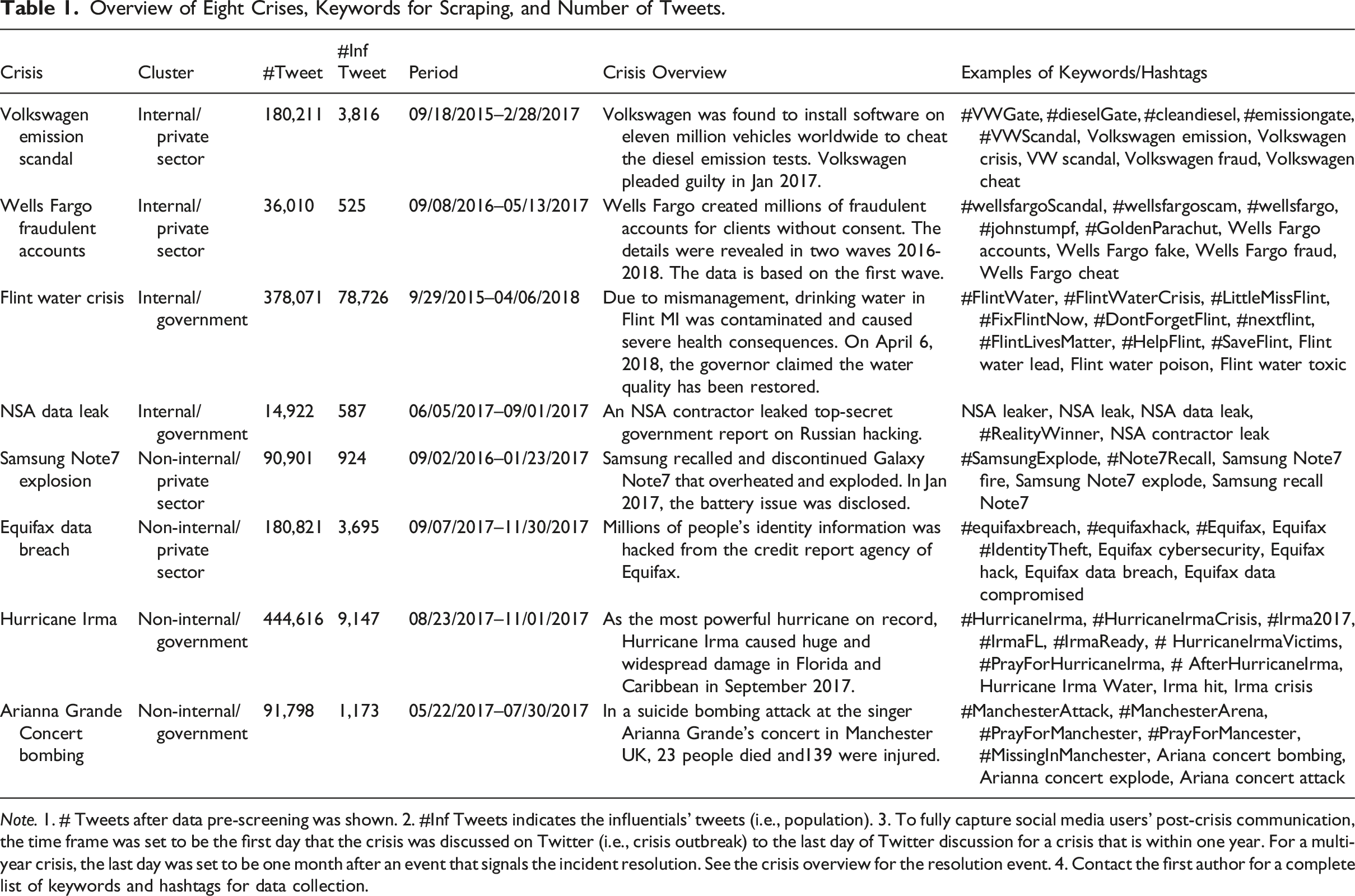
Note. 1. # Tweets after data pre-screening was shown. 2. #Inf Tweets indicates the influentials’ tweets (i.e., population). 3. To fully capture social media users’ post-crisis communication, the time frame was set to be the first day that the crisis was discussed on Twitter (i.e., crisis outbreak) to the last day of Twitter discussion for a crisis that is within one year. For a multi-year crisis, the last day was set to be one month after an event that signals the incident resolution. See the crisis overview for the resolution event. 4. Contact the first author for a complete list of keywords and hashtags for data collection.
Data Collection
A combination of different keywords and hashtags was used to capture all relevant tweets in a certain time frame. The time frame was defined to be the first day that the crisis was discussed on Twitter to the last day of Twitter discussion. For example, in the Volkswagen emission scandal, tweets from 09/18/2015 to 02/27/2017 that contain hashtags such as “#VWgate,” “'#dieselGate,” “#emissiongate,” or keywords such as “vw scandal” and “Volkswagen diesel” were collected (see Table 1 for details). These data were scraped through Twint, an open-source Twitter scraping tool in Python (Twint-Twitter Intelligence Tool, 2021). Not bound by Twitter’s API limitation, Twint can collect all tweets related to a certain topic. The scraped data were pre-screened by a graduate research assistant before further analysis, who vetted these datasets, identified the textual patterns of wrongly captured tweets, and removed redundant or irrelevant ones using Python.
Table 1 shows the tweet volume for each crisis: Volkswagen emission scandal (n = 180,211), Wells Fargo fraudulent accounts (n = 36,010), Samsung Note7 explosion (n = 90,901), and Equifax data breach (n = 180,821), Flint water crisis (n = 378,071), National Security Agency data leak (n = 378,071), Hurricane Irma (n = 444,616), and Arianna Grande Concert bombing (n = 91,798).
Influential Identification and Message Sampling
Zhao, Zhan, and Liu (2018) developed a valid and reliable multidimensional measure to automatically identify Twitter influentials across crises. Social media influence is a multidimensional construct measured by four aspects, including output, reactive outtake, proactive outtake, and network positioning. This measurement was re-validated through confirmatory factor analysis (CFA) using large-scale tweets from eight crises. The results showed that reactive outtake, proactive outtake, and network positioning were important dimensions of social media influence. As such, social media influentials were operationalized as Twitter users who scored top 5% on either of the three influence dimensions.
Tweets by these influentials were extracted to form a population of influentials’ tweets (N = 98,593): Volkswagen emission scandal (n = 3,816), Wells Fargo fraudulent account (n = 525), Samsung Note7 explosion (n = 924), and Equifax data breach (n = 3,695), Flint water crisis (n = 78,726), National Security Agency data leak (n = 587), Hurricane Irma (n = 9,147), and Arianna Grande Concert bombing (n = 1,173). For each crisis, 250 tweets were randomly sampled from the population, leading to a total of 2,000 social media influentials’ tweets for content analysis.
Content Analysis
Two graduate students with expertise in strategic communication were recruited to code these tweets. They worked as independent coders and they were blind to the research questions and hypotheses. The two coders coded 7% of the sampled tweets together during training (n = 140). After several rounds of coding, satisfactory intercoder reliability was achieved on all variables: 0.91 for responsibility frame, 0.92 for topic frame, 1.00 for types of influentials, 0.78 for the informative function of a message, 0.79 for the evaluative function, 1.00 for the social function, 1.00 for covariates including visual and external URL (Krippendorff’s Alpha; Krippendorff, 2004). The two coders split the task and coded all sampled tweets.
Measures
Responsibility Frames
Two types of responsibility frames were coded: episodic (72.1%) versus thematic (27.9%). An episodic frame focuses on individual experience (e.g., Steve Abraira quits amid the suicide bombing criticism), single events (e.g., Samsung starts a recall of Galaxy Note7 smartphones), or isolated incidents (e.g., armed police dragged a suspect out of a car in Manchester tonight), whereas a thematic frame examines long-term trends (e.g., Equifax Q4 profit may fall as data breach takes toll), broad context (e.g., #ManchesterBombing is caused by the government’s immigration policy), or large causes, consequences, and implications beyond an isolated incident (e.g., #Volkswagen scandal may curb Czech growth by up to 1.5 points).
Topic Frames
The topic frames were coded as follows: human interest (15.4%), consequence (15.4%), responsibility (8.0%), problem solution and action (49.3%), and other (e.g., science; 2.4%). The human-interest frame emphasizes individuals’ experience or feelings in the crisis (e.g., Little Evie is still in hospital after the bombing). The consequence frame emphasizes the potential consequence of a crisis, such as impacts on economy or health (e.g., Flint water worries seep into gardens). The responsibility frame focuses on the subject (e.g., a governmental official) or object (e.g., FOIA guidelines) to be blamed for causing or deepening a crisis. The problem solution and action frame focuses on the proposed solution or action to the problem by a stakeholder (e.g., an organization or individual), such as donations for disaster relief, organizational corrective action as crisis response, and governmental emergency response in a terrorist attack. Examples of other frames include morality (e.g., “They are criminals cashing in on Flint’s water crisis.”) or rumor/conspiracy related to a crisis. Tweets that used “other” frames or did not use a particular frame (e.g., “Latest news #manchesterattack…”) were removed from subsequent data analysis.
Types of Social Media Influentials
The following types of influentials were coded: traditional and online media (56.5%), for-profit organizations (9.8%), government (4.2%), nonprofit organizations (13.0%), and ordinary individuals (16.6%). This was determined by browsing a user’s Twitter profile, which typically includes a short bio, pictures, and/or external links. Traditional media with online presence (e.g., New York Times’ website) was coded as traditional media. A news reporter who indicates the affiliation to a traditional media outlet was coded as traditional media rather than ordinary individuals.
Message Functions
Message functions measure the purpose that a source intended to achieve in a post and was coded as follows: informative (82.6%), evaluative (24.5%), and social (5.8%). A post can achieve more than one function, so each function was coded as (1) present or (0) absent. The informative function is typically represented by sharing crisis updates. The evaluative function is represented by make evaluations of a subject or object or expressing viewpoints or feelings in a crisis. The social function entails providing or seeking physical, psychological, and spiritual support.
Covariates
Regarding visuals, 43.2% of tweets contained certain types of visuals including pictures, gifs, or videos. Regarding external links, 73.2% of tweets contained links to external websites.
Analytical Schemes
The tweets were nested within eight crises. To deal with the nested data structure where errors were not independent (Curran, 2003), multilevel modeling (MLM) was used to test the research hypotheses and questions. H1 and H2 hypothesized that crisis-level predictors, namely crisis origin and organization type, affected responsibility and topic frames by social media influentials. RQ1, RQ2, H3, and H4 focused on the effects of message-level predictors, including the type of influentials and communicative functions, on responsibility and topic frames. Multilevel modeling helped examine how social media influentials’ framing was affected by message-level (i.e., level-1) and crisis-level (i.e., level-2) predictors. Explaining variation in outcomes at different levels of data hierarchy also led to a more accurate model specification and fewer biased significant findings (Heck & Thomas, 2015), both of which contributed to more a refined understanding of social media influentials’ framing in crisis communication. The type of influentials was dummy coded (Hox et al., 2010).
Responsibility frames were binary, so multilevel logistic regressions were conducted to test the predictors of the responsibility frame in H1, RQ1, and H3. Topic frames were an unordered categorical outcome, so multilevel multinomial logistic regressions were conducted to test the predictors of topic frames in H2, RQ2, and H4. These multilevel models were specified and tested using Mplus (Muthén & Muthén, 2017). As the dichotomous or categorical outcome was not normally distributed, the logit link function was used to predict the outcome probabilities between 0 and 1 through maximum likelihood with robust standard errors (i.e., MLR; for details, see Muthén & Muthén, 2017).
Following the standard procedures of MLM testing (Heck & Thomas, 2015; Hox et al., 2010), two models were specified and tested. First, I specified a null model with no predictors. The intercept-only model served as a baseline. An intraclass correlation (ICC) was calculated to test the degree of clustering within crises. Second, a random intercept model was tested by adding level-1 predictors (i.e., message functions and type of influentials), level-2 predictors (i.e., attribution and subject of crisis responsibility), and control variables. Note that no additional model (i.e., random slope model) was tested as no cross-level interaction was hypothesized in this study. To equalize message-level predictors and facilitate the interpretation of the intercept, grand-mean centering was used (i.e., the grand mean was subtracted from an individual score on the predictor; Heck & Thomas, 2015).
Results
Predicting Responsibility Frames: H1, RQ1, and H3
Mplus Results for Predicting Responsibility Frames.

Note. N = 1925 after listwise deletion. The reference group is episodic frame. Grand-mean centering was used.
Communicative functions had significant effects on responsibility frames: logit coefficient = 0.79, SE = 0.18, p < .001 for the evaluative function and logit coefficient = −2.02, SE = 0.63, p < .001 for the social function (Table 2). In terms of log odds, if a tweet had an evaluative function, the odds that the tweet adopted the thematic (vs. episodic) frame would increase by 2.21 times. If a tweet had a social function, the odds that the tweet adopted the thematic (vs. episodic) frame would decrease by 0.13 times. H3 was supported.
Regarding type of influentials (RQ1), the logit coefficients were −0.25 (SE = 0.11, p < .05) for governmental agencies as compared with other influentials, 0.54 (SE = 0.24, p < .05) for nonprofit organizations as compared with other influentials, and 0.37 (SE = 0.19, p < .05) for individuals as compared with others. In terms of odds ratios, if a tweet was authored by a governmental influential, the odds that the tweet adopted the thematic frame would decrease by 0.78 times. If a tweet was posted by a nonprofit influential, the odds that the tweet adopted the thematic frame would increase by 1.72 times. And if a tweet was posted by an ordinary individual, the odds that the tweet adopted the thematic frame would increase by 1.45 times.
Predicting Topic Frames: H2, RQ2, and H4
Mplus Results for Predicting Topic Frames.
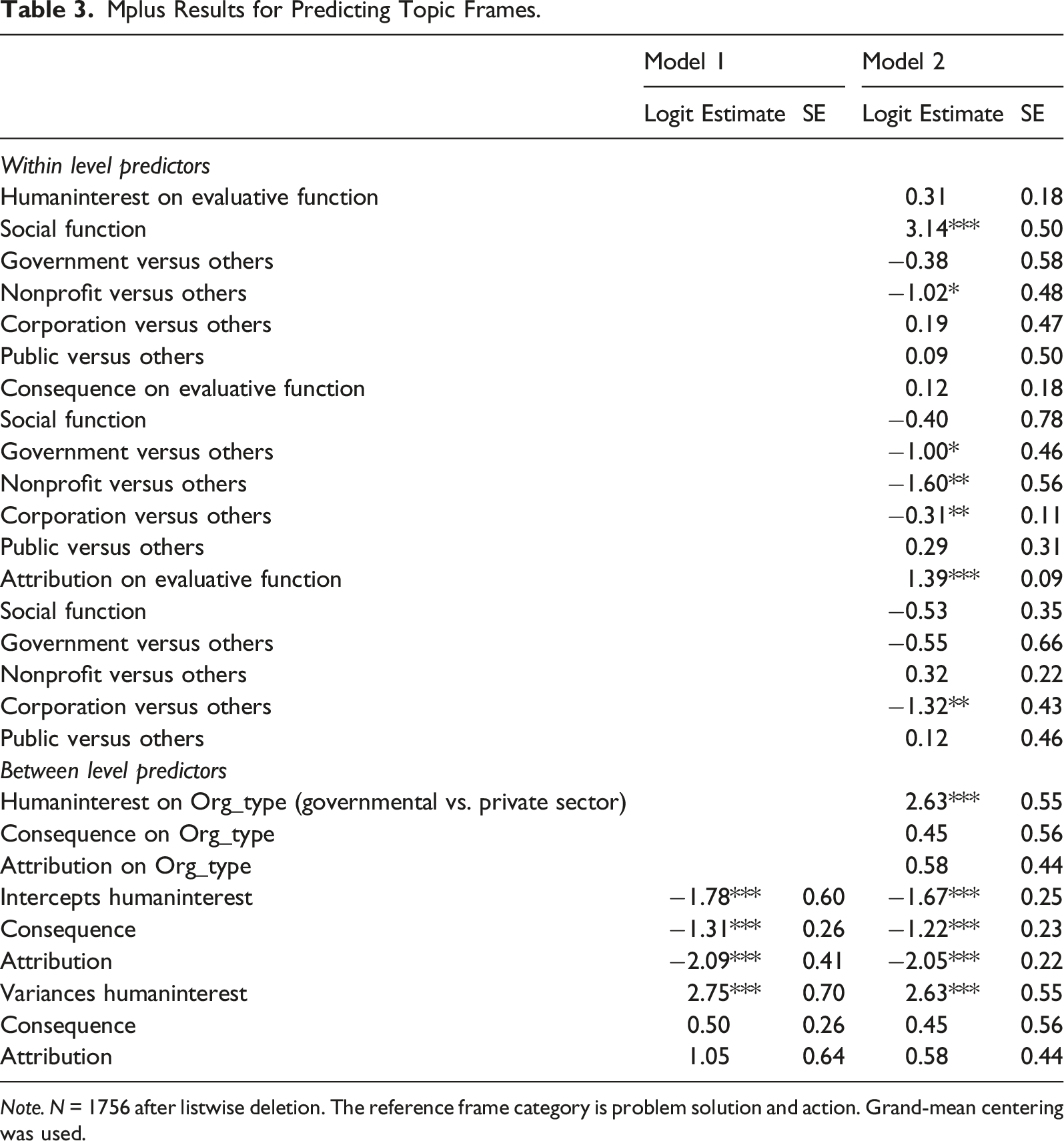
Note. N = 1756 after listwise deletion. The reference frame category is problem solution and action. Grand-mean centering was used.
In terms of communicative functions, the social function predicted the human-interest frame, logit coefficient = 3.14, SE = 0.50, p < .001 and the evaluative function predicted the attribution of responsibility frame, logit coefficient = 1.39, SE = 0.09, p < .001 (Table 3). In terms of odds ratios, if a tweet had a social function, the odds that the tweet adopted the human-interest frame would increase by 23 times; and if a tweet had an evaluative function, the odds that the tweet adopted the attribution of responsibility frame would increase by 4.03 times. H4 was partially supported.
Regarding types of influentials (RQ2), nonprofit organizations were less likely to use the problem solution and action frame (the reference frame) than the human-interest frame, as compared with other types of influentials, logit coefficient = −1.02, SE = 0.48, p < .05. For-profit organizations were also less likely to use the problem solution and action frame rather than the attribution of responsibility frame, as compared with other types of influentials, logit coefficient = −1.32, SE = 0.43, p < .01. All kinds of organizations, including government, nonprofit organizations, and for-profit organizations, were more likely to use the problem solution and action frame, as compared to the consequence frame (see Table 3). Ordinary individuals did not show any preferences for topic frames.
Discussion
This study investigated how social media influentials used responsibility and topic frames in different clusters of crises. The results from MLM showed that both crisis-level and message-level factors affected social media influentials’ frame building in crises. First, crisis origin affected influentials’ usage of responsibility frames, and organization type affected the usage of topic frames. Second, evaluative and social functions of social media influentials’ crisis communication predicted their frame building. Last, certain influentials demonstrated distinct preferences for particular frames regardless of crisis clusters. These results are discussed in detail as follows.
First, crisis-level factors, including crisis origin and organization type, affected social media influentials’ frame usage during crises. Social media influentials were more likely to use thematic (vs. episodic) frames in the crises due to an internal (vs. non-internal) origin. That is to say, during crises caused by organizations’ internal issues, social media influentials created information emphasizing responsibility attribution to the involved organizations rather than individuals to engage their followers. For example, Washington Post focused on Wells Fargo’s responsibility by posting a tweet “What Wells Fargo dodged by agreeing to pay $110 million to settle fake accounts case.” FlintRising, an activist group in Flint Michigan, connected the local water contamination issue with environmental justice and advocated for equal treatment for Flint citizens in a series of tweets. These results contribute to the literature on crisis communication and disaster informatics by revealing the crucial role of crisis-level factors in affecting frame building among social media influentials. Results from this study also supplement the literature by elucidating how heterogeneous social media influentials, including different kinds of organizations and individuals, select frames based on crisis origin (Muralidharan et al., 2011; van der Meer et al., 2014).
In terms of organization type, social media influentials were also more likely to use human interest as compared with problem solution and action in the crises involving governmental (vs. private sector) organizations. Social media influentials likely used the human-interest frame to emphasize the experience of survivors and to advocate donation and support for the survivors. This can be particularly relevant for the crises involving governmental organizations, such as the Flint water crisis or Hurricane Irma in this study. However, social media influentials’ usage of additional frames, including consequence, attribution of responsibility, and problem solution and action, did not differ by crisis clusters. And the problem solution and action frame was frequently used by social media influentials across crises. These findings, together, reveal the importance of considering higher-level contextual factors on social media influentials’ frame building. As such, researchers should consider both contextual factors and internal source characteristics in examining social media influentials’ crisis communication (Jin et al., 2014; van der Meer, 2018).
Next, social media influentials primarily engaged in the informational functions of social media communication, but they also adopted the evaluative and social functions to meet their followers’ needs in different clusters of crises. Social media influentials’ communication functions also predicted their crisis frame usage. The results showed that social media influentials motivated by the evaluative function used thematic (vs. episodic) frame and the attribution of responsibility (vs. problem solution and action) frame during crises. Social media influentials probably engaged their followers by providing opinions emphasizing the responsibility of organizations and the society, supporting the opinion leadership and SMCC literature (Liu and Jin, 2010; Weeks et al., 2017). Social media influentials motivated by the social function adopted the episodic frame and the human-interest frame. They probably chose the two frames to highlight the humane aspects in crises, such as a survivor’s story, the solidarity of residents in a community, or crisis relief efforts (e.g., Muslims donate 30,000 bottles of water to Flint Michigan). Together, these results elucidate the SMCC model in terms of the relationship between social media communicative functions and framing (Zhao et al., 2019).
Last, social media influentials that were nonprofit organizations and individuals were more likely to use thematic frames for attributing responsibility to the society or involved organizations. The organizational influentials, including government, nonprofit organizations, and for-profit organizations, were more likely to use the problem solution and action frame and less likely to use the consequence frame. Individual influentials did not demonstrate a specific preference for topic frames. It seems that crisis framing strategies enable organizational (vs. individual) influentials to strategically highlight their crisis response and to better meet the stakeholders’ expectations. For example, in the crises caused by the misdeeds of governmental agencies (e.g., Flint water crisis), nonprofit organizations gained influence by using the thematic frame to attribute responsibility and the problem solution and action frame to inform the public of their efforts. These results extend the mass communication literature focusing on responsibility frames preferred by news organizations (An & Gower, 2009; Zhang et al., 2015) and reveal the generic patterns regarding how alternative social media influentials use responsibility and topic frames across crises.
Theoretical Implications
By going beyond a single case (Cheng & Cameron, 2018) and using data from multiple crises, this study provides relatively generalizable findings on how different social media influential build frames across crises. Based on a multilevel perspective on social media and crisis communication, the results support the important roles of higher-level contextual factors in influential frame building on social media. Results from this study offer a more systematic and ecologically valid understanding of social media influence conditioned by crisis-level and message-level factors, thereby advancing the literature on social media, crisis communication, and disaster informatics. Future studies should consider additional factors at different levels and study cross-level interactions. For example, researchers can examine crises differing in terms of risk implications or threat immediacy and test how these contextual factors interact with additional message characteristics to affect influential frame building on social media. Findings from this study were based on social media data and thus might fall short of internal validity. Future research can use experiments to ascertain how people respond to social media influentials’ responsibility and topic frames in different clusters of crises.
Moreover, this study goes beyond source characteristics subjectively perceived by audiences (Vrontis et al., 2021) and how these source characteristic render influence (Latané, 1981). Applying the framing approach (Borah, 2011; Entman, 1993), this study tested how objective content characteristics like responsibility and topic frames can be used by social media content creators to gain influence on social media. Social media data from multiple crises allow the author to examine the heterogeneity of social media influentials, including news media, government, companies, nonprofit organizations, individuals, and its impacts on frame buildings. Thus, the results provide more generalizable insights on how organizations and individuals can create and deliver more impactful messages on social media.
Interestingly, social media influentials in this study seldom used the frames of consequence and conflict, both of which were important topic frames for new organizations in the offline context (Semetko & Valkenburg, 2000). Future studies should investigate new forms of frames (e.g., audiovisual frames) on emerging social media platforms such as TikTok. Researchers can also examine the relationship between information veracity and frames, as certain frames might be preferred by malicious actors to disseminate misinformation.
Practical Implications
Social media have become crucial platforms for organizations and individuals to create content and disseminate information during crises. Understanding the patterns of social media influentials’ frame building is of tremendous importance because their frames profoundly shape users’ issue perceptions, attitudes, and support/boycott intentions toward an organization responsible for a crisis (Utz et al., 2013). Findings from this study can help organizations and individuals gain influence on social media by communicating the frames most relevant to social media users. For example, during disasters, the organization responsible for the issue can use episodic or human-interest frames on social media to communicate their social support to those affected for higher message reach and source influence. The continuity of communication output can be more important than the total output amount. By continuously communicating organizational actions and responses using episodic and human-interest frames, organizations can build a strong social presence and gain high influence in crises. In these crises due to an internal origin such as Wells Fargo fraudulent accounts, it is more likely for people to engage in causal attribution related to the involved organization. As such, social media influentials can use the topic frame and the attribution of responsibility frame to provide their followers with opinions.
Furthermore, results from this study help organizations determine opinion endorsement and strengthen persuasive effects by forming collaborations with appropriate social media influentials during crises. Based on crisis clusters, different social media influentials can share similar frames and thus have similar issue interpretations. Organizations can collaborate with influential sources sharing certain frames to amplify their framing effectiveness, as previous research suggests that people rely on multiple sources and channels in a crisis (e.g., a hurricane) to determine preventive actions, particularly when they perceive the crisis to be severe (Liu et al., 2015). For example, a company responsible for a crisis can adopt the problem solution and action frame to increase message reach and follower engagement. Meanwhile, the company can amplify frame influence by forming a partnership with nonprofit organizations that endorse its crisis-related actions.
Limitation and Future Directions
This study has several limitations. First, only the social media platform of Twitter was examined. Different social media platforms have distinct affordances that may affect users’ capacities to frame a certain crisis. For example, fewer characteristics are allowed to be shared on Twitter than on Facebook, so influentials may be more likely to use episodic frames on Twitter than on Facebook. Influentials might predominantly engage in visual framing on platforms such as TikTok. Future studies should look at both textual and visual frame building on different social media platforms. Second, only four crisis clusters were examined. Considering emerging types of crises such as a pandemic, there can be additional crisis-level factors impacting frame building, such as the magnitude of a crisis. Future studies can examine additional clusters of crises to deepen our understanding of social media crisis communication from a multilevel perspective. Last, content analysis in this study cannot reveal how a specific frame used by a social media influential affects the followers’ interpretations of a crisis. Future studies should combine content analysis with experiments to examine how social media influentials’ frame building impacts audience frames in crises.
Despite these limitations, this study offers an ecologically valid and systematic understanding regarding how multilevel factors condition social media influentials’ frame building in crises, thereby unveiling new opportunities of theory building in social media crisis communication.
Footnotes
Declaration of Conflicting Interests
The author(s) declared no potential conflicts of interest with respect to the research, authorship, and/or publication of this article.
Funding
The author(s) received no financial support for the research, authorship, and/or publication of this article.
Author Note
The data collection was conducted at the Hong Kong Baptist University.