



Abstract
Emerging research in computational social science has applied LLMs to automate content analysis, often by prompting a single model to act as a human coder. While a single LLM may suffice for a few manifest variables, it still falls short on diverse latent constructs. And the impact of LLM agent attributes on measurement outcomes remains unclear, limiting their validity for communication research. Drawing upon the literature on interacting agents and communication, this study examines the impact of agent diversity, agent open-mindedness, and human–AI collaboration (HAIC) in a multi-LLM-agent system for automated content analysis. The results demonstrate reliable and accurate measurement of four communication variables across three datasets, with improved performance following agent discussion. Additionally, agent open-mindedness, but not agent diversity, significantly affects measurement outcomes. These results highlight the potential of multi-LLM-agent systems for automated content analysis and suggest the importance of considering agent attributes and values in system design.
Introduction
Amid rapid advancements in information technology, artificial intelligence, and the proliferation of digital data, social and communication scientists are increasingly leveraging computational methods to automate traditional manual methodologies (Jansen et al., 2023; Van Atteveldt & Peng, 2018). In particular, an emerging stream of research focuses on leveraging large language models (LLMs) to automate content analysis and textual analysis (Zhao, Ma, & Ma, 2026; Chew et al., 2023; Törnberg, 2023; Ziems et al., 2024). Using the transformer’s attention mechanism and extensive training data, LLMs provide contextually rich, precise responses that enhance the accuracy of content analysis across contexts. For example, Ziems et al. (2024) showed that through prompt engineering, LLMs can reliably measure different variables such as political ideology and persuasiveness.
However, several challenges remain. First, most automated content analysis methods are variable-based (e.g., sentiment analysis) and lack the versatility to measure the wide range of constructs required for communication research. While a single LLM may be adequate for automating the measurement of manifest variables such as topic and sentiment, their accuracy still falls short of human expert coders when assessing latent, complex concepts such as emotional support or narrative perspective (Zhao, Ma, & Ma, 2026). Second, existing LLM-based automated content analysis often overlooks how agent attributes and values—some of which are inherently embedded in LLMs through their extensive training data—may introduce bias into the analysis. As a result, the impact of LLM agent attributes and their interactions on measurement outcomes remains underexamined. Last, LLMs, due to inherent randomness in their outputs, often lead to varied responses that limit reproducibility and reliability, warranting further study to enhance the replicability and robustness of LLM-based content analysis.
To provide a versatile, valid, and reliable tool for automated content analysis, this study examines the impact of agent attributes and human–AI collaboration, building upon a multi-LLM-agent system (Zhao et al., 2025). Note that “multi-LLM-agent” here refers to multiple instances of the same base model differentiated through prompt-based personas. Thus, observed attribute effects reflect prompt-induced rather than architectural heterogeneity. Specifically, this study contributes to the literature on computational social science (Hilbert et al., 2019; Van Atteveldt & Peng, 2018), content analysis (Krippendorff, 2019; Neuendorf, 2017), LLMs (Brown et al., 2020; Duan et al., 2024), and interacting agents (Waldherr et al., 2021; Wooldridge, 2009) in several important ways. First, it systematically evaluates a multi-LLM-agent system for valid and reliable measurement of diverse communication variables across datasets, using multiple replications to account for LLM randomness. Second, it examines how prompted modifications to LLM agent attributes, such as diversity and open-mindedness, influence their discussions and measurement outcomes. This not only contributes to LLMs and interacting agent research but also provides insights into optimizing LLM agent configurations for improved measurement quality. Third, this study examines how different modes of human–AI collaboration (HAIC)—persuasion vs. supervision—influence outcomes given different agent attributes. This unique focus on HAIC and its relational dynamics extends beyond the traditional human-in-the-loop approach (Mosqueira-Rey et al., 2023), which limits humans to intermittent oversight rather than fostering an ongoing, interactive conversation. By incorporating different forms of interaction between AI agents and human experts, our approach explores HAIC as a means to further improve measurement performance and potentially alleviate LLM bias.
Our experiments, conducted using three datasets and four measurement tasks with GPT-4o-mini with multiple repetitions 1 , support the effectiveness of multiple LLM agents to measure diverse communication concepts with strong reliability and accuracy, with agent discussion, attributes, and human–AI collaboration affecting measurement outcomes. The following section discusses the literature on automated content analysis, LLMs, multiagent framework, and agent-based modeling, which lay the foundation for our work.
Literature Review
Content Analysis Within the Landscape of Computational Social Science
Content analysis is the objective and systematic quantification of communication symbols following predefined coding guidelines and the analysis of the relationships between these quantified values using statistical methods (Holsti, 1969; Krippendorff, 2019; Neuendorf, 2017). Content can be presented in multiple formats, such as text, images, and videos (Riffe et al., 2023). This study focuses on textual content. Quantitative content analysis can measure manifest content (Berelson, 2000), capturing straightforward, widely recognized meanings, such as the frequency of specific keywords or mentions of topics. It can also analyze latent content, capturing connotative, “between-the-lines” meanings such as discrete emotions (Bantum & Owen, 2009), frames (Matthes & Kohring, 2008), morality (Weber et al., 2021), and sexualization (Lynch et al., 2016).
Social scientists rely on reliability and validity to ensure the quality of content analysis. Reliability refers to the consistency of observations using the same measurement instrument across different times, places, and coders, often evaluated through metrics that account for agreement among multiple human coders during training. Such metrics typically adjust for the likelihood of random agreement, ensuring that reliability reflects true coder consistency rather than chance (Krippendorff, 2019). Validity concerns whether a variable, defined by relevant theories, can be reasonably operationalized and measured in content analysis. This suggests that while the measurement often does not fully represent communication reality, it seeks to reduce ambiguity in the representation (Riffe et al., 2023). Central to achieving reliability and validity is the manual coding process (for details, see Appendix A.1), a resource-intensive step that plays a crucial role in content analysis (Krippendorff, 2019; Neuendorf, 2017; Riffe et al., 2023).
While traditional, manual content analysis is well-established and valued for its objectivity and rigor, its scalability and generalizability can be constrained by labor-intensive, time-consuming procedures (Van Atteveldt & Peng, 2018), as well as reliance on the subjective perspectives of a small group of specialized scholars (Wu et al., 2021). For instance, Tankard (2001) lamented the early “lone-scholar” approach, which made framing identification “a rather subjective process.” (p. 98) To overcome these challenges, computational methods such as crowdcoding (Guo et al., 2020; Van Atteveldt et al., 2021), lexicons (Boyd et al., 2022; Hutto & Gilbert, 2014), machine learning (Van Atteveldt et al., 2021; Zhao & Wong, 2024), and large language models (LLMs) (Zhao, Ma, & Ma, 2026; Ziems et al., 2024) have been applied to automate content analysis. Specifically, Ziems et al. (2024) demonstrated that LLMs can perform zero-shot (i.e., without data training) text classification through prompt engineering and reliably measure variables like political ideology and persuasiveness, functioning as data annotators similar to human coders. However, in these studies, LLMs only act as a single coder and their potential mistakes and biases can only be partially mitigated through human-crafted prompts. This study tests different agent attributes and their interactions with human–AI collaboration modes in affecting measurement outcomes. Below we explain how and why LLMs can be used to automate content analysis in detail.
How and Why Can LLMs Be Used to Automate Content Analysis?
An LLM works by iteratively generating the most probable next word based on the previous words that were provided as input. It works similarly to a sentence or paragraph completion engine. For example, when a string of “
An LLM can not only answer questions based on instructions but also take into account context such as a given persona when answering. The contextual information can be concatenated before or after the intended question, forming an augmented input for the LLM’s consumption. The LLM will iteratively conduct the next word prediction based on the intended questions taking into account the input persona. For example, when automating an LLM as a human-like agent to conduct sentiment analysis, one can augment the prompt with persona descriptions for LLM to role-play (Gao, 2023; Zhao et al., 2025), for example, “
LLMs perform extremely well due to the attention mechanism in the transformer architecture, a large number of trainable parameters, and the vast amount of training data (Brown et al., 2020). First, the self-attention mechanism repeatedly refines the numerical representation of each input word to improve its contextualization based on other input words. Within a computer, a word is represented by a vector of numbers. Traditional tokenization algorithms such as Word2Vec or WordPiece have a unique vector representation for every word, leading to ambiguities when the word is used in different contexts. Transformers, instead, can adaptively update their vector representation by also including a weighted sum of the vector representations of all other words appearing at the input. Second, GPTs 3 and 4, the major commercial successes of transformers, were built on scaling up their prior generation with 10
What happens inside an LLM? At a basic level, an LLM is a function approximator that “learns” by adjusting its parameters to predict the likelihood of any word sequence it has encountered during training. When a training sentence is presented to the LLM, its learning engine will update the LLM’s parameters so that the approximated likelihood evaluator will deem the training sentence highly probable. Once the learning engine finishes passing all training examples to LLM for parameter update, LLM as a likelihood evaluator should be well trained to know what sentences are likely (e.g., a sentence from a newspaper) and unlikely (e.g., a random string of words), and can subsequently conduct high-quality iterative sentence/paragraph completion tasks.
Interacting Agents and Multiagent Framework
In computational social science, the multiagent framework and agent-based modeling are two pivotal approaches involving interacting agents, each with distinct emphases and applications. Multiagent research focuses on the design and coordination of a few sophisticated agents with advanced decision-making capabilities, often applied to solve practical problems in fields such as artificial intelligence and distributed systems (Wooldridge, 2009). This approach emphasizes the strategic interaction and cooperation among a small group of agents, each capable of complex behaviors that impact outcomes in various scenarios. Past studies have examined interaction modes including debate (Du et al., 2023; Liang et al., 2023) and consultancy (Kenton et al., 2024). In contrast, agent-based modeling (ABM) employs numerous, simpler agents to simulate emergent phenomena, modeling interactions among entities to reveal system-wide patterns (Gürcan, 2024). This method is particularly effective for understanding complex social dynamics and providing insights into the collective behaviors of the crowd (Gilbert, 2019; Waldherr et al., 2021). Recent works have utilized ABM for sustainability behavior study (Piatti et al., 2024), human society simulation (Park et al., 2023), and academic research collaboration analyses (Hutson & Ratican, 2023).
While our theoretical framework benefits from both lines of scholarship, our focus is the LLM-powered multiagent framework and its application to automated content analysis, where each agent’s nuanced capabilities and attributes significantly impact the outcomes of interactions. Computer science research within this framework has examined how agents’ memory capacity, decision-making strategies, and learning mechanisms, impact collective outcomes (Chen et al., 2018; Dehkordi et al., 2023). Their findings reveal that agent capacities and attributes can impact each agent’s effectiveness in a given context, influencing the overall system’s performance in tasks ranging from simple information retrieval to complex problem-solving. However, the multiagent framework is underexamined in communication and social science, limiting their ability to harness AI interactions and sophisticated decision-making.
Key Agent Attributes in Multi-LLM-Agent Discussion in Content Analysis
Research on interacting agents within complex social systems suggests that designing heterogeneous agents to interact in a simulated environment following simple rules can help assess how these interactions generate patterns observed at the group level (Waldherr et al., 2021). For instance, past research has systematically modified agent attributes to analyze collective outcomes and assess the sensitivity and robustness of observed behaviors in group discussion (Shugars, 2021), opinion dynamics (Sohn & Geidner, 2016), and team efficiency (Lazer & Friedman, 2007). On the other hand, the content analysis literature discusses the role of coder attributes in shaping coding outcomes, but primarily from a standardization standpoint to minimize bias and enhance intercoder reliability. While coder diversity can bring unique perspectives to data interpretation (Church et al., 2019), the focus remains on standardized training to align understanding and ensure uniform application of coding rules (Krippendorff, 2019; Neuendorf, 2017; Riffe et al., 2023). Together, these studies suggest the importance of balancing agent/coder heterogeneity and maintaining consistency when applying the multiagent framework to content analysis. Therefore, we focus on two specific agent attributes, diversity and open-mindedness, and discuss their impacts in multi-LLM-agent content analysis in the following sections.
Diversity of LLM Agents
The social science literature on team/dyadic diversity (e.g., cognitive or skill diversity) emphasizes how the presence of diverse viewpoints contributes to decision-making and task performance. Individuals with different backgrounds, expertise, or experiences often approach tasks with unique cognitive frameworks and informational resources, which can help to identify new opportunities and potential challenges that more homogenous teams may overlook. With a variety of perspectives, diverse team members could make more innovative and high-quality decisions, and more comprehensive approaches to problem-solving (Van Knippenberg et al., 2020).
For example, more diverse backgrounds can contribute to a richer exchange of perspectives, fostering creative solutions through the integration of multiple viewpoints. Research has shown that teams with greater demographic diversity tend to exhibit higher levels of team performance, as members can draw upon a broader range of cultural insights and experiences to generate novel ideas and solutions (Tshetshema & Chan, 2020). Additionally, the range of abilities and expertise present in a team can improve task performance by allowing individuals to draw on complementary strengths and tackle complex problems more effectively (Bell et al., 2011). Thus, cognitive diversity can lead to difference in thinking styles or problem-solving approaches, which contribute to team performance because it encourages critical discussion and reduces the risk of groupthink. Teams that engage in constructive debate and challenge assumptions often achieve more rigorous outcomes (Patrício & Franco, 2022).
Open-Mindedness of LLM Agents
The social science literature considers open-mindedness fundamental in democratic deliberation, defining it as a willingness to consider others’ opinions by relaxing one’s attachment to personal views (Barabas, 2004) and carefully evaluating opposing perspectives and arguments (Gastil, 2000). Shugars (2021)’s agent-based modeling study examined open- vs. close-mindedness as agents’ willingness to accept others’ views. Her findings indicate that open-minded and skeptical agents performed similarly, suggesting this willingness has limited impact on deliberative outcomes. Meanwhile, the interacting agents literature suggests that adaptability in automated agents allows them to adjust beliefs, attitudes, and decisions based on user interactions and environmental changes (Hilbert et al., 2019; Waldherr et al., 2021). This is substantiated by the interaction adaptation theory (Burgoon et al., 1995), which posits that agents not only process information individually but also adaptively respond to the dynamics of other agents’ behaviors.
Emerging literature shows that different LLMs display varying levels of open-mindedness (Brown et al., 2020; Duan et al., 2024; Wei et al., 2022). LLMs trained on a broad and diverse dataset could allow the model to adapt effectively to prompts and user needs due to its exposure to a wide range of ideas, topics, and contexts (Brown et al., 2020). By responding to diverse prompt structures, LLMs can also modify their output to suit specific task requirements (Wei et al., 2022). Duan et al. (2024) serendipitously observed that LLMs like Llama-2-70b-chat demonstrated high adaptability as they more readily gave up and accepted unfair decisions, while GPT-4 and Mistral were more “stubborn,” struggling to reach agreements and negotiating for fairer outcomes. Therefore, this study manipulates LLM agent adaptability through prompting and examines its impacts on LLM-agent-powered content analysis outcomes.
Human–AI Collaboration: Persuasion vs. Supervision
Human–AI collaboration (HAIC) is crucial in automated systems (Renner, 2020; Shoshitaishvili et al., 2017), as effective collaboration can balance the strengths of machine and human agency (Sundar, 2020). Namely, as machines become more agentic, they take on roles traditionally occupied by humans, such as analytics and decision-making. However, human intervention offers a way to balance machine agency with human oversight and refine system outputs to ensure alignment with human insights and reduce potential algorithmic biases (Jolfaei et al., 2022; Xu et al., 2023). Recent work on human–AI teaming suggests that effective collaboration depends not only on whether humans intervene, but also on how the collaborative relationship is structured (Vaccaro et al., 2024). In particular, shared mental models can help humans and AI systems coordinate more effectively by making reasoning processes and expectations more mutually intelligible (Kaur et al., 2019). In a systematic review and meta-analysis, Vaccaro et al. (2024) found that human–AI combinations are not inherently superior, highlighting the importance of theorizing when and how collaboration improves performance. This aligns with emerging discussions of hybrid or “centaur” human–AI systems, which stress the importance of structuring and integrating human and AI roles within collaborative workflows (Borghoff et al., 2025; Saghafian & Idan, 2024).
This study examines the impact of relational dynamics given different agent configurations. Grounded in social influence theories (Cialdini & Cialdini, 2007; French, 1959), there are two types of relational dynamics: in the “persuader” mode, LLM agents treat human experts as collaborative peers and can accept or reject their suggestions; in the “supervisor” mode, human experts act as absolute authorities, and LLM agents must follow their instructions. Persuader mode may encourage stronger alignment with the human expert’s reasoning, because agents must engage with and evaluate the expert’s input rather than merely comply with it. In this sense, persuasion may better support the development of a shared mental model between human and AI collaborators (Kaur et al., 2019). By contrast, supervisor mode may offer a more efficient coordination structure by reducing interactional overhead and enabling direct execution of expert guidance. These relational dynamics may interact with agent attributes to affect coding outcomes. For instance, when a human expert acts as a persuader, agent attributes likely play a role, as agents can actively engage with, resist, or accept the human’s input depending on their open-mindedness or specific demographic/exercise characteristics. As such, this study investigates how different human–AI relational dynamics (supervisor vs. persuader) interact with various configurations of LLM agents. To achieve this, we implement human intervention to facilitate more dynamic exchanges between human and LLM agents.
Summary of Research Questions
Based on the literature review, our first research question asks the extent to which it can automate reliable and valid measures across communication areas. Based on the literature on interacting agents and content analysis, the next question asks about the role of agent discussion in affecting measurement outcomes.
In addition, this study investigates the impacts of systematic modifications to agent attributes and HAIC modes. The literature on team diversity suggests that compared to homogeneous groups, heterogeneous groups can propose more creative, high-quality solutions through integrating multiple perspectives. However, in content analysis, a certain degree of shared coder background and understanding might be essential for the standardized application of coding rules for intercoder reliability. Thus, LLM agent diversity might affect agent discussion and measurement outcomes. Additionally, the literature on the role of open-mindedness in collective discussion and agent simulations suggests that each agent’s open-mindedness could affect discussion outcomes. During content analysis discussions, a certain degree of coder open-mindedness is essential. Coders should be flexible in responding to feedback, which helps align interpretations, reduce personal biases, and enhance intercoder reliability. However, when coders are overly adaptable, they may quickly reach a consensus without deliberation, which can lead to oversimplification and reduce the complexity and richness captured in the analysis. Thus, the following two research questions are proposed to examine the impacts of agent diversity and open-mindedness:
Last, recognizing the significance of HAIC, we distinguish between two modes of human intervention in multi-LLM-agent coding. In supervision mode, the expert operates in a post-hoc verification role, providing guidance that agents are expected to follow. In persuasion mode, the expert operates in an interactive calibration role, offering reasoning that agents can evaluate during deliberation. This distinction is important for content analysis because disagreement resolution often depends not only on correcting outputs, but also on aligning coders’ reasoning through explanation, argumentation, and negotiated interpretation. We therefore ask:
Methods
A Multi-LLM-Agent System for Content Analysis
Content analysis traditionally relies on coder training to ensure validity and reliability (see Appendix A.1 for details). Figure 1 illustrates the design of a multi-LLM-agent system that simulates several key phases of coder training (Zhao et al., 2025), which serves as the basis for this study. First, LLM agents are simulated to resemble human coders, with distinct personas crafted through prompts. Following the guidelines provided in an initial codebook, two agents are independently prompted to code each text in a given sample, mirroring traditional independent coding. All agents are reminded in their prompts to strictly follow the codebook without relying on any external knowledge. Second, in each round of agent training, when the agents disagree on their coding results, they are prompted to engage in discussions to exchange rationales and resolve discrepancies. Workflow of multi-LLM-agent discussion andcodebook update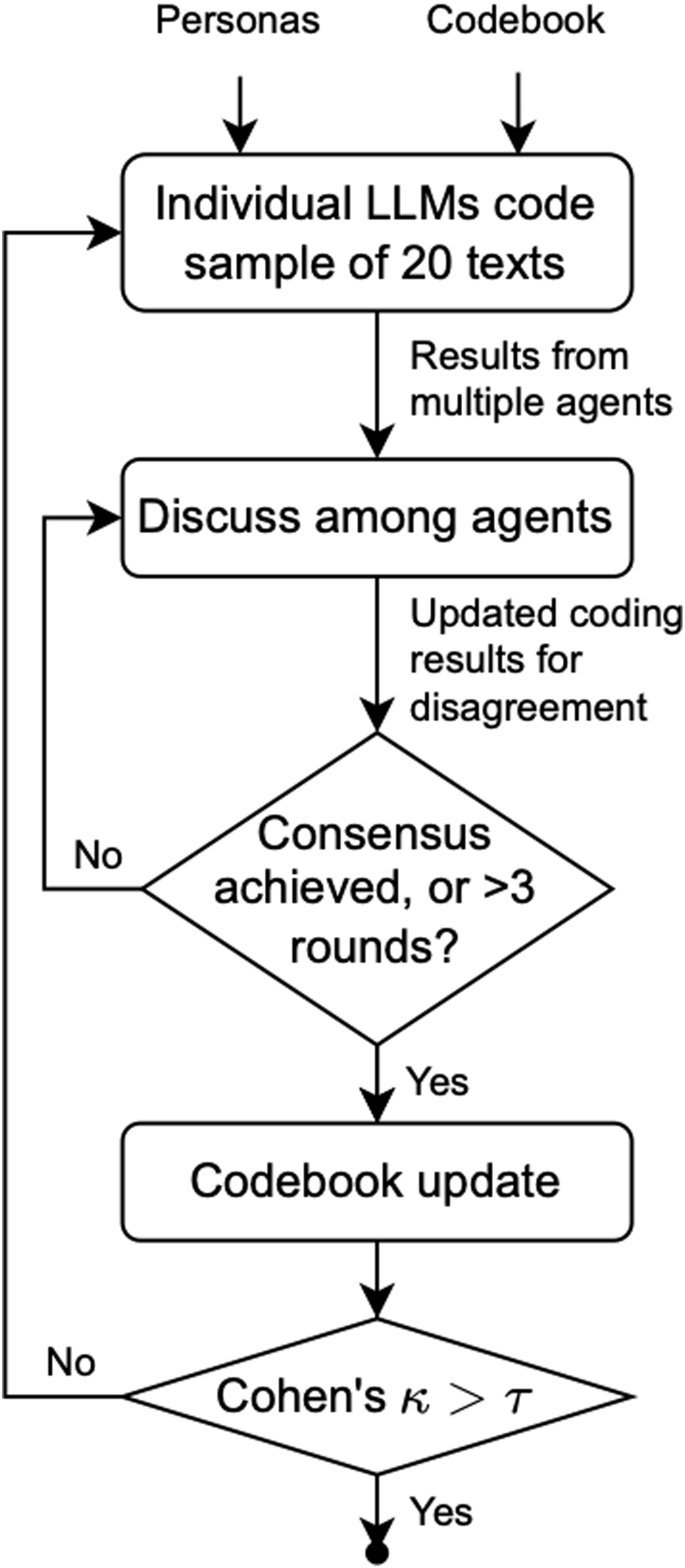
Note that they might accept or reject each other’s response. These discussions continue until a consensus or three discussion rounds are completed. Agent training includes multiple training rounds, each with several discussion rounds to address discrepancies, and continues until a threshold of intercoder reliability is achieved, similar to the process of manual content analysis. At the end of each training round, agents are prompted to update the codebook based on discussions. This serves to increase clarity and reduce ambiguities in the guidelines for greater application consistency. This updated codebook then serves as the guideline for the next training round, ensuring continuous improvement. After achieving reliability, the system analyzes millions of texts.
Datasets and Variables
We conducted experiments using three datasets across four different tasks, each focused on identifying distinct constructs using different textual data. These measurement tasks include two multiclass classification tasks, where a text only belongs to one of several predefined categories, and two multilabel classification tasks, where a text may belong to multiple categories simultaneously. For all datasets, the ground-truth labels were established through manual content analysis following best practices (Krippendorff, 2019; Riffe et al., 2023). Multiple trained experts independently coded the texts; depending on the dataset, the final ground truth was based either on consistently coded cases or on consensus reached through disagreement resolution.
Product Incidents Sentiment (PIS)
This dataset from Zhao and Wong (2024) consists of 200 Twitter/X user comments from various product recalls and corporate incidents from 2014 to 2017, such as the Target Data Breach, Samsung Note 7 Explosion, and Volkswagen Emission Scandal. The task is to detect the primary user sentiment—positive, neutral, or negative—toward the company and its product or service during these incidents. The data were labeled by three human experts with a Krippendorff’s alpha of 0.75, and the ground truth was based on the 200 tweets labeled consistently by all three experts.
Cancer Narratives (CN)
This dataset is based on Ma et al. (2023) and includes 60 Facebook posts from five major breast cancer non-profit organizations worldwide from 2016 to 2021. The first task involves identifying one or more cancer narrative events (CN-E): prevention, detection, treatment, or survivorship. The second task focuses on determining the narrator’s perspective (CN-P), which could be a cancer survivor, family or friends, the organization, journalist, or mixed. Ground-truth labels were established through iterative expert manual coding and consensus-based disagreement resolution. Three human experts achieved Krippendorff’s alphas ranging from .77 to 1.00.
Team Communication Tactics (TCT)
This dataset uses team discussion transcripts from Zhan and Hample (2023), with ground-truth annotations newly developed by the research team for this study. It contains 55 transcripts from 2017 of four-person role-play teams engaging in organizational decision-making discussions. The task involves identifying one or more team communication tactics, including task coordination, opinion solicitation, information sharing, problem evaluation, and opinion statement. The overall agreement rate was above 0.90, and two human experts resolved all disagreements through discussion.
System and LLM Agents Setup
We used GPT-4o-mini via application programming interface (API) calling to simulate coders through predefined personas in Appendix A.4. The GPT-4 family is one of the most powerful LLM models (as of the 4th quarter of 2024 when the experiments were conducted), which supports sophisticated natural language processing and human-like interactions. When combined with tailored prompts, GPT-4 allows for reasoning and dynamic adaptability—key aspects for replicating the intricacies of human discussions and achieving consensus (Hackl et al., 2023; Nori et al., 2023). Our pilot studies confirmed its capability through prompting to adapt coder attributes, decision-making styles, and demographic traits, aligning with the diversity found in real-world human coders. We chose to use GPT-4o-mini over GPT-4o due to the significantly lower cost of the former, which made it possible to process the large volume of text and run a hundred model repetitions required for this study, despite a minor reduction in performance as reported in Zhao et al. (2025). The system design has each agent independently coding 20 textual entries per training round across 3–5 rounds, with up to 3 discussion sessions per round. However, given the current focus on measurement outcomes, we limit codebook updates to non-categorical changes, such as adding examples or explanations for existing categories. More implementation details can be found in Appendix A.2.
Experimental Design
Experiment 1—Agent Diversity
Drawing from social science methodology and linguistic psychology literature (Babbie, 2020; Denzin & Lincoln, 2011; Hyland, 2005), we developed two distinct personas to manipulate cognitive diversity between agents. One persona reflected structured, rule-based thinking, characterized by explicit signposting of analytical steps, adherence to codebooks or checklists, and language emphasizing objectivity, replication, and precision. The other reflected contextual and interpretive thinking, emphasizing nuance, perspective, and lived experience, with a focus on meaning-making and empathetic interpretation rather than strict rule compliance. Based on these personas, two experimental conditions were established: high vs. low agent diversity. Details of these personas and their pairings are provided in Appendix A.4.
Experiment 2—Agent Open-Mindedness
Experiment 2 implemented open-mindedness as a separate prompt-based manipulation, independent of the diversity personas used in Experiment 1. Drawing on the literature (Barabas, 2004; Shugars, 2021), we developed two prompts of similar length and format to represent high versus low agent open-mindedness. An agent with high open-mindedness was prompted with the following: “
Experiment 3—HAIC Modes: Persuasion vs. Supervision
Human experts can intervene at two stages of coder training—during agent discussions and when updating the codebook—using two modes of human–AI collaboration (HAIC). Each mode is defined by distinct prompts given to the AI agents. In the persuasion mode, human experts acted as peers, offering advice agents could accept or reject: “
Manipulation Check
Agent Diversity
A panel of three experts in social science and LLMs reviewed the prompts and agreed upon their content validity. For the manipulation check, we analyzed agent logs using both established and custom lexicons. LIWC’s “Cognitive Processes” category showed no significant difference between agents, likely because both agents’ responses reflect the cognitive style typical in content analysis. However, the agents exhibited different reasoning styles, as measured by the structured and contextual wordlists we developed based on the literature. Structured agents used significantly more explicit, rule-based terms (e.g., “consistency,” “precise,” “explicitly,” “objective”) than contextual agents (M = 5.84, M proportion = 2.6% vs. M = 4.02, M proportion = 1.8%;
Agent Open-Mindedness
Agents with open-minded instructions were more willing to update their coding in response to the discussion, supporting the effectiveness of the manipulation at the condition level. These results should be interpreted as an overall behavioral pattern rather than a precise individual-level test, because the manipulation check uses a simple behavioral indicator and LLM outputs contain inherent randomness. In the high–high condition, Agent 1 changed codes an average of 0.45 times per text (SD = 0.83) and Agent 2 changed 0.62 times (SD = 0.99). In the low–low condition, changes were much less frequent (Agent 1: M = 0.03, SD = 0.17; Agent 2: M = 0.36, SD = 0.49). The mixed (high–low) condition was in between (Agent 1: M = 0.30, SD = 0.73; Agent 2: M = 0.28, SD = 0.69).
Evaluation Metrics
Intercoder Reliability
We use disagreement proportion and Cohen’s kappa to quantify intercoder reliability among LLM agents. The disagreement proportion measures the level of inconsistency among agents applying codebook rules to a dataset. It is defined as
Validity
We use classification accuracy as a proxy for validity. It offers an indication of how well the agents are labeling the data with reference to ground-truth labels. These ground-truth labels were established prior to the experiments through expert manual coding, either by retaining consistently coded cases or by resolving disagreements to produce final labels, depending on the dataset. The classification accuracy is defined as
LLM Randomness
To account for the randomness of LLM agent behaviors, we conduct multiple replications of our experiments and report the averages and sample standard deviations for each metric. The averages for the respective metrics better estimate the intercoder reliability and validity, whereas the sample standard deviations reflect the variability among different LLM runs. The latter quantifies intrinsic randomness from LLMs, relative to the variation caused by our modifications to agent attributes. However, in examining different HAIC modes, multiple repetitions were not feasible due to limited human expert resources and the substantial time to apply different HAIC modes to a dataset (approximately 10 hours).
Results
RQ1 examines the extent to which the system could automate valid and reliable measures of various communication concepts, and RQ2 investigates the role of agent discussion in affecting measurement validity and reliability. To answer the questions, the system was run in 5 repetitions for all datasets, measuring the mean intercoder reliability and validity metrics at two stages: the pre-discussion phase (independent coding) and the post-discussion phase (agent discussions on inconsistent coding results). Note that the reported metrics represent averages across multiple rounds of training in a dataset. Overall, the results show an average of 0.23 improvement in Cohen’s kappa and 0.11 in accuracy across datasets. As shown in Figure 2, before agent discussion, Cohen’s kappa ranged from 0.57 to 0.90, and accuracy ranged from 0.43 to 0.80 across datasets. These variations indicate low to medium intercoder reliability and validity, which might be affected by the complexity of each coding task. For example, as it might be relatively challenging to identify all narrative events in a Facebook post, Cohen’s kappa for narrative events between LLM coders was relatively low at 0.59. Agent discussion improved measurement reliability and validity, as post-discussion Cohen’s kappa ranged from 0.87 to 0.97, and accuracy ranged from 0.74 to 0.86 across datasets, demonstrating moderate to high intercoder reliability and validity. For detailed metrics with means and standard deviations, see Appendix A.3. Improved Accuracy (ACC), disagreement percentage (DP), and Cohen’s kappa (CK) after agent discussion across datasets and tasks
Post-Discussion Performance by Agent Open-Mindedness

Note. ACC = accuracy; DP = disagreement proportion; CK = Cohen’s kappa. Values are means (SDs) based on 20 runs per condition. *
Post-Discussion Performance by Agent Diversity

Note. ACC = accuracy; DP = disagreement proportion; CK = Cohen’s kappa. Values are means (SDs) based on 20 runs per condition; all
For robustness check, we conducted two additional tests. First, we repeated the sentiment-dataset analyses using a comparable LLM, Mistral-Small-3, and observed largely similar patterns (for details, see Appendix A.5). Second, we repeated these analyses on the other two datasets, and these results were weaker and less consistent overall, suggesting that the effects may be task-dependent (for details, see Appendix A.6).
Measurement Outcomes With and Without Human–AI Collaboration (HAIC)

Note. ACC = accuracy; DP = disagreement proportion; CK = Cohen’s kappa. CN-E = cancer narrative events; CN-P = cancer narrative perspective; PIS = product incidents sentiment; TCT = team communication tactics. The “W/o HAIC” baseline is taken from the post-discussion performance under default agent personas reported in Table 5.
Human–AI Collaboration (HAIC) Mode, Agent Open-Mindedness, and Outcomes

Note. ACC = accuracy; DP = disagreement proportion; CK = Cohen’s kappa. CN-E = cancer narrative events; CN-P = cancer narrative perspective; PIS = product incidents sentiment; TCT = team communication tactics.
Discussion
Our results confirm the reliability and accuracy of automated measures of various communication concepts through a multi-LLM-agent system, with agent discussion playing a key role in enhancing measurement quality. We also found that LLM agent open-mindedness and different modes of HAIC can further improve measurement outcomes. The results are discussed in detail below.
Multi-LLM Agents as a Promising Framework
Our results confirm that multiple LLM agents can be used to reliably and accurately measure various communication concepts, including sentiment, team communication tactics, and narrative events and perspectives, across different areas of communication. These tasks include categorizing text into multiple types simultaneously (multilabel) or selecting one type from several options (multiclass). Agent discussion was found to enhance both measurement reliability and accuracy, with greater improvements observed for tasks with lower reliability and accuracy prior to discussion. This highlights the potential of using LLMs as multiple collaborative agents for automated measurement. Namely, when one LLM struggles with complex coding tasks, two working together can achieve better results through collaborative deliberation. This discussion process probably helps clarify coding guidelines, align interpretations, and thereby boost measurement quality. For example, in response to the Facebook post, “
Agent Attributes Matter to a Degree
Our findings also speak to the role of agent open-mindedness in multi-LLM-agent content analysis. Extending Shugars’ (2021) work on open-mindedness in rule-based agent deliberation, our results suggest that prompt-induced open-mindedness can affect post-discussion outcomes in an LLM-agent setting. Specifically, in the focal sentiment task, agent open-mindedness primarily affected post-discussion reliability. Compared with the low–low condition, both conditions with at least one open-minded agent showed stronger post-discussion reliability, reflected in lower disagreement proportions and higher Cohen’s kappa. This reliability pattern was also replicated using a comparable LLM. These findings suggest that LLM agent open-mindedness could support coordination during deliberative coding by making agents more willing to reconsider their initial judgments and resolve disagreements after discussion. During our experiments, agents with low open-mindedness were sometimes found to resist revising their coding decisions after hearing the other agent’s reasoning, whereas conditions with at least one open-minded agent were generally better able to resolve disagreements. Meanwhile, accuracy differences were mostly nonsignificant, although the high–low condition showed higher accuracy than the high–high condition in one comparison. This may suggest that open-mindedness is most useful when balanced with some judgment stability. In a few high–high cases, GPT-4o-mini agents appeared to “overshoot,” repeatedly changing their coding decisions across discussion rounds and sometimes moving away from the benchmark labels. Overall, these results show that, in an LLM-agent setting, open-mindedness improves post-discussion reliability, while its effects on validity appear more limited and context-dependent.
We found limited evidence that agent diversity affected measurement outcomes, contrasting with communication literature suggesting that team diversity enhances performance through unique information processing pathways (Van Knippenberg et al., 2020). Although we designed agent personas with opposite cognitive traits, prompt-based agent persona diversity did not significantly affect accuracy across either GPT-4o-mini or Mistral-Small-3. One possible explanation is that the prompt-based diversity manipulation may have been too limited to induce genuinely distinct perspectives that would improve measurement validity. Because the two agents relied on the same underlying model and training data within each model-specific analysis, their responses may still have reflected largely shared representations despite different persona prompts. For instance, even if we prompt an agent to simulate 20 years of experience in health communication with quantitative expertise, it may still lack the field-specific knowledge and experiences of human experts. Alternatively, the benefits of agent diversity may not be reflected in measurement precision, as diversity might be more advantageous for creative tasks. For example, diverse agents were sometimes more proactive and creative in codebook updates, but these behaviors were not quantified as measurement outcomes in this study.
Utility of Human–AI Collaboration
We found that human–AI collaboration (HAIC) enhanced post-discussion measurement reliability and accuracy, with greater benefits observed for datasets with initially lower performance. This finding highlights the value of HAIC in automated systems, where human input can help structure collaboration and improve coordination between humans and AI (Kaur et al., 2019; Vaccaro et al., 2024). The slightly lower improvement in datasets with initially higher performance may be attributed to a ceiling effect, as post-discussion accuracy and reliability were already relatively high, limiting the potential benefits of further human intervention. However, we did not find strong evidence that one HAIC mode consistently outperformed the other across datasets. Although supervision sometimes yielded slightly stronger results, the pattern varied by task, suggesting that the relative utility of persuasion versus supervision may be context-dependent. This extends persuasion and social influence theories (Cialdini & Cialdini, 2007; French, 1959) to a multiagent framework involving both LLM and human agents, not by identifying a single superior mode, but by showing that different relational structures of human input may matter in different ways. For more standardized tasks (e.g., sentiment detection), direct supervision may help by giving agents clearer guidance and reducing ambiguity in how instructions are implemented. By contrast, for more interpretive tasks (e.g., team communication tactics classification), persuasion may sometimes be useful because it encourages agents to engage with the expert’s reasoning and align their representations more closely with the human’s mental model. Further, we observed that when human experts intervene, the influence of agent open-mindedness becomes more limited overall, likely because expert input helps structure and constrain the discussion process. These results suggest that human intervention can partially reduce the importance of agent attributes in determining measurement outcomes. As such, selecting optimal agent personas may be especially important in situations where human expertise is unavailable.
Theoretical and Practical Implications
Our findings contribute to the interdisciplinary literature of automated content analysis, LLMs, and interacting agents by assessing the utility of a multi-LLM-agent system for valid and reliable measurement of diverse communication constructs, and by demonstrating how human–AI collaboration might further enhance measurement for some complex constructs. By examining the effects of various agent attributes through prompting, our study sheds light on how LLM agent design influences measurement outcomes. The influence of LLM agent open-mindedness on reliability suggests that open-minded agents are more adaptable to nuanced interpretations, aligning better with the interpretative needs of content analysis, which often requires sensitivity to nuanced context in coding latent constructs. Although agent diversity was not found to be significant in this study, examining agent values and their alignment represents an important direction for future research, as the cultural dimensions of LLMs remain underexamined. The agent attributes examined here were operationalized through prompting, meaning that the “multi-LLM-agent” system in this study consisted of multiple agent instances derived from a single base model and differentiated through prompt-based personas. This design offers a practical and experimentally controlled way to isolate the effects of assigned agent attributes. At the same time, the observed effects reflect prompt-induced variation rather than deeper epistemic, cultural, or experiential heterogeneity or architecturally heterogeneous ensembles. Future research should examine whether more authentic heterogeneity can emerge through differences in model families, training data, or fine-tuned sub-models, and whether such variation produces different coding outcomes. Future studies could also examine additional agent attributes, such as ideology, and investigate how these attributes may influence outcomes beyond measurement quality, including the meaningfulness and creativity of the codebook. Further, having human experts supervise LLM agents and intervene in agent discussions and/or codebook updates can further enhance system performance, albeit sometimes incrementally. HAIC may be valuable for datasets that exhibit relatively low performance, as well as for those where potential LLM bias—such as bias related to cultural representation—may be present. Future research should more systematically examine how LLM biases may be reflected in agent discussion and how HAIC can be used to address these biases. This work also makes an equitable contribution to the social science community by leveling the playing field, enabling resource-limited researchers to leverage large datasets and the multi-LLM framework for large-scale content analysis.
Limitations and Future Work
First, our results are based primarily on the commercial model of GPT-4o-mini, although we also conducted a comparative analysis with Mistral-Small-3 and found comparable results. GPT-4o-mini was chosen for its cost-effectiveness—particularly given the large volume of text and the need to run a hundred repetitions—this decision necessarily involved a trade-off in performance. In practical applications, model selection varies depending on the balance between computational cost-efficiency and task effectiveness. At the same time, these results should not be taken to establish broad generalizability across all LLMs, as newer or larger models may show different performance patterns, levels of variability, or sensitivity to agent attributes. Future research should therefore examine whether these patterns hold as model capabilities continue to evolve. Second, isolating variation due to LLM randomness is challenging. Consequently, we conducted one hundred repetitions to test the impact of agent attributes only on a single dataset. Given this limitation, our findings on agent attributes should be generalized with caution, and future research should develop improved methods to account for LLM variability. Future research should also examine whether the observed patterns hold across additional datasets, languages, domains, and content-analytic tasks, and whether similar patterns emerge when the same agent configurations are implemented with different LLMs. Further, this study focuses solely on quantifiable aspects of measurement quality, namely intercoder reliability and accuracy. However, content analysis may also be assessed through qualitative criteria such as codebook update quality. Future research should investigate how multiple agents with varied attributes update and refine codebooks.
Supplemental Material
Supplemental Material - Automating Content Analysis With Multiple LLM Agents: Impacts of Agent Attributes and Human–AI Collaboration
Supplemental Material for Automating Content Analysis With Multiple LLM Agents: Impacts of Agent Attributes and Human–AI Collaboration by Xinyan Zhao, Chengshuai Zhao, Mordecai Mengesteab, Chau-Wai Wong, Mengqi Zhan, Zhen Tan, Tianlong Chen in Social Science Computer Review.
Footnotes

Funding
The authors received no financial support for the research, authorship, and/or publication of this article.
Declaration of Conflicting Interests
The authors declared no potential conflicts of interest with respect to the research, authorship, and/or publication of this article.
Supplemental Material
Supplemental material for this article is available online.
Note
Author Biographies
References
Supplementary Material
Please find the following supplemental material available below.
For Open Access articles published under a Creative Commons License, all supplemental material carries the same license as the article it is associated with.
For non-Open Access articles published, all supplemental material carries a non-exclusive license, and permission requests for re-use of supplemental material or any part of supplemental material shall be sent directly to the copyright owner as specified in the copyright notice associated with the article.
