




Abstract
The authors provide insights concerning the current state of family business research through a survey that included input from more than 80 family business scholars. Findings suggest two general conclusions: first, a collective sense that significant progress has been made; second, a widespread conviction there is still much work to be done. The authors conclude with several recommendations for the field’s continued evolution, which include greater use of family sciences research, the development of innovative measures, the adoption of rich longitudinal methodologies, and inclusion of more diverse subjects and samples.
The voyage of discovery is not in seeking new landscapes but in having new eyes.
It has often been said that there are at least two ways of looking at things; according to Mintzberg (1995), there are at least seven. Writing on the nature of strategic thinking, he proposes that effective strategists are able to enact multiple ways of “seeing,” which include seeing ahead and behind, seeing above and below, seeing beside and beyond, and finally, what he calls “seeing it through.” Whereas seeing behind means understanding the pattern of past achievements, seeing ahead is oriented to a linear extrapolation of the past. In a similar way, although seeing above is about a macro view from 30,000 foot, seeing below is about appreciating the micro significance of the smallest details. In contrast, his third pair of perspectives, seeing beside and beyond, involves expanding the scope of one’s perspective to perceive factors that might in one way or another be excluded by conventional perceptual boundaries. Finally, in consideration of the importance of all this “seeing” resulting in tangible outputs, he included one final kind of perspective—what he called seeing it through. To commemorate the 25th anniversary of Family Business Review (FBR), we seek to take a strategic look at family business research using Mintzberg’s (1995) framework. Rather than simply extrapolate as to what might be ahead by looking at what has gone before, or behind (to use Mintzberg’s terminology), we seek to offer a variety of perspectives, which together provide a richer understanding of where the domain of family business research might potentially be heading.
Our investigation comes at an interesting time; after being overlooked by most academics for most of the 20th century (Litz, 1997; Miller & Le Breton-Miller, 2007), family enterprise is receiving increasing scholarly attention. At one level, this is very encouraging. However, it also raises several questions. For example, when looking at past achievement, are some aspects of the research enterprise, such as conceptualization, seen as having made more or less progress compared with other aspects, such as measurement? Conversely, as we look toward the future, what are perceived as the most significant opportunities for researchers interested in contributing to the emerging domain of family business research? Likewise, what, if any, are the concomitant challenges? In addition, looking not at the discipline but at the disciple, who is also typically interested in conventional career rewards such as tenure and promotion (Frost & Cummings, 1995), what, if any, are the perceived career-related implications for devoting some, or all, of one’s research energies to studying an until-recently peripheral phenomenon such as the family firm?
In this article, we report our findings from an international survey of family business scholars who sought to provide answers to these and other related questions. The study, which was conducted in December 2010, was motivated by several objectives, including (a) to learn how the field assesses the current state of family business research, (b) to comprehend the antecedent motivations of family business scholars, (c) to assess the most significant opportunities and challenges facing the continued development of this domain, and (d) to explore the career-related implications of choosing to study family business.
We proceed as follows. First, to understand the larger historical backdrop for this investigation, we begin by revisiting several review pieces that sought to assess the developmental state of family business research at various points along its evolutionary trajectory during the past quarter century. Second, we then articulate our study’s objectives, both in terms of updating these earlier reviews and also in terms of helping chart the field’s perceptions concerning where this endeavor needs to go and what, if any, barriers are likely to be encountered as it heads that way. Third, we describe our methodology, both in terms of the survey instrument we developed for this investigation and the sample of academics and practitioners that we asked to participate in the study. Fourth, we present a summary of descriptive statistics from our sample of respondents. Fifth, drawing on these data we then develop and present our answers to several questions including those identified at the outset of this piece. We conclude with a discussion of the implications of these findings, as well as suggest some possibilities for the continued development of family business research.
Literature Review: On “Seeing Behind”
One of the “ways of seeing” advocated by Mintzberg involves looking back, that is, understanding the present by appreciating the past. Accordingly, we begin by reviewing the panoply of past research as documented by earlier contributors to the field (listed chronologically these include Handler, 1989; Wortman, 1994; Sharma, Chrisman, & Chua, 1997; Dyer & Sanchez, 1998; Chua, Chrisman, & Steier, 2003; Sharma, 2004; Zahra & Sharma, 2004; Casillas & Acedo, 2007; Chrisman, Kellermanns, Chan, & Liano, 2010). In “reviewing these reviews,” our objectives are threefold: first, to identify what gaps existed; second, to understand what contributions have been made toward filling these gaps; and third, to articulate what gaps remain to be filled (Reuber, 2010).
The early “gaps,” according to Handler (1989), were gargantuan at the time of FBR’s launch 25 years ago. In short, family businesses were effectively a persona non grata in business school settings. Although there were rare exceptions, such as the occasional practitioner piece (e.g., Levinson, 1971) or doctoral dissertation (e.g., Calder, 1957, as cited by Sharma, Hoy, Astrachan, & Koiranen, 2007), the predominant pattern was one of either outright omission, that is, not bothering with family businesses or reluctant relegation of the family enterprise to the categories of either small business (Carland, Hoy, Boulton, & Carland, 1984) or the outright inaccessible. What existed, according to Handler (1989), was essentially a fragmented anecdotally focused body of knowledge in need of increased methodological rigor. Absent such efforts, the field would likely remain an eclectic collection of family-centered “war stories” (Fiet, 2000).
A few years later, Wortman (1994) offered his perspective concerning the scholarly study of family business, asserting that the conceptual and methodological complexity inherent in this phenomenon was potentially overwhelming. What he saw ahead was no small challenge, as attested by his assertion that “no one really knows what the entire field is like or what its boundaries are or should be” (p. 4). In short, Wortman argued that research in this field was not readily given to a “business as usual” approach.
Using the integrative lens of strategic management (Meyer, 1991), Sharma et al. (1997) looked at the field later that same decade. Concurring with Handler’s earlier observation, as this trio looked back they noted a preponderance of descriptive works that focused on family relationships (e.g., Marshack, 1993). They concluded that the way forward meant more explicitly articulating the operative goals and intentions within the family firm, while simultaneously recognizing that the population of family businesses was anything but a homogenous group. Another research priority Sharma et al. (1997) advocated was to work at identifying different types of family firms and, given the phenomenon’s integrative nature, different forms and degrees of implicit and explicit trade-offs operative within the organization. Building on the assertion of interfirm goal heterogeneity, they also encouraged researchers to more explicitly articulate their studies’ dependent variables. In the spirit of advancing the field toward recognition as a legitimate discipline, Sharma et al. (1997) stated that “whether these [i.e., outcome variables] be family harmony, economic performance, or goal achievement matters less than the identification, explicit recognition, and inclusion of these variables to measure the outcomes of decisions and actions” (p. 18).
The past century’s final review came from Dyer and Sanchez (1998) on the occasion of FBR celebrating its first decade of publication. Their reexamination and categorization of 186 articles into nine different article types led them to note a significant shift toward more “conventional” quantitative studies. In addition, in reviewing the institutional origin of the articles’ authors, they reported the large-scale entry of business school academics into the fray. In the spirit of Kuhn’s evolutionary path of normal science, Dyer and Sanchez concluded that there was as yet no definitive paradigm guiding family business research. In their concluding advice concerning the area’s future, they encouraged business-oriented scholars to seek input beyond the business school. Also, given the global nature of family business, they called for increased cross-cultural efforts. Finally, in seeing beyond the present they concluded with a note of caution concerning the field’s future insofar “as disciplines begin to mature they suppress ‘fundamental novelties because they are necessarily subversive of [the discipline’s] basic commitments’” (Dyer & Sanchez, 1998, p. 295, quoting Kuhn, 1970, p. 5).
One of the challenges facing every discipline is that of boundary definition—in short, what is and isn’t part of the discipline? In their 2002 review, Bird, Welsch, Astrachan, and Pistrui noted the special demarcation challenges faced by family business researchers, given that the family businesses do not exist apart from business families (Moores, 2009). According to these authors, “family business has struggled for an identity in an effort to be recognized and accepted as an intellectually rigorous, independent domain” (Bird et al., 2002, p. 338). Echoing Handler’s earlier observations, these authors asserted that this struggle included getting past simplistic and often negative connotations of family business as being effectively synonymous with small business. Likewise, they also stressed that one of the field’s defining challenges centered on articulating the area’s distinctive essence alongside the quasi-related area of entrepreneurship.
In their review, Bird et al. (2002) also sought to assess the quality of research output. More specifically, their comparison of 148 family business articles published prior to 1997 in the combined publication set of Entrepreneurship Theory & Practice (ETP), Journal of Business Venturing (JBV), Family Business Review (FBR), and Journal of Small Business Management (JSBM), alongside a second set of 127 articles published in the same set of journals between 1997 and 2002, led them to conclude that research methods were improving, whereas research topics were increasingly converging on a key set of issues that included management strategy, succession, firm distinctiveness, and intrafirm conflict.
Zahra and Sharma (2004) likewise noted this increase, reporting that beginning in the 1980s and continuing through to the mid-1990s, there was a notable increase in the diversity of topics, scholars, and methodologies. In 2004, Sharma also conducted a review of 217 scholarly works published between 1989 and 2003 and observed a similar increase in both quantity and quality, leading her to infer evidence of “a positive trend in the field toward more sophisticated research that is based on rich theory-based conceptualizations of various phenomenon of interest” (p. 27). However, in spite of the growing volume of theory-driven research, she also concluded that “the majority of research on family firms in the past decade or so has been directed toward the individual or group levels, with only scant interest in the organizational level” and, furthermore, that “the impact of family firms at the societal level has largely been ignored” (p. 22).
More recently, Casillas and Acedo (2007) used co-citation analysis to examine the emerging intellectual structure of family business research. In their examination of 339 articles published in FBR between 1998 and 2005, which examined the number of times two authors or two documents were cited in the literatures, they reported that the average number of references per article increased over time (23.4 citations from 1988 to 1993, 30.1 from 1993 to 1998, and 37.7 from 2000 to 2005); however, more than 79% of all references were cited by only one article, leading them to conclude that “this dispersion of the literature, which often occurs in emerging disciplines, indicates a low level of consensus about the seminal documents of the discipline” (p. 144). To paraphrase Mintzberg’s terminology: a field that appeared, perhaps, a bit too intent on looking ahead at what might be accomplished rather than looking beside at what had already been done.
More recently, Chrisman et al. (2010) assessed the comparative influence of several works using citation counts. In their assessment of 182 articles published between 2003 and 2008 in ETP, FBR, JBV, and JSBM, they identified 25 articles that received the most citations; these included 10 conceptual pieces, 12 empirical works, and 3 literature review/definitional articles. In classifying the theoretical bases of these works they noted an emerging theoretical convergence with 12 pieces based on agency theory (Eisenhardt, 1989), 6 on the resource-based view of the firm (Barney, 1991), with the remainder dispersed across an assortment of different frameworks.
Integrating the Integrations: Implications
So in light of these efforts to “see behind,” where does that leave the field of family business research? One answer: with family firms finally receiving some long overdue attention from a growing group of internationally diverse researchers, based primarily in business schools, who see this complex organizational form as worthy of serious and sustained scholarly study. Beyond that, however, we see less consensus.
Some researchers, such as Moores (2009), optimistically see the research venture as having achieved paradigm status consistent with Kuhn’s (1970) developmental pathway of normal science. The three-circle model (Tagiuri & Davis, 1996), Moores (2009) asserts, provides the focal symbolic generalization around which conventional units, laws, boundary conditions, and systems states (Dubin, 1969) can be organized. At the same time, though, he also qualifies his enthusiasm, proposing that while the summative construct of “familiness” (Habbershon & Williams, 1999) may “have utility in education of, and communication with, those who are naïve to the field” (Dubin, 1969, p.78),” it has “a limited role to play in theory building pending further clarification” (Moores, 2009, p. 174). Moores (2009) also advocates a refocusing of attention away from the family business and onto the business family.
Another perspective is that the field has achieved consensus, but the consensus is at best of a penultimate nature. More specifically, as the increase in scholarly output attests, although there is definite consensus that questions relating to family business are important, there is much less consensus as to the answers; this is suggested at the very least by Casillas and Acedo’s (2007) findings of spotty referencing. The noticeable increase in quantity of output paired with fragmented referencing also suggests at least one potentially disturbing possibility. Although there is clearly more to “count,” the words of a Swiss patent clerk come readily to mind: “Not everything that counts can be measured. Not everything that can be measured counts.” The implications of Einstein’s assertion are potentially significant, insofar as they suggest that quantitative growth may not necessarily be synonymous with qualitative development (Ackoff, 1986).
What then might be ahead? The answer to this question appears largely dependent on how one “sees” the present. If one sees the field at a preparadigmatic stage, we would expect continued debate concerning the organizing paradigm, the three-circle model notwithstanding; conversely, if one sees the field as having achieved paradigmatic status, then more of what we have seen most recently appears most likely, until, at least, the dominant model is deemed inadequate or wanting vis-à-vis one or more unresolved issues. This second possibility also raises the issue of how we see, and what we might see if we looked beyond, the three-circle model (Tagiuri & Davis, 1996). Although this framework has made a critical contribution in grounding the past quarter-century’s research, one question concerns the extent to which this framework is sufficiently adequate for addressing issues at the individual (e.g., Sharma & Irving, 2005) and group levels (Kellermanns & Eddleston, 2004) of analysis. Given what we have seen looking behind, we now offer a summary of what a group of family business scholars see ahead for this field. Before describing our survey’s findings, we first describe our study’s objectives and the methodology used.
Research Objectives
Our objective in this study is to provide the field with a variety of different perspectives on the state of family business research. Although some perspectives, such as seeing behind and ahead, involve an assessment of past achievements and an extrapolation of where these achievements might be leading, others involve looking below, or more specifically within, to understand the motivations and career-related expectations associated with studying family business. In consideration of the silo-oriented realities of the modern university (see Stewart, 2008, for a discussion of why authors often work within only their subset of scholars or department), we also included questions that sought to facilitate perspectives concerning the potential contribution of those beyond the boundaries of the most common institutional home of family business researchers, the business school.
Methodology
Research Instrument
We adopted Mintzberg’s (1995) multifaceted typology of perspectives in designing our research instrument. 1 After including a set of descriptive variables, which included preliminary descriptors such as the respondent’s dominant professional activity (e.g., professor), home faculty (e.g., business), current rank (e.g., associate professor), nature and duration of doctoral study, and most recent 5-year publishing history, we included several sets of items that asked the respondent to assess the field’s current state and future prospects.
Seeing behind and ahead
According to Mintzberg’s multiple ways of seeing, in order to see ahead one must first have a clear understanding of the past. Part 2 of the questionnaire asked the respondent to look “back” on the current state of the field and evaluate several key areas including conceptualization and definition of the field’s central constructs, the state of understanding concerning several key task sets (e.g., governance, succession, etc.), and specific stakeholder groups (e.g., parents, sibling, etc.). Respondents assessed progress-to-date along a 5-point Likert-type scale (where the endpoints of “1” represented “No understanding” and “5” represented “Highly significant understanding”). We also asked respondents to look “ahead” by answering three open-ended questions that included identifying the field’s most significant advances, greatest opportunities, and most pressing challenges.
Seeing above and below
Seeing above relates to the macro view, spanning the entire domain, whereas seeing below is about appreciating the micro significance of the smallest detail. Part 3 of the survey specifically asked respondents to look “below,” or more specifically “within,” and share their motives for studying family businesses. To what extent were different factors, such as intrinsic interest in the phenomenon or the presence of external inducements to study family firms, significant in their decision to undertake scholarly research in this subject area?
Seeing beside and beyond
According to Mintzberg, seeing beside and beyond involved expanding the scope of one’s perspective so that factors that might have been excluded by conventional boundaries can be perceived anew. In consideration of the family business’s inevitable connection to the business family, we asked respondents to look “beyond” the boundaries of the business school and assess the extent to which they thought existing conceptual frameworks and research methodologies were adequate for the study of this organizational hybrid. In addition, we sought to better understand to what extent remedial study (e.g., family systems for business academics) might be an important developmental priority for advancing study of this interdisciplinary phenomenon.
Seeing it through
The seventh and final form of seeing centers on actually accomplishing something; as Mintzberg (1995) notes, “What is the use of doing all this seeing—ahead and behind, above and below, beside and beyond—if nothing gets done?” (p. 70). For the purposes of this investigation, we explored the perceived connection between researching family business and conventional career progress (i.e., achieving tenure and promotion). Accordingly, we asked respondents to share their perceptions concerning the ease or difficulty of developing and advancing a career that included a research interest in family business.
In addition, we explored one final issue that involved a synthesis of seeing ahead, beyond, and through. To what extent, we asked, did respondents anticipate that research productivity in family business would continue (i.e., seeing it through) both within their specific faculty (seeing ahead) and also in their larger university (seeing beyond) if they personally were no longer present. In short, to what extent did respondents see family business research at their institution as a sustainable research enterprise?
Sample and Data Collection
Data were collected from a data set of family business scholars, which was compiled by the authors. The compilation process began with all authors who had published in Family Business Review over the past 5 years, as well as those who had published in the recently launched Journal of Family Business Strategy. We then included members of the review boards of Family Business Review, Entrepreneurship Theory and Practice, and Journal of Family Business Strategy. We also included scholars who had published one or more pieces on family business in leading refereed outlets (as defined by the Financial Times 40 2 list and identified through use of the search words “family business” on googlescholar.com). Finally, we also included the Family Enterprise Research Conference (FERC) listserve in our database of eligible respondents.
Once the list was finalized, we located e-mail addresses for the identified scholars to invite them to participate in an online survey. An e-mail invitation was then sent to 407 family business scholars explaining the survey’s purpose and inviting them to participate in an online survey regarding the state and future of family business research. Participants were informed that their responses were anonymous and that participation was voluntary. No personally identifying information was collected from participants. If they agreed to participate, they were instructed to follow the link provided that would take them directly to the survey. A week later we sent a follow-up email. Following this procedure resulted in usable data from 83 respondents.
Findings
This exploratory study provides both descriptive quantitative estimates and identifies key qualitative themes concerning the present state and future prospects of family business research. Concerning quantitative estimates, we used means, standard deviations, and proportions to report responses to the Likert-type scale items in our survey. Additionally, we used t tests to help assess the significance of differences in observed mean scores. Concerning qualitative themes, we used content analysis to identify recurring patterns in responses to open-ended questions based on independent review by each of the authors.
Descriptive Statistics
We received a total of 83 responses, which represented an effective response rate of 20.4%, which is consistent with similar survey initiatives. The majority of respondents were professors (73.5%), with the overwhelming majority (95.2%) identifying their home faculty as business related. Respondents in professorial positions were predominantly at either the full (34.9%) or associate (38.1%) rank, with 19% at assistant professor. In terms of their doctoral degree’s discipline, the most common backgrounds were in strategy (18%) and management (15.6%) followed by entrepreneurship (12%).
In terms of their respective institutions’ operative mandate, respondents reported that the most strongly encouraged priorities were publishing refereed research (mean = 4.78 on a 5-point scale) and teaching (4.40); publishing in FT 40 outlets was ranked significantly less important (3.82) along with community service (3.73). The biggest single country represented was the United States (43.7% of respondents). Ten percent of the respondents came from Canada, while 31.3% of respondents represented an array of different European countries. Other countries represented also included Australia, Chile, Uruguay, Philippines, Israel, and Nigeria.
To assess differences based on geographical region we ran an ANOVA using the following geographical regions: Europe, North America, Oceania, South America, Asia, Middle East. Our analysis did not find any significant differences in the data based on our respondent’s geographical region. To test further for differences based on demographics, we created cohorts based on the year the respondent indicated they completed their doctorate work: 1970-1979 was one cohort, 1980-1989 was another cohort, and so on. Using decade-based cohorts, we again did not find any significant differences. In terms of recent research productivity, respondents reported that they had contributed to an average of 9.1 publications over the past 5 years, of which 4.2 related to family business issues for a mean “family business research intensity” rating of 46.2%.
Seeing Behind: Assessing the Field’s Understanding
In the second section of our survey, we asked respondents to assess the current state of the field’s understanding in several areas, including research tasks, such as conceptualization and measurement, as well as understanding related to the three “circles” of ownership, management, and family (Gersick, Davis, Hampton, & Lansberg, 1997), as well as a variety of different stakeholder-specific concerns (e.g., spousal relationships; Table 1).
Perceived understanding of the family firm phenomenon (listed in descending order)*
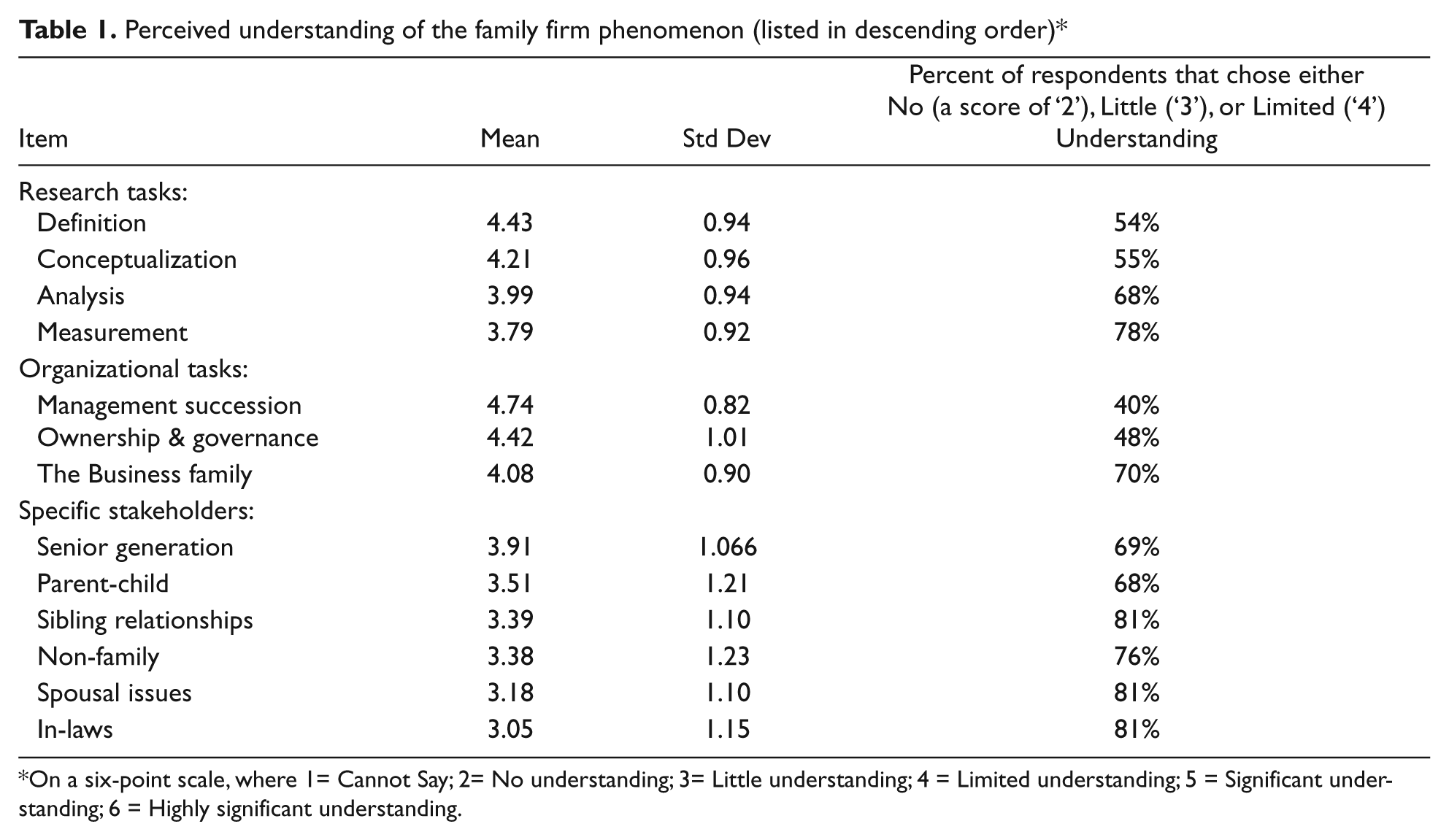
On a six-point scale, where 1= Cannot Say; 2= No understanding; 3= Little understanding; 4 = Limited understanding; 5 = Significant understanding; 6 = Highly significant understanding.
Using a 6-point scale where “1” represented cannot say and “6” represented achievement of highly significant understanding, respondents signaled that the field had made its most significant advances in the research tasks of definition (4.43) and conceptualization (4.21), the organizational tasks of succession (4.74), and governance (4.42). Conversely, the lowest perceived levels of understanding related to the interests of specific stakeholders, such as siblings (3.39), nonfamily (3.38), spouses (3.18), and in-laws (3.05).
These mean scores notwithstanding, the proportion of respondents in each response category tells a slightly different story. More specifically, even though the average scores were high for each of the research topics, the largest proportion of respondents chose a score of 2, 3, or 4, which meant that from their perspective the field had at best “limited understanding” as it concerned conceptualization (55%) chose a response of 2, 3, or 4), definition (54%), measurement (78%), and analysis (68%). Which regard to organizational issues, less than half (48%) indicated no understanding to limited understanding of the topic of ownership and governance; however, 60% indicated significant or highly significant understanding of management succession issues.
Seeing Ahead: Qualitative Commentary on Advances, Opportunities, and Challenges
We also asked respondents a series of three open-ended questions regarding the field’s most significant advances (Question 29), greatest opportunities (Question 30), and greatest challenges (Question 31). Each question resulted in at least 50 responses. Using content analysis, the three authors independently evaluated the responses to the open-ended questions and then reached agreement in determining response categories and assigning responses to categories.
In reviewing these responses, we noted scholars sometimes seeing the same thing in very different ways. For example, in response to the field’s most significant advances, one respondent identified “understanding of the process of succession,” whereas two other respondents indicated that succession issues had been effectively “studied to death.” Although not a contradiction, it nonetheless signaled an important contrast—the former voice focusing on the achievement, the latter voices asserting a need to move beyond. We saw these tensions as an important part of the ongoing conversation regarding the field’s continuing evolution and, as such, are reflected in the representative categories and responses contained in Table 2.
Content Analysis of Advances, Opportunities, and Challenges: Selected Responses
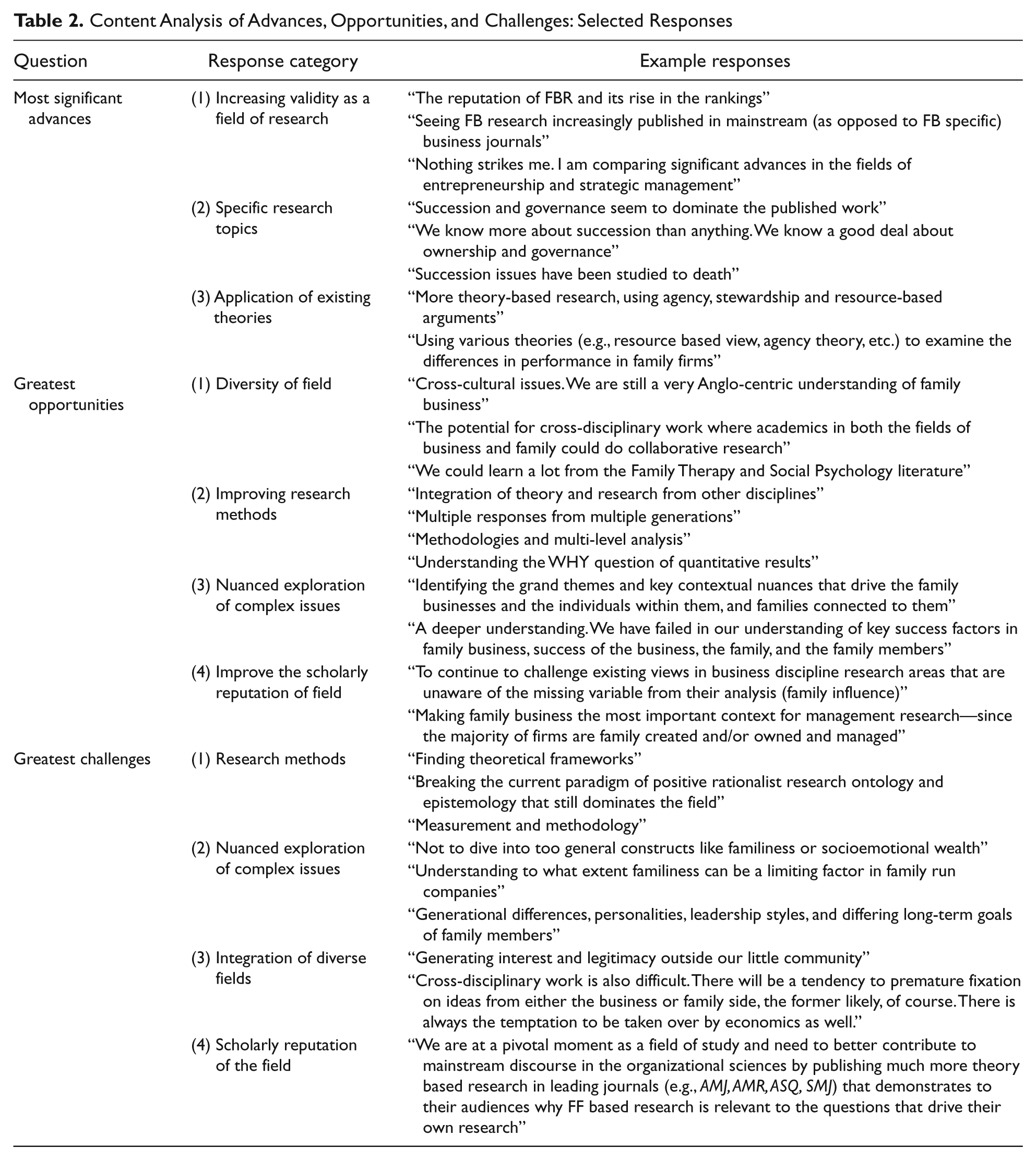
Responses describing the most significant advances were categorized from the content analysis as (a) greater awareness and acceptance of the field of family business; (b) increasing understanding of the field’s central topic set, including succession, ownership, governance, the challenges of defining “family business,” and basic comparisons between family and nonfamily firms; (c) increasing reliance on well-established theories including agency, resource based view, and stewardship. Based on our content analysis, the field’s greatest opportunities included (a) improving of the diversity of the field, including drawing from other disciplines, global sources, and practitioners; (b) improving research methods; (c) examining more nuanced research topics, especially regarding family issues; and (d) continuing to gain in reputation through creation of unique theories. Not surprisingly, responses describing the greatest challenges echoed some of the same answers, but stated them in terms of potential barriers that might be encountered in the future. Accordingly, the most commonly cited challenges centered on (a) developing research methods, including measurement and data analysis issues; (b) enhancing the understanding of complex, nuanced family business issues rather than simplifying relationships to linear formulations; (c) integrating diverse perspectives and disciplines; and (d) overcoming concerns about the field of family business being an accepted field of research.
Seeing Below: Motives for Studying the Family Firm
In our survey’s third section, we probed the relevance of 14 different motives for conducting family business research (e.g., “I do family business research because family businesses are intrinsically interesting”). As Table 3 reports, far and away the biggest driver for undertaking family business research was the perception that family firms are intrinsically interesting (mean of 4.39) with a full 90% of respondents agreeing or strongly agreeing with this assertion. This was followed closely by the perception that family business research fit well alongside other research interests (mean of 4.11). In contrast, encouragement from a family business center (2.10) and the offering of explicit incentives to conduct family business research (2.01) scored lowest.
Perceived Motivations for Undertaking Family Business Research a
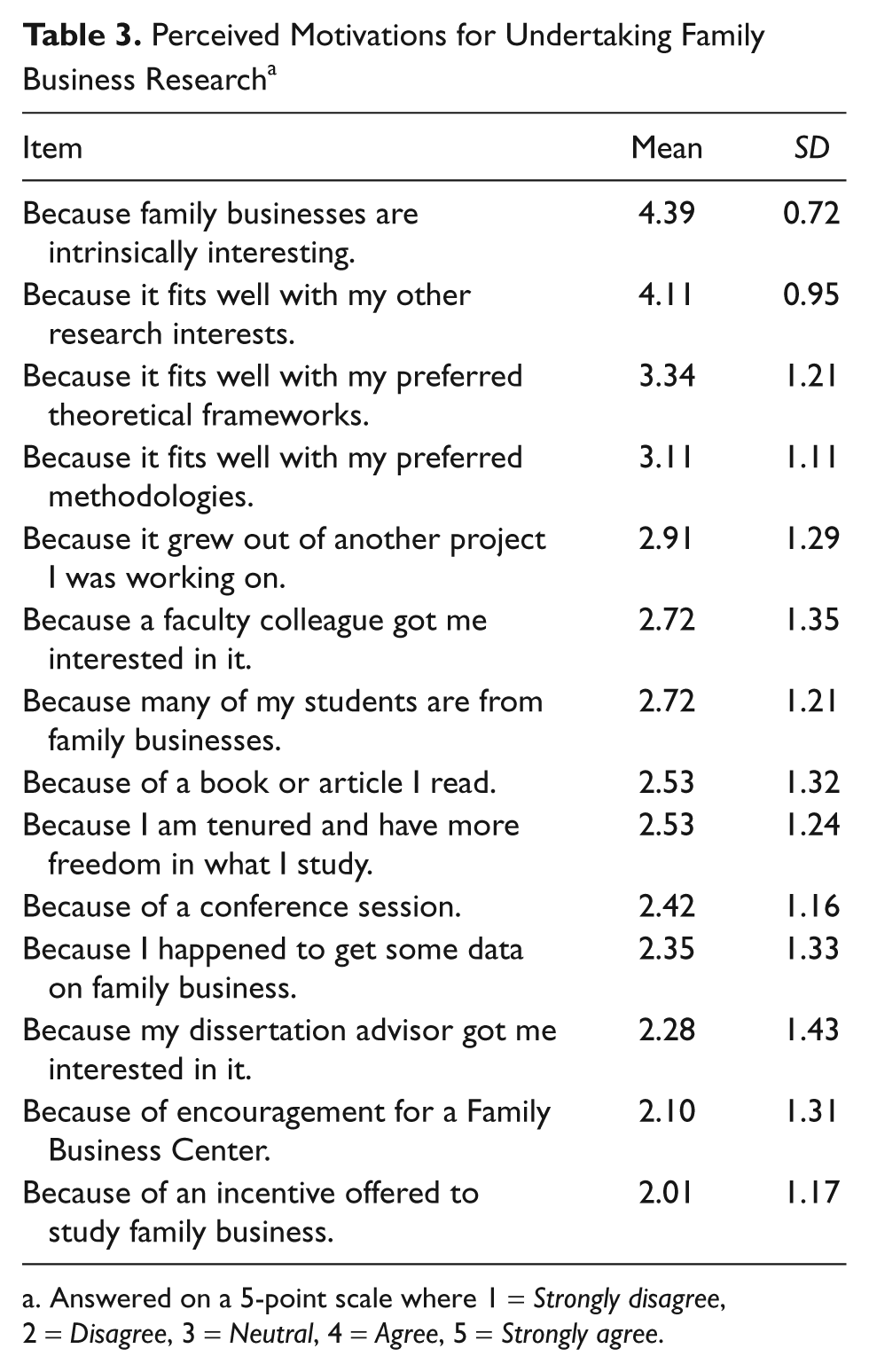
Answered on a 5-point scale where 1 = Strongly disagree, 2 = Disagree, 3 = Neutral, 4 = Agree, 5 = Strongly agree.
In an open-ended question later in the survey, respondents were asked to list the biggest single reason that they conducted family business research. The leading reasons included (a) interest and challenge, (b) influential others, (c) being part of a family firm, and (d) the predominant role of family firms in the respondent’s region.
Seeing Beyond: Perceived Adequacy of Existing Theoretical Frameworks and Methodologies
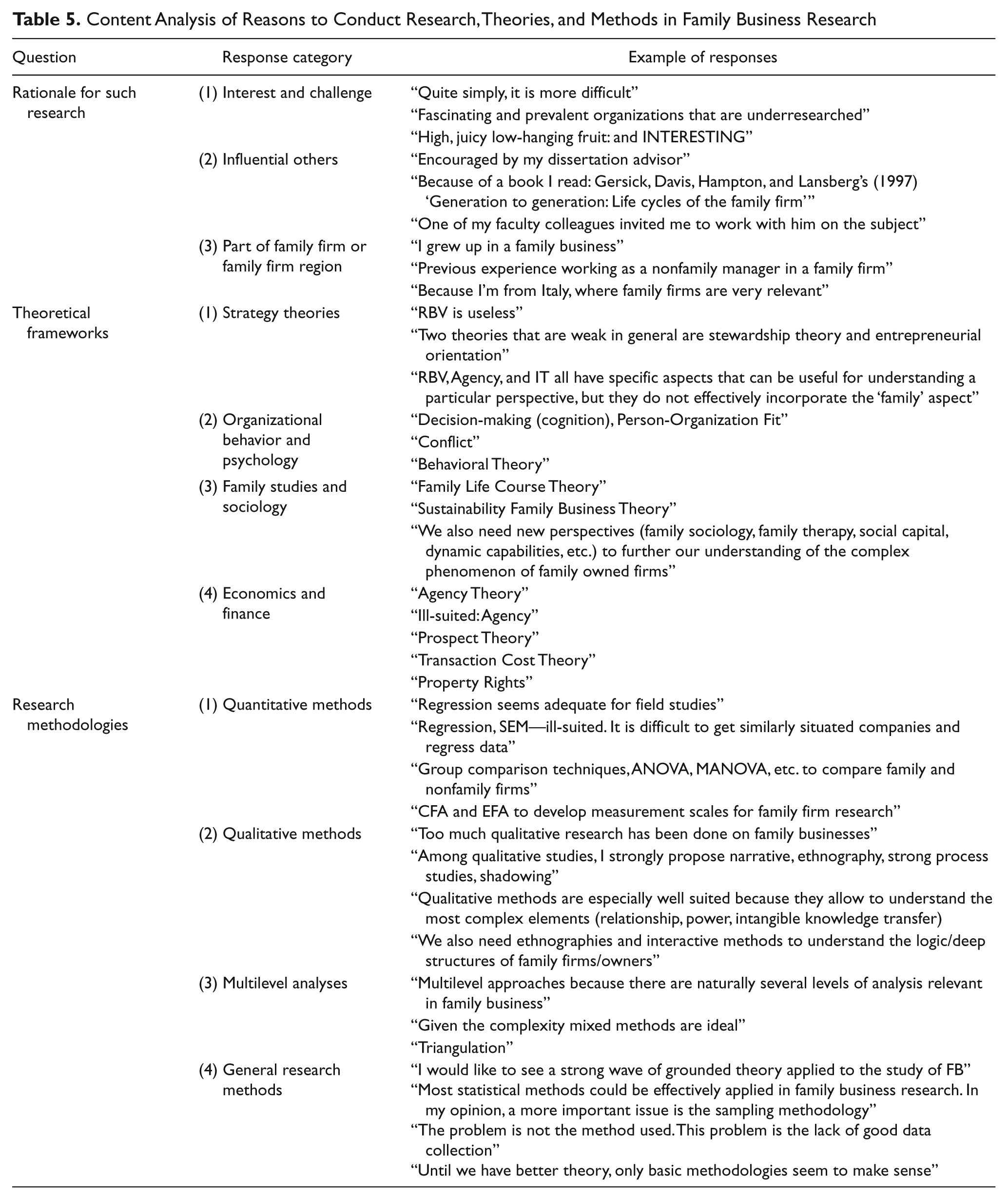
In the fourth section, we explored our respondents’ perceptions concerning extant theoretical and methodological assumptions and frameworks in an effort to “see beyond.” In essence, this section explored whether business-centric frameworks were perceived as appropriate and adequate for a phenomenon as inherently complex and integrative as the family firm. Items ranged from reflecting on the perceived adequacy of theories and methods acquired during graduate school to the respondents’ thoughts on their preparedness to engage both the family and business dimensions. Given the phenomenon’s integrative nature, we also included a final item that asked respondents to assess the degree to which family business is sufficiently different from “generic business” to warrant acquiring new conceptual frameworks not typically included in doctoral-level business studies (Table 4). In addition, we also included open-ended questions that asked respondents to identify theoretical frameworks and research methodologies that seemed especially well-suited, or conversely ill-suited, for family business research (see Table 5).
Perceived Theoretical and Methodological Preparedness for Undertaking Family Business Research a

Answered on a 5-point scale where 1 = Strongly disagree, 2 = Disagree, 3 = Neutral, 4 = Agree, 5 = Strongly agree.
Content Analysis of Reasons to Conduct Research, Theories, and Methods in Family Business Research
As Table 4 reports, there was a marked gap between the perceived adequacy of conceptual frameworks (3.28) and research methodologies (3.77, t statistic = −3.963, p = .0002). We also noted a similar gap between respondents’ self-assessed preparedness for studying the family dimension (3.37) versus the business dimension (4.26, t statistic = −7.492, p ≤ .0001). Our final item, which asked whether different conceptual frameworks might be necessary, received a significantly higher mean score of 3.59 compared with a second item that asked whether new methodologies were necessary for studying the family enterprise (3.04, t statistic = 5.032, p ≤ .0001). In short, when it comes to studying family business these answers would suggest that the field sees itself as better prepared to study the noun of business than the adjective of family.
Seeing It Through: Individual- Career-Related Implications
Given that academics are also motivated by a desire for seeing their efforts result in satisfactory career-related outcomes, one set of items explored the perceived career-related implications of undertaking family business research. As Table 6 summarizes, we observed no significant career costs associated with publishing family business research in general; however, respondents did see it as more difficult to place family business research in FT 40 publications (3.17; t statistic = −2.544, p = .0129). Likewise, there was no sense that undertaking family business research was a “high-risk” career strategy, particularly if one’s publication count was deemed sufficient (72% of respondents agreed or strongly agreed with this statement). Furthermore, respondents were slightly more likely to disagree with the assertion that conducting family business research made it more difficult to get either tenure (2.52) or promotion (2.47). However, an important qualification needs be remembered in interpreting these results—namely, the disproportionate representation by respondents at more advanced career stages (i.e., posttenure and/or promotion).
Career-Related Implications of Undertaking Family Business Research a (Listed by Descending Means)
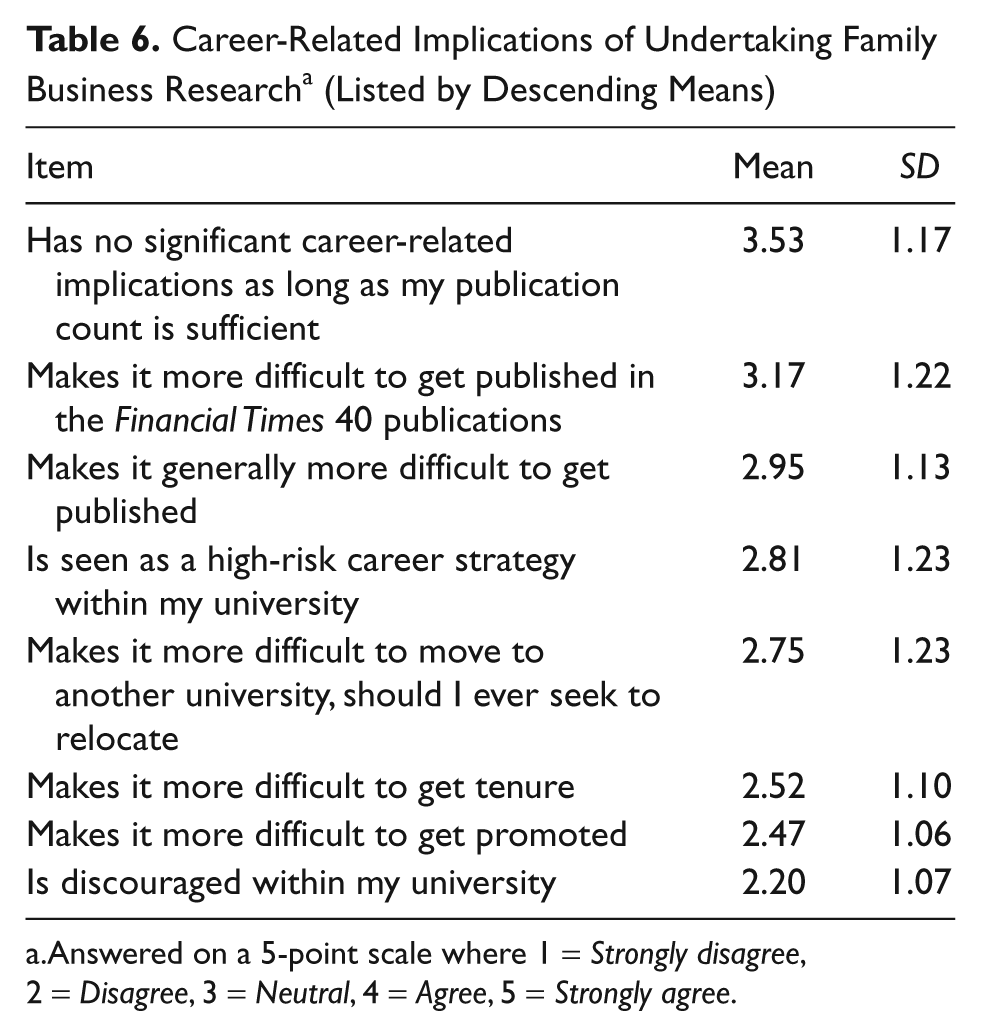
Answered on a 5-point scale where 1 = Strongly disagree, 2 = Disagree, 3 = Neutral, 4 = Agree, 5 = Strongly agree.
Seeing Beyond: Institution- Specific Sustainability
A final pair of items sought to gauge institution-specific prospects for continuing to generate family business research by asking respondents whether they were aware of anyone within their faculty, or larger university context, who would continue researching family business if they were to discontinue their work on family business. The mean score for both faculty-specific (2.26) and university-specific (2.34) awareness was not significantly different. Sixty-six percent of respondents either disagreed or strongly disagreed with the statement “I do not know of anyone within my faculty who would do family business research” and 60% disagreed or strongly disagreed with the statement “I do not know of anyone within the larger university who would do family business research.” In essence, an encouraging sign: the “family” of family business researchers appears to be growing.
Seeing Above: Integrating the Perspectives From 30,000 Feet
Each of these perspectives makes a unique and important contribution to our understanding of family business research—both in terms of where it currently stands and in terms of its developmental priorities for the future. We consider the first topic here, the second in the discussion that follows. As far as where things currently stand, we assert that the field sees significant progress as having been made on some of the field’s seminal issues. However, according to a significant number of respondents, the knowledge trajectory also shows some signs of potentially plateauing. If such a scenario is to be avoided, the advice of several voices, which counseled for the more intentional inclusion of family science research, may be well heeded. Just as we sometimes find out interesting things about family members by spending time with them, so too, we may find our perspectives both refreshed and enlarged by investing some time in the work of our colleagues in family sciences. On the other fronts, the picture is quite encouraging. For example, family business research shows signs of being sufficiently institutionalized in many of our schools as to not work against people seeking tenure and promotion; likewise, it is also sufficiently embedded in most academic contexts to survive the exit of a single academic. But what might these perspectives suggest about the way forward? We consider that question next.
Discussion
Suppose for a moment that the year is not 2012, but 2037, and that the occasion is not the 25th but the 50th anniversary of Family Business Review. Based on the feedback received during our investigation, what might the field hope to see this domain evolve toward by the end of FBR’s second quarter-century? Drawing on the quantitative responses and qualitative commentary received in the course of this investigation, we see the field as aspiring toward at least four key developments.
First, we believe the field hopes to look back and see more intentional inclusion of family science in the study of family enterprise, particularly in doctoral-level study. Related to this, we also see the field as hoping to see these frameworks used alongside existing business-based frameworks, such as those indicated in Table 5 from strategy and organizational behavior, to create entirely new theories that better explain and predict the complex phenomena we commonly call the family business and business family. A second aspiration is that these theoretical developments would be accompanied by more nuanced and longitudinally oriented research methodologies, which are able to appreciate the inherently complex, and often idiosyncratic, nature of performance in both family and firm, and furthermore that these frameworks and methods be deployed in engaging a more diverse set of topics and international contexts. Third, concerning our earlier mention of doctoral-level study, we see the field as also aspiring to more intentionally engage the next generation of scholars in the study of family businesses and business families. Fourth, in the spirit of our first three aspirations, we also see the field aspiring toward explicit outcome measures—that is, that recent gains in scholarly legitimacy be only further enhanced. Given these perceived aspirations, to what extent do we appear to be heading in the right direction?
Drawing on recent efforts, we see several encouraging signs. First, as it concerns calls for a more deliberate inclusion of family science (Dyer, 2009), some research programs (e.g., the University of Alberta, as exemplified by James, Jennings, & Breitkreuz’s effort in this issue) are intentionally seeking to build connections with “scholars in another building” (Stewart, 2008, p. 279), specifically family sciences. Likewise, Björnberg and Nicholson (2007) have contributed an important work in cross-pollination by developing a set of Family Climate Scales, a set of multilevel, multistakeholder measurement scales that assess several aspects of family culture and process, including (a) family adaptability, (b) openness of communication, (c) intergenerational authority, (d) intergenerational attention to needs, (e) emotional cohesion, and (f) cognitive cohesion. Building on such achievements, a possible next step could involve having multiple raters apply such indices longitudinally, a priority we will consider in more depth shortly.
In terms of creating new theoretical approaches, we are also encouraged by recent work on socioemotional wealth (e.g., Berrone, Cruz, Gomez-Mejia, & Larraza-Kintana, 2010) that attempts to “see beyond” conventional performance measures, particularly as it concerns the family-related motives for environmentally responsible management practices. Similarly, we note Nicholson’s (2008) application of evolutionary psychology as a foundation for unraveling the paradox of successful family-in-firm functioning, and Hoffman, Hoelscher, and Sorenson’s (2006) efforts to use family capital theory as a strategy for better explaining the family component of family business. Still other work (Litz, 2008) seeks to take an omnibus view of both the family business and business family through metaphorical comparison to the one-sided topological enigma known as the Möbius strip.
On the methodological front we are similarly encouraged by recent work that seeks to create new ways for studying family firms. For example, in an insightful attempt to examine market orientation in family firms, Zachary, McKenney, Short, and Payne (2011) eschewed using individual-level surveys to generate a large data set and instead content-analyzed letters to shareholders of the S&P 500. Their technique, which considered 1,120 letters to shareholders, aggregated words denoting different types of market orientation into several dimensions, which were then regressed to financial performance outcomes. This team’s unique approach, which combined both nuanced consideration of market orientation and large sample financial data, is indicative of the kind of creativity that we believe this field hopes to only see more of in future efforts. An additional example of this type of approach, which combines both quantitative and qualitative techniques, can be found in the award-winning work of Short, Payne, Brigham, Lumpkin, and Broberg (2009). Accordingly, we also look forward to a forthcoming special issue of FBR that will present works addressing perplexing methodological issues, particularly relating to firm performance.
Likewise, given the nature of the family as “a love system extending through time” (Boulding, 1970, p. 111) and the family–business interface as akin to a House that rises, stands, falls, and sometimes rises again (Litz, 2008), recent longitudinal initiatives, such as those coming out of the Successful Transgenerational Entrepreneurship Practices Project (Habberson, Nordqvist, & Zellweger, 2010; see also www3.babson.edu/eship/step/), warrant special mention. For example, the work of Sieger, Zellweger, Nason, and Clinton (2011), which drew on four longitudinal case studies of family firms in Europe and Central America and used a translevel unit of analysis to determine strategic time-related differences for different kinds of resources, helps unravel the special complexities that arise when love and exchange systems are merged. Likewise, Salvato, Chirico, and Sharma’s (2010) research on the longitudinal dynamics of championing exit and continuity, which explored how impediments to exit were effectively transformed into enablers for transformative change, similarly exemplifies the kind of work we expect to only see more of as the field moves forward. And as we move forward our ongoing challenge will center on remembering the critical longitudinal distinction recently articulated by Ployhart and Vandenberg (2010): “most constructs do not change, evolve, or develop because of time; rather they do so over time” (p. 98).
On the topical front, we see promise in recent efforts, such as Jimenez’s (2009) work on women in family firms that address the special needs and challenges faced by stakeholders in family businesses (Laplume, Sonpar, & Litz, 2008). Likewise, we also wish to highlight important nation-specific contributions, as exemplified by recent studies of family firms in Poland (Kowalewski, Talavera, & Stetsyuk, 2010), Taiwan (Tsai, Hung, Kuo, Kuo, 2006), and Japan (Allouche, Amann, Jaussad, & Kurishina, 2008). Other work, such as Craig and Moores’s (2010) descriptive work on the role of family business in shaping the public policy agenda in a national context, specifically Australia, takes an important step of connecting what we study to how our world works.
In terms of engaging the next generation of scholars, numerous developments signal a healthy baton pass in progress (Dyck, Mauws, Starke, & Mischke, 2002). The Family Firm Institute has supported research in the field since 1989 by awarding the annual Best Unpublished Paper and Best Dissertation awards. Although dedicated conferences, such as Europe’s International Family Enterprise Research Academy (IFERA), North America’s Family Enterprise Research Conference (FERC), and most recently Latin America’s IFERA-Americas, are providing forums devoted to the scholarly study of family enterprise, the expansion of IFERA and FERC’s program offerings to include doctoral consortia (IFERA recently held its fifth, FERC its first) provides a special place for the nurture and encouragement of the next generation.
In terms of more mainstream gatherings, family business research is also becoming an increasingly mainstream topic at the Academy of Management—a search of the 2011 conference program using the phrase “family business” generated no less than 23 different events and with the Best Papers Proceedings including no less than five papers focusing on family firms. Given Bird et al.’s (2002) comment about the need for the field to intellectually individuate from entrepreneurship, another encouraging sign comes in the form of the Entrepreneurship Division recently adding a Best Paper Award for Family Business (sponsored by the Kennesaw State University/Cox Family Enterprise Center). Likewise, in terms of providing early-stage academics with longer term career targets, there are now more prestigious positions related to family business than ever before—a recent survey lists 57 assorted chairs, professorships, and fellows programs in 14 different countries. 3
Concerning supporting that next generation, we believe there may be a special role for family business centers to play. Although our study showed that encouragement offered by these centers scored second lowest as a reason for undertaking research on family business (scoring 2.10, followed only by undertaking family business research because of financial incentives, which scored 2.01 on a 5-point scale), we wonder whether these centers might have a special role to play in supporting the next generation of family business scholars by either facilitating preferential access to business families and/or providing financial support for resource-constrained doctoral students. This possibility concurs with McCann’s (2003) advice, which counseled centers to more intentionally align their efforts around the university’s core functions of research and teaching (emphasis added). In essence, while (and with all due respect) it may be analogically pointless to “dangle carrots” in front of more “senior donkeys” (i.e., full and associate professors), perhaps family business centers might consider re-hanging the carrots in the directions “younger donkeys” (i.e., doctoral students) are already trotting (i.e., researching).
Finally, as it concerns field-level outcome objectives of domain legitimacy, we also see some very encouraging developments. Consider, for example, recent advances in FBR’s Impact Factor ranking. In her Editor’s Notes for 2010, Sharma (2011, p. 5) wrote, “The Impact Factor from the Journal Citation Report rose from 1.357 in 2009 (and 0.675 in 2008) to 1.881 in 2010, ranking FBR as 26th out of 87 business journals.” Commenting further, she also wrote that
The e-alert signups went up more than 50% from 475 in 2009 to 935 in 2010. We received 232 submissions this year—a new record for FBR . . . [including] 163 new submissions and 69 revisions . . . [that overall] represent almost a 30% increase from the previous year, wherein we had received 163 submissions”
More recently, FBR’s editor documented the publication’s continued ascent with FBR’s 2011 Journal Citation Report Impact Factor climbing to 2.426 and an overall ranking of 20th out of 101 ranked publications. Such reports signal a concomitant increase in interests, research submissions, readership, and reputational respect (based on the citation index) and will likely also be accompanied by an increasingly internationally diverse range of submissions, as suggested by 2010 calendar year when manuscripts arrived from 33 different countries (Sharma, 2011).
Conclusion
The poet Gerard Manley Hopkins once wrote, “What you look at hard seems to look hard at you.” In this piece we have sought to take a “hard” and multifaceted look at the intellectual history and future trajectory of family business research. In taking this look, we find, much as Hopkins noted, that what we have looked at also takes a hard look at us. Drawing on the observations and exhortations noted earlier, this “hard look” calls on each of us to transcend the anecdotal (Handler, 1989), acknowledge the complex (Wortman, 1994), recognize the heterogeneous (Sharma et al., 1997), welcome the novel (Dyer & Sanchez, 1998), and articulate the distinctive (Bird et al., 2002). No small challenge. In one sense, though, the challenge has not changed. Looking back to the first article published in FBR, Lansberg, Perrow and Rogolsky (1988) stated, “The Family Business Review is multidisciplinary in nature. It is designed to integrate and legitimate the growing body of knowledge about family firms and to provide a communication for those active in the field” (p. 5).
However, although the challenge has not changed, our expectations clearly have. Much like a family business that must develop and innovate if it is to sustain itself through time, so too, the field of family business research will need to continue to develop and innovate into the future. In short, the field will need to develop and innovate by expanding its conceptual boundaries to more deliberately include the family, enlarge its temporal boundaries to more reflectively appreciate the past, open its international boundaries to welcome findings from a growing array of international and ethnic contexts, and enrich its inherent complexity to appreciate works that present novel variables and engage an increasingly diverse set of topics. Considering one of our survey’s findings, namely, that family businesses are seen as “intrinsically interesting to study” (4.39), alongside Davis’s (1971) longstanding assertion that what’s interesting matters, we look forward to “seeing” what develops over the next 25 years.
Footnotes
The author(s) declared no potential conflicts of interest with respect to the research, authorship, and/or publication of this article.
The author(s) received no financial support for the research, authorship, and/or publication of this article.
Notes
References
Supplementary Material
Please find the following supplemental material available below.
For Open Access articles published under a Creative Commons License, all supplemental material carries the same license as the article it is associated with.
For non-Open Access articles published, all supplemental material carries a non-exclusive license, and permission requests for re-use of supplemental material or any part of supplemental material shall be sent directly to the copyright owner as specified in the copyright notice associated with the article.
