



Abstract

Family business scholars play numerous roles in their endeavor to create new knowledge in an exciting and growing field. Since my early days in graduate school, I have always been mindful of Louis Pondy’s (1985) suggestion that organizational research would benefit from allowing reviewers to play one particular role that he felt would enhance dialogue in the field, namely, the role of defense attorneys. In his classic piece, Pondy argues that academic research would create a more informative exchange of ideas leading to the nurturing of potentially underappreciated works by assigning a reviewer to each piece to play the role of a defense attorney. In this role, reviewers would help promote the merits of a manuscript that might face a potentially biased audience. Having had the honor of serving in an editorial role with several journals, I am even more intrigued with this notion now than I was in my first semester of doctoral studies.
Despite the merits of Pondy’s approach, the role of defending a manuscript continues to largely fall on the efforts of the author team. In addition to defending the unique contribution of a particular paper, family business scholars face the additional challenge of adequately demonstrating how their work provides unique value to the growing field. In this editorial, I provide a few thoughts on how scholars might play the role of defense attorneys who defend their work while preparing it for the initial submission process, proactively anticipating common tactics used by the “prosecution” who might feel that the manuscript is guilty of not providing an adequate contribution to the field. I also present some ideas on how authors can strengthen their defense during the critical cross-examination stage of the manuscript review process by creating compelling responses to review team concerns. I conclude with a checklist that authors might consider when defending their work to the growing field of family business research.
Defending the Initial Submission
Pretrial Preparation
In law, a trial typically occurs when two parties come together in court to settle a dispute. To apply this metaphor to the publication process, when authors submit a manuscript to Family Business Review (FBR), they are making a claim that the journal should provide them some pages to print their work. In some cases, a judge simply decides the basic claim can be easily dismissed (such as when an editor desk rejects a manuscript). In other cases, the editor (or associate editor) acts something as both a judge and jury where reviewers serve something similar to the role of prosecutors.
One key success factor common to both successful attorneys as well as successful authors is the advanced commitment to considerable pretrial work. In the legal system, for example, defense attorneys might file a motion to change the venue of a trial because individuals living near the location where a crime occurred may potentially be biased against the defendant. In the same way, authors need to carefully choose the journal where they hope to see their work published. In the case of FBR, authors need to thoughtfully consider if their work is best suited to that publication outlet. When in doubt, a short note (perhaps including an abstract) to the editor asking about the suitability of a particular piece for FBR could serve as a valuable pretrial motion. In a similar vein, sending a manuscript out for peer review is an excellent strategy to ensure you will be able to go through the “revise-and-resubmit” process successfully before submitting to a particular journal (Ketchen, 2002).
Legal experts often prepare by carefully studying and digesting the work of previous court cases and the applicability of previous outcomes to the case at hand. In a similar vein, the literature review is a key element of preparation for authors hoping to build knowledge concerning family business in the case of their particular papers (Reuber, 2010). Famed English scientist Isaac Newton once quipped, “If I have seen further it is by standing on the shoulders of giants.” Authors submitting to FBR should be careful to incorporate the works of giants in the field of family business as well as other more recent efforts that have contributed to the field or the particular topic of interest. For example, as the field of family business has matured, so too has the need to incorporate more valid measures in empirical papers and such advancement should be reflected in the work of papers submitted to FBR (Pearson & Lumpkin, 2011). Given the value of the literature review to identify such important elements needed to create a scholarly work, I have at times been shocked at how many manuscripts are submitted with very few or no references to previous work found in the pages of FBR.
The Opening Statement
Although the importance of pretrial preparation cannot be overstated, courtroom dramas generally begin with the opening statement given by the prosecution followed by similar statements provided by defense attorneys. In the publication process, there is an advantage for the defense as the only opening statement is provided by authors who have multiple opportunities to convince the review team in regard to the merits of their case for publication. English lawyer Sir William Garron formalized the idea that a defendant is “innocent until proven guilty,” in the late 1700s; however, the general principle dates back at least to sixth-century Roman law. An equivalent notion can be found in the legal systems of Brazil, Italy, Philippines, Poland, Spain, France, and the United States. Although individuals involved in the legal systems of many countries begin their case with the presumption of innocence, my experience is that this default does not hold for authors in a world where acceptance rates of many journals hover around 10% or less.
Given the daunting task of convincing editors and reviewers that your work has merit, I submit that presenting your case to convince the judges (i.e., editors and reviewers) in your initial arguments is critical. One way (among many others) to provide a compelling introduction is to simply state what your study is the first to accomplish. You might be the first to apply a construct used in other fields to research in family business (e.g., Zachary, McKenny, Short, & Payne, 2011). You could be the first to show the merits of using a given theory to build knowledge of family business dynamics (Reay & Whetten, 2011). You could be the first to challenge the assumptions of a particular theory by examining the phenomenon in the family business context. Whatever the case, explicitly stating what your work is the first to accomplish and why that work is important is helpful for making a compelling opening argument. Unfortunately, I have found that many authors who submit to FBR could be found “guilty” of failing to provide a compelling case for their work.
The contribution identified in your introduction should balance the desire to provide a compelling opening statement with the need to be clear and concise in explaining the goals of your work to an audience that may have little familiarity with your specific area of study. The movie Philadelphia is useful for illustrating the necessity of providing a simple, clear explanation of an otherwise complex legal situation. In the film, protagonist Andrew Beckett believes he was illegally terminated due to his sexual orientation and searches to find a lawyer who will defend his case. Although reluctant at first, personal injury lawyer Joe Miller eventually agrees to defend Beckett. When attempting to understand the intricacies of the case, Miller encourages Beckett to “explain it to me like I’m a four-year-old.” Authors should also consider this appeal before submitting their work to an audience who may not be familiar with the research, definitions, or theoretical perspectives authors may have relied on when crafting their manuscript.
A key element to consider when outlining a contribution is to make sure that a compelling story is being told (Short, 2009). For example, it may be tempting to articulate the contribution of your article by walking the reviewer through the parts of the paper (first we review the literature on XYZ, then we present our hypotheses, then we test our hypotheses and present our results, and we conclude with implications). I would encourage authors to consider if such an introduction truly provides the most compelling case for publication. Although generally accurate and useful for providing an overall understanding of the nature of the paper, introductions written in this manner often fail to fully advocate the unique value of a particular work. I would ask that authors consider one question: Could the walkthrough in my introduction be applied to another (or several other) papers? If the answer is “yes,” then authors probably need to rework their introduction and more explicitly note the elements unique to their work.
One of the unique challenges faced by authors submitting to FBR is that a contribution to family business research is needed in order to successfully navigate the publication process. To provide an example of one common problem, allow me to suggest that simply relying on a sample of family firms is not (in and of itself) generally a contribution to family business research. In contrast, authors might demonstrate how their research challenges existing theories (that may not apply in a family business context) or empirically demonstrate differences between family firms and nonfamily firms.
Understanding the Prosecution
For scholars hoping to publish in the pages of FBR, understanding how editors and reviewers often play the role of the prosecution (in addition to the roles of judge and jury) may provide some insights to help improve the chances of eventual publication. At FBR, the editor first acts as a judge to assess if a submitted manuscript falls within the general domain of the journal’s mission. If a manuscript passes this first hurdle, a second judgment occurs when an associate editor examines the piece for the presence of issues that would warrant a desk rejection. A judgment for the decision to desk reject a manuscript occurs when a paper (a) does not fit the mission of FBR, (b) does not build or test theory, (c) fails to build on previous family business research, (d) is not relevant to the study of family firms, or (d) does not follow the FBR submission guidelines (Craig, 2010). If the manuscript passes this second judgment, the associate editor will then send the manuscript out for peer review and provide another judgment based on the feedback from the other members of the review team.
Editors (as well as reviewers) might recommend rejection for any number of reasons. Although potentially endless motivations exist, I have always found Daft’s (1985) piece on “Why I recommend that your manuscript be rejected and what you can do about it” to be particularly insightful. In his chapter, Daft outlines themes among 258 major problems found in 111 manuscripts he reviewed for Academy of Management Journal and Administrative Science Quarterly. I read this article almost yearly, and it has been my experience that the reasons offered by Daft have changed very little if at all in the quarter of a century since the original publication of his work. Although I will not recount every reason offered by Daft, I will summarize a few of the most common reasons that I have seen in my role as associate editor with FBR and provide some thoughts on how authors might defend against such offenses.
Lack of theory is the first and most common reason many manuscripts are rejected (Daft, 1985). Bacharach (1989) notes, “The primary goal of a theory is to answer the questions of how, when, and why” (p. 498). Contributing to theory that is relevant to family business may provide knowledge to explain why family firms may differ from nonfamily firms in a manner that improves established theory (Reay & Whetten, 2011). Unfortunately, I have seen a number of manuscripts submitted to FBR where there is a complete lack of integration of theory into the work. For instance, in some cases authors state that “research suggests” or “research has found” certain relationships exist, backing up such statements with relevant citations. After providing a few paragraphs of this kind of research support, a formal hypothesis is presented. This kind of logic is what Ketchen (2002) refers to as “argumentation by citation.” In such cases, authors are often found “guilty” of failure to integrate theory into their work.
Integrating theory need not be overly complex, but it does need to be made explicit. If the goal of the research is exploratory, theory should simply serve as a plausible explanation to help the reader understand why phenomena may exist. For example, Short, Payne, Brigham, Lumpkin, and Broberg (2009) use research on organizational identity as a theoretical lens to motivate their research questions examining differences in entrepreneurial orientation between family firms and nonfamily firms. Theory can also be used to generate specific hypotheses as with Pagliarussi and Rapozo’s (2011) use of agency theory in the context of an emerging economy to better understand agency conflicts of family firms in emerging economies. As a general rule, if a study tests specific hypotheses then generally a specific theoretical perspective should be invoked to help us understand why relationships between study variables should be expected to exist.
Inadequate research design often provides a reason for reviewers to recommend rejection (Daft, 1985). As an associate editor of FBR, I have seen several common concerns that merit note. One issue that seems to be common among rejected manuscripts to FBR is research with the potential for common method variance. Perhaps this should not be surprising as other prestigious journals such as the Journal of Applied Psychology have often noted “single-shot, cross-sectional, self-report survey designs” are those most associated with desk rejections of manuscripts submitted to that outlet (Kozlowski, 2009, p. 3).
Another common issue related to research design is an unfortunate situation where the context (e.g., a specific country) seems to be the driving force of a manuscript with little rationale for why firms in that country might serve as an ideal context to add knowledge to research on family business. Certainly the application of knowledge to a different context can be valuable. For instance, examining a relationship long held to be of importance in organizational studies in the family business context could be informative if the family business context alters the relationship. Alternatively, the family business context may be shaped by differences in national context. If this is the case, such differences need to be incorporated into the greater study design.
Tsang and Kwan (1999) provide an excellent perspective on replication and theory development in organizational science that family business scholars can leverage to provide a compelling motivation for a particular piece. Specifically, they note six types of replications with the potential to add to organizational knowledge. Scholars would be well served to digest and incorporate their work when seeking to provide a compelling case for a contribution where replication is a key value driver for the work.
The use of amateur style and tone is another noteworthy reason for rejection offered by Daft (1985). There are two forms of this problem that seem to be common across rejected manuscripts. The first occurs when a manuscript very clearly does not seem to follow the style guidelines for submission to FBR. For example, use of single-spacing when the journal calls for double-spacing, or submitting a 60-page manuscript when the guidelines limit the number of pages to 35 inclusive. Such papers give the reader the impression that the work was originally prepared for another outlet, or perhaps worse, that the authors are not capable of following simple and straightforward instructions. In such cases, the editorial team is unlikely to place trust in the authors to digest their more thoughtful comments and/or address more intricate issues. The second issue of amateur style occurs when the authors present their work in a manner that suggests they may not have a strong command of the academic literature and how it should be used. For example, I have seen many manuscripts where the references cited in a work look as if they were largely a culmination of readings in a doctoral-level seminar in family business, entrepreneurship, and/or strategic management. Similarly, failure to cite relevant works that have appeared in previous pages of FBR make it difficult for reviewers to believe that the authors have command of the relevant literature. In contrast, excellent manuscripts generally integrate classic works with more recent relevant contributions. A final area where amateur tone occurs is when authors overstate the potential contribution of their work. Just as a person who is famous should not have to tell others of their fame, authors should not have to tell the reader that their work is interesting. Nor should they make definitive statements about the scale of their contribution to literature or how their work overshadows previous research in the field. In contrast, an interesting contribution to family business research involves building knowledge specific to the field as well as an understanding of how it contributes to the greater business literature (Salvato & Aldrich, 2012).
Preparing a Revision Defense
Legal scholars have argued that the cross-examination is one of the greatest vehicles for truth seeking (Wigmore, 1904). As such, many famous trials continue to be studied and retold. One such example concerns the story of the famous “Scopes Monkey Trial” in the United States in 1925 that debated the legality of incorporating an evolutionary perspective to creation in high school science curriculum. The courtroom drama was magnified due to the fame of the representation of each side of the case. The prosecution for the State of Tennessee (arguing against incorporation of an evolutionary perspective) was represented by William Jennings Bryan (a three-time U.S. presidential candidate). Famed defense attorney Clarence Darrow represented John Thomas Scopes (the high school teacher advocating the value of incorporating evolutionary teaching into the classroom). The notoriety of the cross-examinations created by these great legal minds has been recounted with the classic play (and film) Inherit the Wind.
Legal dramas need not be based on fact to provide a compelling memory regarding the power of successful cross-examination. My Cousin Vinny (hailed as one of the funniest courtroom dramas to ever hit the silver screen) shows that the power of the cross-examination holds at least equal weight to that of the opening statement. The film chronicles the troubles of Vincent Gambini (AKA Vinny) as a lawyer struggling in his first case. His difficulties in navigating courtroom procedures are compounded because the New York native must also work to understand nuances associated with the location of his trial—rural Alabama. Overcoming initial struggles, Vinny eventually prevails by referencing the considerable time needed to cook a local dish (i.e., grits) as a powerful piece of contextual evidence that leads him to successfully defend his client.
Both films mentioned above are valuable for illustrating the importance of learning critical “rules of the game” that should be followed to make a compelling legal presentation. During the publication process, the response document (and accompanying revised manuscript) serves the role of the cross-examination for authors to assuage the fears of the review team and offer new evidence not presented in the original manuscript. I hope to share some tricks that I have witnessed as an editor, reviewer, and author with the goal of helping others provide a compelling cross-defense below.
The Fifth Amendment of the U.S. Constitution protects witnesses from self-incrimination. Consequently, to “plead the fifth” means that individuals refrain from answering questions that might lead to negative outcomes for themselves. Although this strategy may be tempting for individuals who have something to hide in a courtroom trial, this tactic is rarely advantageous during the review process. Wise attorneys offer compelling evidence to convince the judge and jury of the merits of their case. In a similar manner, authors should make it extremely clear how they responded to the concerns of the review team. An excellent response to reviewer concerns might begin by stating, “We made three changes in response to your concern that our work lacked appropriate theory (followed by listing each of the three changes).” If the changes in the manuscript can be captured in a single new paragraph that appears in the revised manuscript, authors might be wise to include that paragraph as a compelling “Exhibit A” that might assuage reviewer concerns. I offer these points because I have been surprised at the number of responses documents that offer somewhat vague comments simply stating that a reviewer’s concern has been addressed without offering specific evidence of changes. When possible, authors can help clarify their own thoughts and present them in a succinct manner by creating a numbered “executive summary” of major changes to the document. I would recommend presenting this exhibit toward the end of the responses to the editor’s comments.
In many revisions, the opportunity to introduce new evidence arises. My advice is that authors are wise to capitalize when such scenarios present themselves. When authors show diligence by collecting additional data, conducting additional tests, or incorporating additional control variables, this shows that they are truly engaging in the thoughtful comments of the review team. In some cases, these tests may be presented as supplemental analyses (e.g., in a post hoc test or footnote). However, the effort expended to present such evidence is almost always appreciated during the revision process.
In legal dramas, the tone set by a particular attorney is often as memorable as the evidence presented and outcome of the case. Authors can learn from this tendency when crafting their cases to address review team concerns. In Harper Lee’s classic tale, To Kill a Mockingbird, attorney Atticus Finch serves as a genteel lawyer in the Deep South region of the United States during a time of unparalleled racial prejudice (the story takes place in the year 1936). Throughout the movie, Finch shows a diligence unexpected for a White Southern lawyer representing a Black client that draws praise from the Black community and the family of his defendant. Yet at times Finch treads lightly when defending his client, failing to strike the testimony of a witness against his client who refuses to answer questions. Eventually, his client is convicted. Legal experts have debated the extent to which Atticus could (or should) have done more to defend his client in a society that was decidedly unjust to racial inequality (Banks, 2006).
Similar to the dilemma faced by Atticus Finch, authors responding to reviewer concerns must strike a delicate balance between working to accommodate review team concerns while defending the merits of their work. Although I am of the philosophy that the review process generally provides valuable improvements to the authors’ work, there are certainly times when authors must stand their ground. The best way to manage this potential dilemma is by engaging reviewers in a respectful and conversational tone. Tell reviewers why you made the decisions you did, which might necessitate changing your work if there is a flaw in your original logic or research design. However, if you believe you are on safe ground based on previous literature, do not hesitate to explain why you believe your choices make sense given the goals and trade-offs of your research. In contrast, I have often seen responses documents with extensive usage of “thank you” as well as unnecessary apologies to reviewers accompanied by relatively few substantive changes to the manuscript. Although a respectful tone with the review team is always appreciated, engagement in an informative dialogue is probably a more effective and efficient tact than simply offering excessive pleasantries without carefully noting how important concerns were addressed.
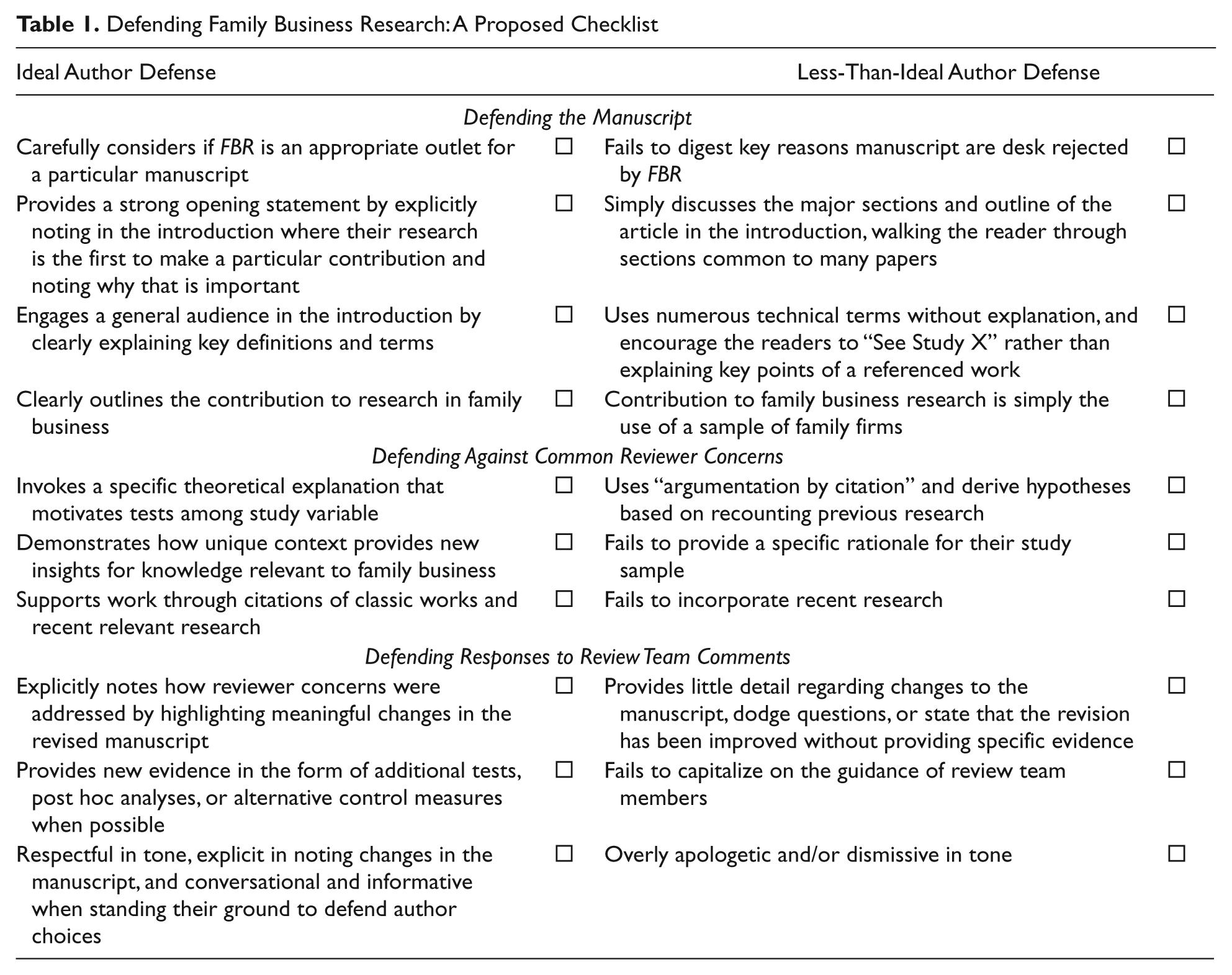
In conclusion, making a contribution to research in family business necessitates that authors defend important areas of scholarship common to the organizational sciences in general as well as specific elements of unique interest to family business scholars. Table 1 provides a checklist for authors to consider when submitting a work to FBR and revising their efforts if such an opportunity arises. It is my hope that my thoughts help readers to appreciate the excellent defense work of previous contributors to FBR over the past quarter of a century and help prevent potential authors from being found guilty of common mistakes that prohibit their work from being accepted to FBR.
Defending Family Business Research: A Proposed Checklist
Footnotes
Acknowledgements
I am grateful to Aaron McKenny, Allison Pearson, Trish Reay, Rebecca Reuber, Pramodita Sharma, Karen Vinton, and several anonymous associate editors of Family Business Review for their valuable comments on an earlier draft of this editorial.